


Abstract : This article explores the central thesis of N.S. Lyons’ essay American Strong Gods, which builds on R.R. Reno’s concept of “strong gods” as binding ideals such as faith, nation, and honor. It examines how postwar liberalism’s commitment to the “open society” suppressed these values in favor of individualism and technocracy, resulting in societal fragmentation and spiritual malaise. The piece uses Donald Trump as a live case study to illustrate the re-emergence of these strong gods in contemporary American politics. Trump’s rhetoric and appeal are analyzed not as anomalies, but as expressions of a broader cultural longing for meaning, identity, and collective purpose. The article argues for a thoughtful engagement with these forces, recognizing their potential both to unify and to divide.
In his compelling essay American Strong Gods, political analyst N.S. Lyons offers a powerful reinterpretation of current Western political unrest by turning to the concept of “strong gods,” a term coined by theologian R.R. Reno.
These strong gods refer not to literal deities, but to binding ideals—truth, love, faith, nation, honor, and sacred order—that once gave coherence and meaning to social and political life. Lyons argues that the postwar liberal order, shaped by the traumas of fascism and totalitarianism, deliberately exiled these gods in favor of a more open, pluralistic society. The intention was noble: to prevent the return of dangerous ideologies. But the result has been an increasingly fragmented, disoriented civilization.
Central to Lyons’ argument is the notion that the liberal “open society,” as defined by Karl Popper, required the dismantling of all strong, unifying convictions. Anything that created a firm boundary between in-group and out-group was deemed suspect. Instead, the open society elevated individual autonomy, moral relativism, globalism, and technocratic rationalism as its highest ideals. Institutions of power—academia, media, government—were gradually reoriented to uphold this consensus. Yet, in doing so, the liberal order stripped life of its shared meanings. What was gained in tolerance and material progress was, in many ways, lost in cultural coherence and spiritual purpose.
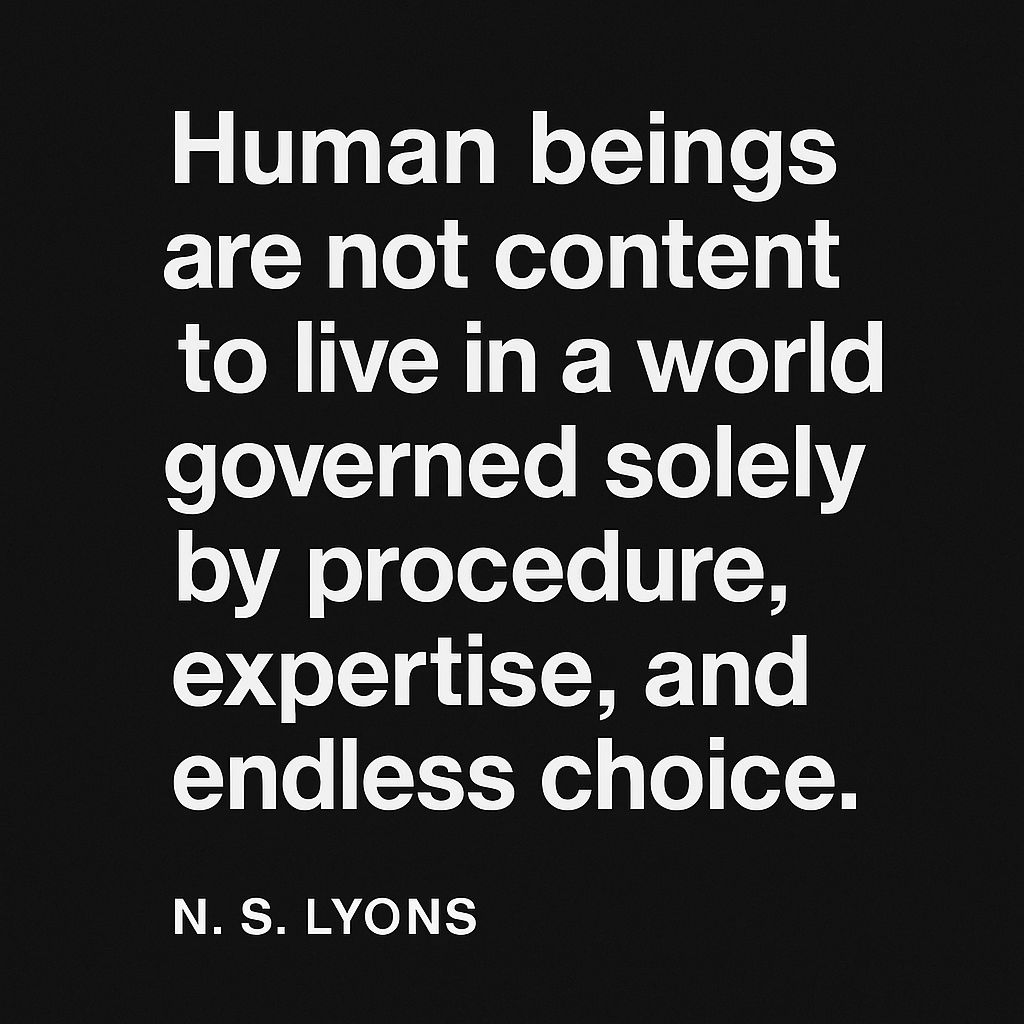
Lyons does not celebrate the return of strong gods uncritically. He warns that these forces are inherently double-edged. They can animate civilizations, but also destroy them. The strong gods of nationalism and ideological fervor helped fuel the catastrophes of the 20th century. But their total exile has not led to utopia. Instead, it has created a vacuum—one that, Lyons argues, will inevitably be filled. Human beings, he contends, are not content to live in a world governed solely by procedure, expertise, and endless choice. They long for belonging, purpose, and truth.
Donald J. Trump emerges in Lyons’ framework not as a traditional strong man, but as a vessel for these long-suppressed forces. Trump’s rise is better understood not through policy analysis or elite critique, but as a cultural moment—a response to the discontents of the liberal order. His appeal is less about ideology than affect. He offers certainty where others hedge, identity where others abstract, and loyalty where others equivocate. He evokes America as something sacred and embattled. To many, he represents the return of meaning in a world gone gray.
Consider Trump’s core messages: “Make America Great Again,” “America First,” and his persistent framing of political opponents as not just wrong but traitorous. These are not technocratic arguments. They are moral and civilizational appeals. Trump positions himself not as a manager of government, but as a protector of a besieged cultural heritage. His rallies function more like revival meetings than policy seminars. His supporters do not speak of balancing budgets but of restoring lost honor and defending the homeland.
This rhetorical strategy resonates with millions who feel alienated by the culture of liberal managerialism. These are individuals who may have experienced economic decline, social dislocation, or the sense that their values are being mocked or erased by a distant elite. Trump, regardless of his own inconsistencies, channels their desire for rootedness. He gives voice to those who feel their America is vanishing and that they are being asked to applaud its disappearance.
To his critics, this is nothing more than reactionary populism—a dangerous flirtation with authoritarianism. And there is merit to these concerns. Trump’s disregard for institutional norms, embrace of conspiratorial thinking, and polarizing style all raise red flags. But to dismiss his supporters as merely duped or hateful is to miss the larger cultural phenomenon at play. The longing they express is real. And it is not going away.
Lyons warns that strong gods cannot be wished away by elite disdain or technocratic fixes. They are resilient precisely because they speak to enduring human needs: the need for identity, for belonging, for shared meaning. When those needs are unmet by the dominant order, they will re-emerge in new and unpredictable forms. Trump is one such form. There will be others.
The challenge, then, is not how to suppress the strong gods, but how to engage them wisely. Can a society rediscover a shared moral vision without tipping into fanaticism? Can it reintegrate meaning and identity without excluding the other? These are no longer abstract questions. They are the terrain of politics in the twenty-first century.
The return of strong gods does not guarantee renewal. It may bring conflict, as incompatible visions of the good vie for dominance. But it also presents an opportunity. A culture that reclaims conviction, moral seriousness, and a sense of the sacred might rediscover the social bonds it has lost. It might become capable once again of collective purpose.
Trump may not be the prophet of this renewal. His flaws are manifold. But his rise is a symptom of a deeper condition—one that cannot be healed by more of the same managerial neutrality. Lyons’ essay urges us to see this moment not as an aberration, but as a reckoning.
The strong gods have returned.
The question is: what will we do with them?
In Learning……. Shakti Ghosal
References
- Lyons, N.S. “American Strong Gods.” The Upheaval. https://theupheaval.substack.com/p/american-strong-gods
- Reno, R.R. Return of the Strong Gods: Nationalism, Populism, and the Future of the West. Regnery Gateway, 2019.
- Popper, Karl. The Open Society and Its Enemies. Princeton University Press, 1945.

 A New Beginning
interesting post. makes sense.
not relevant here in Australia where our history doesn’t go back very far. 1788.
G
LikeLike
That can be so reassuring for you in Australia. Bur in today’s world, we are all interconnected and a malaise in one lace can soon spread.
Thank you for taking the time to comment.
Shakti
LikeLiked by 1 person