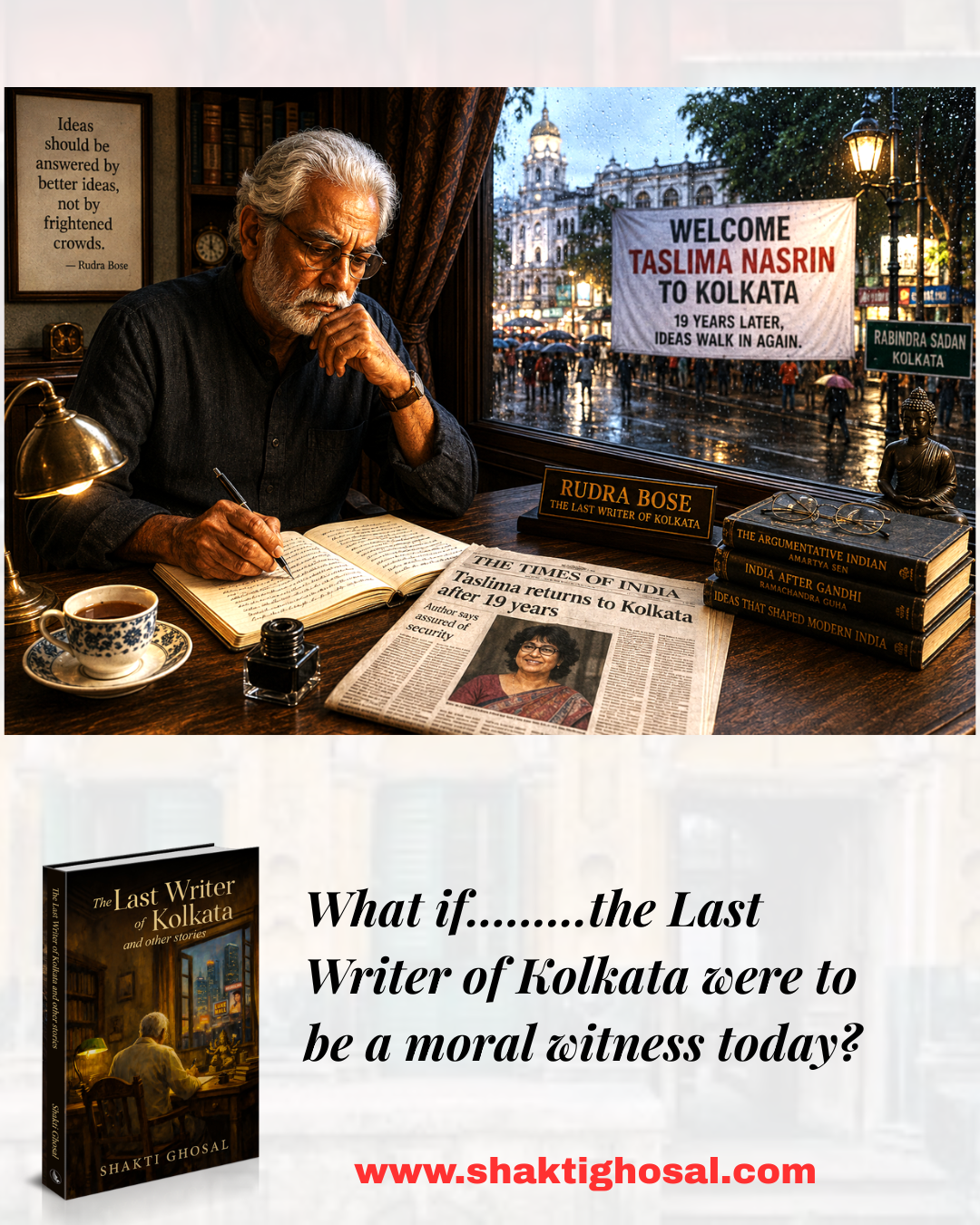
The first light of the morning came and sat on the window grille, hesitated, then leapt in. Like an old song, tired and familiar, trying to be remembered.
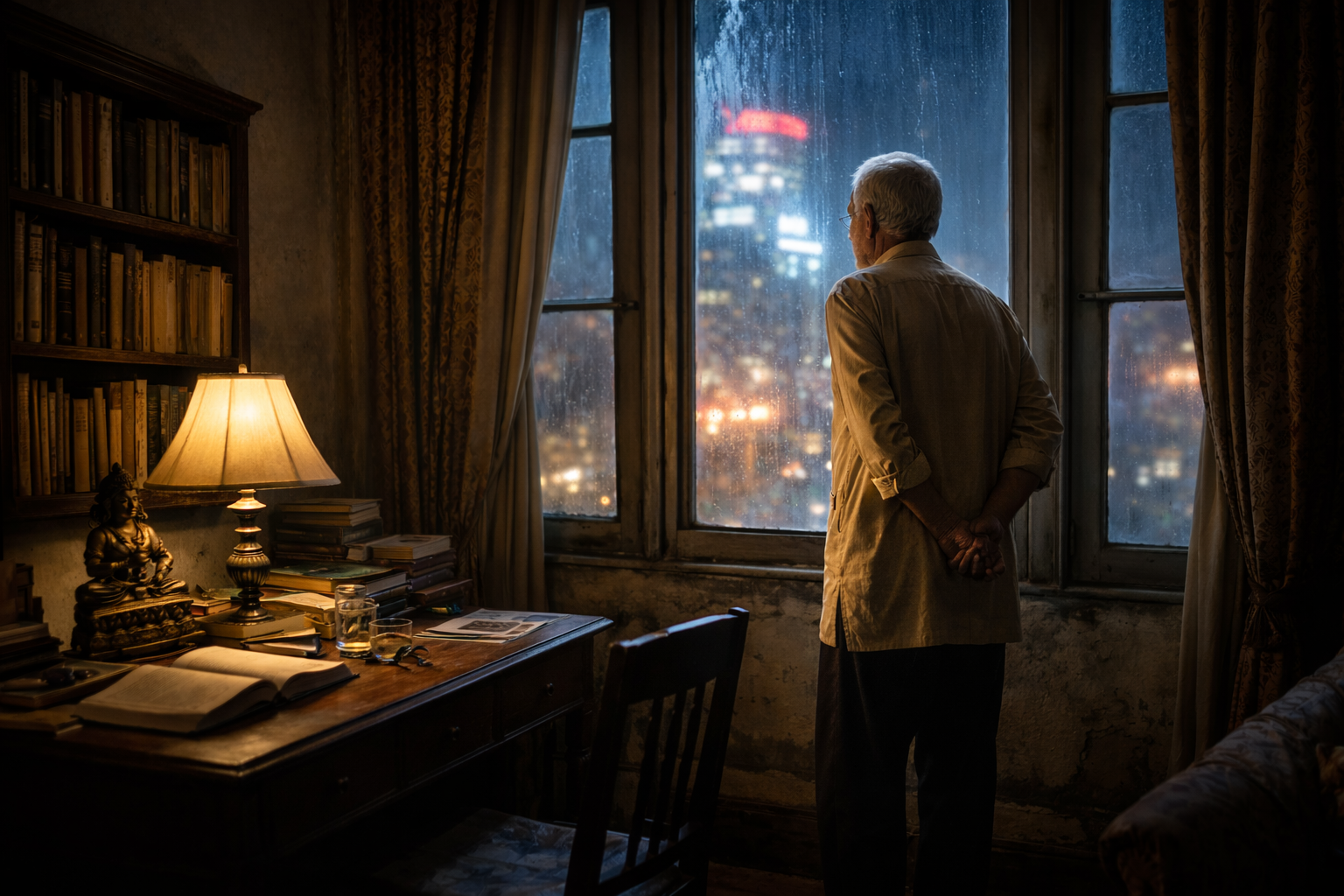
Rudra Bose sat by the window, a cup of tea steaming beside him. The cup was chipped, the saucer mismatched, the tea, a stubborn blend of milk, tea dust, and habit.
Outside, the lane yawned into a waking slumber, its air thick with last night’s incense, stale samosa oil, and the ever-present, low-grade emissions.
“Ma is coming,” he had heard someone shout on the street last evening……
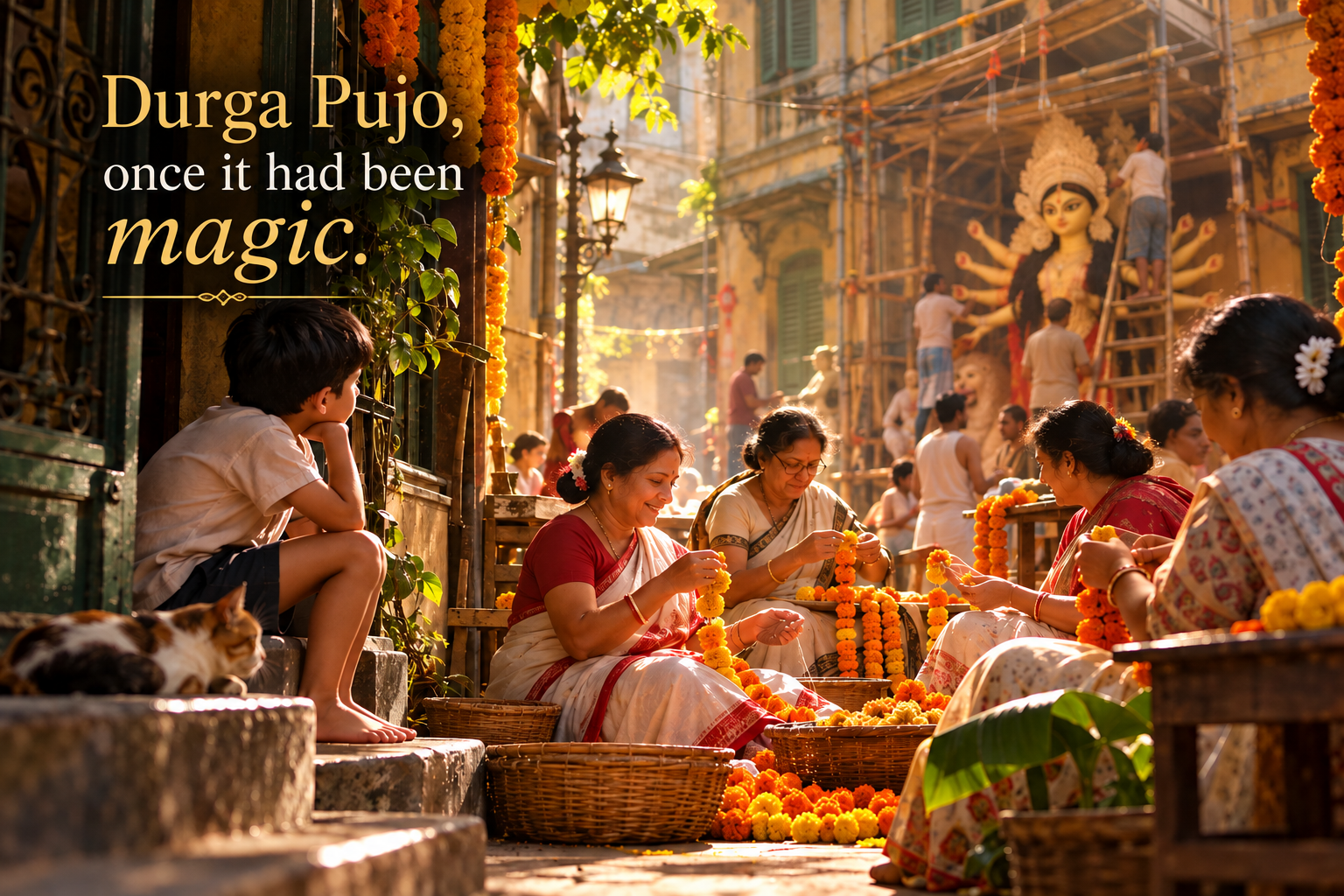
Durga Pujo. Once, it had been magic.
As a boy, he had spent mornings watching Mashis, aunts and Boudis, sisters-in-law, threading marigolds for the Pandal and Thakurer Bedi.
— An excerpt from The Last Writer of Kolkata and Other Stories
What does Durga Pujo mean to you?
Is it the Goddess, the neighbourhood, the people we grew up with—or a Kolkata that lives on in our memories, even as the city changes around us?
This Mahalaya, I invite you to step into Rudra Bose’s world: a future Kolkata where technology has transformed the city, but the longing for what has been lost remains deeply human.
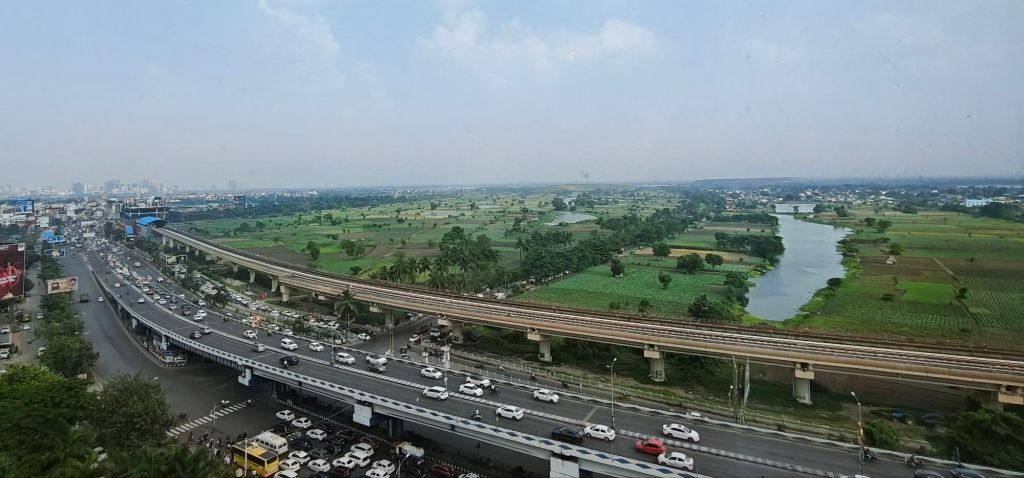
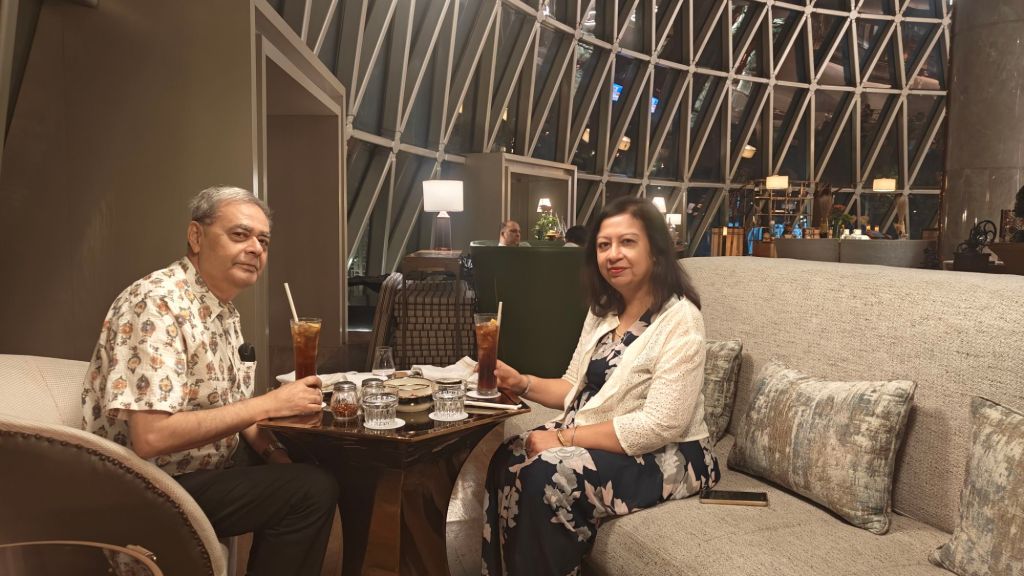
From the tenth floor of a hotel room, Kolkata offers an interesting perspective.
Below me, traffic rushes towards destinations I can only guess at. The Metro glides above the road. Beyond the concrete, patches of green survive, almost defiantly, against the advancing city.
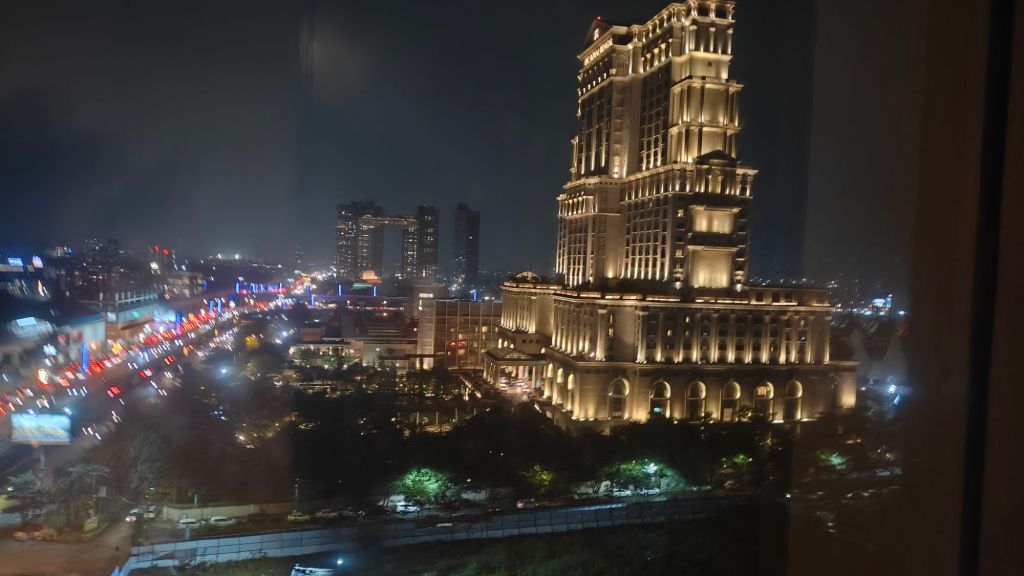
At night, the landscape transforms. Buildings light up, roads become rivers of red and white, and the city acquires a certain grandeur.
Kolkata oh!
Yet I find myself wondering about the Kolkata that lies beyond these views.
The person hurrying to work. The family waiting for someone to return. The lives unfolding behind those illuminated windows.
A city is never merely what we see. It is everything that remains unseen.
Perhaps that is why I continue to observe, to question and to write.
Every window offers a view. Every view conceals a thousand stories.
And somewhere among them, there may be another story waiting for Rudra Bose. Shakti Ghosal
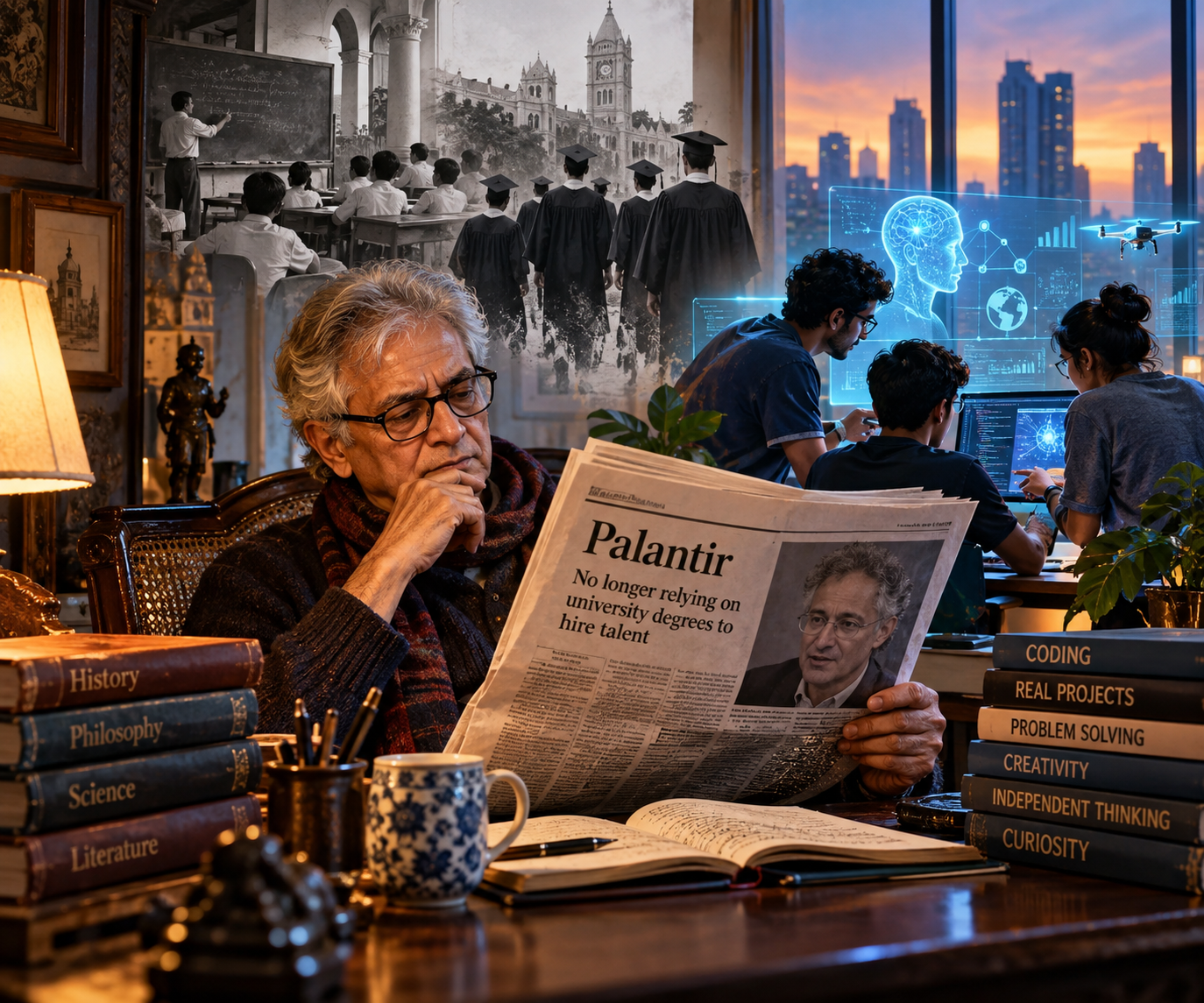
I came across a post recently about Palantir that made me pause.
It quoted its CEO, Alex Karp, as saying that the company is no longer relying entirely on traditional university degrees to identify talent. Instead, young people are being given the opportunity to work on real problems, demonstrate what they can do, and learn by doing.
The post made a provocative observation: “The university had centuries to shape the best minds. Entrepreneurs will do it in a decade.” That stayed with me.. Because it raises a much more uncomfortable question: Have our educational institutions slowly forgotten what education is supposed to accomplish?
We teach children what to think. We rarely teach them how to think. We reward the right answer more than the difficult question. We celebrate memory more than curiosity. We measure achievement through certificates rather than through the ability to see what others cannot. And then we wonder why so many highly educated people struggle to imagine a different future.
I realised that companies like Palantir are beginning to look beyond degrees. Young people are being given real problems to solve instead of certificates to prove that they are ready to solve them. It reminded me of something we seem to have forgotten. Perhaps education was never meant to manufacture employable people. Perhaps it was meant to create unmanageable minds. Minds that question. Minds that doubt. Minds that refuse to accept “this is how it has always been done.”
Perhaps the real crisis is not that AI will replace education. Perhaps it is that AI will expose how little education was actually about thinking.
As I closed the newspaper, the thought came to me. What if the future doesn’t need better educated children…… but freer minds?
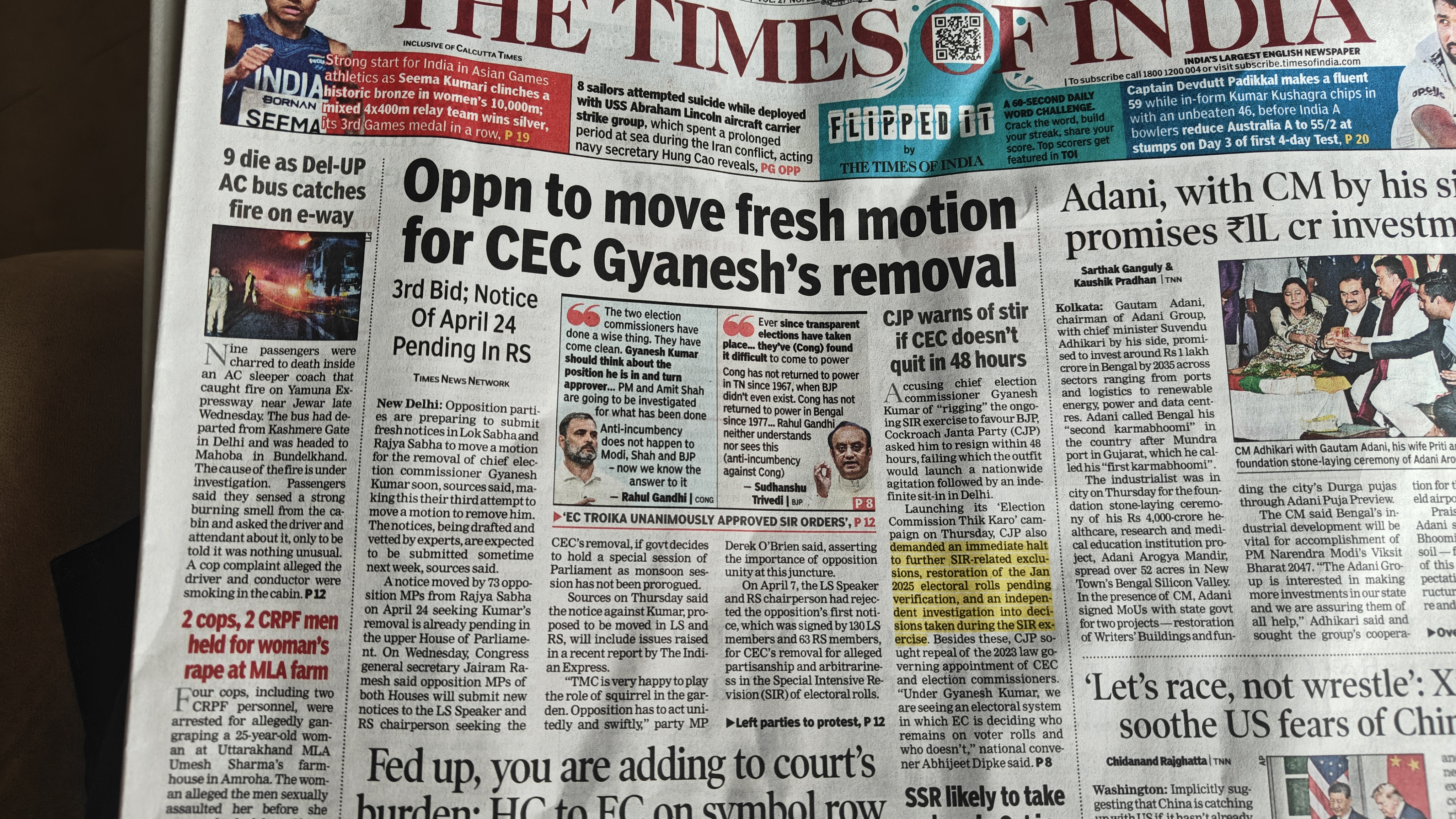
This morning I opened the newspaper to find that democracy had acquired a new battlefield.
Not Parliament. Not the streets. It was about the voter list.
There were allegations, counter-allegations, objections, explanations and demands for resignation. The Election Commission said decisions were unanimous. Others said two Commissioners had repeatedly raised objections. I wondered what happens when the referee becomes part of the argument.
Newspaper report on the ongoing controversy.
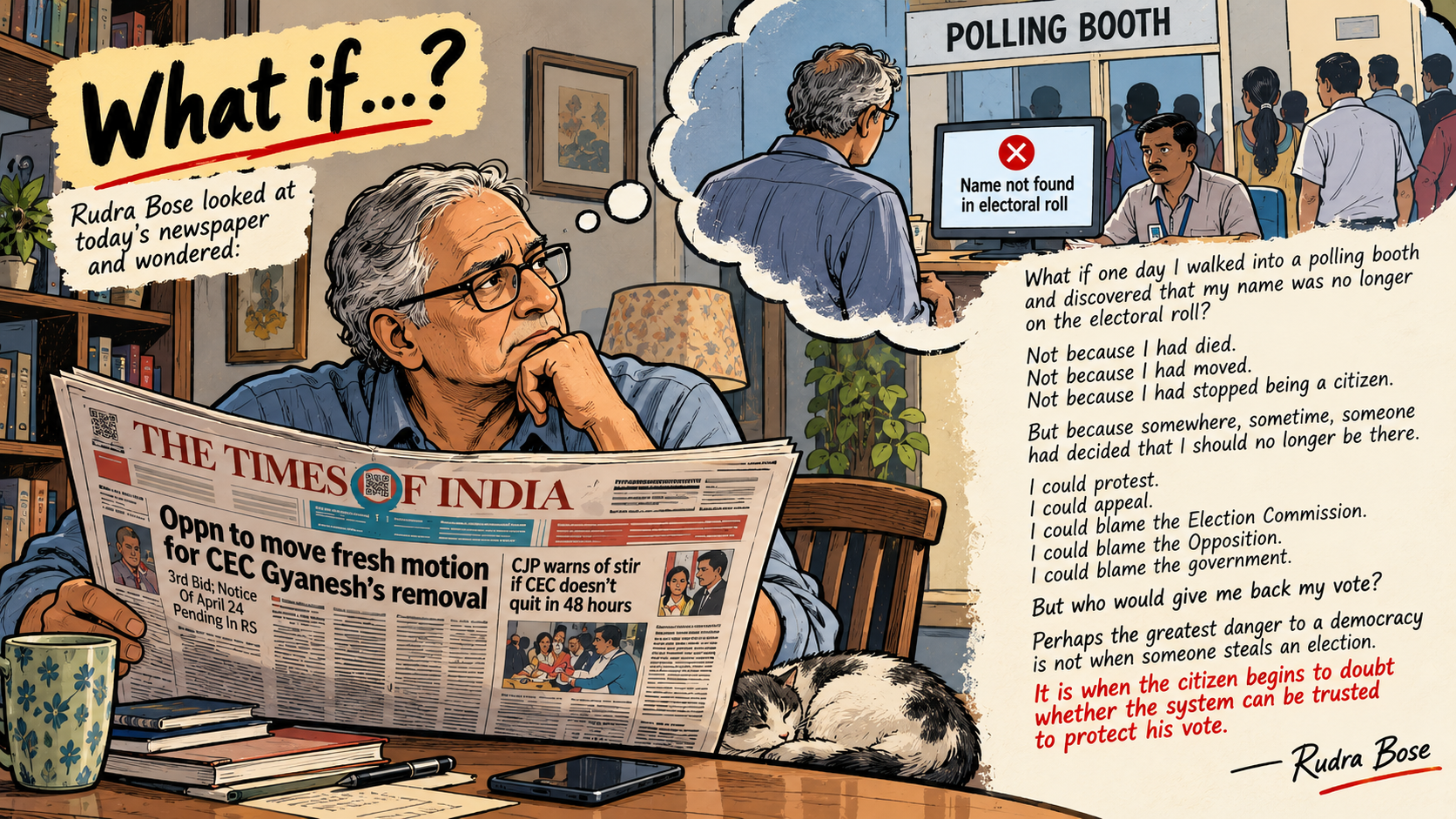
Then I imagined something more frightening. What if, one morning, I walked into a polling booth and discovered that my name was no longer there?
Not because I had died. Not because I had moved. Not because I had stopped being a citizen. But because somewhere inside a database, a decision had been made.
And suddenly I realised: Democracy does not merely depend on the right to vote. It depends on the quiet certainty that when you arrive to exercise that right, your name will still be there.
Perhaps that is the real test of an election. Not who wins or loses. But whether the citizen still trusts the hand that counts his vote.
I came across a story recently. I do not know whether it is true.
Perhaps it is. Perhaps it has gathered a little fiction around a kernel of truth. And perhaps, like many stories that move between people, it has become less concerned with historical accuracy than with a truth of another kind—the truth of the human heart.
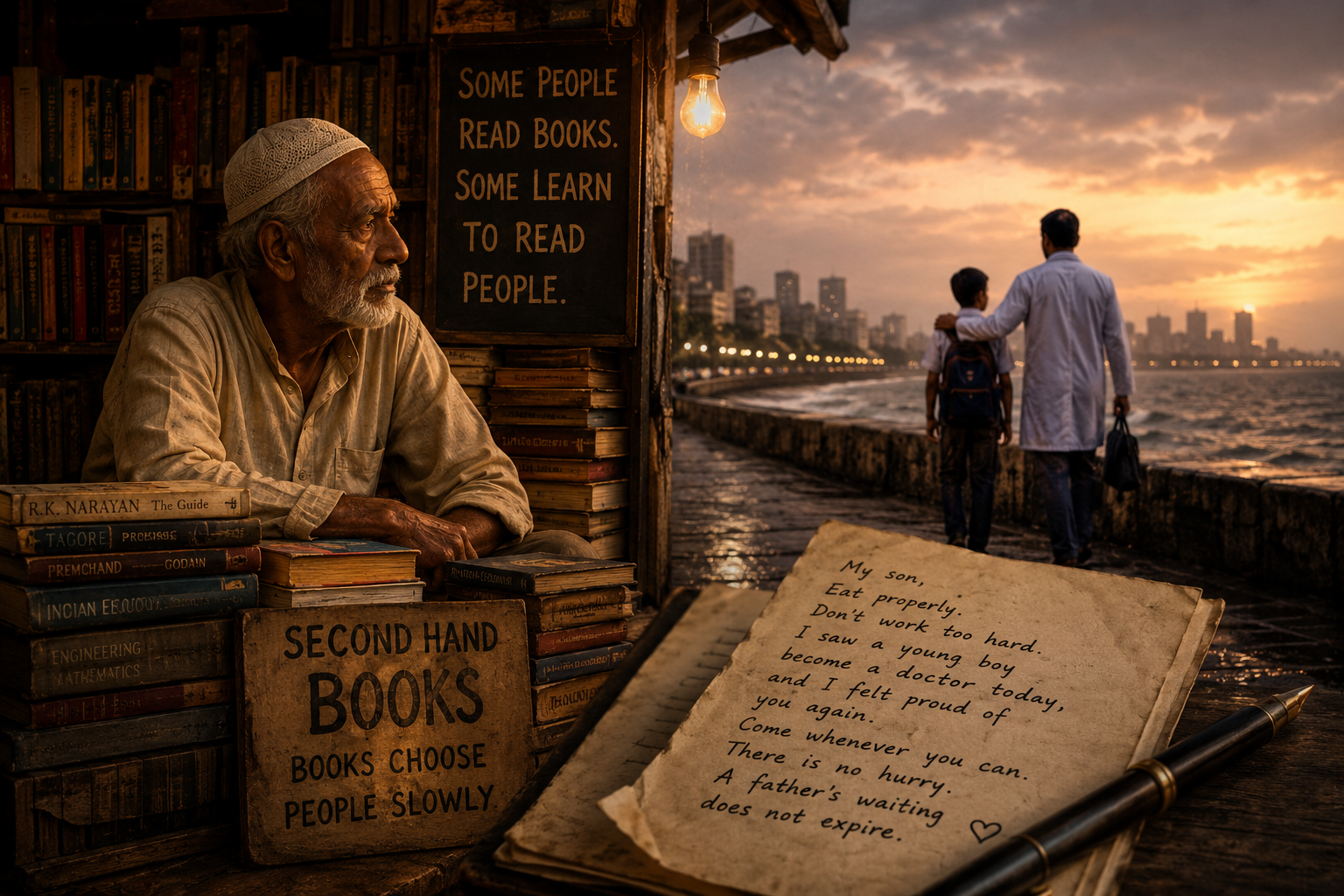
It was about an old man called Salim who sold second-hand books outside Churchgate Station in Mumbai. There was something almost unbearably poignant about him. He had spent his life surrounded by books. And he could not read, not a single word. He had never had the opportunity to go to school. Poverty had closed that door before he was old enough to understand what education meant. Yet he knew his books. He could locate them by the colour of their covers, their size, their position on the shelf. He remembered who had bought them and, sometimes, why. When someone expressed surprise that a man surrounded by thousands of books could not read, he apparently said: “Some people read books. Some learn to read people.”
Whether Salim ever existed is, for me, almost beside the point. Because I was reminded of two stories I wrote in The Last Writer of Kolkata. The first is about an ageing writer whose memories—and the culture embedded within them—become something that others wish to digitise, package and sell.
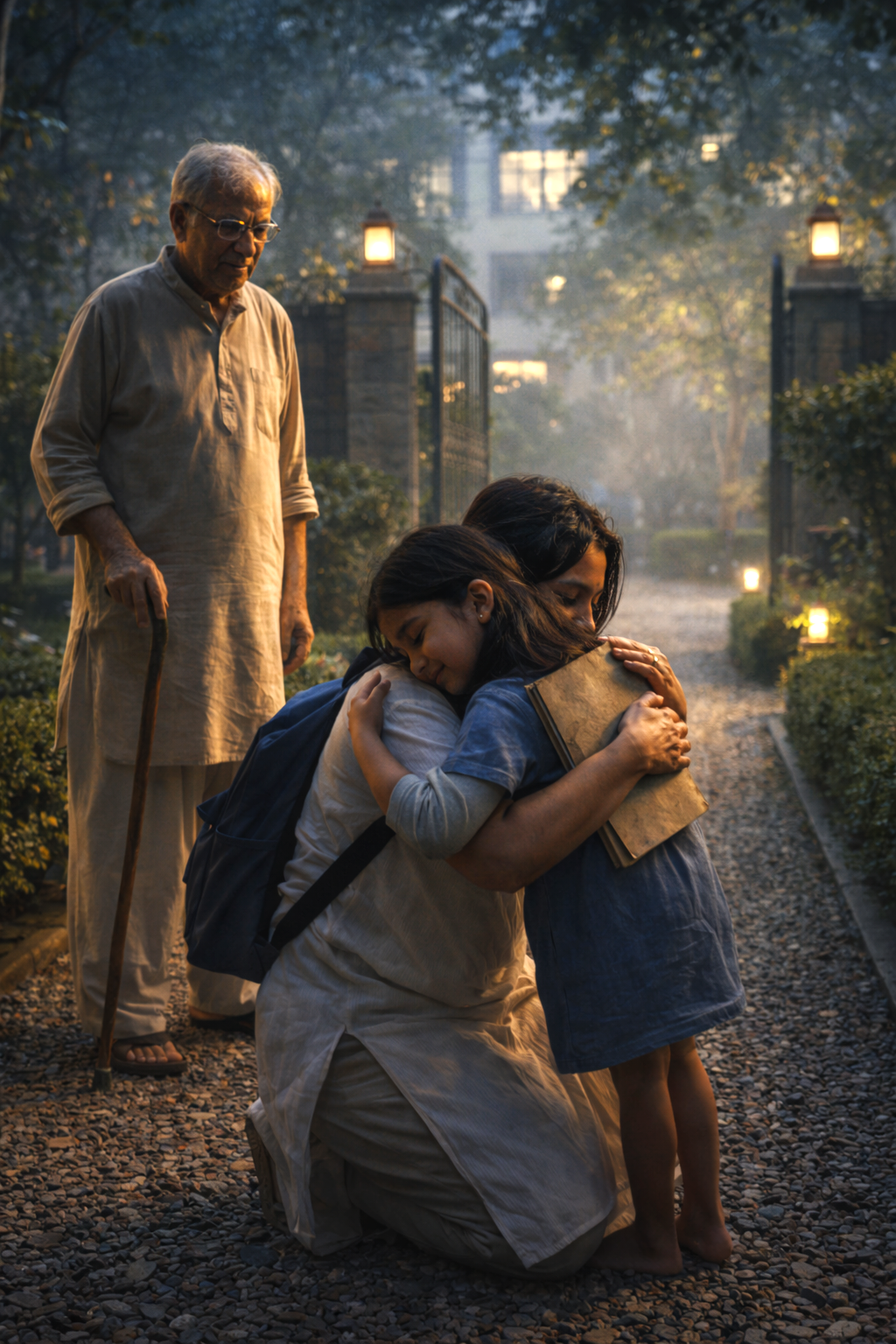
The second, When the Rain Remembered, is about an old couple, Pradyut and Jaya, who shelter a displaced child called Rai in a retirement enclave where everything has been reduced to rules, protocols and algorithms.
At first glance, these stories might appear to have little in common. But perhaps they do. All three stories are really about what it means to remember. And what it means to care.
The old writer in Kolkata possesses something that technology cannot quite capture—the texture of memory, the fragrance of a city, the small details that make a life one’s own. Pradyut and Jaya discover that a home is not a place governed by regulations. It is created when someone decides that another human being matters. And the story about Salim? He could not read the books he sold.But he understood something that many of us, despite all our education, sometimes forget. A book is only paper and ink until it touches a human life.
Salim had a son. He had worked and sacrificed so that his son could study, become a doctor and eventually build a life abroad. He had given his child what he himself had been denied. And then, as happens so often in life, distance entered quietly. Not through anger, not through rejection but simply through life. Work became demanding. Calls became less frequent. Visits were postponed. There was always a tomorrow. Until, one day, there wasn’t.
The story says that after Salim died, his son discovered letters his father had dictated over the years but never sent. One sentence stayed with me: “A father’s waiting does not expire.”
Perhaps that is what touched my heart. Because parents seldom announce their loneliness. They say, “I am fine.” They say, “Don’t worry about me.” They say, “Come whenever you can.” And children, believing there will always be another opportunity, postpone the visit, the call, the embrace. Until time makes the decision for them.
Yet there is another part of Salim’s story that moved me even more.
He did not allow his deprivation to become bitterness.
He began giving books to children who, like him, might otherwise never have had access to education. His pain became someone else’s opportunity. His emptiness became someone else’s doorway. And suddenly I found myself thinking again of When the Rain Remembered. Pradyut and Jaya did not change the world. They simply opened a door. They gave shelter to a child whom a system had no place for.
But sometimes that is how humanity survives. Not through grand gestures. But through small acts of defiance against indifference. A door opened. A book given away. A child protected. A lonely person remembered. A hand held. A call made before it is too late.
And then I thought of The Last Writer of Kolkata. What survives us? It is not necessarily our possessions. Not even necessarily our achievements. Perhaps it is the memory we leave in another human being. The writer Rudra Bose leaves behind memories. Pradyut and Jaya leave behind a sense of belonging. Salim leaves behind children who can read the books he never could. And perhaps that is the irony at the heart of his story. The illiterate bookseller who understood literature better than many who have read thousands of books. Because he understood that the ultimate purpose of a book is not to be read. It is to change something in us.
And perhaps the ultimate purpose of a life is not to be remembered by everyone. It is to have mattered deeply to someone. There is something else I find profoundly moving about the idea of Salim’s unsent letters. We spend much of our lives writing things down. Be it as Emails, messages, posts, documents and even books. But the most important things we write are often never written on paper at all.
We write them in the lives of our children. In the confidence of a student. In the memory of a friend. In the courage of someone we encouraged. In the kindness we showed a stranger. These are the things that remain when the writer is gone. Perhaps, in the end, every life is a book. Some are beautifully bound, others torn and weathered. Some have pages missing, some are never published. And some, like Salim’s, may never have been able to read their own pages.
But that does not mean they were unwritten. For our lives are constantly writing themselves into the lives of others. And perhaps that is what The Last Writer of Kolkata, When the Rain Remembered, and this haunting story of a bookseller are really trying to tell : We may forget the words. We may forget the books. We may even forget the people who taught us the words. But we rarely forget how someone made us feel when we were in need of being understood.
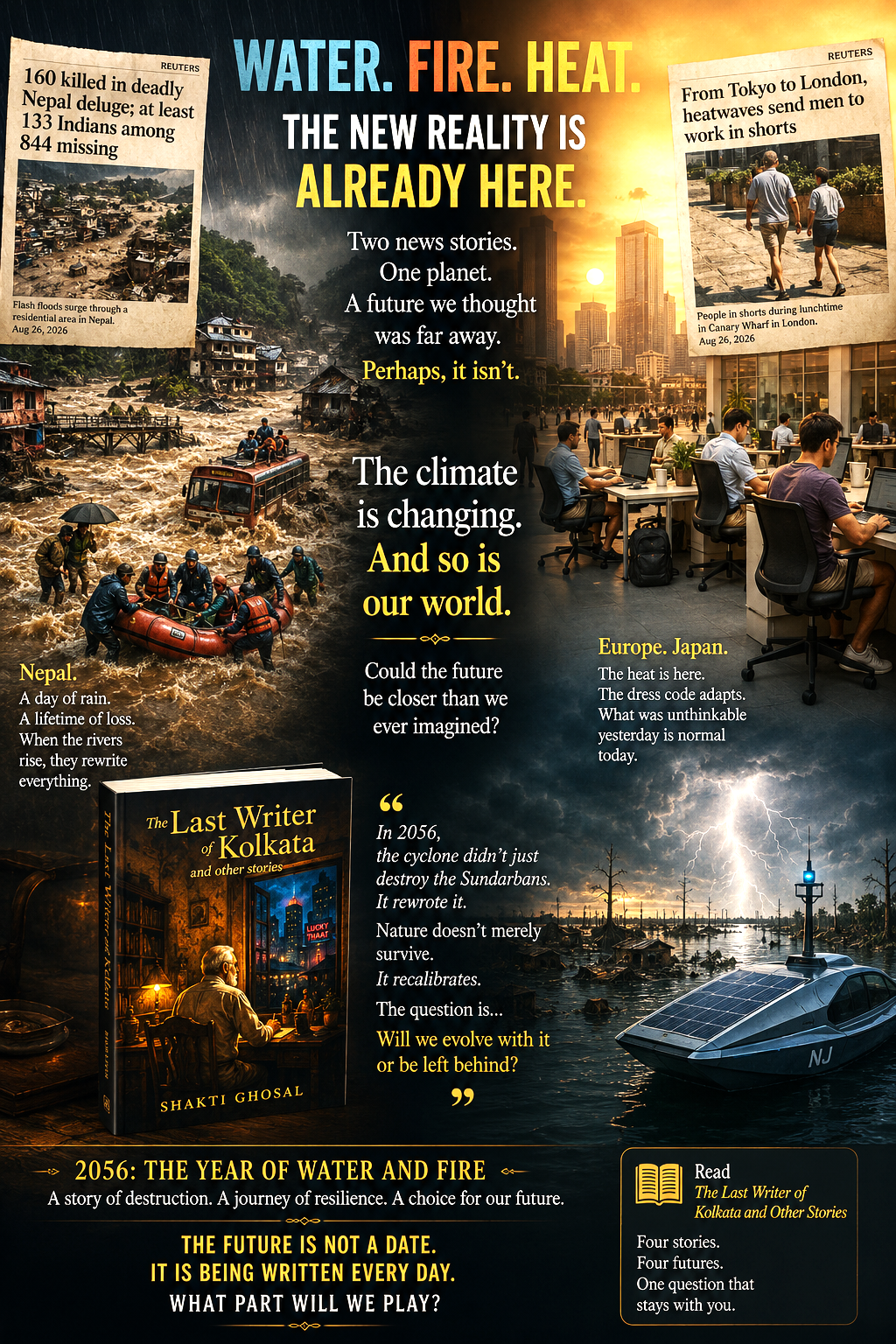
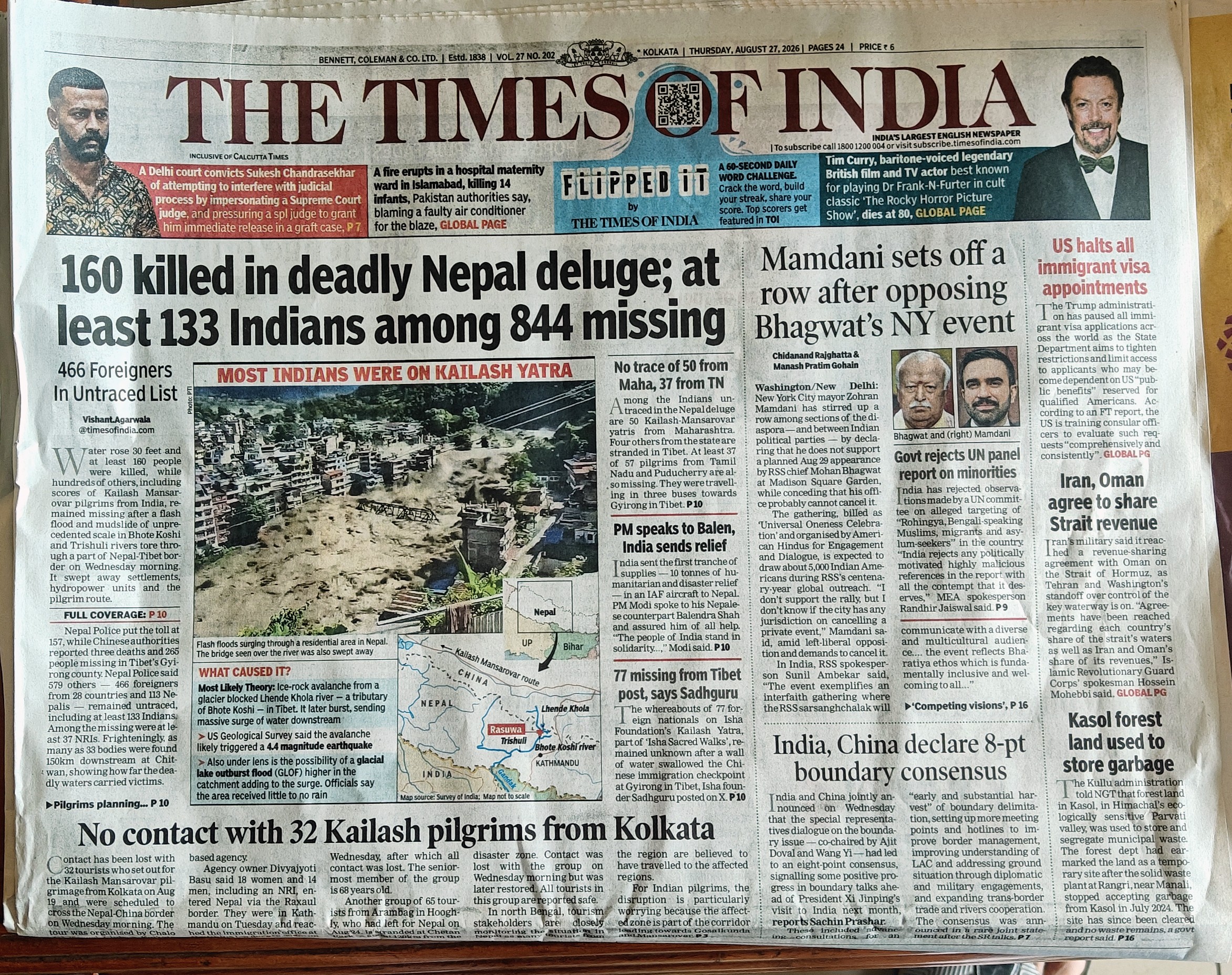
The first was from Nepal: devastating floods, homes swept away, lives lost, roads and bridges disappearing beneath an angry torrent of water.
Death and destruction
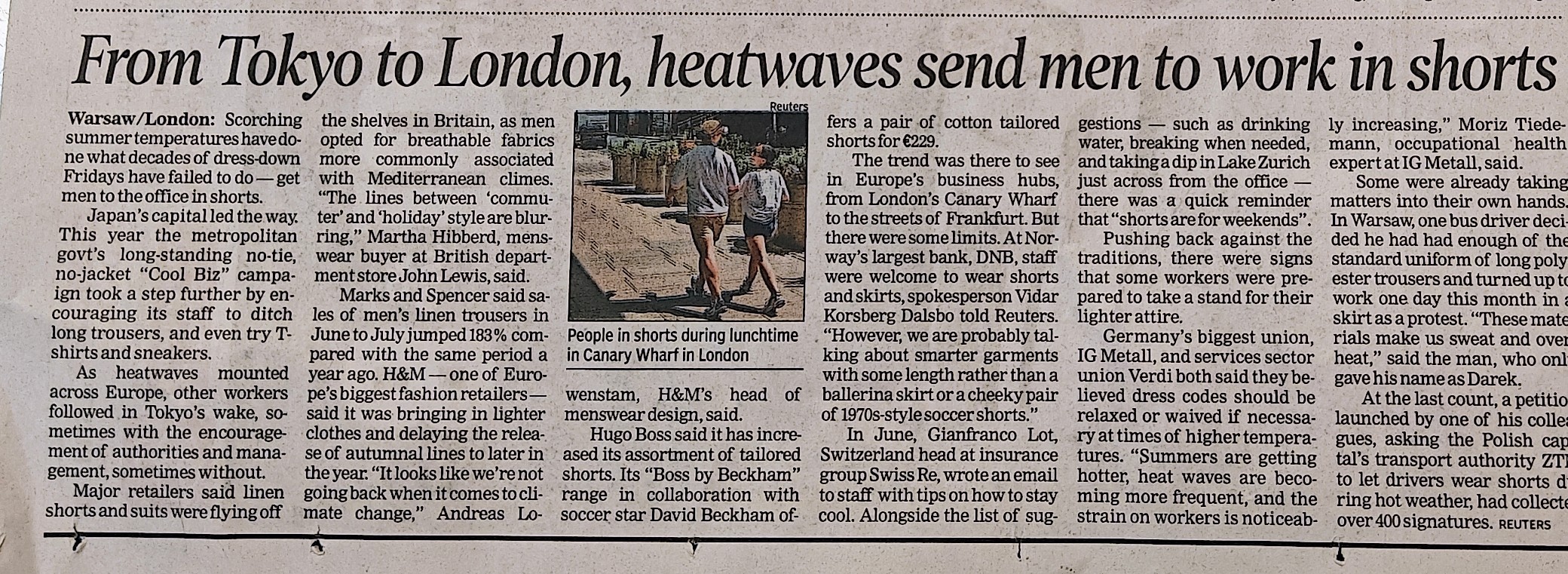
The second was almost deceptively ordinary. Across parts of Europe and Japan, persistent heatwaves are becoming so severe that something once unthinkable is changing: formal office wear is giving way to shorts, T-shirts and sneakers. What was once considered casual is becoming necessary simply to cope with the heat.
Heat waves across Europe and Japan
At first, the two stories seem to have little in common. One is about water. The other is about heat. But perhaps they are telling us the same story. The climate is changing. And slowly, almost imperceptibly, the boundaries of what we consider “normal” are changing with it.
When I wrote 2056: The Year of Water and Fire, I deliberately placed the catastrophic events some thirty years into the future. Even while writing it, I wondered whether I was being too dramatic—or perhaps, paradoxically, not dramatic enough.
Today, I find myself wondering something else. Could the future I imagined be closer than I thought? We tend to imagine climate catastrophe as something spectacular and distant: a great cyclone, a flooded city, an apocalyptic landscape sometime in the middle of the century. But perhaps climate change does not announce itself that way. Perhaps it arrives quietly. A few more unbearable nights. A flood where there wasn’t one before. A river changing its course. A crop failing. A species disappearing. An office worker deciding that trousers are simply too hot to wear. And then, one day, much like that frog in the slowly heating water, we realise that something we considered extraordinary has quietly become normal.
That is what unsettles me most. The danger is not merely that the planet is becoming warmer or that extreme weather is becoming more destructive. It is that to survive, we need to gradually become accustomed to the extraordinary. We need to adapt our clothes, our buildings. And we need to adapt our working hours, our expectations. And perhaps, without realising it, we have begun to adapt our definition of what constitutes a crisis.
In 2056, I imagined a Sundarbans battered by rising waters and increasingly violent storms. Yet the story is not ultimately about destruction. It is about resilience—of people, of technology, and perhaps most importantly, of nature itself. But resilience should never become an excuse for complacency. The fact that human beings can adapt does not mean that we should keep testing the limits of that adaptation.
The future is not a date on a calendar. It is being assembled quietly, day by day, in the choices we make—and in the warnings we choose to notice. Perhaps the most frightening question is no longer “What will the world look like in 2056?” Perhaps it is: “How much of 2056 have we already begun to live?”
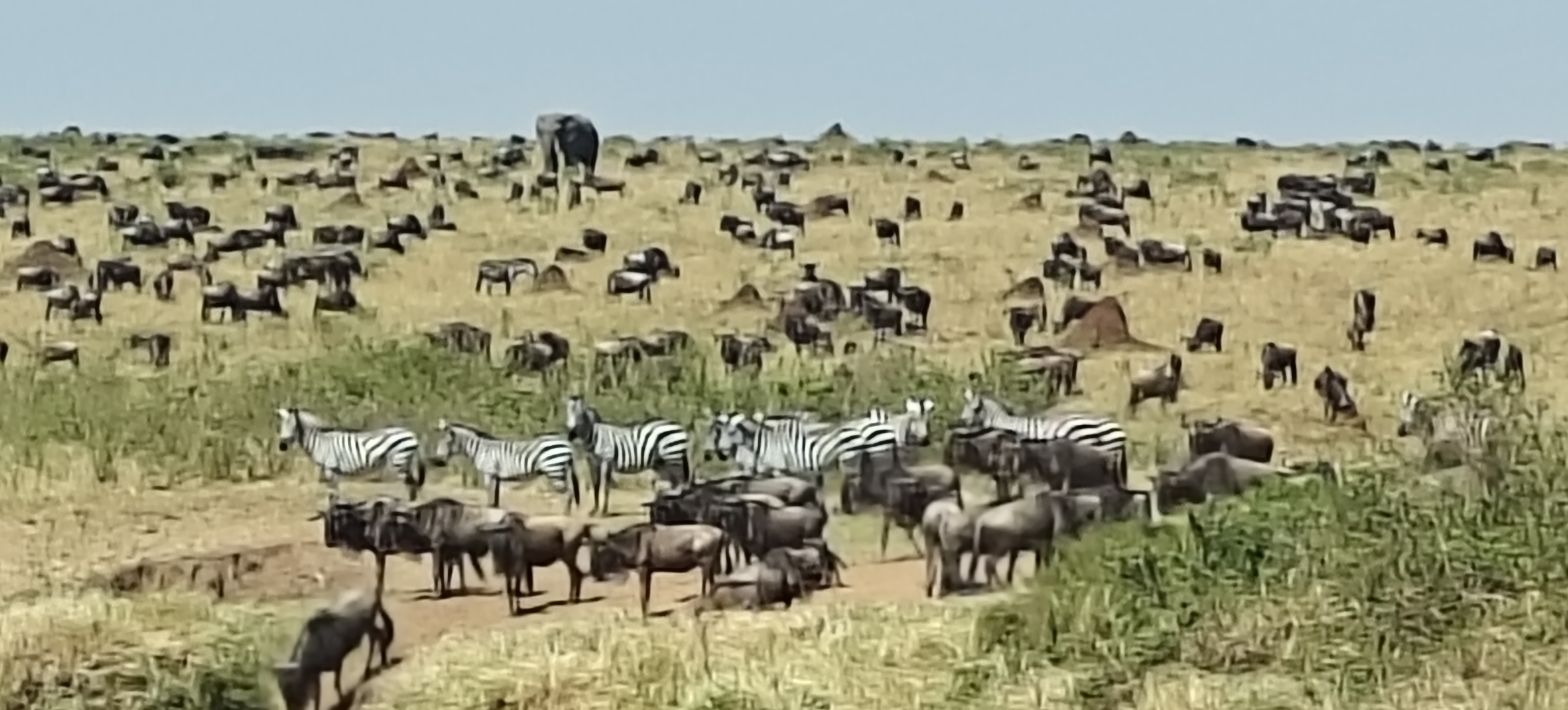
I spent the morning watching the animals move across the Kenyan savannah. There were wildebeest everywhere. Zebras moved among them almost casually. An elephant and its cub stood beneath a tree. In the distance, the landscape seemed to stretch endlessly, without walls, roads or buildings to interrupt it. For a while, I simply watched.
A space with no boundaries
There was something strangely humbling about seeing so many creatures occupy the same landscape without any apparent need to possess it. They did not own the land. They did not draw boundaries across it. They did not put up signs announcing that a particular piece of earth belonged to them. They simply lived there.
The Savannah co-existence
And then a thought occurred to me. What if we have misunderstood our place in the world?
For centuries, we have measured human progress by our ability to control nature. We cut down forests and called it development. We dammed rivers and called it progress. We covered open land with concrete and called it urbanisation. We moved mountains, redirected water, altered landscapes and exterminated species after species, making them disappear. And while doing so, we often congratulated ourselves on our ingenuity and intelligence.
The great migration through Mara
But somewhere along the way, we perhaps began to confuse our ability to control something with the right to own it. The savannah seemed to offer me a different philosophy. The animals did not appear to be conquering the land. They were part of it. The elephant did not need to dominate the tree beneath which it stood. The zebra did not need to fence off its patch of grass. The wildebeest did not need a title deed to the earth beneath its feet. They belonged to the landscape without claiming it. Perhaps that is what we have forgotten. We speak endlessly about what we will leave behind. Be it buildings, businesses, fortunes, roads or institutions. We would strive to leave our names on plaques and our photographs on walls. But perhaps there is another kind of legacy…….
The Zebra did not need to fence off its grass….
What we choose not to destroy. The forest we would leave standing. The river and the waterbody we would allow to remain clean. The animal(s) whose habitat we would protect. The open space we chose not to convert into concrete. The silence we did not fill.
The silence we did not fill….
Standing there in Kenya, I began to wonder whether civilisation should really be measured by how much of nature we can bend to our will. Or how much of nature we chose to leave as it is. Perhaps the more difficult measure is how much power we possess—and how much restraint we exercise. Because restraint requires something that conquest does not. It requires us to recognise that we are not the center of everything. The realisation that the earth existed before us, the wild existed before our cities, our borders and our ambitions. And, if we are wise enough, much of it will continue to exist after we are gone.
Will this exist after we are gone?
Perhaps we are not the owners of this world after all. Perhaps we are merely its temporary custodians. We arrived without asking permission. We will leave without taking anything with us. Between those two moments lies the brief privilege of being of who we are and our presence here.
We remain privileged to have been here…….
And so I find myself asking a different question. Not simply, what will we build while we are here? But, what will remain because we were here? I closed my notebook. The animals continued moving across the savannah. They had not heard my question. Perhaps they did not need to. They seemed to know the answer already.
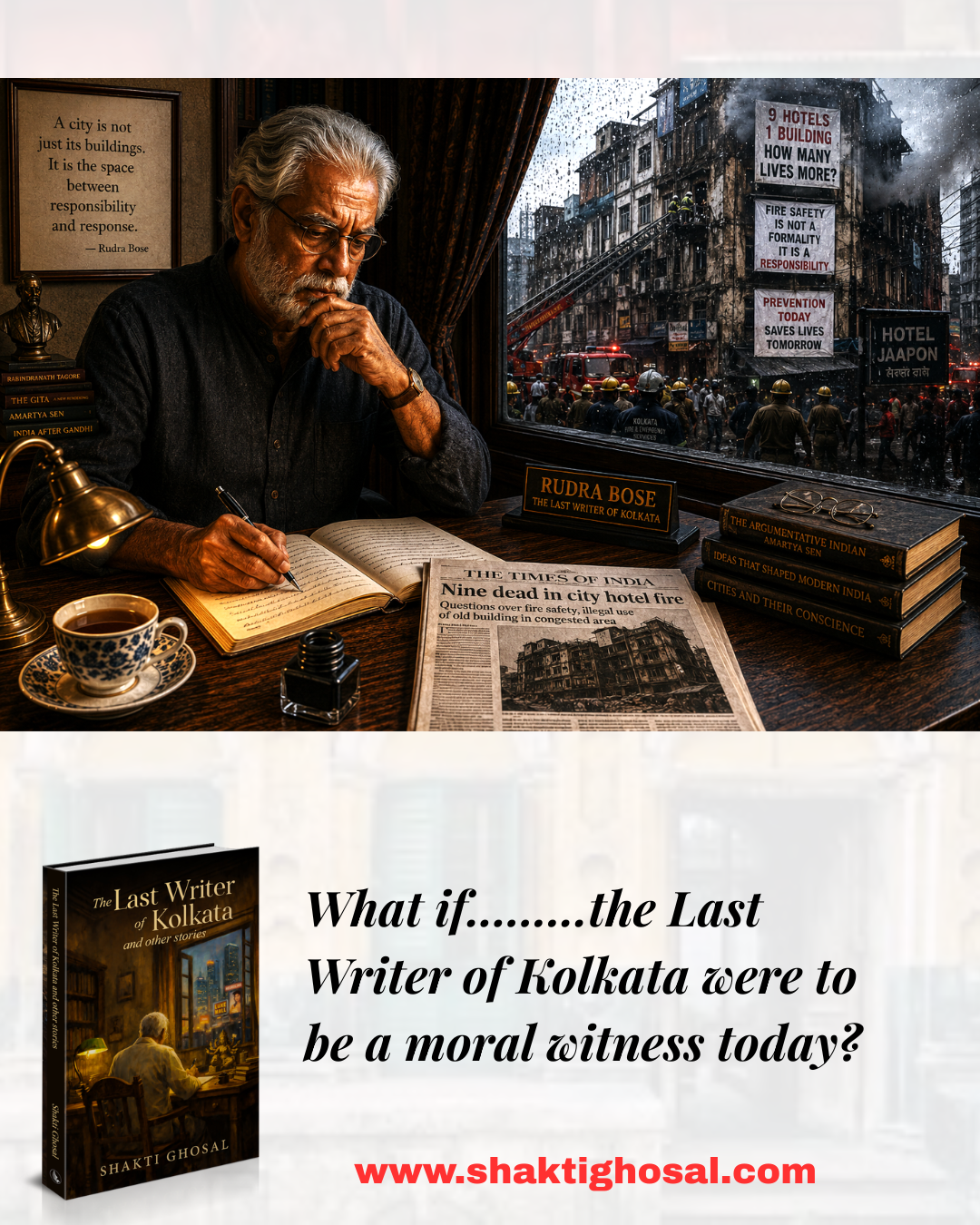
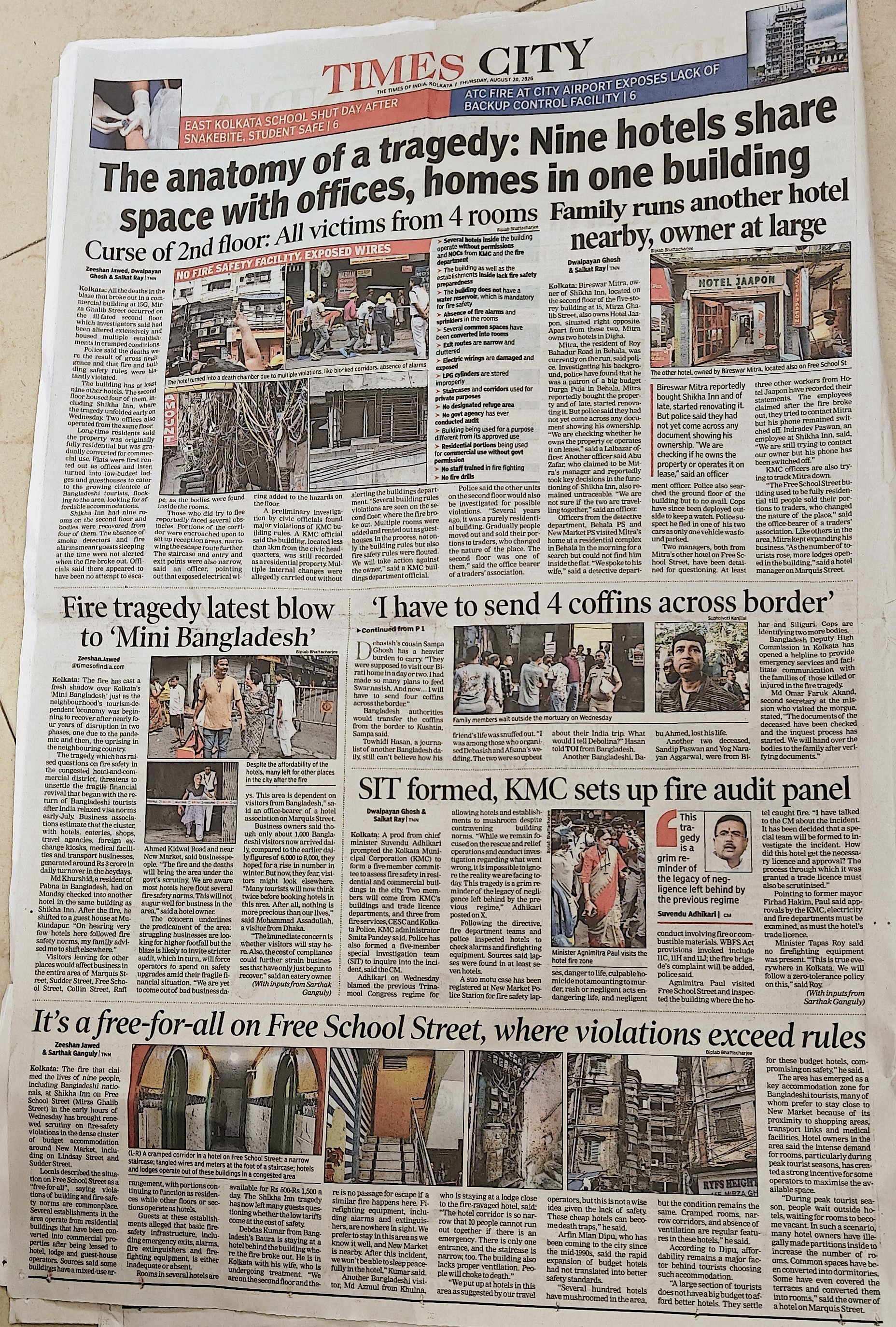
….. a city allows danger to become normal until tragedy makes it visible.
August 2026
The fire in the Free School street building which housed hotels, offices and homes may have started with a short circuit. But tragedies of this magnitude are rarely caused by a single spark. Nine people died in a building where hotels, offices and homes had somehow learnt to coexist within a maze of cramped spaces, narrow passages and questions about fire safety.
Times Of India report
I kept wondering: who allowed this to become normal? Perhaps that is the more uncomfortable question. A city does not become unsafe in one day. It becomes unsafe one ignored violation at a time. One certificate not checked. One inspection postponed. One illegal alteration overlooked. One warning that nobody thought was urgent. And then, one night, the building catches fire.
We will now demand accountability. There will be investigations, committees, audits and perhaps arrests. All these are surely necessary. But does governance have to begin only after people die? The real test of a city is not how efficiently it rescues people from a burning building. It is whether it had the courage to prevent that building from becoming a death trap in the first place.
As I folded the newspaper, I wondered whether we have become too accustomed to calling preventable tragedies accidents. Perhaps the most important responsibility of governance is not to manage disasters better. It is to make fewer disasters possible.
……societies change not because they have become wiser but because they become preoccupied with different anxieties.
August 2026
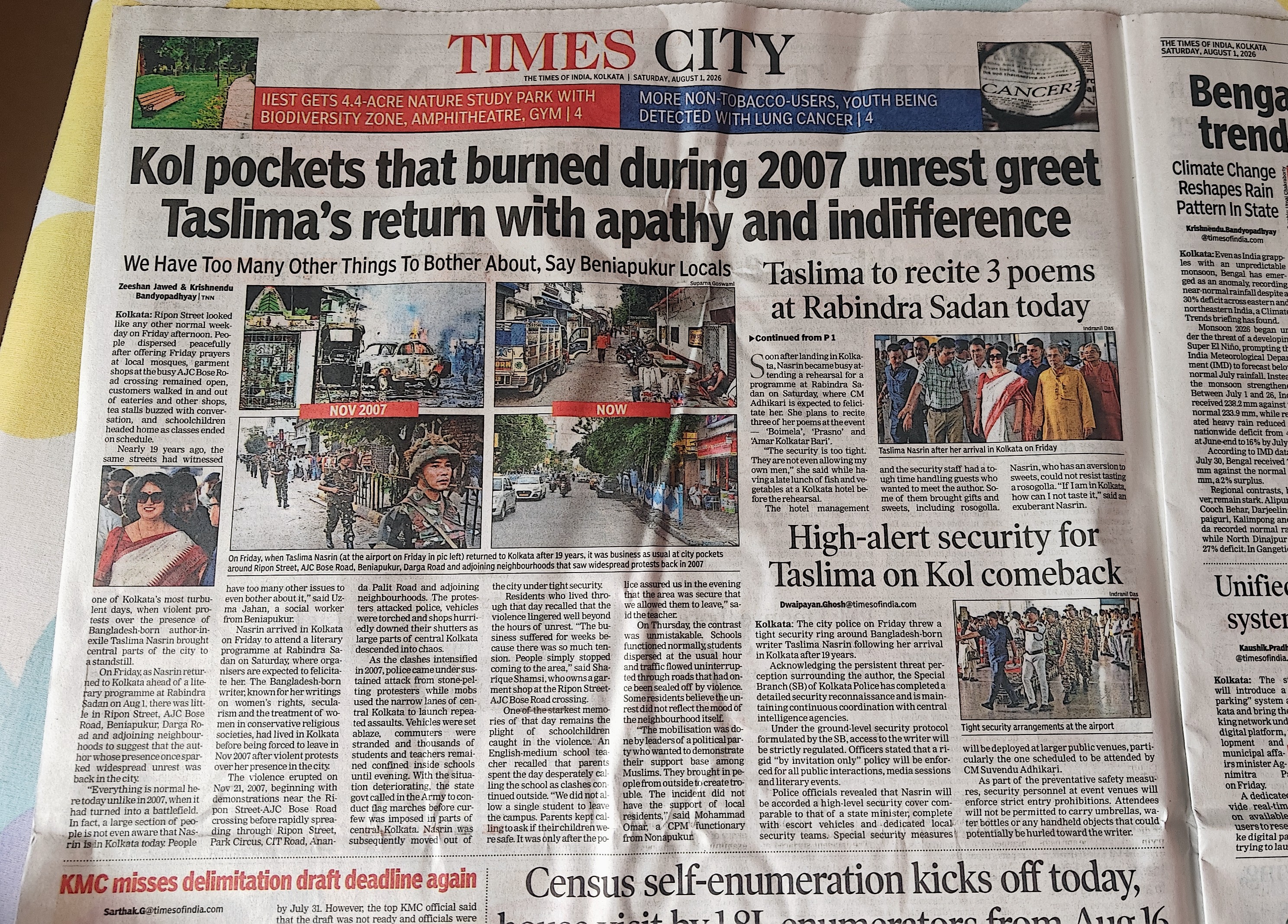
Nineteen years. That is long enough for a child to become an adult. It is also long enough for governments to rise and fall. Long enough for a city to forget the sound of its own anger.
The other day, the newspaper told me that Taslima Nasrin has returned to Kolkata after nineteen years. The same city that once burned over her presence now seems to have greeted her mostly with routine, security cordons and a curious indifference.
Talima Nasrin report in the Newspaper
It made me wonder. What has really changed? Did we become more tolerant? Did we finally learn that books and what is written within need not be answered with barricades? Or have we simply acquired newer fears that leave us with less energy for old ones?
Perhaps every generation chooses its own battles. Yesterday it was identity. Today it is jobs, examinations, inflation, technology, security and an uncertain future. The loudest outrage of one decade quietly becomes yesterday’s headline.
As I folded the newspaper, I realised that a mature society is not one where everyone agrees. It is one where disagreement no longer needs to be escorted by violence. If Kolkata has truly changed, the victory does not belong to any government, any ideology or any writer.It belongs to the simple belief that ideas should be answered by better ideas, not by frightened crowds.
That is how civilisation grows—almost unnoticed, one quieter street at a time.
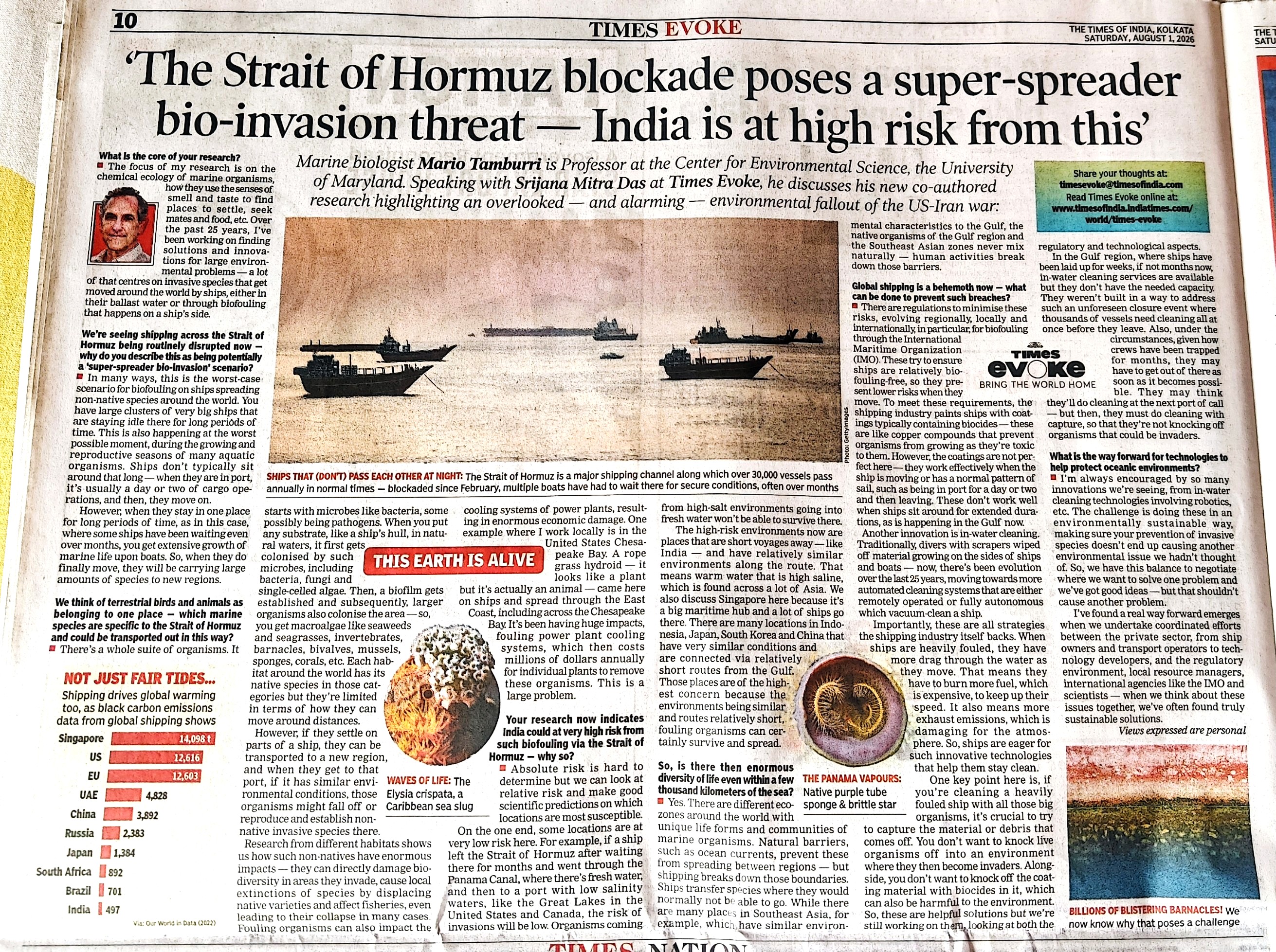
A newspaper report I read the other day literally stopped me in my tracks. It spoke about an unexpected consequence of the geopolitical tensions around the Strait of Hormuz. As ships remain berthed for prolonged periods, marine scientists are warning of an increased risk of invasive organisms hitching a ride across oceans, disrupting ecosystems thousands of kilometres away. At first glance, it appeared to be a story about shipping and marine biology. But as I read further, I realised it was really a story about something much larger.
A Times of india report
Nature rarely responds in straight lines. A political conflict can become an environmental risk. A delay in maritime traffic could alter the movement of microscopic life. Human decisions in one corner of the world quietly reshape ecosystems in another.
While writing 2056: The Year of Water and Fire, I had found myself returning repeatedly to this thought. We often imagine climate change as a sequence of visible catastrophes—cyclones, floods, rising seas. Yet the more profound transformations are often quieter. Species migrate. Rivers redraw themselves. New ecological relationships emerge. Life adapts in ways we neither anticipate nor fully understand. Toward the end of the story, after a devastating cyclone had rewritten the geography of the Sundarbans, the first instinct of the survivors was despair. But when the dronobots began mapping the devastation, they uncovered something unexpected. Amid the destruction, nature was already experimenting. Islands were shifting. Mangroves were finding new footholds. Wildlife was adapting. The ecosystem, scarred but alive, was quietly reorganising itself for a different climate. It was neither revenge nor redemption, it was recalibration.
That thought had stayed with me because it challenges one of our deepest assumptions. We often speak of “saving nature,” as though it were a fragile object waiting for human intervention. History suggests something more humbling. Nature has an extraordinary capacity to reinvent itself. It is we who struggle to keep pace with the consequences of that reinvention.
Perhaps the real lesson is this. The future will not unfold as a neat extension of the present. It will emerge through countless interactions we barely notice today—between politics and ecology, technology and biology, human ambition and planetary resilience.
In 2056, Nayanjol, the sentient boat, eventually becomes more than a machine. He becomes a guardian who understands that survival does not lie in resisting nature, but in learning to listen to it.
Maybe that is the question our own times are quietly asking. Not whether nature will adapt. But whether we will.