Why do so many of your stories seem to end sadly?


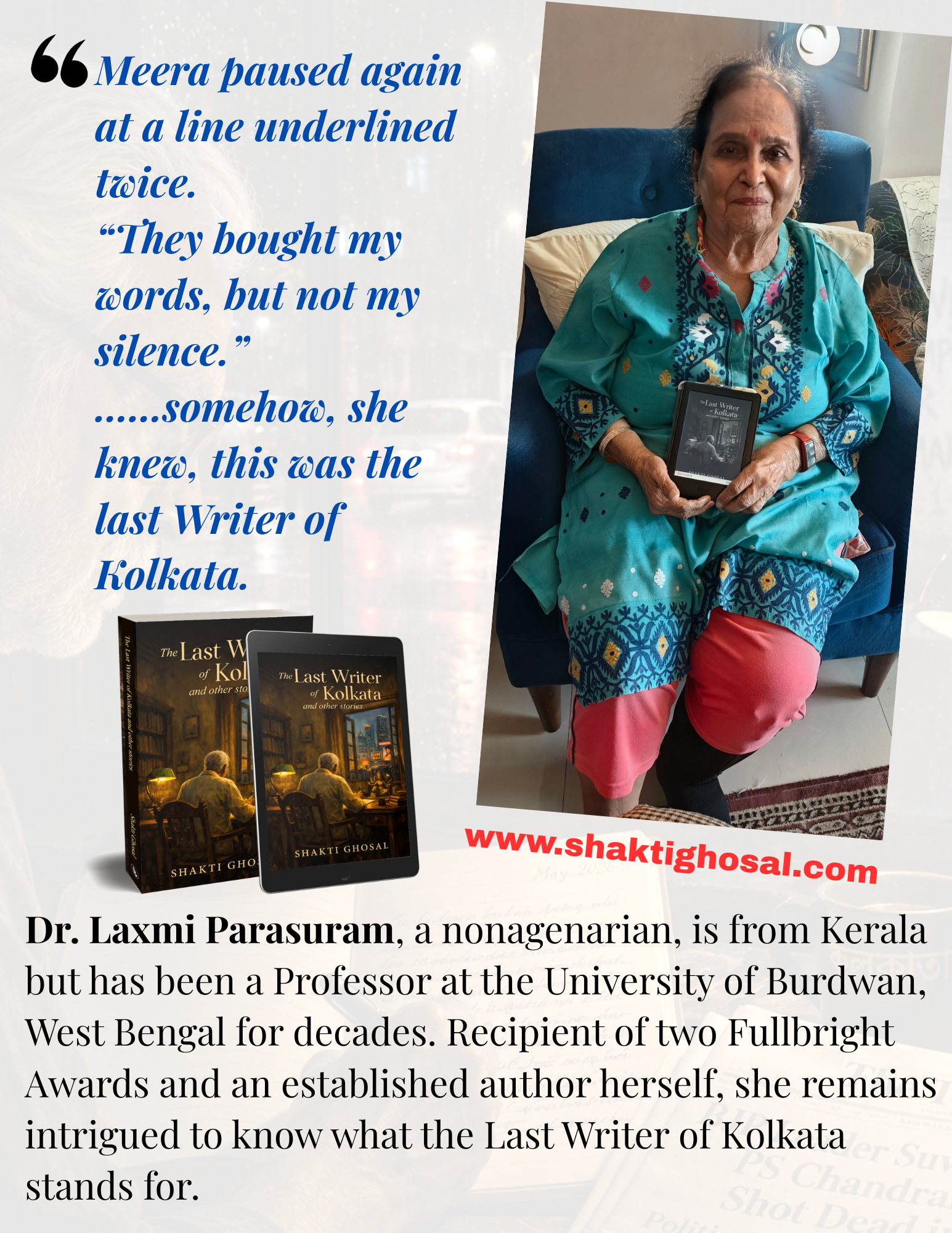
When I met Dr. Laxmi Parasuram to hear her thoughts on The Last Writer of Kolkata and Other Stories, I expected literary observations. What I received instead was a question that lingered.

She spoke of the emotional weight in the stories—the sentiment, the ache, the quiet melancholy. Then she asked, “Why do so many of your stories seem to end sadly?”

The question took me by surprise. I had never consciously thought of these as sad endings. To me, these stories are about ordinary people standing at extraordinary crossroads—where technology, hard trends, and shifting social realities place pressure on the human spirit. In those moments of disruption, what gets tested is not merely survival, but something deeper: memory, dignity, love, identity, silence, moral choice.

And when the protagonists choose to hold on to some irreducible fragment of their humanness—even at a cost—I had seen that not as tragedy, but as resistance. Yet perhaps this is the paradox of our times.

What one person sees as loss, another may see as courage. What appears to be a sad ending may, in fact, be the final refusal to surrender what makes us human.

It made me wonder: Have we become so accustomed to measuring success by comfort, victory, and neat resolutions that acts of emotional fidelity now look like defeat?

Dr. Parasuram’s question stayed with me. And perhaps that is what literature is meant to do—not provide answers but quietly rearrange the questions we ask ourselves.

In Musing……. Shakti Ghosal

Four futures. Four hard truths. And the fragile choices that still make us human.


Set in a near future shaped by forces already gathering momentum, this collection explores what happens when irreversible hard trends collide with ordinary human lives. From climate catastrophe and algorithmic control to cultural erasure and institutionalized ageing, each story follows characters forced to rethink love, loyalty, memory, and courage as familiar worlds quietly transform around them. These are not tales of spectacular collapse, but of subtle reckonings—where survival lies not in resistance alone, but in choosing what must still be remembered, protected, and passed on.

The Last Writer of Kolkata
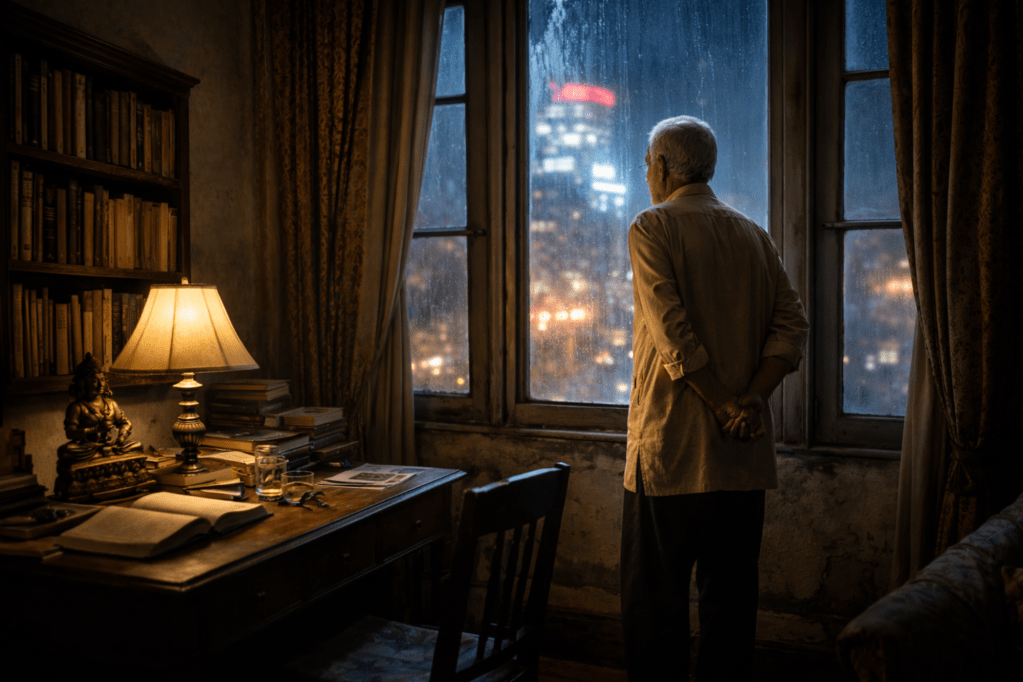
In a near-future Kolkata where memory, culture, and even grief are packaged and sold, an ageing writer quietly records a city that no longer listens. When his private words are appropriated and monetized, the story becomes a haunting meditation on erasure, resistance, and the fragile dignity of remembering in a world that profits from forgetting.

2056: The Year of the Water and Fire
In a near-future Sundarbans battered by super-cyclones and rising seas, a grieving environmentalist, his resolute daughter, and a sentient AI boat are caught between prophecy and science as fire erupts beneath the ocean. As water and flame converge, the story asks a haunting question: when nature reclaims its power, is survival an act of technology, faith—or human courage to stand and choose?

Echo Chamber
In a near future where minds are seamlessly linked and memories can be accessed, altered, and weaponized, a gifted intelligence analyst uncovers a conspiracy that turns thought itself into a tool of control. As truth, identity, and free will begin to blur, the story confronts a chilling question: when belief is engineered, is freedom still a choice—or merely an illusion?

When the Rain Remembered
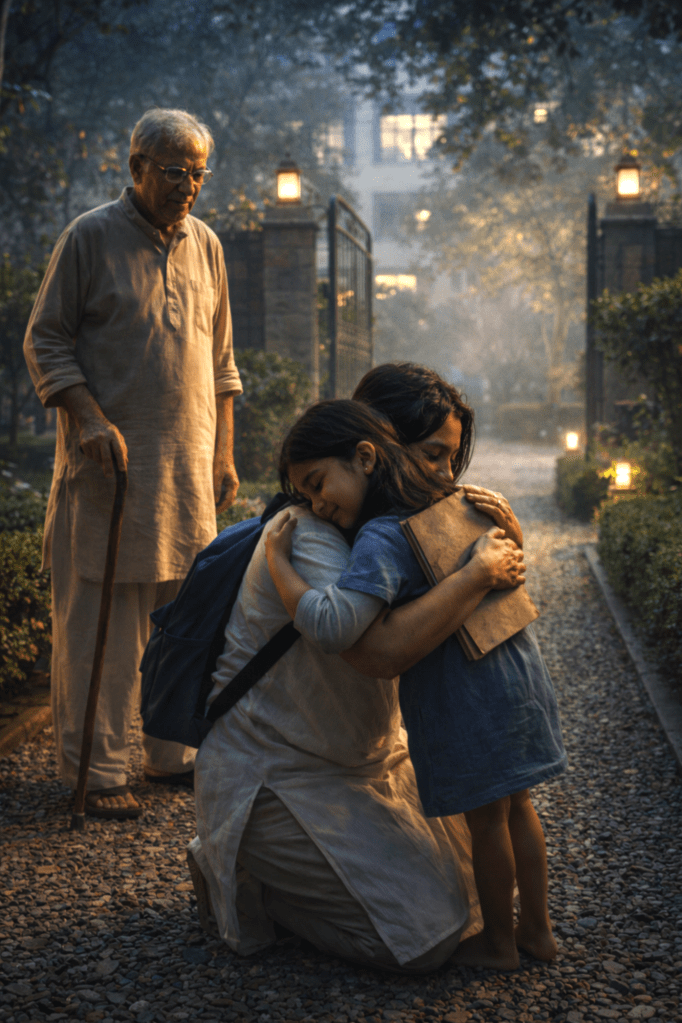
In a near-future Kolkata where ageing has been systematized and kindness regulated, an elderly couple shelter a displaced child inside a gated retirement enclave that has forgotten laughter. As rain, unrest, and quiet courage unsettle rigid rules, the story becomes a tender meditation on belonging—asking whether homes are built by policy, or by the human instinct to care.

The Last writer of Kolkata and other stories is making waves amongst discerning readers. To know more, visit: http://www.shaktighosal.com

In musing…… Shakti Ghosal

Ma Is Coming


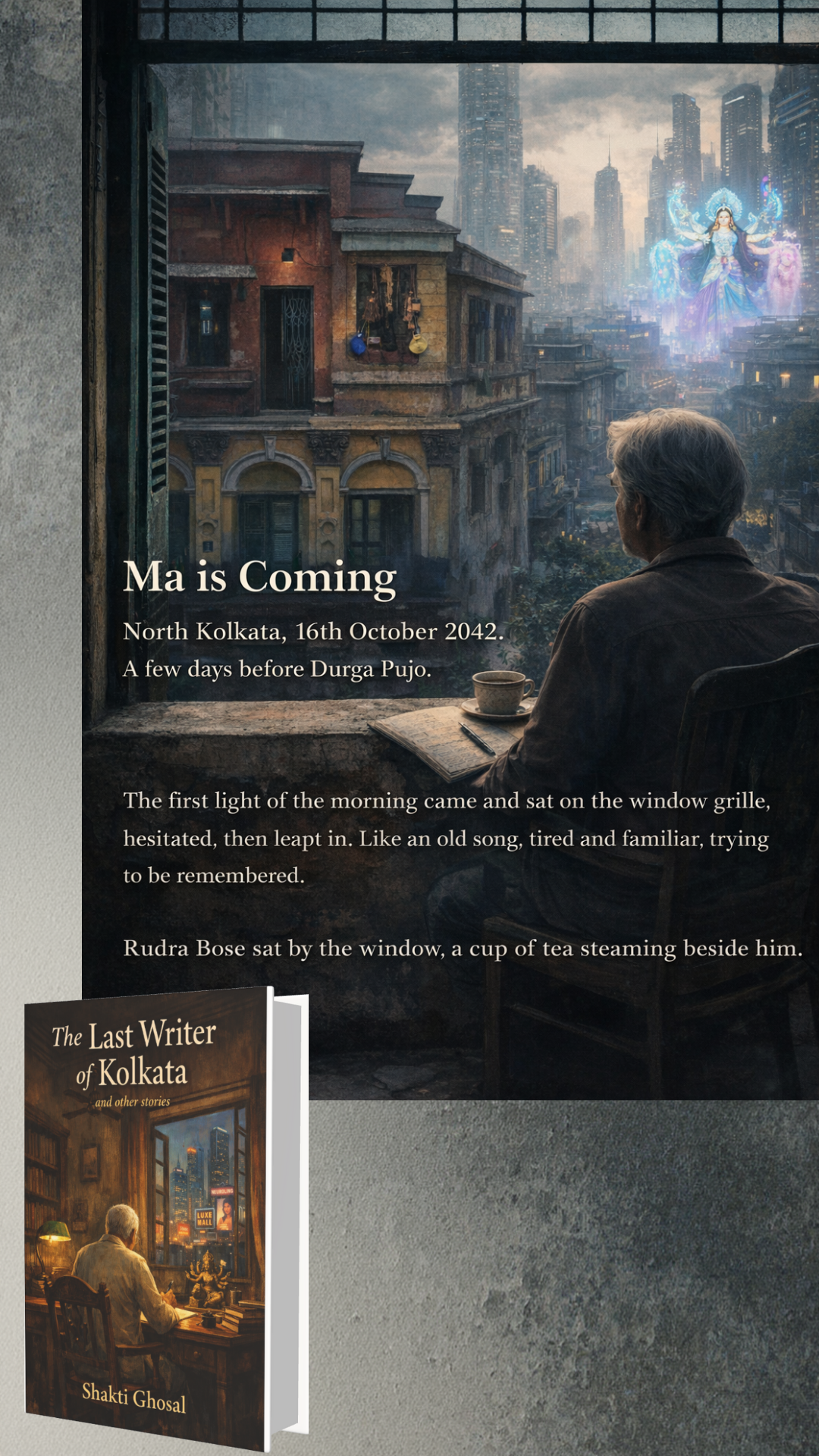
Ma is Coming

North Kolkata, 16th October 2042. A few days before Durga Pujo.

The first light of the morning came and sat on the window grille, hesitated, then leapt in. Like an old song, tired and familiar, trying to be remembered.

Rudra Bose sat by the window, a cup of tea steaming beside him. The cup was chipped, the saucer mismatched, the tea, a stubborn blend of milk, tea dust, and habit. Outside, the lane yawned into a waking slumber, its air thick with last night’s incense, stale samosa oil, and the ever-present, low-grade air pollution.

“Ma is coming,” he had heard someone shout on the street last evening.

She was, of course. Ma came every year. Only nowadays she arrived on a cloud of holograms, flanked by LED lions and thunderous drumbeats pouring through subwoofers. The city had found new ways to worship, more theatrical, more saleable.

Rudra shifted in his chair, his bones protesting like rusted hinges. In his lap, his journal lay open, an old pen resting across the page like a reluctant weapon. He hadn’t written yet. He was waiting, unsure of something. Was he waiting for a thought, a familiar smell, or the comfort of a Kolkata that seemed to slip further away each year?

Durga Pujo. Once, it had been magic.

As a boy, he had spent mornings watching Mashis, aunts and Boudis, sisters-in-law threading marigolds for the Pandal and Thakurer Bedi. In the afternoons it would be the decorators stringing up festoon lights of different colours all along the lane. Nights were all about rehearsing lines for the Natok, stage play they would perform on Nabami.

He had once accompanied his mother, walking barefoot to the river to collect Gangajal, the sacred waters of Ganga. He remembered his father reading out the Chandipath under a suffused light. Long buried memories of his parents surfaced and meandered.

“Rudra, you were born with too much silence,” his mother had once said, as she used a hand fan during load shedding. “You are eleven. Most boys your age chase dragonflies. You chase metaphors.”

“I like listening,” he had replied, “Words sound different when you don’t rush to answer them.”

His mother had turned towards him, “Then promise me, don’t let the noise teach you to forget what silence feels like.”

North Kolkata is the soul of the city, where the past isn’t just remembered—it’s lived. Often called “Babu Kolkata,” this region is a labyrinth of narrow lanes, grand 19th-century mansions, and centuries-old traditions that remain untouched by modernity. Historically, the British referred to the area inhabited by the native Bengali elite as the “Black Town,” in contrast to the “White Town” of Central Kolkata where the British lived.

North Kolkata features in the ‘Last writer of Kolkata’, part of my forthcoming book of the same name. Should you wish to receive exclusive previews and the chance of winning a free copy of the book, do write to me @ author.esgee@gmail.com

Shakti Ghosal