Book of the Month review by Outlook India


Aditi Chakraborty is part of the editorial team of the Outlook India group. She has recently done a ‘Book of the Month’ review of ‘The Last Writer of Kolkata and other stories.’

Aditi writes:

‘Shakti Ghosal, in his new book ‘The Last Writer of Kolkata and other stories’, draws a fascinating balance between speculative imagination and deep human struggles that the characters endure. It is a book that highlights technological advancement with emotional vulnerability and social disruption.

Interestingly, Shakti’s stories do not begin with technology; they begin with human dilemmas. An ageing couple confronting abandonment. A man wrestling with memory and cultural erasure. A mind questioning engineered conformity. A community facing ecological collapse. Once the emotional conflict becomes clear, the speculative framework grows around it organically. Readers may enter through the futuristic premise, but they remain because the emotional stakes feel recognisable. The future changes settings; it does not abolish vulnerability.

Environmental collapse, engineered echo chambers, and optimised living appear throughout the collection. Yet the author emphasises that ‘The Last Writer of Kolkata and other stories’ is a work of fiction and not to be treated as a prophecy. However, he agrees that there is a cautionary dimension. Fictions can illuminate trajectories already visible in the present. For instance, climate anxiety is not speculative. Nor is algorithmic influence speculative. Similarly, the pursuit of frictionless efficiency at the cost of emotional depth is not speculative. These are contemporary realities. What his book allows us to do is emotionally inhabit the consequences before they fully arrive.

Despite the unsettling worlds in the book, there is a recurring emphasis on love, dignity, and human connection at the centre of these narratives. “I do not believe technology, however transformative, can erase the fundamental emotional architecture of being human. Civilisations evolve. Systems collapse. Tools become more intelligent. But a parent’s concern, a child’s longing, the dignity of memory, the need to be seen, the quiet courage of human connection—these remain stubbornly persistent,” he explains. For Shakti, love is not merely sentiment. It is resistance. Dignity is resistance. Choosing connection in increasingly impersonal worlds is resistance. “If my stories contain unsettling futures, it is because I wanted the emotional stakes to feel urgent. But despair alone makes for shallow storytelling. I am more interested in the resilience of tenderness.”

The complete Book of the Month review in Outlook India can be found here.

https://www.outlookindia.com/amp/story/announcements/news-media-wire/book-review-shakti-ghoshals-the-last-writer-of-kolkata-and-other-stories

The Day Strength chose Silence


I paused when I saw this photograph.

A tiger—nature’s embodiment of power—lying quietly on the face of the Buddha. What struck me was not the contrast, but the harmony.

As we grow older, many of us spend years trying to get rid of our inner tiger. Our anger. Our ambition. Our ego. Our restlessness needs to prove ourselves. But perhaps wisdom is not about killing the tiger.Perhaps it is about teaching it to rest.

The tiger is still there. The strength is still there. The fire is still there. But it no longer needs to bare its teeth at every passing challenge.

I have met people who were gentle because they were weak. And I have met a few who were gentle because they were strong enough to choose peace.The second kind are rare.

Looking at this image, I was reminded that the real journey is not from power to powerlessness. It is from power to self-mastery.

When the tiger learns to rest, the Buddha smiles.

In musing……         Shakti Ghosal

A Conversation on the Edge of Tomorrow


Yesterday’s storm in Kolkata was not merely weather. It was a warning.

87 kmph winds. Uprooted trees. Flooded streets.

The broken branches would no doubt get cleared. The roads would reopen. And life too will resume its familiar rhythm. But perhaps that is precisely how great changes begin—not as catastrophes, but as interruptions. A little more water. A little more heat. A little more wind. Until one day we realise that what we called “unusual” has become normal.

While writing 2056: The Year of Water and Fire, I imagined a world shaped by rising waters and extreme weather. Yesterday, Kolkata offered a glimpse of that possibility. The future is rarely somewhere ahead of us. Often, it is already knocking at the door.

In Musing….. Shakti Ghosal

#TheLastWriterOfKolkata #ClimateChange #Kolkata #2056TheYearOfWaterAndFire #ShaktiGhosal

Why do so many of your stories seem to end sadly?


When I met Dr. Laxmi Parasuram to hear her thoughts on The Last Writer of Kolkata and Other Stories, I expected literary observations. What I received instead was a question that lingered.

She spoke of the emotional weight in the stories—the sentiment, the ache, the quiet melancholy. Then she asked, “Why do so many of your stories seem to end sadly?”

The question took me by surprise. I had never consciously thought of these as sad endings. To me, these stories are about ordinary people standing at extraordinary crossroads—where technology, hard trends, and shifting social realities place pressure on the human spirit. In those moments of disruption, what gets tested is not merely survival, but something deeper: memory, dignity, love, identity, silence, moral choice.

And when the protagonists choose to hold on to some irreducible fragment of their humanness—even at a cost—I had seen that not as tragedy, but as resistance. Yet perhaps this is the paradox of our times.

What one person sees as loss, another may see as courage. What appears to be a sad ending may, in fact, be the final refusal to surrender what makes us human.

It made me wonder: Have we become so accustomed to measuring success by comfort, victory, and neat resolutions that acts of emotional fidelity now look like defeat?

Dr. Parasuram’s question stayed with me. And perhaps that is what literature is meant to do—not provide answers but quietly rearrange the questions we ask ourselves.

In Musing……. Shakti Ghosal

Releasing Judgment- a conversation from the past


Over coffee during an office one to one meeting, a colleague—let’s call him Arvind—looked visibly irritated.

“Honestly,” he said, stirring his coffee with unnecessary force, “I don’t understand how some people get promoted. That guy in Operations is always late, misses details, and somehow everyone thinks he’s brilliant.”

I smiled. “That sounds less like an observation and more like a verdict.”

He laughed. “Come on. I’m just being realistic.”

“Maybe,” I said. “Or maybe you’re being human.”

He looked at me curiously.

I asked, “Have you noticed what happens when we judge someone?”

“What?”

“We stop being curious.”

I could immediately see that my words had landed and Arvind had a thoughtful expression. I continued.

“When we label someone—lazy, incompetent, arrogant, unprofessional—we close the case in our minds. We allow no appeal, no fresh evidence and no deeper inquiry.”

Arvind leaned back slowly, “So you’re saying judgment is wrong?”

“N, I would not say that. I think discernment is necessary as Leaders must make decisions. But judgment—the kind that quietly declares I understand this person completely, and I know why they are wrong—that’s something else.”

I could sense that Arvind was listening now. I probed, “Think about the last time someone judged you. You probably didn’t feel inspired. You felt defensive. That’s because judgment rarely creates dialogue. It creates distance.”

After a pause, he said, “But what if I’m right?”

I laughed and said, “Even if you are right, judgment often makes the other person stop listening. The issue is not factual accuracy. It’s emotional impact.”

He went quiet.

Then I asked, “Suppose his lateness isn’t carelessness. Suppose he’s caring for an ill parent. Suppose he works differently. Suppose the brilliance others see is something you haven’t yet noticed.”

“You’re asking me to assume the best?”

“No. I’m asking you to remain open.”

Another silence. Then he said softly, “So where does judgment come from?”

That was the real question. “Sometimes,” I said, “from our own insecurity. Comparison is judgment in formal clothes. When we are fully at peace with ourselves, we spend less energy measuring others.”

“That’s uncomfortable.”

“Growth usually is.”

As we got up to leave, he said, “You know, I was actually upset because I thought I deserved that recognition.”

There it was. It was Hurt masquerading as Anger. It was not superiority, it was vulnerability.

And that’s the thing about judgment. It often enters wearing the mask of certainty, when what’s really underneath is something unresolved within us.

Since that conversation, I’ve been asking myself a different question—not ‘What’s wrong with that person?’ but ‘What story am I telling myself about them—and why?’

Judgment may be instinctive. But awareness is a choice. And perhaps leadership begins there.

In musing……                                                                                                                Shakti Ghosal

Four futures. Four hard truths. And the fragile choices that still make us human.


Set in a near future shaped by forces already gathering momentum, this collection explores what happens when irreversible hard trends collide with ordinary human lives. From climate catastrophe and algorithmic control to cultural erasure and institutionalized ageing, each story follows characters forced to rethink love, loyalty, memory, and courage as familiar worlds quietly transform around them. These are not tales of spectacular collapse, but of subtle reckonings—where survival lies not in resistance alone, but in choosing what must still be remembered, protected, and passed on.

The Last Writer of Kolkata
In a near-future Kolkata where memory, culture, and even grief are packaged and sold, an ageing writer quietly records a city that no longer listens. When his private words are appropriated and monetized, the story becomes a haunting meditation on erasure, resistance, and the fragile dignity of remembering in a world that profits from forgetting.

2056: The Year of the Water and Fire
In a near-future Sundarbans battered by super-cyclones and rising seas, a grieving environmentalist, his resolute daughter, and a sentient AI boat are caught between prophecy and science as fire erupts beneath the ocean. As water and flame converge, the story asks a haunting question: when nature reclaims its power, is survival an act of technology, faith—or human courage to stand and choose?

Echo Chamber
In a near future where minds are seamlessly linked and memories can be accessed, altered, and weaponized, a gifted intelligence analyst uncovers a conspiracy that turns thought itself into a tool of control. As truth, identity, and free will begin to blur, the story confronts a chilling question: when belief is engineered, is freedom still a choice—or merely an illusion?

When the Rain Remembered
In a near-future Kolkata where ageing has been systematized and kindness regulated, an elderly couple shelter a displaced child inside a gated retirement enclave that has forgotten laughter. As rain, unrest, and quiet courage unsettle rigid rules, the story becomes a tender meditation on belonging—asking whether homes are built by policy, or by the human instinct to care.

The Last writer of Kolkata and other stories is making waves amongst discerning readers. To know more, visit: http://www.shaktighosal.com

In musing…… Shakti Ghosal

That memory of so many years back started reeling through in striking hues.


Ron with his wife Oishi were staying in their serviced apartment in Pakhiralaya; they were on a visit to Sundarbans. Their daughter Rusha had not accompanied them on that trip because of college work. That evening was heavy and suffocating, as a cyclone loomed. Oishi, with a set of volunteers, was working to strengthen bandhs and send supplies to an isolated fishermen community.

Despite Ron entreating with her to come hinterland to safety, Oishi had remained stubborn.

Rasping breath, hurried footsteps—Oishi’s silhouette moved through the dense mangrove shadows, her figure flickering in the erratic glow of distant lightning. The wind howled through the tangled branches, the sound merging with the guttural cries of unseen creatures.

Her breath was coming in short, sharp gasps. She clutched her shawl tightly around her, the fabric soaked and heavy against her skin. The path back to the apartment was barely visible, obscured by the relentless downpour. The ground beneath her feet was treacherous, a shifting sludge of mud and tangled roots.

A sudden gust slammed against her like a malevolent force, making her stumble. She somehow caught herself against a tree, the bark was slick, unforgiving. Behind her, something creaked ominously. The storm was trying to shift the forest itself, bending it to its fury.

The sound came, low at first, then a deafening crack. The air trembled with it. A loud whooshing sound accompanied the toppling of a tree. Oishi turned, eyes wide, searching. A massive limb, gaunt and jagged, descended toward her in an unstoppable arc. The sharp end glinted in the erratic lightning, a spear of nature’s wrath.

She tried to move. But it was too late. A piercing scream became a crescendo, riding atop the growls and grumbles of thunder, rising between the heavens and earth. And then, silence, it was swallowed by the storm.”

The mysterious Pakhiralaya in Sundarbans, the planet’s largest surviving estuarine mangrove forest, features in the story ‘2056: The year of the Water and Fire’, part of my book ‘The Last Writer of Kolkata and other stories’. The book is making waves amongst discerning readers. For more details, visit: http://www.shaktighosal.com.

The Last Writer of Kolkata


The future does not arrive all at once.
It seeps in quietly — through our cities, our screens, our climate, our homes, and our hearts.

Set in a near future shaped by forces already gathering momentum, this compelling collection explores what happens when irreversible hard trends collide with ordinary human lives. When familiar worlds tilt just enough to reveal what has already begun to change, they become recognisable tomorrows, shaped by powerful forces. A writer watches memory become a commodity in a digitised culture. An environmentalist confronts the fury of a climate unbound. Minds are shaped inside engineered echo chambers. An aging couple discovers that love, not technology, is the last refuge of belonging. These are not science fiction tales of spectacular collapse, but of subtle reckonings—where survival lies not in resistance alone, but in choosing what must still be remembered, protected, and passed on.

At once intimate and expansive, the stories follow ordinary people navigating extraordinary transitions — holding on to memory, dignity, connection, and hope as the ground beneath them shifts.

Blending imagination with insight, this book offers fiction as a lens — an exploration not of what gadgets we will build, but of who we may become.

The future is coming.

But the human story is still being written.

In musing…….. Shakti Ghosal

The AI Contagion – A view in 2028 AD


How It All Began (2025–2026)

What started as seemingly rational corporate cost-cutting became a destructive economic force:
AI tools rapidly improved, especially agentic systems capable of building and adapting software, performing research, legal work, advice, and much more.

By late 2025, enterprise IT teams began using AI agents to replicate functions previously outsourced to expensive SaaS providers. AI worked 24/7, did not require salaries or healthcare, and drastically lowered marginal labour costs.

This triggered an investment cycle where companies laid off humans and invested the savings into even more AI capability — a negative feedback loop with no built-in brake.


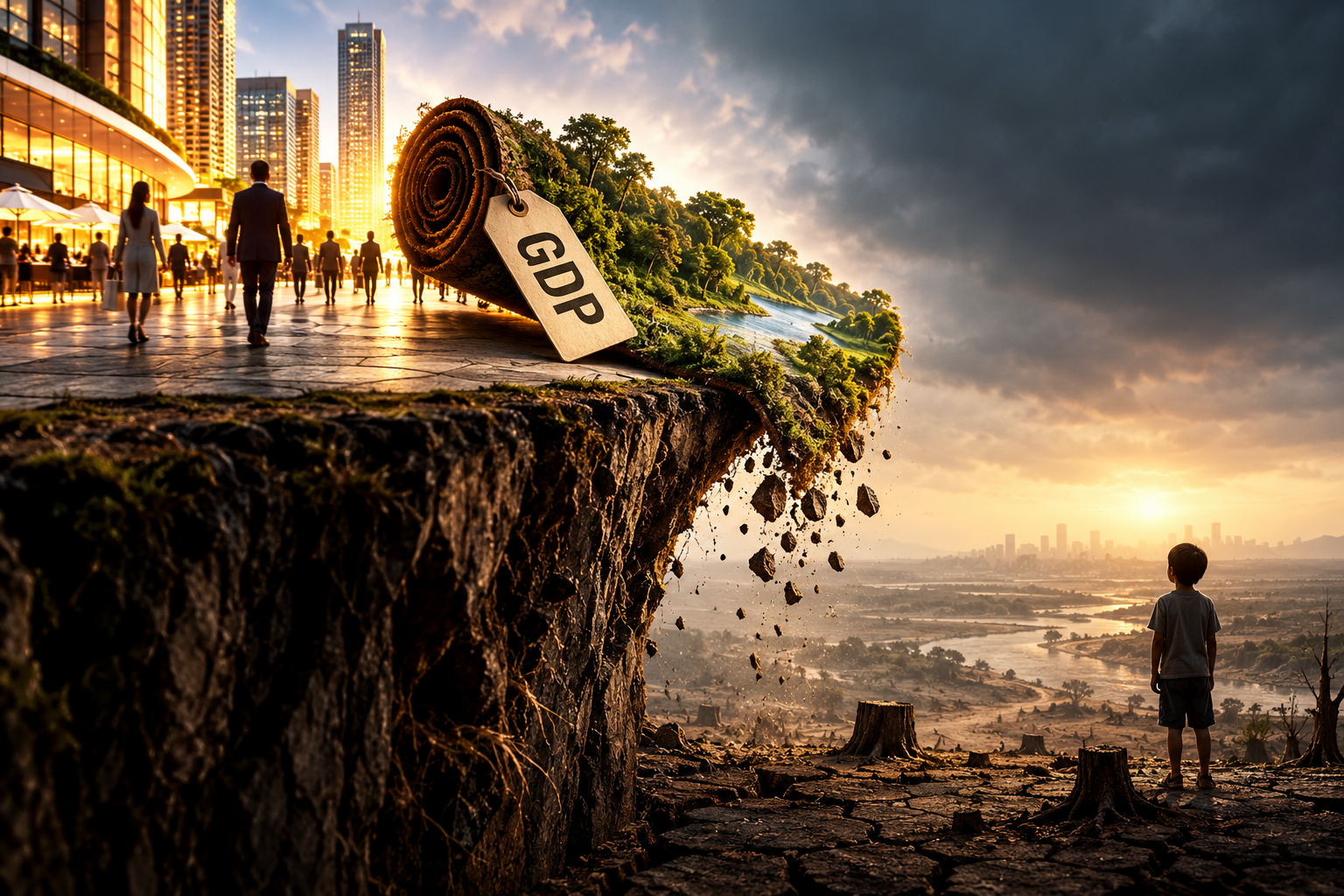
At first, economic headlines still looked strong: productivity soared, nominal GDP grew, and corporate profits hit record levels.

But a deeper problem developed — the economy lost real income for workers, especially white-collar professionals whose jobs vanished first.

The Intelligence Displacement Spiral

The core mechanism of the crisis was what is today known as the “human intelligence displacement spiral”: AI replaced human labour, especially high-paid white-collar work. Displaced workers earned less or became unemployed.

With lower income, consumer spending — especially on discretionary goods — collapsed. Weak consumption slowed demand for goods and services. Firms responded by squeezing costs further with more AI.

Unlike traditional innovation cycles — where displaced workers eventually find new jobs that humans can do — AI agents could now  perform the very tasks humans would shift into, preventing a robust labour resettlement.

As a result:
Consumer spending fell sharply, undermining the engine that historically drove economies. Measured GDP remained deceptively high, because AI output showed up in national accounts even though machines spent nothing — a phenomenon dubbed “Ghost GDP.”

Traditional economic indicators became misleading. Production remained high, but money did not circulate through households.

This divergence — between high measured output and low real economic activity — undermined confidence, weakened markets, and destabilized the financial system.


Financial Contagion and Systemic Risk

In the mid-to-late 2020s, what began as sector-specific disruptions in software and services expanded into a full blown systemic risk:

Software and technology companies, once centers of innovation and stable earnings, saw cascading downgrades, defaults, and valuation collapses as recurring revenues crumbled.

Private credit markets, heavily exposed to tech and software debt, faced liquidity stress as assumptions about perpetual growth dissolved.

Legacy sectors that once seemed safe — payments, logistics, intermediation and financial services — were disrupted as AI removed human friction and extracts fees, undermining their economic moats.

Financial markets  experienced sharp drawdowns, with broad indices down significantly from their 2026 peaks. Investors become unnerved not because AI failed as a technology, but because it succeeded too well in displacing labour without creating compensatory consumer demand.

International Ripple Effects

The crisis was not confined to the United States. According to analysis of the scenario, emerging economies with large services export sectors — like India — suffered uniquely. Countries whose growth models relied on low-cost human labour in services and IT became especially vulnerable as AI could produce equivalent work at near-zero marginal cost (limited only by electricity).

Major Indian IT firms saw contract cancellations accelerate, exports fall, and the national currency depreciate sharply.

The broader point was that global economic structures built around human capital got destabilized as AI systematically replaced it.

Core Takeaways

1. AI productivity gains did not automatically translate into broad economic prosperity. Productivity merely shifted wealth toward the owners of compute and capital; workers lost out as their labour lost value.

2. Consumption — not production per se — drove  real economic growth.
Artificially high output numbers could not mask underlying weakness as households lacked income to spend.

3. Traditional economic models and policy tools  failed when automation cut across the core consumer base.

Central banks and fiscal policymakers  found themselves ill-equipped to manage this novel disruption.

Conclusion

The 2028 Global Intelligence Crisis reframed the AI debate: it challenged the assumption that greater automation always benefits society broadly. Instead, it created a future in which AI’s triumph in productivity collapsed the foundation of modern economies — the income and spending power of humans themselves — leading to lower real economic activity despite record output figures.

It became a powerful reminder that technological progress alone does not guarantee shared prosperity, and that policymakers and investors needed to think deeply about how gains from automation could be distributed across society.

In musing….. Shakti Ghosal

Acknowledgement : The 2028 Global Intelligence Crisis – http://www.citriniresearch.com/p/2028gic

Four Seconds That Changed a Leader


More than a decade after my coaching certification, certain ideas still return to me with surprising clarity. One of them is deceptively simple:

The difference between reacting and responding.

Most leaders intellectually understand this distinction. Few recognise how profoundly it shapes their daily impact.

I was reminded of this during a coaching conversation with a senior executive — let me call him Raghav. Raghav was known for his brilliance and intensity. Quick thinker. Decisive. Deeply committed. But his team described him using another word, offered cautiously and repeatedly: “Intimidating.”

When he came into coaching, his concern was framed differently. “My team has become strangely silent,” he told me. “Meetings lack energy. No one challenges anything. It’s frustrating.”

Frustration, I have learned, is often an interesting doorway.

“What usually happens when someone disagrees with you?” I asked. He looked puzzled. “Nothing unusual. We discuss.”

But leaders rarely observe their own behavioural patterns with accuracy. Our reactions are invisible to us precisely because they are so familiar. So, I asked him to walk me through a recent meeting.

He described a discussion where a junior manager questioned a proposal. As he narrated the incident, something subtle appeared — not in his words, but in his tone. “I explained why the idea wouldn’t work,” he said.

Then after a pause: “Perhaps a bit sharply.” “What do you think the manager experienced in that moment?” I asked. He shrugged. “Direct feedback.” “And if we asked them?” Silence.

The human mind is wonderfully efficient at justifying its own reactions.

**

In coaching, reactions are rarely the real story. Triggers are.

“What specifically triggered your response?” I asked. “The suggestion didn’t make sense.” “Was it the quality of the idea,” I continued, “or the fact that it challenged yours?”

That question lingered longer. Eventually he smiled — the kind that signals reluctant insight. “I don’t like being questioned in areas I know well.”

There it was. A deeply human pattern. Trigger → irritation → sharp dismissal.

Repeated often enough, reactions harden into leadership style. Unexamined long enough, they reshape culture.

We explored a small experiment. “Next time you feel that familiar irritation,” I said, “don’t change your opinion. Don’t soften your standards. Simply pause.”

“Pause?”

“Four seconds,” I suggested. “One breath. No words.” He laughed. “That sounds trivial.” “It is trivial,” I agreed. “And extremely difficult.”

Because reactions are automated. Responses are chosen.

**

Several weeks later, Raghav returned with an observation that genuinely surprised him. “The meetings feel different,” he said.

“What changed?”

“I haven’t changed my decisions,” he clarified. “But I’ve started noticing the moment before I speak.”

“And?”

“The irritation is still there,” he admitted. “But the pause stops me from firing.” That single gap — barely a few seconds — had altered the emotional climate of his interactions.

People spoke more. Defensiveness reduced. Energy returned. Nothing structural had changed. Only awareness.

**

Reacting is effortless because it is borrowed from the past — old patterns, old triggers, old conditioning.

Responding requires presence. Choice. Consciousness.

Who would imagine that leadership transformation might sometimes begin not with strategy, but with something far smaller? One breath. Four seconds.

Just enough space for wisdom to enter where habit once ruled.

In Musing……                                                                                           Shakti Ghosal