As I have gone through life , I have found some folks proudly wearing their age ( and the wisdom that flows from that) like a badge. And others, using a curious phrase ( which incidentally became fashionable) : “Age is just a number.”
Perhaps. But I have often wondered why some people feel compelled to repeat it so often. The calendar is not the enemy. The years do not diminish us. They simply tell a story.
Yet many of us seem desperate to negotiate with time. We shave a few ( and sometimes a little more!) years off our age, boast of being sixty when we are actually seventy, or cling fiercely to an image of ourselves that belonged to another decade. As we try to convince ourselves and others.
Why?
Maybe because age reminds us of something we would rather not confront. That the world is passing us by and we fear missing out. That life is finite. That some doors have closed. That our bodies have their own timetable. That one day we will have to hand over the baton to others.
The strange thing is that wisdom was never meant to compete with youth. A banyan tree does not apologize for not being a sapling. A river does not pretend to be a mountain stream. Both possess a different kind of beauty.
Perhaps maturity begins when we stop treating age as an accusation and start treating it as an achievement. After all, growing old is not a failure. It is a privilege denied to many.
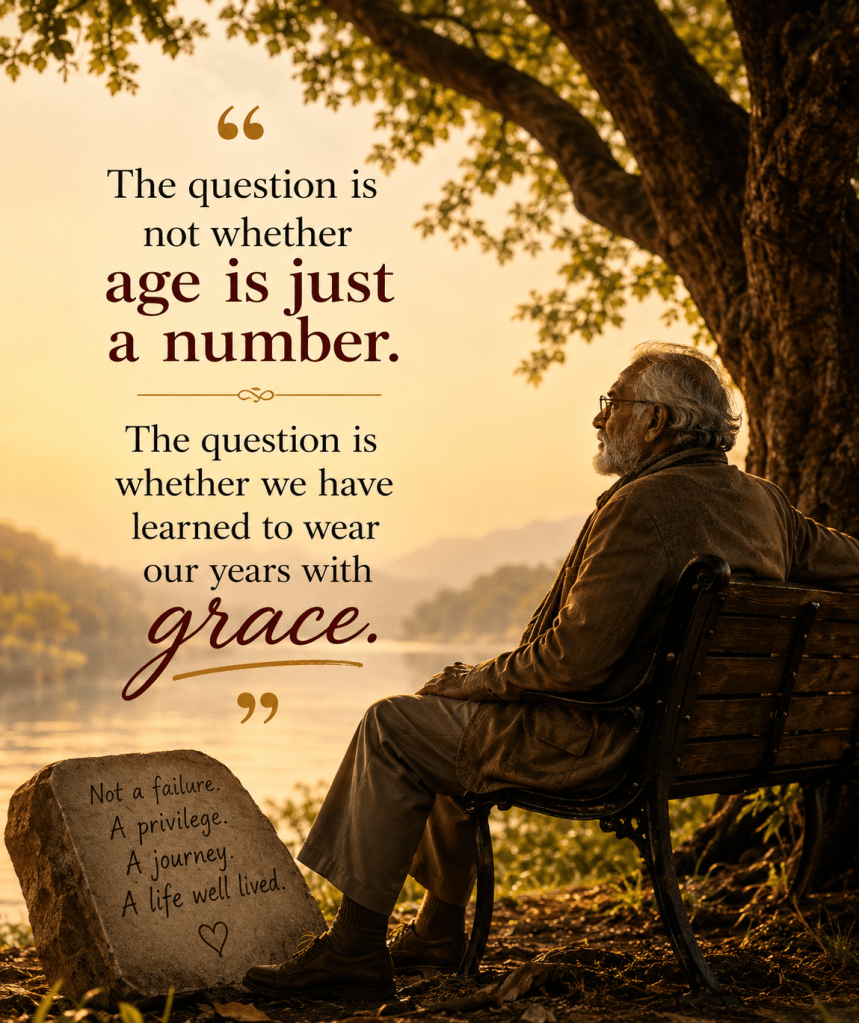
The question is not whether age is just a number. The question is whether we have learned to wear our years with grace.
Have you ever wondered about all the things you do not want, all the things you avoid? These may be at your workplace. Or they may be in your personal life or relationships. Do you realise that all the things you do not want can actually support you to move forward in life?
In the second year of my post graduation, we had to choose elective courses to achieve a minimum number of credits. I remained in my comfort zone by choosing electives which I had the ability to do with minimum effort. I avoided taking on courses in the Computer Science domain (then in its infancy and consequently a ‘black box’ to me) which I figured would require a lot of learning and effort. Was it a mere avoidance mindset or a deeper fear of failure? Most of my batchmates who ‘took the jump’ and majored in Computer Science subsequently did very well in their careers. Fear of failure can help us succeed.
Fear of failure can help us succeed
An aspect we do not want is frustration. Frustration is really our reaction to stuff we do not like or cannot control. The ugly underbelly of frustration is that we tend to vent it on folks who may have nothing to do with it. These folks may be our spouse, family members or colleagues at work place. Frustration shows up as anger, impatience or both. I can recall a particularly difficult meeting with a client about a service failure in which they threatened to cancel our contract. It was a situation outside our control but my reaction had been to call the service team and vent my frustration on them. What I had done was to further spread the cycle of exhausting negativity without finding a solution. The section head though was a guy with a cool temperament; leaving the meeting he did what was needed to be done to retrieve the situation. Frustration can be a good thing if we channel it to move towards solution finding.
Frustration can be a good thing……
We do not want to do ‘heavy lifting’, we succumb to the temptation of doing theoretical stuff. In a previous project assignment, I interacted with two kinds of people. The first set were those who were smart, articulate, detested leaving office and had theoretical solutions for all operational issues. The second set were those who were low profile, operated in the field and were hands-on with the project. I found it comforting to hang out with the first set and opinionate about what was needed to be done or not done; true to the perception I held I avoided going out into the field. However, I soon found that grit, resilience and character developed only when I got down to ‘digging ditches’ in the field to circumvent failures, prevent time over-runs and ensure project completion. Resilience and Character wait on the other side of our disappointment and failure ditch.
Resilience & Character wait on the other side of our failure & disappointment ditch
In the hurry-scurry of our work life, we tend to develop revolving -door relationships. Relationships that we create to achieve quick business objectives and which tend to get jettisoned soon after. Such relationships may seem energizing, even meaningful in the moment, but really build a shallow work life. How many of these questions can you answer in the affirmative?
Do you take genuine care of the people who pull alongside you?
Do you invest time with your team and other stakeholders beyond work related stuff?
Do you serve those who serve you?
The deeper we nurture relationships, the more valuable they become.
The deeper we nurture relationships, the more valuable they become.