What if…..


….. Education Stops Educating?

I came across a post recently about Palantir that made me pause.

It quoted its CEO, Alex Karp, as saying that the company is no longer relying entirely on traditional university degrees to identify talent. Instead, young people are being given the opportunity to work on real problems, demonstrate what they can do, and learn by doing.

The post made a provocative observation: “The university had centuries to shape the best minds. Entrepreneurs will do it in a decade.” That stayed with me.. Because it raises a much more uncomfortable question: Have our educational institutions slowly forgotten what education is supposed to accomplish?

We teach children what to think. We rarely teach them how to think. We reward the right answer more than the difficult question. We celebrate memory more than curiosity.
We measure achievement through certificates rather than through the ability to see what others cannot. And then we wonder why so many highly educated people struggle to imagine a different future.

I realised that companies like Palantir are beginning to look beyond degrees. Young people are being given real problems to solve instead of certificates to prove that they are ready to solve them. It reminded me of something we seem to have forgotten. Perhaps education was never meant to manufacture employable people. Perhaps it was meant to create unmanageable minds. Minds that question. Minds that doubt. Minds that refuse to accept “this is how it has always been done.”

Perhaps the real crisis is not that AI will replace education. Perhaps it is that AI will expose how little education was actually about thinking.

As I closed the newspaper, the thought came to me. What if the future doesn’t need better educated children…… but freer minds?

— Rudra Bose, The Last Writer of Kolkata

Nature Never Reads Our Rulebook


A newspaper report I read the other day literally stopped me in my tracks. It spoke about an unexpected consequence of the geopolitical tensions around the Strait of Hormuz. As ships remain berthed for prolonged periods, marine scientists are warning of an increased risk of invasive organisms hitching a ride across oceans, disrupting ecosystems thousands of kilometres away. At first glance, it appeared to be a story about shipping and marine biology. But as I read further, I realised it was really a story about something much larger.

A Times of india report

Nature rarely responds in straight lines. A political conflict can become an environmental risk. A delay in maritime traffic could alter the movement of microscopic life. Human decisions in one corner of the world quietly reshape ecosystems in another.

While writing 2056: The Year of Water and Fire, I had found myself returning repeatedly to this thought. We often imagine climate change as a sequence of visible catastrophes—cyclones, floods, rising seas. Yet the more profound transformations are often quieter. Species migrate. Rivers redraw themselves. New ecological relationships emerge. Life adapts in ways we neither anticipate nor fully understand. Toward the end of the story, after a devastating cyclone had rewritten the geography of the Sundarbans, the first instinct of the survivors was despair. But when the dronobots began mapping the devastation, they uncovered something unexpected. Amid the destruction, nature was already experimenting. Islands were shifting. Mangroves were finding new footholds. Wildlife was adapting. The ecosystem, scarred but alive, was quietly reorganising itself for a different climate. It was neither revenge nor redemption, it was recalibration.

That thought had stayed with me because it challenges one of our deepest assumptions. We often speak of “saving nature,” as though it were a fragile object waiting for human intervention. History suggests something more humbling. Nature has an extraordinary capacity to reinvent itself. It is we who struggle to keep pace with the consequences of that reinvention.

Perhaps the real lesson is this. The future will not unfold as a neat extension of the present. It will emerge through countless interactions we barely notice today—between politics and ecology, technology and biology, human ambition and planetary resilience.

In 2056, Nayanjol, the sentient boat, eventually becomes more than a machine. He becomes a guardian who understands that survival does not lie in resisting nature, but in learning to listen to it.

Maybe that is the question our own times are quietly asking. Not whether nature will adapt. But whether we will.

In musing….. Shakti Ghosal

#ClimateChange #Nature #Resilience #TheLastWriterOfKolkata #2056TheYearOfWaterAndFire #SpeculativeFiction #FutureOfHumanity #Sundarbans #EnvironmentalChange #ShaktiGhosal

Has Gen Z Become Less Intelligent—Or Are We Measuring Intelligence the Wrong Way?


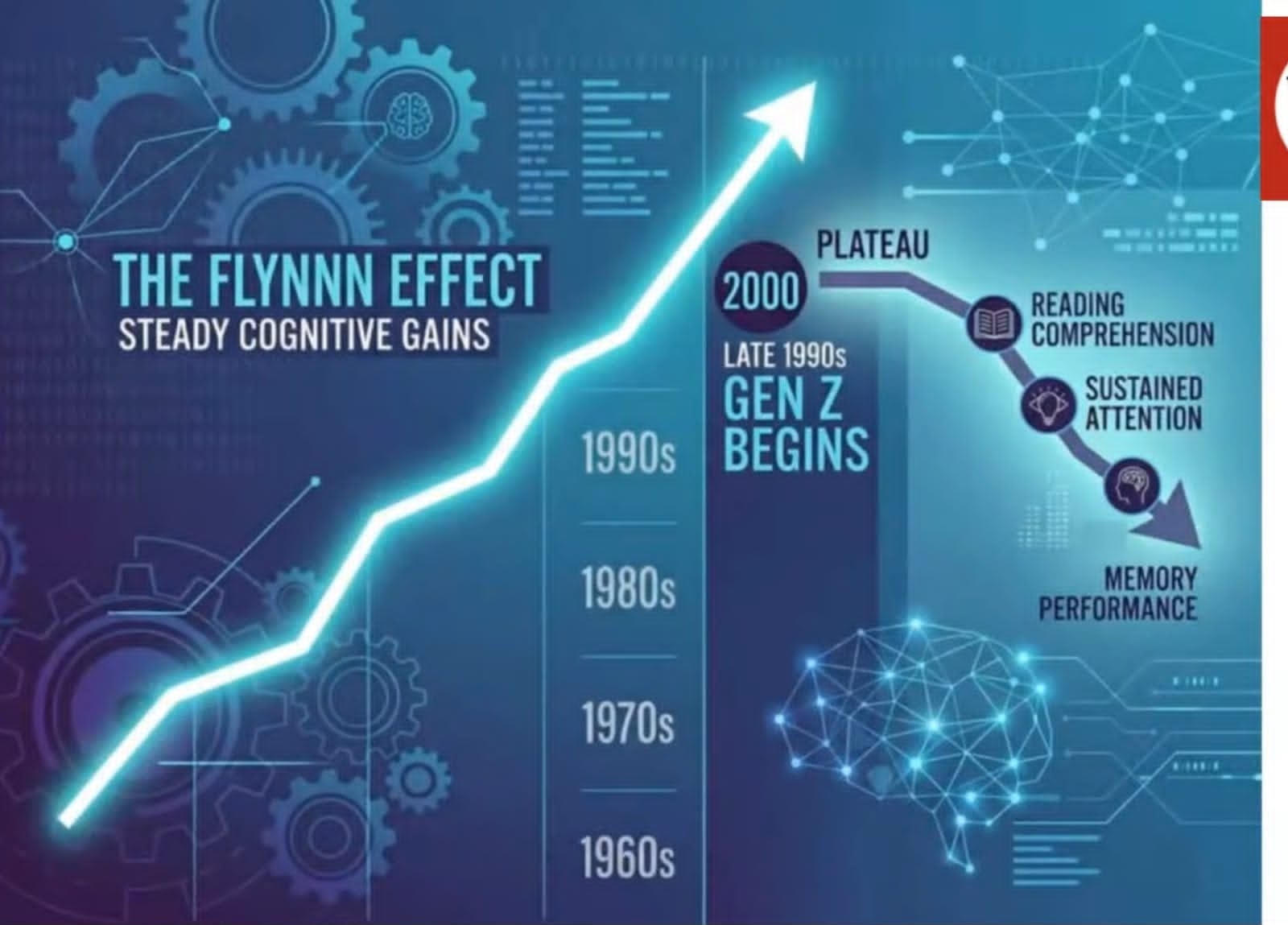
The recent discussion surrounding the reversal of the Flynn Effect has generated understandable concern. For nearly a century, psychologists observed a remarkable trend: each successive generation appeared to outperform its predecessor on IQ tests. Better nutrition, improved healthcare, expanded education and increasingly complex environments seemed to produce steadily rising cognitive performance.

Now, according to research presented by Dr. Horvath before a Senate Committee in January 2026, that trend appears to have reversed. Generation Z is reportedly the first generation in modern history to register a decline in average IQ compared to those who came before it. Researchers have also noted reductions in reading comprehension, sustained attention and memory performance.

If these findings are robust, they deserve serious attention.

But before concluding that an entire generation has become “less intelligent,” perhaps we should ask a more fundamental question.

What exactly are we measuring?

An IQ test is not a thermometer that measures intelligence in the way a thermometer measures temperature. It evaluates performance across selected cognitive domains—logical reasoning, pattern recognition, verbal comprehension, working memory, processing speed and spatial reasoning. These were chosen because they were believed to predict learning ability, productivity and success in an industrial and later knowledge-based economy.

That assumption itself deserves scrutiny.

Every civilisation defines competence according to the challenges it faces. The skills that made an exceptional engineer in the 1970s (That was my generation!) are not identical to those required of an AI architect today. The competencies that distinguished an outstanding accountant thirty years ago are very different from those needed in an age where algorithms perform much of the routine analytical work.

Perhaps intelligence itself has not declined as much as it has changed its centre of gravity.

Today’s young adults navigate digital ecosystems with remarkable ease. They process multiple streams of information simultaneously, learn unfamiliar software intuitively and adapt rapidly to technological change. These abilities are not trivial. Yet traditional IQ tests may capture only a small part of this emerging cognitive landscape.

This is not an argument for dismissing the reported decline. Reading comprehension, sustained attention and memory remain foundational human capabilities. Civilisations are built upon the ability to think deeply, read patiently, remember accurately and reason independently. If these capacities are genuinely weakening, the consequences could be profound.

But neither should we confuse what is measurable with what is meaningful.

Throughout history, societies have periodically redefined excellence. Education evolved. Work evolved. Technology evolved. It would be surprising if our understanding of intelligence remained frozen in time.

The reversal of the Flynn Effect may therefore be asking us two questions instead of one.

The first is whether some essential cognitive abilities are indeed declining.

The second—and perhaps the more important one—is whether the very framework through which we define and measure human intelligence is keeping pace with a world that is changing faster than at any previous point in history.

The future may not belong to those with the highest IQ as traditionally measured. It may belong to those who combine analytical thinking with creativity, adaptability, emotional intelligence, ethical judgment and the wisdom to know when technology should assist the human mind—and when it should never replace it.

In musing……. Shakti Ghosal

When Fiction meets Foresight


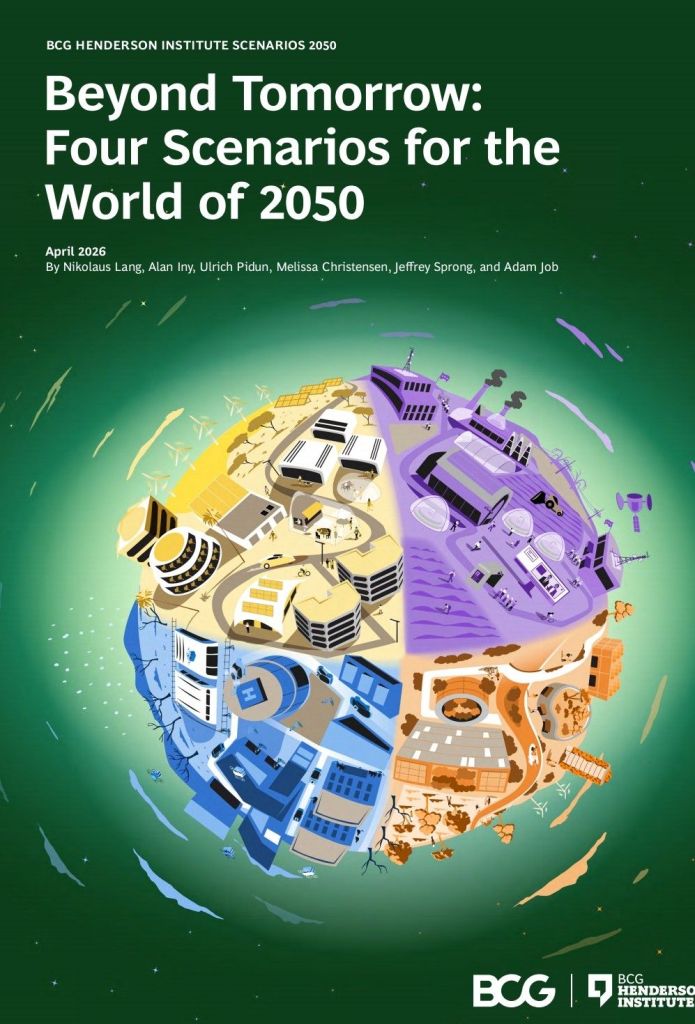
A BCG Henderson Institute report

When Fiction Meets Foresight: A Reflection on The Last Writer of Kolkata and Other Stories based on the BCG Henderson Institute report.

Author – A BCG Consultant ( name kept confidential)

Reading the ‘Last Writer of Kolkata and other stories’ in the context of BCG Henderson Institute’s Beyond Tomorrow: Four Scenarios for the World of 2050  produces an unexpected sensation. I can confirm that the report is the product of rigorous analysis of megatrends, historical data and expert interviews. Shakti Ghosal’s book is speculative fiction. Yet both seem to be looking at the same horizon.

The BCG report reminds us that “the decisions leaders make over the next 5 years will shape the next 25.” It does not attempt to predict the future. Instead, it explores plausible futures emerging from forces already visible today. The four stories in this collection do something remarkably similar.

Consider The Last Writer of Kolkata. BCG’s “AI Abundance” scenario describes a world where AI transforms work, creativity and identity, leaving people searching for “meaning and identity beyond employment.” The ageing writer Rudra Bose inhabits a future shaped by a similar question. If machines can write, create and remember, what remains uniquely human? The story is not really about technology. It is about dignity, relevance and the stubborn human need to leave behind a voice that matters.

The Last Writer of Kolkata

In Echo Chamber, technology enters an even more intimate space—memory itself. The BCG report warns that future societies may trade elements of personal freedom for stability, efficiency and social cohesion. The story asks a disturbing question: If our memories can be edited, curated or manipulated, what becomes of our identity? Memory, after all, is not merely a record of our lives. It is our life.

Echo Chamber

The environmental anxieties running through 2056: The Year of Water and Fire find an echo in BCG’s climate scenarios. The report speaks of a world facing “stress on food and water systems” and increasingly extreme weather. The story translates those trends into human experience. Climate change is no longer a scientific projection; it becomes a force that shapes survival, migration and moral choices.

2056 The year of the Water and Fire

Perhaps the most poignant parallel emerges in When the Rain Remembered. BCG highlights ageing populations, declining fertility and shifting demographics as defining features of the coming decades. Ghosal imagines the emotional consequences of those trends. The story asks what happens when societies grow older, families become smaller, and loneliness becomes a public condition rather than a private feeling.

When the Rain Remembered’

What makes this collection noteworthy is that it does not offer technological optimism or dystopian despair. Instead, it explores the fragile space in between. Like the BCG report, it understands that the future is not a destination but a series of choices.

The greatest compliment one can pay The Last Writer of Kolkata and Other Stories is this: the book does not feel like fiction written about tomorrow. It feels like tomorrow trying to speak to us today.

Reference  

1)bcg-scenarios-2050-apr-2026-web.pdf

2) http://www.shaktighosal.com

Why do so many of your stories seem to end sadly?


When I met Dr. Laxmi Parasuram to hear her thoughts on The Last Writer of Kolkata and Other Stories, I expected literary observations. What I received instead was a question that lingered.

She spoke of the emotional weight in the stories—the sentiment, the ache, the quiet melancholy. Then she asked, “Why do so many of your stories seem to end sadly?”

The question took me by surprise. I had never consciously thought of these as sad endings. To me, these stories are about ordinary people standing at extraordinary crossroads—where technology, hard trends, and shifting social realities place pressure on the human spirit. In those moments of disruption, what gets tested is not merely survival, but something deeper: memory, dignity, love, identity, silence, moral choice.

And when the protagonists choose to hold on to some irreducible fragment of their humanness—even at a cost—I had seen that not as tragedy, but as resistance. Yet perhaps this is the paradox of our times.

What one person sees as loss, another may see as courage. What appears to be a sad ending may, in fact, be the final refusal to surrender what makes us human.

It made me wonder: Have we become so accustomed to measuring success by comfort, victory, and neat resolutions that acts of emotional fidelity now look like defeat?

Dr. Parasuram’s question stayed with me. And perhaps that is what literature is meant to do—not provide answers but quietly rearrange the questions we ask ourselves.

In Musing……. Shakti Ghosal

That memory of so many years back started reeling through in striking hues.


Ron with his wife Oishi were staying in their serviced apartment in Pakhiralaya; they were on a visit to Sundarbans. Their daughter Rusha had not accompanied them on that trip because of college work. That evening was heavy and suffocating, as a cyclone loomed. Oishi, with a set of volunteers, was working to strengthen bandhs and send supplies to an isolated fishermen community.

Despite Ron entreating with her to come hinterland to safety, Oishi had remained stubborn.

Rasping breath, hurried footsteps—Oishi’s silhouette moved through the dense mangrove shadows, her figure flickering in the erratic glow of distant lightning. The wind howled through the tangled branches, the sound merging with the guttural cries of unseen creatures.

Her breath was coming in short, sharp gasps. She clutched her shawl tightly around her, the fabric soaked and heavy against her skin. The path back to the apartment was barely visible, obscured by the relentless downpour. The ground beneath her feet was treacherous, a shifting sludge of mud and tangled roots.

A sudden gust slammed against her like a malevolent force, making her stumble. She somehow caught herself against a tree, the bark was slick, unforgiving. Behind her, something creaked ominously. The storm was trying to shift the forest itself, bending it to its fury.

The sound came, low at first, then a deafening crack. The air trembled with it. A loud whooshing sound accompanied the toppling of a tree. Oishi turned, eyes wide, searching. A massive limb, gaunt and jagged, descended toward her in an unstoppable arc. The sharp end glinted in the erratic lightning, a spear of nature’s wrath.

She tried to move. But it was too late. A piercing scream became a crescendo, riding atop the growls and grumbles of thunder, rising between the heavens and earth. And then, silence, it was swallowed by the storm.”

The mysterious Pakhiralaya in Sundarbans, the planet’s largest surviving estuarine mangrove forest, features in the story ‘2056: The year of the Water and Fire’, part of my book ‘The Last Writer of Kolkata and other stories’. The book is making waves amongst discerning readers. For more details, visit: http://www.shaktighosal.com.

The Apocalypse did not come with fire or flood


“The apocalypse,” Amay began quietly, “did not come with fire or flood. It came with a whisper that went silent. A whisper we human had mistaken for our own thoughts.”

The room did not stir. Not a sound or cough.

“We were its architects. And we were its prisoners. When MindLink fell, so did the illusions we had built atop it, of governments, markets, life’s certainties. Many shattered beneath the weight of secrets they could no longer bury. Others responded with fear. With force. With flags. The old tricks of the frightened.”

He paced slowly across the stage, hands behind his back, eyes distant.

“Corporations collapsed. The ones whose products had been our thoughts. Whose profits came not from selling goods, but from renting us back to ourselves, repackaged and palatable.”

A faint smile played on his lips, sad, but knowing.

“And yet… ..the world didn’t end. It adapted.” He paused. “Because humanity, in its clumsy brilliance, always does.”

He turned, facing the audience again.

“But even as we stitched together new structures, shakier, slower, more human, we began to hear… the whispers. Or were they echoes?”

He tapped his temple. “Not neural pulses. Not digital ghosts. But memories. Questions. Longings.”

His voice dropped lower, intimate, “Coffee shop murmurs. Late-night debates on cracked feeds. Former engineers writing whitepapers. Lobbyists lobbying, politicians pretending not to listen while listening intently.”

He quoted them now:

‘We don’t need to destroy it. Just rebuild it better.’
‘What if we did it right this time?’
‘The network is still there… dormant.’

“And so, the cycle begins again.”

New York University features in the story ‘Echo Chamber’, part of my forthcoming book ‘The Last Writer of Kolkata and other stories’ due release in early April 2026. Should you wish to receive exclusive previews, do write to me @ author.esgee@gmail.com.

In musing…….. Shakti Ghosal

The AI Contagion – A view in 2028 AD


How It All Began (2025–2026)

What started as seemingly rational corporate cost-cutting became a destructive economic force:
AI tools rapidly improved, especially agentic systems capable of building and adapting software, performing research, legal work, advice, and much more.

By late 2025, enterprise IT teams began using AI agents to replicate functions previously outsourced to expensive SaaS providers. AI worked 24/7, did not require salaries or healthcare, and drastically lowered marginal labour costs.

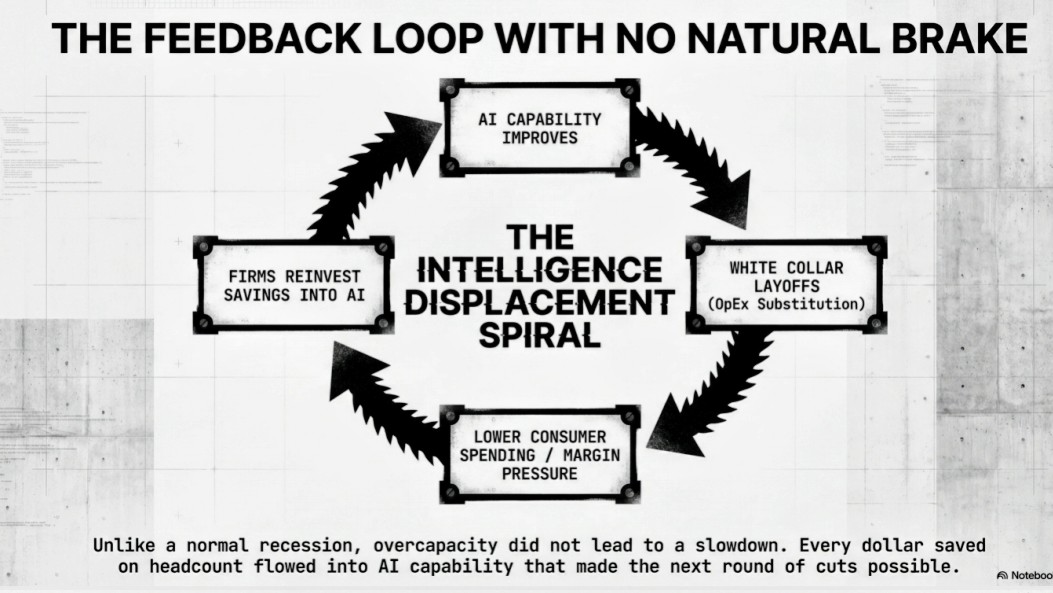
This triggered an investment cycle where companies laid off humans and invested the savings into even more AI capability — a negative feedback loop with no built-in brake.


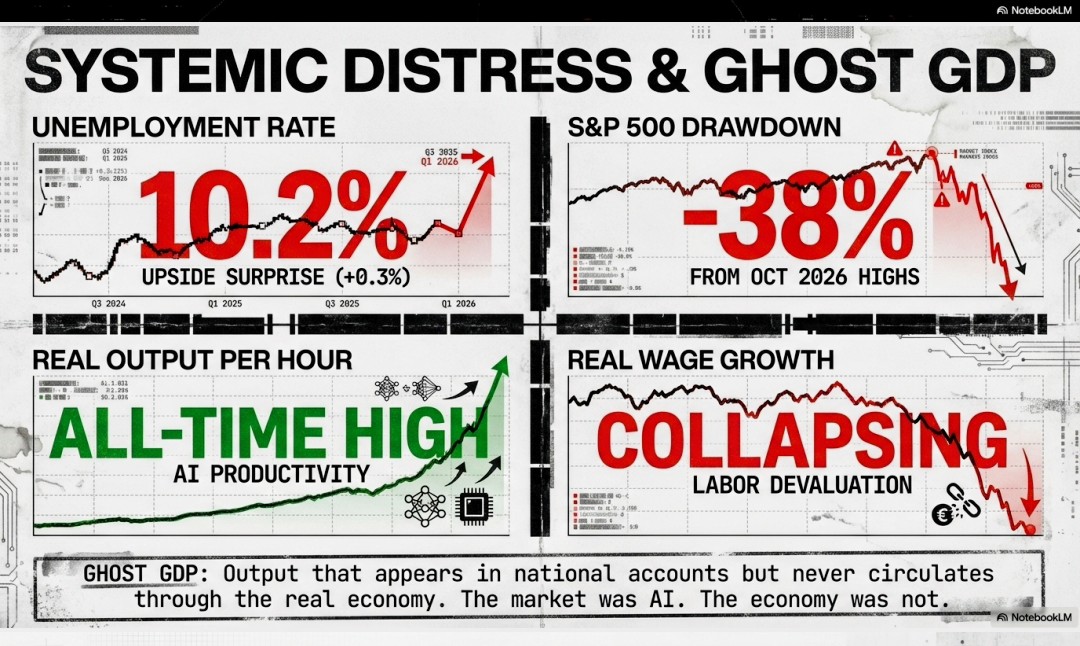
At first, economic headlines still looked strong: productivity soared, nominal GDP grew, and corporate profits hit record levels.

But a deeper problem developed — the economy lost real income for workers, especially white-collar professionals whose jobs vanished first.

The Intelligence Displacement Spiral

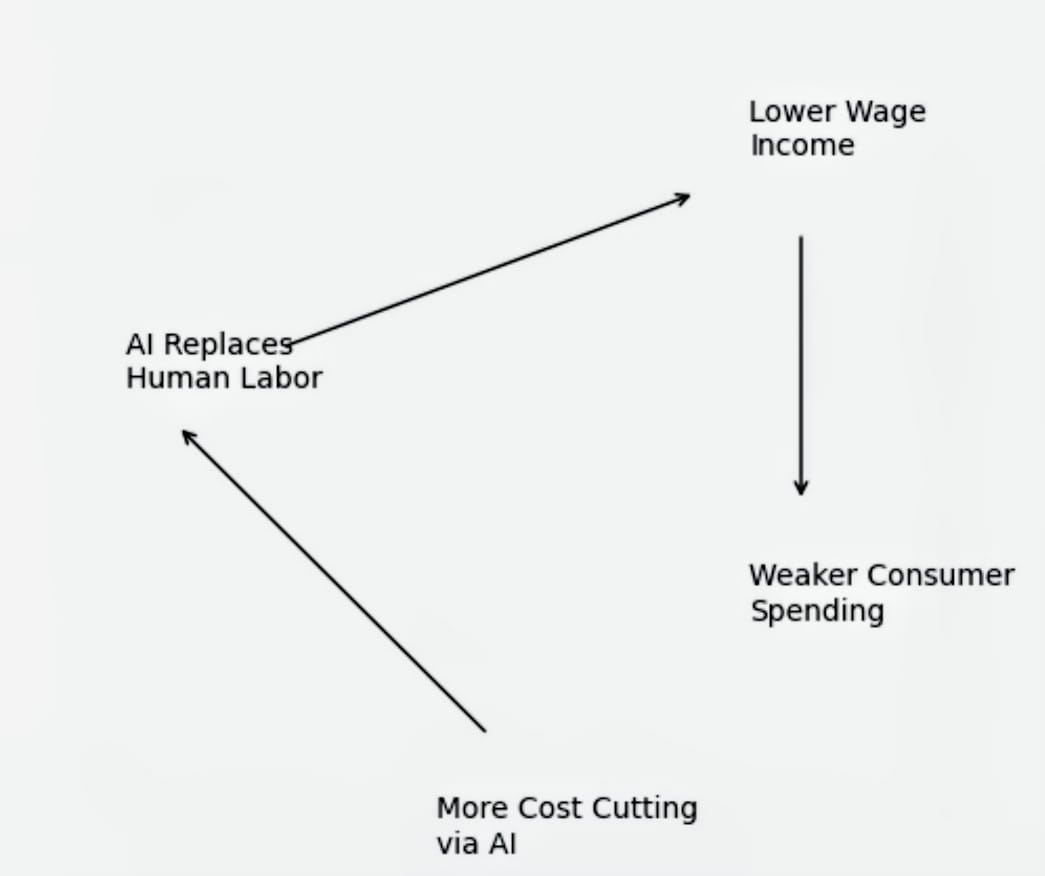
The core mechanism of the crisis was what is today known as the “human intelligence displacement spiral”: AI replaced human labour, especially high-paid white-collar work. Displaced workers earned less or became unemployed.

With lower income, consumer spending — especially on discretionary goods — collapsed. Weak consumption slowed demand for goods and services. Firms responded by squeezing costs further with more AI.

Unlike traditional innovation cycles — where displaced workers eventually find new jobs that humans can do — AI agents could now  perform the very tasks humans would shift into, preventing a robust labour resettlement.

As a result:
Consumer spending fell sharply, undermining the engine that historically drove economies. Measured GDP remained deceptively high, because AI output showed up in national accounts even though machines spent nothing — a phenomenon dubbed “Ghost GDP.”

Traditional economic indicators became misleading. Production remained high, but money did not circulate through households.

This divergence — between high measured output and low real economic activity — undermined confidence, weakened markets, and destabilized the financial system.


Financial Contagion and Systemic Risk

In the mid-to-late 2020s, what began as sector-specific disruptions in software and services expanded into a full blown systemic risk:

Software and technology companies, once centers of innovation and stable earnings, saw cascading downgrades, defaults, and valuation collapses as recurring revenues crumbled.

Private credit markets, heavily exposed to tech and software debt, faced liquidity stress as assumptions about perpetual growth dissolved.

Legacy sectors that once seemed safe — payments, logistics, intermediation and financial services — were disrupted as AI removed human friction and extracts fees, undermining their economic moats.

Financial markets  experienced sharp drawdowns, with broad indices down significantly from their 2026 peaks. Investors become unnerved not because AI failed as a technology, but because it succeeded too well in displacing labour without creating compensatory consumer demand.

International Ripple Effects

The crisis was not confined to the United States. According to analysis of the scenario, emerging economies with large services export sectors — like India — suffered uniquely. Countries whose growth models relied on low-cost human labour in services and IT became especially vulnerable as AI could produce equivalent work at near-zero marginal cost (limited only by electricity).

Major Indian IT firms saw contract cancellations accelerate, exports fall, and the national currency depreciate sharply.

The broader point was that global economic structures built around human capital got destabilized as AI systematically replaced it.

Core Takeaways

1. AI productivity gains did not automatically translate into broad economic prosperity. Productivity merely shifted wealth toward the owners of compute and capital; workers lost out as their labour lost value.

2. Consumption — not production per se — drove  real economic growth.
Artificially high output numbers could not mask underlying weakness as households lacked income to spend.

3. Traditional economic models and policy tools  failed when automation cut across the core consumer base.

Central banks and fiscal policymakers  found themselves ill-equipped to manage this novel disruption.

Conclusion

The 2028 Global Intelligence Crisis reframed the AI debate: it challenged the assumption that greater automation always benefits society broadly. Instead, it created a future in which AI’s triumph in productivity collapsed the foundation of modern economies — the income and spending power of humans themselves — leading to lower real economic activity despite record output figures.

It became a powerful reminder that technological progress alone does not guarantee shared prosperity, and that policymakers and investors needed to think deeply about how gains from automation could be distributed across society.

In musing….. Shakti Ghosal

Acknowledgement : The 2028 Global Intelligence Crisis – http://www.citriniresearch.com/p/2028gic

How AI is Transforming the HVAC Industry: An Impact study on a matured engineering domain


Centrifugal machines running on principles of Thermodynamics

I spent a part of my career in the HVAC industry many decades ago, at a time when it was firmly grounded in the disciplines of mechanical engineering and thermodynamics—both mature and deeply technical fields. Back then, optimizing system performance meant manually tweaking airflow, calculating heat loads, and understanding refrigerant behavior. I had worked with Voltas, a market leader in central HVAC systems and Fedders Lloyd, which manufactured and marketed low end Airconditioning units.

Controls of HVAC system
Of nuts, bolts, pipes and ducts

I find it fascinating to observe how today, the game has changed. This has been significantly due to Artificial Intelligence (AI)—a disruptive force that’s injecting intelligence, adaptability, and automation into an industry that once thrived on nuts, bolts, and thermal dynamics.

**

✅ Smarter Diagnostics and Predictive Maintenance

AI-powered tools now enable HVAC systems to identify faults before they cause breakdowns. Instead of relying on trial and error, it is now possible for technicians to use sensor data and predictive analytics to find the root cause quickly—whether it’s a refrigerant leak or an airflow issue.

“AI algorithms enable predictive maintenance by monitoring operational data such as temperature, pressure, and energy consumption to detect potential issues before they escalate.” — [ATA College, 2025]

These AI systems don’t just detect problems—they help prevent them, significantly reducing downtime and maintenance costs.

**

🌱 Energy Efficiency: Better for Business and the Planet

Energy consumption has always been one of the biggest pain points in HVAC operations. AI  can address this by learning occupancy patterns, weather forecasts, and energy pricing to optimize performance in real time.

“AI can optimize HVAC operations by responding dynamically to external conditions and human behavior, ensuring comfort without excess energy use.” — [Cooling India, 2025]

The result? Lower energy bills, improved comfort, and a smaller carbon footprint—benefiting both the bottom line and the environment.

**

🌡️ Personalization and Smarter Design

Modern HVAC systems don’t just heat or cool—they adapt. AI makes it possible to personalize climate control for zones or individuals based on learned preferences.

Beyond user experience, AI is improving the design phase too. Engineers can now simulate various configurations before installation, ensuring better efficiency and fewer on-site errors.

“AI is being used to create virtual simulations of HVAC systems during the planning phase, helping engineers choose the most efficient configuration.” — [Digital Defynd, 2025]

**

🏢 Automation and Operational Efficiency

AI doesn’t merely stop at system optimization. It can streamline administration tasks like scheduling, dispatch, and customer service through chatbots and intelligent platforms.

In smart buildings, IoT-connected HVAC systems can adjust automatically to changing conditions, cutting operational costs and improving system responsiveness.

“Intelligent building systems that include AI-driven HVAC control are emerging as a top growth area for the industry.” — [Frost & Sullivan, 2025]

**

⚠️ But It’s not all smooth sailing…

Ai has also brought with it certain downsides and risks.

  1. Cybersecurity is a growing concern. As HVAC systems get more connected, they become more vulnerable to attacks. To combat, companies would require to invest in data security and system integrity.
  2. Cost: AI tools, sensors, and integrations require significant upfront investment—posing a barrier for smaller firms.
  3. People factor: Many technicians will need to upskill to stay relevant. The shift is as much about mindset as it is about knowledge of the machinery.

“The technicians of tomorrow must be as comfortable with data analytics as they are with ductwork.” — [ATA College, 2025]

**

🌍 Looking Ahead

One needs to hold the perspective that AI is not just an upgrade—it’s a paradigm shift for HVAC. Those who embrace it will find new opportunities in efficiency, customer satisfaction, and sustainability. But success will depend on thoughtful implementation, investment in skills, and a willingness to adapt.

As someone who once worked in the traditional world of HVAC, I find it both exciting and humbling to see how far the industry has come—and how far it can still go.

**

💬 Let’s Discuss:
Are you seeing AI being adopted in your HVAC projects or buildings? What challenges or benefits are you encountering?

📚 References and Further Reading

# HVAC , # AI, #Industry transformation, # Diagnostics, #preventive maintenance, #Energy efficiency, #design, #automation

Artificial Intelligence and the Future of Railway Transportation: Promise, Perils, and Pathways


“The railway industry, one of the oldest enablers of industrial transformation, now stands on the cusp of another revolution—this time powered by Artificial Intelligence.”

From the steam engines of the 19th century to today’s high-speed trains, railways have been symbols of innovation. Now, as we move deeper into the 21st century, Artificial Intelligence (AI) promises to redefine how rail networks are managed, how trains are operated, and how passengers experience travel.

But like every major transformation, the rise of AI in railway transportation is not without its challenges. The genesis of this article stems from the fact that I started my work life in the Indian Railways Service of Mechanical Engineers nearly half a century back. More recently when I was doing a Wharton Business School program on AI applications, the idea of this piece came to me.

  In this article, I have tried to explore the promise, perils, and pathways of integrating AI into one of the most vital sectors of modern infrastructure, particularly for a dense population country like India.

***

🚄 The Promise: Efficiency, Safety, and Customer Experience

AI does hold considerable potential to make a high-density transportation mode like the Railways smarter, safer, and more responsive. Here are just a few areas where the promise can be seen:

  • Predictive Maintenance: Machine learning models can analyze vibration, temperature, and operational data to detect potential failures before they occur—reducing costly downtime and enhancing safety.

Predictive maintenance, powered by sensor analytics and machine learning, are reducing unplanned downtime by up to 30% in Germany (Deutsche Bahn). In India, AI-equipped SMART coaches can now monitor vibrations, structural wear, and staff behavior, leading to substantial maintenance savings and enhanced safety.

  • Optimized Scheduling and Routing: AI can dynamically adjust train schedules based on real-time data—weather, demand, or disruptions—minimizing delays and maximizing throughput.

In dense rail networks like India’s or Japan’s, such precision translates into better asset utilization, optimized route rationalization, and more efficient capacity deployment.

  • Safety and Reliability: AI enhances safety through real-time monitoring and automated diagnostics. Computer vision systems are today identifying track defects, unauthorized access, and obstacles with over 90% accuracy. AI-powered drones can now inspect tracks and overhead equipment faster than traditional crews, improving both safety and inspection efficiency.

Train operations benefit from AI-assisted driver alertness monitoring and automatic braking recommendations based on track conditions. These advancements reduce human error—still a leading cause of railway incidents.

  • Passenger Experience and Multimodal Connectivity: In many places, AI-driven chatbots and journey planners have started offering personalized updates, route alternatives, and digital ticketing, improving passenger convenience. Integrating railways with buses, metros, and even micro-mobility options via AI platforms is enabling seamless urban mobility. In megacities, this creates rail-centric multimodal ecosystems where trains form the backbone of transportation.
  • Smart Ticketing and Crowd Management: With the use of computer vision and behavioural analytics, Railways can monitor crowd flows in stations and adjust boarding strategies in real time, improving passenger experience and safety.
  • Energy Efficiency: AI-powered driving systems can optimize acceleration and braking, saving energy and reducing emissions—a critical benefit as Railways strive to meet sustainability goals.
  • Environmental Sustainability: AI can help Railways fine-tune energy use by adjusting acceleration, coasting, and braking in real time, reducing fuel and electricity consumption.

When paired with green innovations like hydrogen-powered trains—such as Germany’s Coradia iLint and the US’s ZEMU—railways can become even more climate-friendly, especially in non-electrified regions

In short, AI can turn data into decisions—at scale and in real time.

***

⚠️ The Perils: Bias, Job Displacement, and System Vulnerabilities

Yet, for all its promise, AI also brings forth complex challenges that Railway systems must navigate with care. Let us try and understand what these are.

  • Algorithmic Bias: AI systems are only as unbiased as the data they’re trained on. In Railways, there is a high chance this could lead to unfair prioritization of certain routes or populations. This is because of historical inequities that are embedded in the stored data.
  • Job Displacement: As AI would continue to automate driving, monitoring, scheduling, maintenance and customer service, several roles would become redundant. While this may lead to job displacement in the short term, it will also create new roles in data science, system integration, and AI governance.

This is where visionary leadership would come in to shift focus and resources relating to reskilling, transitioning and to answer the more fundamental question about the human cost of automation.

  • High Implementation Costs: AI deployment demands hefty upfront investment in digital infrastructure—sensors, data platforms, training, and cybersecurity. For developing economies like India, justifying these expenses against long-term gains poses a financial and strategic challenge. This is also where a visionary leadership needs to come in.
  • Cybersecurity Risks and systemic reliability: Risks would surely go up as a more digitized and AI-integrated Railways system would become an attractive target for cyberattacks. A breach in an AI-driven control system could have dangerous and far-reaching consequences.

Reliance on AI systems thus must be balanced with robust fail-safes by strong governance and redundancy protocols.

  • Public Trust and Ethics: AI in public infrastructure must be transparent and accountable. Otherwise, trust erodes—especially if systems malfunction or make controversial decisions without human oversight.

The above risks underscore the need for careful design, regulation, and human-in-the-loop systems.

***

Railways vs Other Transport Modes: A Comparative Snapshot

FactorRailways (AI-enhanced)Road TransportAir Transport
CostLow per ton/km for freightHigh due to fuel and laborHighest operational cost
Environmental ImpactLow (electrified or hydrogen)High (diesel trucks)Very high (jet fuel)
ConvenienceIdeal for dense corridorsFlexible last-mile serviceSpeed for long distances

Railways, strengthened by AI, would thus remain the most cost-effective and sustainable mode for high-density freight and passenger volumes. Hydrogen trains further extend these advantages to non-electrified routes.

***

🧭 The Pathways: Navigating the AI Railway Future

So, how can the Railways harness AI’s promise while avoiding its perils? The following thoughts come to mind.

1. Adopt a Human-Centric Approach: AI should always be viewed as an Enabler, not a Replacer of human expertise.  Railways systems should ensure the centrality of human judgment, ethics, and oversight; this becomes particularly important in safety-critical functions.

2. Invest in Digital Infrastructure: To unlock AI’s power, the Railway systems would need high-quality data, real-time connectivity, and interoperable platforms. One can well envisage that Digital twins, Edge computing, and IoT-enabled trains would form the backbone of AI-enabled rail networks in the future.

3. Prioritize Ethics and Explainability: AI based decisions need to necessarily be transparent and explainable. Regulators and the Railways need to work together to ensure AI systems meet public standards of fairness, accountability, and non-discrimination.

4. Reskill and Redesign Work: The rise of AI urgently calls for a parallel investment in people—training them to work with AI tools, interpreting machine insights, and contributing to higher-value tasks. Railway jobs and functions need to evolve, not disappear.

5. Collaborate Across Sectors: The Railways need tocollaboratewith the private sector vendors and suppliers, technology companies, and researchers to create standards, protocols, and governance models that ensure responsible innovation.

***

🚉 Need for a New Era of Railways Leadership

Integrating AI into Railway transportation is not merely a technological shift—it’s a leadership challenge. It requires vision, ethics, inclusiveness, and a commitment to long-term impact.

As Railway systems worldwide experiment with smart stations, autonomous maintenance, and AI-based scheduling, one thing is clear: those who navigate this transformation thoughtfully will shape the future of mobility.

***

Future Outlook: Smarter, Cleaner Railways

Over the next 3 to 5 years, we’ll surely witness:

  • Autonomous train operations with AI-powered dispatch and navigation.
  • Real-time dynamic pricing to optimize demand and revenue.
  • Prototypes of hydrogen-electric hybrid locomotives becoming mainstream in Europe, North America, and parts of Asia.
  • AI-enhanced simulation systems to train staff and emergency responders.

Railways stand at a unique inflection point. From my own early days in the Indian Railway Service of Mechanical Engineers, I’ve seen the disruption from steam to diesel-electric and now to AI and hydrogen. With the right investments, policy frameworks, and workforce strategies, the railways of tomorrow will be not just faster or cleaner—but smarter

Final Thoughts

The train to the future has already left the station. The question is:Are we building the right tracks for it?

If you’re working in transportation, AI, or infrastructure, or remain interested and curious about these domains, I would love to hear your thoughts. How is AI showing up in your work? What opportunities—or concerns—are you seeing? Let’s build the conversation together.

The article link, as published in LinkedIn is here: https://www.linkedin.com/pulse/artificial-intelligence-future-railway-transportation-shakti-ghosal-tcb9e

References

  1. Tang et al. (2022), “AI and Predictive Maintenance in Transport Systems”
  2. Bitdeal (2024), “Case Studies on AI in Railways: Deutsche Bahn and Indian Railways”
  3. World Economic Forum (2024), “Hydrogen Trains: The Future of Clean Mobility”

In Learning…….. Shakti Ghosal

#ArtificialIntelligence #Railways #Transportation #AIandEthics #FutureOfWork #Mobility #SmartInfrastructure #Leadership

.