The newspapers this morning carry photographs I find difficult to look at for long.
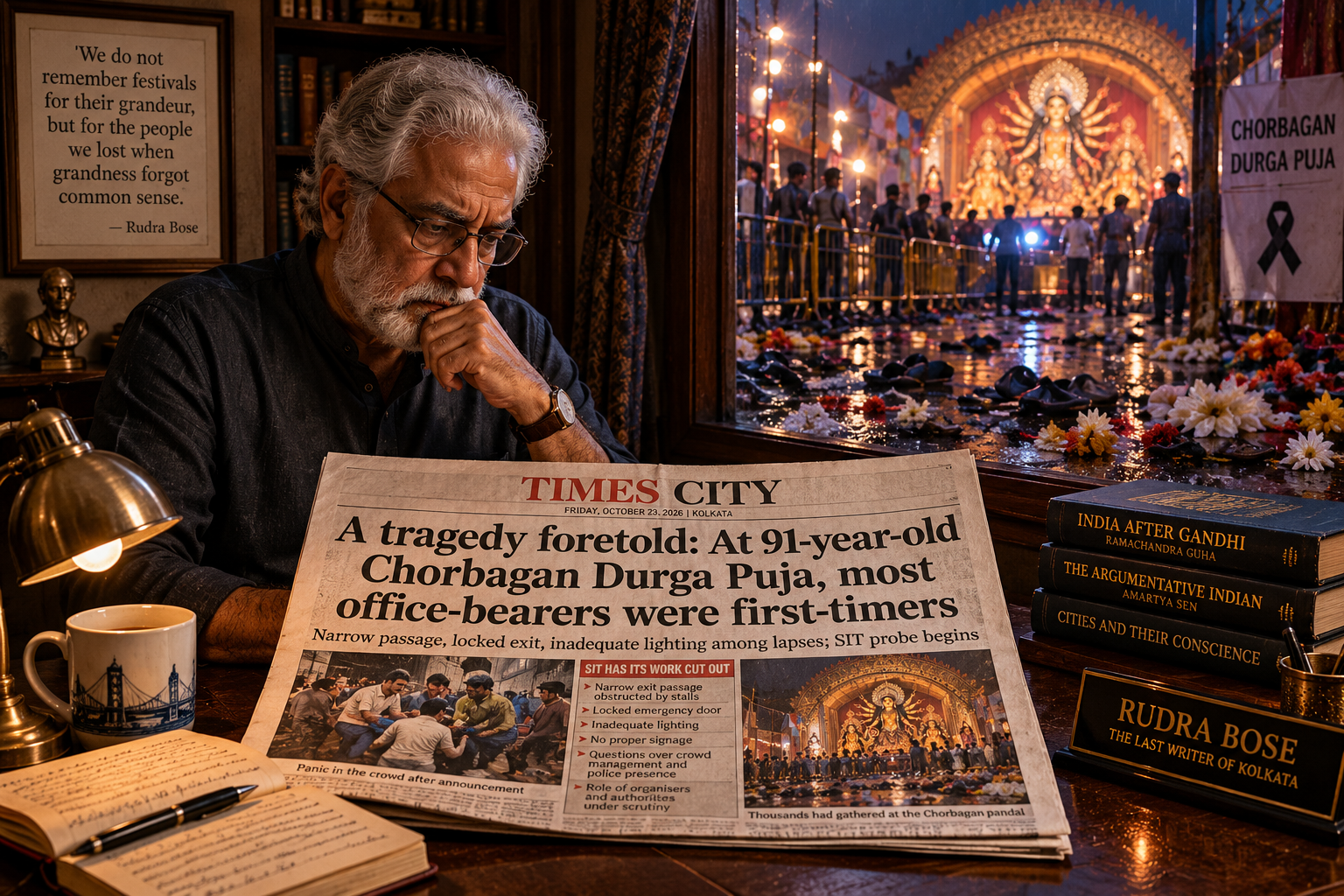
Chorbagan. Saptami. A Durga Pujo pandal that had welcomed thousands, now a scene of devastation. Nineteen lives lost, families shattered, and a city struggling to understand how a celebration could turn into such a catastrophe.
The initial findings reported in the newspapers make for uncomfortable reading. A narrow exit passage. A locked emergency door. Temporary stalls obstructing movement. Inadequate lighting. Questions about crowd density, police presence and the arrangements for moving people to safety. Heavy rain had pushed people towards the pandal. An announcement about a possible collapse reportedly triggered panic.
The Chief Minister announced compensation of ₹25 lakh for each bereaved family. Arrests followed. A Special Investigation Team was appointed. These are immediate responses. They matter. But I find myself wondering whether we are once again addressing the aftermath of a disaster more urgently than the conditions that made it possible.
“What if the tragedy was not simply the consequence of a panicked crowd, but the culmination of many small failures that nobody stopped in time?”
I have watched Kolkata celebrate Durga Pujo for decades. Our pandals are expressions of imagination, community pride and collective enterprise. They are also increasingly elaborate, drawing enormous crowds into temporary structures and carefully choreographed spaces. Yet a pandal is not merely an artistic installation. It is a place where thousands of human beings must be able to enter, move, gather and leave safely—even when it rains, an exit becomes blocked, or panic spreads through a crowd.
Which brings me to questions that the investigation must answer: ‘Who approved the layout? Who inspected the exits? Who certified the safety arrangements? And who was responsible for ensuring that the conditions of approval were actually met?’
The organisers have responsibilities. So do the authorities entrusted with clearances, inspections, crowd management and emergency preparedness. If there were lapses, we must establish all those who were responsible for them, rather than assume that responsibility begins and ends with the person who happened to make an announcement or the individuals who have been arrested. An arrest is not a finding of guilt. Nor is the appointment of an inquiry proof that the system has corrected itself.
And compensation, however necessary, cannot compensate for the absence of a mother, a father, a child or a loved one. It can provide financial relief. It cannot answer the question that will haunt the families long after the headlines have faded: why was this allowed to happen?
I worry, too, about what comes next. A committee will submit its report. Officials will examine the findings. Standard operating procedures may be revised. New instructions may be circulated before the next Pujo.
But will anything fundamental change? Will every pandal be independently checked for safe exits, unobstructed passages, structural integrity and realistic crowd capacity? Will inspections take place on the ground rather than merely on paper? Will responsibility be clearly assigned, with consequences for those who ignore safety requirements? And will organisers and authorities be prepared to turn people away when capacity is reached, even at the cost of disappointing a crowd?
These are not questions of bureaucracy. They are questions of how much we value human life when it competes with convenience, prestige, spectacle and the pressure to accommodate just a few more visitors.
As I folded the newspaper, I thought of the families who had gone out to celebrate Saptami and returned home without someone they loved. We will rebuild pandals. We will welcome the crowds again. The drums will sound, the lights will come on, and Kolkata will once more surrender itself to the enchantment of Pujo.
But if the next year’s arrangements look reassuringly familiar, while the underlying failures remain untouched, then the inquiry will have served only to document a tragedy—not prevent another. A tragedy is not truly investigated when we discover only what went wrong. It is investigated when we make it harder for the same failures to happen again.
And perhaps the most sacred offering we can make to Ma Durga is not another spectacular pandal, but a city that refuses to treat preventable deaths as the price of celebration.
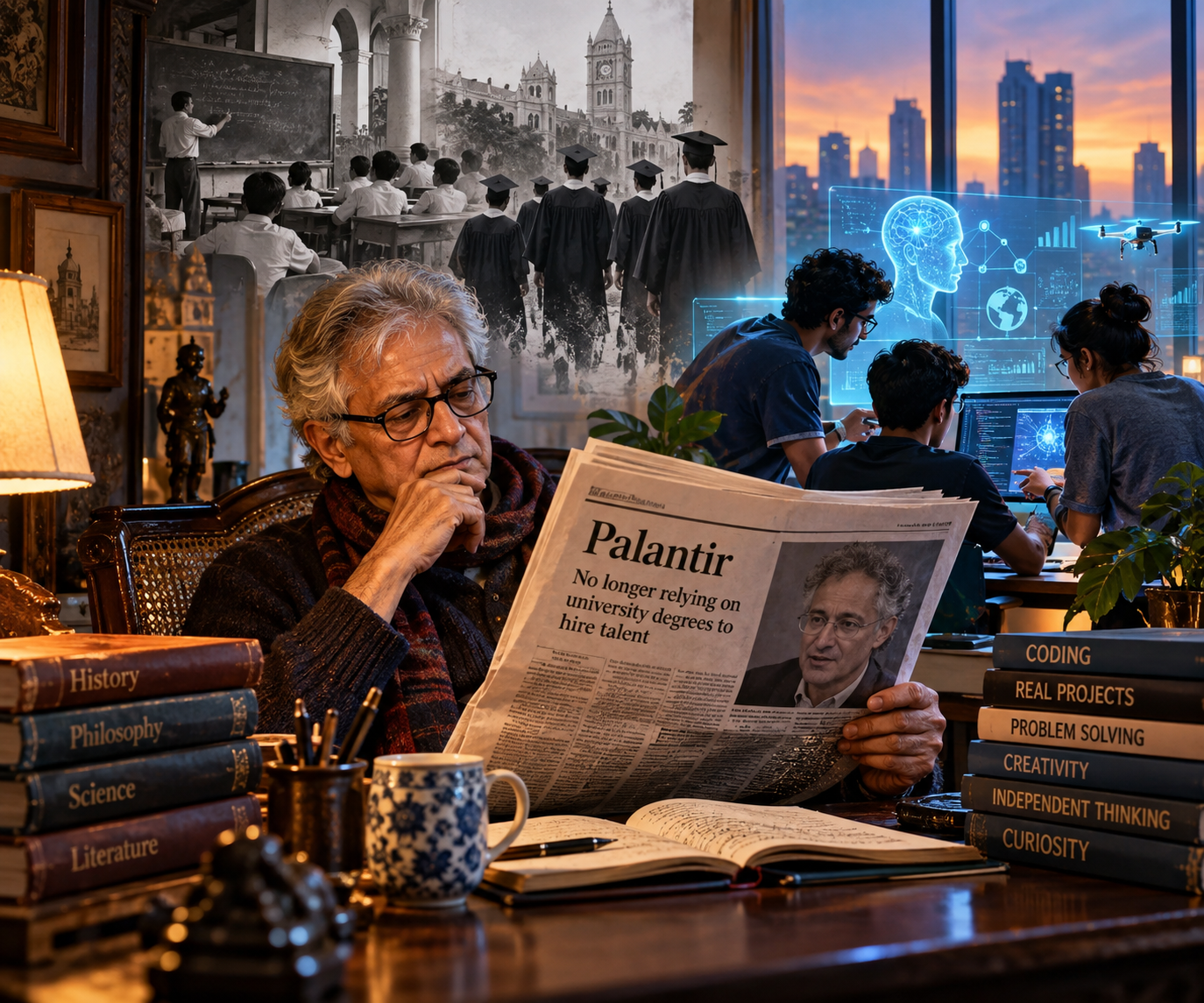
I came across a post recently about Palantir that made me pause.
It quoted its CEO, Alex Karp, as saying that the company is no longer relying entirely on traditional university degrees to identify talent. Instead, young people are being given the opportunity to work on real problems, demonstrate what they can do, and learn by doing.
The post made a provocative observation: “The university had centuries to shape the best minds. Entrepreneurs will do it in a decade.” That stayed with me.. Because it raises a much more uncomfortable question: Have our educational institutions slowly forgotten what education is supposed to accomplish?
We teach children what to think. We rarely teach them how to think. We reward the right answer more than the difficult question. We celebrate memory more than curiosity. We measure achievement through certificates rather than through the ability to see what others cannot. And then we wonder why so many highly educated people struggle to imagine a different future.
I realised that companies like Palantir are beginning to look beyond degrees. Young people are being given real problems to solve instead of certificates to prove that they are ready to solve them. It reminded me of something we seem to have forgotten. Perhaps education was never meant to manufacture employable people. Perhaps it was meant to create unmanageable minds. Minds that question. Minds that doubt. Minds that refuse to accept “this is how it has always been done.”
Perhaps the real crisis is not that AI will replace education. Perhaps it is that AI will expose how little education was actually about thinking.
As I closed the newspaper, the thought came to me. What if the future doesn’t need better educated children…… but freer minds?
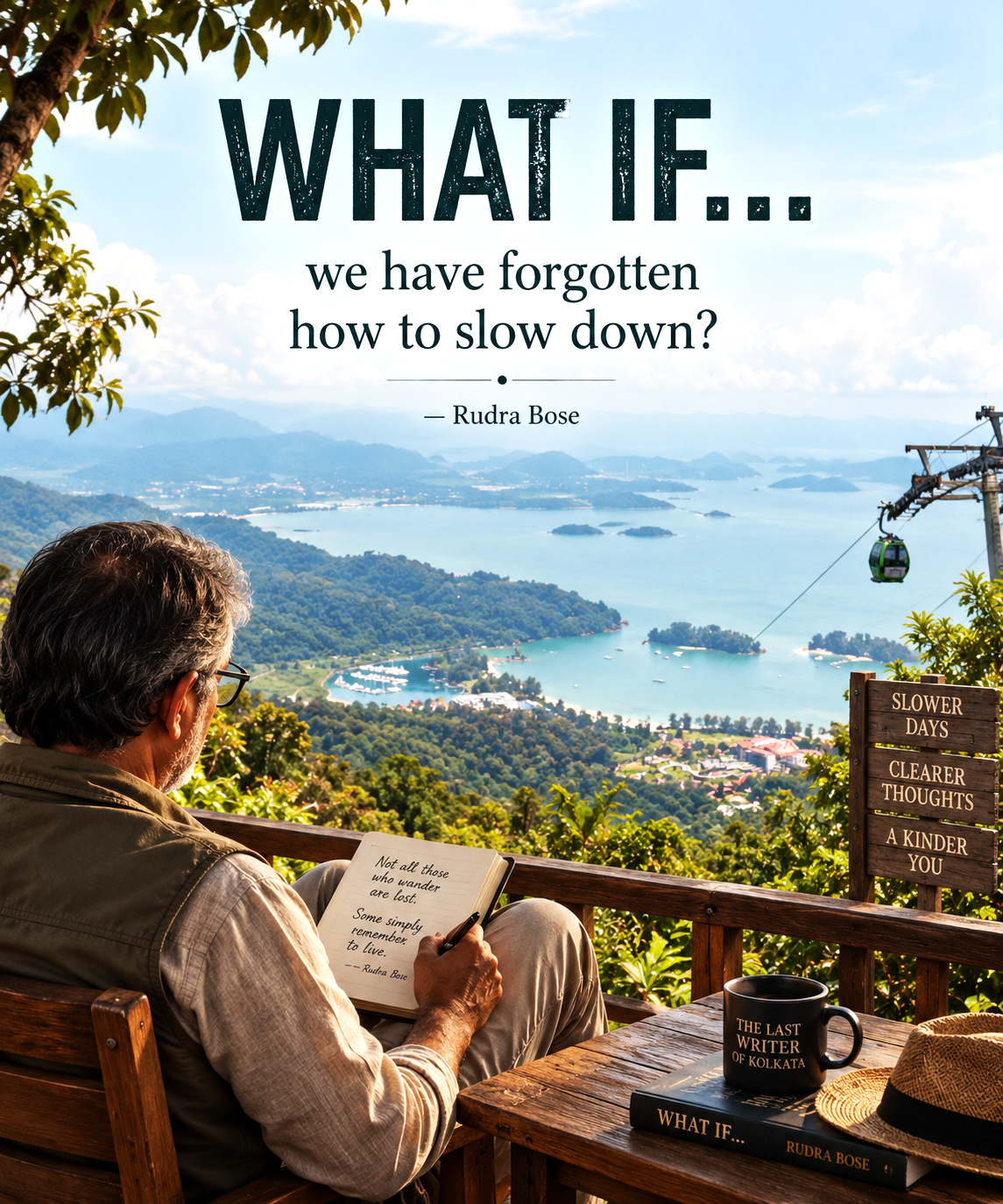
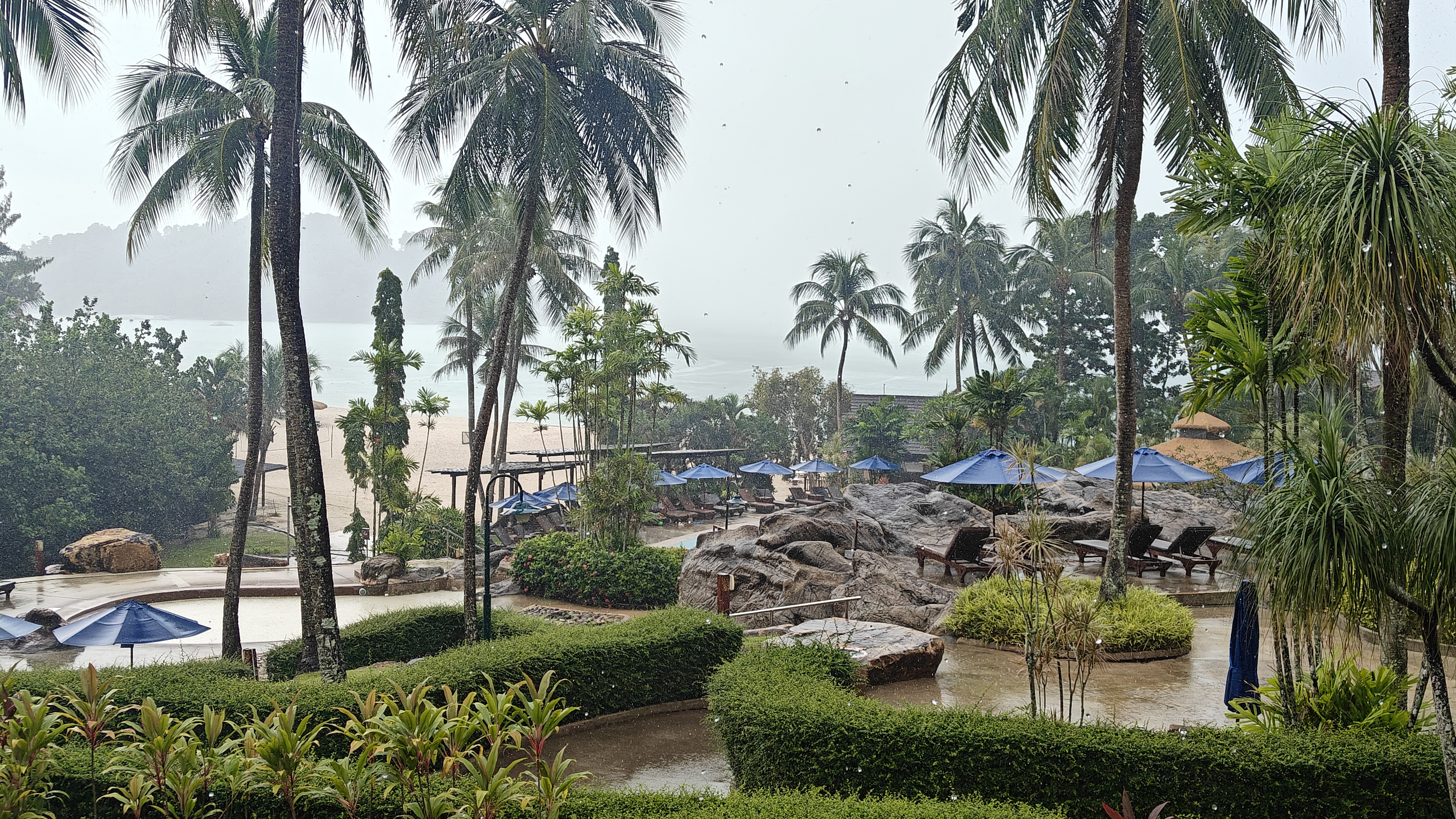
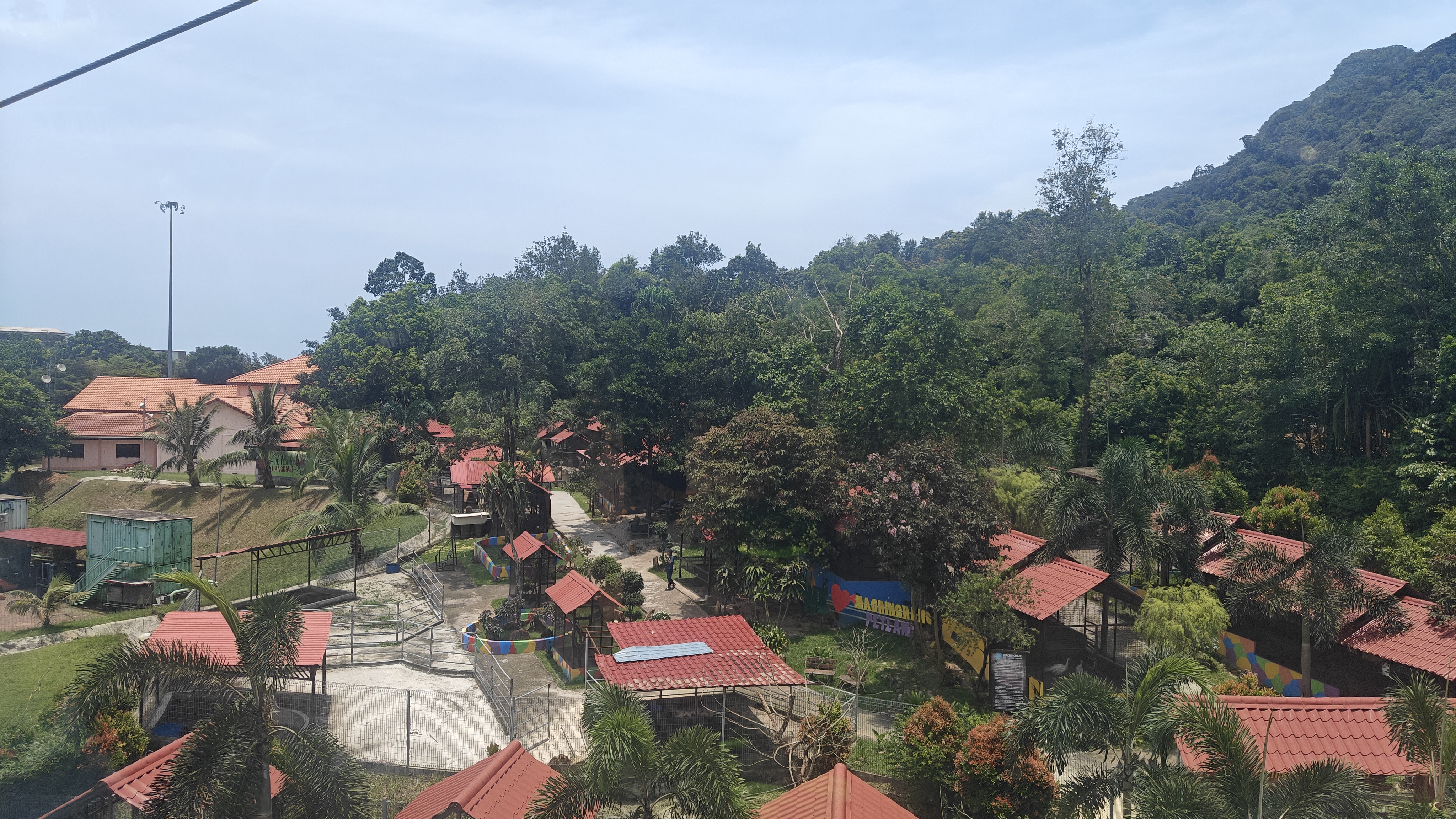
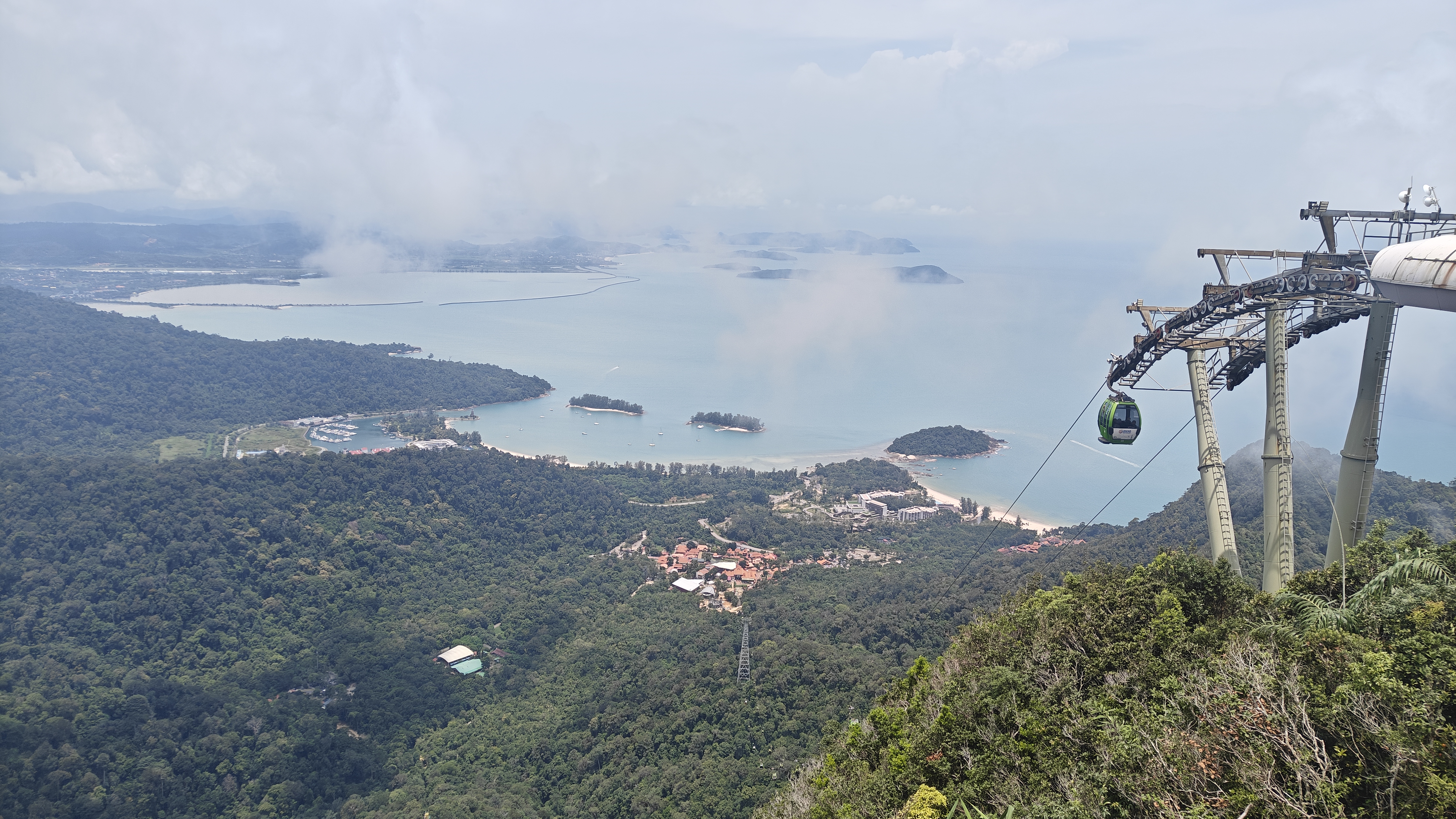
I came to Langkawi expecting to see another beautiful place. I found that the sea was beautiful. So was the Rainforest, so were the beaches.
The white beaches beckonThe Rainforest chalets
But after a while, I stopped looking at the beauty and began noticing something else.
The pace. The trees did not seem to be in a hurry to grow. The waves did not seem anxious about reaching the shore. The clouds moved without consulting a clock. Even the boats seemed to understand that there was nowhere more important to be.
And as I watched, I wondered when we had forgotten this simple rhythm. We hurry to work. Hurry to meetings. Hurry to finish. Hurry to achieve. And then, having spent years rushing towards the future, we discover that the present has quietly passed us by.
Perhaps the problem is not that we don’t have enough time. Perhaps we have forgotten how to inhabit the time we have. Standing by the sea, I found myself asking: What if slowing down is not falling behind? What if it is actually a way of moving forward—with greater awareness of where we are going?
Perhaps we don’t always need another destination. Sometimes we simply need to stop long enough to notice the journey.
….notice the journey
I closed my notebook and watched the waves return to the shore. They had been doing it for thousands of years. Unhurried. Unconcerned. And somehow, always on time.
….. a city allows danger to become normal until tragedy makes it visible.
August 2026
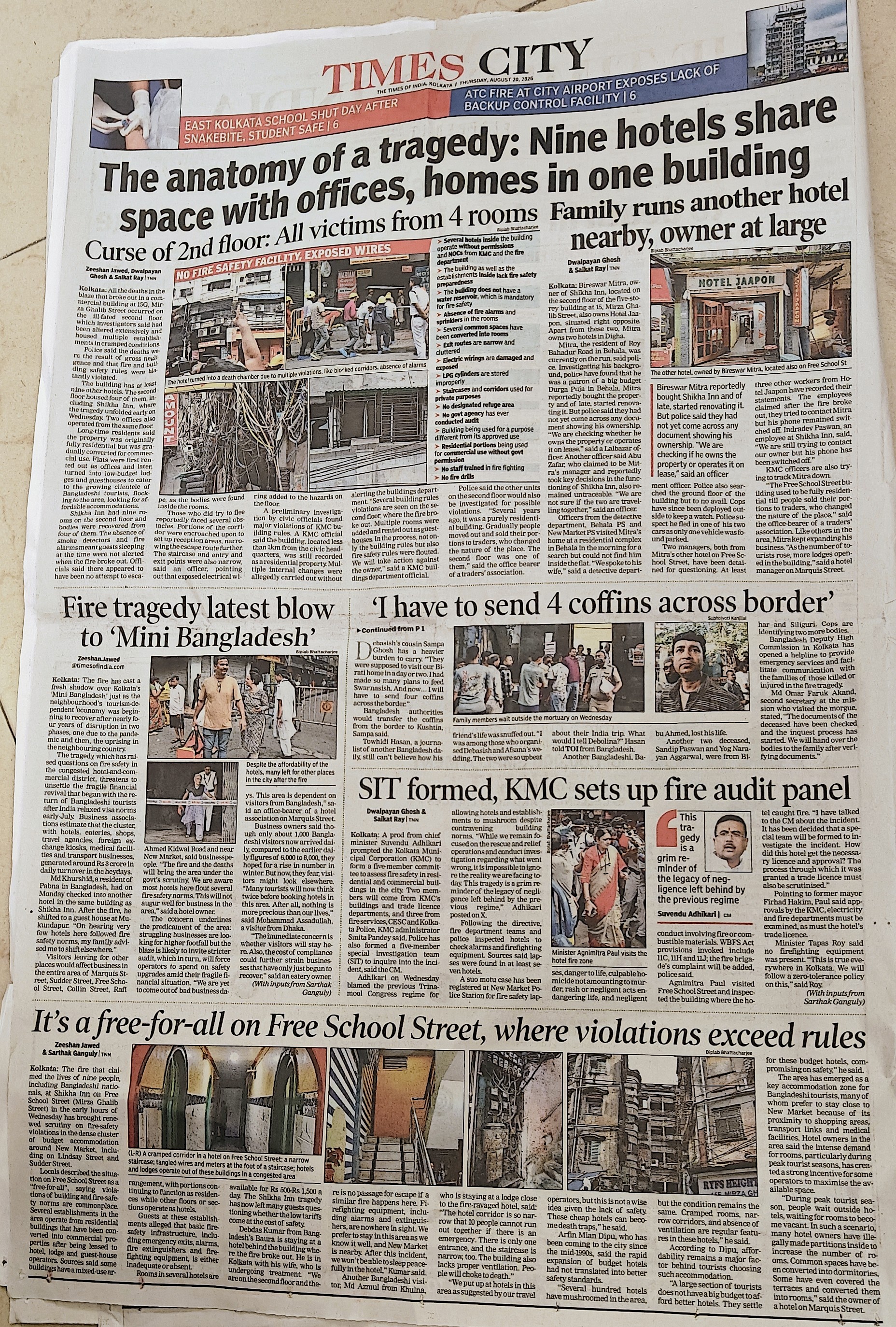
The fire in the Free School street building which housed hotels, offices and homes may have started with a short circuit. But tragedies of this magnitude are rarely caused by a single spark. Nine people died in a building where hotels, offices and homes had somehow learnt to coexist within a maze of cramped spaces, narrow passages and questions about fire safety.
Times Of India report
I kept wondering: who allowed this to become normal? Perhaps that is the more uncomfortable question. A city does not become unsafe in one day. It becomes unsafe one ignored violation at a time. One certificate not checked. One inspection postponed. One illegal alteration overlooked. One warning that nobody thought was urgent. And then, one night, the building catches fire.
We will now demand accountability. There will be investigations, committees, audits and perhaps arrests. All these are surely necessary. But does governance have to begin only after people die? The real test of a city is not how efficiently it rescues people from a burning building. It is whether it had the courage to prevent that building from becoming a death trap in the first place.
As I folded the newspaper, I wondered whether we have become too accustomed to calling preventable tragedies accidents. Perhaps the most important responsibility of governance is not to manage disasters better. It is to make fewer disasters possible.
…. we do not really know the people who live beside us?
August 2026
When I was a child, every neighbourhood had an unofficial security system. It was called knowing one another. Your mother knew who lived next door. The grocer knew whose son had returned from college. The postman knew which house had a new baby. The stranger was noticed because everyone else was familiar.
Today we have CCTV cameras, biometric gates, visitor apps, facial recognition and digital identities. Yet we often do not know the person who shares the lift with us.
The newspapers tell us that a young man, described by neighbours as polite and ordinary, is now accused of living a different life of a terrorist behind an ordinary face. If the allegations are proven true, it is a chilling reminder that the greatest disguises are no longer masks. They are routines. Terrorism succeeds long before any explosion. It succeeds the day suspicion replaces trust, when every unfamiliar face begins to look dangerous, and every ordinary neighbour becomes a question mark.
That is precisely why a civilised society must refuse both complacency and paranoia. Security agencies must remain vigilant. Citizens must remain alert. But neither should surrender the humanity that allows communities to exist.
As I folded the newspaper, I wondered whether the greatest security failure of our times is not merely that dangerous people can hide among ordinary citizens. It is that modern life has quietly taught ordinary citizens to live among one another without ever truly knowing those around us. Perhaps the strongest wall against terror is not built of concrete or surveillance. Perhaps it begins when a society rediscovers the forgotten art of being a community.
……when a generation no longer asks for privilege, but for credibility.
July 2026
A few mornings back I learnt that an entire movement has chosen to call itself the ‘Cockroach Janta Party’. I smiled. Not because the name is amusing. But because history has always had an odd habit of allowing the insulted to reclaim the insult. (I recall many years back, the Chai-wallah epithet had provided a positive momentum to Prime Minister Modi’s persona)
There was a time when young people marched carrying flags. Today they march carrying memes. Yesterday’s slogans have become today’s hashtags.
Yet beneath the humour, I hear something painfully familiar. It is not anger; it is disappointment.
Every generation believes the next examination will open the next door. When that examination itself becomes the subject of doubt, it is not merely a paper that leaks. Trust does.
The young are often accused of being impatient. Perhaps they are. But there are few things more dangerous than asking an entire generation to wait while uncertainty becomes a way of life.
Governments may negotiate. Oppositions may protest. Television studios will certainly debate. But none of them can afford to overlook the quiet question echoing through millions of homes, ‘If merit itself begins to look negotiable, what exactly are young people expected to believe in?’
As I folded the newspaper, I realised that the greatest examination before our nation is no longer the one written by students. It is the one our institutions are writing every day. And unlike the students, they will not be judged by the answers they give. They will be judged by the trust they restore.