

Rudra Bose’s diary | Kolkata 23rd October 2026
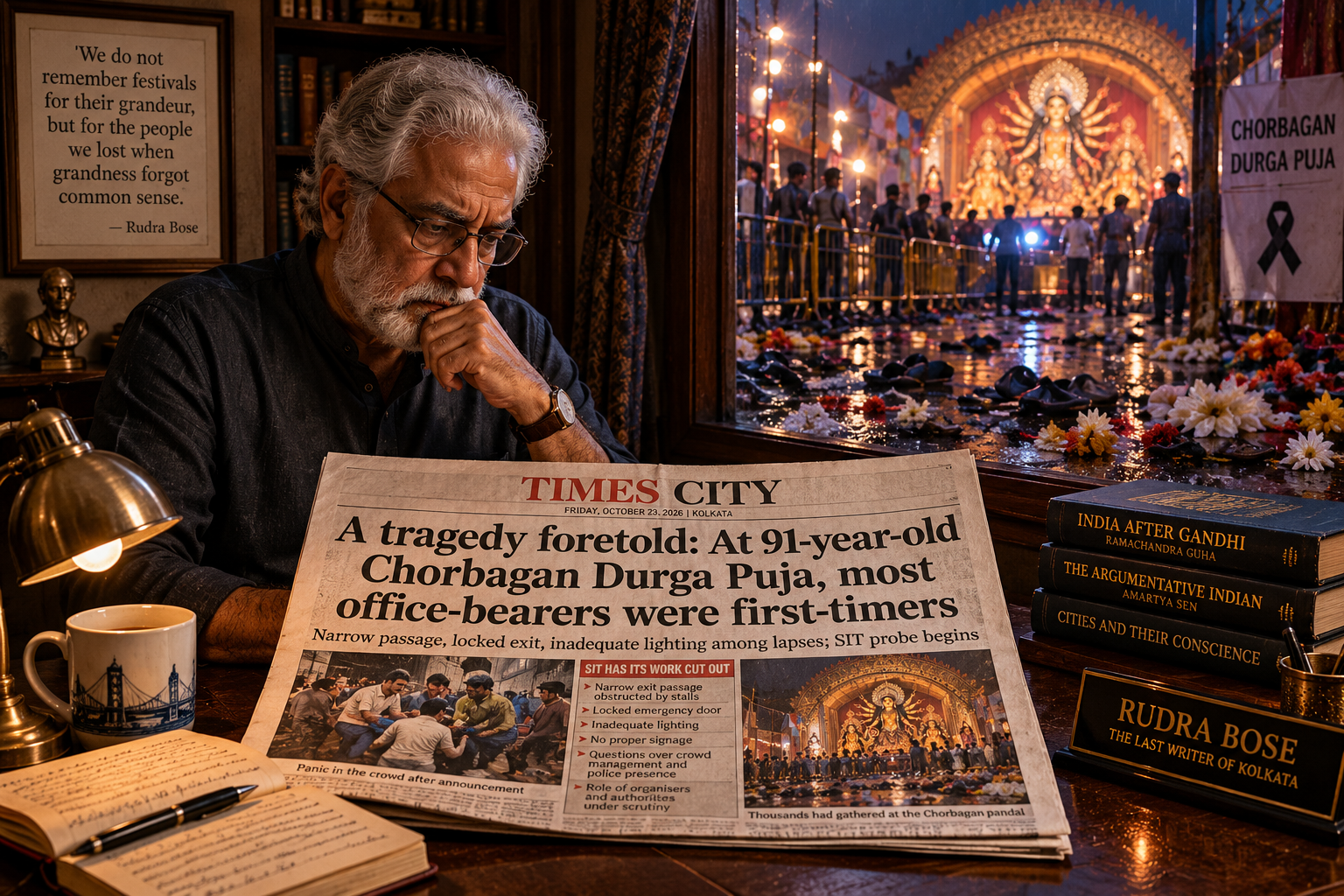
The newspapers this morning carry photographs I find difficult to look at for long.
Chorbagan. Saptami. A Durga Pujo pandal that had welcomed thousands, now a scene of devastation. Nineteen lives lost, families shattered, and a city struggling to understand how a celebration could turn into such a catastrophe.
The initial findings reported in the newspapers make for uncomfortable reading. A narrow exit passage. A locked emergency door. Temporary stalls obstructing movement. Inadequate lighting. Questions about crowd density, police presence and the arrangements for moving people to safety. Heavy rain had pushed people towards the pandal. An announcement about a possible collapse reportedly triggered panic.
The Chief Minister announced compensation of ₹25 lakh for each bereaved family. Arrests followed. A Special Investigation Team was appointed. These are immediate responses. They matter. But I find myself wondering whether we are once again addressing the aftermath of a disaster more urgently than the conditions that made it possible.
“What if the tragedy was not simply the consequence of a panicked crowd, but the culmination of many small failures that nobody stopped in time?”
I have watched Kolkata celebrate Durga Pujo for decades. Our pandals are expressions of imagination, community pride and collective enterprise. They are also increasingly elaborate, drawing enormous crowds into temporary structures and carefully choreographed spaces. Yet a pandal is not merely an artistic installation. It is a place where thousands of human beings must be able to enter, move, gather and leave safely—even when it rains, an exit becomes blocked, or panic spreads through a crowd.
Which brings me to questions that the investigation must answer: ‘Who approved the layout? Who inspected the exits? Who certified the safety arrangements? And who was responsible for ensuring that the conditions of approval were actually met?’
The organisers have responsibilities. So do the authorities entrusted with clearances, inspections, crowd management and emergency preparedness. If there were lapses, we must establish all those who were responsible for them, rather than assume that responsibility begins and ends with the person who happened to make an announcement or the individuals who have been arrested. An arrest is not a finding of guilt. Nor is the appointment of an inquiry proof that the system has corrected itself.
And compensation, however necessary, cannot compensate for the absence of a mother, a father, a child or a loved one. It can provide financial relief. It cannot answer the question that will haunt the families long after the headlines have faded: why was this allowed to happen?
I worry, too, about what comes next. A committee will submit its report. Officials will examine the findings. Standard operating procedures may be revised. New instructions may be circulated before the next Pujo.
But will anything fundamental change? Will every pandal be independently checked for safe exits, unobstructed passages, structural integrity and realistic crowd capacity? Will inspections take place on the ground rather than merely on paper? Will responsibility be clearly assigned, with consequences for those who ignore safety requirements? And will organisers and authorities be prepared to turn people away when capacity is reached, even at the cost of disappointing a crowd?
These are not questions of bureaucracy. They are questions of how much we value human life when it competes with convenience, prestige, spectacle and the pressure to accommodate just a few more visitors.
As I folded the newspaper, I thought of the families who had gone out to celebrate Saptami and returned home without someone they loved. We will rebuild pandals. We will welcome the crowds again. The drums will sound, the lights will come on, and Kolkata will once more surrender itself to the enchantment of Pujo.
But if the next year’s arrangements look reassuringly familiar, while the underlying failures remain untouched, then the inquiry will have served only to document a tragedy—not prevent another. A tragedy is not truly investigated when we discover only what went wrong. It is investigated when we make it harder for the same failures to happen again.
And perhaps the most sacred offering we can make to Ma Durga is not another spectacular pandal, but a city that refuses to treat preventable deaths as the price of celebration.
— Rudra Bose , The Last Writer of Kolkata
#rudrabose, #thelastwriterofkolkata, #whatif, #chorbagan tragedy

