
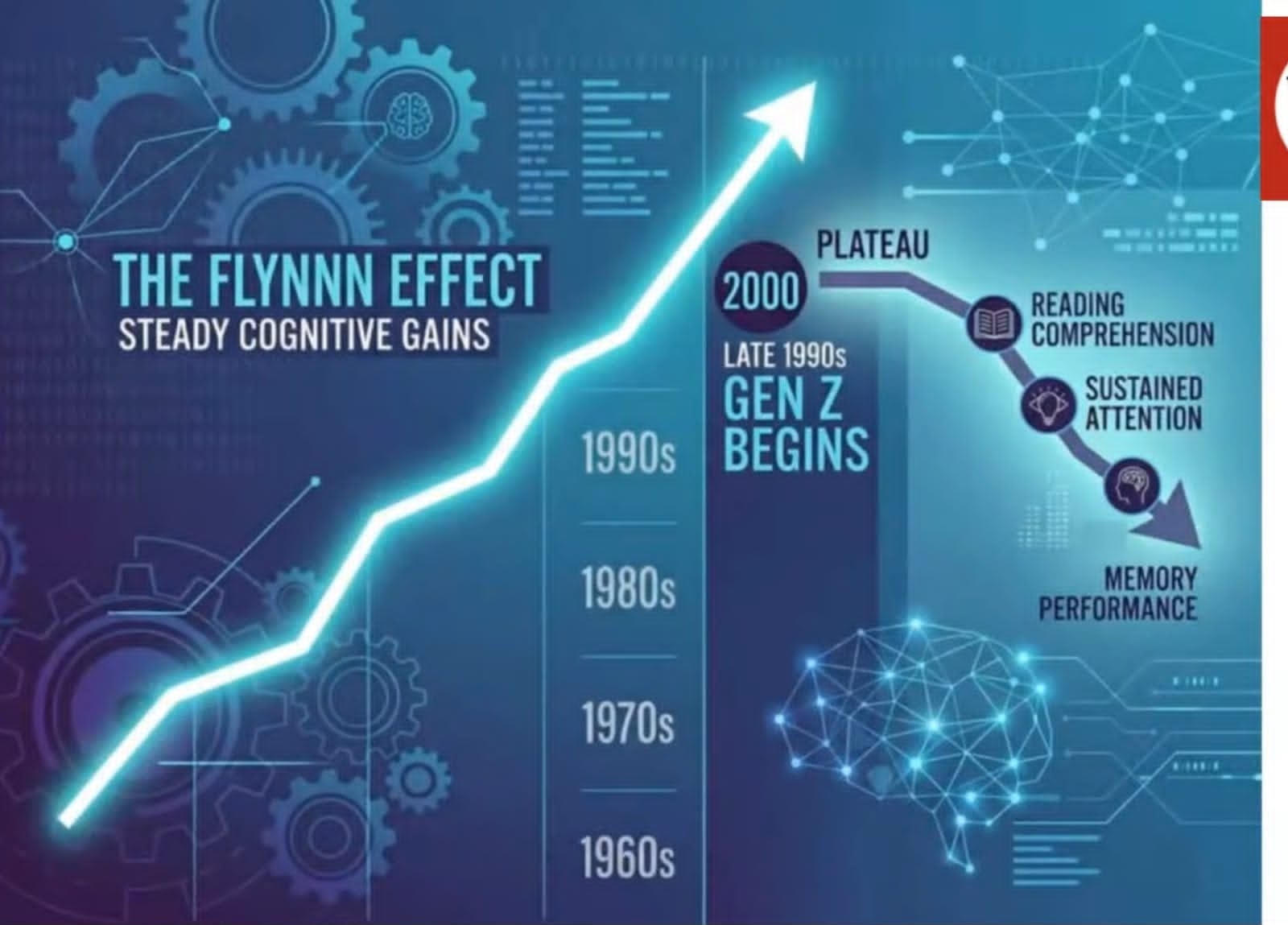
The recent discussion surrounding the reversal of the Flynn Effect has generated understandable concern. For nearly a century, psychologists observed a remarkable trend: each successive generation appeared to outperform its predecessor on IQ tests. Better nutrition, improved healthcare, expanded education and increasingly complex environments seemed to produce steadily rising cognitive performance.
Now, according to research presented by Dr. Horvath before a Senate Committee in January 2026, that trend appears to have reversed. Generation Z is reportedly the first generation in modern history to register a decline in average IQ compared to those who came before it. Researchers have also noted reductions in reading comprehension, sustained attention and memory performance.
If these findings are robust, they deserve serious attention.
But before concluding that an entire generation has become “less intelligent,” perhaps we should ask a more fundamental question.
What exactly are we measuring?
An IQ test is not a thermometer that measures intelligence in the way a thermometer measures temperature. It evaluates performance across selected cognitive domains—logical reasoning, pattern recognition, verbal comprehension, working memory, processing speed and spatial reasoning. These were chosen because they were believed to predict learning ability, productivity and success in an industrial and later knowledge-based economy.
That assumption itself deserves scrutiny.
Every civilisation defines competence according to the challenges it faces. The skills that made an exceptional engineer in the 1970s (That was my generation!) are not identical to those required of an AI architect today. The competencies that distinguished an outstanding accountant thirty years ago are very different from those needed in an age where algorithms perform much of the routine analytical work.
Perhaps intelligence itself has not declined as much as it has changed its centre of gravity.
Today’s young adults navigate digital ecosystems with remarkable ease. They process multiple streams of information simultaneously, learn unfamiliar software intuitively and adapt rapidly to technological change. These abilities are not trivial. Yet traditional IQ tests may capture only a small part of this emerging cognitive landscape.
This is not an argument for dismissing the reported decline. Reading comprehension, sustained attention and memory remain foundational human capabilities. Civilisations are built upon the ability to think deeply, read patiently, remember accurately and reason independently. If these capacities are genuinely weakening, the consequences could be profound.
But neither should we confuse what is measurable with what is meaningful.
Throughout history, societies have periodically redefined excellence. Education evolved. Work evolved. Technology evolved. It would be surprising if our understanding of intelligence remained frozen in time.
The reversal of the Flynn Effect may therefore be asking us two questions instead of one.
The first is whether some essential cognitive abilities are indeed declining.
The second—and perhaps the more important one—is whether the very framework through which we define and measure human intelligence is keeping pace with a world that is changing faster than at any previous point in history.
The future may not belong to those with the highest IQ as traditionally measured. It may belong to those who combine analytical thinking with creativity, adaptability, emotional intelligence, ethical judgment and the wisdom to know when technology should assist the human mind—and when it should never replace it.
In musing……. Shakti Ghosal