

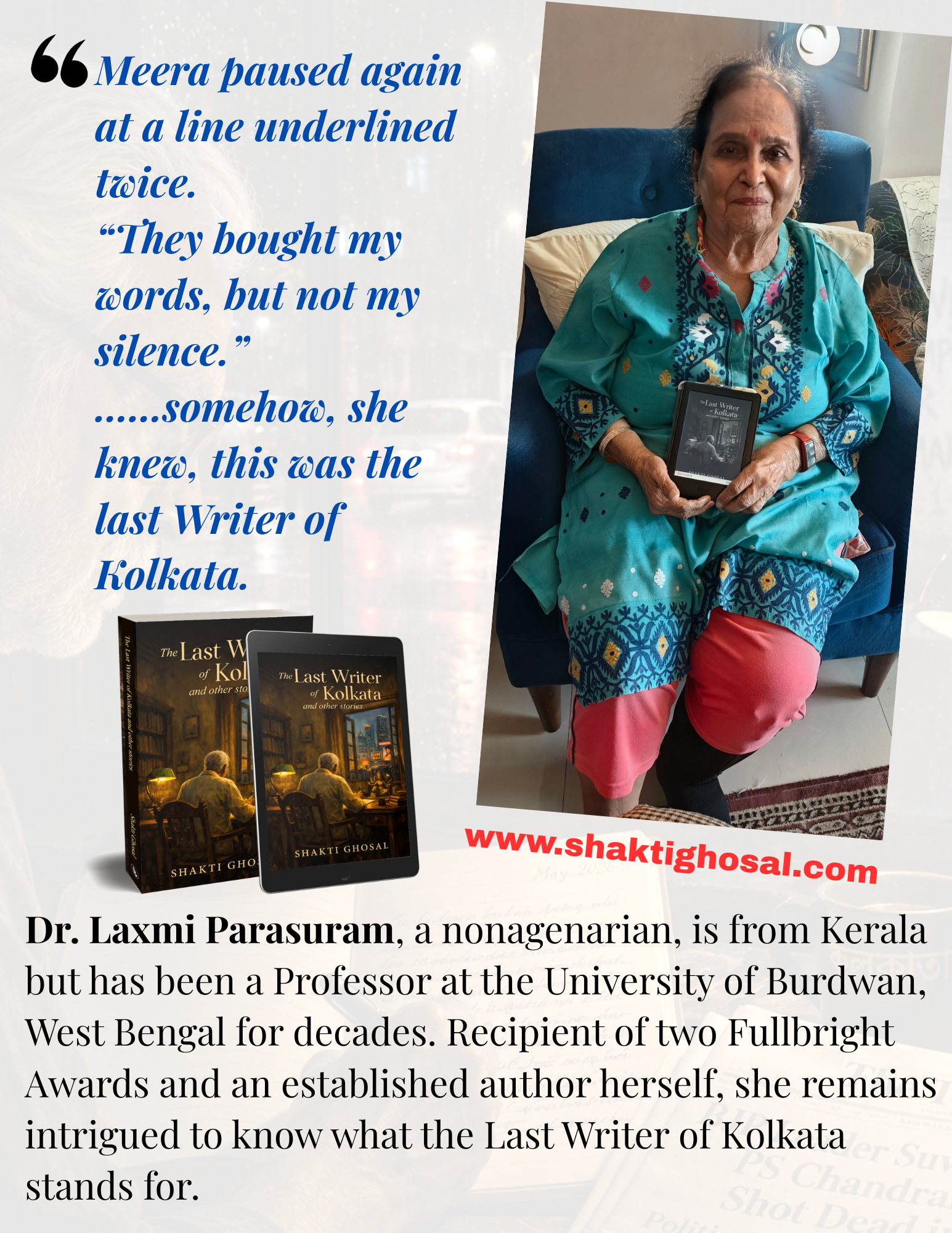
When I met Dr. Laxmi Parasuram to hear her thoughts on The Last Writer of Kolkata and Other Stories, I expected literary observations. What I received instead was a question that lingered.
She spoke of the emotional weight in the stories—the sentiment, the ache, the quiet melancholy. Then she asked, “Why do so many of your stories seem to end sadly?”
The question took me by surprise. I had never consciously thought of these as sad endings. To me, these stories are about ordinary people standing at extraordinary crossroads—where technology, hard trends, and shifting social realities place pressure on the human spirit. In those moments of disruption, what gets tested is not merely survival, but something deeper: memory, dignity, love, identity, silence, moral choice.
And when the protagonists choose to hold on to some irreducible fragment of their humanness—even at a cost—I had seen that not as tragedy, but as resistance. Yet perhaps this is the paradox of our times.
What one person sees as loss, another may see as courage. What appears to be a sad ending may, in fact, be the final refusal to surrender what makes us human.
It made me wonder: Have we become so accustomed to measuring success by comfort, victory, and neat resolutions that acts of emotional fidelity now look like defeat?
Dr. Parasuram’s question stayed with me. And perhaps that is what literature is meant to do—not provide answers but quietly rearrange the questions we ask ourselves.
In Musing……. Shakti Ghosal
 A New Beginning