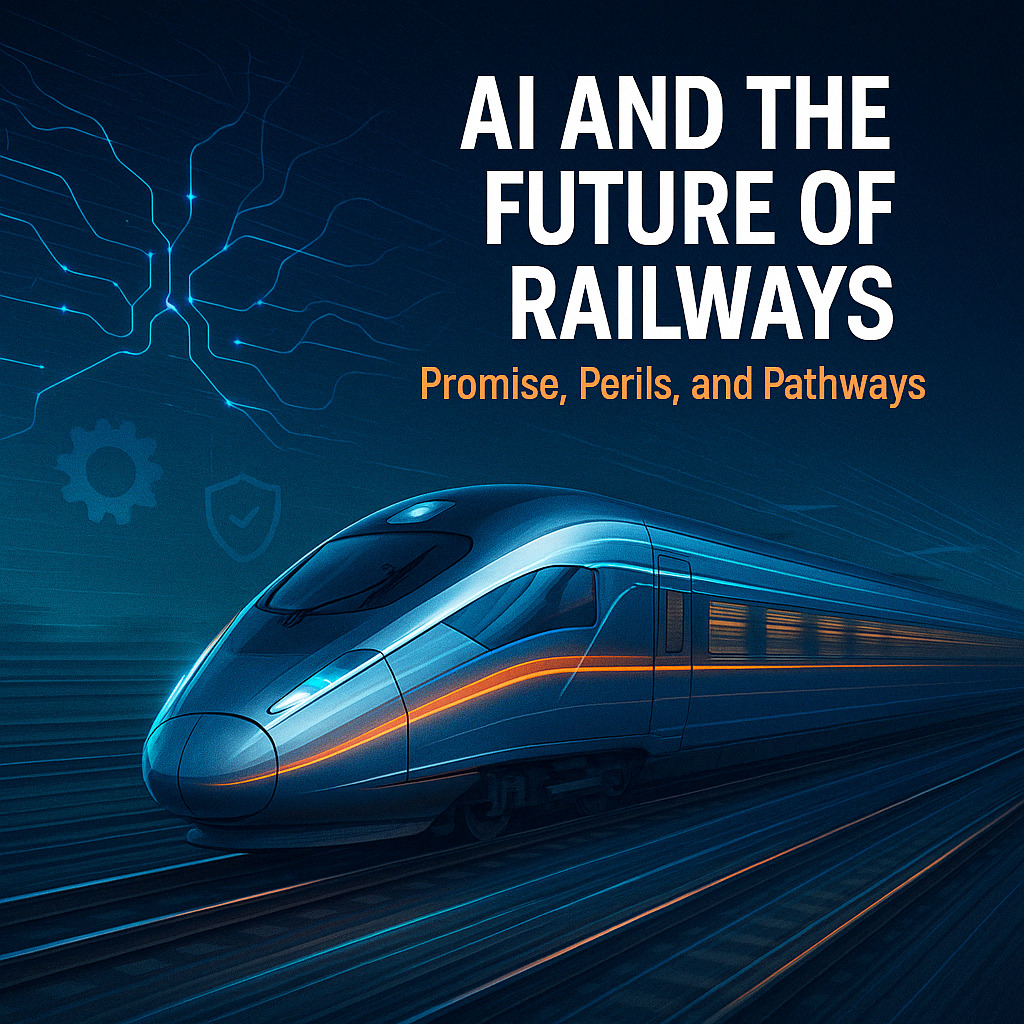
“The railway industry, one of the oldest enablers of industrial transformation, now stands on the cusp of another revolution—this time powered by Artificial Intelligence.”
From the steam engines of the 19th century to today’s high-speed trains, railways have been symbols of innovation. Now, as we move deeper into the 21st century, Artificial Intelligence (AI) promises to redefine how rail networks are managed, how trains are operated, and how passengers experience travel.
But like every major transformation, the rise of AI in railway transportation is not without its challenges. The genesis of this article stems from the fact that I started my work life in the Indian Railways Service of Mechanical Engineers nearly half a century back. More recently when I was doing a Wharton Business School program on AI applications, the idea of this piece came to me.

In this article, I have tried to explore the promise, perils, and pathways of integrating AI into one of the most vital sectors of modern infrastructure, particularly for a dense population country like India.
***
🚄 The Promise: Efficiency, Safety, and Customer Experience
AI does hold considerable potential to make a high-density transportation mode like the Railways smarter, safer, and more responsive. Here are just a few areas where the promise can be seen:
- Predictive Maintenance: Machine learning models can analyze vibration, temperature, and operational data to detect potential failures before they occur—reducing costly downtime and enhancing safety.
Predictive maintenance, powered by sensor analytics and machine learning, are reducing unplanned downtime by up to 30% in Germany (Deutsche Bahn). In India, AI-equipped SMART coaches can now monitor vibrations, structural wear, and staff behavior, leading to substantial maintenance savings and enhanced safety.
- Optimized Scheduling and Routing: AI can dynamically adjust train schedules based on real-time data—weather, demand, or disruptions—minimizing delays and maximizing throughput.
In dense rail networks like India’s or Japan’s, such precision translates into better asset utilization, optimized route rationalization, and more efficient capacity deployment.
- Safety and Reliability: AI enhances safety through real-time monitoring and automated diagnostics. Computer vision systems are today identifying track defects, unauthorized access, and obstacles with over 90% accuracy. AI-powered drones can now inspect tracks and overhead equipment faster than traditional crews, improving both safety and inspection efficiency.
Train operations benefit from AI-assisted driver alertness monitoring and automatic braking recommendations based on track conditions. These advancements reduce human error—still a leading cause of railway incidents.
- Passenger Experience and Multimodal Connectivity: In many places, AI-driven chatbots and journey planners have started offering personalized updates, route alternatives, and digital ticketing, improving passenger convenience. Integrating railways with buses, metros, and even micro-mobility options via AI platforms is enabling seamless urban mobility. In megacities, this creates rail-centric multimodal ecosystems where trains form the backbone of transportation.
- Smart Ticketing and Crowd Management: With the use of computer vision and behavioural analytics, Railways can monitor crowd flows in stations and adjust boarding strategies in real time, improving passenger experience and safety.
- Energy Efficiency: AI-powered driving systems can optimize acceleration and braking, saving energy and reducing emissions—a critical benefit as Railways strive to meet sustainability goals.
- Environmental Sustainability: AI can help Railways fine-tune energy use by adjusting acceleration, coasting, and braking in real time, reducing fuel and electricity consumption.
When paired with green innovations like hydrogen-powered trains—such as Germany’s Coradia iLint and the US’s ZEMU—railways can become even more climate-friendly, especially in non-electrified regions
In short, AI can turn data into decisions—at scale and in real time.
***
⚠️ The Perils: Bias, Job Displacement, and System Vulnerabilities
Yet, for all its promise, AI also brings forth complex challenges that Railway systems must navigate with care. Let us try and understand what these are.
- Algorithmic Bias: AI systems are only as unbiased as the data they’re trained on. In Railways, there is a high chance this could lead to unfair prioritization of certain routes or populations. This is because of historical inequities that are embedded in the stored data.
- Job Displacement: As AI would continue to automate driving, monitoring, scheduling, maintenance and customer service, several roles would become redundant. While this may lead to job displacement in the short term, it will also create new roles in data science, system integration, and AI governance.
This is where visionary leadership would come in to shift focus and resources relating to reskilling, transitioning and to answer the more fundamental question about the human cost of automation.
- High Implementation Costs: AI deployment demands hefty upfront investment in digital infrastructure—sensors, data platforms, training, and cybersecurity. For developing economies like India, justifying these expenses against long-term gains poses a financial and strategic challenge. This is also where a visionary leadership needs to come in.
- Cybersecurity Risks and systemic reliability: Risks would surely go up as a more digitized and AI-integrated Railways system would become an attractive target for cyberattacks. A breach in an AI-driven control system could have dangerous and far-reaching consequences.
Reliance on AI systems thus must be balanced with robust fail-safes by strong governance and redundancy protocols.
- Public Trust and Ethics: AI in public infrastructure must be transparent and accountable. Otherwise, trust erodes—especially if systems malfunction or make controversial decisions without human oversight.
The above risks underscore the need for careful design, regulation, and human-in-the-loop systems.
***
Railways vs Other Transport Modes: A Comparative Snapshot
| Factor | Railways (AI-enhanced) | Road Transport | Air Transport |
| Cost | Low per ton/km for freight | High due to fuel and labor | Highest operational cost |
| Environmental Impact | Low (electrified or hydrogen) | High (diesel trucks) | Very high (jet fuel) |
| Convenience | Ideal for dense corridors | Flexible last-mile service | Speed for long distances |
Railways, strengthened by AI, would thus remain the most cost-effective and sustainable mode for high-density freight and passenger volumes. Hydrogen trains further extend these advantages to non-electrified routes.
***
🧭 The Pathways: Navigating the AI Railway Future
So, how can the Railways harness AI’s promise while avoiding its perils? The following thoughts come to mind.
1. Adopt a Human-Centric Approach: AI should always be viewed as an Enabler, not a Replacer of human expertise. Railways systems should ensure the centrality of human judgment, ethics, and oversight; this becomes particularly important in safety-critical functions.
2. Invest in Digital Infrastructure: To unlock AI’s power, the Railway systems would need high-quality data, real-time connectivity, and interoperable platforms. One can well envisage that Digital twins, Edge computing, and IoT-enabled trains would form the backbone of AI-enabled rail networks in the future.
3. Prioritize Ethics and Explainability: AI based decisions need to necessarily be transparent and explainable. Regulators and the Railways need to work together to ensure AI systems meet public standards of fairness, accountability, and non-discrimination.
4. Reskill and Redesign Work: The rise of AI urgently calls for a parallel investment in people—training them to work with AI tools, interpreting machine insights, and contributing to higher-value tasks. Railway jobs and functions need to evolve, not disappear.
5. Collaborate Across Sectors: The Railways need tocollaboratewith the private sector vendors and suppliers, technology companies, and researchers to create standards, protocols, and governance models that ensure responsible innovation.
***
🚉 Need for a New Era of Railways Leadership
Integrating AI into Railway transportation is not merely a technological shift—it’s a leadership challenge. It requires vision, ethics, inclusiveness, and a commitment to long-term impact.
As Railway systems worldwide experiment with smart stations, autonomous maintenance, and AI-based scheduling, one thing is clear: those who navigate this transformation thoughtfully will shape the future of mobility.
***
Future Outlook: Smarter, Cleaner Railways
Over the next 3 to 5 years, we’ll surely witness:
- Autonomous train operations with AI-powered dispatch and navigation.
- Real-time dynamic pricing to optimize demand and revenue.
- Prototypes of hydrogen-electric hybrid locomotives becoming mainstream in Europe, North America, and parts of Asia.
- AI-enhanced simulation systems to train staff and emergency responders.
Railways stand at a unique inflection point. From my own early days in the Indian Railway Service of Mechanical Engineers, I’ve seen the disruption from steam to diesel-electric and now to AI and hydrogen. With the right investments, policy frameworks, and workforce strategies, the railways of tomorrow will be not just faster or cleaner—but smarter
Final Thoughts
The train to the future has already left the station. The question is:Are we building the right tracks for it?
If you’re working in transportation, AI, or infrastructure, or remain interested and curious about these domains, I would love to hear your thoughts. How is AI showing up in your work? What opportunities—or concerns—are you seeing? Let’s build the conversation together.
The article link, as published in LinkedIn is here: https://www.linkedin.com/pulse/artificial-intelligence-future-railway-transportation-shakti-ghosal-tcb9e
References
- Tang et al. (2022), “AI and Predictive Maintenance in Transport Systems”
- Bitdeal (2024), “Case Studies on AI in Railways: Deutsche Bahn and Indian Railways”
- World Economic Forum (2024), “Hydrogen Trains: The Future of Clean Mobility”
In Learning…….. Shakti Ghosal
#ArtificialIntelligence #Railways #Transportation #AIandEthics #FutureOfWork #Mobility #SmartInfrastructure #Leadership
.