

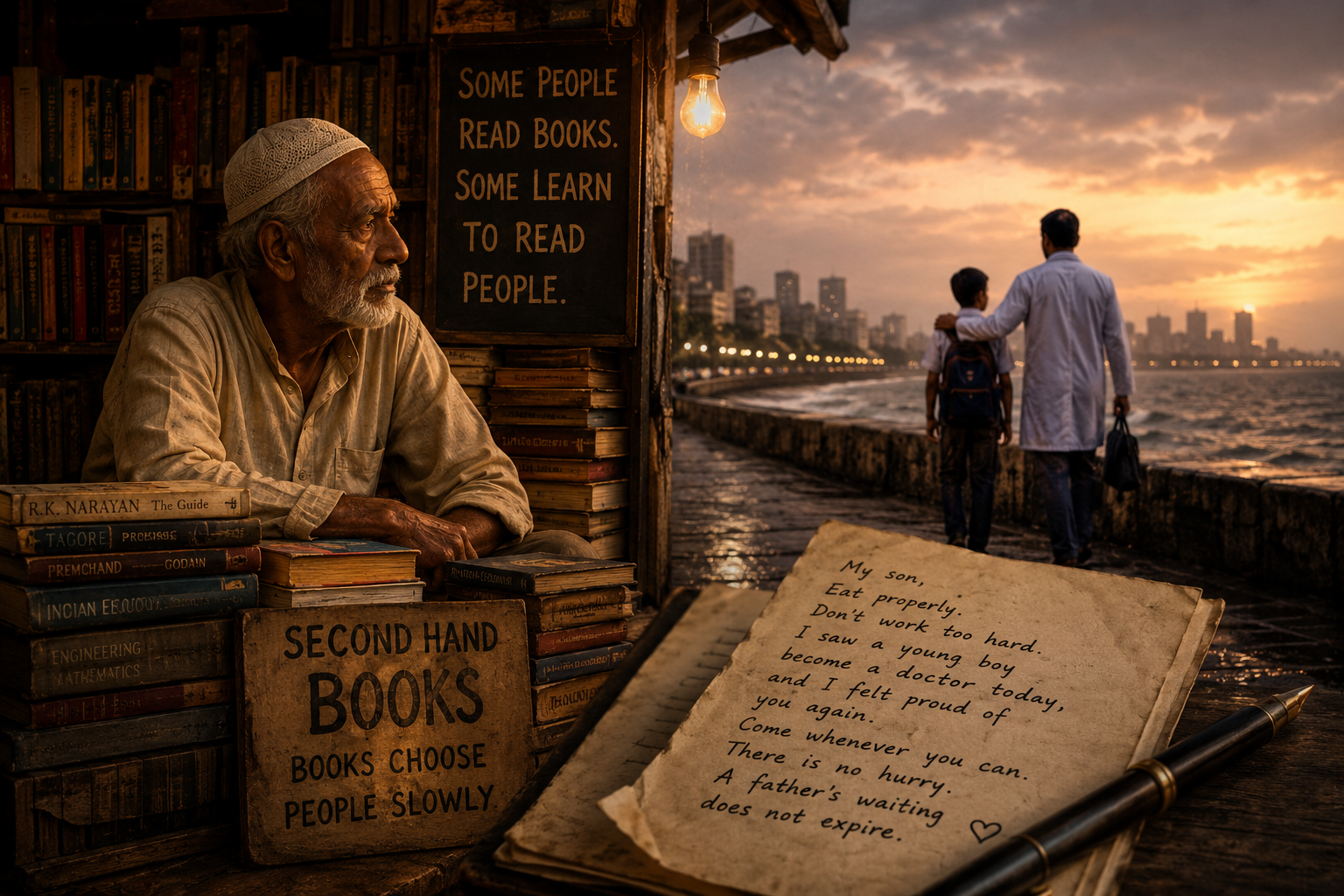
I came across a story recently. I do not know whether it is true.
Perhaps it is. Perhaps it has gathered a little fiction around a kernel of truth. And perhaps, like many stories that move between people, it has become less concerned with historical accuracy than with a truth of another kind—the truth of the human heart.
It was about an old man called Salim who sold second-hand books outside Churchgate Station in Mumbai. There was something almost unbearably poignant about him. He had spent his life surrounded by books. And he could not read, not a single word. He had never had the opportunity to go to school. Poverty had closed that door before he was old enough to understand what education meant. Yet he knew his books. He could locate them by the colour of their covers, their size, their position on the shelf. He remembered who had bought them and, sometimes, why. When someone expressed surprise that a man surrounded by thousands of books could not read, he apparently said: “Some people read books. Some learn to read people.”
Whether Salim ever existed is, for me, almost beside the point. Because I was reminded of two stories I wrote in The Last Writer of Kolkata. The first is about an ageing writer whose memories—and the culture embedded within them—become something that others wish to digitise, package and sell.
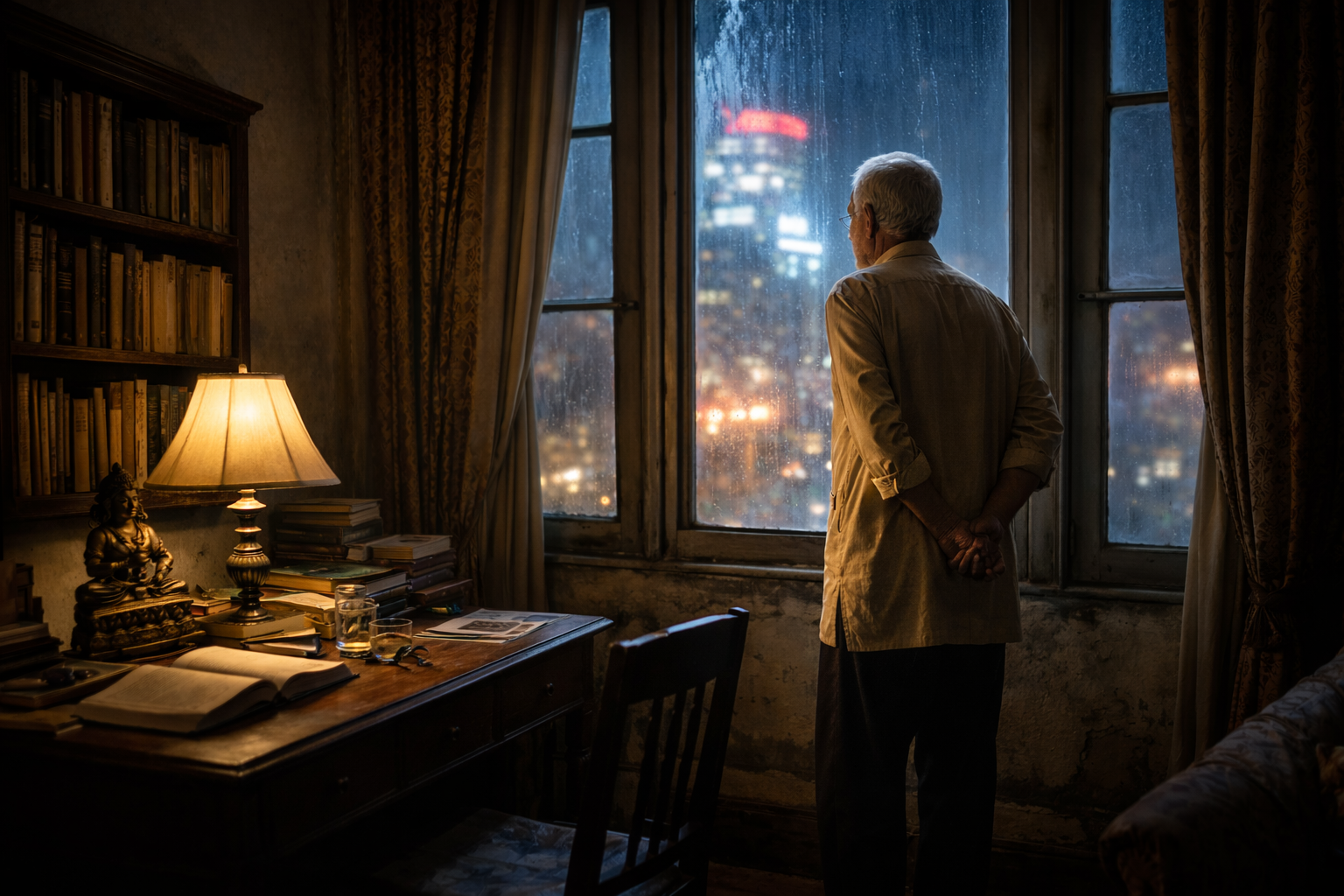
The second, When the Rain Remembered, is about an old couple, Pradyut and Jaya, who shelter a displaced child called Rai in a retirement enclave where everything has been reduced to rules, protocols and algorithms.
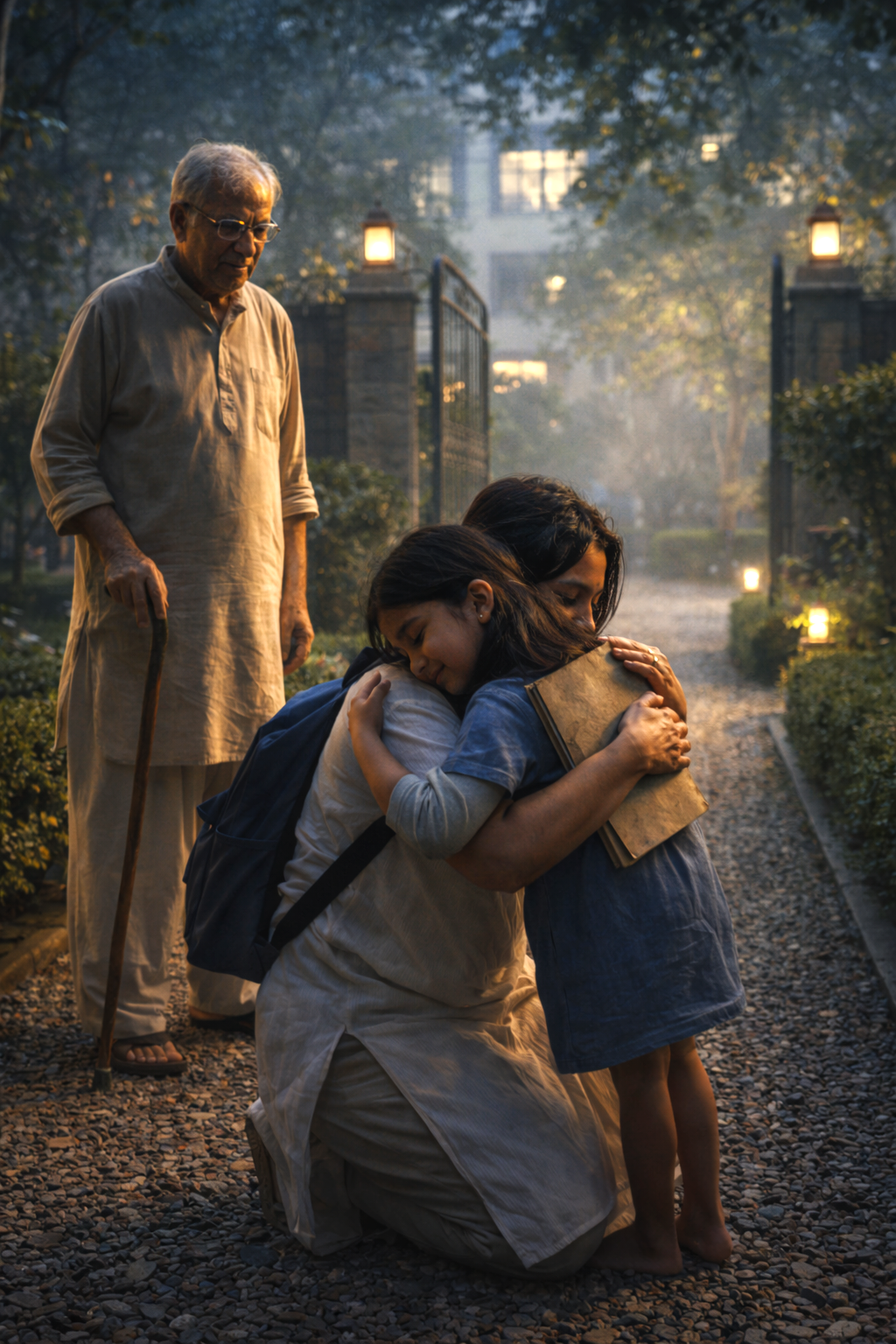
At first glance, these stories might appear to have little in common. But perhaps they do. All three stories are really about what it means to remember. And what it means to care.
The old writer in Kolkata possesses something that technology cannot quite capture—the texture of memory, the fragrance of a city, the small details that make a life one’s own. Pradyut and Jaya discover that a home is not a place governed by regulations. It is created when someone decides that another human being matters. And the story about Salim? He could not read the books he sold.But he understood something that many of us, despite all our education, sometimes forget. A book is only paper and ink until it touches a human life.
Salim had a son. He had worked and sacrificed so that his son could study, become a doctor and eventually build a life abroad. He had given his child what he himself had been denied. And then, as happens so often in life, distance entered quietly. Not through anger, not through rejection but simply through life. Work became demanding. Calls became less frequent. Visits were postponed. There was always a tomorrow. Until, one day, there wasn’t.
The story says that after Salim died, his son discovered letters his father had dictated over the years but never sent. One sentence stayed with me: “A father’s waiting does not expire.”
Perhaps that is what touched my heart. Because parents seldom announce their loneliness. They say, “I am fine.” They say, “Don’t worry about me.” They say, “Come whenever you can.” And children, believing there will always be another opportunity, postpone the visit, the call, the embrace. Until time makes the decision for them.
Yet there is another part of Salim’s story that moved me even more.
He did not allow his deprivation to become bitterness.
He began giving books to children who, like him, might otherwise never have had access to education. His pain became someone else’s opportunity. His emptiness became someone else’s doorway. And suddenly I found myself thinking again of When the Rain Remembered. Pradyut and Jaya did not change the world. They simply opened a door. They gave shelter to a child whom a system had no place for.
But sometimes that is how humanity survives. Not through grand gestures. But through small acts of defiance against indifference. A door opened. A book given away. A child protected. A lonely person remembered. A hand held. A call made before it is too late.
And then I thought of The Last Writer of Kolkata. What survives us? It is not necessarily our possessions. Not even necessarily our achievements. Perhaps it is the memory we leave in another human being. The writer Rudra Bose leaves behind memories. Pradyut and Jaya leave behind a sense of belonging. Salim leaves behind children who can read the books he never could. And perhaps that is the irony at the heart of his story. The illiterate bookseller who understood literature better than many who have read thousands of books. Because he understood that the ultimate purpose of a book is not to be read. It is to change something in us.
And perhaps the ultimate purpose of a life is not to be remembered by everyone. It is to have mattered deeply to someone. There is something else I find profoundly moving about the idea of Salim’s unsent letters. We spend much of our lives writing things down. Be it as Emails, messages, posts, documents and even books. But the most important things we write are often never written on paper at all.
We write them in the lives of our children. In the confidence of a student. In the memory of a friend. In the courage of someone we encouraged. In the kindness we showed a stranger. These are the things that remain when the writer is gone. Perhaps, in the end, every life is a book. Some are beautifully bound, others torn and weathered. Some have pages missing, some are never published. And some, like Salim’s, may never have been able to read their own pages.
But that does not mean they were unwritten. For our lives are constantly writing themselves into the lives of others. And perhaps that is what The Last Writer of Kolkata, When the Rain Remembered, and this haunting story of a bookseller are really trying to tell : We may forget the words. We may forget the books. We may even forget the people who taught us the words. But we rarely forget how someone made us feel when we were in need of being understood.
In musing……. Shakti Ghosal

