

Atomic Dome today
The bomb exploded 600 meters above the city. A blinding flash of light, a thumping boom and more than 50,000 people were dead. Those who survived were destined to suffer from the horrendous effects of radiation linked diseases and mental trauma over months and years.
I was at the Hiroshima Peace Memorial Museum, watching the recreation of 6th August 1945, that fateful day when ‘fat boy’, the first Atomic Bomb, was dropped and detonated over the city of Hiroshima.
A detailed cinematic view of how Hiroshima would have looked on that day was being projected from the ceiling on a large circular surface. It was akin to looking at the city from above. I could see the city scape with cars, vehicles and streetcars moving on the roads, boats sailing on the river channels and the concentration of buildings in the city Centre. A city like any other, with people going about their daily chores. Doing what they should, thinking of tomorrow, aspiring for a better future.


Then the bomb comes into view. Pirouetting and gyrating as it falls in slow motion. If I had not known what it was, it did not look menacing at all. And then it explodes. A writhing, swirling engulfment by crimson flames, smoke and a mushrooming cloud blocks out everything. When visibility returns, I can see nothing on the ground except a few building structures standing; everything else had been obliterated.

As I meandered through the Hiroshima Peace Memorial Museum, looking at the exhibits, the graphic visuals and reading the quotes of unknown people of eighty years back, little did I realise the mind-altering experience it was having for me.
A visit to Japan and Hiroshima had been on my bucket list for a long time. My dad used to frequently tell me stories about his trip to Japan in the nineteen fifties. Japan was barely a few years beyond the great war when all its cities had been devastated by American bombing. But as per my dad, it’s veritable phoenix like ‘rise from the ashes’ was a testimony to the Japanese indomitable spirit.
Moving out of the Museum, I strolled through the Hiroshima Peace Memorial gardens. I could see the skeletal remains of the Atom Bomb dome, now a UNESCO heritage site. Interestingly, it was the only building close to the nuclear blast which remained standing. Today, it remains a mute reminder to an event which should never have happened.

In between the Museum and the Atomic Dome is the memorial cenotaph, a saddle shaped monument in remembrance of all those whose life got so suddenly snuffed out by the atomic bomb.

The park, nestled as it is between the gently flowing waters of two river canals, has a tear shaped outline. Does it signify the tear drops of the holocaust survivors as they went about looking for their near and dear ones all those years ago? I wondered………


As I walked under the afternoon sun, the images and the writings in the museum danced and coalesced in my mind. The perceptions of the victor and the vanquished. How those perceptions led to differing narratives and actions. Those contrasting threads of recorded history about what led to what happened and how what happened showed up for the unaware Hiroshima dwellers on that fateful day. Yes, there was a victor and a vanquished. But no winners, only losers all round ……….

**
- With the surrender of Germany, the Allies focus had shifted to Japan which continued to fight. The Potsdam declaration of end July 1945 threatened ‘utter destruction’ and sought an unconditional surrender of Japan, a demand that got rejected by the Japanese armed forces.
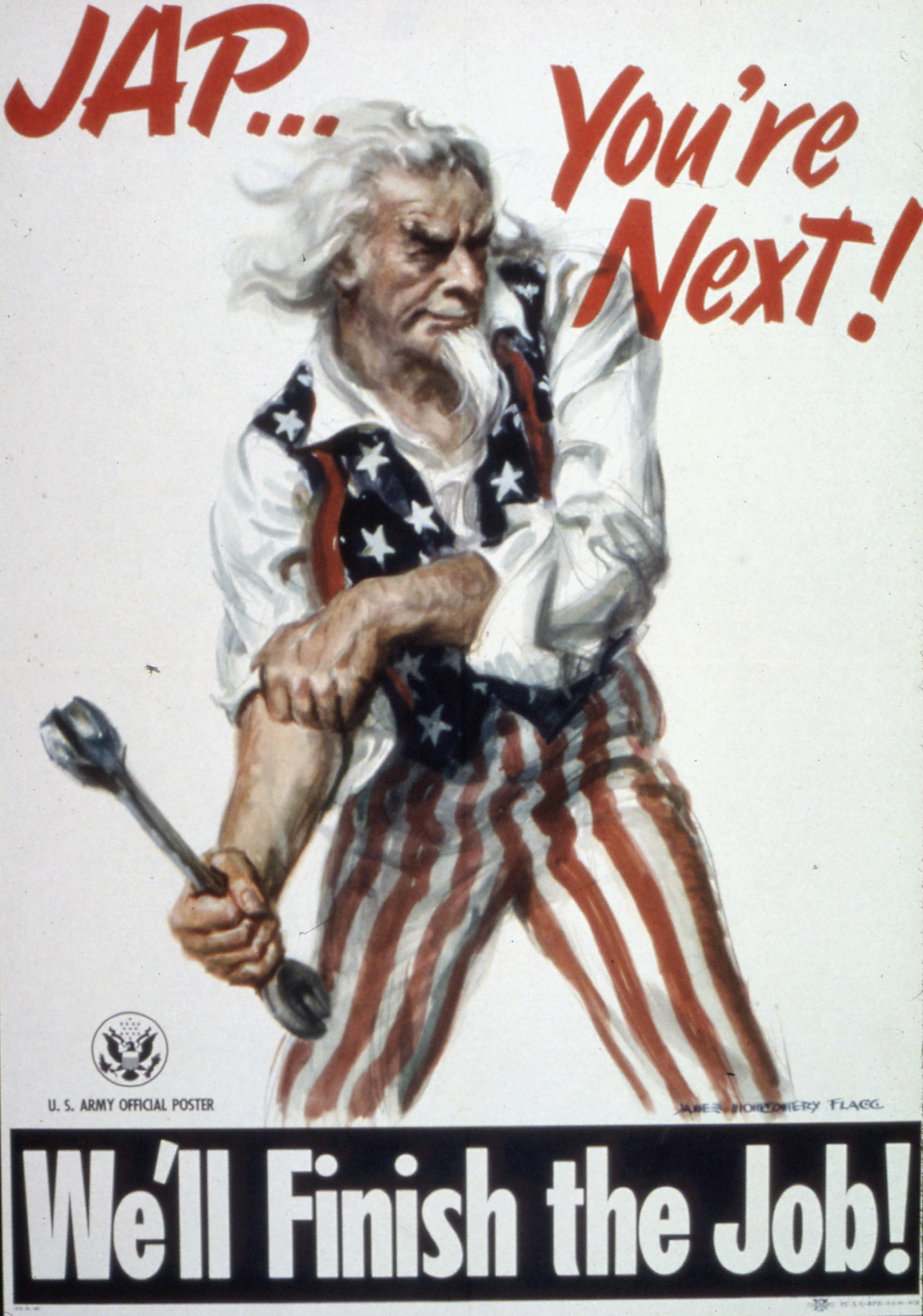
US War publicity poster
“My mother and I, aged 6, went grocery shopping. Every- one was out on their verandas, enjoying the absence of piercing warning signals. Suddenly, an old man yelled ‘Plane!’ Everyone scurried into their homemade bomb shelters. My mother and I escaped into a nearby shop. As the ground began to rumble, she quickly tore off the tatami flooring, tucked me under it and hovered over me on all fours.
Everything turned white. We were too stunned to move, for about 10 minutes. When we finally crawled out from under the tatami mat, there was glass everywhere, and tiny bits of dust and debris floating in the air. The once clear blue sky had turned into an inky shade of purple and grey…….”
-Takato Michishita, Atomic Bomb survivor
- Despite brutal firebombing of more than a hundred Japanese cities and towns which led to near destruction of infrastructure and large civilian casualties, the American high command remained unconvinced about its efficacy to end the war. The firebombing of Tokyo, codenamed Operation Meetinghouse, killed an estimated hundred thousand and destroyed forty square kilometers and more than two hundred and fifty thousand buildings in a single night.
“I was three years old at the time of the bombing. I don’t remember much, but I do recall that my surroundings turned blindingly white, like a million camera flashes going off at once. Then, pitch darkness. I was buried alive under the house, I’ve been told. When my uncle finally found me and pulled my tiny three-year-old body out from under the debris, I was unconscious. My face was misshapen. He was certain that I was dead.
Thankfully, I survived. But since that day, mysterious scabs began to form all over my body. I lost hearing in my left ear, probably due to the air blast. My younger sister suffers from chronic muscle cramps to this day, on top of kidney issues that has her on dialysis three times a week. ‘What did I do to the Americans?’ she would often say, ‘Why did they do this to me?”
-Yasujiro Tanaka, Atomic bomb survivor
- As a full-fledged Allied invasion and ground offensive into Japan was being planned, U.S. President Truman and his war cabinet were getting increasingly alarmed by the estimates of American casualty that would occur from such an invasion. The estimates ranged between two to four million casualties and more than half a million dead. A nation and its citizens were increasingly war fatigued. The President and his cabinet came round to the view that it would be better to use Atomic Bombs to end the war quickly and save American lives. But can such an arithmetic tradeoff justify taking the lives of innocent citizens? I wondered……
“I was eight when the bomb dropped. My older sister was 12. She left early that morning to work on a tatemono sokai (building demolition) site and never came home. My parents searched for her for months and months. They never found her remains. My parents refused to send an obituary notice until the day that they died, in hopes that she was healthy and alive somewhere, somehow.
I too was affected by the radiation and vomited profusely after the bomb attack. My hair fell out, my gums bled, and I was too ill to attend school………”
-Emiko Okada, Atomic Bomb survivor
- A month before that fateful day when the Atom bomb was dropped on Hiroshima, the highly secretive Manhattan project in the US had produced two distinctive types of atomic weapons. The first was code named ‘Little Boy,’ a Uranium based fission chain reaction type bomb. The other was called the ‘Fat Man,’ a more sophisticated and powerful plutonium-based implosion type weapon. Nuclear Physicist J. Robert Oppenheimer, now made famous by the Oscar winning movie of the same name, oversaw the research into the calculation of the fissile material critical mass and detonation.
“Then the sky turned bright white. My siblings and I were knocked off our feet and violently slammed back into the bomb shelter. We had no idea what had happened.
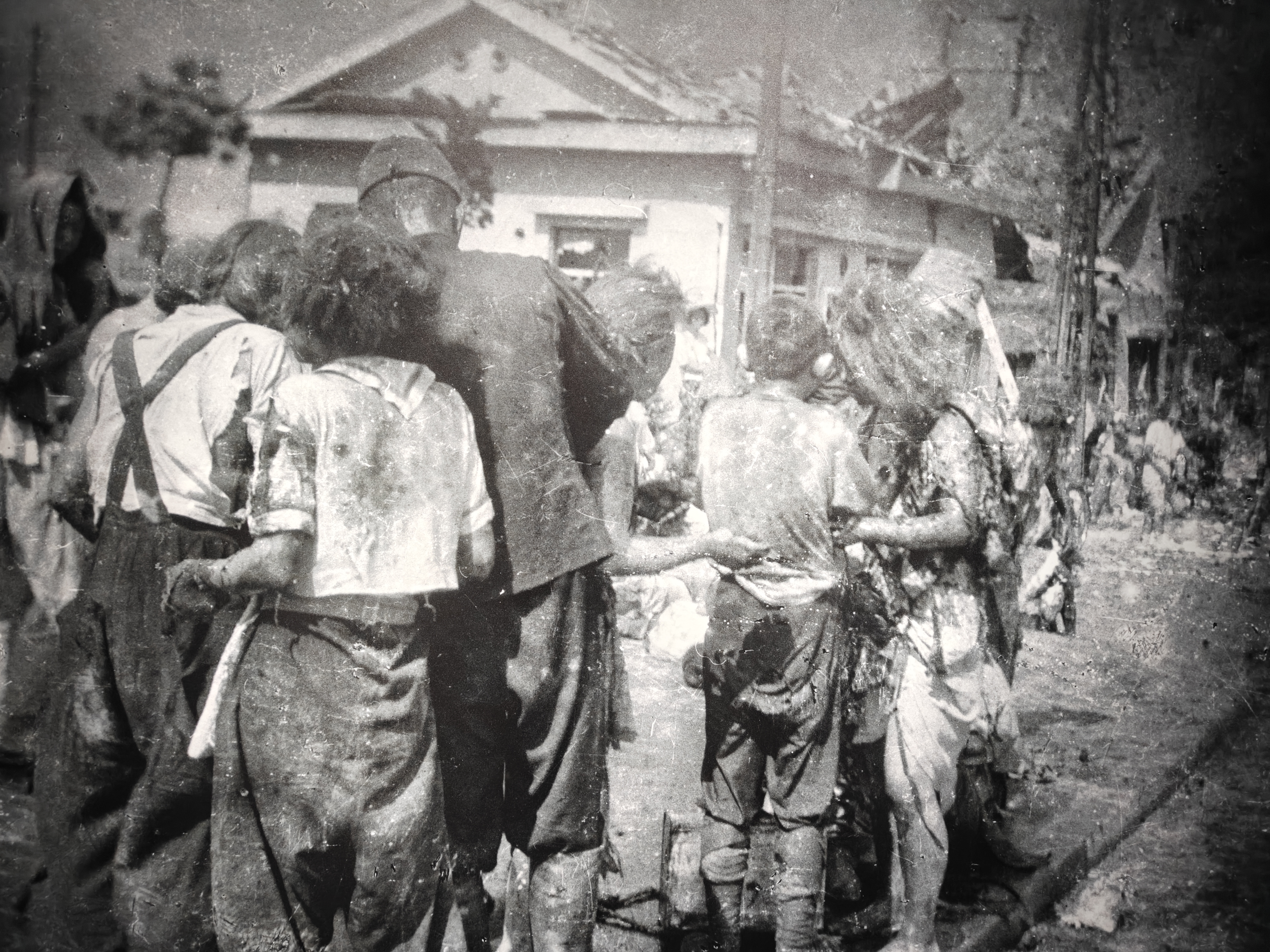
As we sat there shell-shocked and confused, heavily injured burn victims came stumbling into the bomb shelter en masse. Their skin had peeled off their bodies and faces and hung limply down on the ground, in ribbons. Their hair was burnt down to a few measly centimeters from the scalp. Many of the victims collapsed as soon as they reached the bomb shelter entrance, forming a massive pile of contorted bodies. The stench and heat were unbearable.”
-Shigeko Matsumoto, Atomic Bomb survivor
- As the Atomic Bombs were being assembled for eventual use, simultaneously, pilots of the U.S. Air Force were getting trained on the long-distance B-29 Super fortress aircrafts which would be used to deliver the bombs.
“As my mother and I were eating breakfast, I heard the deep rumble of engines overhead. Our ears were trained back then; I knew it was a B-29 immediately. I stepped out into the field out front but saw no planes. Bewildered, I glanced to the northeast. I saw a black dot in the sky. Suddenly, it ‘burst’ into a ball of blinding light that filled my surroundings. A gust of hot wind hit my face; I instantly closed my eyes and knelt to the ground. As I tried to gain footing, another gust of wind lifted me up and I hit something hard. I do not remember what happened after that.
When I finally came to, I was passed out in front of a bouka suisou (stone water container used to extinguish fires back then). Suddenly, I felt an intense burning sensation on my face and arms, and tried to dunk my body into the bouka suisou. The water made it worse. I heard my mother’s voice in the distance. ‘Fujio! Fujio!’ I clung to her desperately as she scooped me up in her arms. ‘It burns, mama! It burns!’
I drifted in and out of consciousness for the next few days. My face swelled up so badly that I could not open my eyes. I was treated briefly at an air raid shelter and later at a hospital in Hatsukaichi, and was eventually brought home wrapped in bandages all over my body.”
-Fujio Torikoshi, Atomic Bomb survivor

- Just after 2 am on 6th August 1945, three B-29s took off from the island of Tinian and proceeded on their six-hour flight to Japan. One of them, the Enola Gay, carried the Little Boy atomic bomb. The bomb was released and detonated over Hiroshima just after eight in the morning. The radius of destruction was two kilometers with fires raging over eleven square kilometers.
“One incident I will never forget is cremating my father. My brothers and I gently laid his blackened, swollen body atop a burnt beam in front of the factory where we found him dead and set him alight. His ankles jutted out awkwardly as the rest of his body was engulfed in flames. My oldest brother suggested that we take a piece of his skull – based on a common practice in Japanese funerals in which family members pass around a tiny piece of the skull with chopsticks after cremation – and leave him be.
As soon as our chopsticks touched the surface, however, the skull cracked open like plaster and his half-cremated brain spilled out. My brothers and I screamed and ran away, leaving our father behind. We abandoned him, in the worst state possible.”
-Yoshiro Yamawaki, Atomic Bomb survivor.

- From the Enola Gay, the crew saw “a giant purple mushroom” that was boiling upward and had reached much above the aircraft altitude. At the base of the cloud, fires were springing up everywhere amid a turbulent mass of smoke that had the appearance of bubbling hot tar. The city that had been clearly visible in the sunlight a few minutes ago, had completely disappeared under smoke and fire. Captain Robert Lewis, co-pilot of Enola Gay, wrote in his log, “My God! What have we done?”
“The injured were sprawled out over the railroad tracks, scorched and black. When I walked by, they moaned in agony. ‘Water… water…’. I heard a man in passing announce that giving water to the burn victims would kill them. I was torn. I knew that these people had hours, if not minutes, to live. These burn victims – they were no longer of this world.
‘Water… water…’
I decided to look for a water source. Luckily, I found a futon nearby engulfed in flames. I tore a piece of it off, dipped it in the rice paddy nearby, and wrang it over the burn victims’ mouths. There were about 40 of them. I went back and forth, from the rice paddy to the railroad tracks. They drank the muddy water eagerly. Among them was my dear friend Yamada. ‘Yama- da! Yamada!’ I exclaimed, giddy to see a familiar face. I placed my hand on his chest. His skin slid right off, exposing his flesh. I was mortified. ‘Water…’ he murmured. I wrang the water over his mouth. Five minutes later, he was dead.
In fact, most of the people I tended to were dead…….”
-Inosuke Hayasaki, Atomic Bomb survivor
**
Epilogue: The final death toll in Hiroshima from the bomb was close to 150,000 people, mostly civilians. An event which led to Japan surrendering nine days later, effectively ending the great war.
Despite heightened awareness of the ‘end of Humanity’ risk posed by nuclear weapons, the cold war between the U.S. and the erstwhile U.S.S.R. ensured continued stockpiling of these very weapons.
In Remembrance…… Shakti Ghosal
Acknowledgements:
- Time Magazine ‘After the Bomb’, 1985.
- Wikipedia: ‘Atomic bombings of Hiroshima and Nagasaki’
- Several of the photos used are from the exhibits in the Hiroshima Peace Memorial Museum.



















 A New Beginning