
The Chronicler and the Curse of BOM Jesus


I chanced upon a news item of a buried ship in one of the world’s driest deserts in Namibia, with a haul of centuries old treasure, untouched by centuries.

The discovery of the sunken ship was made in 2008, in the southern expanse of Namibia’s desolate Sperrgebiet, forbidden territory. Later identified as the Bom Jesus, a Portuguese vessel which was lost five hundred years back during a trade voyage to India. The ship represented the Portuguese maritime empire’s pivot towards India and the east at the height of the Age of Discovery.

Led by Dr. Dieter Noli, a South African archaeologist of repute, the excavating team uncovered more than 2000 gold coins, ivory tusks, copper ingots, and weapons, all in a remarkable state of preservation. Unlike most coastal shipwrecks degraded or looted over time, the Bom Jesus had been pushed inland over centuries by geological forces, and combined with wind blown sediment, it had remained sealed in a natural sarcophagus.

https://search.app/5Ji9D

**

“The sea forgets no soul — it only waits for their return.”

They called it the Age of Discovery. But for those of us who sailed it, it was the Age of Reckoning.

It was the year of Our Lord 1533 when Bom Jesus set forth from Lisbon. She was a three-masted carrack of near 120 feet, her hull of oak black with pitch, her sails heavy canvas stitched in gold thread with the Cross of Christ. She carried five decks — the lower hold stacked with copper ingots from Augsburg and elephant tusks from Sierra Leone, the middle filled with gold and trade wares bound for Goa, and above, our cramped berths where men slept beside their sins.
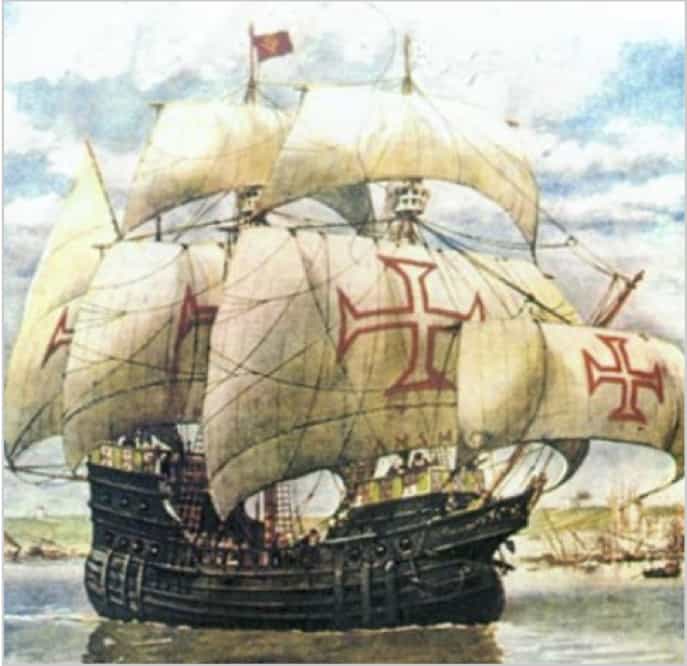
I was the ship’s Chronicler — João Mendes, son of no one worth naming — tasked by the Casa da Índia to record the journey. I fancied myself a man of words, not of winds; I soon learned the sea had its own grammar.

We departed on Ascension Day, bells tolling from the Sé Cathedral, the scent of incense mixing with tar and brine. Captain Dom Diogo Pereira, a veteran of the Carreira da Índia, Portuguese East India Company, stood on the quarterdeck, broad-shouldered and proud, his hand resting on the hilt of his Toledo blade.

“Men of Portugal!” he thundered. “We sail for God and the King! For gold, glory — and for home, if He wills it!”

“Deus nos guie! God guide us!” we cried back, and the Bom Jesus glided down the Tagus into destiny.

Our route was the old one — past Cape Verde to the Gulf of Guinea, then around the Cape of Good Hope, across the endless Indian Ocean to Cochin and Goa. Ten thousand miles of wind, wave, and unseen graves of adventurers.

The first few weeks were kind. Trade winds filled our foresails; flying fish glittered beside the hull. We dined on hardtack, dried cod, and the Captain’s pride. At night I climbed the forecastle to watch the stars wheel — the Southern Cross like a torch over the horizon. The helmsman, old Mateus, would nod at it and murmur, “Mesmo o céu muda para quem navega. Even the heavens shift for those who sail.”

But the sea does not love those who sail it for long.

Near Cape Verde, the wind changed. The compass began to shudder though the sky looked clear. In the hold, a carpenter found an unlisted chest, iron-bound, its seal a reversed cruciform sigil.

The Captain frowned. “No such cargo was declared,” he muttered.

The priest, Father Almeida, whispered, “It bears the mark of the Templários, Templars. Heresy!”

“Open it,” the Captain ordered.

We broke the seal. Inside lay a crucifix of black gold, the figure inverted. It was a Satanic symbol! The air turned cold, though the day outside burned hot. The priest crossed himself. The Captain ordered it resealed and hidden. That night, lightning struck our mainmast.

An inverted, old, gold, satanic cross

Superstition spreads faster than scurvy. The men whispered that we carried a relic damned by God. One swore he heard chanting beneath the deck. Another said he saw a man in robes walking the gunwale at midnight, his feet never touching the wood.

Still, we sailed on — south past Angola, into seas uncharted. The coast grew barren; dunes stretched like the bones of the world. The charts called it Costa dos Esqueletos — the Skeleton Coast. We knew that even the seagulls avoided it.

Then the fog came. It was thick, white, soundless, relentlessly surrounding us. The lookout cried, “Land! Sand ahead!”

“Hard to larboard!” shouted the Captain.

But the current seemed to seize us like a claw. The keel scraped something unseen. The Bom Jesus groaned, a deep, living sound. Below, the ballast shifted; the copper ingots sliding here and there. The ship’s stability seemed to be teetering.

“Drop anchor!” cried Mateus. “Santa Maria, tem Piedade! Saint Mary, have mercy!

The anchor vanished into the mist. The ship tilted. The priest clutched his crucifix and began to pray, though the words seemed to be coming out backwards.

I stumbled to the hold to rescue my journals. The water flooding in seemed to glow faintly green. I saw that the sealed chest had burst open. The inverted crucifix floated upright, its eyes gleaming red as coals. Around it, the gold coins trembled, rising and falling as if breathing. I remember shouting, “Capitão! Venha ver isto!, Captain, come see this!”

He never did. The hull split. Sand and water surged in. The ship screamed as if alive, ribs cracking, decks collapsing. I clung to a beam as men were swept into the dunes that moved like tides.

Through the maelstrom I saw — or dreamt I saw — a figure standing on the water’s surface, face hidden by a cowl, hand raised in benediction. The bell tolled, though no man rang it. Then all went black.

When I awoke, the world was silent. I lay on a dune, the wreckage scattered around me, half-buried in glittering sand. No ship. No men. Only the wind’s long sigh.

I found my quill and a scrap of parchment. The ink had turned thick with salt. I began to write. I needed to remember, to exist. The days blurred. The sun moved, the dunes shifted. Sometimes I would see the broken ribs of the Bom Jesus thrust through the sand like bones. Once, I heard laughter carried on the wind. The laughter of men long drowned.

At night, a pale glow rises from the sea. I hear the toll of the bell, steady, patient. When the fog drifts inland, I glimpse lanterns bobbing on the horizon. Our ship sailing still, her sails tattered, her decks empty. I know her. She calls out to me.

Perhaps I never left her. Perhaps I am still aboard, walking the splintered deck, quill in hand, scratching words no living eye will read.

If you find this parchment, if by some fate the sands give it back, take heed: do not seek the Bom Jesus. Her treasures lie where faith and greed collide, guarded by the sea’s own curse.

And should you hear a bell tolling across a calm shore, do not answer.
For the Bom Jesus sails yet. And her chronicler still writes. Though his hands are bone, and his words drift like mist upon the tide.

“In every wave sleeps a memory, and in every wreck, a prayer unfinished.”

In musing……                                                                                          Shakti Ghosal

What secret did Lal Dighi hide?


Turning, he called out to the guard outside, “Ask my special guards to meet me”.

Two robed men came in. Omichand commanded, “Follow that ayah who accompanied the English woman. Find out all that the woman knows and who all she has met over the last few days. Do what you need to do but ensure that details of Joba’s movements do not get around”.

The next morning, the Captain Commandant’s household was in a tizzy. His wife’s trusted ayah had vanished in the night. Initial suspicion that she had run away with some valuables was quickly dispelled when nothing was found to be missing. Jim got the fort security to investigate but they came up with no answers. The mystery got solved after a few days in a rather gruesome manner when the ayah’s dead body was found floating in the Lal Dighi with her throat slit. 

The above is an excerpt from the award-winning, ‘The Chronicler of the Hooghly’.

Have you read it yet?

www.shaktighosal.com

Ashtami


1947

‘The fire of communal violence was spreading. There existed enough baggage of distrust and enmity between two of the major communities in the country to fan it.

News trickled in about the incendiary speech made by the Bengal Chief Minister Shaheed Suhrawardy and the ensuing cycle of violence which would later come to be known as the Great Calcutta Killings. Since both their larger families were in Bengal, Sujit and Bina were concerned and sent postcards enquiring about the safety and health of everyone. They even offered family members to leave Calcutta for some time and come and stay with them in New Delhi. Mercifully, they got back replies by post that there was nothing to worry about at the moment and all were safe.

But the Calcutta killings and the subsequent incidents of communal violence that followed in several parts of North India were but a trailer of what was to come…………..’

The above is an excerpt from the story Ashtami, part of the Chronicler of the Hooghly.

Book of the Month, Nazm -e- Hayat literary award winner. Available worldwide on Amazon.

www.shaktighosal.com

Authors’ collaboration


Collaboration between two authors can be a virtuous cycle of learning for both.

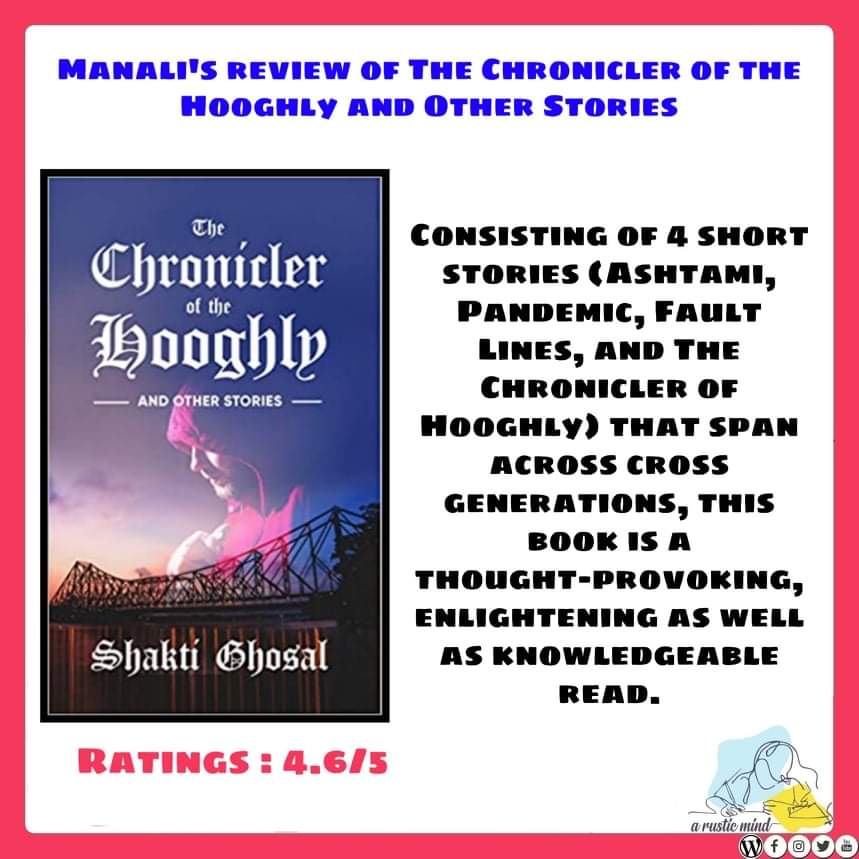
In her review of ‘The Chronicler of the Hooghly and other stories, author Manali Desai writes:

  • All the stories compare a time in India (especially Kolkata) from pre-independence vs now, making us ponder whether things have really changed and also highlighting the fact that ‘the past repeats itself’ and some actions/decisions have their impacts resonated through ages.
  • The writing style doesn’t always paint a pretty or desolate picture, but in fact, manages to preserve the beauty of simple simplicity by interlinking the heritage of Kolkata with commonality. Though the colours are a bit subdued and faded, but they carry lineage and ancestry.
  •  The most striking feature of the book is how the author has let his creativity rewrite history. It comes out especially well in “The Chronicler of the Hooghly” where the paths have been intertwined with well-known historical figures of Bengal.
  • The writing is simple and yet holds the capacity to make a reader fall in love with old Calcutta making them curious about the city’s past.
  •  The stories are thought-provoking and represent various human nature/emotions like greed, sadness, anger but the most applaud-worthy part about the actions in each story is how they bring home the message of karmic ends.

In my review of Manali’s book, I had said :

 “I was coaxed to read the book by a Facebook friend. I had downloaded it in Kindle a while back but could complete the reading only today.

Author Manali Desai took me on a journey. A journey inhabited by three millennials Ayesha Banerjee, Viren Joshi and Abhi Agrawal. A journey which spanned Mumbai, Kolkata and Chandigarh. A journey  into the mind and the world of the Millennial.  And I have come out enriched!

The prologue containing Ayesha’s poetry recital is at once heart wrenching, as it punches the reader in the guts. Showcase as it does one of the evils of our societal mindset.

Adopting an easy and racy writing style, Manali’s narrative does manage to operate at two levels. At one level, the tale is one of the proverbial romance triangle and what that shows up as in social interactions and conversations – during morning walks, in the college canteen and situations. At another level exists the unsureness and the confusion about making a choice. For me the end was somewhat abrupt. Apart from this a nice read.

I would urge Manali Desai to keep on writing.”

In our author collaborative session, we had an interesting discussion on the above aspects.

#shaktighosal#chroniclerofthehooghly#nazmesahityaaward2021#bookofthemonth#manalidesai

India’s 75th year of Independence


‘Came the partition of the country and the independence speech of the first Prime Minister Jawaharlal Nehru in which he proclaimed, “At the stroke of the midnight hour, when the world sleeps, India will awake to life and freedom”.

What followed was something quite the contrary.

Rather than awakening to life, people were awakening to bloodshed, killings, rape and pillage. Rather than awakening to freedom to live where they chose to, people were being forced to leave behind everything they possessed and cross a newly created artificial border, homeless and penniless.

The above is an excerpt from Ashtami, one of the stories in ‘The Chronicler of the Hooghly and other stories’ which recently received the Nazm-e-Sahitya award for 2021.

On this day, as we mark the 75th year of India’s independence, the following excerpt from the section ‘Hebrews’ in the New Testament comes to mind.

“So since we stand surrounded by all those who have gone before, an enormous cloud of witnesses, let us drop every extra weight, every sin that clings to us and slackens our pace, and let us run with endurance the long race set before us.

We may feel alone, but we aren’t. We are surrounded by an army of witnesses. They have run the race of faith and finished well. It is now our turn.

Let us not forget all those who have gone before. Indeed, now it is our turn.

www.shaktighosal.com

#shaktighosal#nazmesahityaaward2021 #Chroniclerofthehooghly #historical,#historicalfiction,#writersofinstagram,#instaauthor,#authorofinstagram,#readrsofinstagram,#novel,#readersgonnaread,#booklover,#bookworm,#ereader,#kindlebook,#bookrecommendation

A discussion in the Metaphysical World


Goura Prasad from Odisha, a student of literature, has sent me this beautiful piece and I am copying it below:

“I’m an admirer of literature. I used to write short poems, few lines about my teachers and felt happy to write about that. I ‘m enjoying The Chronicler of the Hooghly on a fine Sunday morning.

The Chronicler of the Hooghly is a good book with a unique writing style. It can be best enjoyed at the dining table, a father with a copy of the book in his hand and his children as active listeners.

Goura Prasad further provides this so very interesting discussion in the metaphysical world!

(Topic- Author Shakti Ghosal)

If Shakespeare, George Benard Shaw, William Wordsworth, Robert Frost and some other contemporary writers of their level were to talk to each other in the metaphysical world regarding Author Shakti Ghosal they may be very much thankful towards him firstly.

How Shakti is deeply rooted in the field of literature with some advanced literary ideas; claps may come voluntarily from them while talking to each other in the metaphysical world.

Shakespeare might say this to Shakti, “I’ve written so many dramas and sonnets, but the way you present the incidents with appropriate scenes Hail Thee to it.”

George Benard Shaw might suggest, ” No foreigner can speak English with hundred percent accuracy but your writing style is worth observing.”

Robert Frost may confide, ” I could not stop in the forest to enjoy the growing darkness of an advancing evening as I was assigned with so many responsibilities and I ‘ve mentioned this also in “Stopping by Woods on Snowy Evening.” But from our discussion, I can assure you I’ll take leave to enjoy your The Chronicler of the Hooghly.”

And the discussion goes on……..

Thank you Goura for the above wonderful thought. You have indeed made my day!!

www.shaktighosal.com

#shaktighosal#chroniclerofthehooghly#nazmesahityaaward2021#bookofthemonth#novel,#readersgonnaread,#booklover,#bookworm,#ereader,#kindlebook,#bookrecommendation,#fiction,,#bookloversunite,#booksbooksbooks#booknerd,#bookobsessed,#bookaddict,#booksofig,#bookstherapy,#returntoreading,#rediscovergoodread,#happyreading,#bookishlife,#booksbrat

The Hooghly has seen it all….


A thrilling saga of a mystical pearl necklace which spins history and myth addictively across different dimensions.

Across time as it takes the reader on a two and a half centuries journey.

Across human failings and virtues of political intrigue, greed, betrayal, love and magnanimity.

The Chronicler of the Hooghly continues to make emotional waves worldwide.

In the words of The Telegraph, “…. it is the sensitive treatment of the characters battling these tragedies that enriches these tales.”    

http://www.shaktighosal.com

#shaktighosal#Chroniclerofthehooghly#bookofthemonth#bookcommunity#bookaholic#bibliophile  #shelfie#bookshelf#readers#bookoftheday#ilovereading#bookblog#bookgeek#bookalicious#readingforfun#ilovebooks#bookstagramfeature#booklife#bookaddiction#beautifulbooks#unitedbookstagram#bookishfeatures#bookgeek

Nazm-e-Sahitya Award 2021


Nazmehayat was conceived as a platform for worthy writers. Curated by its two founders Swapnil Singh and Anushree Goswami, Nazmehayat offers book recommendations, contests as also a blogging platform for writers. It has a significant presence on social media platforms.

Nazmehayat has the vision to become a leading Literature platform in the world.

www.nazmehayat.com

Today morning, I woke up to the pleasurable news that Nazmehayat has awarded me the Nazme Sahitya award 2021 for the Chronicler of the Hooghly and other stories.

Thank you Nazmehayat for the recognition.

The Brahman


‘ Deb returned to Calcutta, but to greater worldly burdens. One day, as he sat with his friend, he confided, “Having lost my father, I sought solitude. What I have got instead are never-ending duties and worldly commitments. There is a struggle going on inside me and I do not know who would win- the World or the Spirit.”

That night, Deb saw his departed mother in his dream, “Hast thou really become the One who knows Brahma? If so, sanctified is thine family, fulfilled is thine mother’s desire.”

Deb woke up to find all his worries gone and his mind feeling like a feather.

When Carr, Tagore and Company finally declared bankruptcy and with it the closure of all the businesses, Deb said to Sarada, “All our businesses and property have gone out of my hands. What I had prayed for has been granted and realised. As the moon gets freed from Rahu, so has my soul become free from the worries of the world and now feels the heaven of Brahman.”

Thus it was that the son of Prince Dwarkanath became Rishi Debendranath. The pearl necklace and the curse that accompanied it had come a full circle. It had journeyed from adorning Lord Krishna in Chandernagore to driving the scion of a business empire based in Kolkata to renounce everything and embrace spirituality.’

The above is an excerpt from the story ‘The Chronicler of the Hooghly’ from the book of the same name. The book continues to make emotional waves worldwide with more than one hundred and seventy excellent ratings and reviews on Amazon and Good Reads.

www.shaktighosal.com

#shaktighosal#chroniclerofthehooghly#debendranathtagore#bookofthemonth#emotionalread#bookshelf#readers#bookoftheday#ilovereading#bookblog#bookgeek#bookalicious#readingforfun#ilovebooks#bookstagramfeature#booklife#bookaddiction#beautifulbooks#unitedbookstagram#bookishfeatures#bookgeek#bookprojects#readingforfun#addictedtobooks#readabook