Twilight or Dawn? America and the Paradox of Empire


Abstract

Empires are rarely undone by external invasion; they corrode from within. The American project, like Rome, Britain, and Persia before it, now faces the timeless paradox of imperial overreach: wealth without equity, dominance without renewal. This article situates America’s trajectory within the historical cycle of imperial rise and decline, drawing upon both philosophical reflection and historical precedent. The central question is whether the United States will recognize decline as an opportunity for renewal, or whether, blinded by illusions of permanence, it will follow the path of its predecessors into twilight.

**

Introduction: The Cycles of Empire

Over the last few months, especially as the American tariff challenge for the rest of the world heated up, two distinct narratives have emerged in the public space. The first dwells on the unfairness—indeed the shortsightedness—of U.S. tariff policy and how it is being differentially applied to target certain countries while sparing others. The second narrative takes a step back and enters the philosophical domain: What makes America act the way it does? The symptoms, they argue, are those of an empire in decline.

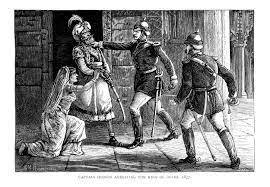
In this piece I attempt to make sense of the unfolding moment through a historical lens of past empires. From the Achaemenid Persians to the British Raj, empires rose not only on military might but on the promise of order and prosperity. Yet, as Gibbon observed in his monumental study of Rome, empires collapse when external expansion conceals internal fragility. ¹

Toynbee later refined this insight, suggesting that civilizations do not perish from conquest but from their failure to respond creatively to crises. ² America, with its wealth concentrated in elites and its politics increasingly polarized, today finds itself at a similar point of reckoning.

**

The Illusion of Permanence

Decline is often hastened by the presumption of permanence. The British Empire, enriched by its Indian possessions, clung to naval supremacy long after its economic foundations had weakened. The Qing dynasty, flush with silver inflows, remained blind to the destabilizing flood of opium that hollowed out its society. The Ottomans celebrated elaborate military ceremony even as their agrarian base stagnated. In each case, the empire was undone less by external enemies than by its inability to adapt.³

The United States mirrors these patterns. Its massive trade deficits, spiraling national debt, and persistent militarism signal not strength but imbalance. Each dollar allocated to foreign wars secures corporate gain more than civic renewal. Bridges crumble, schools falter, healthcare divides communities, and social trust erodes. Yet the spectacle of global dominance continues—an aircraft carrier here, a sanctions regime there—masking fragility at home. This, too, is the illusion of permanence.

Rome thought itself eternal, describing itself as the urbs aeterna, the eternal city. Britain assumed that the sun would never set on its empire. America today speaks of “exceptionalism” with the same conviction, believing its dominance to be destiny rather than circumstance. The danger lies in mistaking temporary advantage for permanent security.

**

The Anatomy of Overreach

The trajectory of great powers often follows a recognizable arc: expansion, consolidation, overreach, and decline. Paul Kennedy, in The Rise and Fall of the Great Powers, describes how military commitments abroad eventually outstrip economic capacity at home.³ For Rome, it was the expense of garrisoning distant frontiers. For Spain, the drain of endless wars in Europe. For Britain, the unsustainable costs of two world wars.

For the United States, overreach is visible in both economic and military forms. The U.S. spends more on defence than the next ten countries combined, maintaining hundreds of bases across the globe. Meanwhile, its domestic economy is marked by widening inequality, stagnant wages, and crumbling infrastructure. The paradox is stark: a nation capable of projecting power thousands of miles away struggles to repair its own highways or ensure equitable healthcare.

Tariff wars, trade imbalances, and fiscal deficits echo earlier imperial mistakes. Protectionist policies may secure short-term bargaining chips, but they also reveal a deeper anxiety: the fear that economic primacy is slipping away. History suggests that such reactive measures rarely restore strength; they merely postpone the reckoning.

**

Philosophy of Decline and Renewal

At its core, the phenomenon of empire offers a philosophical lesson in impermanence. Heraclitus, writing in the sixth century BCE, reminded us that “all things flow,” that permanence is an illusion.⁴ To mistake hegemony for destiny is to deny this truth.

Toynbee argued that the decisive moment for civilizations lies in their response to challenge: renewal through creativity or collapse through inertia.² Renewal requires humility, the willingness to recognize that decline is not failure but an opportunity for rebalance. For America, such renewal would mean abandoning the imperial reflex and returning to the foundations of civic life—justice, education, community, and sustainability.

True security lies not in endless war or technological spectacle but in balance: between wealth and justice, expansion and reflection, ambition and humility. Without such rebalancing, the American century risks being remembered as another brilliant but fleeting flame in history’s long night.

**

Lessons from History

The cycles of history caution against complacency. Rome endured for centuries, but its collapse was sudden when it came. The Qing dynasty appeared invulnerable until it unravelled within a few decades. The Soviet Union, projecting strength one year, disintegrated the next. Empires rarely decline in a linear, predictable fashion; instead, they erode silently until an external shock exposes their fragility.

For the United States, that shock could come from multiple directions: financial crisis, climate catastrophe, technological disruption, or internal political fracture. Already, polarization corrodes trust in institutions, while economic inequality breeds resentment. These fissures, if unaddressed, could accelerate decline.

Yet history also shows that renewal is possible. Japan, devastated by war, reinvented itself as an economic powerhouse. Post-imperial Britain, though diminished, adapted into a service economy and retained cultural influence. Even Rome, in its Byzantine continuation, transformed decline into resilience. America, too, could reimagine itself—not as empire, but as a republic recommitted to equity and balance.

**

Conclusion

The setting sun is not fate; it is metaphor. Empires end not because history commands it but because they fail to heed its rhythms. Whether America confronts its inner distortions or clings to the illusion of permanence will decide whether twilight yields dawn—or darkness.

The challenge, then, is not to deny decline but to interpret it rightly. If decline is seen as failure, America will cling to militarism, exceptionalism, and spectacle until resources are exhausted. But if decline is embraced as a chance for renewal, the American project may yet rediscover vitality—proving that twilight need not always lead to night. Sometimes, it can be the hour before a new dawn.

**

Notes

  1. Gibbon, Edward. The History of the Decline and Fall of the Roman Empire (1776–1789).
  2. Toynbee, Arnold. A Study of History. Oxford University Press, 1934–1961.
  3. Kennedy, Paul. The Rise and Fall of the Great Powers. Random House, 1987.
  4. Heraclitus. Fragments. c. 500 BCE.

In musing……..                                            Shakti Ghosal

How AI is Transforming the HVAC Industry: An Impact study on a matured engineering domain


Centrifugal machines running on principles of Thermodynamics

I spent a part of my career in the HVAC industry many decades ago, at a time when it was firmly grounded in the disciplines of mechanical engineering and thermodynamics—both mature and deeply technical fields. Back then, optimizing system performance meant manually tweaking airflow, calculating heat loads, and understanding refrigerant behavior. I had worked with Voltas, a market leader in central HVAC systems and Fedders Lloyd, which manufactured and marketed low end Airconditioning units.

Controls of HVAC system
Of nuts, bolts, pipes and ducts

I find it fascinating to observe how today, the game has changed. This has been significantly due to Artificial Intelligence (AI)—a disruptive force that’s injecting intelligence, adaptability, and automation into an industry that once thrived on nuts, bolts, and thermal dynamics.

**

Smarter Diagnostics and Predictive Maintenance

AI-powered tools now enable HVAC systems to identify faults before they cause breakdowns. Instead of relying on trial and error, it is now possible for technicians to use sensor data and predictive analytics to find the root cause quickly—whether it’s a refrigerant leak or an airflow issue.

“AI algorithms enable predictive maintenance by monitoring operational data such as temperature, pressure, and energy consumption to detect potential issues before they escalate.” — [ATA College, 2025]

These AI systems don’t just detect problems—they help prevent them, significantly reducing downtime and maintenance costs.

**

🌱 Energy Efficiency: Better for Business and the Planet

Energy consumption has always been one of the biggest pain points in HVAC operations. AI  can address this by learning occupancy patterns, weather forecasts, and energy pricing to optimize performance in real time.

“AI can optimize HVAC operations by responding dynamically to external conditions and human behavior, ensuring comfort without excess energy use.” — [Cooling India, 2025]

The result? Lower energy bills, improved comfort, and a smaller carbon footprint—benefiting both the bottom line and the environment.

**

🌡️ Personalization and Smarter Design

Modern HVAC systems don’t just heat or cool—they adapt. AI makes it possible to personalize climate control for zones or individuals based on learned preferences.

Beyond user experience, AI is improving the design phase too. Engineers can now simulate various configurations before installation, ensuring better efficiency and fewer on-site errors.

“AI is being used to create virtual simulations of HVAC systems during the planning phase, helping engineers choose the most efficient configuration.” — [Digital Defynd, 2025]

**

🏢 Automation and Operational Efficiency

AI doesn’t merely stop at system optimization. It can streamline administration tasks like scheduling, dispatch, and customer service through chatbots and intelligent platforms.

In smart buildings, IoT-connected HVAC systems can adjust automatically to changing conditions, cutting operational costs and improving system responsiveness.

“Intelligent building systems that include AI-driven HVAC control are emerging as a top growth area for the industry.” — [Frost & Sullivan, 2025]

**

⚠️ But It’s not all smooth sailing…

Ai has also brought with it certain downsides and risks.

  1. Cybersecurity is a growing concern. As HVAC systems get more connected, they become more vulnerable to attacks. To combat, companies would require to invest in data security and system integrity.
  2. Cost: AI tools, sensors, and integrations require significant upfront investment—posing a barrier for smaller firms.
  3. People factor: Many technicians will need to upskill to stay relevant. The shift is as much about mindset as it is about knowledge of the machinery.

“The technicians of tomorrow must be as comfortable with data analytics as they are with ductwork.” — [ATA College, 2025]

**

🌍 Looking Ahead

One needs to hold the perspective that AI is not just an upgrade—it’s a paradigm shift for HVAC. Those who embrace it will find new opportunities in efficiency, customer satisfaction, and sustainability. But success will depend on thoughtful implementation, investment in skills, and a willingness to adapt.

As someone who once worked in the traditional world of HVAC, I find it both exciting and humbling to see how far the industry has come—and how far it can still go.

**

💬 Let’s Discuss:
Are you seeing AI being adopted in your HVAC projects or buildings? What challenges or benefits are you encountering?

📚 References and Further Reading

# HVAC , # AI, #Industry transformation, # Diagnostics, #preventive maintenance, #Energy efficiency, #design, #automation

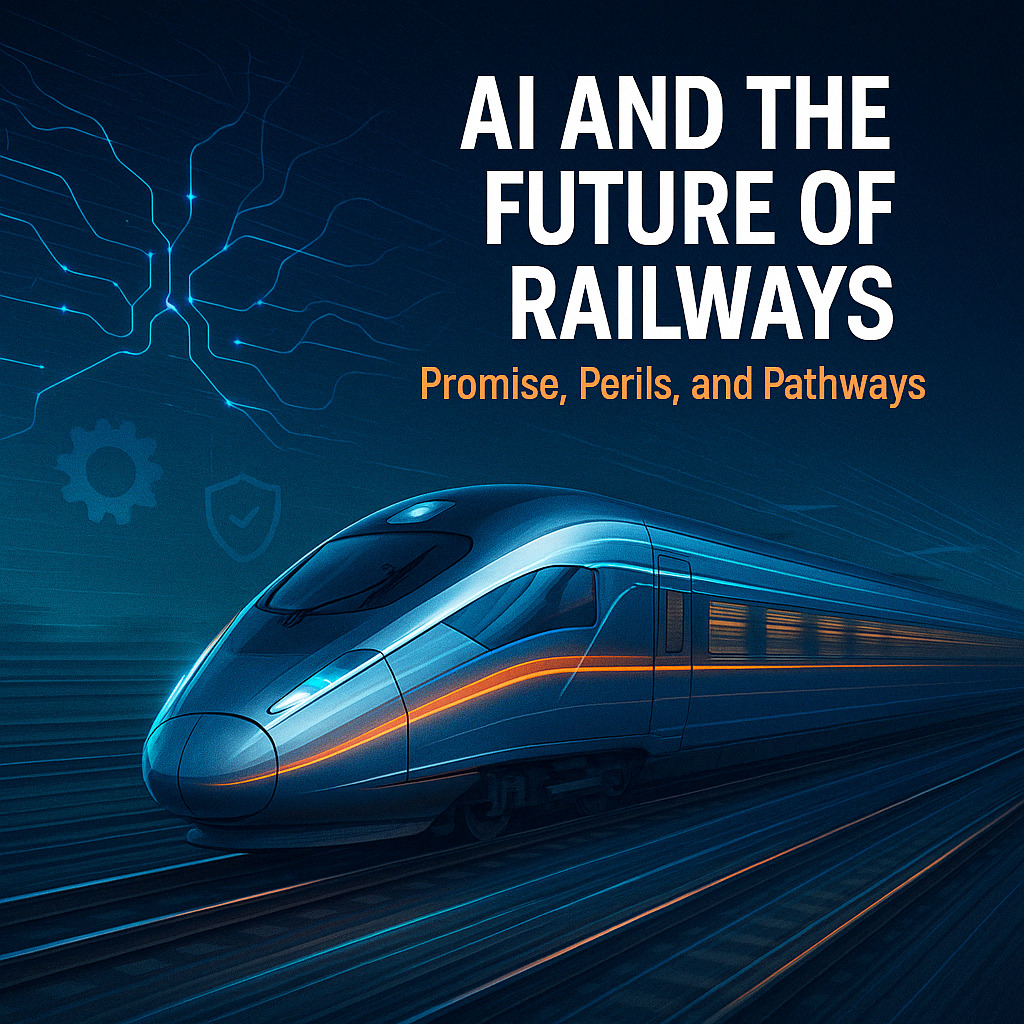
Artificial Intelligence and the Future of Railway Transportation: Promise, Perils, and Pathways


“The railway industry, one of the oldest enablers of industrial transformation, now stands on the cusp of another revolution—this time powered by Artificial Intelligence.”

From the steam engines of the 19th century to today’s high-speed trains, railways have been symbols of innovation. Now, as we move deeper into the 21st century, Artificial Intelligence (AI) promises to redefine how rail networks are managed, how trains are operated, and how passengers experience travel.

But like every major transformation, the rise of AI in railway transportation is not without its challenges. The genesis of this article stems from the fact that I started my work life in the Indian Railways Service of Mechanical Engineers nearly half a century back. More recently when I was doing a Wharton Business School program on AI applications, the idea of this piece came to me.

  In this article, I have tried to explore the promise, perils, and pathways of integrating AI into one of the most vital sectors of modern infrastructure, particularly for a dense population country like India.

***

🚄 The Promise: Efficiency, Safety, and Customer Experience

AI does hold considerable potential to make a high-density transportation mode like the Railways smarter, safer, and more responsive. Here are just a few areas where the promise can be seen:

  • Predictive Maintenance: Machine learning models can analyze vibration, temperature, and operational data to detect potential failures before they occur—reducing costly downtime and enhancing safety.

Predictive maintenance, powered by sensor analytics and machine learning, are reducing unplanned downtime by up to 30% in Germany (Deutsche Bahn). In India, AI-equipped SMART coaches can now monitor vibrations, structural wear, and staff behavior, leading to substantial maintenance savings and enhanced safety.

  • Optimized Scheduling and Routing: AI can dynamically adjust train schedules based on real-time data—weather, demand, or disruptions—minimizing delays and maximizing throughput.

In dense rail networks like India’s or Japan’s, such precision translates into better asset utilization, optimized route rationalization, and more efficient capacity deployment.

  • Safety and Reliability: AI enhances safety through real-time monitoring and automated diagnostics. Computer vision systems are today identifying track defects, unauthorized access, and obstacles with over 90% accuracy. AI-powered drones can now inspect tracks and overhead equipment faster than traditional crews, improving both safety and inspection efficiency.

Train operations benefit from AI-assisted driver alertness monitoring and automatic braking recommendations based on track conditions. These advancements reduce human error—still a leading cause of railway incidents.

  • Passenger Experience and Multimodal Connectivity: In many places, AI-driven chatbots and journey planners have started offering personalized updates, route alternatives, and digital ticketing, improving passenger convenience. Integrating railways with buses, metros, and even micro-mobility options via AI platforms is enabling seamless urban mobility. In megacities, this creates rail-centric multimodal ecosystems where trains form the backbone of transportation.
  • Smart Ticketing and Crowd Management: With the use of computer vision and behavioural analytics, Railways can monitor crowd flows in stations and adjust boarding strategies in real time, improving passenger experience and safety.
  • Energy Efficiency: AI-powered driving systems can optimize acceleration and braking, saving energy and reducing emissions—a critical benefit as Railways strive to meet sustainability goals.
  • Environmental Sustainability: AI can help Railways fine-tune energy use by adjusting acceleration, coasting, and braking in real time, reducing fuel and electricity consumption.

When paired with green innovations like hydrogen-powered trains—such as Germany’s Coradia iLint and the US’s ZEMU—railways can become even more climate-friendly, especially in non-electrified regions

In short, AI can turn data into decisions—at scale and in real time.

***

⚠️ The Perils: Bias, Job Displacement, and System Vulnerabilities

Yet, for all its promise, AI also brings forth complex challenges that Railway systems must navigate with care. Let us try and understand what these are.

  • Algorithmic Bias: AI systems are only as unbiased as the data they’re trained on. In Railways, there is a high chance this could lead to unfair prioritization of certain routes or populations. This is because of historical inequities that are embedded in the stored data.
  • Job Displacement: As AI would continue to automate driving, monitoring, scheduling, maintenance and customer service, several roles would become redundant. While this may lead to job displacement in the short term, it will also create new roles in data science, system integration, and AI governance.

This is where visionary leadership would come in to shift focus and resources relating to reskilling, transitioning and to answer the more fundamental question about the human cost of automation.

  • High Implementation Costs: AI deployment demands hefty upfront investment in digital infrastructure—sensors, data platforms, training, and cybersecurity. For developing economies like India, justifying these expenses against long-term gains poses a financial and strategic challenge. This is also where a visionary leadership needs to come in.
  • Cybersecurity Risks and systemic reliability: Risks would surely go up as a more digitized and AI-integrated Railways system would become an attractive target for cyberattacks. A breach in an AI-driven control system could have dangerous and far-reaching consequences.

Reliance on AI systems thus must be balanced with robust fail-safes by strong governance and redundancy protocols.

  • Public Trust and Ethics: AI in public infrastructure must be transparent and accountable. Otherwise, trust erodes—especially if systems malfunction or make controversial decisions without human oversight.

The above risks underscore the need for careful design, regulation, and human-in-the-loop systems.

***

Railways vs Other Transport Modes: A Comparative Snapshot

FactorRailways (AI-enhanced)Road TransportAir Transport
CostLow per ton/km for freightHigh due to fuel and laborHighest operational cost
Environmental ImpactLow (electrified or hydrogen)High (diesel trucks)Very high (jet fuel)
ConvenienceIdeal for dense corridorsFlexible last-mile serviceSpeed for long distances

Railways, strengthened by AI, would thus remain the most cost-effective and sustainable mode for high-density freight and passenger volumes. Hydrogen trains further extend these advantages to non-electrified routes.

***

🧭 The Pathways: Navigating the AI Railway Future

So, how can the Railways harness AI’s promise while avoiding its perils? The following thoughts come to mind.

1. Adopt a Human-Centric Approach: AI should always be viewed as an Enabler, not a Replacer of human expertise.  Railways systems should ensure the centrality of human judgment, ethics, and oversight; this becomes particularly important in safety-critical functions.

2. Invest in Digital Infrastructure: To unlock AI’s power, the Railway systems would need high-quality data, real-time connectivity, and interoperable platforms. One can well envisage that Digital twins, Edge computing, and IoT-enabled trains would form the backbone of AI-enabled rail networks in the future.

3. Prioritize Ethics and Explainability: AI based decisions need to necessarily be transparent and explainable. Regulators and the Railways need to work together to ensure AI systems meet public standards of fairness, accountability, and non-discrimination.

4. Reskill and Redesign Work: The rise of AI urgently calls for a parallel investment in people—training them to work with AI tools, interpreting machine insights, and contributing to higher-value tasks. Railway jobs and functions need to evolve, not disappear.

5. Collaborate Across Sectors: The Railways need tocollaboratewith the private sector vendors and suppliers, technology companies, and researchers to create standards, protocols, and governance models that ensure responsible innovation.

***

🚉 Need for a New Era of Railways Leadership

Integrating AI into Railway transportation is not merely a technological shift—it’s a leadership challenge. It requires vision, ethics, inclusiveness, and a commitment to long-term impact.

As Railway systems worldwide experiment with smart stations, autonomous maintenance, and AI-based scheduling, one thing is clear: those who navigate this transformation thoughtfully will shape the future of mobility.

***

Future Outlook: Smarter, Cleaner Railways

Over the next 3 to 5 years, we’ll surely witness:

  • Autonomous train operations with AI-powered dispatch and navigation.
  • Real-time dynamic pricing to optimize demand and revenue.
  • Prototypes of hydrogen-electric hybrid locomotives becoming mainstream in Europe, North America, and parts of Asia.
  • AI-enhanced simulation systems to train staff and emergency responders.

Railways stand at a unique inflection point. From my own early days in the Indian Railway Service of Mechanical Engineers, I’ve seen the disruption from steam to diesel-electric and now to AI and hydrogen. With the right investments, policy frameworks, and workforce strategies, the railways of tomorrow will be not just faster or cleaner—but smarter

Final Thoughts

The train to the future has already left the station. The question is:Are we building the right tracks for it?

If you’re working in transportation, AI, or infrastructure, or remain interested and curious about these domains, I would love to hear your thoughts. How is AI showing up in your work? What opportunities—or concerns—are you seeing? Let’s build the conversation together.

The article link, as published in LinkedIn is here: https://www.linkedin.com/pulse/artificial-intelligence-future-railway-transportation-shakti-ghosal-tcb9e

References

  1. Tang et al. (2022), “AI and Predictive Maintenance in Transport Systems”
  2. Bitdeal (2024), “Case Studies on AI in Railways: Deutsche Bahn and Indian Railways”
  3. World Economic Forum (2024), “Hydrogen Trains: The Future of Clean Mobility”

In Learning…….. Shakti Ghosal

#ArtificialIntelligence #Railways #Transportation #AIandEthics #FutureOfWork #Mobility #SmartInfrastructure #Leadership

.

Bengali Wedding 2022


My younger daughter Piya’s wedding was being celebrated.

The interesting thing was that though I have participated in several Bengali weddings, including my own. over the years, this one was providing me a refreshing ‘stand and stare’ perspective of the goings-on. Was this because this was ostensibly the last big event in the family? Or was it because of my acquiring a more relaxed and less impatient mindset with advancing age? I remained unsure.

The Tubri firecracker of Bengal has no real parallel elsewhere. When lit, the small round earthen pot emanates a gentle gurgling sound with tiny sparks coming out of the hole. The intensity increases with the colourful sparkles streaming up to great heights, accompanied by the rising crescendo of the combustion sound.

Like the Tubri, the Bengali Wedding too starts as a gentle symphony of fun and bonhomie which then blooms into a larger-than-life event showcased through a riot of colour, lights, feasting, and rituals.

Ai Buro Bhat, that Bachelorette and Rice event. The last ‘big meal’ of the would-be bride as a bachelor!

It is a much-awaited ritual and the wedding bell starts to ring as family and friends gather to bless the bride-to-be. A sumptuous meal awaits her and the others present. Ranging as it does from fish and meat dishes, fried foods to Mishti, the traditional Bengali sweets. A fun event replete with jokes, reminiscences by the elders, and banter.

The blessing…..as my nonagenarian ( 90 years old) mother blows the conch shell

Ai Buro Bhat

The pre-wedding evening gets packed with four events.

The Mehndi event is all about creating exquisite body art through the application of Mehndi or Henna. An event in which the bride-to-be and other ladies participate. As the evening progresses, Mehndi, that red-orange stain applied on the palms and hands, keeps on darkening! It is said that the darker the mehndi, the more would be love in the air.

Mehndi mysticism

Those exquisite designs

Ashirbaad, the Bengali pre-wedding ceremony, is all about blessing the would-be couple. The ritual is symbolized by parents and senior family members putting dhaan, rice husk and dubyo, trefoil leaves on the heads of the to-be-weds, along with exchanging gifts of gold jewellery, clothes, and sweets.

Ashirbaad

The blessing

Sangeet literally means music. The Sangeet event with its music and dance, is a celebration of the wedding union and bonding. Everyone is expected to let one’s hair down and shake a leg. Be it through impromptu jiving or a choreographed dance performance.

Let’s waltz into the future….

Shall we jive?

Shake a leg

Rock n’ roll!

Eyi to Hethaye kunjo chayaye

And finally, it is about that one ring that signifies a resolve to join together in life’s journey. The Engagement ring ceremony.

The engagement

Comes the Bengali Wedding Day when the bride and the groom tie the knot.

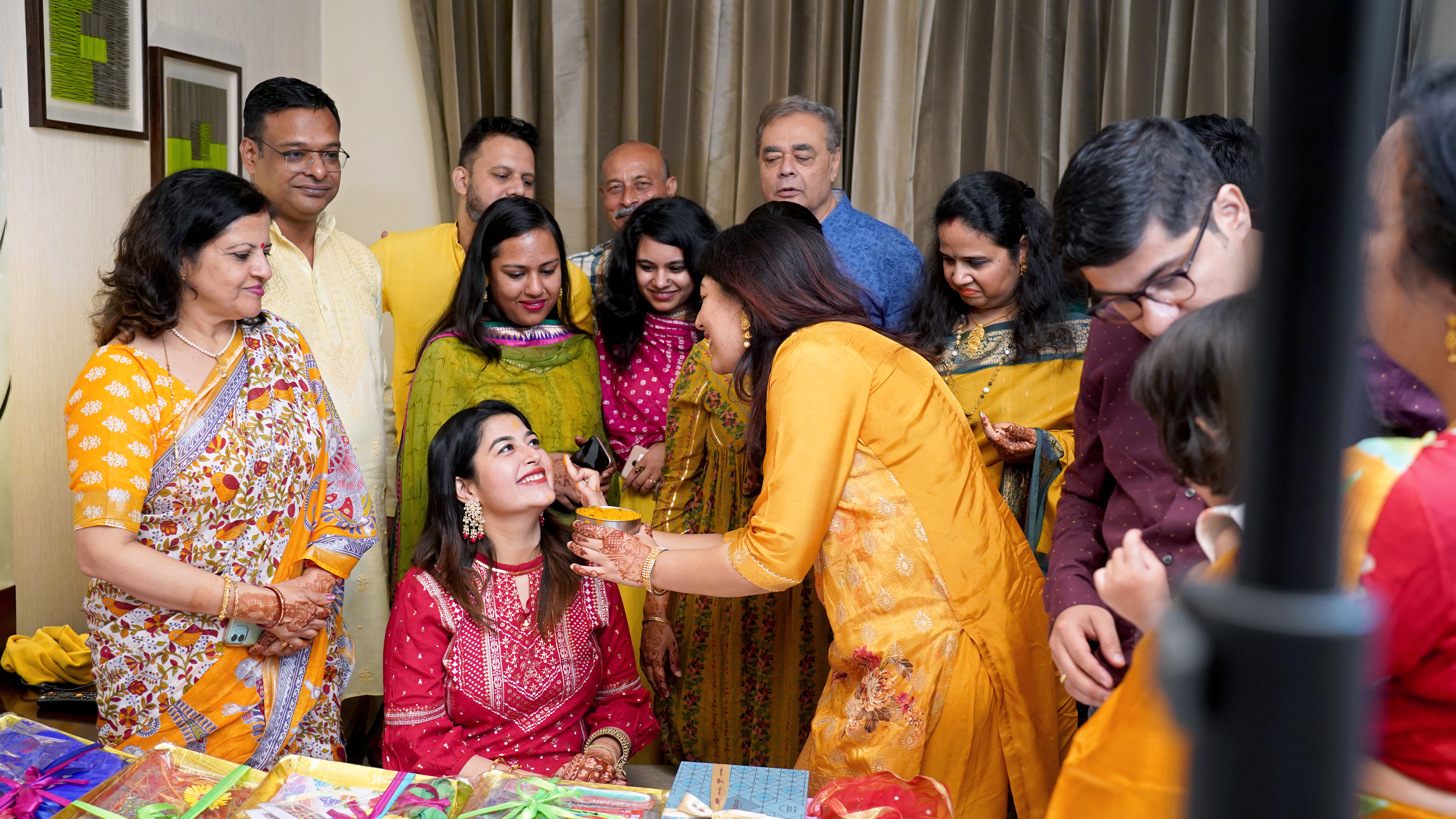
The morning starts with the Gaye Holud ritual. Gaye Holud is all about smearing turmeric paste on the bride’s face and body. The ‘groom smeared’ turmeric is brought for the bride by the groom’s family members. Apart from being considered a beautifying and brightening agent, turmeric symbolizes healthy relationships for the future.

Gaye Holud

The Bengali wedding has the practice of exchanging attractively packaged gifts. The bridegroom’s family members bring these along with the bowl of turmeric paste for the gaye holud. All those brightly decorated tatta trays, containing as they do clothes, gifts and accessories, are a visual delight. Apart from the sheer creative effort to make them, Tatta trays are supposed to bring with them abundant blessings and good wishes.

Totto ……. can you spot the decked-up fish?

Bor Boron is all about formally welcoming the groom to the wedding. The Bor, Groom arrives with his bor jatri entourage (On his wedding day, Piyush the groom, and all the others had to come through a heavy downpour!). The bride’s mother does Boron viz. blesses and welcomes the groom at the entrance with a kula, bamboo winnow accompanied by the sounds of Uludhwani, before the latter is escorted to the Chhadnatola, the wedding mandap.

Bor Boron

Bor Jatri

Quintessential Bengali bride

Subho Dhristi is that first exchange of glances between the bride and the groom. Carried on a pidi, a wooden stool, seven times around the standing groom, the bride keeps her face covered with paan patta.  betel leaves before slowly revealing her face for that auspicious glance.

Prelude to Shubho Drishti

Comes the Mala Bodol in which the bride and the groom garland each other thrice, the Sampradan in which the father ‘hands over’ his daughter, the bride, to the groom and the Anjali in which the groom holds the bride’s hands from behind as they offer khoi, puffed rice to the sacred yagna fire.

Mala Bodol

Sampradan

Anjali

The evening is still young … so photo opportunity, some dancing, good food, and drinks for all!

Newly weds

The evening is young!

Let’s make some noise!

Next morning and it is time for the bittersweet custom of Bidaye. The bride bids farewell to her parents and other family members as she gets ready to accompany her newly wedded husband to his home.

Bidaye

Let’s go home.

As the Bride reaches her new abode, she is welcomed by her mother-in-law with Arati, a ritual meant to bring in light. She steps into an Alta (red dye) filled tray and then walks onto a white cloth. Those alta laced red footprints on the cloth are supposed to herald Goddess Lakshmi into the household.

Arati

Lakshmi steps

It is the day of the Bou Bhaat and the wedding reception.

Bou Bhaat literally means bride’s feast.  It signifies two things. As the bride settles down in her new home, it is time for the bhat Kapor ritual in which she is offered a new saree and jewellery by her newly wedded husband signifying that he takes responsibility for her food and clothes from now on. The bride then serves rice to all family members implying that she is now part of the household.

Bhat Kapor

Bou Bhat

In the evening, the groom’s family invites all family members and friends to a preetibhoj or a gala dinner. The bride’s family, the kone jatri , are guests of honour at this reception.

Welcome to our beginning!

The arrival

The wedding cake

Preetibhoj

Guests @ the Gala Dinner

What does the future hold in store?

As an observer of the wedding events and rituals, I sensed how the Bengali Wedding has been able to maintain vibrancy and relevance by imbibing popular parts from elsewhere. The Sangeet custom is an import from Punjab and North India. The Mehndi tradition is from the Middle East and according to some sources, was brought into North India by the Moghuls. Over the years, it has become part of Bengali weddings too. The wedding cake, with its origins in ancient Rome, has always been part of wedding traditions in Europe. It has become increasingly popular in Indian and Bengali weddings. An eclectic blend of these customs from elsewhere with the traditional Bengali ones made the whole event a fascinating one for me.

Piya and Piyush’s wedding also made me recall the few lines I had penned about a Bengali wedding of a century back in my book, The Chronicler of the Hooghly and other stories:

“Thoughts and memories coalesced. 

Malati looking at Dipen shyly from under her ghomta, saree drawn over eyes, on their wedding night during shubha drishti.

Malati being raised higher and higher by her brothers in fun to prevent Dipen from garlanding her easily during their wedding.”

http://www.shaktighosal.com

I was left with the realisation that even though our society and the collective mindset have changed beyond recognition over the last hundred years, somewhere, somehow the glue of our customs and rituals has provided a reassuring continuity.

Shakti Ghosal

Of Germ Pods and Personal Learning Clouds……… two trends of a post COVID future


It is fascinating to see how technologies originate in response to unmet needs and then go on to transform and impact the world in unfathomable ways.

In this post, I look at two such technology initiatives and then explore how they might evolve and impact us.

The first technology initiative is Germ Pods.

It was early April 2020 and the Covid had just started making initial inroads into India with recorded infections hovering around a couple of thousand.  The Government launched an innovative contact tracing and self-assessment mobile App called Aarogya Setu. It became the fastest growing App in the world with more than fifty million downloads in less than two weeks. The App gathered data from positive infection reports on a real time basis and was designed to identify infection hot spots and alert the user about the number of Covid infected people in the vicinity. Government ministries and Indian Airports made it mandatory for all people to register into the App to ensure low risk. Aarogya Setu was subsequently merged with the COWIN portal which was designed to register and update vaccination status at the individual level.

Countries around the world launched similar contact, movement and vaccination status tracing Apps during the pandemic.

As I muse, the import and the transformative potential of the tracing and status app becomes clear. The future would be about a real need to protect and secure the health of oneself and one’s own community. Increasingly, testing for various transmissible diseases, real time tracing and proximity alerts would form the basis of AI based algorithmic analysis to create hierarchies of health risk statuses. In spite of repeated assurances that individual privacy norms would be protected, geographic and digital clusters of such hierarchies would begin to emerge and, in more ways than one, would trample on individual’s privacy and behaviour. These clusters or “Germ pods” would over time become much more than mere health pods. They would morph as digital identifiers of micro-groups displaying differing economic, demographic and social behaviours.  Can you imagine what such identifiers would do in the hands of marketing organisations, Government policy makers and politicians?

What thus started off as mere health protecting ‘Germ Pods’ might become somewhat sinister gatekeeping tools allowing individual entry based on constantly tweaked algorithms; they would actually become functionally invisible to folks who do not qualify. Groups would get shielded from public view as well as from one another, as they get into exclusive symbiotic relationships with marketing organisations and the Government. Overall transparency and accountability in a society relating to spreading of resources would take a hit, further exacerbating the ‘have’ and ‘have not’ divide.

My sense is that in the future, the above transformative technology might usher in a societal problem.

The second technology initiative is Personal Learning Clouds.

 For some years, I have been engaged in training the next tier Leadership for a large business group in India. While the need for Leadership development programs is acutely felt in today’s VUCA (Volatile, Uncertain, Complex, Ambiguous) environment, the organisation also senses that traditional class room case study-based programs are no longer working to prepare tomorrow’s leaders for the challenges they would face. The training manager thus finds it hard to justify costs relating to such training programs. Last but not the least, the program does not really get ‘owned’ by the participants’ boss and other team members leading to the program learning not getting the needed support for effective application at the workplace.

The pandemic has fast paced the shift of training programs onto Zoom and other digital platforms. My client organisation has started seeing this as a great alternative, cutting down as it does requirements of logistics and physical infrastructure. The participants are able to virtually join in from their work desks or homes with a much shorter lead time.

As I think of the emerging trend, I visualize the birth of ‘Personal Learning Cloud (PLC)’ in today’s rapidly changing and constrained environment. The PLC would be flexible, allowing  24X7 accessibility to learning modules aligned to the need and behaviour of an individual and his team. Over time the PLC would emerge as a networked learning infrastructure. It would not only allow overall lowering of training costs but would facilitate the organisational leadership to offer ‘just in time’ targeted learning experiences for personnel according to his / her role and immediate organisational needs. Finally, the PLC ‘s real time accessibility, relevance and interactive capability would allow the learner’s immediate superior to become an active stakeholder in the process and provide support and accountability.

I sense that over time the PLC would make learning personalized as well as democratized (in terms of access) and would allow organisations a better gauge to measure return on investment and ensure work place application. Something essential to keep the ‘just in time’ PLC based learning relevant in a fast-changing world.

My hope is that in the future, the above is where significant growth and development opportunity would lie.

In learning……….                                                                               Shakti Ghosal

Acknowledgement:

  1. ‘After the Pandemic: What happens next?’ – Document prepared by Ayca Guralp, Instititue of the Future, CA, US.
  2. ‘The future of Leadership Development’ – HBR March-April 2019

The economic inequality fallout of the pandemic


While doing a course on, ‘Welcome to our post-pandemic future’, the aspect of economic inequality trend jumped out at me. A trend that seems to have accelerated since the onset of the pandemic.

Statistics show that the eight wealthiest people in the world now have as much wealth as the bottom 3.5 billion people combined! Incredible as it seems, that is correct. The combined wealth of this league of extraordinary gentlemen out weighs that of three and a half billion people! It set me thinking. What is that differentiating proposition that creates such a disparity? Is it the intelligence quotient, is it the emotional quotient, a combination of the two or something else?

As I reviewed the behaviour patterns and articulations of these extraordinarily wealthy gentlemen. I could discern a pattern. A common underlying theme behind such incredible wealth creation seemed to be a knack of envisaging a future that seemed impossible, in fact laughable to most folks around. However, these individuals held the belief to hunker down and live into that future, having the doggedness to hang on till they could make it true.

 I discovered something else. As the world shifted in terms of technology and mindset, there came a moment when the window of opportunity aligned with the envisaged future and competence set of the individual. Because of the ability to hunker down and hang on, the individual could recognize that ‘clunk’ of the future as it arrived and take appropriate action. This seemed to be true for Bill Gates, Jeff Bezos and Mark Zuckerberg as well as the others on the list.

In the next three to five years, how could we expect to see the growing economic inequality pan out and its impact on the world? One might envisage depressed ‘across the board’ consumer demand and a drag on the global economy. Most of us can recognize the negative potential of a severe long-term drag.

In one of my earlier posts some years back (https://esgeemusings.com/2017/01/22/a-brave-new-world/), I had mused:

“…….Our Brave New World too seems to be a story of the blue and red pills allowing us a choice of the path we could take.

One road leads us to a virtual utopia. Inhabited by people fully able to realise their creative and innovative potentials. A world where people are uniquely free to follow their passions and creative urges. Where innovations are exploding every other day and unimaginable wealth is getting created. Where products and services are plentiful and available to all. Where being wealthy or not no longer matters. A world that has finally come to realise the socialistic dreams of Karl Marx and Lenin, but in a warped way.

The other way is to the land of dystopia. Of people lacking meaningful work and condemned to exist on the lower rungs of Maslow’s hierarchy. With not a hope in hell of achieving the higher rungs of potential. Of folks condemned to live on a Universal basic income provided by the Governments of the day. Of large sections of society feeling increasingly dispossessed and spiralling down into drugs, gambling, terrorism and similar madness……….”

 As I think of the growing inequality of today, I do spot some of the above-mentioned patterns of change. But I remain unsure of a pre-determined outcome. Would the economic disparity continue to grow? If so, what could each one of us do to support folks to more effectively handle the situation?

I sense that over the next few years, the world would need to go through a period of healing, not only emotional healing from the damage and trauma of the pandemic but a movement to restore overall consensus and a more equitable share for all towards livelihood. All of us would need to get involved and ensure that groups who have been disproportionately affected are at the table for coming up with plans and solutions, including young people, and that they have a chance to really have a say in what happens next to ensure a better and safer future in the coming years.

In Learning…………..                                                                                                      Shakti Ghosal

Does the Omicron variant herald the beginning of the end of the Pandemic?


The newly discovered Omicron variant of the original COVID 19 virus strain is under the microscope of genetic investigation. Initial studies indicate that the variant has a surprisingly high number of mutations ( about thirty) in the spike protein of the virus, allowing it to spread much more easily compared to the other variants. Field reports seem to substantiate this. 

The world is on the threshold of the third year of the pandemic. To try and understand what might happen going forward, we could draw some lessons from the past.

The last major pandemic of the Spanish flu of a century back waned in its third year. We might wonder as to how that happened.  There had been no vaccine then and consequently, the impact of the pandemic had been far more deadly in the initial years. Broad estimates indicate that 500 million people, which was a quarter of the world population at that time, had gotten infected as the virus spread around the globe through ships. Around one-tenth of those infected died which would work out to fifty million deaths! But by the third year of the pandemic, two shifts had taken place.  Mankind had naturally developed antibodies and had to cope with a milder infection with the virus mutating to a much less dangerous variant which has remained with us since.

Now let’s jump a hundred years into the future to the present. The virus keeps on mutating as is its wont. We have been witness to the Alpha, Beta, Delta and now the Omicron variants. To date, the Delta variant, which has been the most aggressively predominant form, accounts for 99% of recorded infections.

But now comes the Omicron. Barely a week has passed since researchers in Botswana and South Africa alerted the world about this new strain. But the variant is already seen in more than twenty countries around the globe. Omicron is seen to have an infection spreading capability of more than three to five times that of the Delta variant. There would be no place to hide from the Omicron.

Today I read in the papers of a doctor in Bangalore, one of the two known infected individuals in that city, saying that ‘apart from body ache and low fever, he felt absolutely fine’. South African doctors too have reported that though the Omicron variant has the capability to evade vaccine induced immunity and reinfect an individual, it creates mild illness symptoms with almost nil requirement of hospitalization.  Clearly, the Omicron is well on its way to displacing the Delta as the predominant COVID 19 spreader. And as it spreads and reinfects more and more of the world population, it also shows us the light at the end of the pandemic tunnel.

Why do I say that?

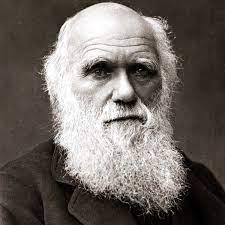
More than one and a half centuries back, Charles Darwin expounded his theory of evolution by natural selection. In it, he said that organisms best adapted to their environment are more likely to survive and flourish. As organisms continue to mutate and have variations, there would be the inevitable selection of those which possess advantageous variations allowing them to multiply and survive.

So, it is in the case of virus strains. That variant which can spread the most and infect the host in a manner that the spread does not get restricted would take over. This is what happened in the Spanish flu pandemic. And my sense is this is what is now happening in the current pandemic with the Omicron taking center stage. Omicron impacts humans mildly allowing it to remain undetected and spread faster and faster. With new cycles of infections and reinfections along with natural as well as vaccine induced antibodies within the human population, the world would eventually reach a sustainable balance between the virus and its host.

If my above surmise is correct, the Omicron variant might just be heralding the beginning of the end of the current pandemic.

In learning…..

Shakti Ghosal

An encounter with the witnessing tree


The Witnessing tree…..

I saw this tree standing forlornly in one corner of the Red fort complex in Delhi a couple of days back.

I asked, ‘ So, what have you been witness to?’

The tree replied, ‘ I was born to witness the stars above Shahjahanabad.

Diwan-i-Am (Hall of Audience) at the Red Fort in New Delhi, India.

But what I witnessed was the ebb and flow of the history of this land.

Of the ebbing of the Mughals as the blinded emperor Shah Alam II sat forlornly in his ravaged palace……

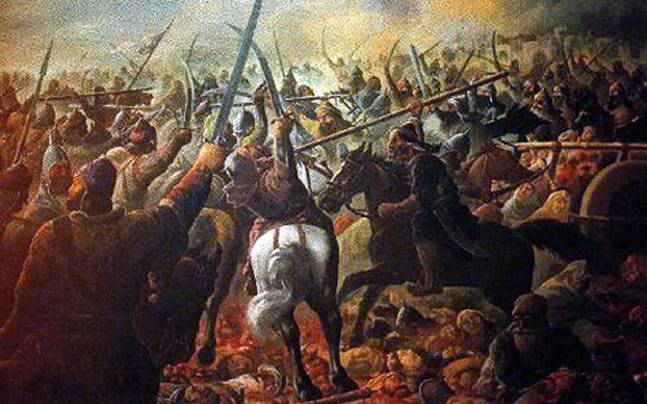
Of the ebbing of the Marathas after the defeat in the third battle of Panipat…..

The third battle of Panipat…..

Of the ebbing of the Jats in the late eighteenth-century……

Of the ebbing of the British empire with their departure from India in the twentieth century……

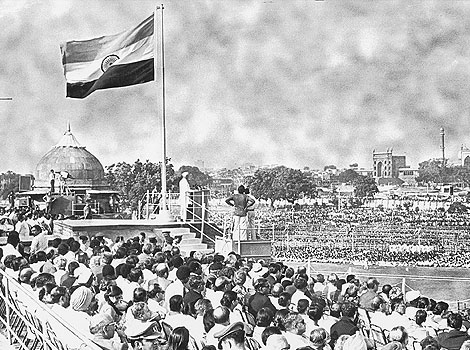
Indian Flag on the ramparts of Red Fort….

And with each such ebb, the plunder of this fort’s riches and the conscience of Man.’

Sustainability and Globalisation


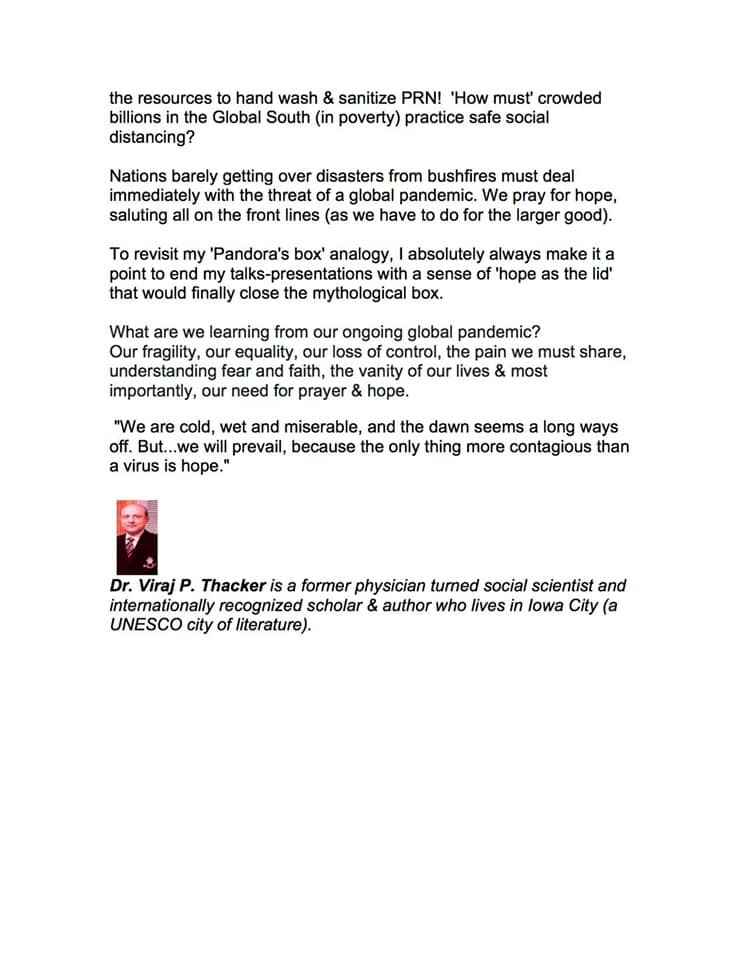
Dr. Viraj P. Thacker, the best-selling author of ‘The Myth of prosperity: Globalisation and the South’, has remained passionate about continuing his Late Mother’s work of a lifetime in the areas of Women & Children, the Environment, Sustainability & Social Justice. This has also led him to set up ‘Manushi for sustainable development’ of which he is the international executive director.

I am sharing a collage of the events associated with the above initiative as well as a thought-provoking article on Globalisation that he has published recently.

Environment, sustainability and Climate Change are areas I remain passionate about. My next book might just be in this area…..

#shaktighosal#sustainability#environment#climatechange#globalisation

The Millennial Leadership Series : Disrupt or be Disrupted?


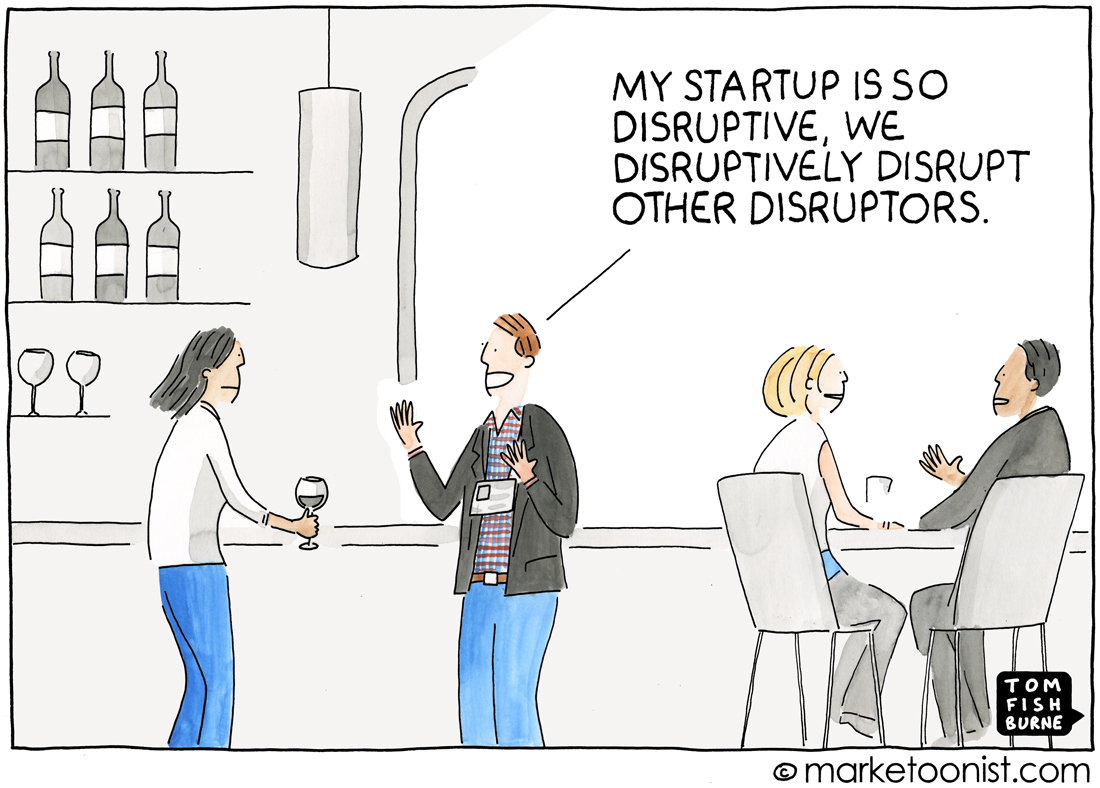
disruptive humour

Disruption, be it through technology, innovation process or through something else, seems to be the flavour of the corporate environment. So what is disruption? In simple terms, it is when a new product or service helps create a new market and in the process significantly weakens and at times destroys an existing product or service, market category and even an industry.

As can be seen from the above, there are two facets of Leadership that operate in a disruptive environment.

First, the kind of Leadership that can envision and innovate a product, service or process that  either creates a new market or sets about destroying an existing product market category. Think of the I Phone. Think of Uber.

Second, the kind of Leadership that can recognise the disruptions gaining strength within the industry and take timely and intuitive actions to not only protect one’s  existing business but ride the disruption as an opportunity. Think of General Motors and its incisive investments into EV and autonomous vehicle technology.

The 20th Century has been witness to innumerable cases of strong leaderships with impeccable management credentials consistently failing to anticipate market disruptions and falling by the wayside. Think of Kodak.

With the exponential growth of disruptive products and processes that we are witness to today and the convergence of these to create mega disruptive trends, a completely new kind of Leadership blueprint and mindset is needed to be effective in the twenty-first century.

What kind of Leadership blueprint and mindset might this be? How does one acquire it?


In Learning………

Presentation1