“Did you read that piece I sent?” Arjun asked. Sameer frowned. “Who wrote it?”
“Why?” “Because that tells me everything.”
“So the argument doesn’t matter?” “Oh! it does matter,” Sameer said. “All folks who offer opinions always have an agenda.”
Arjun watched him quietly. “So we don’t examine the idea… we examine the person?”
Sameer shrugged. “Background. Bias. That’s how you know.”
Case closed.No thinking required. We like to believe we are rational. But most of the time, we are defenders, not thinkers.
Once a belief settles into the mind, it doesn’t stay a belief for long. It quietly becomes identity. And the moment that happens, any opposing idea stops feeling like information. It feels like an attack. Not on the argument. On us.
“Just look at the data,” Arjun said. “I already know the truth,” Sameer replied.That was the shift.His mind had stopped being a judge.It had become a lawyer. *Not asking, “What is true?”But, “How do I prove I’m right?”*
So the evidence hunt began: “I’ve read studies that agree with me.” “Experts support this.” “Your source must be flawed.”
And when facts refuse to cooperate? The mind does what skilled lawyers do. It bends them. Reframes them. Twists them — until they fit the story already believed.
“But you didn’t even consider it,” Arjun said. “I don’t need to,” Sameer replied. “I know the type.” That’s the final defense. If you can’t defeat the idea, discredit the person. “Who said it?” “What’s their background?” “What bias can we label them with?” Once a label is found, the argument is declared invalid. Comfort restored. Identity protected. This isn’t intelligence at work. This is ego guarding identity.
Psychology calls it confirmation bias — the tendency to search for evidence that supports what we already believe and dismiss what doesn’t. But deeper than that, it’s belief defense. The mind protecting its mental world from discomfort. Because being wrong doesn’t just feel incorrect. It feels like losing a piece of who we are.
Arjun said softly, “You know when real thinking starts?” Sameer looked at him. “When something challenges you… and you still choose to look.” A long pause. “That uncomfortable feeling?” Arjun added. “That’s the doorway most of us shut.”
Because growth never comes from defending what we already know. It comes from risking being wrong.
And in that small, silent moment —when we stop arguing and start examining — the mind takes off its lawyer’s coat…and remembers how to be a judge.
This was the question that was debated during a podcast which I did recently with Executive Coach Frank Marinko in Australia.
All of us know that leadership is all about making choices. It is about aligning the organisation and its underlying stakeholder relationships with an overarching vision and intrinsic values. However, the prism that each stakeholder uses to evaluate decisions and decide on a roadmap could be significantly different from one another. We might hold complete clarity, based on our own belief and experience-based prism, about what and how something needs to be done. This is where the pitfall of a ‘My way or highway’ mindset lies.
Based on market conditions and the need to do a strategic shift, you might need to cut costs by reducing the workforce. But this could lead to employee insecurity and negative publicity. You might decide to use certain material to improve product quality but that might bring a backlash from environmentalists. A tradeoff between shareholder profits and employee benefits might lead to morale drop and lower productivity. Such a list of potential pitfalls can be long.
So how could you as a leader successfully negotiate and mitigate the above risks?
In this context, you might wish to listen to the two podcasts which are in the laser coaching realm.
Some years back, I had a Divisional head join the team.
The guy had impressed the recruiting board with his talk of ‘track record’ and ‘ideas’ about how he planned to transform the business. When I got around to have a chat with him, he seemed to be all humility and spoke of his own self development through working and learning from me. But several subsequent events seemed to indicate that at the sniff of a challenge, his self-serving shield would go up, a lot of talk about blaming the environment and others in the team would emerge but not much action on the ground. In the meanwhile, the company kept losing competent and productive staff as well as customer accounts; his oft repeated declaration about ‘brickwalling’ them did not seem to be working.
To me it appeared that the Divisional Head did not know what he was working to develop; he was definitely not working on his own leadership. When I again had a chat with him, what came up were several blames. ‘That he had not bargained for the kind of work he was now being expected to do.’ ‘That I was failing to support him adequately.’ ‘That he was stuck with incompetent team members.’
In a nutshell, the job stank, I as the boss stank and the team stank! I did not have the heart to ask the guy that if the world all around stank, could it be that he himself was the problem?
How many of you have faced a similar situation at the workplace? If you have, have you wondered what one might need to do to transform the situation?
The world can shift when one shows up with authenticity and with humility.
Transformation:
When we see ourselves as the problem, we can be the solution too. We need to spend more time working on our own selves rather than trying to fix others.
Do we have the expectation that our team members should be the harbinger of good news and developments? We need to lower that expectation.
Empathy is a strong word; being empathetic is easier said than done. Nonetheless we need to practice putting ourselves in the shoes of others and seeing the world through their lens.
Gain the realization that others do not really humble us; we humble ourselves.
Show up as a servant leader. A leadership style that enables everyone in the organisation to feel empowered and thrive fearlessly as his / her authentic self.
Say ‘Thank you’ to three persons in a day. Look them in the eye and be specific. If someone is not around, send a thank you email or Whatsapp or make a call.
A way to grow one’s Leadership is through introspection. One needs to look back into one’s past and identify all that which contributed to one’s Leadership and performance development.
This may sound easy but it is not. As we move through work responsibilities and the corporate hierarchy, we tend to develop our own plethora of ‘what we believe made us succeed’ mechanisms consisting of inauthentic facades, assumptions and ‘need to impress the other guy’ behaviours. We also hone our survival instincts. So, when we do get down to ‘looking into our past’ and identifying all that which contributed to our development and growth, we tend to see stuff distorted by our facades, beliefs and impress the-other-guy behaviours.
The way to grow one’s leadership through introspection is to do the following practices.
Ask yourself, ‘Who were the people who changed you?’
When I thought about this question, I could identify two individuals.
The first was a senior colleague at the start of my career as an Assistant Mechanical Engineer in the Indian Railways. The quality that my colleague brought into our relationship was one of sunny optimism and a natural instinct to mentor without a self-serving mindset.
The second was my boss in Voltas Ltd, where I was handling HVAC projects. The quality that he brought into our relationship was one of down to earth openness and transparency.
I realise today that what allowed me to grow through the above relationships was to try and inculcate a non-self-serving mindset as also authenticity through openness and transparency.
Ask yourself, ‘What kind of people did you gravitate towards?’
When I thought about this question, I could again identify two individuals.
In my tenure in the Indian Railways, I had two workshop foremen report to me. The first was a kind of a ‘yes man’ guy. He made me at once comfortable through his unquestioning loyalty; he would do exactly what I asked him to. This was a great relationship for maintaining status quo about situations and other stuff.
The second was a guy who was a ‘shop floor rebel’. He would usually give a counter viewpoint to most stuff I would suggest, and at times speak uncomfortable truths based on his own past experience and arguments. I would often ‘see’ his approach as unwillingness to accept my authority or trying to prove me wrong. I would feel upset.
This did not seem to be the kind of relationship I would be comfortable with or gravitate towards at that point in time. But I realise today that the person who allowed me to grow was this ‘rebel’ guy as he shattered my comfort zone and forced me to look at uncomfortable possibilities.
So how might you grow your leadership in today’s disruptive world? How might you foster such growth in your team members?
Gain mastery about how to succeed in a business environment that is constantly changing and being disrupted. Do this free module:
The reign of the dinosaurs had long ended. Snuffed out by an unlikely asteroid strike. A fifteen kilometers wide piece of Iridium laced rock had struck near present day Mexico, creating a ten times wide crater and unleashing lava, ashes, smoke and gigantic waves around the world.
Though the mass extinction event exterminated most of the flora and fauna on the planet, the continental drift and shifts continued unhampered for millions of years thereafter. The active planetary crust led to the Indian land mass smashing into the Eurasian land plate. The resulting crumpling and buckling at the collision point led to what came to be known as the Himalayas, a veritable abode of the Gods, the tallest mountain range in the world. An awesome creation standing testimony to Earth’s inner energies.
The permanent glaciers and ice formations led to glacial water bodies being formed. This is how the lake came into being. Situated at a height of 18,000 feet within the mighty Himalayan range, the lake acquired a mystical aura for all men and religions who passed by. The waters remained mostly frozen due to the height and the overwhelming presence of the Dongmar glacier which nestled it. Thirsty men and animals could not quench their thirst. And so it came to pass that a Guru was passing by when he too felt the mystical aura of the lake. He put his hand in the lake and Lo and behold! The water stopped freezing and became available for all to quench their thirst. This subduing of the Dongmar glacier’s frozen might by the Guru gave the lake the name of Gurudongmar. The second highest lake in the world with water that no longer froze.
**
The Man was indeed getting on in years.
As a child, he had been precocious and so had been nicknamed. ‘Buro’, an old man. He was now precisely that, replete with the mindset of the elderly. Over the years, he had acquired a liking for travelling and seeing the world. Age had dimmed the eyes somewhat, but not that inner passion to set forth and discover new places.
When the Man first heard about the wondrous lake of Gurudongmar, his heart urged him to travel. His brain though was more circumspect; it counselled, “My dear chap, are you crazy? You suffer from vertigo. What might happen when you go up all those torturously winding roads?” His friends too cautioned; they related dire tales of folks collapsing from lack of oxygen in a no-Man’s land with medical facilities hard to come by.
“But when a Man makes up his mind, he is not made for defeat. He can lose out, even destroyed, but not defeated.”
The tug of war between thoughts continued. But the die had been cast, the travel plans stood finalised. Came the day of travel and the Man set forth armed with some basic medications, a quiet resolve and some raucous misgivings. A flight, several car rides through mountainous roads into the Himalayan kingdom and the day of reckoning arrived.
“This was not the time to think of what was not there. It was the time to think of what one could do with what was there.”
Six in the morning and after nursing a cup of hot tea, the Man set forth for his rendezvous with the lake.
The slow wafting mist seemed in perfect harmony with the biting chill outside the moving car.
Passing through the last army check post, the vehicle climbed to the Kala Pathar, black stone viewpoint.
The fresh snow from the previous night lay in gay abandon. The white mist drifted upwards, a curtain rising up from the snow flakes and into the low hanging clouds.
As the old man stood watching the shifting views of the Kala Pathar blackness through the whiteness of the entwining gaps in the mist, it seemed like a ballet being performed. Was it the Universe sending him a message of hope?
“Every day is a new day. It is better to think it would be lucky. So when luck does come, one would be ready.”
The climb towards the lake had begun. It was not on roads cut out on the mountainsides which the man had been used to. It was on a rising terrain with no roads or markings to provide a direction. It was all down to the driver and the vehicle, their combined experience and strength to negotiate the path.
And then, all of a sudden, the heavens opened up. Sunbeams splayed and sliced all around. The climb had now reached above the level of the clouds and mist, a surreal moment. The old man nibbled on slivers of ginger; he had been advised so by some friends. A final swerving climb over barren rocks and the vehicle stopped on a mound from where the lake could be seen.
The stillness of the blue waters seemed to beckon. ‘Come, partake of my mysticism.’ The sun shone in all its splendour. Was it trying to discover that mystical aura with all those reflections? At the far end of the waters, part shrouded by rising mists, towered the snow laden glacier. As the old man stood transfixed by the wondrous surroundings, the tug of thoughts took over. Was this the place where divinity was born? What made the pristine barrenness so unworldly? Was it the glacier with its whiteness, or the water with its blueness?
A needle pricked the cheek. Then some more. Shaken out of his stupor, the man looked around. The hitherto gentle breeze had gained in strength. Crested by a whirlwind, tiny pebbles and dust particles chased each other in an ethereal dance. As the needles borne by the wind swayed through the onlookers, a soft murmur of protest could be heard. The old man slowly turned and moved back towards the waiting vehicle.
In Learning…….. Shakti Ghosal
Disclosure: The Old Man in the post is the author himself.
Acknowledgement : ‘The Old Man and the Sea’ by Ernest Hemingway
Sometime back, at a two-day Leadership Development program that I was running for Larsen and Toubro Ltd (a heavy engineering and multi-business conglomerate in India), a participant came to me during one of the breaks and said:
“All these techniques which we are learning seem to be of little value to me. I am faced with a different kind of problem. My boss has a strong controlling impulse. It is usually his way or the highway. It seems to me he believes this mindset is what has helped him reach his current position. So even if I try, there is never a win/win situation for my boss vis a vis me. What should I do?”
@ L & T Workshop
As I stood there listening to him, several thoughts came to mind. I asked him whether he was okay to delve into the issue some more.
We need to start exploring. We need to ask, ‘What is that which our ‘controlling boss’ would really like to control and change?’ And even more important, ‘What is that we ourselves are willing to let go?’ For ‘letting go’ could be the start of getting back in control.
Could we try and meet the ‘control freak’ half away down? For instance, certain relationships and one to one interactions could still be kept under our control. This realization itself can give us a sense of empowerment.
Could we ‘let go’ by avoiding reacting when we are being pushed to accept the controller’s point of view? Acknowledge what we have been told and then explain what we plan to do, why we have decided so and that we are willing to take full responsibility of the outcome.
The above exploration would allow us to create our action steps in the matter, thus elevating our own control of the situation.
‘Becoming a leader’ does not arise from knowing techniques or aping what we see great leaders do as they exercise leadership effectively in varied situations. Leadership and Performance is very little about what we know, it is almost all about how we see. ‘How we see’ comes from our ability to shift our perception through developing a contextual framework for our own selves.
I built me a castle With dragons and kings And I’d ride off with them As I stood by my window And looked out on those……
I walked leisurely on the pedestrian path.
Walkers and tourists milled around me, like me all moving at a leisurely pace. No one seemed to be in a hurry. A family led by Dad with the son on his shoulders passes me in the opposite direction. Just in front, a group of giggling young women were taking a barrage of selfies. It seemed one or the other was not satisfied with the result, be it one’s expression or the way the long cables and the end tower showed up in the photo. A quick joint review, some more giggles and someone in the group would volunteer to take a new selfie. I watched this microcosm of humanity flowing around me.
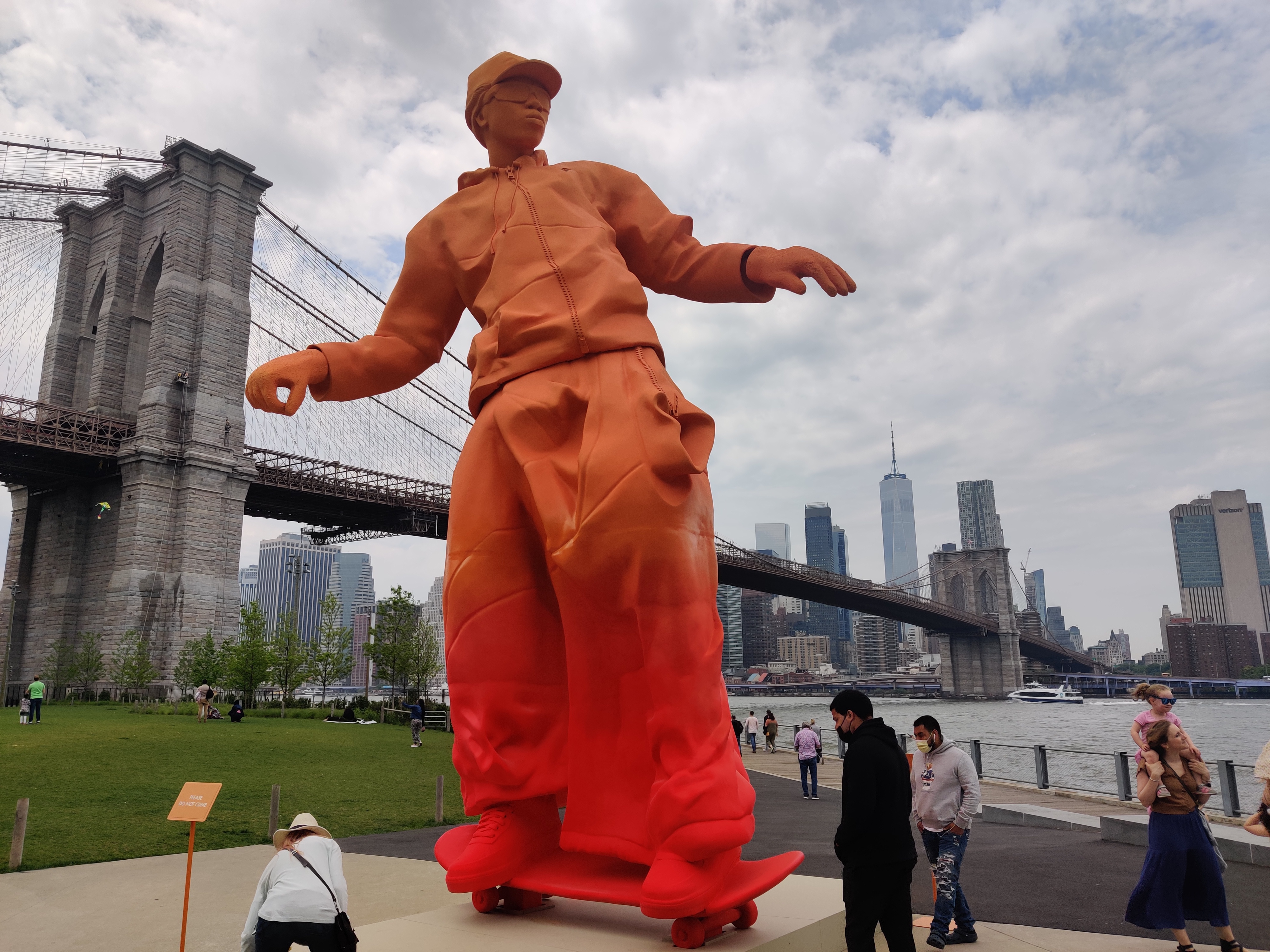
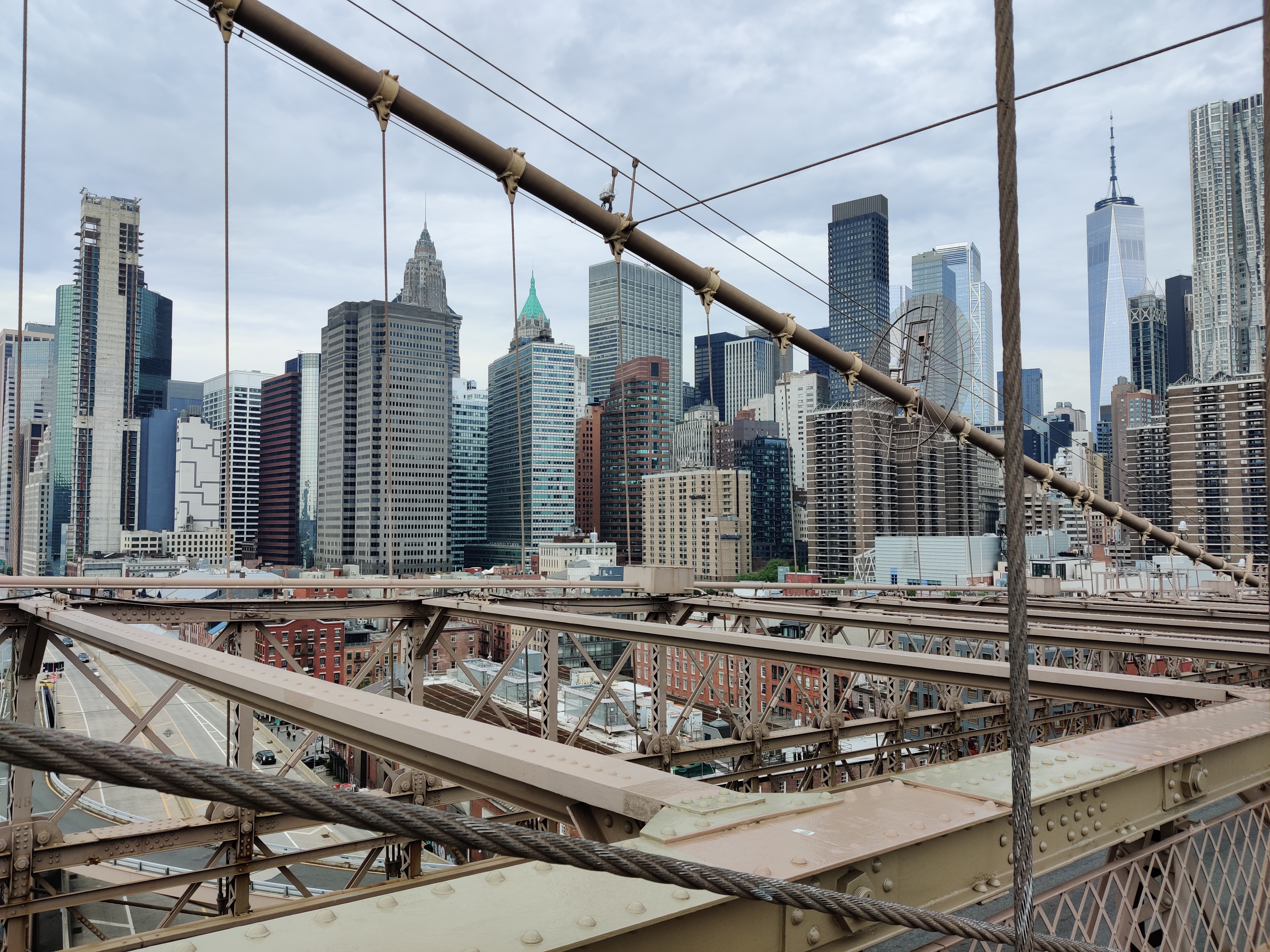
It was a beautiful sunny morning which had prompted us to venture out on a spot of sightseeing. I was on the pedestrian walkway of the legendary Brooklyn Bridge. Below me on both sides were the motorways with cars and SUVs moving in either direction between lower Manhattan and Brooklyn.
One had glorious views of the New York skyline as well as the leisurely flow of the East River below. To the right one could spot Governor’s Island and in the distance the Statue of Liberty. But as I stood looking around, my mind’s eye wandered off to another unforgettable vision involving the Brooklyn bridge. Powerful searchlights frantically flashing, sounds of helicopters, people jumping off the bridge into the waters below as a terrified News Reporter announces that all of us are going to die! One of the most emotional scenes from the blockbuster ‘I am Legend’ in which scientist Robert Neville (Will Smith) tries to evacuate his wife and daughter from pandemic ridden Manhattan, only to see them die as another helicopter crashes into theirs in the chaos. In the background, the Brooklyn Bridge is being blown up by military aircraft to contain the spread of the disease.
An iconic film showing visuals of an iconic bridge.
A hundred and forty years old structure, the Brooklyn Bridge was the world’s first and longest steel-wire suspension bridge at the time of its opening. What further distinguishes the bridge are the pair of gothic towers standing tall on either side, holding the steel wires in place. Legend has it that when the lead engineer and architect Washington Roebling, became sick and bedridden, his wife Emily, who knew nothing about engineering or architecture, took over the project. For the next ten years, till the project got done, she studied Engineering design and project management on her own and became the first person to cross the bridge upon completion. The following was said about Emily and the Brooklyn bridge:
“…an everlasting monument to the self-sacrificing devotion of a woman and of her capacity for that higher education from which she has been too long disbarred.”
A sad reminder of the fact that during Emily’s time, women were not allowed into Engineering institutions in the US.
Having walked the mile long stretch of the Bridge, we stepped onto the roads of Brooklyn. The neighbourhood in which Neil Diamond had grown up six decades back. With his baritone voice and wonderful songwriting capabilities, Neil Diamond has been my favourite pop and country musician and singer since youth. The singer reminisces about his childhood in that wonderful number, ‘Brooklyn Roads’:
‘Two floors above the butcher First door on the right Life filled to the brim As I stood by my window And I looked out of those Brooklyn Roads……’
Neil Diamond
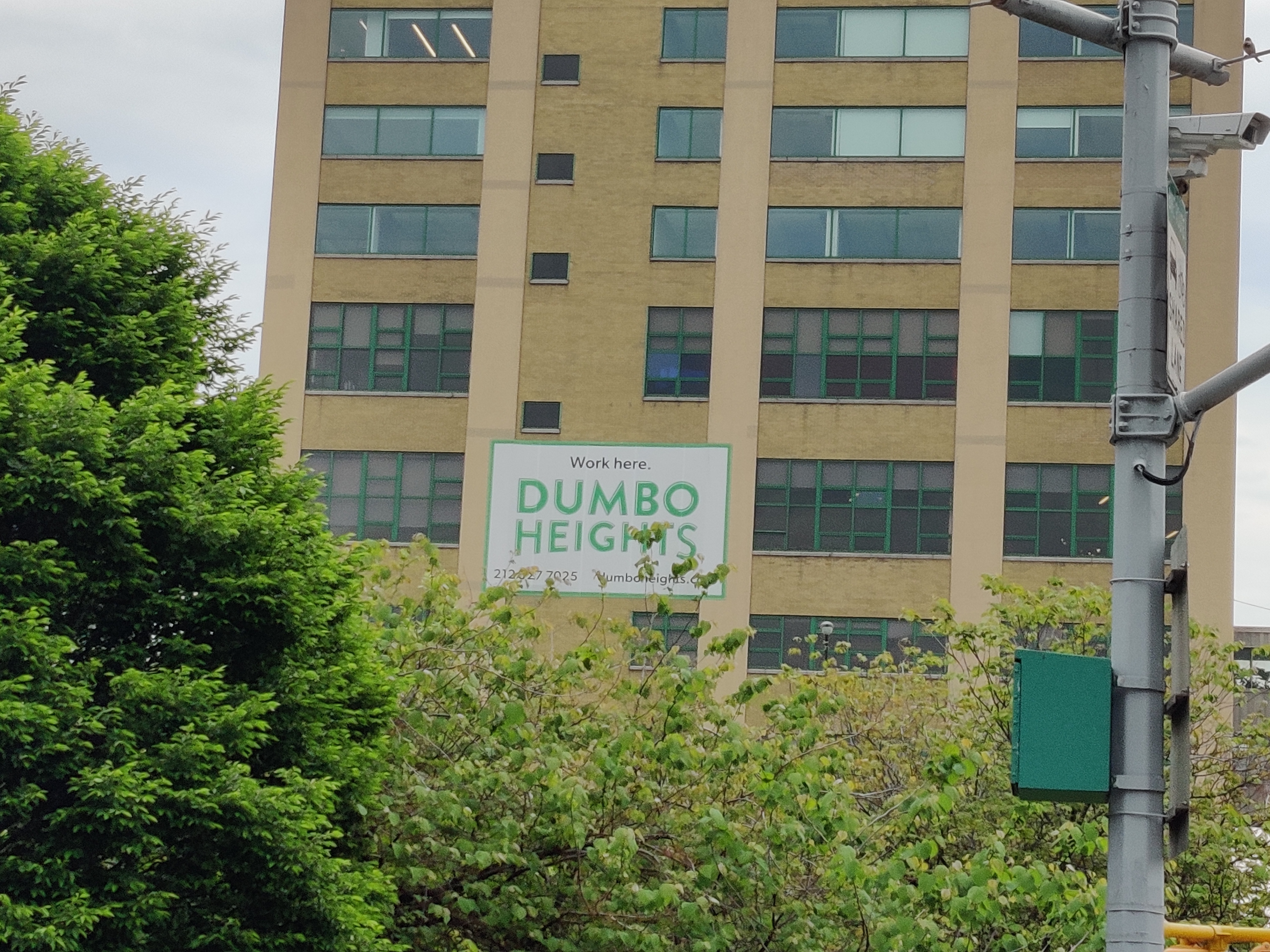
The place we were walking through had the curious name of DUMBO. I was left wondering whether it had anything to do with Disney’s Dumbo the flying elephant. Or was it about some presumed dumb folks who might have resided there in the past?
‘And report cards I was always Afraid to show
Mama’d come to school And as I’d sit there softly crying Teacher’d say, “He’s just not trying He’s got a good head if he’d apply it” But you know yourself It’s always somewhere else’
I learnt that DUMBO was really the short nomenclature for ‘Down Under the Manhattan Bridge Overpass’. Ironically, the neighbourhood today is home to a large number of technology start-up companies with the earlier warehouses on the riverfront converted into quaint eating houses and pubs overlooking the waters.
A bridge, a musician and a neighbourhood came together as legends for me that morning. They came with tales that were anecdotal, possibly unverifiable but nonetheless remain ingrained in my mind.
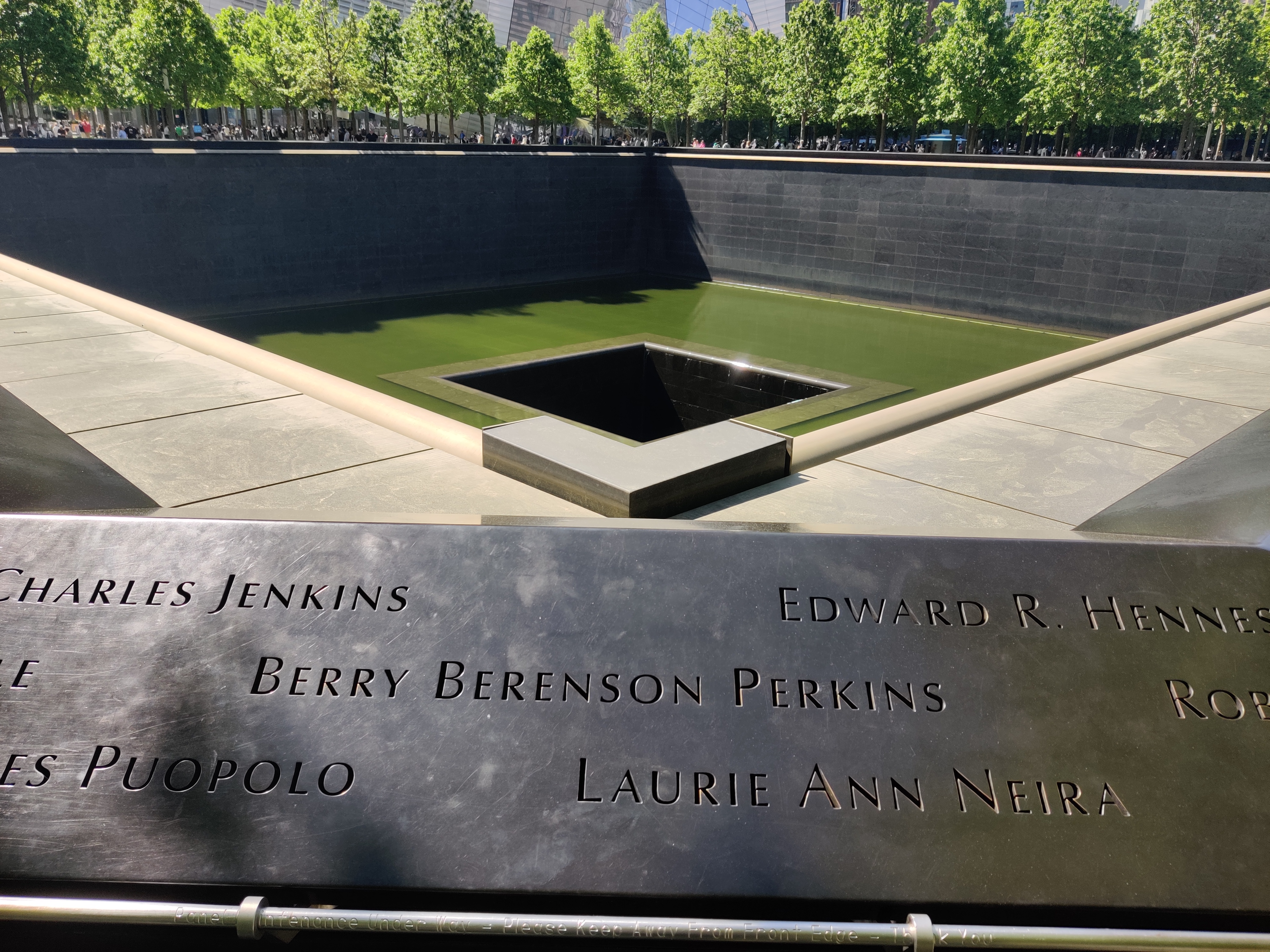
The water cascaded down the black granite sides, flowing as rivulets before disappearing into the small squarish void in the center. As I looked at the flowing water, juxtaposed feelings pulled in different directions. A feeling of melancholy and sadness about the flow of our lives which was perhaps never to return. But also a feeling of peace and acceptance, an emotional cleansing about all that was not right, maybe would never be right.
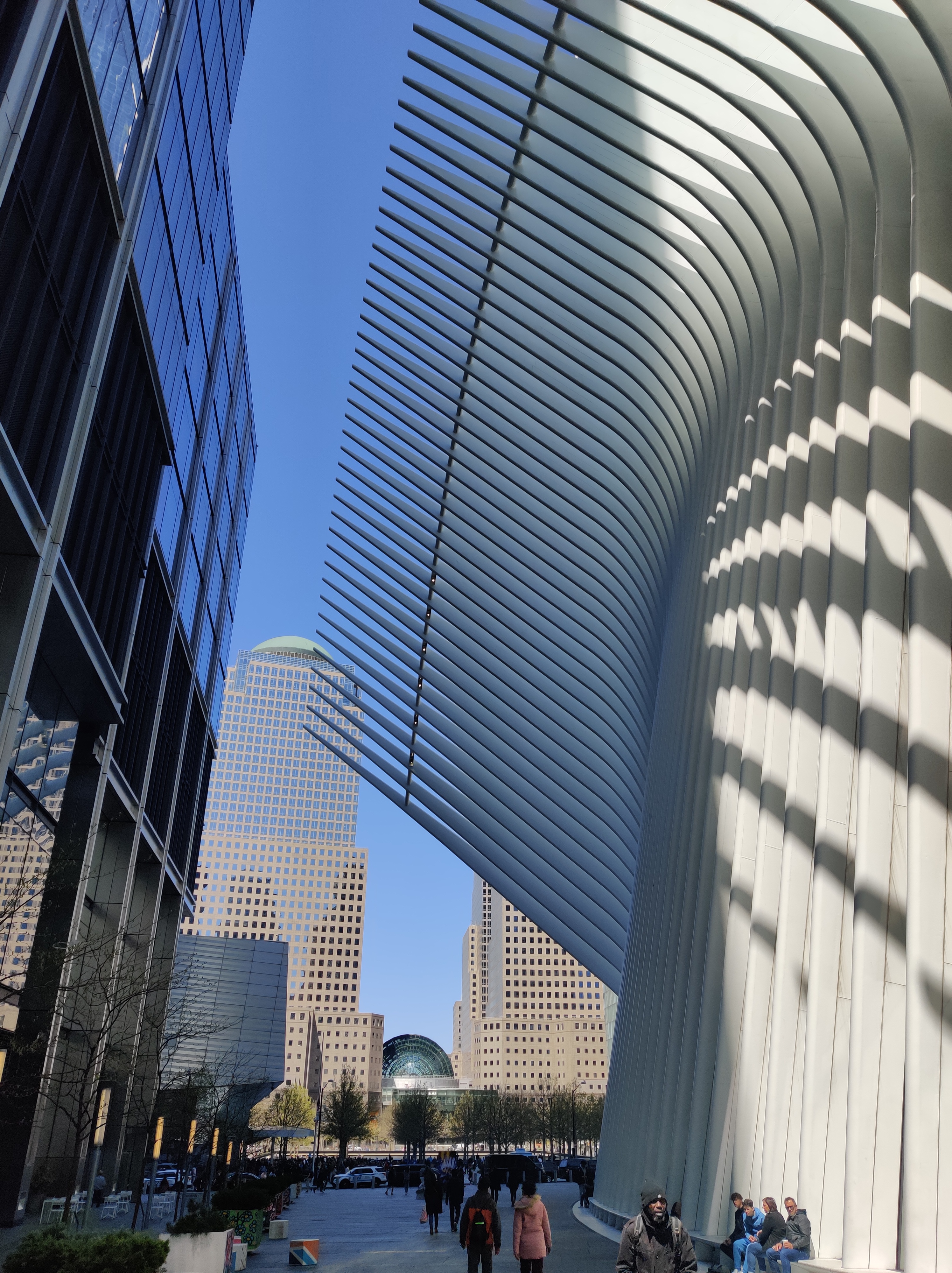
From the corner of my eyes, I could see the Oculus, that majestic steel ribbed white wings about to soar up into the skies. The reflections on the nearby glass towers seemed to be heralding a brighter, more vibrant tomorrow. A tomorrow in which peace and acceptance might run the winning lap.
I was at the site of the two World Trade Center towers in Manhattan which had gone down in the September eleventh attack more than two decades back. The black granite square pools with flowing, falling water had been built as memorials to that event. The Oculus served as the integrated transportation hub built for the Path and Subway trains.
Oculus Transportation hub at the World Trade Center complex
As I stood there in contemplation, the place was a tranquil and serene island in the midst of high energy Manhattan life. Did the flowing water suggest a life force embryo just below the surface? That somehow brought into our thoughts those who had perished in the attack, their names etched on the sides serving as the only reminder? Or was it that the simplicity of the slow cascades into the void which could never be filled (as per the memorial architect Michael Arad) allowed their ‘absence (from our living world) to be made visible’?
**
My memory went back to that day decades ago.
It was evening. I was in the office and had called a colleague to discuss an operational issue when he excitedly mentioned about a disaster in which an aircraft had crashed into one of the World Trade Center (WTC) towers in New York. We spoke about the incident for a couple of minutes and wondered about the low probability of an aircraft crashing into a building.
Returning home after office, I switched on the TV only to see the news headlines flashing all over, ‘AMERICA UNDER ATTACK!’ In the interim, a second aircraft also carrying passengers had slammed into a second WTC tower. Burning from the aviation fuel of the colliding aircrafts, both the towers collapsed. A third aircraft had crashed into Pentagon, the US Defence headquarters in Washington DC. Due to the time zone difference, what was evening for me was really morning hours on the US Eastern seaboard where the attacks were taking place. Close to three thousand people died in the attacks.
What seemed at that point in time a senseless act of violence led to a fundamental shift in the way US saw the world and how its foreign policy would come to be defined. Over the next two decades, US would engage in conflicts aimed at crushing terrorism in various parts of the globe. From demolishing Osama Bin Laden’s Al Qaeda bases in Afghanistan to the Iraq invasion and removal of Saddam Hussein to confronting the self-styled Islamic State in Syria.
I think of our world today. The actors have changed, the issues have shifted but the conflicts remain.
**
A couple of days back, I heard the tragic news of the Texas shooting in which a teenager Salvador Ramos armed with a gun entered an elementary school and senselessly shot and killed nineteen children and two adults. The carnage was a deadly reminder that even the world’s most powerful nation is unable to protect its children in their innocence.
My granddaughter has been going to a play school. She loves going there. For us, the school is a safe haven that nurtures. I agonise when I think of what might be passing through the minds of the parents and grandparents of those children whose lives were so brutally snuffed out even before they got the chance to blossom. Like me they too would have had complete faith in the safety and security of their child in school.
I muse. What is that which leads to some folks inflicting injury and death on others? I sense that this arises from an extreme psychologically aberrant mindset. A mindset which shifts into viciousness from its inability to accept ‘we versus they’ differences. So it was with Osama Bin Laden, so it is with Salvador Ramos.
An all-powerful state like the US does possess the weapons and technology to wage war against the enemy without.
But does it possess the conviction and resolve to change the mindset of the enemy within?
The Pandemic has been with us now for more than one and a half years. A virulent new strain, the Delta variant, is the new weapon unleashed by the wily COVID 19 virus to negate all that the vaccines have been doing. Conspiracy theories abound. We look on helplessly through a tunnel with no apparent light visible at the other end yet.
The West and its much vaunted ideal of human freedom is on the backfoot. As US retreats, Afghanistan has once again proved to be the graveyard of Empires- earlier the British, then the USSR and now Pax Americana. The swiftness of the Taliban takeover has been shocking as they begin the task of taking the country back into the medieval ages.
More than 600 people inside a C 17 aircraft fleeing Kabul on the Indian Independence Day 15th Aug. 2021
Almost two decades back, US President Bush had declared, “Engendering democracy across the Middle East ‘must be a focus of American policy’ for decades to come”. Today democracy is sputtering like a flame about to go out, with the failure of the much-vaunted Arab Spring and the Middle East in a far worse situation than previously.
We are into an irreversible global warming era, possibly the most serious climate crisis faced by Mankind. July 2021 was the hottest month ever recorded on the planet. An extreme heat wave in Canada at a searing high of 49.6 deg. C. was a one-thousand-year weather event. Floods ripped through geographically distant countries like Germany and China. Drought stalked others. It is now being widely claimed in scientific circles that the Arctic would soon be devoid of ice with the resultant rise of sea water levels and low-lying areas going under.
The above are glimpses of a frightening and dystopian future we are headed into.
Now here is the other story.
In the last month alone, one billion people have been vaccinated against COVID 19. By the end of this year more than half the people on the planet would have received the vaccine. Truly a stupendous achievement in terms of swiftness of response and effectiveness.
The COVID-19 crisis has led to a veritable explosion of scientific progress in the tinkering of genetic information flow and the formulation of proteins, the ultimate nano machines. Trials are currently being done for protein-based vaccines for diseases ranging from Cancer to HIV.
As we speak, electricity generation from the clean sources of solar, wind, hydro and nuclear has outstripped that from ‘dirty’ coal. Closer home in India, the wind and solar generating capacity has exceeded the milestone of 100GW output. In more and more countries, low carbon economy valuations are rising rapidly. The reason is economic. The average cost of power generation from clean sources is now half that from fossil fuels.
As investors spot a rising opportunity, more money is getting committed to climate investment funds in a day than used to be raised in years a short time back. Three weeks ago, two global asset managers, TPG and Brookfield, closed a combined $12.4 billion in climate investment funds.
Reforestation and conservation funding is taking place in countries as disparate as Indonesia and Bolivia who are supporting equatorial rain forests to United states and Canada who are focusing on wetlands, grasslands and coastal areas and the regeneration of flora and fauna therein.
These are but a few stories of a Utopian future we seem to be headed into.
So which future, whether the Dystopian or the Utopian, would come true?
As Morpheus says to Neo in the Matrix:
“……This is your last chance. After this, there is no turning back. You take the blue pill—the story ends, you…. believe whatever you want to believe. You take the red pill……. and I show you how deep the rabbit hole goes. Remember: all I’m offering is the truth. Nothing more….”
Is our future really like the story of the blue and red pills and the need for us to make a choice of the path?
Or could it be that there is no choice after all? The two futures, dystopian and utopian, would always exist together, like the two sides of a coin. It would all come down to our world view and the context lens we choose to use. If our context was one of dystopia, we would see signals of collapse in every situation we look at. Similarly, if we were to deploy our utopian context, we would notice the signals of renewal and hope all around.
Our story, the shared and evolving narrative that it is, would always contain both dystopia and utopia, both collapse and renewal. It would depend on us which context lens we choose to deploy, which future we would wish to live into.
“What we do makes a difference, and we have to decide what kind of a difference we want to make.” Jane Goodall, English Primatologist & Anthropologist
Acknowledgement: The above piece is inspired by ‘Collapse, Renewal and Rope of History’ written by Angus Hervey, Future Crunch Journal, Aug. 24th 2021
“Enlightenment, and the death which comes before it, is the primary business of Varanasi.”
Tahir Shah, author – Sorcerer’s Apprentice, 1998
If you are born in India, as I was, Varanasi, that immortal city of Lord Shiva and his consort Sati, slowly but surely becomes a part of your psyche.
My first visit to Varanasi with my mother continues to hold vivid memories for me even today. In my teens then, it was possibly the first time when I faced the confusion of how the same ground situation occurred so differently to my mother compared to me.
What occurred to me as narrow serpentine alleys, overcrowded and difficult to breathe places showed up as a delectable array of holy shrines, temples and ashrams to my mother.
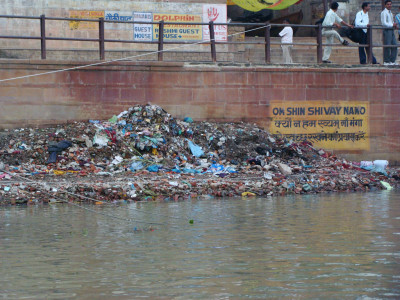
What occurred for me as slippery, dirty steps to be avoided at all costs lest I fall into a smelly cesspool, showed up as venerable ‘ghats’ of the holy Ganga river, promising salvation and nirvana to my mother.
What showed up for me as a city bursting at its seams with the old and the dying, sickness, leprosy and burning funeral pyres, seemed to show up as life’s final destination and a passport to heaven for my mother.
As is the norm, come sunrise, I accompanied my mother for the holy dip in the Ganges. When we reached the ghat, the place was already thronging with hundreds of people, some already in the flowing waters, others taking an oil massage as a prelude to the dip. A motley crowd of beggars, tea sellers, urchins, saffron clad ‘sadhus’ and devotees jockeyed for space and spiritual advantage.
My mother urged me, “Come, take a dip. Doing it is so holy, it would cleanse you of all your past sins.”
Now that was no doubt tempting. I could recall sins a plenty that I had committed over the last few months itself. But what held me back was the sight of raw sewage belching into the river with a dull roar. Not to speak of what appeared to be floating dead bodies and the vultures above. I had also heard sordid tales of unclaimed bodies, which no one came to cremate, being tied to a rock and sunk to the river bottom. I had this scary vision of stepping onto a body and being possessed by an angry spirit thereafter. The net result was that I refused to take that holy dip, much to my mother’s chagrin and embarrassment.
Whenever I have mused about that visit subsequently, I have wondered what was it that created the almost diametrically opposite reality about Varanasi for my mother and me.
Coming as she did from an overly traditional, semi agrarian Bengali household in suburban Calcutta and growing up in a joint family, my mother imbibed strong elements of religious and ritualistic ‘Dos and Don’ts’ apart from a conditioning to not question the collective view and mindset. I suspect this is what would have made her take to Varanasi and its ethos like a fish takes to the water. For Varanasi is all about the occurring of a collective mind. That collective mind which through centuries and millennia, has read the Gita, quoted the Upanishads and chanted the vedic mantras on those very ghats.
I on the other hand, born and living in a nuclear family and receiving a liberal education, had very little exposure to the traditions, rituals and collective beliefs coming down the ages. So where my mother could selectively ‘see and tune into’ the devotional hymns, the fragrance of the incense and purity of the saffron colour all around her, I was left struggling to come to terms with the sludge and the floating trash, the smell of feces, the sickness and the poverty on physical display.
Today, when I look back to that Varanasi visit, I can see how the differing realities of the city effected us. My mother’s occurring of reality brought her great bliss and fulfillment. My occurring on the other hand brought in trepidation and doubt. I begin to realise how both the realities were illusions, anchored as they were to how the situations occurred to each one of us.
Like the above, do we see how most conflicts in society and the world can be traced back to the aspect of reality illusion? An illusion which makes us erroneously conclude that what shows up for us as a result of our own world view and frames of references is in fact the only reality and we refuse to accept any differing perspectives. Merely holding the awareness that differing realities can and do occur for each of us, and this is but normal, can lead to significant lowering of conflicts…….
“Reality is merely an illusion, albeit a very persistent one.” Albert Einstein














 A New Beginning