
How to Thrive Amid Disruption: Key Insights


 I had posted on a similar topic a couple of years back, but in a different context. It was based on an interaction I had with a participant in a workshop I had conducted then.

Interestingly, I was recently invited by the Goa Business School, Goa University to speak on the same topic.  What we were really looking at is succeeding in an environment that is constantly changing and being disrupted. By new technologies like AI, new competitors, new business processes. The question for us was, ‘So what does one do to win?’

I related a story from my own professional life.

In a past assignment, I was managing a Travel & Destination services t company. One of our major customer accounts was the national petroleum development organisation and because of the large business quantum, we had an implant operation with a dedicated team. Our service and response levels were appreciated by the client.

As our contract period was ending, the company released a tender for a subsequent period. Believing the client was happy with us, we submitted our competitive offer in line with what we had done during our last successful bid. When the tender was finalised, we were shocked to know that we had lost. When we asked the client’s commercial team, we were informed that we had not complied with the technical terms of the bid. Going back to the drawing board, we found that in the tender document, there had been a small section requiring development and implementation of a Travel management Services, TMS in short, software as part of the client’s intranet, which we had not responded to.

Soon, we had the opportunity to bid against a tender released by the National Gas Company. We noticed that in this tender document too, there was a requirement of implementing a TMS software. This time we were careful enough to comply with the requirement by indicating our willingness to develop. But we again lost the tender! The winner was a competitor who already possessed a fully developed TMS module and had provided a live demonstration of the same to the client.

We had been disrupted. By a new technology, a new competitor, which together had disrupted our traditional business mode, a model which had worked well all these years. The world had shifted, the business need in the environment had changed and the earlier alignment which our company’s competence set had with the environment, had been lost.

**

In 1849, French writer Jean-Baptiste Alphonse Karr wrote, “plus ça change, plus c’est la même chose” which in English translates to “the more things change, the more they stay the same.”

The above perspective is possibly at the heart of why we get disrupted. The human mind loves continuity and certainty. These allow us to make sense of what we see as stuff we are familiar with, which our brain does using mind models based on our past experiences. But what happens when we are faced with something we have never encountered before? Our brains somehow try to force fit these unknown inputs into one of our mind models. Even though we remain unaware, this ‘force fit’ sense making process leads to the observed inputs getting distorted, some parts get amplified while others which do not fit, get discarded. Thus, when we probabilistically try to predict, often we fail and get disrupted.
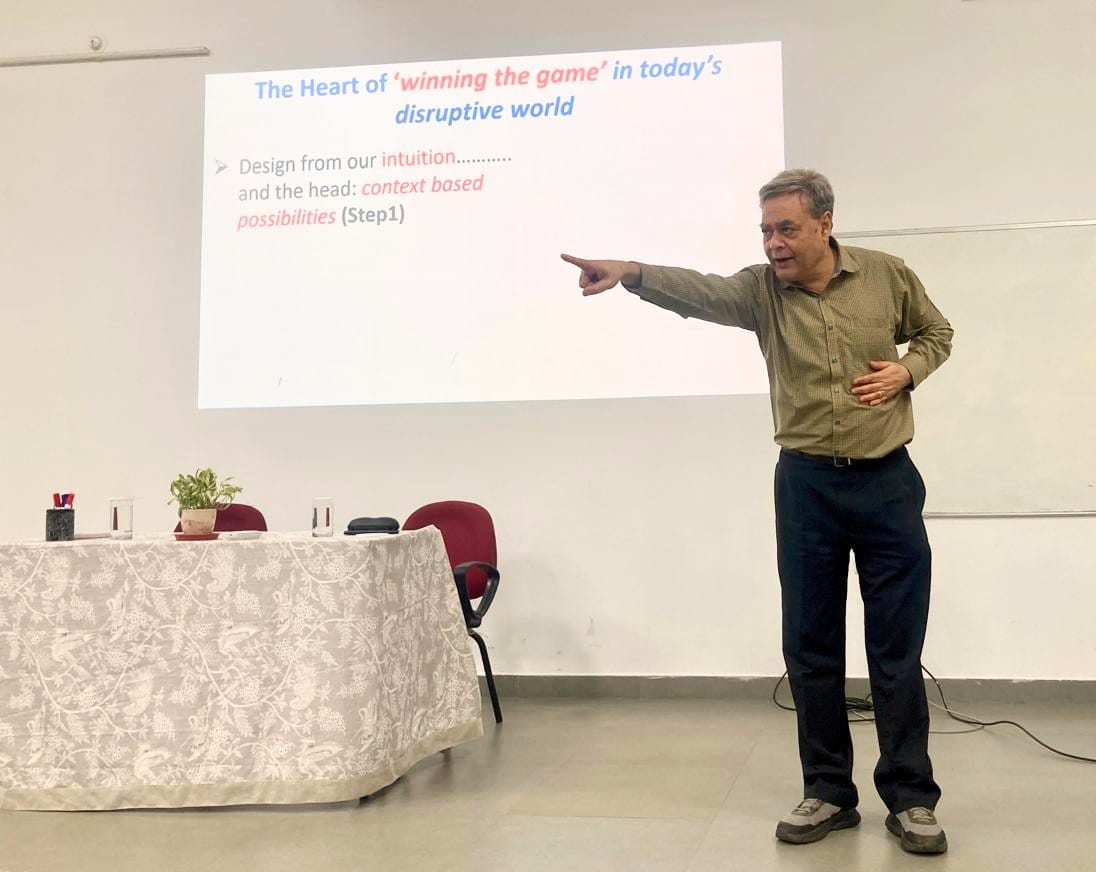
The disruptive world allows us to reside in a narrow band in the present with a hazy and uncertain future in front and the inability to take recourse of the past.  Thus to successfully negotiate we need to shift away from our usual probability-based mindset into a mindset of possibilities.

In the session I showcased certain action steps which would support us to do the shift.

I got around to explaining that the first Action step is to create a context for ourselves within our own domain through using hard trends in three areas viz. Demographics, Regulatory and Technology (DRT Context). The hard trends that we uncover become the framework of the context we are creating. Our context would allow us to view every situation in a particular manner.

At this juncture a participant asked for this step to be shown through a case study or live example. I elaborated using the example of the Aviation Industry.

Demographics: Major customer profile shift is occurring viz. growth of young budget traveller and the elderly. Communication technologies is leading to the decline of Business travel. Climate change is shifting the seasonality of leisure travel. Customer behavior is also changing, with short booking windows—often a week or two with fewer travelers making plans far in advance.

Regulatory: Climate change is leading to increased incidences of air borne diseases requiring changes in booking process e.g. Pre-flight testing, need for registration of previous and past travel etc. Technology is allowing airlines to have seamless connectivity within the travel ecosystem to increase demand + assist governments and regulators in creating worldwide / regional standards for hygiene as well as operations.

Technology: Integrated and contact less handling at the airport regarding access viz. boarding pass issual, traveller identification through eye scans, baggage check-in etc. Seat allotment keeping in mind traveler profile, past medical history etc.

Action Step 2 is about using our above created DRT context to make three lists. List of all that we are certain of, list of things we know, and list of things we can do. If we put in the requisite time to make the lists, new possibilities would start showing up for us, a reflection of our improved competence to shift into a possibility mindset.

Action Step 3 is about further sharpening the saw for possibility mindset creation. We do that by unplugging ourself from our present clutter and challenges, then plugging ourself into the future and then use the ‘hard trend’ context created in Step 1, the 3 lists of being certain, knowing and doing ability in Step 2 to do anticipatory & future back thinking through a structured enquiry.

Action Step 4 is about Relational Assimilation which is identifying and defining groups relevant to our business and optimising the group boundary level interactions to advance our own interests. It thus is all about addressing stakeholder concerns. So, who are these stakeholders? They are wide ranging entities. Starting from the company Owners. Employees, who are the internal stakeholders to Customers, suppliers, our banks and financiers- our external stakeholders. But we also have environmental stakeholders viz. local community, society at large and the Government and regulatory authorities. Each of the stakeholders impact the organisation and ourselves in some way, some directly, others indirectly. To ensure effective relational assimilation, we need to exhibit certain qualities in our interactions.
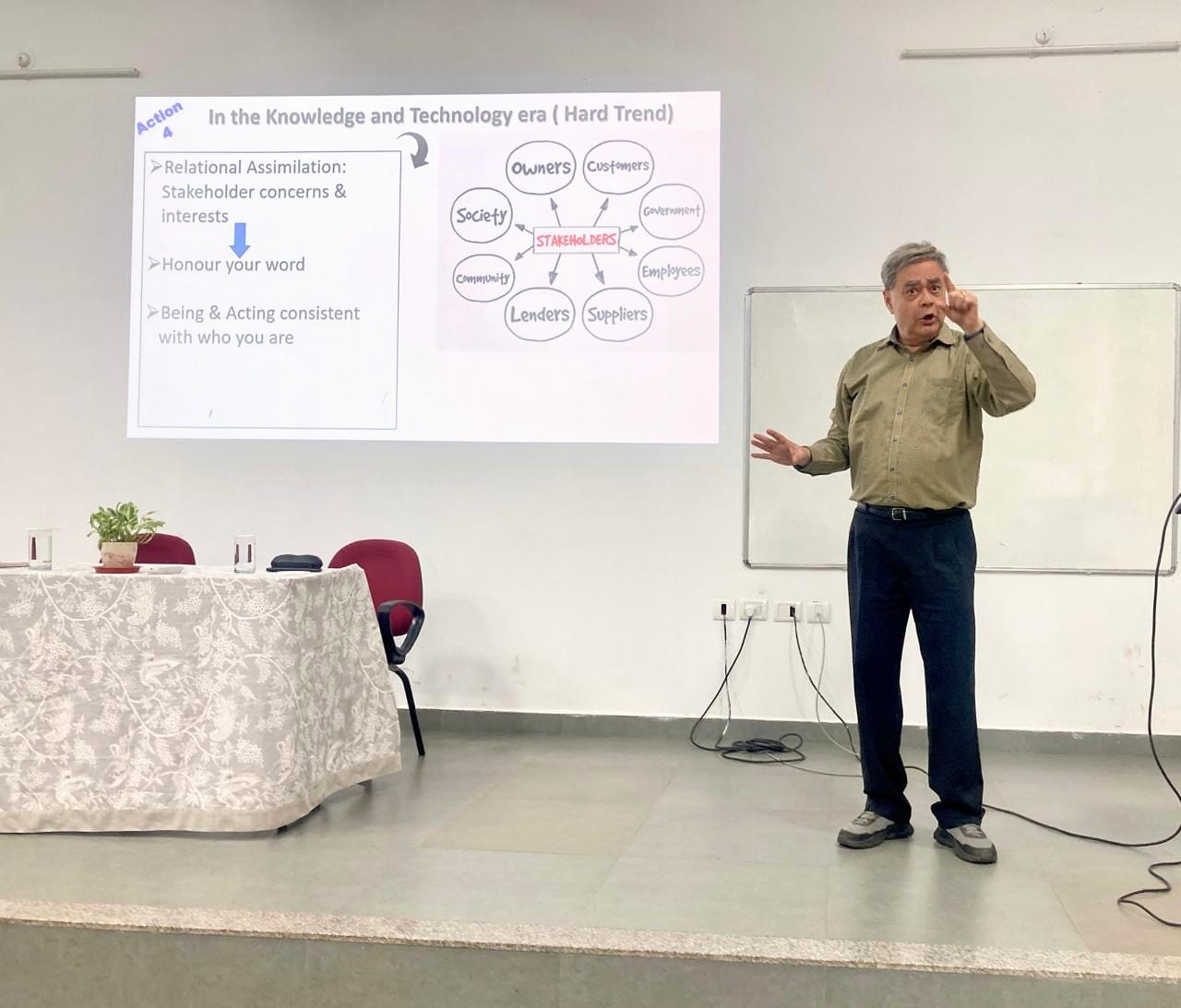
  •  Honouring or Integity of our word. Have we ever considered the fact that we are really equal to your word, nothing more , nothing less? We might see ourself as an individual with certain looks, qualifications, competencies etc. But to the outside world, we are perceived as our word. So, what is ‘Honouring our word’? This means keeping our word and as soon as we realize we are not able to do so, we need to inform all effected parties that we cannot keep our word within the time frame indicated earlier, offer a new time frame to do it and declare that we would take care of the consequences if any, of not keeping our word as per the earlier indicated time frame.

Can you see from what I just said that while it is not possible to keep our word under different situations, we can always ensure that we honour our word?

  • Being and acting consistent with who you are: This is all about being authentic. Bill George, former CEO, Medtronics and Professor of Leadership at Harvard Business School, concluded, “After years of studying leaders and their traits, I believe that Leadership begins and ends with authenticity.”

So how does one improve one’s own authenticity? Simply put, it is by being authentic about our inauthenticities’. We need to be publicly authentic about our inauthenticity with those around us for whom this inauthenticity matters.

  • Listening with no intention, no judgment, no Right or Wrong:. This is called Active Listening. A special kind of listening that we use to allow the speaker to articulate his or her own strongly held positions, views, rationalisations, justifications and unexamined beliefs. When we engage in active listening, we do it without colouring our own mind with our own intention, own judgments and our own views about what is being said being right or wrong. You could start with practicing active listening once a day and then slowly increasing the number till the trait becomes part of you.

As you make Integrity, Authenticity and Active Listening part of your repertoire for dealing with your stakeholders, you will see the significant upswing in empathy, respect and trust in your dealings. Action 4 is thus the catalyzing agent to ensure the achievement of the action steps you had created based on the first 3 actions.
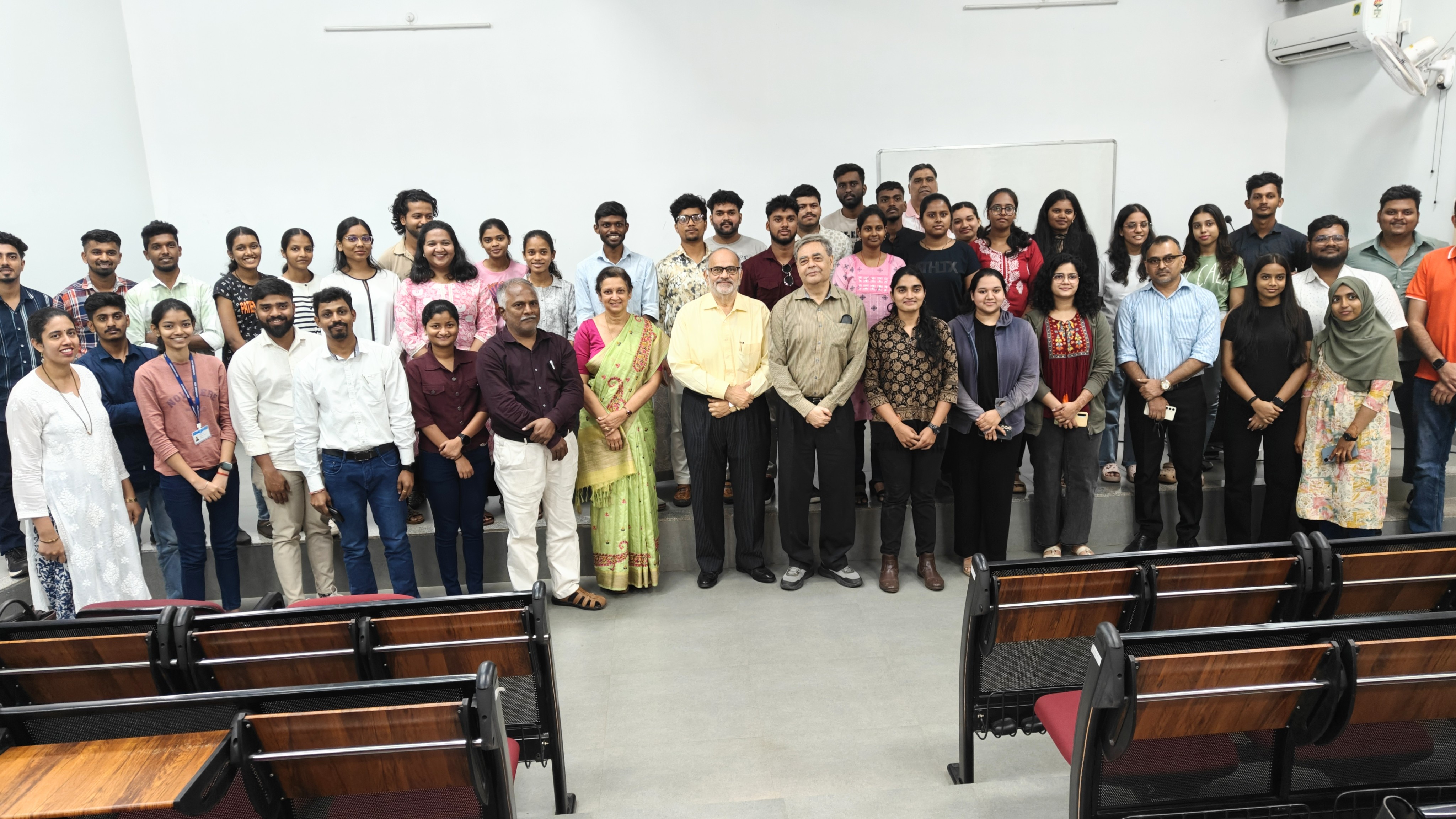
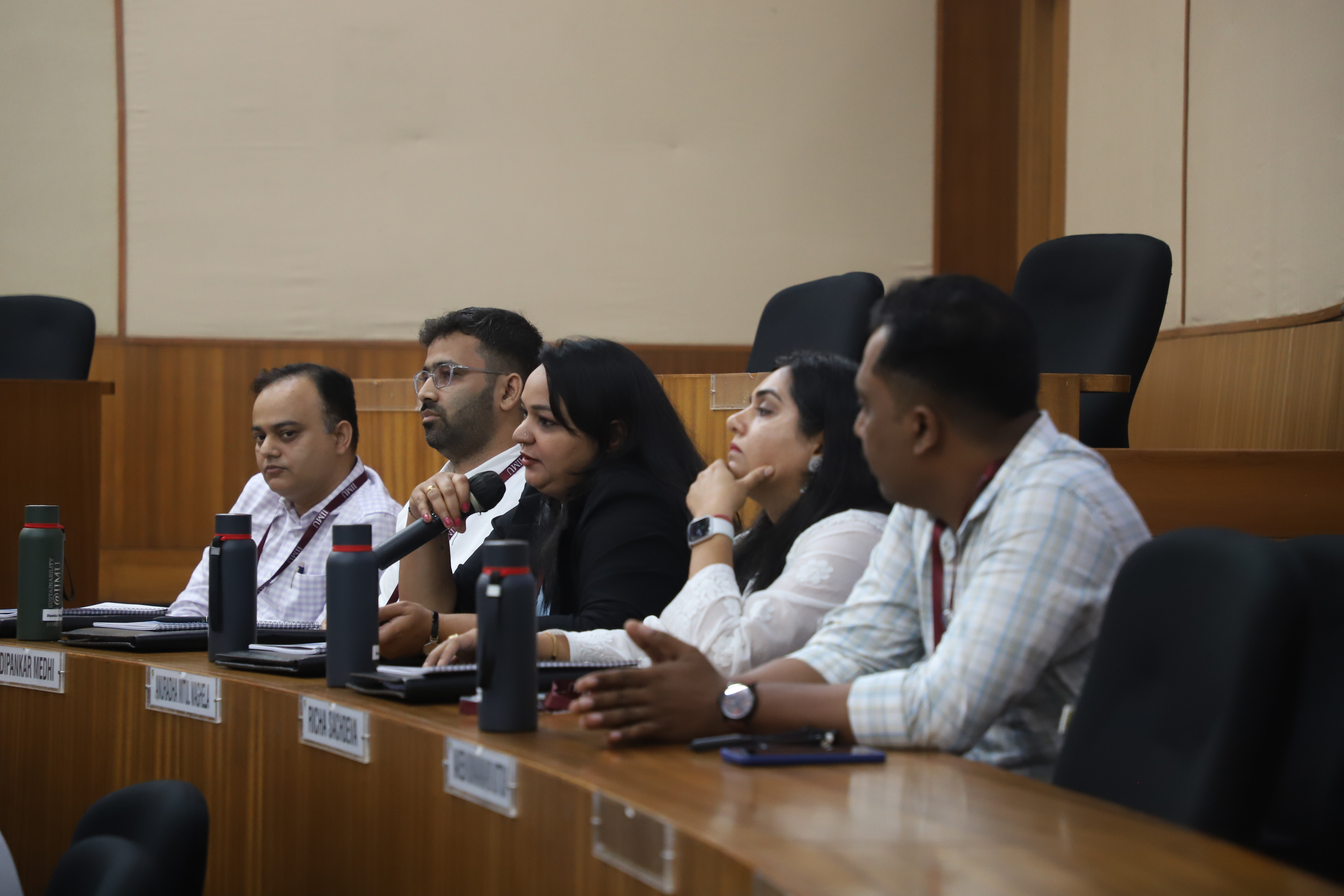
With the participants

**

In the ultimate analysis, Winning in a disruptive world is all about  that ability to See, Comprehend & therefore Interact with life (and situation) differently than most people do. ‘Winners of a disruptive world SEE….and come to live in a different world.

In Learning….. Shakti Ghosal
The Mantra of Personal Mastery


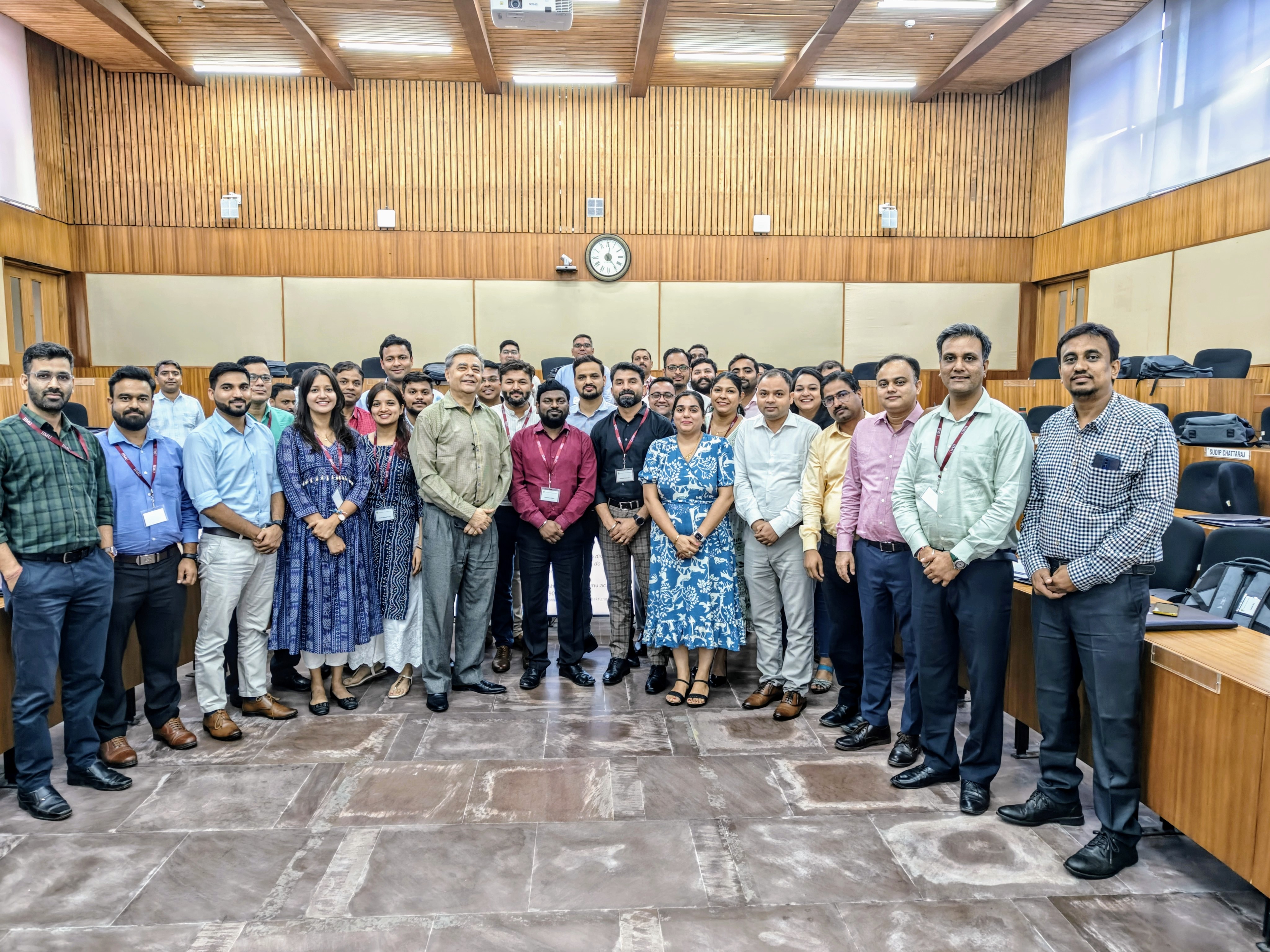
Recently at an IIM Udaipur conducted Management Development Program (MDP) for Indus Towers managers, I anchored four sessions. We started with the overarching perspective of Leadership and personal mastery before drilling down to specifics of Power & influence in teams, Managing high performance teams and the Feedback & Delegation aspects in Team Dynamics. We ensured a surfeit of activities, Role Plays and Case Studies to deepen the learning through practice and Ideation.

oplus_262144

In one of the sessions, we were in discussion of the aspects of ‘Honouring one’s word’ and ‘Being Authentic’ as performance accelerators of a team. Several participants mentioned their reservations about this, as under:

“If we become authentic and honour our word and others in the team do not do it, we would be taken advantage of and would be forced to do the work of others”

“All this is good theory but just does not work in real life. The fact is the Management has perceptions of who are good versus who are bad and irrespective of whether we honour our word or not, the favoured ones would get rewarded in terms of promotions and bonus”

In life, we are conditioned to judge others on moral and ethical yardsticks but remain quick to rationalize our own failings against the same yardsticks. We look around to try and determine who all are ‘honouring their word’ and tell ourselves that we would wait for others to honour and keep their word before we keep our own. As Chris Argyris had said about self-deception, ‘Put simply, people consistently act inconsistently, unaware of the contradiction between the way they think they are acting and the way they really act.’

 To gain the ability to honour our own word, we should be prepared to deeply deliberate and answer the question, ‘Where is my word when it comes time for me to keep my own word?’  In the ultimate analysis, there is a simple but inviolable equation of workability which is YOU are equal to YOUR WORD.

As I explained to the participants, team performance has very little to do with peering over shoulders to ascertain who is doing what. It has almost everything to do with how we can create trust of others in us. And creating trust has everything to do about Integrity viz. honouring our word and being authentic about how we show up for others. While some may try and take advantage of your trust in the short term, the aura of trust leads to team members gravitating towards you, working with you as you shift into being a natural leader.

How might you incorporate ‘Honouring your word’ and ‘Being authentic’ as part of how you show up tomorrow with your stakeholders?

In Learning……. Shakti Ghosal

Further Reading: ‘Integrity is a matter of a person’s word- nothing more, nothing less’– Michael Jensen, Professor Emeritus, Harvard Business School. Revised March 28, 2014.

Note : Indus Towers is India’s largest mobile tower installation company.  In India, 3 out of every 5 calls made are through an Indus site. https://www.industowers.com/

I = My Word


You may choose your words like a connoisseur, And polish it up with art, But the word that sways, and stirs, and stays, Is the word that comes from the heart.

Ella Wheeler Wilcox, American author and poetess, 19th century

I recall the 1970s supernatural classic, ‘The Exorcist’ in which the possessed Regan, when asked “Who are you?” replies in a demonic voice, “Nowonmai”. Initially thought to be something in a foreign dialect, the reply is later deciphered to be, ‘I am no one’, when read backwards.

Regan in The Exorcist

What is it that makes us ask the question, “Who are you?” It seems to support us to create a fix about the other person. About his characteristics, about his viewpoint, about his intentions. We try to determine the authentic self in the person which then allows us to engage with him powerfully.

At the other end, the enquiry ‘Who am I’ allows us to present a perspective of ourselves which we feel offers the best chance for engagement and success. Said another way, we show up, not as our authentic self, but in the best manner possible to get the job done. Clearly, over time, our ‘Who am I’ face does become a talent for deception.

It is in the attempted matching between the “Who are you” gained perspective and “Who am I” put on mask that the effectiveness of engagement and relationship between two individuals lies.
untitled
Who am I? I remember those times as a child when having nothing better to do, I would stare into the mirror and wonder, “How is that me?” Am I me because of the name which my parents christened me with? Or because of how I look? Or because of how I think, speak, act? Or because of how I behave with others? After all these decades today, when I think back to those questions, I yet remain uncertain of the answers.

Who am I? Why do I experience this sense of self? Is it a natural function of my mind? Or is it some spiritual awareness that keeps tugging at me? The fact remains that with every passing day, I keep changing. Every day I change into the person I become in the moment. As I sift through photographs and memories, I am confronted with the realisation that I am a person who is significantly different from the person I had been at an earlier time. Both physically and mentally, I see myself changing, adding, subtracting, becoming …..Me.

But if I am always changing, adding, subtracting, becoming, where does the assurance of ‘Who am I’ lie? For is this assurance not critical to my engagement and effectiveness in the world? As I muse on this, my thoughts shift to a webinar series titled ‘Integrity: Without it nothing works’ which I participated in recently. In it, author Mike Jensen concludes that the foundation for being a high performance individual is to declare “Who I am is my word”. He goes on to say that within his own organisation, a perspective shift to ‘I am my word’ amongst employees led to a 300% improvement in performance with no additional inputs.

As per Mike, since I am my word, I become whole and complete only when my word is whole and complete. And how does my word become whole and complete? This happens when I honour my word. I can do this in two ways. First by doing what I said and in case I am unable to do so, I inform about this to all the people counting on me and be willing to clean up any mess that might get created.
Broken_Promises_by_HerrFous

Why does honouring my word become important? Because it makes my word, and thereby me the person, whole and complete. This is what goes a long way to improve the potential of my performance. To understand this some more, let us look at the example of a car. For optimum performance, it needs to have been designed right, all its components need to be in place and functioning and you, the owner, drive it correctly. Should any of these aspects be missing or not right, the car would malfunction, become unreliable and essentially would lack integrity. So it is true with me (or you). When my word and therefore I, am whole and complete and therefore in Integrity, I radiate an empowered and trustworthy persona and my actions get perceived as reliable and consistent. This then becomes the core of ‘Who I am’ which does not change even when I change physically and mentally. The power of “I AM equal to MY WORD” lies in this. As my word gets perceived as that changeless anchor I am to which everyone around me can tie their knots of trust and faith to.
integrity
As I muse of all the difficult-to-handle aspects ranging from self deception about not honouring my word ‘ Do I really need to if no one is looking’ to fear of acknowledging that I would not be able to keep my word ‘How on earth would I clean all the mess that would ensue’, I realise the best place to start is to give my word to myself that I would be my word.

In Learning…….. Shakti Ghosal

Acknowledgement :‘Integrity: Without it nothing works’. Harvard Negotiation, Organisation and Market Research Paper No. 10-042 by Michael C. Jensen,Jessie Isidor Straus Professor Emeritus, Harvard Business School, April 3, 2014.

Indian Elections and the Law of Integrity


Over the last one month, the screen images continue to focus on that greatest show of Democracy on Earth, the on-going national elections in India. Close to a billion voters being wooed by a fractious, cacophonous political lot.
Indian elections
I notice contrasting articulations.

On one hand, I see political parties investing a lot of energy and resources to disseminate what they stand for. Their manifestoes drip with great intentions that they are committed to fulfill if voted to power. Candidates vie with each other for that once in five years photo opportunity to stand shoulder to shoulder clutching their copy of this ‘intention bible’.But when a politician is confronted with non-fulfilment of earlier electoral promises, he is quick to ascribe causes. Of how the opposition was non-supportive in the parliament. Of how resources and funds were not made available. Of how, inspite of all such great challenges, he continues to remain totally committed to usher in development, both economic and social.

On the other hand, I see the man on the street expressing his disenchantment with the political class, even the political process. Of his ire at the lack of fulfillment of election manifestoes in the past. Of his perception that election promises are meant to garner votes and quickly abandoned thereafter. Of his perspective that politicians exist only to feather their own nests in terms of aggrandizing power, influence and money, giving scarcely a thought to the welfare of the citizenry. Of his fervent hope that at least this time around, the politicians coming to power might be motivated to focus on development, both economic and social.

I muse about this lack of alignment between the politician and citizenry even though both speak of the same goal viz. development, economic and social. Do I sense a loss of faith in the workability of our political system? What is at the core of this failure?

My thoughts shift to the Integrity model which I had read about recently. Authors Werner Erhard, Michael Jensen and Steve Zaffron present this model to demonstrate how Integrity, as defined by them, is intrinsic to the workability in any situation.
imagesAY8T79ZE
As per the authors, Integrity is all about our word being whole and complete, both to ourselves and to others. What is the meaning of word being whole and complete, one may ask. It means “Honouring our word” which is keeping our word and in case we are not able to do so, be willing to be held responsible for clearing any mess caused by that. The Law of Integrity states that as integrity (honouring the word) declines, workability declines, and as workability declines, the opportunity for performance declines.’

As I look at the Integrity model in the context of the Indian elections, I wonder about the contradictions the political process throws up. Could it be that the contradiction we see of espousing integrity but not honouring the word is a trait that exists in each one of us? So,what is it then that stops us seeing this contradiction? As I think of this, the following thoughts fleet through my mind.

Do we see Integrity as some kind of a virtue to aspire for rather than an underlying condition for performance? When we see integrity thus, we rarely think twice before sacrificing it to ‘succeed’.
• Do we suffer from self deception when it comes to our own out-of-integrity behaviour as we are quick to put the blame somewhere else but fail to see how our own failure to perform is linked to this violation of the law of integrity?
• What is it that stops us from admitting that we will not be keeping our word? Is it from a fear that we would be responsible for ‘cleaning the mess’ and thus look bad in front of others?
• Do we realise that having given our word, any attempt to subsequently link that to a likely benefit for us makes us look untrustworthy?

As I think of the divergence between words and deeds that has rendered our political system (which also includes us!) untrustworthy and undermined its workability, I am left wondering at the kind of political language that may be used by both politicians and citizenry alike. A language that would align the commitments. A language that would ensure that owning upto our commitment failures and taking responsibility of the clean-up becomes the norm…….

In learning………….. Shakti Ghosal

Acknowledgement: ‘Integrity: A positive model’ by Werner Erhard, Michael Jensen and Steve Zaffron, Harvard Business School Working Paper No. 10-061, Revised May, 2013