

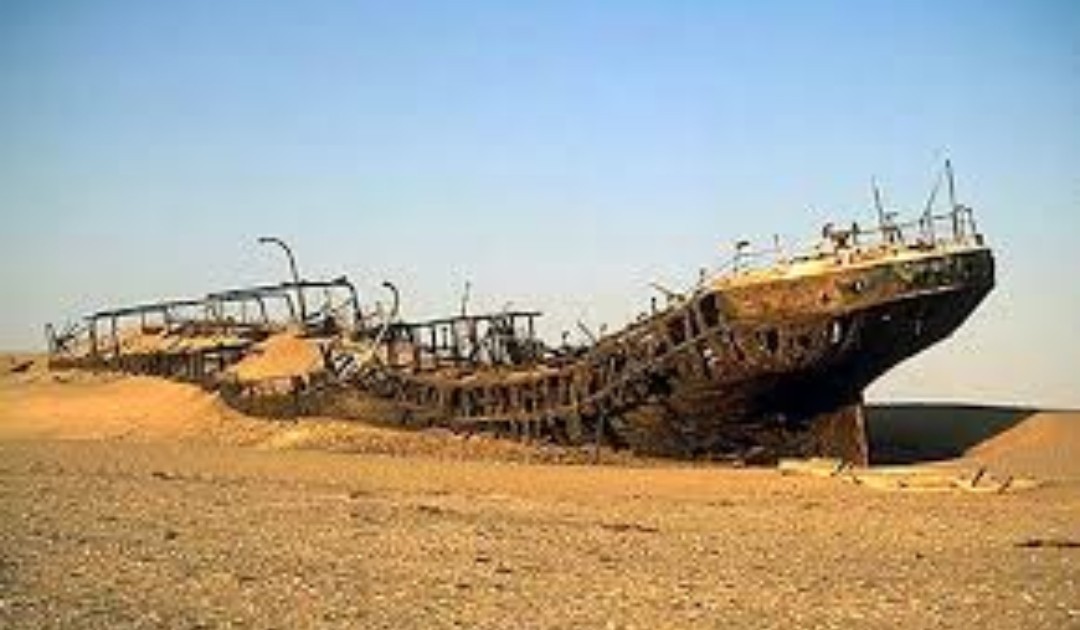
I chanced upon a news item of a buried ship in one of the world’s driest deserts in Namibia, with a haul of centuries old treasure, untouched by centuries.
The discovery of the sunken ship was made in 2008, in the southern expanse of Namibia’s desolate Sperrgebiet, forbidden territory. Later identified as the Bom Jesus, a Portuguese vessel which was lost five hundred years back during a trade voyage to India. The ship represented the Portuguese maritime empire’s pivot towards India and the east at the height of the Age of Discovery.

Led by Dr. Dieter Noli, a South African archaeologist of repute, the excavating team uncovered more than 2000 gold coins, ivory tusks, copper ingots, and weapons, all in a remarkable state of preservation. Unlike most coastal shipwrecks degraded or looted over time, the Bom Jesus had been pushed inland over centuries by geological forces, and combined with wind blown sediment, it had remained sealed in a natural sarcophagus.

**
“The sea forgets no soul — it only waits for their return.”
They called it the Age of Discovery. But for those of us who sailed it, it was the Age of Reckoning.
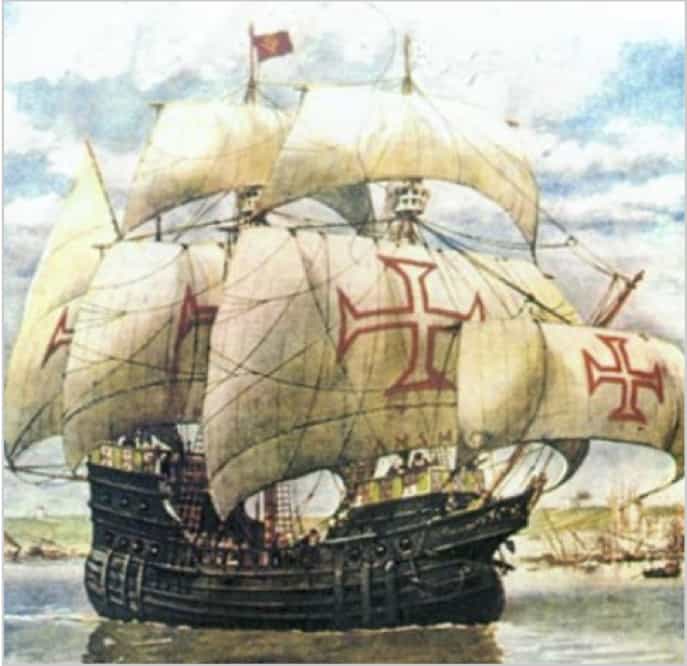
It was the year of Our Lord 1533 when Bom Jesus set forth from Lisbon. She was a three-masted carrack of near 120 feet, her hull of oak black with pitch, her sails heavy canvas stitched in gold thread with the Cross of Christ. She carried five decks — the lower hold stacked with copper ingots from Augsburg and elephant tusks from Sierra Leone, the middle filled with gold and trade wares bound for Goa, and above, our cramped berths where men slept beside their sins.
I was the ship’s Chronicler — João Mendes, son of no one worth naming — tasked by the Casa da Índia to record the journey. I fancied myself a man of words, not of winds; I soon learned the sea had its own grammar.
We departed on Ascension Day, bells tolling from the Sé Cathedral, the scent of incense mixing with tar and brine. Captain Dom Diogo Pereira, a veteran of the Carreira da Índia, Portuguese East India Company, stood on the quarterdeck, broad-shouldered and proud, his hand resting on the hilt of his Toledo blade.

“Men of Portugal!” he thundered. “We sail for God and the King! For gold, glory — and for home, if He wills it!”
“Deus nos guie! God guide us!” we cried back, and the Bom Jesus glided down the Tagus into destiny.
Our route was the old one — past Cape Verde to the Gulf of Guinea, then around the Cape of Good Hope, across the endless Indian Ocean to Cochin and Goa. Ten thousand miles of wind, wave, and unseen graves of adventurers.
The first few weeks were kind. Trade winds filled our foresails; flying fish glittered beside the hull. We dined on hardtack, dried cod, and the Captain’s pride. At night I climbed the forecastle to watch the stars wheel — the Southern Cross like a torch over the horizon. The helmsman, old Mateus, would nod at it and murmur, “Mesmo o céu muda para quem navega. Even the heavens shift for those who sail.”
But the sea does not love those who sail it for long.
Near Cape Verde, the wind changed. The compass began to shudder though the sky looked clear. In the hold, a carpenter found an unlisted chest, iron-bound, its seal a reversed cruciform sigil.
The Captain frowned. “No such cargo was declared,” he muttered.
The priest, Father Almeida, whispered, “It bears the mark of the Templários, Templars. Heresy!”
“Open it,” the Captain ordered.
We broke the seal. Inside lay a crucifix of black gold, the figure inverted. It was a Satanic symbol! The air turned cold, though the day outside burned hot. The priest crossed himself. The Captain ordered it resealed and hidden. That night, lightning struck our mainmast.

Superstition spreads faster than scurvy. The men whispered that we carried a relic damned by God. One swore he heard chanting beneath the deck. Another said he saw a man in robes walking the gunwale at midnight, his feet never touching the wood.
Still, we sailed on — south past Angola, into seas uncharted. The coast grew barren; dunes stretched like the bones of the world. The charts called it Costa dos Esqueletos — the Skeleton Coast. We knew that even the seagulls avoided it.
Then the fog came. It was thick, white, soundless, relentlessly surrounding us. The lookout cried, “Land! Sand ahead!”
“Hard to larboard!” shouted the Captain.
But the current seemed to seize us like a claw. The keel scraped something unseen. The Bom Jesus groaned, a deep, living sound. Below, the ballast shifted; the copper ingots sliding here and there. The ship’s stability seemed to be teetering.
“Drop anchor!” cried Mateus. “Santa Maria, tem Piedade! Saint Mary, have mercy!”
The anchor vanished into the mist. The ship tilted. The priest clutched his crucifix and began to pray, though the words seemed to be coming out backwards.
I stumbled to the hold to rescue my journals. The water flooding in seemed to glow faintly green. I saw that the sealed chest had burst open. The inverted crucifix floated upright, its eyes gleaming red as coals. Around it, the gold coins trembled, rising and falling as if breathing. I remember shouting, “Capitão! Venha ver isto!, Captain, come see this!”
He never did. The hull split. Sand and water surged in. The ship screamed as if alive, ribs cracking, decks collapsing. I clung to a beam as men were swept into the dunes that moved like tides.
Through the maelstrom I saw — or dreamt I saw — a figure standing on the water’s surface, face hidden by a cowl, hand raised in benediction. The bell tolled, though no man rang it. Then all went black.
When I awoke, the world was silent. I lay on a dune, the wreckage scattered around me, half-buried in glittering sand. No ship. No men. Only the wind’s long sigh.
I found my quill and a scrap of parchment. The ink had turned thick with salt. I began to write. I needed to remember, to exist. The days blurred. The sun moved, the dunes shifted. Sometimes I would see the broken ribs of the Bom Jesus thrust through the sand like bones. Once, I heard laughter carried on the wind. The laughter of men long drowned.
At night, a pale glow rises from the sea. I hear the toll of the bell, steady, patient. When the fog drifts inland, I glimpse lanterns bobbing on the horizon. Our ship sailing still, her sails tattered, her decks empty. I know her. She calls out to me.
Perhaps I never left her. Perhaps I am still aboard, walking the splintered deck, quill in hand, scratching words no living eye will read.
If you find this parchment, if by some fate the sands give it back, take heed: do not seek the Bom Jesus. Her treasures lie where faith and greed collide, guarded by the sea’s own curse.
And should you hear a bell tolling across a calm shore, do not answer.
For the Bom Jesus sails yet. And her chronicler still writes. Though his hands are bone, and his words drift like mist upon the tide.
“In every wave sleeps a memory, and in every wreck, a prayer unfinished.”
In musing…… Shakti Ghosal


 A New Beginning