The Royal Bengal Tiger was always just beyond the frame—a whisper in mangroves, a rumour in grasslands, a story told by guides with knowing smiles.
In the Sundarbans, they warned us, “Don’t look too hard. If you see one, chances are you won’t be seen after.” We looked anyway. We saw nothing.
At Ranthambore National Park, dawn and dusk gave us….. Pugmarks, droppings, and growing humility.
At Periyar Wildlife Sanctuary, they didn’t even pretend. “Forget it,” they said kindly.
And then— it was the turn of Tadoba Tiger Reserve……where, quite unexpectedly, fortune decided to shift…. and behave like Lucknow hospitality.
It began like a well-directed play. Our jeep was rolling lazily when the guide suddenly sprang up, as if the forest had whispered directly into his spine— “Look behind!”
And there she was. A tigress. Standing squarely on the road. Unhurried. Unapologetic. Entirely in charge.
She gazed past us, not at us— as though we were merely an inconvenient paragraph in her story. A low, resonant rumble followed. And then another and another.
“That,” the guide declared with reverence, “is the mother calling her children.”
Of course she was. Even in the wild, mothers don’t wait forever.
What then transpired in front of our eyes was akin to a screenplay. But of the most elegant kind.
As we continued to be transfixed by the one behind, the guide shouted again and pointed. From the front, another tigress appeared—a sibling, perhaps…….She carried a prey in her jaws with the nonchalance of someone bringing snacks to a gathering.
The mother’s rumble deepened.
Translation (we imagined): “Food is fine. But where are the children?”
And then we saw them again. Three grown cubs, walking in a line— like reluctant teenagers responding to a call they had heard thrice already.
They were magnificent. And mildly disobedient.
The mother paced the shoreline now, her calls shifting between soft persuasion and unmistakable authority. It was a language older than words— half love, half command. The forest listened. So did we.
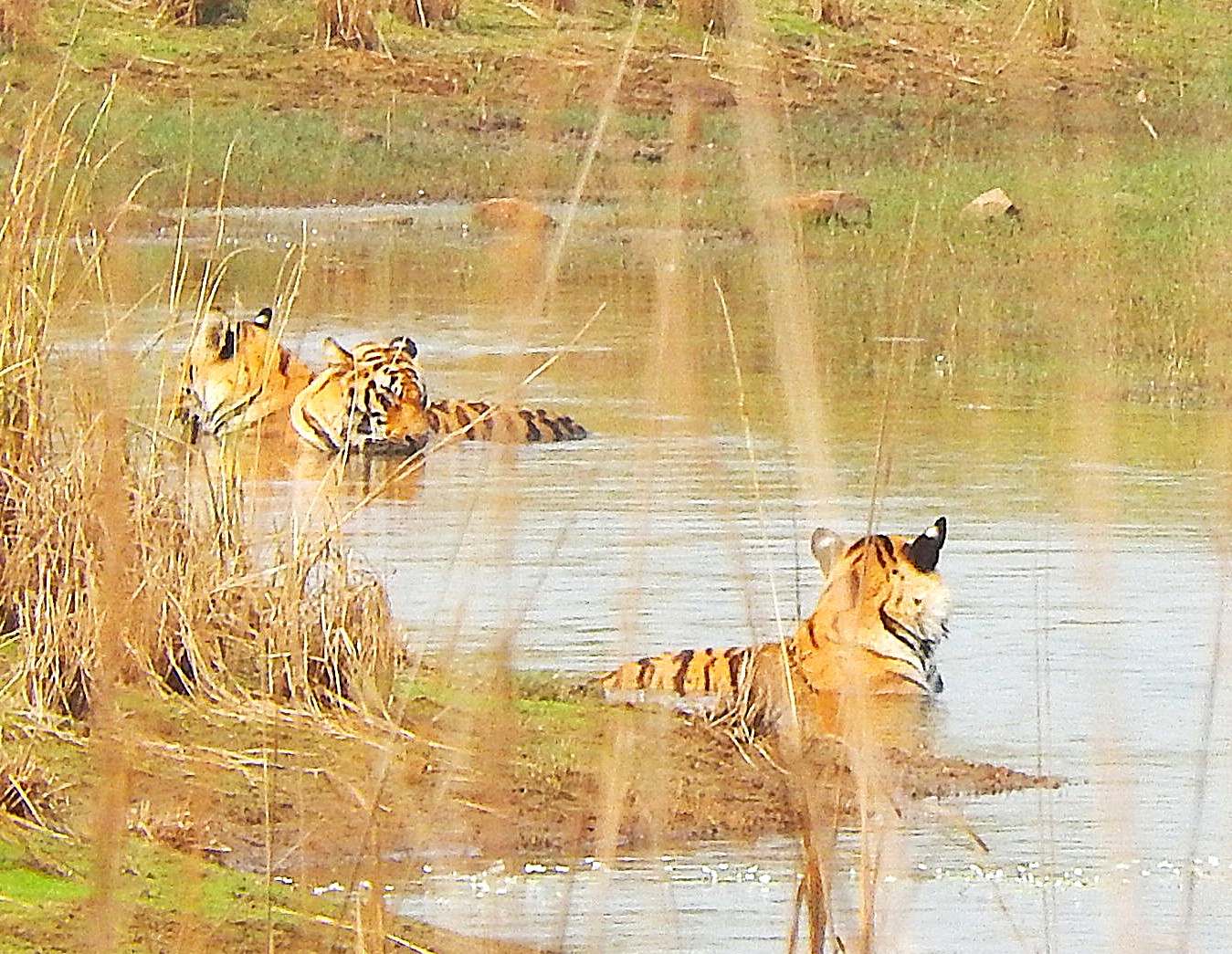
One cub made the first move. It slipped into the water, cutting through it with quiet determination—towards the waiting mother. The other two paused. Of course they did. Every family has those who hesitate at the edge.
The mother, now joined by the brave one, turned and looked back at the rest of the family on the other side. A decision was made and the mother and cub swam again. Not away, but towards the uncertain. And then, as if reminded of something fundamental, the remaining two followed.
For a moment, time forgot to move. Four tigers. Water rippling. Sunlight holding its breath. And us— utterly irrelevant, yet impossibly privileged.
We had spent years trying to see a tiger. This time we were seeing something else. Not power. Not danger. Not even wilderness. We merely saw a mother trying to gather her children.
And in that quiet, persistent calling, echoing across water and time, the jungle revealed its oldest truth:In every world, wild or civilised, the fiercest force is not the hunt—it is the pull of belonging.
From the sun-drenched vineyards of Hawke’s Bay to the Art Deco charms of Napier and the cultured vibes of Wellington, our North Island journey in New Zealand was a heady blend of scenic beauty, fine wine, coastal elegance, and urban character. Here’s a glimpse of three unforgettable days soaking in the essence of Kiwi culture, cuisine, and charm.
Pacific Coastline
**
New Zealand often conjures images of snow-capped peaks, sheep-dotted meadows, and fjord-streaked landscapes. But on the North Island’s eastern edge lies a less-trumpeted triad of experiences that seduce the senses in a quieter, more intimate way: the sun-drenched vineyards of Hawke’s Bay, the Art Deco elegance of Napier, and the cosmopolitan charm of Wellington.
We began the day heading toward Hawke’s Bay, a region known for its Mediterranean climate, rich soils, and status as one of New Zealand’s finest wine-producing areas. The road wound through rolling hills and vineyard vistas that stretched out like pages from a postcard. It’s no wonder that Lonely Planet calls Hawke’s Bay “a food and wine lover’s paradise… where long sunny days and fertile plains create the perfect recipe for indulgence.”
Hawke’s Bay
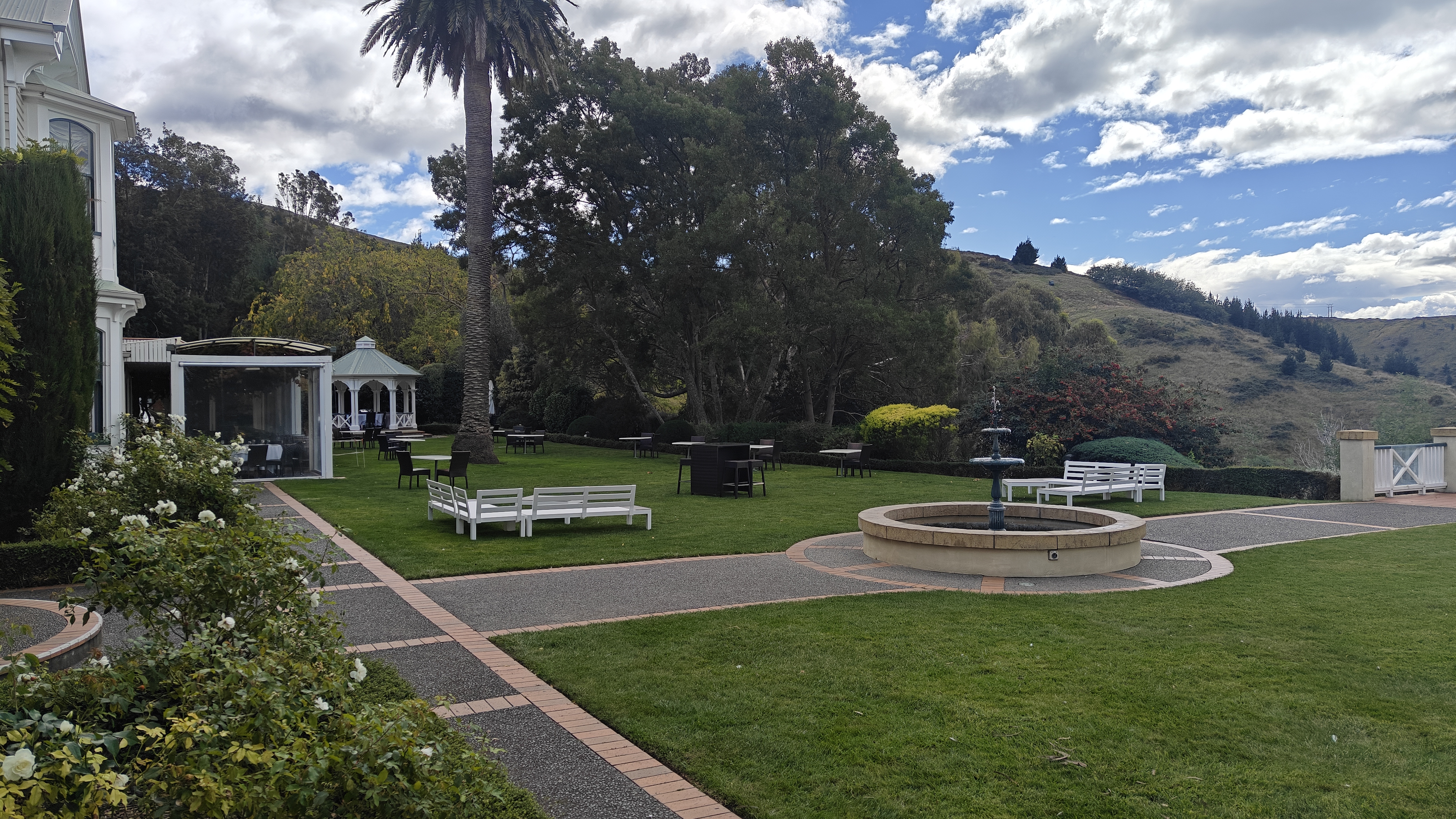
Our stop at Mission Estate Winery—New Zealand’s oldest established winery dating back to 1851—was the highlight of our visit. The elegant colonial-era structure welcomed us like an old friend, and we quickly found ourselves immersed in a world of subtle textures and fragrant bouquets. The Sauvignon Blanc stood out with its crisp minerality, but it was the velvety Syrah that stayed with us long after the last sip. A relaxed lunch followed in a shaded courtyard adorned with trellises, garden blooms, and birdsong. It felt more like a countryside dream than a scheduled stop.
Mission Estate Winery
The next chapter of our journey took us to Napier, a gem of a coastal town shaped by both tragedy and triumph. Rebuilt in the 1930s following a devastating earthquake, the town now proudly showcases one of the most concentrated collections of Art Deco architecture in the world. A stroll down its palm-lined promenade revealed a town wrapped in pastel tones and whimsical curves, as if time itself had taken a gentler turn here.
Art Deco
Condé Nast Traveler once described Napier as “a place where you’ll want to slow down and look up,” and that’s exactly what I did. As I meandered through the town, every façade seemed to carry a story—of resilience, rebirth, and remarkable aesthetic unity. Our hotel, perched with unobstructed views of the Pacific Ocean, felt like a poetic pause in this narrative. The sea, ever restless, offered a calming counterpoint to the symmetry of the streets.
The following morning, we descended further south to Wellington, the capital city nestled between rolling hills and a sparkling harbour. Where Napier wore nostalgia on its sleeve, Wellington was vibrantly alive—a city that fused culture and creativity with surprising sophistication. Its streets, both parallel and sloped, gave it a geometric charm, while cafés spilled out onto sidewalks filled with young creatives, office-goers, and the occasional street performer.
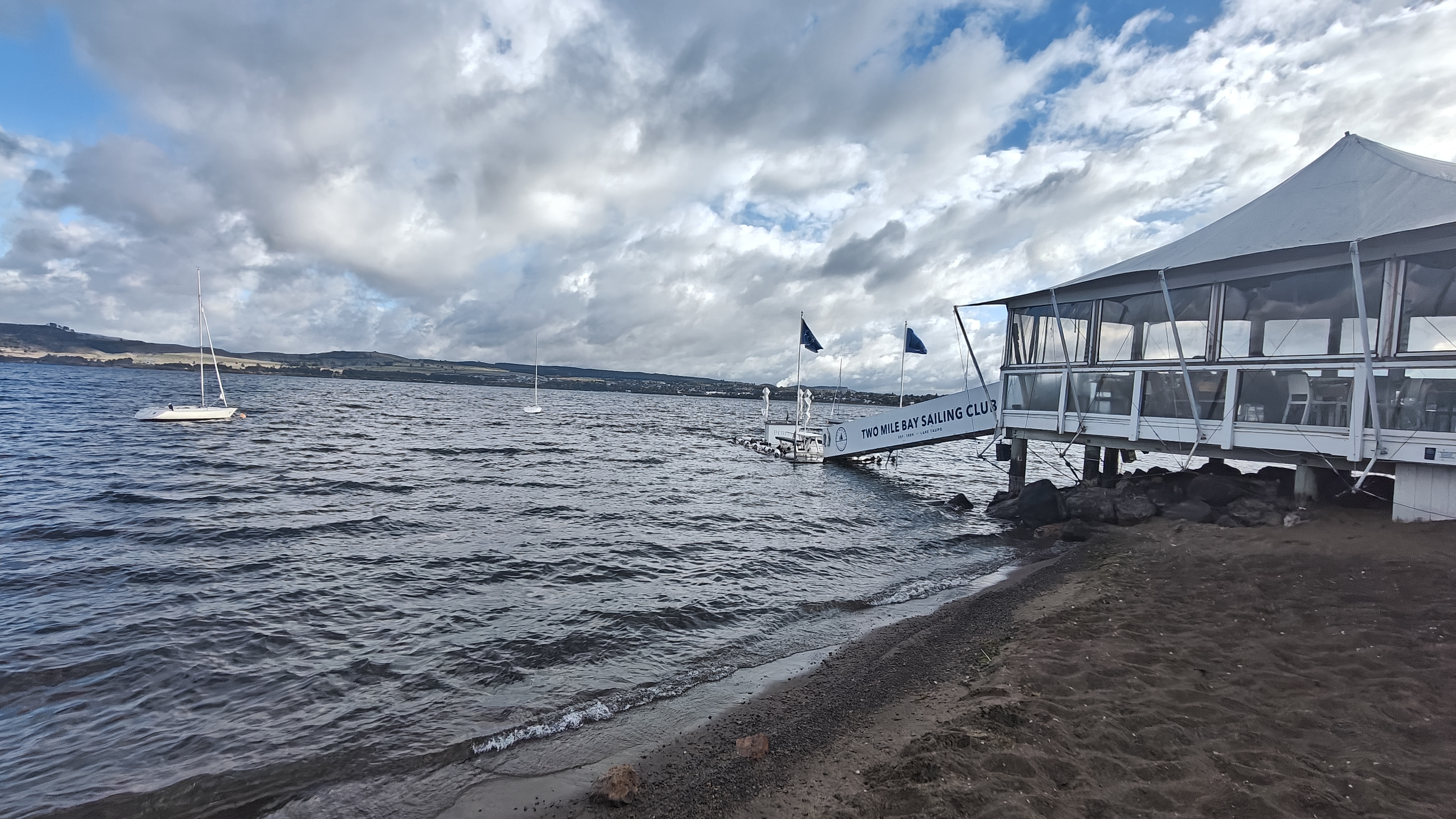
There’s something beautifully paradoxical about Wellington—it’s compact yet buzzing, orderly yet expressive. The Wellington Marina invited us to pause and breathe in the city’s rhythm. Boats bobbed gently in their berths, while locals wandered past us with wind-blown hair and takeaway coffees. No surprise then that the BBC once referred to Wellington as “the coolest little capital in the world.”
Wellington Marina
Dinner was a quiet affair, but we couldn’t resist passing by the city’s political heart—the Beehive, a part of the New Zealand Parliament complexes. The building’s modernist circular form is either intriguing or awkward, depending on your point of view. I found it oddly compelling, a symbol perhaps of the country’s bold architectural spirit, unafraid to provoke a reaction.
As we wound down our day in Wellington, I couldn’t help but reflect on the journey. Each place had offered something distinct: Hawke’s Bay’s pastoral elegance, Napier’s vintage soul, and Wellington’s urban charisma. Yet all were stitched together by a common Kiwi thread—warmth, nature, and quiet sophistication.
In a world where travel often tries to impress through spectacle, this journey stood out for its graceful subtlety. It didn’t shout; it sang.
This article explores the social behavior commonly referred to as “Puppy Dog Wag Tail Syndrome”—where older individuals attempt to gain acceptance from younger social groups through excessive compliance, self-effacement, or mimicry, wagging one’s tail so to say! While this behavior stems from a natural human desire for belonging, it often compromises one’s authenticity and self-respect. Drawing from research in social psychology, this piece delves into the emotional drivers behind such behavior and advocates for embracing authenticity across generational lines.
Have you ever witnessed an elderly individual awkwardly trying to “blend in” with a younger group? Perhaps they crack out-of-place jokes, adopt unfamiliar slang, or seem constantly eager to please — laughing too hard, offering unsolicited help, or nervously seeking approval. This performative effort to fit in, often at the cost of dignity and self-awareness, is what might be called Puppy Dog Syndrome. Much like an over-eager pet desperate for affection, the individual’s behavior becomes centered around pleasing others, often sacrificing self-expression and confidence in the process.
While it may appear superficial on the surface, this behavior is rooted in something deeply human: the need to belong. Social psychologists Roy Baumeister and Mark Leary (1995) identified belongingness as a fundamental human motivation. Regardless of age, people crave connection, approval, and inclusion. Yet, when belonging feels uncertain — especially in cross-generational settings where values, cultural references, and energy levels diverge — the fear of exclusion can drive compensatory behaviors.
Older individuals, particularly in youth-dominated spaces like workplaces, social media platforms, or casual gatherings, may feel a loss of relevance or influence. In such settings, some try to gain favor by imitating youth or subordinating themselves — often unconsciously — in exchange for social acceptance. But the cost of such behavior can be significant. Carl Rogers, the humanistic psychologist, referred to this pattern as living according to “conditions of worth” — behaving in ways that earn external validation rather than expressing one’s true self.
This misalignment can take a psychological toll. A 2006 study by Kernis and Goldman found that chronic inauthenticity is associated with lower self-esteem, increased anxiety, and reduced life satisfaction. It’s a hollow kind of belonging that demands constant performance, rather than one built on mutual respect and individuality.
What’s most tragic about Puppy Dog Syndrome is that it often masks the rich experience, insight, and stability that older individuals have to offer. Rather than chasing youth, they might be better served — and more appreciated — by showing up as their authentic selves, offering perspective rather than parody.
Intergenerational engagement works best not through mimicry but through mutual curiosity and honesty. Younger generations often value authenticity more than they let on. There’s strength in standing tall in one’s own identity, wisdom in speaking with one’s own voice, and grace in not needing to follow the crowd.
In a world obsessed with fitting in, perhaps the most radical act is simply being yourself — fully, unapologetically, and without the need for approval.
References
Baumeister, R. F., & Leary, M. R. (1995). The need to belong: Desire for interpersonal attachments as a fundamental human motivation. Psychological Bulletin, 117(3), 497–529.
Kernis, M. H., & Goldman, B. M. (2006). A multicomponent conceptualization of authenticity: Theory and research. Advances in Experimental Social Psychology, 38, 283–357.
Rogers, C. R. (1959). A theory of therapy, personality and interpersonal relationships as developed in the client-centered framework. In S. Koch (Ed.), Psychology: A Study of a Science, Vol. 3. McGraw-Hill.
Abstract :Volcanoes, Redwoods, Maori traditions, and turquoise waterfalls—our journey through Rotorua, Murupara, and Taupo was like walking through nature’s raw and sacred diary. From the haunting silence of a buried village to the fiery hiss of boiling mud pools, and the warmth of a traditional Maori Hangi—New Zealand never stops surprising. 🌋🌲🌊
We skirted the edge of Lake Rotorua in hopeful anticipation, eyes squinting past the mist, searching for the silhouette of the legendary Mount Tarawera. But nature had other plans. Clouds draped the landscape like a reluctant curtain, denying us a view of the volcano that, in 1886, tore apart an entire region in a violent, unforgettable eruption.
Lake Rotorua
As we moved closer to the remnants of this catastrophe, we reached the Buried Village of Te Wairoa. It was haunting, almost sacred. Buildings lie preserved in ash, stories frozen in time, and silence whispered louder than words. Our guide painted a vivid picture of the night the earth roared—of ash raining down, of craters splitting open, and lives changed forever. According to the Buried Village site, it is “New Zealand’s most visited archaeological site, where stories of resilience and survival rise from the earth.” (Reference 1) And indeed, walking among the ruins, one feels that spirit deeply.
Buried village of Te Wairoa
From volcanic scars, we sought the solace of trees—and what trees they were! The Whakarewarewa Forest, just outside Rotorua, offered a surreal contrast. We wandered under towering Redwoods—some over 100 years old—and marveled at the magnificence of Douglas Firs and the ethereal grace of silver ferns, New Zealand’s national icon. Walking in their shadow, one feels both infinitely small and impossibly privileged. As described by Whakarewarewa Village, this forest is home to “majestic trees from California alongside native species in a uniquely Kiwi blend,” and the harmony between old world and new world flora is breathtaking.
Those Redwoods of Whakarewarewa
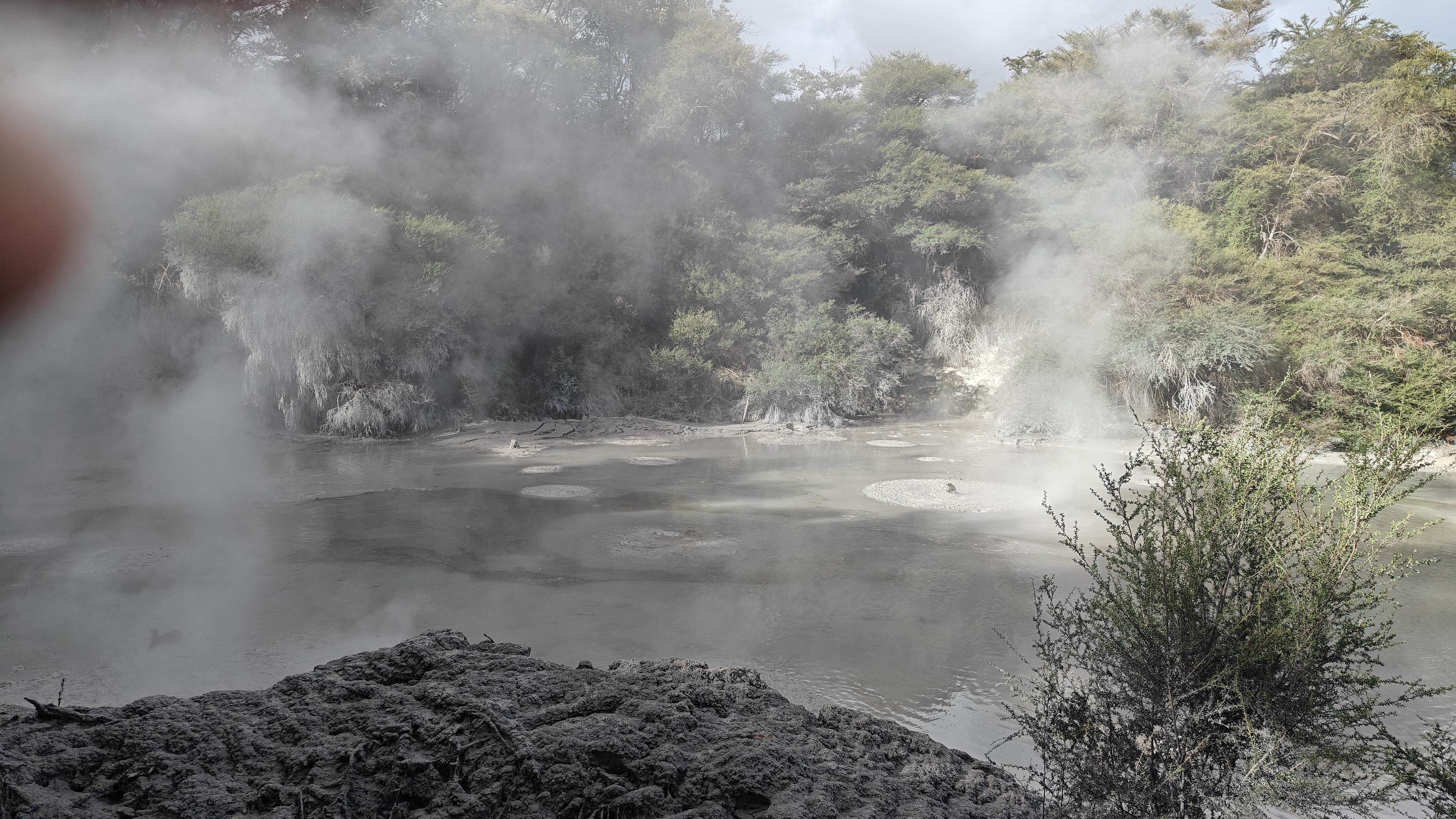
Yet Rotorua wasn’t done with its drama. The ground here breathes fire. Boiling mud pools gurgled around us, sending plumes of steam into the crisp morning air. Lakes hissed and steamed as though conversing with ancient gods. The smell of sulphur lingered, sharp and earthy. And yes, the unsettling thought did strike—what if another eruption lay dormant beneath our very feet?
Boiling mudpools of Rotorua
From geothermal energy to spiritual energy, we travelled onward to Lake Aniwhenua in Murupara. Here, the journey took a cultural turn. We were welcomed by the Māori people in a traditional ceremony that blended chants, fierce expressions, and deep respect. Though the language was unfamiliar, the sincerity needed no translation.
Maori temple
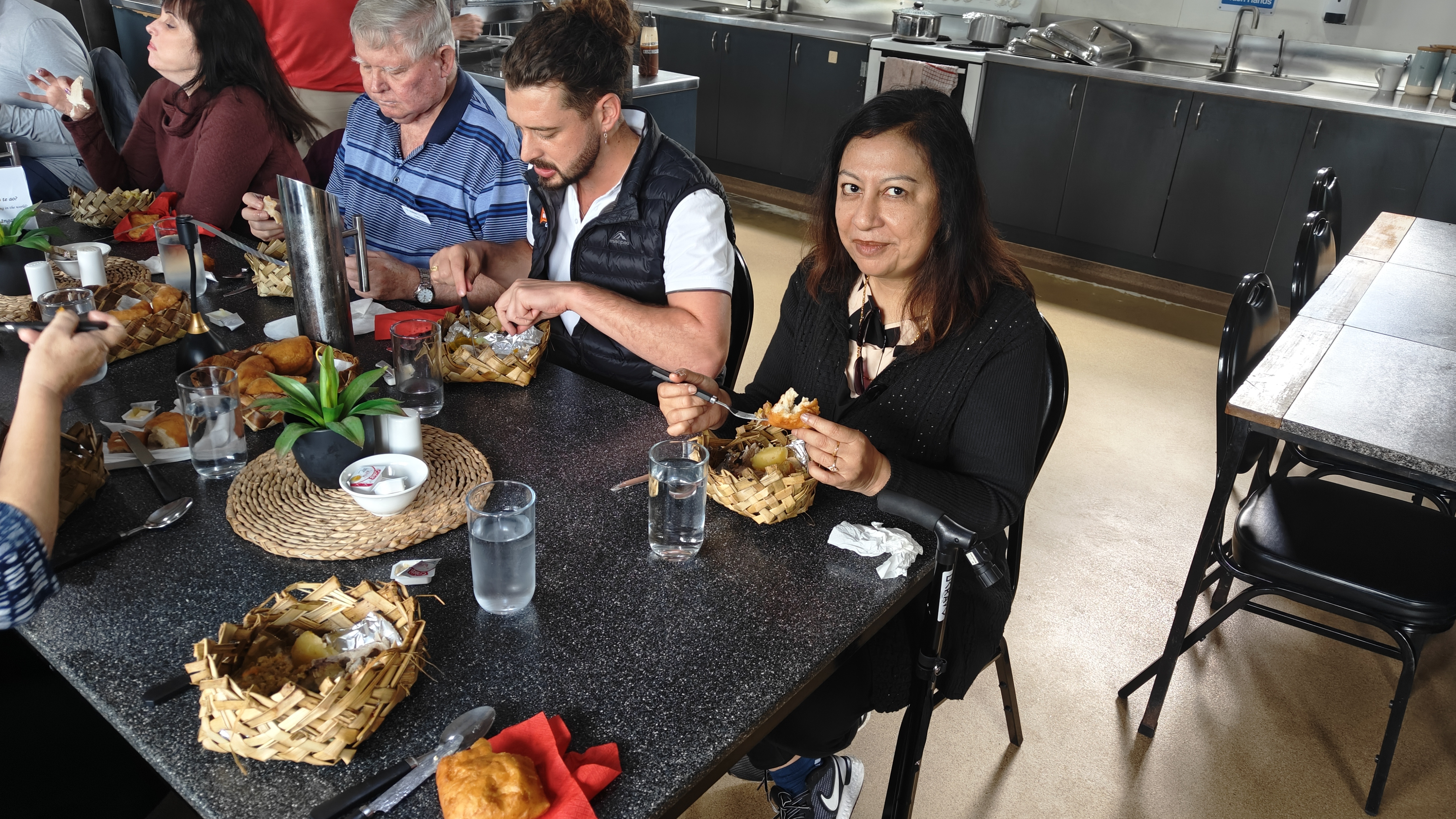
The highlight was witnessing the preparation of a traditional Hāngi meal—an earth-oven cooking method that has nourished Māori communities for centuries. Watching the fire-heated stones laid into a pit, food wrapped and buried under earth, felt remarkably similar to the tandoor cooking I’ve seen in North India. Different continents, similar soul food.
Hangi preparation
Later that afternoon at the Māori lodge, as the Hāngi was unveiled and its earthy aroma filled the air, it felt like we were not just eating a meal—we were partaking in a ceremony of memory, tradition, and togetherness. As the village itself puts it, “Whakarewarewa is more than just a village—it is a living legacy of Māori culture and community,” (Reference 2) and every moment we spent there reinforced that truth.
Traditional Maori meal
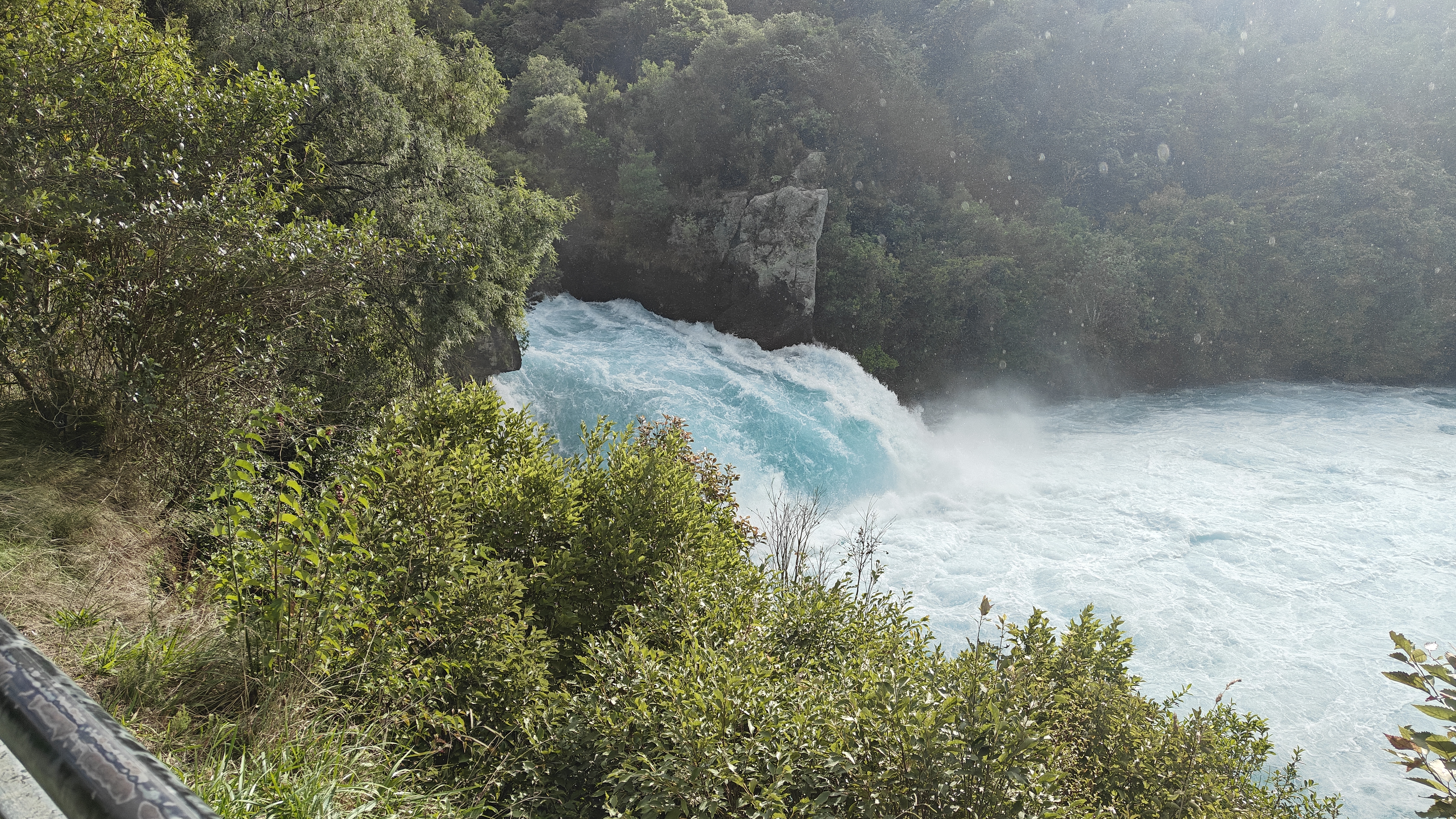
The final leg of this segment took us to Taupo, but not before a breathtaking interlude at the Huka Falls. The water there doesn’t just fall—it thunders. A hypnotic blue torrent squeezes through a narrow gorge before erupting into a frothy cascade. According to LoveTaupo.com, this “220,000 litres per second of crystal clear water” ( Reference 3) surging through the Waikato River is one of New Zealand’s most visited natural attractions—and for good reason. It’s power and poetry in motion.
The blue torrents of Huka
As we stood watching the falls, droplets misting our faces, I realised New Zealand isn’t just a destination—it’s an emotion. It stirs awe and respect in equal measure. One moment it shows you the fury of nature, and the next, it cradles you in cultural warmth.
And so, this chapter of our journey closed—not with an exclamation, but a deep, quiet breath of gratitude.
Centrifugal machines running on principles of Thermodynamics
I spent a part of my career in the HVAC industry many decades ago, at a time when it was firmly grounded in the disciplines of mechanical engineering and thermodynamics—both mature and deeply technical fields. Back then, optimizing system performance meant manually tweaking airflow, calculating heat loads, and understanding refrigerant behavior. I had worked with Voltas, a market leader in central HVAC systems and Fedders Lloyd, which manufactured and marketed low end Airconditioning units.
Controls of HVAC systemOf nuts, bolts, pipes and ducts
I find it fascinating to observe how today, the game has changed. This has been significantly due to Artificial Intelligence (AI)—a disruptive force that’s injecting intelligence, adaptability, and automation into an industry that once thrived on nuts, bolts, and thermal dynamics.
**
✅Smarter Diagnostics and Predictive Maintenance
AI-powered tools now enable HVAC systems to identify faults before they cause breakdowns. Instead of relying on trial and error, it is now possible for technicians to use sensor data and predictive analytics to find the root cause quickly—whether it’s a refrigerant leak or an airflow issue.
“AI algorithms enable predictive maintenance by monitoring operational data such as temperature, pressure, and energy consumption to detect potential issues before they escalate.” — [ATA College, 2025]
These AI systems don’t just detect problems—they help prevent them, significantly reducing downtime and maintenance costs.
**
🌱Energy Efficiency: Better for Business and the Planet
Energy consumption has always been one of the biggest pain points in HVAC operations. AI can address this by learning occupancy patterns, weather forecasts, and energy pricing to optimize performance in real time.
“AI can optimize HVAC operations by responding dynamically to external conditions and human behavior, ensuring comfort without excess energy use.” — [Cooling India, 2025]
The result? Lower energy bills, improved comfort, and a smaller carbon footprint—benefiting both the bottom line and the environment.
**
🌡️Personalization and Smarter Design
Modern HVAC systems don’t just heat or cool—they adapt. AI makes it possible to personalize climate control for zones or individuals based on learned preferences.
Beyond user experience, AI is improving the design phase too. Engineers can now simulate various configurations before installation, ensuring better efficiency and fewer on-site errors.
“AI is being used to create virtual simulations of HVAC systems during the planning phase, helping engineers choose the most efficient configuration.” — [Digital Defynd, 2025]
**
🏢Automation and Operational Efficiency
AI doesn’t merely stop at system optimization. It can streamline administration tasks like scheduling, dispatch, and customer service through chatbots and intelligent platforms.
In smart buildings, IoT-connected HVAC systems can adjust automatically to changing conditions, cutting operational costs and improving system responsiveness.
“Intelligent building systems that include AI-driven HVAC control are emerging as a top growth area for the industry.” — [Frost & Sullivan, 2025]
**
⚠️But It’s not all smooth sailing…
Ai has also brought with it certain downsides and risks.
Cybersecurity is a growing concern. As HVAC systems get more connected, they become more vulnerable to attacks. To combat, companies would require to invest in data security and system integrity.
Cost: AI tools, sensors, and integrations require significant upfront investment—posing a barrier for smaller firms.
People factor: Many technicians will need to upskill to stay relevant. The shift is as much about mindset as it is about knowledge of the machinery.
“The technicians of tomorrow must be as comfortable with data analytics as they are with ductwork.” — [ATA College, 2025]
**
🌍Looking Ahead
One needs to hold the perspective that AI is not just an upgrade—it’s a paradigm shift for HVAC. Those who embrace it will find new opportunities in efficiency, customer satisfaction, and sustainability. But success will depend on thoughtful implementation, investment in skills, and a willingness to adapt.
As someone who once worked in the traditional world of HVAC, I find it both exciting and humbling to see how far the industry has come—and how far it can still go.
**
💬 Let’s Discuss: Are you seeing AI being adopted in your HVAC projects or buildings? What challenges or benefits are you encountering?
In today’s dynamic and disruptive world, where change is the only constant, the ability to listen deeply and effectively—what we call ‘Power Listening’—has become an essential leadership and personal development skill. To many of us, Listening occurs as a passive process. No one notices when we tune off, we also retain the luxury of judging what we are hearing. This is also why Listening is a complex and demanding skill that needs conscious effort and self-awareness. I have always found it difficult to listen to what is being said with no intention, no judgment, no right or wrong.
In a landscape characterized by rapid technological advancements, shifting economic paradigms, and evolving workplace dynamics, power listening enables leaders, professionals, and individuals to navigate complexities with greater clarity, empathy, and strategic foresight.
According to Zenger and Folkman (2016) in their Harvard Business Review article What Great Listeners Actually Do, great listening goes beyond simply being silent while others speak. It involves active engagement, thoughtful questioning, and creating a safe space for open dialogue. Similarly, in The Power of Listening in Leadership (Forbes, 2021), Kevin Kruse emphasizes that effective listening strengthens leadership presence and fosters trust in professional relationships.
Understanding the Challenges of Listening
Despite its fundamental role in communication, listening is often overshadowed by speaking. Many assume they are good listeners, yet, as I have realized through personal introspection, listening is fraught with unconscious biases, preconceptions, and cognitive distractions. Each individual listens for different reasons and in unique ways, influenced by past experiences, emotions, and personal filters.
Reflecting on my own listening tendencies, I recognize that my ability to listen deeply is not always consistent. My engagement in a conversation depends largely on three factors: (1) my genuine interest and curiosity in the subject matter, (2) the perceived relevance and importance of the topic to me, and (3) the significance of the speaker in my personal and professional life. In the absence of these factors, I have observed a decline in my listening quality, often succumbing to perceptual blocks such as impatience, judgment, and the urge to prepare my response rather than truly absorbing the speaker’s message.
The Value of Power Listening
Power listening goes beyond hearing words—it involves deep engagement, empathy, and a conscious effort to understand the speaker’s perspective. I have personally found that when practiced effectively, power listening yields several benefits:
Building Trust and Confidence: A powerful listener enhances the self-worth of others, creating an environment of psychological safety where individuals feel valued and heard.
Enhancing Leadership Effectiveness: Leaders who listen powerfully cultivate stronger relationships, inspire loyalty, and encourage collaboration. Employees and stakeholders gravitate towards those who make them feel understood.
Facilitating Problem-Solving and Innovation: Power listening fosters a collaborative and open atmosphere, enabling teams to engage in meaningful dialogue and address complex challenges effectively.
Encouraging a Growth Mindset: When leaders listen without judgment, they instill confidence in others, encouraging a culture of learning, experimentation, and continuous improvement.
A Plan to Enhance Power Listening Skills
One might ask the question, ‘So what kind of a plan one needs to become a power listener?’ My plan included the following steps:
Develop Self-Awareness: I continuously assessed my natural listening tendencies, acknowledged biases, and consciously worked to overcome them.
Identify Communication Gaps: By reflecting on daily interactions, I could recognize patterns where my listening faltered and I needed to refocus back.
Practice Active Listening: I needed to implement the following techniques in my conversations:
Attentiveness: Focus on the speaker’s words, emotions, and underlying intent.
Empathy: Place myself in the speaker’s position, avoiding premature judgment.
Validation: Reflect back to the speaker meaningful insights to acknowledge and appreciate the speaker’s perspective.
Mental Clarity: Train myself to resist formulating responses while listening.
Patience: Allow space for the speaker to elaborate without interruption.
Encouragement: Reinforce the speaker’s strengths and motivate action.
The Emotional Impact of Being Heard
Listening is not just a transactional activity—it is deeply emotional and relational. When I am truly listened to, I experience a profound sense of connection, self-worth, and trust. The act of being heard or having ‘being gotten’ fulfills an intrinsic human need, fostering intimacy and mutual respect. Philosophers have long argued that being listened to is one of the most powerful affirmations of one’s existence. It provides the confidence to articulate thoughts, process challenges, and move forward with clarity and purpose.
Conclusion
In an era where distractions are rampant and attention spans are shrinking, power listening stands as a critical skill that differentiates effective leaders and impactful professionals. It is a skill that must be cultivated with intentionality, self-reflection, and consistent practice. By refining our listening abilities, we could aspire to become a more empathetic, perceptive, and influential leader—one who not only hears but truly understands and empowers others. In doing so, one would contribute to a more engaged, collaborative, and resilient world.
In Learning…… Shakti Ghosal
References
Zenger, J., & Folkman, J. (2016). What Great Listeners Actually Do. Harvard Business Review. Retrieved from https://hbr.org
Kruse, K. (2021). The Power of Listening in Leadership. Forbes. Retrieved from https://www.forbes.com
“The ability to observe without evaluating is the highest form of intelligence” – Jiddu Krishnamurti
Some years back, I did a course on Mindfulness. I did it more out of curiosity. The course turned out to be significantly experiential in nature, involving several practices.
So what is Mindfulness? At its core it is the practice of paying attention to the present moment with openness, curiosity, and without judgment. It is about being ‘in the moment’ with awareness of where one is, what one is doing. As one practices this, one reduces one’s reactiveness or being overwhelmed by situations, circumstances, and people.
When I think back, I realise that my first exposure to and experience of Mindfulness and intervention based on it was more than20 years back. I had participated in a week long “Art of Living” program. The essence of the program was a routine which consisted of ‘Pranayam, Bhrastika and Kriya”. All these practices were essentially breathing routines, heightened awareness of the flow of breath and culminating with a body scan. While it had not been mentioned then as being a Mindfulness practice, I realised subsequently that it was so.
After I started practicing Mindfulness through the Art of Living routine, I did start noticing a higher level of energy through the day as also being more at peace with my situation. By God’s grace, I have been able to avoid chronic health situations like hypertension, stress related ailments etc. I somehow sense that one of the contributing reasons for my being able to maintain good physical and mental health has been my continuing the practice of Mindfulness as elaborated above.
In a recent ‘Mindset Matters’ podcast, Executive Coach Frank Marinko and I had a lively conversation about what ‘Mindfulness’ is and its impact.
As I thought about this question, a workplace experience from the past showed up. In my first job, I was an Assistant Mechanical Engineer in an Electric Diesel Locomotive maintenance workshop of the Indian Railways. I seemed to be confronted with disparate and multiple problems like dirty work bays, breakdown of machines, the workers’ trade union raising different kinds of demands, and so on. As I tackled one issue, other workplace crises seemed to occur elsewhere. I was always firefighting with disparate problems with no overall improvements in terms of productivity and output.
Over time, I became demotivated with ‘loser mindset’ thoughts which kept circling in my head. These thoughts were like ‘I am doing the best I can’, ‘No point in trying hard, nothing will change’, “I have a wrong boss, bad subordinates’… and so on. A kind of workplace lethargy set in, a laziness to try newer ways and the unwillingness to get out of the rut.
My mind shifted during a footplate inspection when I experienced firsthand the problems faced by the travellers from locomotive failures. A context got created in my mind, ‘When we don’t operate timely schedules, people’s lives get effected’. As I brought this perspective as an overarching vision for myself, my day-to-day work focus, the language I would use, my handling of situations changed. I felt more energy flow, motivation, and excitement. What was more remarkable was that my team started aligning itself with the overarching vision. My passion seemed to be seeping into them as they perceived that the actions were also addressing their own concerns.
As I think back, I can say that what can motivate us most is our ability to create an overarching vision which excites and pulls us towards goal achievement as more and more stakeholders start seeing the vision meaningful, relevant, and addressing their own concerns.
Recently, in a ‘Mindset Matters’ podcast, while discussing the above subject, we came to a counterintuitive and interesting perspective that the sheer act of encouraging someone else can lead to our own selves being encouraged and motivated to achieve our own goals.
Should you wish to listen to the podcast, do DM me and I would be happy to send the link.
The bomb exploded 600 meters above the city. A blinding flash of light, a thumping boom and more than 50,000 people were dead. Those who survived were destined to suffer from the horrendous effects of radiation linked diseases and mental trauma over months and years.
I was at the Hiroshima Peace Memorial Museum, watching the recreation of 6th August 1945, that fateful day when ‘fat boy’, the first Atomic Bomb, was dropped and detonated over the city of Hiroshima.
A detailed cinematic view of how Hiroshima would have looked on that day was being projected from the ceiling on a large circular surface. It was akin to looking at the city from above. I could see the city scape with cars, vehicles and streetcars moving on the roads, boats sailing on the river channels and the concentration of buildings in the city Centre. A city like any other, with people going about their daily chores. Doing what they should, thinking of tomorrow, aspiring for a better future.
Hiroshima on 6th August 1945 morning Street cars on Hiroshima streets on 6th Aug. 1945 morning
Then the bomb comes into view. Pirouetting and gyrating as it falls in slow motion. If I had not known what it was, it did not look menacing at all. And then it explodes. A writhing, swirling engulfment by crimson flames, smoke and a mushrooming cloud blocks out everything. When visibility returns, I can see nothing on the ground except a few building structures standing; everything else had been obliterated.
Hiroshima on 6th August 1945 after the Bomb
As I meandered through the Hiroshima Peace Memorial Museum, looking at the exhibits, the graphic visuals and reading the quotes of unknown people of eighty years back, little did I realise the mind-altering experience it was having for me.
A visit to Japan and Hiroshima had been on my bucket list for a long time. My dad used to frequently tell me stories about his trip to Japan in the nineteen fifties. Japan was barely a few years beyond the great war when all its cities had been devastated by American bombing. But as per my dad, it’s veritable phoenix like ‘rise from the ashes’ was a testimony to the Japanese indomitable spirit.
Moving out of the Museum, I strolled through the Hiroshima Peace Memorial gardens. I could see the skeletal remains of the Atom Bomb dome, now a UNESCO heritage site. Interestingly, it was the only building close to the nuclear blast which remained standing. Today, it remains a mute reminder to an event which should never have happened.
The Atomic Dome buiding after the bombing
In between the Museum and the Atomic Dome is the memorial cenotaph, a saddle shaped monument in remembrance of all those whose life got so suddenly snuffed out by the atomic bomb.
A view of the memorial cenotaph
The park, nestled as it is between the gently flowing waters of two river canals, has a tear shaped outline. Does it signify the tear drops of the holocaust survivors as they went about looking for their near and dear ones all those years ago? I wondered………
Peace memorial garden- the river canalHiroshima Peace Memorial garden
As I walked under the afternoon sun, the images and the writings in the museum danced and coalesced in my mind. The perceptions of the victor and the vanquished. How those perceptions led to differing narratives and actions. Those contrasting threads of recorded history about what led to what happened and how what happened showed up for the unaware Hiroshima dwellers on that fateful day. Yes, there was a victor and a vanquished. But no winners, only losers all round ……….
@ Hiroshima Castle which was completely destroyed by the bomb, reconstructed a few years later
**
With the surrender of Germany, the Allies focus had shifted to Japan which continued to fight. The Potsdam declaration of end July 1945 threatened ‘utter destruction’ and sought an unconditional surrender of Japan, a demand that got rejected by the Japanese armed forces.
US War publicity poster
“My mother and I, aged 6, went grocery shopping. Every- one was out on their verandas, enjoying the absence of piercing warning signals. Suddenly, an old man yelled ‘Plane!’ Everyone scurried into their homemade bomb shelters. My mother and I escaped into a nearby shop. As the ground began to rumble, she quickly tore off the tatami flooring, tucked me under it and hovered over me on all fours.
Everything turned white. We were too stunned to move, for about 10 minutes. When we finally crawled out from under the tatami mat, there was glass everywhere, and tiny bits of dust and debris floating in the air. The once clear blue sky had turned into an inky shade of purple and grey…….”
-Takato Michishita, Atomic Bomb survivor
Despite brutal firebombing of more than a hundred Japanese cities and towns which led to near destruction of infrastructure and large civilian casualties, the American high command remained unconvinced about its efficacy to end the war. The firebombing of Tokyo, codenamed Operation Meetinghouse, killed an estimated hundred thousand and destroyed forty square kilometers and more than two hundred and fifty thousand buildings in a single night.
“I was three years old at the time of the bombing. I don’t remember much, but I do recall that my surroundings turned blindingly white, like a million camera flashes going off at once. Then, pitch darkness. I was buried alive under the house, I’ve been told. When my uncle finally found me and pulled my tiny three-year-old body out from under the debris, I was unconscious. My face was misshapen. He was certain that I was dead.
Thankfully, I survived. But since that day, mysterious scabs began to form all over my body. I lost hearing in my left ear, probably due to the air blast. My younger sister suffers from chronic muscle cramps to this day, on top of kidney issues that has her on dialysis three times a week. ‘What did I do to the Americans?’ she would often say, ‘Why did they do this to me?”
-Yasujiro Tanaka, Atomic bomb survivor
As a full-fledged Allied invasion and ground offensive into Japan was being planned, U.S. President Truman and his war cabinet were getting increasingly alarmed by the estimates of American casualty that would occur from such an invasion. The estimates ranged between two to four million casualties and more than half a million dead. A nation and its citizens were increasingly war fatigued. The President and his cabinet came round to the view that it would be better to use Atomic Bombs to end the war quickly and save American lives. But can such an arithmetic tradeoff justify taking the lives of innocent citizens? I wondered……
“I was eight when the bomb dropped. My older sister was 12. She left early that morning to work on a tatemono sokai (building demolition) site and never came home. My parents searched for her for months and months. They never found her remains. My parents refused to send an obituary notice until the day that they died, in hopes that she was healthy and alive somewhere, somehow.
I too was affected by the radiation and vomited profusely after the bomb attack. My hair fell out, my gums bled, and I was too ill to attend school………”
-Emiko Okada, Atomic Bomb survivor
A month before that fateful day when the Atom bomb was dropped on Hiroshima, the highly secretive Manhattan project in the US had produced two distinctive types of atomic weapons. The first was code named ‘Little Boy,’ a Uranium based fission chain reaction type bomb. The other was called the ‘Fat Man,’ a more sophisticated and powerful plutonium-based implosion type weapon. Nuclear Physicist J. Robert Oppenheimer, now made famous by the Oscar winning movie of the same name, oversaw the research into the calculation of the fissile material critical mass and detonation.
“Then the sky turned bright white. My siblings and I were knocked off our feet and violently slammed back into the bomb shelter. We had no idea what had happened.
As we sat there shell-shocked and confused, heavily injured burn victims came stumbling into the bomb shelter en masse. Their skin had peeled off their bodies and faces and hung limply down on the ground, in ribbons. Their hair was burnt down to a few measly centimeters from the scalp. Many of the victims collapsed as soon as they reached the bomb shelter entrance, forming a massive pile of contorted bodies. The stench and heat were unbearable.”
-Shigeko Matsumoto, Atomic Bomb survivor
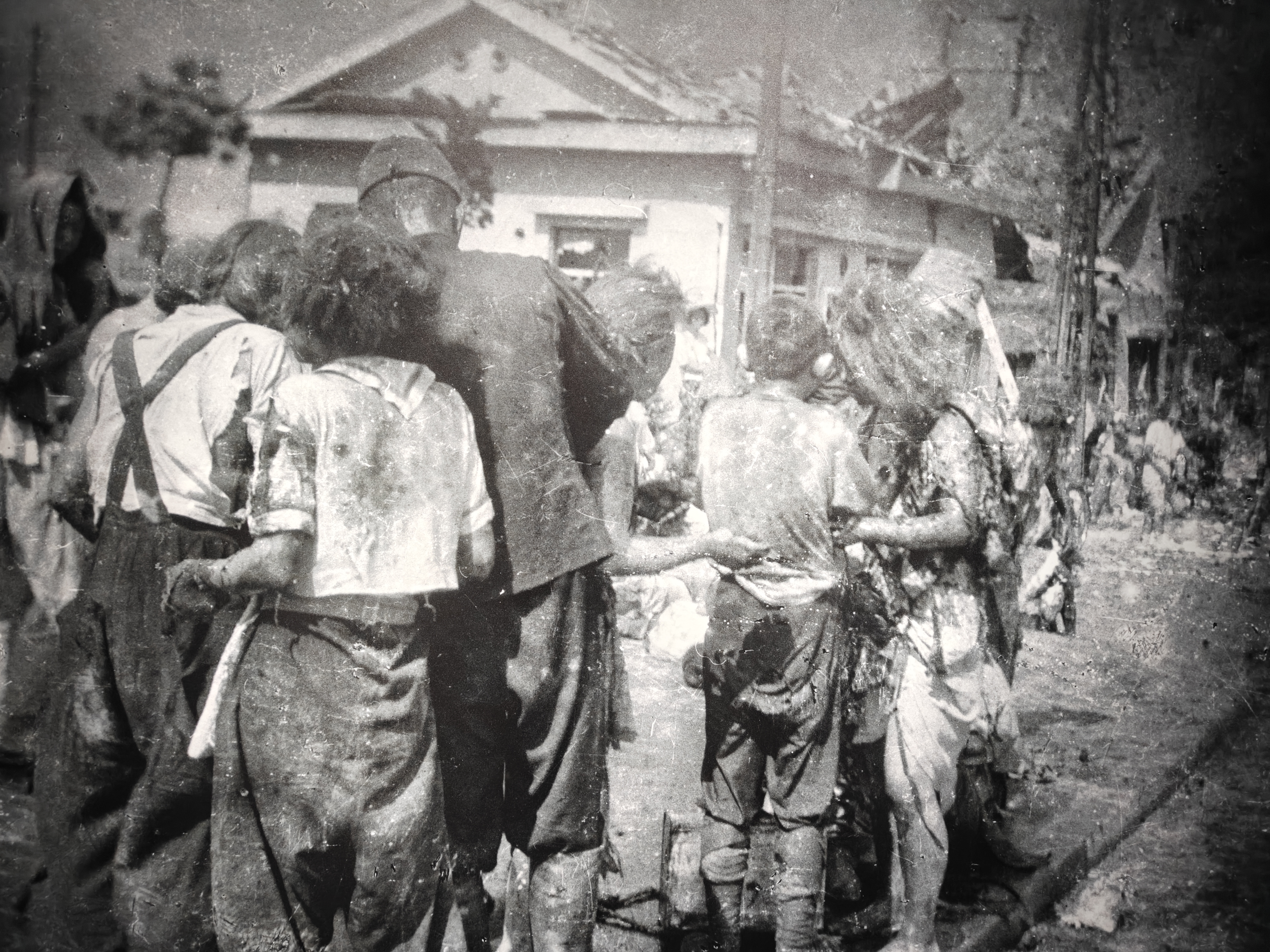
In the aftermath of the bomb
As the Atomic Bombs were being assembled for eventual use, simultaneously, pilots of the U.S. Air Force were getting trained on the long-distance B-29 Super fortress aircrafts which would be used to deliver the bombs.
“As my mother and I were eating breakfast, I heard the deep rumble of engines overhead. Our ears were trained back then; I knew it was a B-29 immediately. I stepped out into the field out front but saw no planes. Bewildered, I glanced to the northeast. I saw a black dot in the sky. Suddenly, it ‘burst’ into a ball of blinding light that filled my surroundings. A gust of hot wind hit my face; I instantly closed my eyes and knelt to the ground. As I tried to gain footing, another gust of wind lifted me up and I hit something hard. I do not remember what happened after that.
When I finally came to, I was passed out in front of a bouka suisou (stone water container used to extinguish fires back then). Suddenly, I felt an intense burning sensation on my face and arms, and tried to dunk my body into the bouka suisou. The water made it worse. I heard my mother’s voice in the distance. ‘Fujio! Fujio!’ I clung to her desperately as she scooped me up in her arms. ‘It burns, mama! It burns!’
I drifted in and out of consciousness for the next few days. My face swelled up so badly that I could not open my eyes. I was treated briefly at an air raid shelter and later at a hospital in Hatsukaichi, and was eventually brought home wrapped in bandages all over my body.”
-Fujio Torikoshi, Atomic Bomb survivor
In the adtermath of the bomb
Just after 2 am on 6th August 1945, three B-29s took off from the island of Tinian and proceeded on their six-hour flight to Japan. One of them, the Enola Gay, carried the Little Boy atomic bomb. The bomb was released and detonated over Hiroshima just after eight in the morning. The radius of destruction was two kilometers with fires raging over eleven square kilometers.
“One incident I will never forget is cremating my father. My brothers and I gently laid his blackened, swollen body atop a burnt beam in front of the factory where we found him dead and set him alight. His ankles jutted out awkwardly as the rest of his body was engulfed in flames. My oldest brother suggested that we take a piece of his skull – based on a common practice in Japanese funerals in which family members pass around a tiny piece of the skull with chopsticks after cremation – and leave him be.
As soon as our chopsticks touched the surface, however, the skull cracked open like plaster and his half-cremated brain spilled out. My brothers and I screamed and ran away, leaving our father behind. We abandoned him, in the worst state possible.”
-Yoshiro Yamawaki, Atomic Bomb survivor.
Melted statue of Buddha
From the Enola Gay, the crew saw “a giant purple mushroom” that was boiling upward and had reached much above the aircraft altitude. At the base of the cloud, fires were springing up everywhere amid a turbulent mass of smoke that had the appearance of bubbling hot tar. The city that had been clearly visible in the sunlight a few minutes ago, had completely disappeared under smoke and fire. Captain Robert Lewis, co-pilot of Enola Gay, wrote in his log, “My God! What have we done?”
“The injured were sprawled out over the railroad tracks, scorched and black. When I walked by, they moaned in agony. ‘Water… water…’. I heard a man in passing announce that giving water to the burn victims would kill them. I was torn. I knew that these people had hours, if not minutes, to live. These burn victims – they were no longer of this world.
‘Water… water…’
I decided to look for a water source. Luckily, I found a futon nearby engulfed in flames. I tore a piece of it off, dipped it in the rice paddy nearby, and wrang it over the burn victims’ mouths. There were about 40 of them. I went back and forth, from the rice paddy to the railroad tracks. They drank the muddy water eagerly. Among them was my dear friend Yamada. ‘Yama- da! Yamada!’ I exclaimed, giddy to see a familiar face. I placed my hand on his chest. His skin slid right off, exposing his flesh. I was mortified. ‘Water…’ he murmured. I wrang the water over his mouth. Five minutes later, he was dead.
In fact, most of the people I tended to were dead…….”
-Inosuke Hayasaki, Atomic Bomb survivor
**
Epilogue: The final death toll in Hiroshima from the bomb was close to 150,000 people, mostly civilians. An event which led to Japan surrendering nine days later, effectively ending the great war.
Despite heightened awareness of the ‘end of Humanity’ risk posed by nuclear weapons, the cold war between the U.S. and the erstwhile U.S.S.R. ensured continued stockpiling of these very weapons.
In Remembrance…… Shakti Ghosal
Acknowledgements:
Time Magazine ‘After the Bomb’, 1985.
Wikipedia: ‘Atomic bombings of Hiroshima and Nagasaki’
Several of the photos used are from the exhibits in the Hiroshima Peace Memorial Museum.
Some years back, I had a Divisional head join the team.
The guy had impressed the recruiting board with his talk of ‘track record’ and ‘ideas’ about how he planned to transform the business. When I got around to have a chat with him, he seemed to be all humility and spoke of his own self development through working and learning from me. But several subsequent events seemed to indicate that at the sniff of a challenge, his self-serving shield would go up, a lot of talk about blaming the environment and others in the team would emerge but not much action on the ground. In the meanwhile, the company kept losing competent and productive staff as well as customer accounts; his oft repeated declaration about ‘brickwalling’ them did not seem to be working.
To me it appeared that the Divisional Head did not know what he was working to develop; he was definitely not working on his own leadership. When I again had a chat with him, what came up were several blames. ‘That he had not bargained for the kind of work he was now being expected to do.’ ‘That I was failing to support him adequately.’ ‘That he was stuck with incompetent team members.’
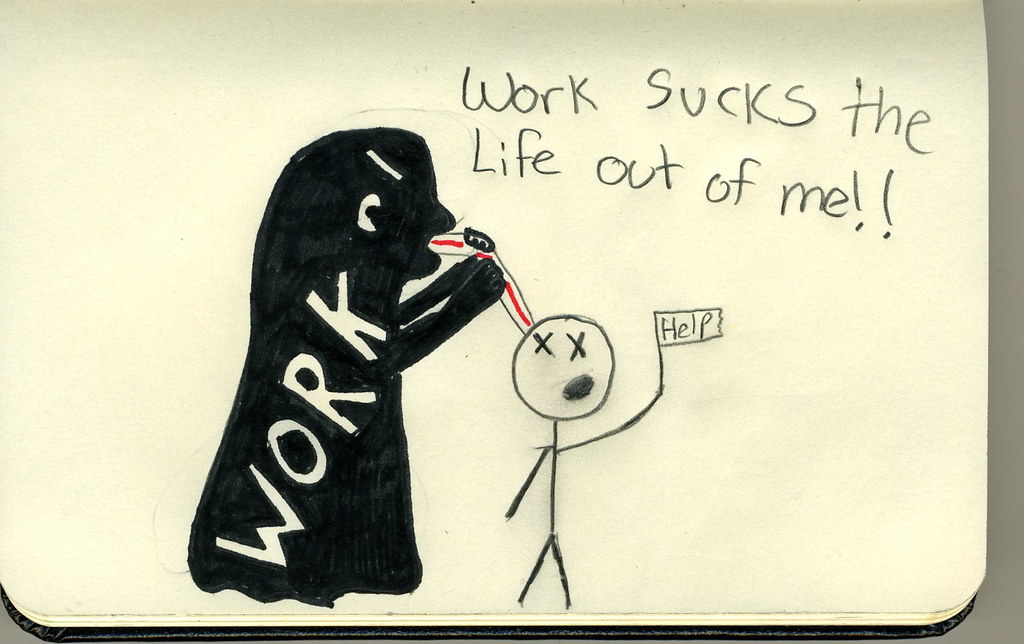
In a nutshell, the job stank, I as the boss stank and the team stank! I did not have the heart to ask the guy that if the world all around stank, could it be that he himself was the problem?
How many of you have faced a similar situation at the workplace? If you have, have you wondered what one might need to do to transform the situation?
The world can shift when one shows up with authenticity and with humility.
Transformation:
When we see ourselves as the problem, we can be the solution too. We need to spend more time working on our own selves rather than trying to fix others.
Do we have the expectation that our team members should be the harbinger of good news and developments? We need to lower that expectation.
Empathy is a strong word; being empathetic is easier said than done. Nonetheless we need to practice putting ourselves in the shoes of others and seeing the world through their lens.
Gain the realization that others do not really humble us; we humble ourselves.
Show up as a servant leader. A leadership style that enables everyone in the organisation to feel empowered and thrive fearlessly as his / her authentic self.
Say ‘Thank you’ to three persons in a day. Look them in the eye and be specific. If someone is not around, send a thank you email or Whatsapp or make a call.



















 A New Beginning