When Silence Speaks: The Voiceless and the Silenced


In an age of selective hearing, understanding whose voices are ignored—and whose are feared—reveals the deeper politics of power and truth.

Abstract

In a world overflowing with voices, some are never heard. Some are never allowed to speak. This article explores the crucial difference between those who are voiceless and those who are deliberately silenced. One group is ignored, the other is feared. Understanding this difference helps us see the mechanics of power, injustice, and the politics of listening in today’s world. As Noam Chomsky famously said, “The smart way to keep people passive and obedient is to strictly limit the spectrum of acceptable opinion, but allow very lively debate within that spectrum.”

**

The idea of this piece came to me when in a social media group discussion about the unevenness of spiritual access in India based on class, caste and privilege, someone quoted author Arundhati Roy’s quote that “There’s really no such thing as the ‘voiceless’. There are only the deliberately silenced, or the preferably unheard.”

The more I thought about what Arundhati had opined, the more I sensed that she had lumped two discrete aspects of our society into one.

What is being Voiceless?

I recall the first few days of India’s response to the COVID – 19 pandemic and the lockdown that ensued. When the country literally shut down with just four hours’ notice, millions of workers—daily wage earners, domestic helpers, factory hands—were stranded without transport, money, or food. With no options available and with little support, around 40 million workers began walking hundreds of kilometres back to their villages. What came to be known as the great migrant crisis of the pandemic.

The workers weren’t silent, in fact far from it. They shared stories, walked in mass protests, called journalists. But their pain barely entered the official narrative. The crisis was, for a time, treated like an unfortunate footnote in a larger national story.

Migrant workers during pandemic

“The working class was not just unseen—they were not considered,” wrote Harsh Mander in The Indian Express. “It was a failure of both empathy and accountability.”

These were people whose voices weren’t suppressed, but simply didn’t count. That’s what it means to be voiceless.

As sociologist Michael Schudson put it, “Communication is a resource distributed as unequally as income or education.” Some voices simply don’t travel—not because they’re weak, but because the world refuses to hear them. This is indeed ironic in an age in which speaking up in fact has never been easier. Through the universal access to tweets, videos, blogs, and platforms are everywhere. But being heard? That’s something else entirely.

Being voiceless doesn’t mean someone has nothing to say. It means that what they say doesn’t register. Their stories don’t make the news. Their ideas don’t get invited to conferences. Their lives rarely shape policy decisions. They live in the blind spots of our systems. One of the main aspects which makes our society unequal.

Now let’s look at the aspect of those who Are the Silenced?

In 2017, the gruesome assassination of Gauri Lankesh hit the headlines in India. A fearless journalist and activist, Lankesh had been a sharp critic of communal violence, right-wing extremism, and state-sponsored misinformation. Her Kannada weekly, Gauri Lankesh Patrike, became a platform for truth-telling and resistance.

Gauri was shot dead outside her home in Bengaluru, her murder was not random—it was a warning.
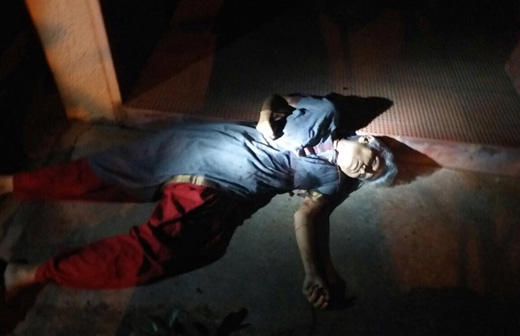
Gauri Lankesh assassination

As journalist Rana Ayyub wrote: “Gauri’s crime was that she refused to be quiet.”

Gauri Lankesh had a platform. She was being heard. And that is exactly why she was targeted. She wasn’t voiceless. She was silenced because her voice made those in power uncomfortable. To those in power, Gauri’s voice had become too powerful; her words shone light on dark places, threatened the status quo, exposed inconvenient truths.

A recent report by the Committee to Protect Journalists ( CPJ) noted that a record number of journalists were jailed in 2022—not for false reporting, but for exposing the truth. As the CPJ observed: “Censorship is no longer enough; silencing must be enforced.”

Can we now see the intrinsic difference between those who are voiceless, and those who are deliberately silenced? Some people, no matter how loudly they speak, never seem to matter. Others are quickly shut down because what they say matters too much. The first are ignored. The second are suppressed. And both are symptoms of a far deeper crisis of listening in our times.

 Why the Difference Matters

At first glance, both the voiceless and the silenced seem to suffer the same fate: not being heard. But the reasons behind their invisibility are fundamentally different.

  • The voiceless are ignored because they’re deemed irrelevant.
  • The silenced are suppressed because they’re considered dangerous.

One is a symptom of systemic neglect. The other, of deliberate fear.

Understanding this distinction is vital. It helps us recognize the difference between absence and erasure, between invisibility and targeting.

The Role of Selective Listening

Today, listening has become selective and often algorithmic. Digital platforms and connectivities are amplifying outrage, repetition, and ideology—not complexity, dissent, or nuance. In such a space, it’s easy for the voiceless to disappear into the margins, and for the silenced to be made invisible through force or discrediting.

As Noam Chomsky famously said, “The smart way to keep people passive and obedient is to strictly limit the spectrum of acceptable opinion, but allow very lively debate within that spectrum.”. As I thought of this, I could see the Voiceless and the Silenced at the two ends of the truth spectrum. Both represent ‘uncomfortable truths’ for the political dispensation and the administration. It is the centre space which holds the ‘comfortable truth’ which the powers that be would always support and push to expand. The voiceless never make it into that spectrum. The silenced try to expand their end, encroach into the ‘comfortable truth’ space and unfortunately end up paying  the price

So what can each one of us do?

We need to recognize that the difference between the voiceless and the silenced also changes how we respond. We might decide to support in the following manner.

  • The voiceless need amplification. Their stories must be brought to the centre. This would require better representation, inclusive platforms, and ethical journalism.
  • The silenced need protection. They must be defended by laws, by solidarity, and by public pressure. Their speech is often a warning bell the rest of us ignore at our own peril.

Both are vital to a functioning democracy. But only one—the silenced—reminds us that truth still threatens power.

In musing…….                                                           Shakti Ghosal

References

  1. Schudson, Michael. The Sociology of News. W. W. Norton & Company, 2000.
  2. Committee to Protect Journalists. Record Number of Journalists Jailed Worldwide. CPJ, 2022. https://cpj.org/reports/2022
  3. Chomsky, Noam. Media Control: The Spectacular Achievements of Propaganda. Seven Stories Press, 1997.
  4. Mander, Harsh. “Locked Down and Left Behind.” The Indian Express, May 2020.
  5. Ayyub, Rana. “Gauri Lankesh’s Murder Was Not an Aberration.” The Washington Post, Sept 2017

The Chronicler Tales…….


The Chronicler of the Hooghly, and other stories, adjudged Book of the Month (March 2021) is available worldwide on Amazon, Flipkart and select bookstores.

#chroniclerofthehooghly#encourageauthorshakti#shaktighosal#bookofthemonth

An exposition from the Bhagvad Gita


“You know Elokeshi, as I sat near the funeral pyre, watching my father’s mortal remains turn into ashes which were being blown by the wind, it seemed to me that my father’s soul was being released for its heavenward journey”, observed Dipen.

Elokeshi was looking at Dipen steadfastly, and then said softly, “In Bhagavad Geeta, Shree Krishna says:

Vasansi jir nani yattha vihaya

Navani grih nati maro parani

Tatha Sharirani vihaya jir nanya

Nyani sanyati navani dehi

Just like we do not change even when we replace our old garments with new, so does the soul remain unchanged as it discards its worn-out body and takes birth in a new one”.

As he listened to the erudition of Elokeshi through her recital of the verses from Geeta, something inside Dipen shifted and tears started coursing out of his eyes. Gently, Elokeshi put his head on her shoulder as she caressed his hair.

Snippet: In Hinduism it is believed that as the soul reincarnates in a new body in a new life, one’s thoughts and actions in the previous life, either good or bad, impact one’s destiny and fate. This is the concept of Karma.

The above is an excerpt from the story Pandemic, part of my forthcoming book ‘The Chronicler of the Hooghly and other stories’ which is scheduled to release this month (February ’21). For updates, do visit

#thechroniclerofthehooghly,#shaktighosal,#bhagvadgita,#pandemic,#bookcommunity,bookaholic #bibliophile , #readers# #bookoftheday#bookgeek#readingforfun#ilovebooks#booklife#bookaddiction,#readersgonnaread, #booklover, #bookworm, #bookrecommendation, #fiction, #booknerd, #bookobsessed, #returntoreading, #rediscovergoodread, #happyreading

Widows of Bengal


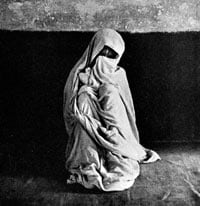
“Her unadorned face with a parting free of sindoor and a simply worn white sari indicated her to be a young widow. Something in her appearance impacted Dipen.

 Dipen could recall his aunt becoming a widow when he was a mere seven or eight, she had her hair cut short and seemed perpetually in a complaining and cantankerous mood. She was required to observe strict fast on certain days and Dipen still remembered how she would secretly beg him for moa or naru, homemade Bengali sweets. Considered inauspicious, Dipen’s aunt was barred from participating in joyous occasions; to everyone around she personified inconvenience and this showed up in the insensitive behaviour of family members towards her. Dipen was too young to understand the ramifications but as he grew older, he could sense the unforgiving and interminable despair that his aunt’s life had represented.”

Snippet: In the early twentieth century, the plight of widows in Bengal continued to be terrible, arising from customs and social ostracization.Even though remarriage of widows had been made legally permissible from mid-nineteenth century, largely due to the efforts of the Brahmin social reformer Ishwar Chandra Vidyasagar, society continued to frown on all such attempts.

Once the husband died , the torture of his wife began. It was as if Lord Yama of the netherworld was taking away her soul. Even when she had to endure the grief of her husband’s death, society somehow held her ‘responsible’ for the death and even her closest relatives could not come to console her. A woman whose husband had died was thus like a living corpse. She had no rights in the home and had to remain as a slave to other family members. 

The above extract is from the story Pandemic, a part of my forthcoming book, ‘The Chronicler of the Hooghly and other stories’.

Should you wish to receive exclusive previews and the chance of winning a free copy of the book, do participate in the monthly contests.

#historicalfiction,#pageturner,#thechroniclerofthehooghly,#shaktighosal,#pandemic,

#goodread,#mindopener.

The Embarkation and the Journey


Come! Embark with the Chronicler on a journey through Time and Transformation.

Four Stories. Five Crucible experiences.

What could be behind you taking this trip today……. and me telling you this tale?

Which Pandemic is going to leave a more lasting impact, the one inside the head or the one outside, can we be sure?

Can a moan carry with it the realisation that friendship and harmony have lost out to communal mindset and greed?

What do you say when you go away……. only to come back and find that your life has irretrievably changed?

In Learning………

Shakti Ghosal

The Burning Ghats of Keoratola


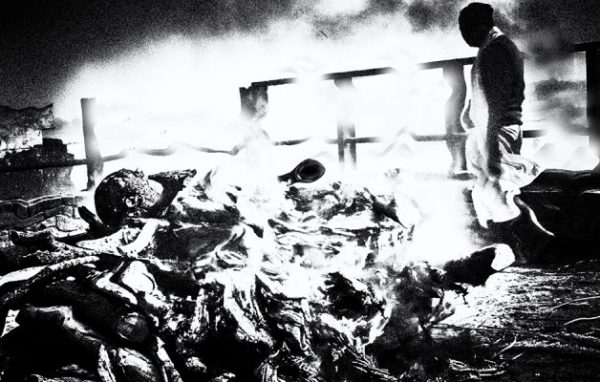
Reaching the cremation ghat at Keoratola, Dipen and his accompanying group were confronted first hand with the immense tragedy and the pain arising from the pandemic tearing through the city and the province. Dead bodies were lying in every conceivable place; on bullock carts, on both sides of the narrow pathway going to the burning ghats and under makeshift canopies. In some cases, there were people around the dead bodies but in other cases, it seemed the bodies had been left there and abandoned. There were hordes of dirty, soot covered urchins accosting groups who had come to do the cremation. The oppressive smoke and the odour of burning pyres were all pervasive. Jostling for supremacy with the putrid smoke and smell was a cacophony of crying, moaning, shouting and Vedic chants.

Keoratola cremation ground features in the story Pandemic, a part of my forthcoming book, ‘The Chronicler of the Hooghly and other stories ’. Should you wish to receive exclusive previews and the chance of winning a free copy of the book, do write to me at: author.esgee@gmail.com

Pandemic


In the Pandemic, the events span a century between the pandemics of 1919 to 2020; between Dipen and Indranil who have a tenuous link over four generations and arising from an old and decrepit palace and its Shiva linga.

When confronted by tragedy, the vastly different societal conditioning and development of a hundred years, cannot detract from the eerily similar impact.

“The pandemic did go away. But it left in its wake corpses, both dead and living”.

The above is a blurb from Pandemic, one of the four stories of my forthcoming book, ” The Chronicler of the Hooghly”.

 Should you wish to receive exclusive previews and free copy of the book, do write to me @ author.esgee@gmail.com.

https://www.facebook.com/author.shaktighosal

Pandemic and how to plug into the future

There is going to be a post Pandemic world. That is a certainty. What is also certain is that the post Pandemic world would require significantly different perspectives and competence set.


“The one thing I’ve personally learned is you’ve got to get ahead of the curve, don’t try to deny it or put your head in the sand, and wish for the best. These are the times when a culture and an organization gets tested”

– Michael Hansen, CEO, Cengage

There is going to be a post Pandemic world. That is a certainty. What is also certain is that the post Pandemic world would require significantly different perspectives and competence set; we would come to live in a world with a new normal.

The pandemic is a black swan event. What that implies is that none of us have faced anything like it before. What happens when we are confronted with something about which we know nothing about? We become like the caveman in the dark of the night, neither able to see the path to the safety of our cave nor know whether a saber tooth is lurking nearby waiting to pounce. Neurochemicals flood our brain, we become geared to fight or take flight.

In the present day context, a black swan event leads to our primal brain conditioning kicking in. We get drawn into the uncertain and the total lack of knowledge aspects of the event. The more we try, the more we fail to make sense. We feel dis-empowered, make assumptions and frequently adopt high risk strategy without much thought or evaluation. When we fail we are quick to blame the VUCA (the volatility, Uncertainty, Complexity and Ambiguity) inherent in the environment. In short we are disrupted.  

Why do we get disrupted? Because we keep on trying to predict what would happen in the future. We keep on working with probabilities. But since a black swan event has no precedence, allowing no experience from our past to guide us, we fail.

In a post pandemic world, we need to shift into a mindset of possibilities.

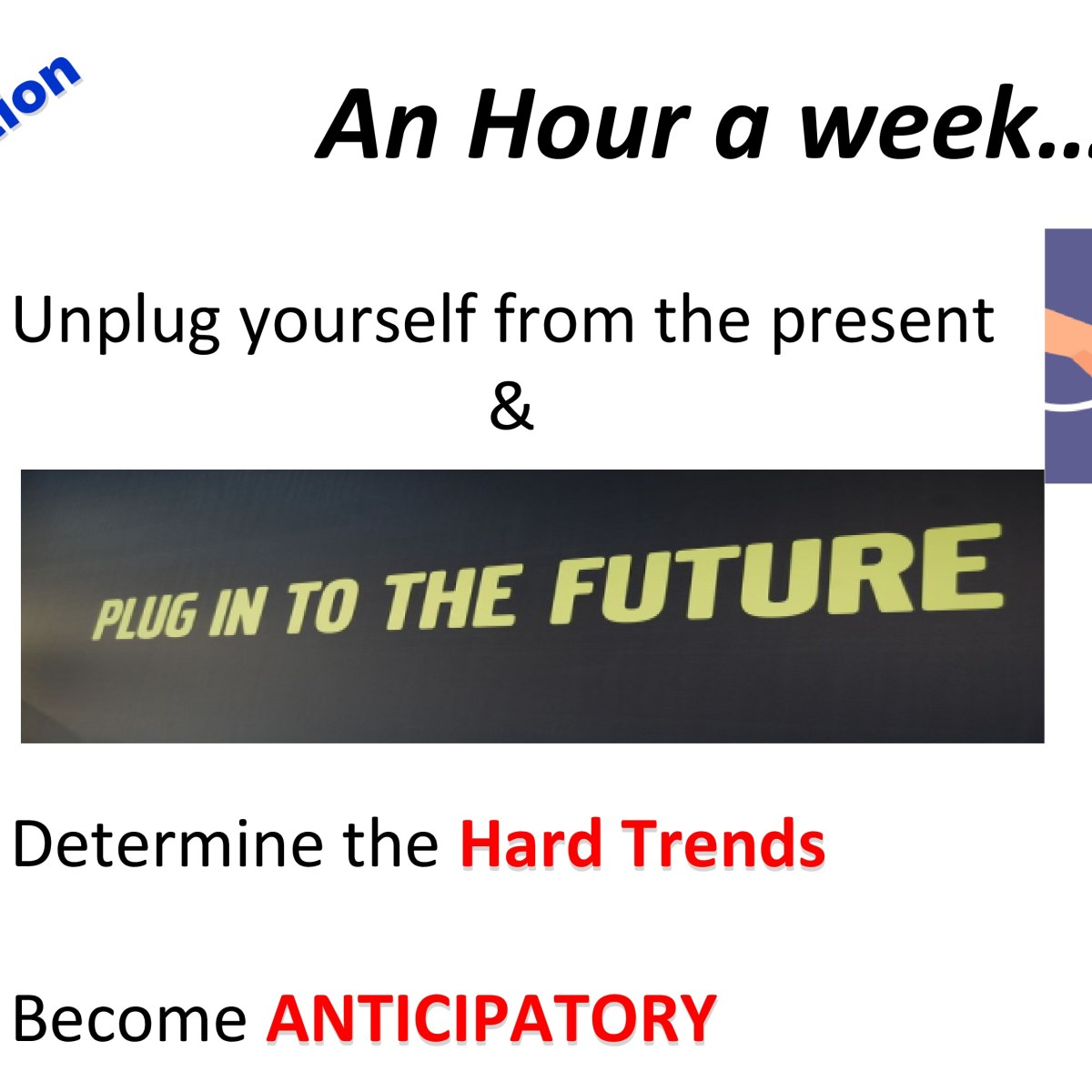
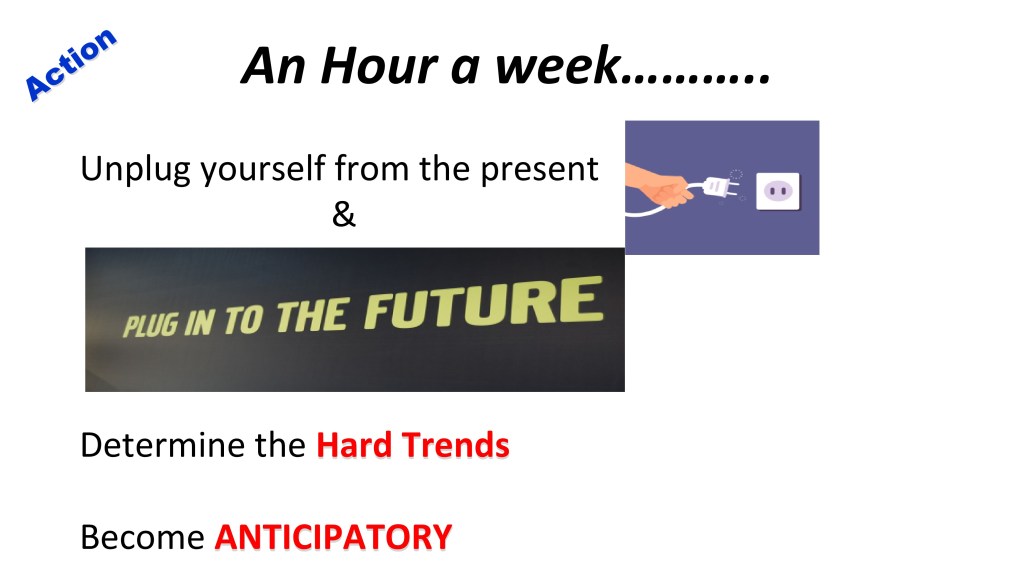
I invite you to do this practise for just one hour a week. During this hour, unplug yourself from the present. Unplug from all your existing challenges and apprehensions. Unplug from your inherent belief system which is telling you that once things normalise, you would go back to how things were in the past. This is where the fallacy lies and you need to be aware of that.

Then plug yourself into the future. How do you do that? You do that by establishing hard trends about which you do have significant certainty and do know some facts.

Your One hour a Week practice to plug into the future

You make three lists.

The first list is of all things you are certain of.

The second list is of all those things and aspects which you know, which are part of your competences.

The final list is of all things you can do.

This very act of making these lists would shift your mindset and open up possibilities. This leaves you empowered, you evaluate to choose low risk strategy, thereby gaining confidence and focus. As you succeed, you become a disruptor in the new world.

As you practise, you would become more proficient to determine the hard trends. You would become Anticipatory as you develop the capacity for future back thinking. You stand in the created future and look back to establish what actions and strategy you need to work on today to make the future happen.

  1. How might you deliver business and revenue goals, organisational growth and marketplace success in a post pandemic environment?
  2. How would you make sense of what might put brakes on organizational velocity in the post pandemic environment and how to un-brake?
  3. How might you get high performance from team members in the uncertainty of the post pandemic world ?

In Learning……

Shakti Ghosal