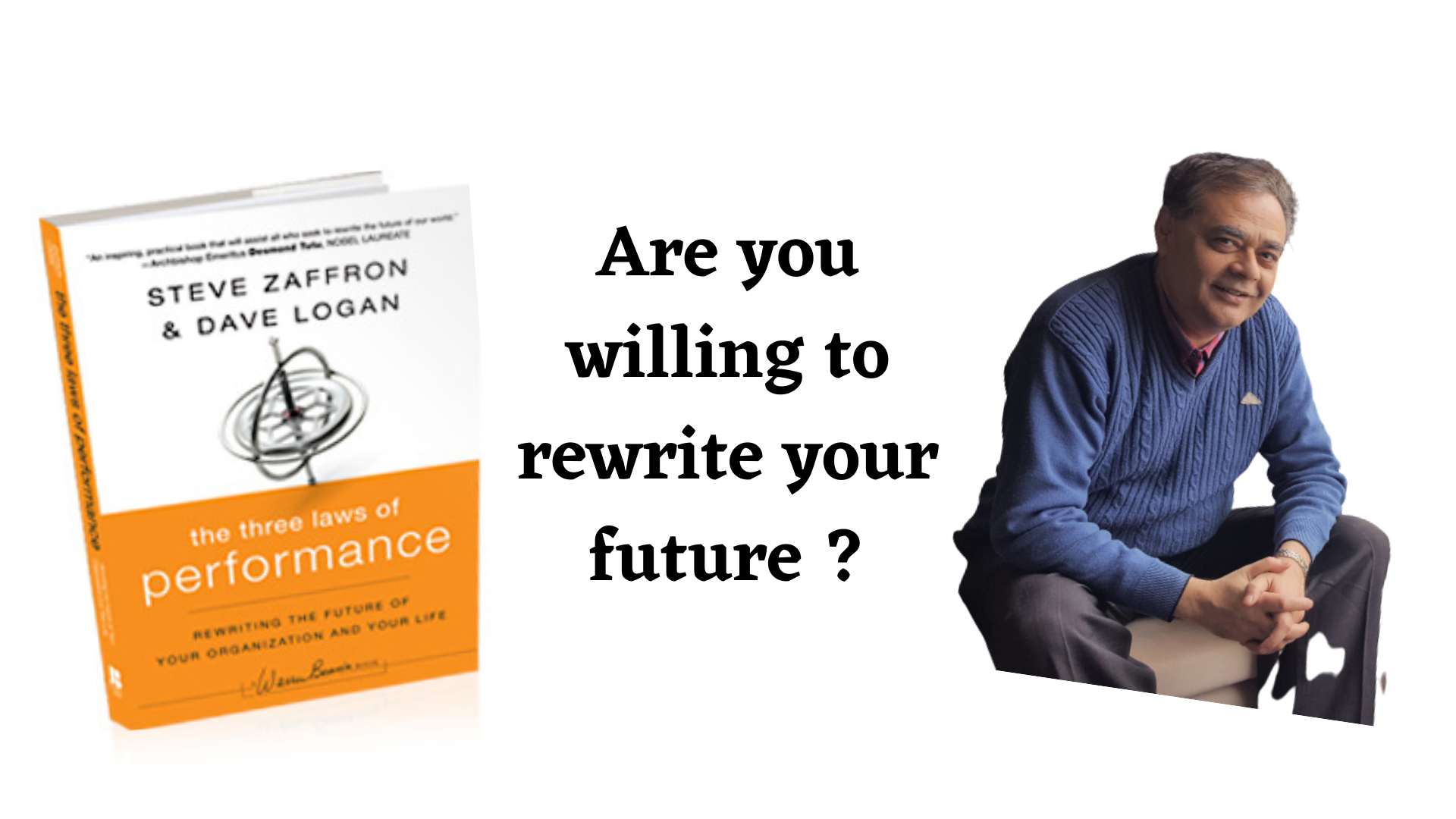
I had recently spoken about the 3 Laws of performance on the E- Bookery platform.
Are you willing to rewrite the future of your organization and Life? Watch this 30 minutes video to get a blueprint for achieving performance breakthroughs.
How can you shift from being disengaged to being proactive, from being resigned to become inspired, from being frustrated to becoming innovative?
I was in a meeting with my new Chairman. I was passionately elucidating my future plans for the business.
The Chairman looked at me, made a sign of smallness with his fingers and said, “Your businesses generate too small a revenue!”. The stress was on the smallness, the inconsequence of all that I and my businesses were doing.
Stumbling out of the meeting, I was in a daze. To be told by your boss that all your efforts and dreams, all that you stood for, did not matter in the larger scheme of things, was devastating.
As I look back at that crucible moment, I can see how it changed the trajectory of my life thereon.
For days afterward, I was pummeled down by negative thoughts and low self-esteem. I swung between anxiety, anger and bitterness.
The way it occurred to me, there were all these guys, less qualified and with less competence, who were being acknowledged because they seemed to be ‘at the right place at the right time.’
I felt small. I hadn’t done anything wrong to deserve what I had heard. From that one conversation, I seemed to have lost a significant part of myself, opening up hitherto un-noticed doors to self-doubt and self-flagellation.
But then a thought came to me, ‘Had I done enough right?’
I unburdened myself by speaking about the incident and my thoughts to my wife and a couple of trusted workplace colleagues. I felt less like an idiot when I shared what I learned from screwing up. This helped me to move beyond the dark side of my self-doubt and low self-esteem.
The incident supported me to work on that crucible moment question, “Had I done enough right?” It taught me the practice of Self Reflection. It is this that opened up for me new possibilities and opportunities of growth.
In his Wall Street Journal and Publishers Weekly bestseller, ‘The Blueprint: 6 Practical Steps to Lift Your Leadership to New Heights’, author Doug Conant speaks of his own journey of self-reflection and discovery that revolutionized his leadership and transformed his career trajectory.
Doug condenses his remarkable leadership story into six practical steps.
Reach High – Envision
Dig Deep – Reflect
Lay the Groundwork – Study
Design – Plan
Build – Practice
Reinforce – Improve
In today’s world of uncertainty and disruption which can leave us stuck and overwhelmed, the above six steps have the potential to lift our leadership and performance to heights that would bring us career success, joy and fulfillment.
Meanwhile on the other side of the world, Riya with daughter Tiri decide to have a fun day with the elegant Mice couple, Mickey and Minnie. They have chosen to live by the Chronicler’s coaching philosophy of, ‘Life is….‘. As Professor Gracy Samjetsabam mentions in her review, ‘……..sprinkles of confetti of coaching in life skills.…..’
@Times Square, New York
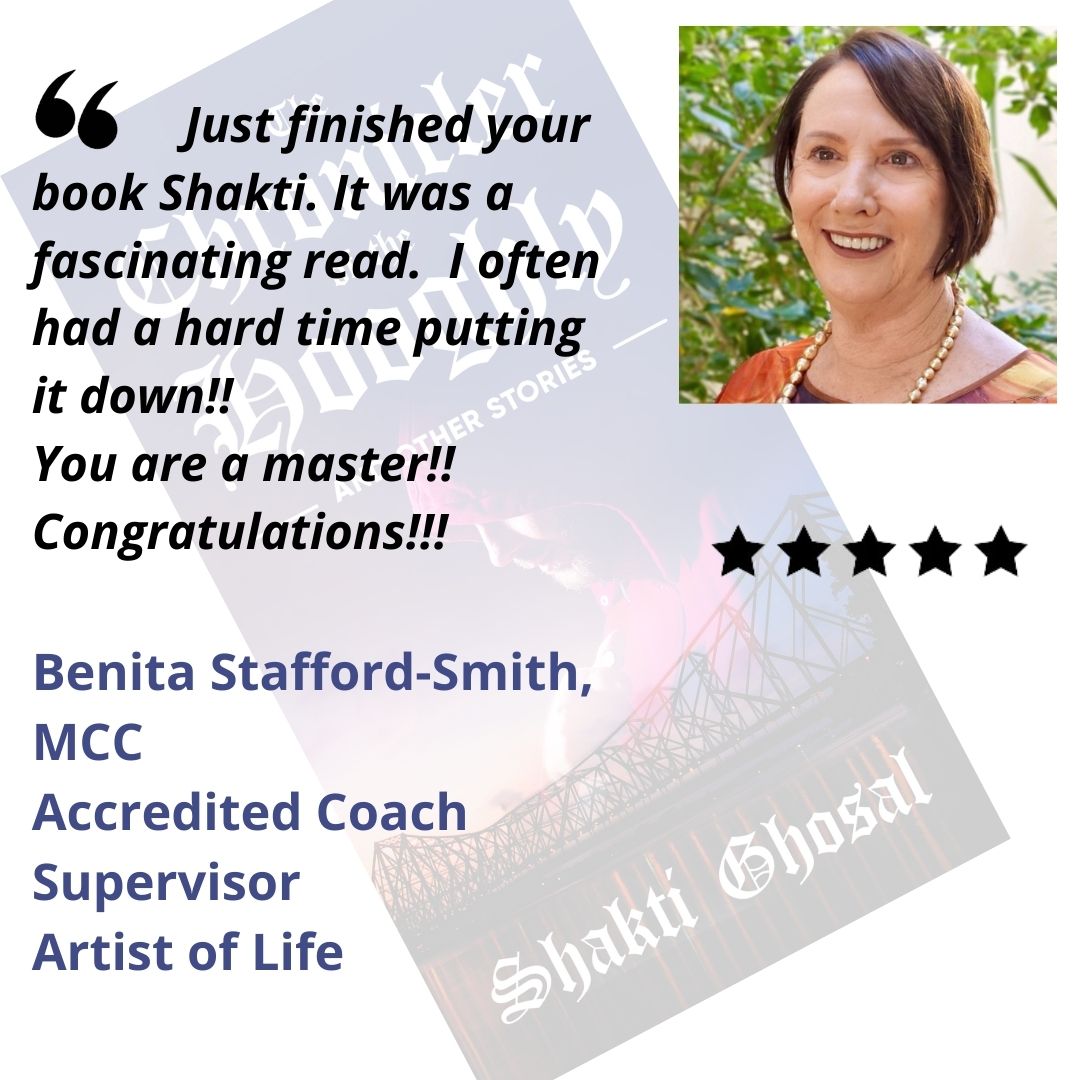
The Chronicler of the Hooghly and other stories’ is available worldwide on Amazon, Flipkart and select bookstores.
Adjudged ‘Book of the Month’ for March 2021 by Booknerds, The book has already got more than a hundred excellent ratings and reviews on Amazon worldwide.
Moolya Foundation is a global non-profit organisation with an aim to bring greater inclusivity in public affairs through digital leadership.
The mission of Moolya Foundation is to expand the conversation surrounding public affairs and empower every citizen in the digital age where marginalisation of the common people is fast growing.
To abridge the socio-economic, political and information inequalities in digital societies, Moolya Foundation envisions creating future leaders in public affairs who shall be at the forefront to represent the interest of the common people.
Do see this first part of my freewheeling session with Neha Gour of Moolya Foundation in which we discuss ‘Is Digital Leadership a Skill or a Mindset?’ As happens at such times, The Chronicler of the Hooghly also gets discussed!
It was a simple idea that brought in the Reboot Toolbox. An idea about how to support our own-selves (as well as others) to remain relevant in a world with a new normal?
As part of the Reboot Toolbox initiative, a Webinar titled “Pandemic and how to plug-in to the future” has been showcased over the last couple of weeks to alumni associations, students and employees of Leading B Schools and organisations. The Webinar underlined the premise that different skill sets and way of looking at situations would be needed in the new normal. The webinar introduced to the participants practices using the 4 Action Stage initiatives framework and a Resilience Tool.
how to support our own-selves (as well as others) to remain relevant in a world with a new normal?
The Reboot Toolbox is about a vision to upgrade Leadership and Performance in a world with a new normal. A world in which Uncertainty and Volatility would be the norm. The Reboot Toolbox would strive to bring new thoughts and practices aligned to the new normal.
As part of the vision, I invite you to join the Cause. You could do that in the following manner.
(1) Engage in discussions on the forum.
(2) Contribute thoughts, articles and tools to support others in the journey.
(3) Spread the word about the Reboot Toolbox Webinars within your organisation as also to others. They come Free of Cost!
Should the Reboot Toolbox and its vision resonate for you, do reply back to me Offline on : shakti.ghosal@gmail.com
How do you maximise your influence and impact in a fast changing environment?
A Do-it-yourself plan.
Some years back in my work life I came across an individual who for anonymity’s sake we will call Shib.
Shib was insecure and hankered for a leadership role as a way to get out of insecurity. At every opportunity he would showcase and ‘beat his drum’ about his past experience. He refused to accept that in the disruptive environment that the business was facing, experiential learning was ill suited to handle the situations being confronted.. More significantly the ‘All knowing, All doing’ defensive shield that had become his second nature prevented Shib from acknowledging that he might be lacking competences needed to engage with the situations. These two over time became a dangerous mix for an increasingly inauthentic and damaging behaviour with the guy resorting to his positional ‘Command and Control’ power more and more as the organisational performance nosedived.
What does use of positional power lead to? Like termite it starts to eat into the existing credibility and trust structure of an organisation which takes a long time to build. Once credibility starts getting lost, influence gets diminished and impact gets diluted.
The Shib Case study made me recall what Malcolm Forbes, the publisher of Forbes magazine, had once remarked:
“Those who enjoy responsibility usually get it, those who merely like exercising authority usually lose it”
In the increasingly uncertain and fast-changing business world of today, many of us may be falling into the ‘Shib trap’ of over- reliance on positional power without even realising it. We thus need to do a periodic dip-stick test to review our sphere of influence and efficacy of our impact. Should we notice operational zones exhibiting uncertain influence and impact, it could be time to take action.
So what could you do to enhance your influence and increase your impact?
To create a coordinated effort, you and your team members need to be accountable to each other in terms of tasks, actions and time lines. Ask this question of yourself:
‘Are you willing to be accountable to your team members about your performance as you would like them to be about their performance?’
Do you have a Learner mindset? Are you willing to discuss with your team the skills and behaviours you are developing for your own self? Are you willing to be vulnerable about yourself and your own need and efforts to improve yourself?
Do you personally invest in others? When things go wrong, are you willing to take a deep breath, desist from fault-finding but rather say to the team, “I know how stressed you guys must be feeling at this juncture!”
Are you willing to align ‘Who you are’ with what your team members perceive about you? To gain an insight into the extent of this alignment (or not), you may wish to see how many of these questions you answer as “YES”:
When you give space to others, do they see you as passive?
When you are compassionate, do your team mates see it as weakness?
When you display energy, do others see you as being pushy?
When you take a decision, do your team members see that as controlling?
Be willing to become vulnerable by asking your team members to tell you about what they perceive as your top three ‘bad’ areas. These could be aspects like Arrogance, Passive, Self-opinionated, Impulsive, Indecisive, Untrustworthy, Close minded, Impatience etc. In case they feel uncomfortable to tell you these on your face, it is okay to get this feedback anonymously.
Identify the top three negative characteristics that you embody in the eyes of team members and stakeholders. Then ask them these two questions for each of these characteristics.
“What is that one thing I could do that would stop me showing up as arrogant ( or impatient, untrustworthy etc) ?”
“What is that which I should stop doing that makes me show up as arrogant (or impatient, untrustworthy etc.) ?”
What is that which blocks you from achieving professional success? What practices could you adopt to remove such blocks and maximise your potential?
‘Your limitation – it’s only your imagination’
Are you aware of what professional success would look like for you in terms of your performance, career and life ? What is that which blocks you from achieving professional success? What practices could you adopt to remove such blocks and maximise your potential?
Maximising our professional success is never about what impacts us but our response to that. We never see the world as it is, we see it and respond to it as it occurs for us.
We remain unaware that our listening ( or for that matter seeing, understanding, interpreting) is not an empty vessel, not a blank slate. We assume that whatever someone says to us (that is, what enters our ears) registers in our listening (lands for us) exactly as it was said. This is never so and this is what constrains and distorts our perceptions and actions.
Professional Success is thus really about creating a context that could empower you towards a future that you would like to achieve. What could be the elements of such a context?
Professional Success is also about moving up the effectiveness ladder in terms of how you contribute viz. Doing it under supervision to doing it independently to doing it through others to setting a strategic direction. As you move up in this manner, your contribution expands in terms of your influence, perspective,complexity and impact.
Your Stakeholding network
To maximise your professional success I invite you to deliberate and try and answer the following.
What mental attitude and skills would you need to develop to be able toprogress through the above stages?
What kind of a risk-taking style do you have and how does it support your development? How could you change your risk-taking style in order to further increase your effectiveness?
What patterns do you see among those with whom you have the strongest relationships? What patterns do you see among those with whom you do not have the strongest relationships, or any at all?
Think about a person in your network with whom you have a strong relationship. What can you leverage in your relationship with this person to help you build or strengthen your relationship with others?
Choose one key person inside your network who, if you had a stronger relationship, could better support your effectiveness. What is the benefit of improving this relationship? What is the cost if you don’t? What if anything is getting in the way?
Choose one key person outside your network who, if you had a stronger relationship, could better support your effectiveness. What is the benefit of improving this relationship? What is the cost if you don’t? What if anything is getting in the way?
How to be an effective leader during accelerating change and disruption
Change is the only Constant. Or is it?
In my previous post, ‘Heralding the Twenties’ I had spoken of the Change Trap. To cope with an ever accelerating pace of change, we need to become someone or something we were never before. Which in turn leads to a negative impact on our creativity, performance and engagement. I had outlined a practice to avoid this negative impact.
As a changing environment and disruption touches us, we need to have a flexible surface to engage. Which essentially means the need to jettison our past derived rigidity and mindset. With accelerating change, our surface is always in a state of flux. For many if not most of us, this surface flux permeates inwards and starts effecting our core consisting of our values, our passions and relationships. This is when we fall into the Change trap.
Effective leadership in the midst of accelerating change and disruption starts with that changeless core containing your values, passions and relationships. You hold an enhanced awareness of these aspects. You then use these as guiding posts in your language and relationships. This becomes the basis for your effective tango with change and disruption.
An un-fixed and possibility-based mindset allows you to use future-based (rather than past-based) language with others.
If you already know based on your past experience, there is no place to change.
Be willing to reach out to others even if they are not seeking you.
Be willing to speak about the uncomfortable elephant in the room even if it disturbs a cosy status quo.
I invite you to think of and answer these questions in your dealings within your organisation and with team members.
What gets in your way of helping others who have taken on new and unknown challenges?
What language might you use with others which would ignite transformation?
What did you do that encouraged others to perform?
…… and more importantly,
What did you do that drained the energy of others?
“To improve is to change; to be perfect is to change often.”
—Winston Churchill
We remain days away from entering a brand new decade.
A hundred years back, it was called the roaring twenties. An era of economic boom. What kind of twenties are we going to have this time?
I invite you to ponder on the above as also these questions. How would work change? What would create wealth? How would the exponential growth in 24 X 7 human connectivity through social media impact us and our lives?
We are into a world which is changing at an ever increasing pace. We need to continually become someone or something we never were before.
So what happens when we continually become someone or something we never were before? We feel discomfort, fear, uncertainty; we are on edge. How we feel impacts how we act, how we work. So being on edge with negative feelings as above leads to loss of creativity, inability to take risks, loss of productivity and engagement. And herein lies the danger of becoming someone or something we never were before. I call this the Change Trap.
So what could we do to avoid the Change Trap? Since it is difficult to control our feelings, we need to see how we could shift its impact on how we act, how we perform. One way of doing this is to focus inwards – into the kind of changeless core that we are and what makes us tick. Our big vision about the world and our self, our competences, our passions and our relationships.
In the New Year, I invite you to do this practice for just the first fortnight to empower yourself and avoid the Change Trap. Write down the following in your diary every day for 15 days before you go to bed.
When you were at your best today, what were you doing?
When you saw your energy going up, what were you involved in ?
When you felt happy helping someone, what did you do?
Should you persevere with this practise for a fortnight, you will notice how its impact changes your life and the world around you!
I wish you Merry Christmas and a lovely 2020 ahead.
Recently I had the opportunity to be a Master Mentor to a set of alumni mentors of a premier business school as part of its ambitious initiative to offer a Career Support Program for its graduating students. As the master mentor, my role was really about ensuring the effectiveness of the mentoring process.
The alumni mentors had graduated from the same school few years back and were shaping up as young business leaders in the industry.
In one of my interactions, an alumni mentor mentioned that inspite of his efforts, he sensed a lack of openness and desire to engage from some of the students. I could sense his frustration of seeing his mentoring efforts becoming unproductive.
I asked, “What shows up when you think of your own leading ability?”
“Well, when I am able to influence and get things done”, he answered.
“… and when you see that happening, what behaviours do you display?” I continued.
Reflecting a bit, the mentor replied, “Well I believe I encourage people to take on new initiatives.”
I could sense the disparity between what the mentor believed he was committed to and the outcome that he was achieving. I avoided saying so.
Changing the track somewhat, I then asked, “What do you think gets in the way when you try to support others to take on new challenges?”
The alumni mentor responded almost immediately, “Well I think I need to be more empathetic and less of a stickler to holding people accountable.”
I thanked him for this great insight.
***********
As a Leader, Manager or Supervisor dealing with teams tasked to produce outcomes, we get conditioned to link results to all that is happening outside us. So tracking people, their performance and holding them accountable comes naturally to us. Very seldom do we look inside our own selves to determine whether the way we speak, listen and act could have a bearing on our team member’s performance. This is where the power of empathy steps in.
In the disruptive world that we live in, where past performance has less and less traction for the future, Leaders need to anchor more within, with empathy at the core of growth and transformation.
What might you do today to focus on building trust through empathy?
How could you be a ‘success enabler’ of people by proactively removing barriers out of their way?
How could you be a sounding board for people to come to, so that you could put them in a position to succeed?