Bethlehem and its Star


Bethlehem, a narrative woven with care,

From missionaries’ prayers to steel’s fiery glare.

Through seasons of change, the city stands tall,

A testament to history, embraced by all.

On an invitation from a close friend, we decided to take a weekend trip to Bethlehem in the state of Pennsylvania. The road travel was a pleasurable one on the I-78 highway and it took just under one and a half hours even though there was a drizzle.

We exited the highway to find ourself in a quaint town with its residential suburb. Directions by the Google map was impeccable and we were soon at my friend’s place nursing a glass of wine and some welcoming starters in front of a brightly decorated Christmas tree.

The conversation soon veered to the fascinating aspect of how the New World has used so many names from the Old World for its own towns and places. So, it seems to have happened for Bethlehem. And therein hang a couple of tales.

Driving through Bethlehem town, one cannot fail to notice the Victorian architecture, presumably from colonial times. The historic part of the town looks just that, with gabled sidewalks and stairways going down to different levels. This dates back to the mid eighteenth century when Bethlehem was founded as a missionary community by a small group of Moravians. The location chosen was where two rivers join, the Monocacy and Lehigh. What is less known is that this was also the time when wars with the original Indian settlers were being fought in the region. In the book ‘Snow over Bethlehem’ chronicling events recorded in old Moravian diaries, author Katherine Milhous writes about a group of children taking refuge in the strong stone buildings of Bethlehem to escape from the ongoing Indian wars. As Christmas approaches, the town of Bethlehem and the children are saved from an Indian attack by a miraculous event.

In Bethlehem’s embrace, a tale unfolds,

A legacy scripted, in stories untold.

Moravian missionaries, with purpose divine,

Founded a haven, where faith did entwine.

During the American War of independence, in the latter part of the eighteenth century, many continental force veterans fled to Bethlehem as the British army advanced from the east. Amongst them was the French aristocrat Marquis De Lafayette who enjoyed a father-son relationship with Commander in Chief George Washington. The Marquis is arguably one of the most fascinating individuals in the pages of history. He was instrumental in trapping British General Lord Charles Cornwallis (future Governor General of India) and his troops in Yorktown which led to the British surrender and losing the war. Subsequently, during the French revolution, as the commander of the National Guard in Paris, the Marquis saved King Louis XVI and Queen Marie Antoinette from the fury of a crowd in Versailles and escorted them back to Paris. He subsequently supported the transfer of power from the aristocracy to the bourgeoisie. In remembrance, Lafayette was granted honorary citizenship of the US in 2002.

Bethlehem has a nice downtown and we drove through a nice medley of restaurants, storefronts and pleasingly architectured buildings. The centre of attraction, visible from a distance, were the five rusted blast furnaces of the erstwhile Bethlehem steel company. Now known as the steel stacks, they serve as a dramatic backdrop to a newly created art and entertainment district.

Bethlehem steel, a symbol of the American industrial revolution, came into being at the turn of the twentieth century. The steel plant supplied steel for many of the famed structures like the Empire state building, the Rockefeller centre and Chrysler Building on Manhattan to name a few. However, it achieved iconic status during the second world war when the corporation President promised Franklin D. Roosevelt, “Mr. President, we remain fully committed to your war effort and will build and handover one warship a day”. The company kept its promise and exceeded that by fifteen ships!

Smokestacks whispered tales of industry’s might,

Yet, in Bethlehem’s heart, shone a guiding light.

Amidst the clangour of progress, a spirit remained,

Of community, resilience, and dreams unrestrained.

Sadly, the company could not keep pace with evolving technologies and competition in the second half of the century and filed for bankruptcy a hundred years after it came into being. The steel stacks stand in mute testimony to a glorious industrial past.

Bethlehem is known as the Christmas City of US. As one drives through the suburbs and downtown, this becomes apparent with every building joining the festive mood with wondrous lighting and decorations. We decided to visit the Christkindlmarkt, the annual Christmas market. The market had been set-up in the steel stacks area and consisted of three massive tents full of traditional artisans displaying their craft, delicious food, knick-knacks and even ice sculptures. The German look and feel were overwhelming.

Even though a huge area had been designated for car parking, it was difficult to find a slot because of surging visitors.

As the embers of industry began to cool,

Bethlehem’s spirit endured, an eternal jewel.

From furnaces to festivals, the city transformed,

A Christmas market, where magic is performed.

My host mentioned about the star of Bethlehem in passing. I amusingly thought to myself, if Bethlehem is here, can the star be far behind. Sadly, we didn’t get the chance to spot the star of Bethlehem; we came to know that it is a cluster of LEDs installed at a place called the south mountain (we did not go there). Seems there has been a star on the south mountain since the 1930s.
As we drove back, the Star of Bethlehem continued to be in my thoughts. How the three Magi from the East were guided by the star to Jesus’ birthplace in Bethlehem. How on that wintry night, some shepherds were in the adjoining fields guarding their flocks of sheep. And the depth of the parallel between the sheep being taken to Bethlehem to be sacrificed on Sabbath (Friday) and years later, Jesus Christ being led to Bethlehem and crucified on Sabbath. Did the star of Bethlehem see it all?

In musing…….                                                               Shakti Ghosal

Acknowledgement: Snow over Bethlehem by Katherine Milhous. Publisher: Charles Scribner’s Sons; First Edition (January 1, 1945)

Long Island – It’s legend, it’s Lore, it’s Landscape


“Long Island, where every whisper of the wind carries the echoes of its legend, every tale spun weaves into its lore, and every horizon unveils the tapestry of its landscape.”

I had been fascinated with Long Island since the time I had read F. Scott Fitzerald’s ‘The Great Gatsby’. The place symbolised for me the American dream, the roaring economy, the hedonism and a fast evolving, couldn’t-care- less society of a hundred years ago. I recall this line about Jay Gatsby’s extravagant parties, “There was music from my neighbour’s house through the summer nights. In his blue gardens men and girls came and went like moths among the whisperings and the champagne and the stars”.

More recently, Long Island again came back to mind as I watched that disturbing apocalyptic movie ‘Leave the world behind’. The story played out in a luxurious Long Island home with menacing deer herds symbolising a world and its technology coming apart.

So recently, when we got the opportunity of a longish break to take a vacation on Long Island, I was excited.

We drove through Manhattan and the boroughs of Brooklyn and Queens on our way to Riverhead where we planned to stay. The place turned out to be a quaint town with some excellent Mexican eateries.

Riverhead is at the fork from where the East and the West fingers of the island branch out. Our room had a view onto a lake which had a surreal lustre under moonlight. As we relaxed in the evening, the conversation took a supernatural turn as it is wont to do at such times.

There is the tale of ‘Curse of The Lady of the lake’ which does the rounds in these parts. Legend has it that a Native American princess takes the life of one boy every year by drowning them in the lake, as she looks for her lost love. It is about a beautiful Indian princess who fell in love with a settler named Hugh Birdsall. Birdsall lived in a log hut and the princess was not permitted to meet him. For seven years she sent messages to him on bits of bark that floated underground from the lake to his hut. After seven years of waiting, she paddled out to the middle of the lake in her canoe. The next day the canoe carrying her dead body floated down to her lover. He leaped into the canoe and together they were swept out to sea.

Prior to the seventeenth century, Long Island had been inhabited by several Indian tribes before the European colonisers arrived. First it was the Dutch who started settling on the west side. They were soon followed by the English who initially came in on the east side but eventually took over the entire island. The English presence became so strong on the island that even during the American Revolution, while the British troops were losing ground to the American army elsewhere, they won the crucial Battle of Long Island and continued to hold sway on the island till the end of the war.

As an interesting aside, General George Washington, the Commander in Chief of the American continental army, having gained the upper hand over the British at Boston, moved his army to defend New York because of its strategic port. However, he was outmanoeuvred by the British when his troops were attacked from two sides and had to hastily retreat with his men back to Manhattan. Part of the victorious British troops was led by Charles Cornwallis. Years later though, General Cornwallis with the entire British troops surrendered to George Washington at Yorktown, marking the beginning of the end of British colonisation in America. He subsequently took over as Governor General of the Indian colony. The American war experience may have influenced Cornwallis in terms of his approach to governance in India and perhaps a desire to avoid the mistakes made in the American colonies.

As we travelled on the western finger towards the tip, the landscape transformed into vineyards and undulating woods. We took a Wine Tasting break at one of the Wineries near Peconic bay. We sat sipping some of the excellent Reserve Merlots, Chardonnays and Cabernet Sauvignons served with cheese and ham.

Looking out at the rolling vineyards and woods, we seemed to have indeed left the world behind. In our mind’s eye, we could see the herd of antlered deer looking back at us.

The next day we motored down on the east branch of Long Island. This is the part where the Rich and Famous have homes. The Hampton suburbs are dotted with colonial era and extravagant mansions. One is quite likely to come face to face with glamorous looking folks inside super markets and get tempted to pop the question, “Are you famous?” With luck, one might bump into Sarah Jessica Parker or Matthew Broderick!

Driving onwards through picture perfect suburbs, we finally reached Land’s End, the farthest point of Long Island jutting out into the Atlantic Ocean.

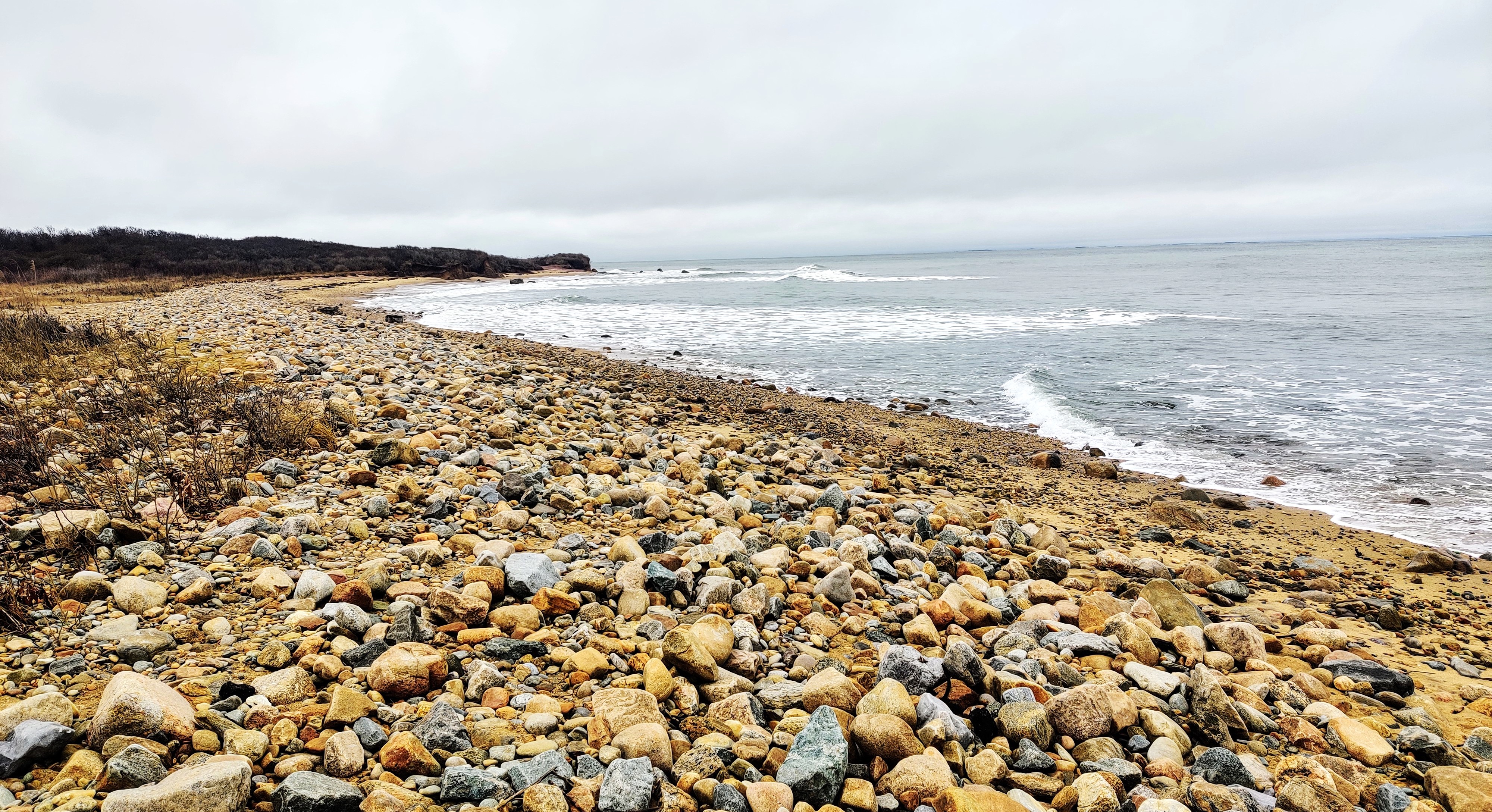
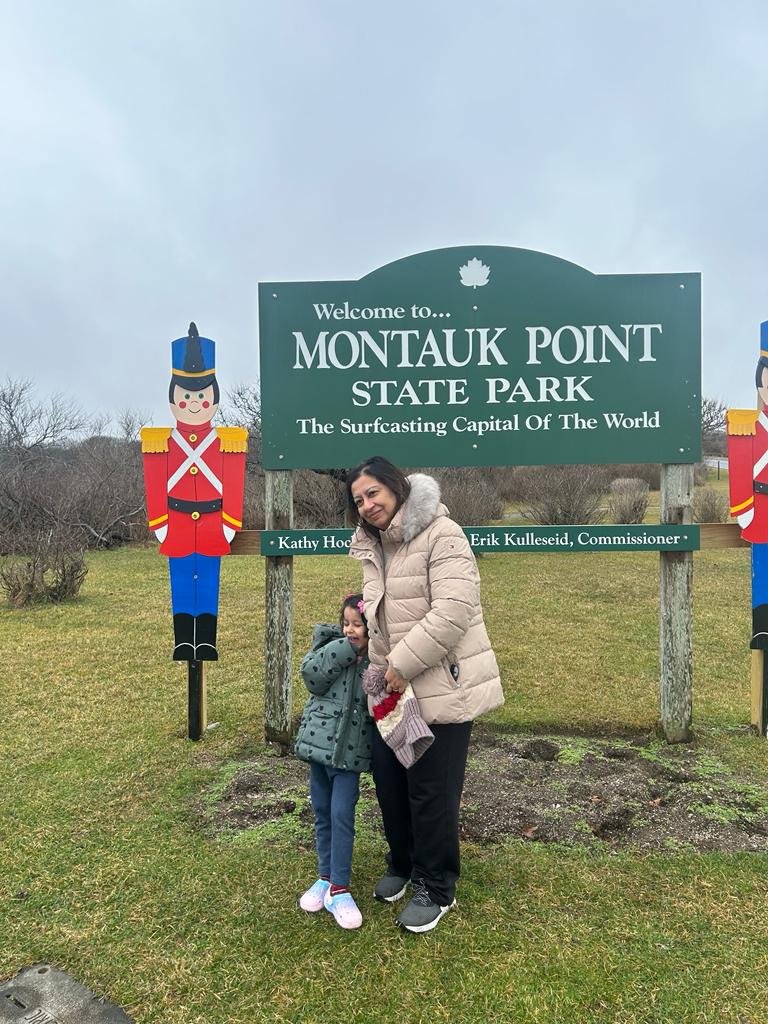
Montauk, named after the original Indian tribe which lived in these parts, has wonderful viewing points of the ocean apart from desolate beaches and the Montauk lighthouse. A veritable treat of a 360-degree view of the Atlantic awaited us.

Standing there, my thoughts went to The Great Gatsby’s East Egg and West Egg neighbourhoods and the lighthouse light which flashed across the bay.

Having explored Long Island and its two branches, it was time for us to get back. I was happy to have seen and experienced all that Long Island had to offer. Or so I thought!

Driving back, we noticed an exit to Amityville. The memory jangled.

The Amityville story became known across the globe with the publication of the book ‘The Amityville Horror- A True story’ half a century back, subsequently made into several movies over decades. The infamous house in Amityville is where an individual murdered six members of his family in their sleep. The Lutz family purchased and moved into the house a year later. That is when the terror began and the family had to literally run away in twenty-eight days. The Lutzs could never give details about what they faced in the house but alluded to evil spirits and demons. A priest who had been invited to bless the house was forced to leave by a deep voice telling him to ‘get out!’; later he developed high fever and blisters on his hand.

As we continued on our way back to New York city, Long Island held sway on me with the legend, lore and landscapes it had spawned.

In musing…….                                                                                Shakti Ghosal

PostBlock

Summary

VisibilityPublic

PublishToday at 4:37 am

URLesgeemusings.com/2024/01/22/long-island-its-legend-its-lore-its-landscape/Stick to the top of the blogPOST FORMATAsideAudioChatGalleryImageLinkQuoteStandardStatusVideoAUTHORShakti GhosalSwitch to draftMove to trash

Access

Excerpt

12 Revisions

Categories

SEARCH CATEGORIESPersonalPlacesShakti GhosalTravelAuthorThe Chronicler of the HooghlyAwarenessBookClimate changeCoachingContestCrucible experienceCustomsDevelopmentDisruptionPandemicenvironmentFictionHistorical FictionHistoryLeadershipLeadership IncubationRelational IntelligenceLife experienceManagementEconomicspage turnerperformancePhilosophyRitualsTransformationTrendsWorld eventAdd New Category

Tags

ADD NEW TAG

Amittyville (1 of 16)Amittyville

Amityville Horror (2 of 16)Amityville Horror

Atlantic Ocean (3 of 16)Atlantic Ocean

battle if Long Island (4 of 16)battle if Long Island

F Scott Fitzerald (5 of 16)F Scott Fitzerald

Hampton (6 of 16)Hampton

Hugh Birdsall (7 of 16)Hugh Birdsall

Leave the world behind (8 of 16)Leave the world behind

Long Island (9 of 16)Long Island

Lutz family (10 of 16)Lutz family

Montauk (11 of 16)Montauk

Montauk Point State Park (12 of 16)

The Robber Baron Mansion & the American Way


Vanderbilt Mansion today

Wishing all Readers merry Christmas and a great and purposeful 2024!

1938

President Franklin D. Roosevelt was staying in his favoured Hyde Park home. An early riser, he was standing by the window allowing the early aura to caress him. The low hung clouds, changing hues from the morning sun, glistened shades of orange as they floated by.

The rather modest Springwood estate had been home to President Roosevelt since birth. As he looked out at the estate’s trees and greenery, in his mind’s eye he was grappling with more weightier subjects. Coming at the helm of affairs five years back during the great depression, he had steered this vast land through the New Deal and 3 R’s reforms which he believed had allowed for people to regain faith in themselves, leading to employment rising and recoveries in Agriculture, Industry and Banking. However, once again, the country was facing production and profit declines coupled with rising unemployment. Arrayed with this threat of depression rearing its head, was the larger danger of the ongoing European conflict escalating out of control and engulfing the United States too. Roosevelt’s preferred policy to keep the US neutral was coming under increasing strain with both France and Britain pleading for US involvement against Adolf Hitler and Germany.

With an effort, the President shifted his mind from the above grim thoughts. He loved to look at the trees flourishing all around, now grown from the saplings he had been painstakingly planting for over a quarter of a century. Just a few days back, he had come to know that Mrs. Margaret Van Allen, the owner of the estate in the north, was hobnobbing with land developers to sell off the property. Having witnessed the birth of the Vanderbilt estate in his teens, he had a certain attachment to it.

President Roosevelt asked for his specially designed Ford Phaeton to be brought onto the driveway; he loved driving the car around Hyde Park. Followed by his security in a separate vehicle, he was soon on his way to the Vanderbilt mansion a few miles to the north.

“Mr. President, this is indeed an honour”, gushed Margaret Van Allen. “I just got a call an hour back about your visit, so do pardon any lack of…….”

“Mrs. Allen, it is I who needs to apologise for this unwarranted and sudden intrusion”, President Roosevelt responded with his usual grace. “I will come to the point. I understand you want to sell the estate. Your beautiful home has always held a special place in my heart. It is not only the magnificence of this mansion which I saw built as a teenager, I knew your aunt Louise and uncle Frederick well. They were so passionate and proud of their home. The Vanderbilt estate is the soul of Hyde Park. If it gets divided and sold off in parts, the casualty would not only be Hyde Park but the wonderful collection of trees. I would hate to see that happen….”

The President’s voice seemed to trail off as if coalescing with some deeper thoughts.

“I dream of Hyde Park the way it has been since my childhood. I plan to will my own estate at Springwood in its entirety to the American people. That way it’s past heritage would be preserved for future generations. May I also request you to do the same. That way the entire Hyde Park area would remain preserved”.

Margaret Van Allen felt elated at being asked by the President of the United States to join him in such a noble cause. She promised to consider the proposal seriously.

As President Roosevelt was leaving on the expansive circular driveway, he could not but help admire the beautiful array of trees and plants which Frederick Vanderbilt had so lovingly nurtured over decades.

**

Present

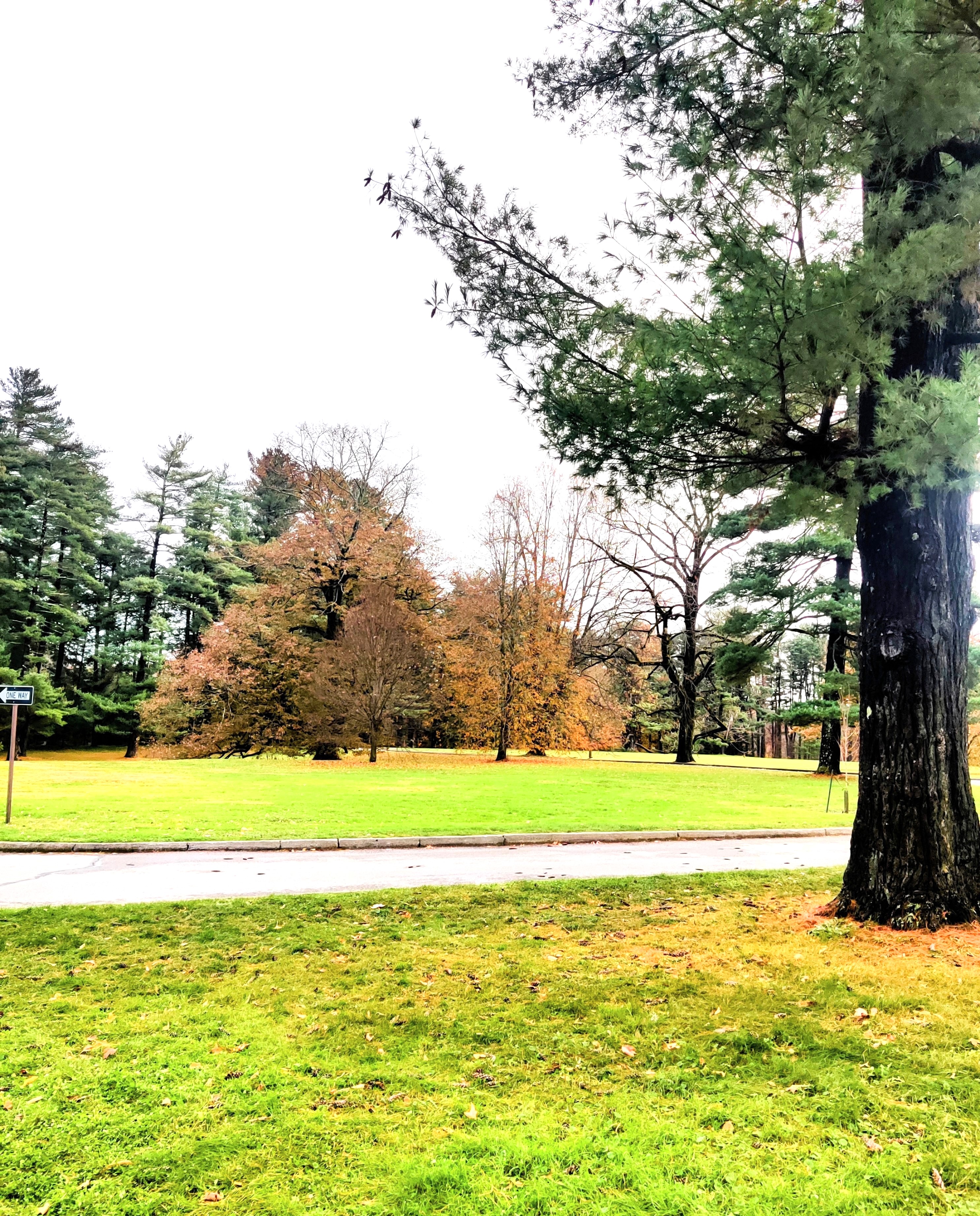
We could not help but admire the trees and the gardens as we drove on the circular driveway to the car parking area.

We were visiting the Vanderbilt mansion, the national historic site in the Hyde Park area on the banks of the Hudson River. We had heard impressive accounts about the place and were curious to know more.  Parking our car, we strolled to the small chalet like building which housed the National Park Service (NPS) office, the mansion was visible at some distance. From the French windows in the rear, one got the first views of the flowing Hudson; the in between park area was a golden abundance of fallen leaves, glistening in the autumn sun.

Hudson river banks in the autumn

How the NPS got into the place is an interesting story. More than eight decades back, Margaret Allen, the niece of Frederick Vanderbilt, moved by President Roosevelt’s vision, decided to handover the estate to the Government. The US Congress approved the acquisition and the expansive park with the mansion was purchased by the NPS against a consideration of one dollar!

The rise of the Vanderbilts forms the basis of the book ‘The First Tycoon: The epic life of Cornelius Vanderbilt’. Author T. J. Stiles provides an engrossing perspective of the American capitalism’s original sinner, the man who inspired the term ‘robber baron’.

Cornelius Vanderbilt, the family founder, was the individual who essentially invented the modern corporation through his purchase and consolidation of New York’s major railroads, and brought the American professional and managerial middle class into being. His influence remains so great as to be almost intangible. As the author writes: ‘He may have left his most lasting mark in the invisible world, by creating an unseen corporate architecture which later generations of Americans would take for granted.’

According to the author, Cornelius Vanderbilt’s greatest coup was buying up New York’s major railroad lines, using every trick in his arsenal, including the manipulation of stock prices. His wealth became enormous. He writes that Vanderbilt ‘exacerbated problems that would never be fully solved: a huge disparity in wealth between rich and poor; the concentration of great power in private hands; the fraud and self-serving deception that thrives in an unregulated environment.

Cornelius’ grandson Frederick had a personality quite contrary to that of his grandfather’s flamboyance and bluster. Quiet and reserved by nature, Frederick Vanderbilt nevertheless possessed great investment skill to rapidly increase the inheritance he had received. He with his wife Louise purchased the Hyde Park estate and built a palatial country home for themselves which came to be known as the Vanderbilt mansion.

The Vanderbilt mansion was inspired by the Italian renaissance styles. It really showcased Frederick and Louise’s obsession to flaunt their taste of refinement. Money in itself would never give the status of Western Europe’s blue-blooded aristocracy which the couple hankered for; what was needed was to assume the tastes and behaviour. Stepping into the entrance hall of the mansion and looking at the opulence and object d’arts, one gets the sense that the owners wanted to leave an indelible impact in the minds of visitors.

Entrance lobby

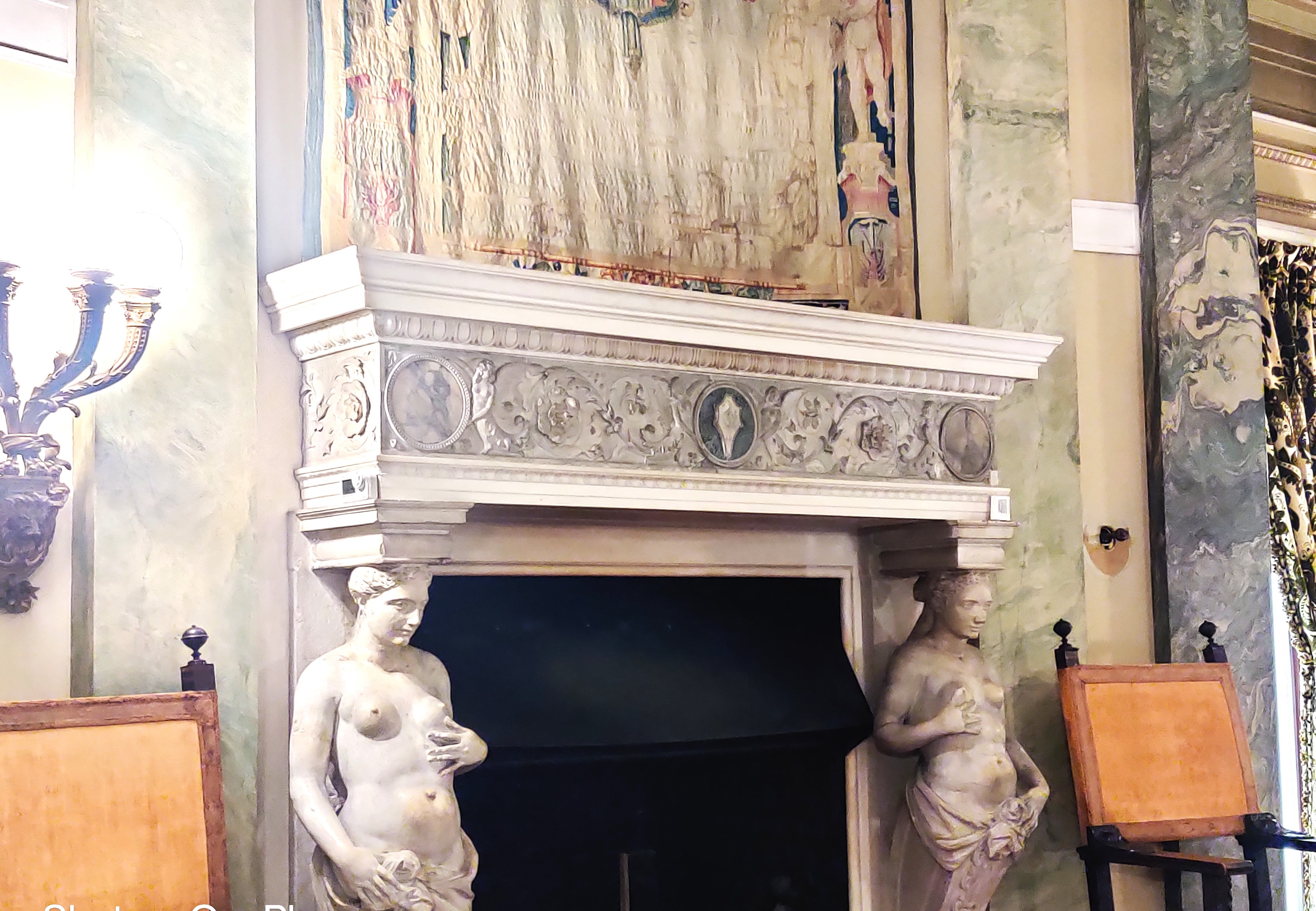
Each of the mansion rooms, be it the guest entertainment area, formal dining room, the study and boudoirs, seem to be telling a story of their own. Standing there, one could almost see Frederick retiring with his guests post dinner for a brandy and a fireplace chat.

Guest seating

Dining room

The mansion remained the preferred home of Frederick Vanderbilt and his wife Louise for several decades. It incorporated a number of modern innovations of the day, including plush bathrooms and the couple lived a life of incredible luxury with sixty employees at their beck and call.

Bedroom

Bathroom of early twentieth century

Looking at the extensive kitchen, staff dining areas in the basement with separate stairways and bedrooms, one gets reminded of Downton Abbey and the life of the retinue of servants attached to the British aristocratic Crawley family in the series.

After Louise Vanderbilt’s death in 1926, Frederick lived a largely reclusive life in the mansion till he passed away twelve years later. Prior to his death, he bequeathed the estate to Louise’s niece Margearet Van Allen.

As we left the Vanderbilt estate at the end of our visit, the beauty of the surroundings seemed juxtaposed with visions of the Robber Baron family and the manner in which they contributed to the American way, the disparity in wealth, the aggrandisement of power and the unregulated environment it had spawned.

The American way……

In musing………                                                              Shakti Ghosal

Acknowledgement:

  1. The NPS Guide services @ the Vanderbilt Mansion
  2. ‘The First Tycoon: The Epic life of Cornelius Vanderbilt’, by T.J. Stiles, April, 2010. Winner of National Book Award.

Disclosure: The conversations in the first section are fictional constructs based on historical incidents.

The Old Man and the Lake


The reign of the dinosaurs had long ended. Snuffed out by an unlikely asteroid strike. A fifteen kilometers wide piece of Iridium laced rock had struck near present day Mexico, creating a ten times wide crater and unleashing lava, ashes, smoke and gigantic waves around the world.

Though the mass extinction event exterminated most of the flora and fauna on the planet, the continental drift and shifts continued unhampered for millions of years thereafter. The active planetary crust led to the Indian land mass smashing into the Eurasian land plate. The resulting crumpling and buckling at the collision point led to what came to be known as the Himalayas, a veritable abode of the Gods, the tallest mountain range in the world. An awesome creation standing testimony to Earth’s inner energies.

The permanent glaciers and ice formations led to glacial water bodies being formed. This is how the lake came into being. Situated at a height of 18,000 feet within the mighty Himalayan range, the lake acquired a mystical aura for all men and religions who passed by. The waters remained mostly frozen due to the height and the overwhelming presence of the Dongmar glacier which nestled it. Thirsty men and animals could not quench their thirst. And so it came to pass that a Guru was passing by when he too felt the mystical aura of the lake. He put his hand in the lake and Lo and behold! The water stopped freezing and became available for all to quench their thirst. This subduing of the Dongmar glacier’s frozen might by the Guru gave the lake the name of Gurudongmar. The second highest lake in the world with water that no longer froze.

**

The Man was indeed getting on in years.

 As a child, he had been precocious and so had been nicknamed. ‘Buro’, an old man. He was now precisely that, replete with the mindset of the elderly. Over the years, he had acquired a liking  for travelling and seeing the world. Age had dimmed the eyes somewhat, but not that inner passion to set forth and discover new places.

When the Man first heard about the wondrous lake of Gurudongmar, his heart urged him to travel. His brain though was more circumspect; it counselled, “My dear chap, are you crazy? You suffer from vertigo. What might happen when you go up all those torturously winding roads?” His friends too cautioned; they related dire tales of folks collapsing from lack of oxygen in a no-Man’s land with medical facilities hard to come by.

“But when a Man makes up his mind, he is not made for defeat. He can lose out, even destroyed, but not defeated.”

The tug of war between thoughts continued. But the die had been cast, the travel plans stood finalised. Came the day of travel and the Man set forth armed with some basic medications, a quiet resolve and  some raucous misgivings. A flight, several car rides through mountainous roads into the Himalayan kingdom and the day of reckoning arrived.

“This was not the time to think of what was not there. It was the time to think of what one could do with what was there.”

Six in the morning and after nursing a cup of hot tea, the Man set forth for his rendezvous with the lake.


The slow wafting mist seemed in perfect harmony with the biting chill outside the moving car.

Passing through the last army check post, the vehicle climbed to the Kala Pathar, black stone viewpoint. 

The fresh snow from the previous night lay in gay abandon. The white mist drifted upwards, a curtain rising up from the snow flakes and into the low hanging clouds.

As the old man stood watching the shifting views of the  Kala Pathar  blackness through the whiteness of the entwining  gaps in the mist, it seemed like a ballet being performed. Was it the Universe sending him a message of hope?

“Every day is a new day. It is better to think it would be lucky. So when luck does come, one would be ready.”

The climb towards the lake had begun. It was not on roads cut out on the mountainsides which the man had been used to.  It was on a rising terrain with no roads or markings to provide a direction. It was all down to the driver and the vehicle, their combined experience and strength to negotiate the path.

And then, all of a sudden, the heavens opened up. Sunbeams splayed and sliced all around. The climb had now reached above the level of the clouds and mist, a surreal moment. The old man nibbled on slivers of ginger; he had been advised so by some friends. A final swerving climb over barren rocks and the vehicle stopped on a mound from where the lake could be seen.

The stillness of the blue waters seemed to beckon. ‘Come, partake of my mysticism.’ The sun shone in all its splendour. Was it trying to discover that mystical aura with all those reflections? At the far end of the waters, part shrouded by rising mists, towered the snow laden glacier. As the old man stood transfixed by the wondrous surroundings, the tug of thoughts took over. Was this the place where divinity was born?  What made the pristine barrenness so unworldly? Was it the glacier with its whiteness, or the water with its blueness?

A needle pricked the cheek. Then some more. Shaken out of his stupor, the man looked around. The hitherto gentle breeze had gained in strength. Crested by a whirlwind, tiny pebbles and dust particles chased each other in an ethereal dance. As the needles borne by the  wind swayed through the onlookers, a soft murmur of protest could be heard. The old man slowly turned and moved back towards the waiting vehicle.

In Learning……..                                                                                         Shakti Ghosal

Disclosure: The Old Man in the post is the author himself.

Acknowledgement : ‘The Old Man and the Sea’ by Ernest Hemingway

The murmur of Terracotta


‘Baked earth temples, where the fired 
body is porous.
How does this work? Monsoon rains drench all,
But there they are, that should have melted wet in the wash
And drained and dribbled away, solidified like candle wax,
But they stand in their various stalwart clay red forms…..’

We boarded an early morning train from Santragachi Junction for our three-hour journey to Bishnupur, the temple town of West Bengal. We had heard tales of its heritage, architecture and fascinating terracotta artifacts.

Alighting at a quaint station,  our waiting car whisked us to the Banphool treehouse resort in the Joypur forest area where we were booked to stay over the next few days. I was visiting the Bankura district for the first time and realised it had excellent forest cover.

Banphool Treehouse

Did you know that Bishnupur was the jewel in the crown of arguably one of the oldest-running kingdoms in the world? The Malla dynasty was founded in the 7th century and continued to exist till the beginning of the 20th! Moving along the narrow roads and lanes, I mused about this continuation of a single dynasty over a thousand years through the turbulence of India’s history. I could not think of any other kingdom of India which had replicated this feat. Waves of Muslim invasions through the Khyber pass, the might and spread of the Mughal empire, the colonization of the sub-continent by the British had ensured that the longevity of homegrown kingdoms remained limited. So how did the Malla kingdom continue the way it did? Was it because the Malla kings had the wisdom to be flexible and used diplomacy to ensure they were not conquered? Or was it because the focus of the invaders was on the fertile and revenue-generating Gangetic plains and the forest areas of Bankura and Bishnupur held little attraction? Or could it have been a combination of both?

The uniqueness of Bisnupur’s architecture stems from the short supply of stones in the area. The local architects, centuries ago, found a way to build using the local ‘Laal Matti’ red clay; they used burnt bricks made of this. Incredibly the builders could use the interlocked red clay bricks to make roofs and overhanging arches without the need for concrete or other supporting structures. The temples and buildings made in this manner, using laal mathi bricks, locally available laterite blocks, and Terracotta overlays, have survived for centuries!

 It is said that the kingdom of Mallabhum, in its heyday, extended far beyond Bankura. Encompassing as it did the districts of Burdwan, Birbhum, Midnapur, Purulia and going up to the southeast part of present-day Jharkhand state. What to me remains intriguing is the flowering of creativity manifested by the fascinating Terracotta art form, the Dokra craft on metal, the timeless beauty of Baluchari and Tassar sarees and the Hindustani classical music form known as Bishnupur Gharana. What is that which catalysed this huge upsurge of artistry in a forest land? What could have been the motivation to sustain such creativity against all odds?

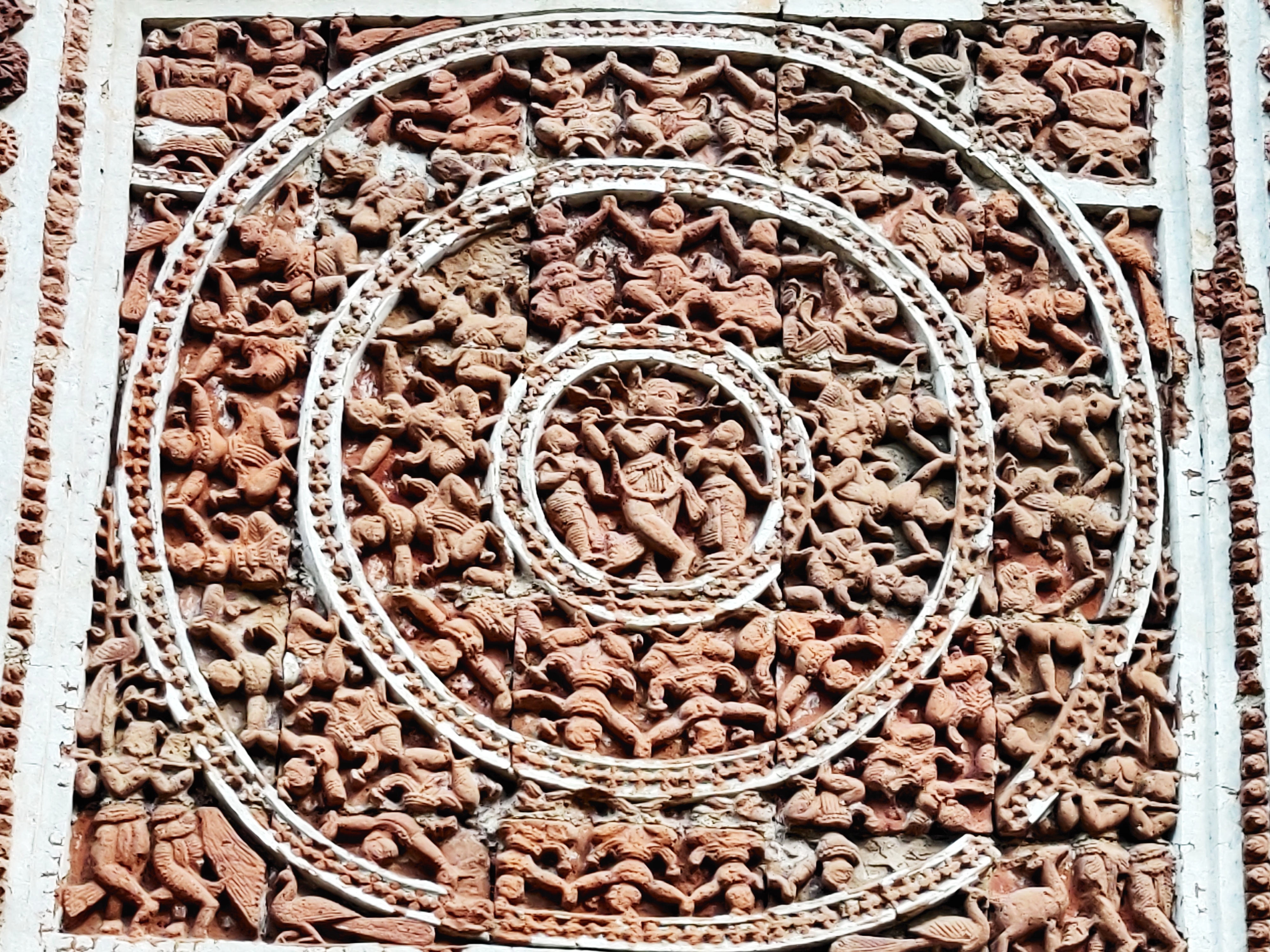
Which brings me to the Terracotta temples and the associated art form which the Malla rulers took to mesmerizing heights. The intricately chiselled terracotta panels stand out, depicting as they do, mostly incidents from Krishna and Radha’s liason, but to a lesser extent, important scenes from the Hindu epics Mahabharat and Ramayana.

Terracotta panel

The Rasmancha, a four-century old arched temple structure with a pyramid-like top. Replete with visions of Radha playing with Lord Krishna during Rash Purnima, that full moon night in November.

Rasmancha

The arcs and the arches…

The Shyam Rai temple, the only panch ratna or five pinnacle temple in Bishnupur with terracotta art on all four sides.

Shyam Rai temple

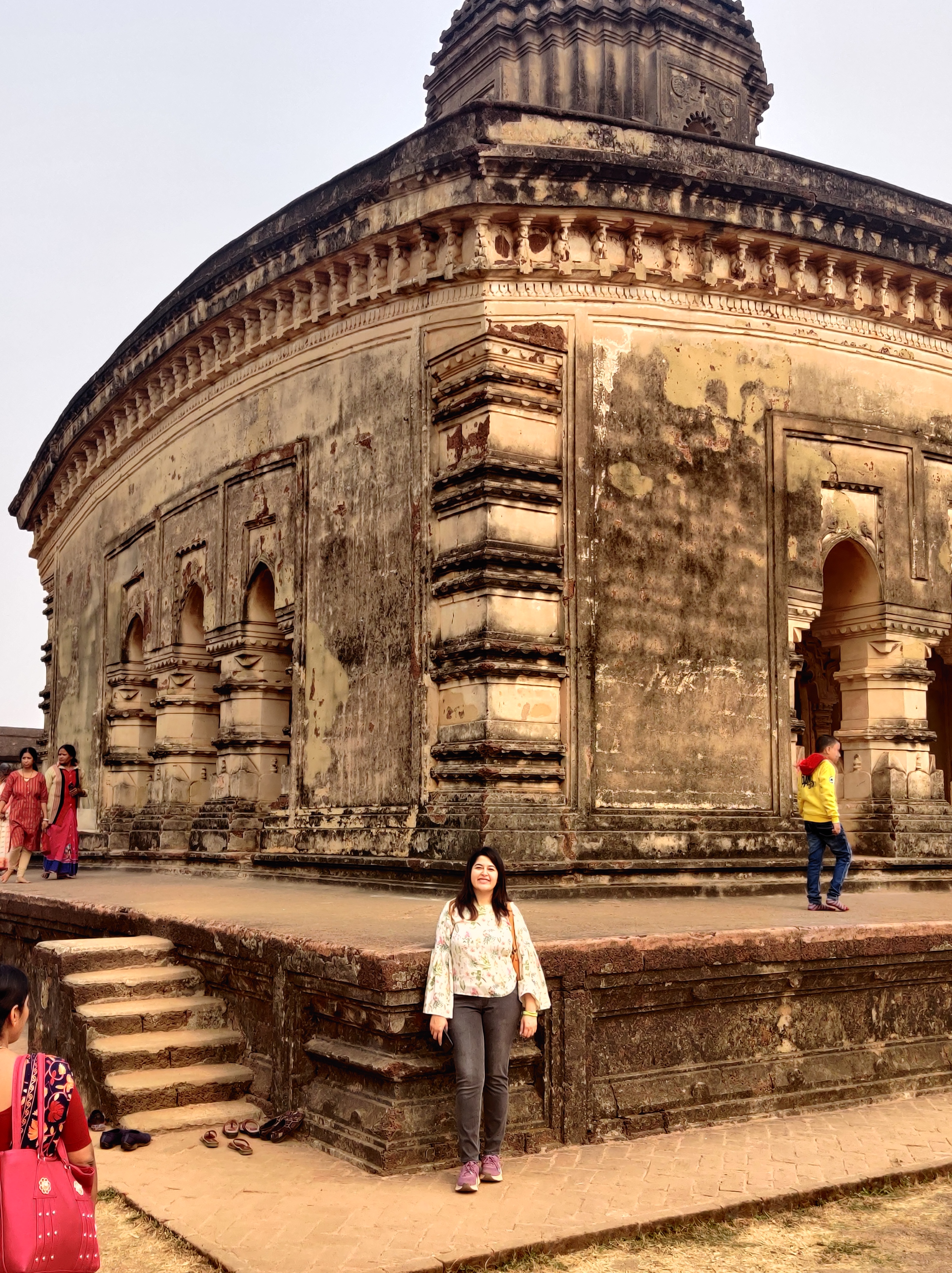
The Jor Bangla temple, with an innovative roof design akin to two thatched roofs joined together.

Jor Bangla temple

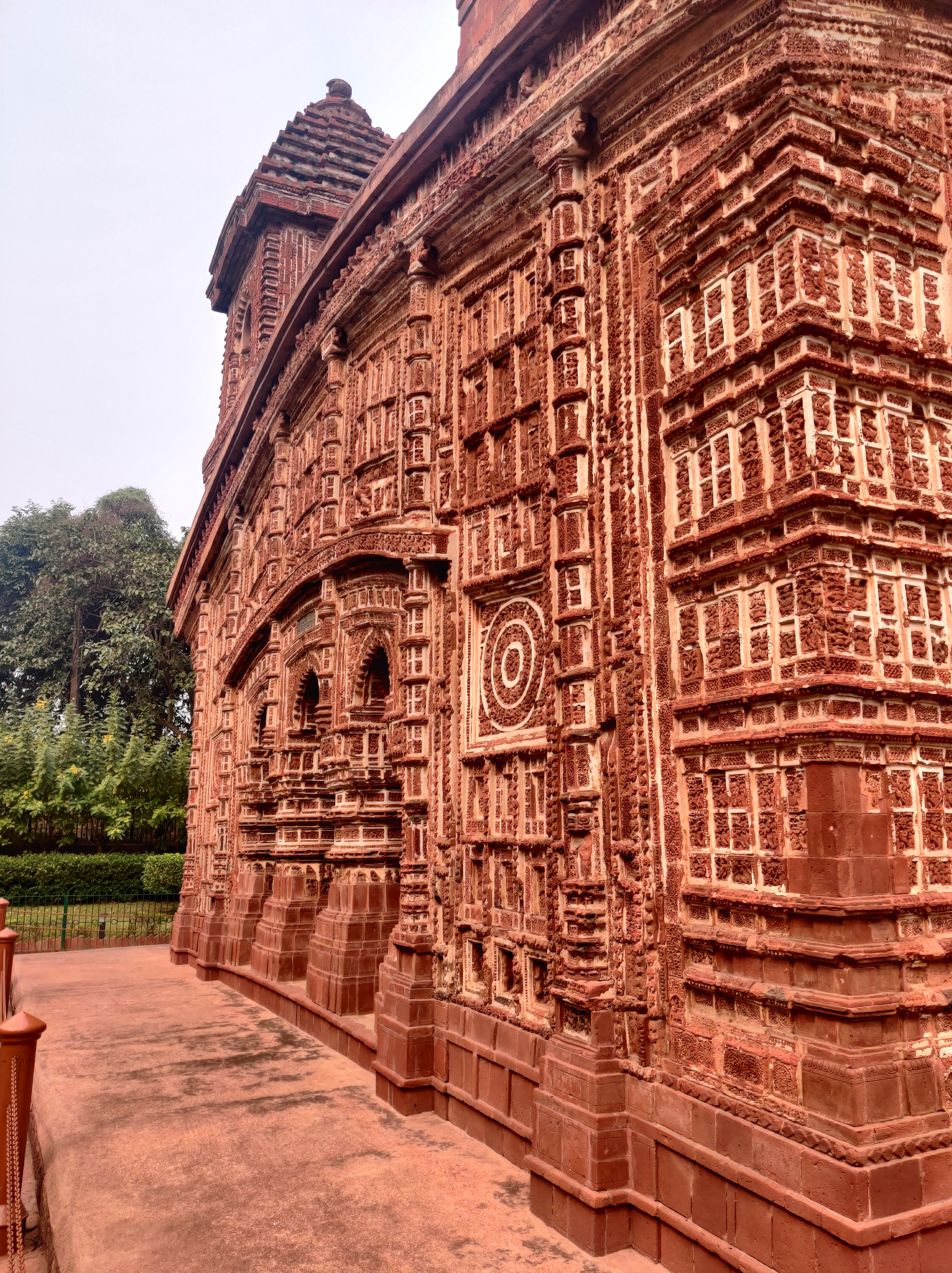
The Madan Mohan temple, a large structure with exceptionally detailed wall art depicting Krishna Leela.

Madan Mohan temple

‘…….Each one a sculpture, arcs and arched doorways, outer walls
Of small framed panels, depicting: Ganesh, Siva, Varuna, men
And women, carriages and animals, cows and collocations
Of the visible world, elephants engaged in the act of coition,
Mounted, each panel an astonishment, hundreds of them,
On each side wall. One temple’s roof’s a pyramidal lift
Of straight diagonal lines, converging; another’s is as swift
A symmetrical curve as a scimitar’s blade, four curves,
Balanced; another’s uses square shapes; all are brazen,
Terra cotta red, and smell of cold earth. The air is wet and warm……’

Outer walls

Chiselled intricacy of Terracotta

In fact, I learned that the Bishnupur temples were inspired by those built in faraway Vrindavan, tales of which had been brought by travellers and vaishnavite disciples over the centuries. However, the architecture and forms remained distinct, following local traditions and innovations.

Nestled incongruously amongst the terracotta temples sits a large four-meter Dalmadol cannon. Legend has it that when attacked by Maratha marauders, the Malla ruler himself fired the cannon to save the region.

Dalmodol Cannon

I had gone to Bishnupur to see the temples. I returned reliving the entrancing tales of Mallabhum’s Rajas, their creative passion for architecture and their devotion to Lord Krishna. Do I still hear the sounds of Rasleela in the corridors of Rasmanch? Do the murmurs of Terracotta surround me whichever way I turn?

In Musing……..                                                                   Shakti Ghosal

Acknowledgement: Quoted verses are by Alan Riach, Scottish author and Academician.

When a Jail speaks to you


“No one truly knows a nation until one has been inside its jails. A nation should not be judged by how it treats its highest citizens but its lowest ones.” – Nelson Mandela

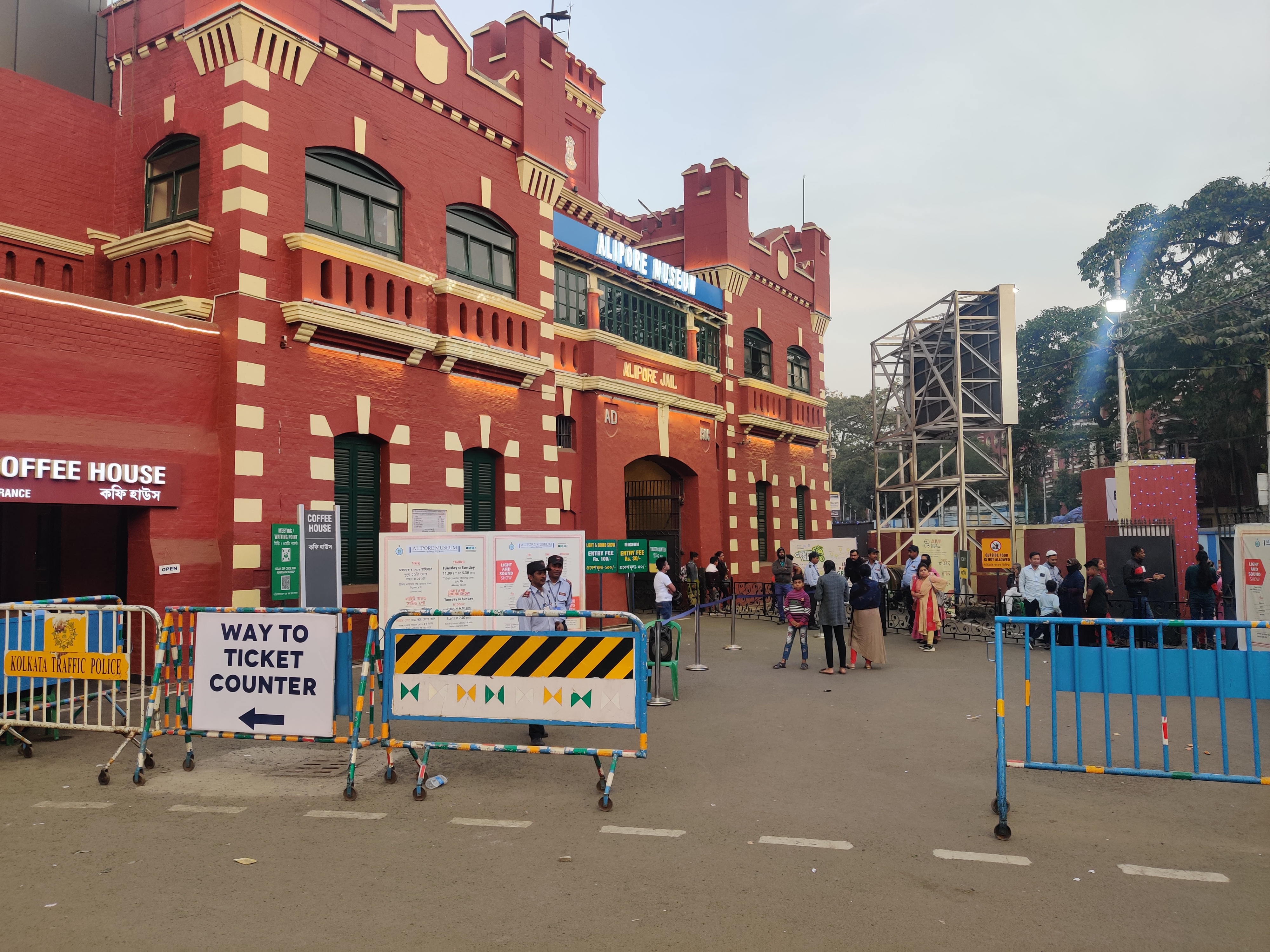
Alipore Jail in Kolkata has recently been converted into a museum and we made a visit. I found the place refreshingly well laid out with directional signs to the various highlights.

Though not well known, there are actually two Alipore Jails. The first Alipore jail, later called the Presidency jail, was built more than two hundred years back. The newer one, which continued to be known as the Alipore Jail, was built close to the earlier one in the early twentieth century. Known as a ‘correctional home’, it was used by the British to hold political prisoners.

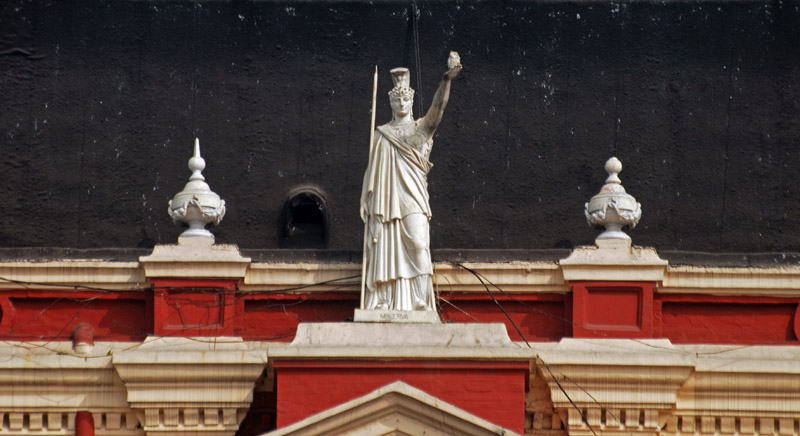
A few miles away from Alipore jail is Dalhousie Square. Named after Governor General Lord Dalhousie, who held office in the mid-nineteenth century, it was and continues to be the administrative and Business epicenter of Kolkata. Standing majestically at the center is the Writer’s Building with its French renaissance style architecture, Roman facade and rooftop statues.

Dalhousie Square is today known as Benoy Badal Dinesh (BBD in short) Bagh and therein hangs a tale of an interesting connect it has with Alipore Jail.

It was 1930. With the Indian freedom struggle at its peak, Alipore Jail was bursting at its seams with political prisoners. Colonel N. S. Simpson, the Inspector General of Police, had become the epitome of brutality when it came to dealing with political prisoners. Seeing himself as an able administrator, Simpson had devised an efficient and brutal system to force the prison inmates to reveal their political ideologies and ‘terrorism’ plans.  Merciless beatings while hung from a tree, putting chilli powder on the genitals etc. were commonplace.

Three Bengali revolutionaries Benoy, Dinesh and Badal, aged twenty-two, nineteen and eighteen, chanced to come together. Members of the Bengal Volunteers, a group set up by Netaji Subhas Chandra Bose a couple of years earlier, they had found their life’s calling in revolutionary activities. The threesome, having heard horror stories about Colonel Simpson’s notoriety, decided to take the fight to the British administrator.

To gain access to the Writer’s building the three youngsters entered Writer’s building wearing immaculate western attire. Asking to meet Colonel Simpson, they shot him dead point blank. BBD Bagh today stands testimony to the courage of this threesome.

***

As I stood looking at the Alipore jail gallows, I heard a sound and turned around to see an old tree standing forlornly in the courtyard. The rustling leaves seemed to be whispering to me about the killings and the merciless beatings it had been witness to. Did I hear Dinesh shout ‘Vande Mataram’ as he was being taken to the gallows?

Dusk fell and I watched the red-bricked Jail walls come alive and take on the colour of blood. The coloured lasers of the ongoing Light and Sound show pranced to and fro. A multitude of voices ebbed and flowed, from various directions.

Netaji Subhas Bose protesting against brutal assaults on other inmates, just before he was knocked unconscious from a head blow.

Subhas Bose inviting Deshbandhu Chittaranjan Das to a frugal meal that he had painstakingly cooked himself.

Young Indira ‘Priyadarshini’ Gandhi meeting her father Jawaharlal Nehru ( first Prime Minister of independent India) when he was incarcerated in a cell for participating in the civil disobedience movement.

Dr. Bidhan Chandra Roy ( a future Chief Minister of the state of West Bengal), himself serving a sentence, treating sick and injured prisoners in the jail hospital.

The whisperings of the guards on watch tower duty.

The tales that the jail was relating to me were of innumerable shades. Of sacrifice and suppression. Of idealism and brutality.

Night had fallen when I stepped out of the Alipore Jail complex to return home. 

As I got into the cab, I mused on the dichotomy of the Western civilizational ethos about freedom and bondage. Did that ethos emanate from a deep-down racial distrust of ‘non-western’ people and their purported non-adherence to western civility and norms which had justified Europe’s colonization ( it was never termed conquest!) of almost all of the planet?

 When it came to India, The British parliament and administration had gone to great pains to justify its ‘colonial intervention’ in the name of the rule of law, human rights and upliftment of the natives. An image of a benign Raj was fostered, a righteous mask was worn through setting up parliamentary commissions and inquiries every time there were reported cases of extortion and torture. The British would always take the moral high ground claiming ignorance of torture and beatings indulged in by the indigenous havildars and policemen a category which was illiterate, poorly paid and only too happy to curry favours with the British Sahebs.

In 1854, the Madras torture commission, which had been set up to investigate allegations of torture in the police department, had scathingly observed:

The police establishment has become the bane and pest of society, the terror of the community, and the origin of half the misery and discontent that exist among the subjects of Government. Corruption and bribery reign paramount throughout the whole establishment; violence, torture, and cruelty are their chief instruments for detecting crime, implicating innocence, or extorting money. Robberies are daily and nightly committed, and not unfrequently with their connivance; certain suspicious characters are taken up and conveyed to some secluded spot far out of reach of witnesses; every species of cruelty is exercised upon them; if guilty, the crime is invariably confessed, and stolen property discovered; but a tempting bribe soon release[s] them from custody….’

A hundred and seventy years on, does the above sound eerily familiar? As I sat thinking of all this in the cab, the irony of the situation did not escape me. The British have long gone, our tryst with destiny is now three-quarters of a century old. But our governance and law-enforcing structures seem to perpetuate those very aspects which our forefathers had fought against.  

Would the shifting of the jail facilities away from British structures like the Alipore Jail finally allow for fresh thoughts and mindsets to set in? I wondered.

The museum boasts an excellent coffee shop which we thoroughly enjoyed. A visit is recommended.

In Musing…….                                                                                 Shakti Ghosal

Acknowledgement : “Very wicked children”: “Indian torture” and the Madras Torture Commission report of 1855: by Anuj Bhuwaniam Replicated from Sur – Revista Internacional de Direitos Humanos, São Paulo, vol.6, n.10, pp. 6-27, 2009

Gangani and the two lenses


We visited Gangani.

A little over an hour’s drive from Joypur in Bankura district ( West Bengal, India) where we were vacationing, The Gangani ravines are known as Bengal’s very own Grand Canyon. A remnant of the last Ice age and the glacial activities at that time (anywhere up to two million years ago), the carved rock formations offer a breathtaking sight. As if to provide some relief to the frozen cliff and ravines, the river Shilabati meanders lazily below.

An interesting Legend links Gangani to the great Indian epic Mahabharata.

It is said that after the Pandava brothers lost the game of dice to their cousins the Kauravas, they were exiled for twelve years in the forests.  During this period, they reached these lands which were being terrorized by the demon Bakasura. The villagers had to provide a huge quantity of food along with a human every day to the demon to ensure that the land was not ravaged. On hearing of this, Bheem, the second brother of the Pandava clan, offered to go with the food the following day.

Now Bheem was strong and well trained but it remained uncertain if he could take on the might of the powerful demon. But in the epic battle that ensued, Bheem displayed frightful ferocity and slayed Bakasura. The crumpled land and ravines remain a testimony to that.


I stood there and looked at the ravines and the land formation below.

As I wore the geological lens, I could visualize how the weathering through millennia might have created those interesting carvings and structures which I was witness to.

As I changed the lens and wore the mythological one, I could well nigh hear the roars and sounds of that titanic conflict with the adversaries slugging it out over days.

It is fascinating how our beliefs about what we are witness to can be so much based on the viewing lens we choose to wear.

In Learning……                                                                  Shakti Ghosal

Konark- Spiritualism versus Eroticism


“Language of Man here is defeated by the language of stone.” – Rabindranath Tagore

A visit to Puri in Odisha can never be complete without a trip to the Konark Sun temple. Having paid our homage to Lord Jagannath in that iconic Puri temple in the morning hours, we had the afternoon available for going to Konark.

A surprisingly good infrastructure exists in terms of road access from Puri as well as the upkeep of the Konark Sun temple complex. Getting down from the car in front of the long walkway, I had my first glimpse of the famous temple in the distance. The tiled pathway, overlooking gardens and the Konark temple information Centre (which incidentally has a wonderful audio-visual show about the temple and its origins) lead to the temple.

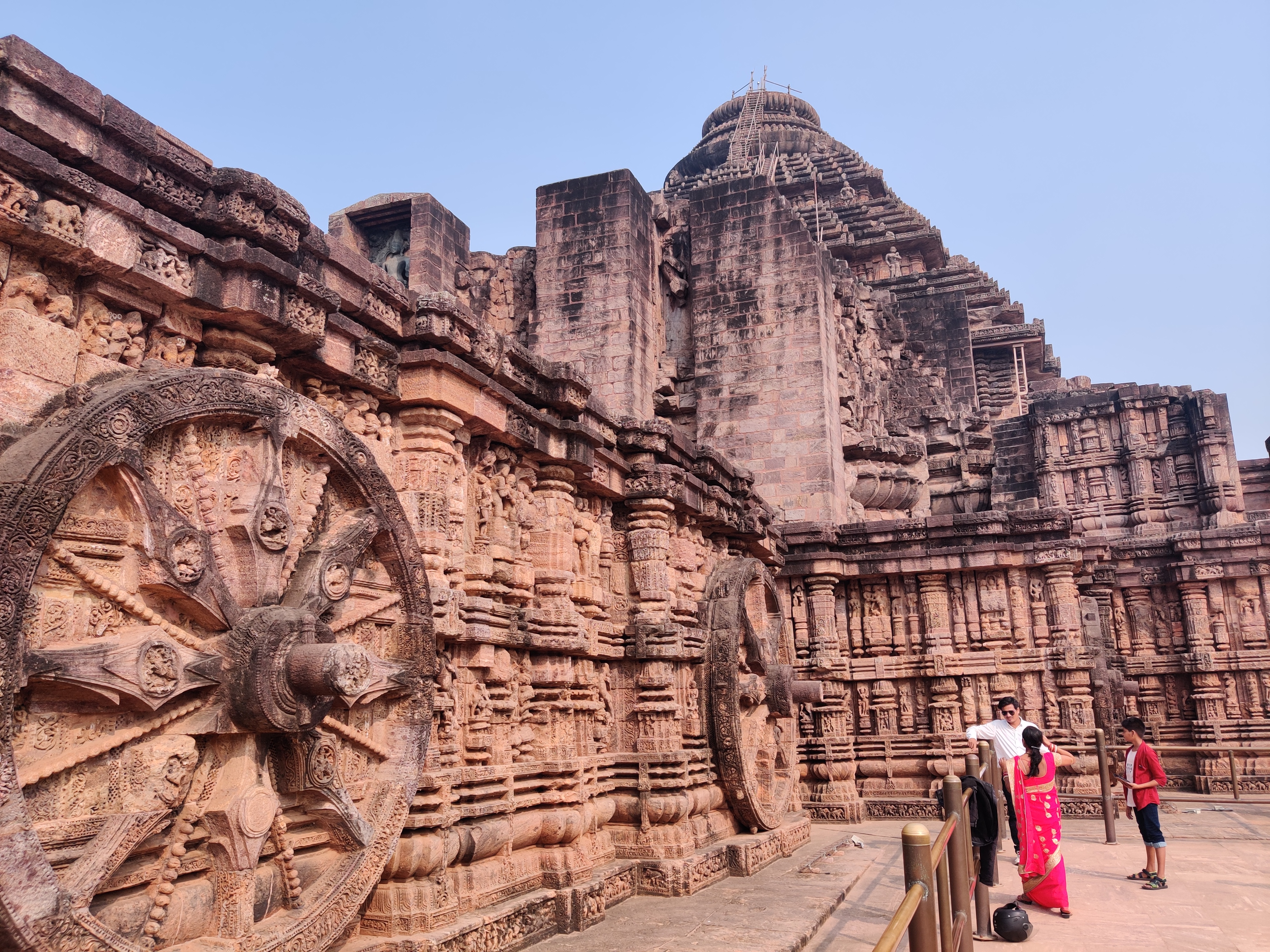
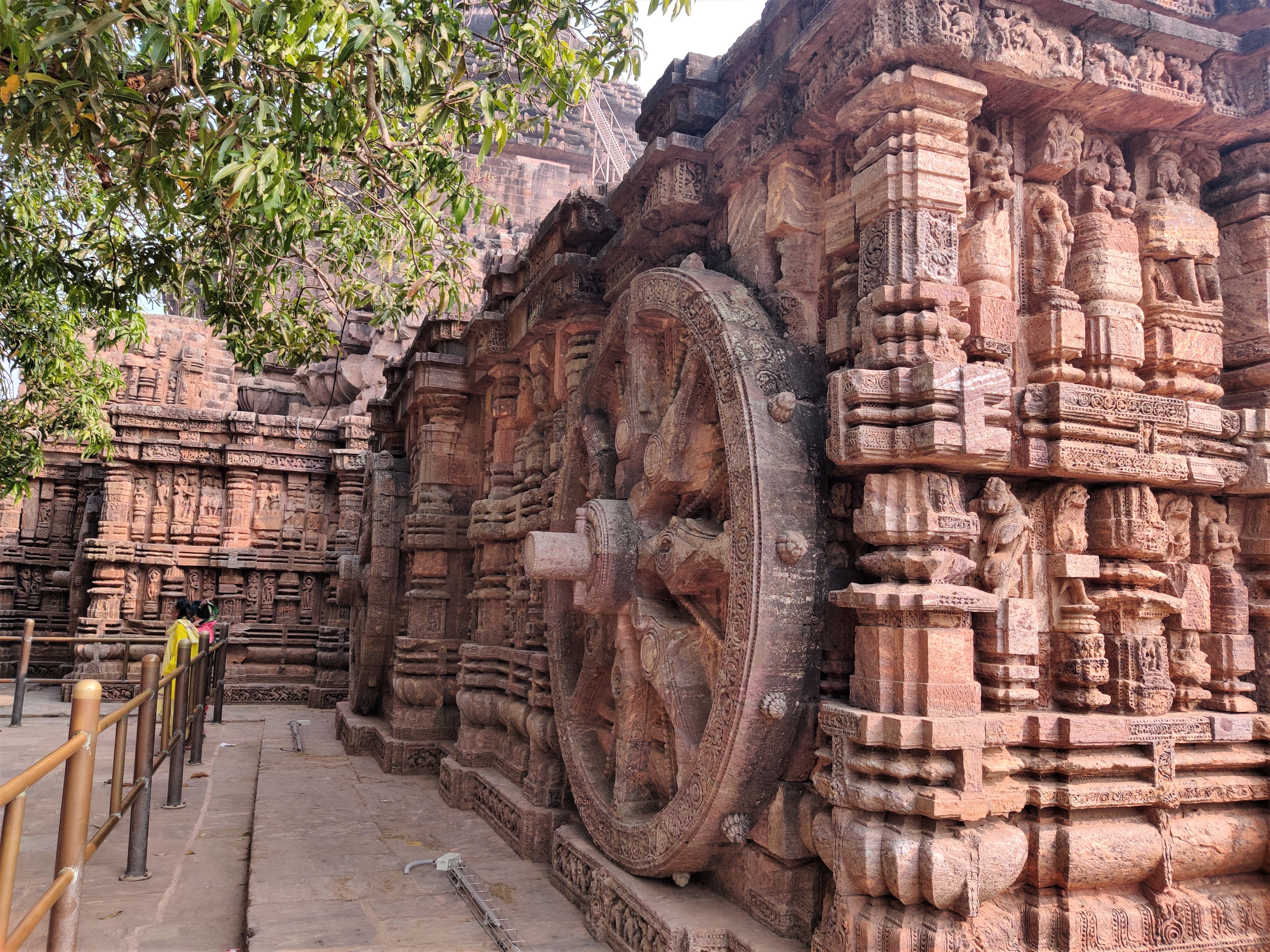
Standing there, as I looked at the ruined structure, my mind’s eye brought in the vision of an enormous chariot with its giant wheels and horses, a resplendent Sun seated as the charioteer, taking flight across the sky. The word Konark in Sanskrit is a sandhi, a combination of two words: Koṇa, which signifies a corner and Arka which refers to the Hindu Sun God, Surya. Built out of stone seven and a half centuries back, the temple is an intricately carved, giant chariot of Surya, replete with ornaments, twenty-four giant wheels and pulled by seven horses. Throughout history, different cultures and lands have referred to ‘crossing the seven seas’ for a travel around the world. In India, it is called, ‘Saat Samundar Paar’. Did the seven-horse drawn chariot of the Sun God signify that it had the motive power to circumvent the world?

The temple external walls are sculpted with intricate and jewelry like miniature details. The carvings range from Hindu Gods and Goddesses, nymphlike apsaras, nature inspired motifs, day to day living and cultural activities of people ( Artha and Dharma) , animals, birds and sea creatures along with some depictions of the life and times of the king. Ernst Binfirld Havell, the English art historian and author, writes that the Konark temple is “one of the grandest examples of Indian sculpture extant“, adding that they express “as much fire and passion as the greatest European art” such as that found in Venice.

As I looked at the lengthening shadows of an evening sun, I envisioned the year 1756 AD when Vice Admiral Charles Watson of the East India Company navy accompanied by Robert Clive, was rushing to Calcutta to take back Fort William recently captured by the Bengal Nawab, Siraj Ud Daulah. Spotting the Black Pagoda, as the Konark Sun Temple was known then, along with the White Pagoda, the Jagannath temple near the then coastline ( which has since receded), Watson would surely have been relieved that their destination at the mouth of the Bay of Bengal was near.

History indicates that the Konark Sun temple was destroyed by invasions and natural calamities. Over time it ceased to attract the pious and the faithful. And like the other famous Hindu temple at Angkor Wat in present day Cambodia, the Sun temple too disappeared under dense forests for a long time prior to being rediscovered.

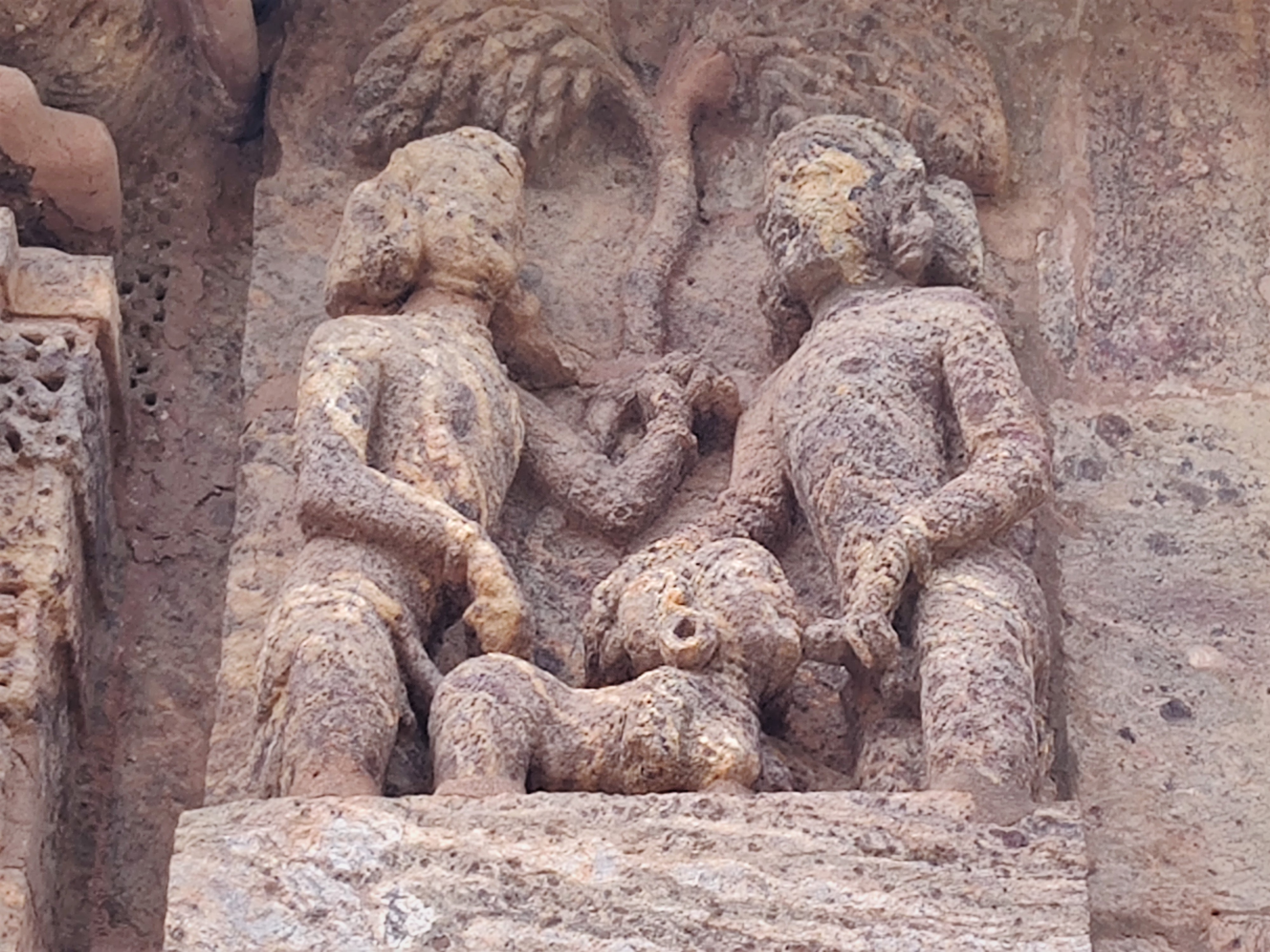
What remains most intriguing however is the highly erotic sculptures interspersed amongst the aforementioned carvings. As I stood there looking at the sculptures, it seemed that eroticism held sway over all else. The carved in stone figurines displayed sexual engagements and coitus in varying positions. I saw several of the chariot wheels depicting different sexual postures. What I found astonishing was the uninhibited depictions of polyandry, polygamy and lesbianism.

As I walked way, I was beset with several thought trains, trying to make sense of such brazen display of sexuality in a temple made to worship the Sun.

Was the displayed eroticism a deliberate attempt to increase sexual activity amongst the population in the 13th century? I had read somewhere that Buddhism, the prevailing religion in the land of Kalinga, preached abstinence which over the centuries, had led to a declining population. Had the King thus ordered the seductive carvings to stimulate carnal desires in his subjects?

Could it be that the depictions were a result of the sexual longings of the thousands of artisans tasked to work on the temple carvings for twelve long years, away from home and family?

Or were the erotic creations deliberate to strengthen the spiritual and divine belief of the devotees coming to the temple? Was the seemingly random display of eroticism, scattered amongst other displays of  Gods, nature and public life motifs, a trigger for the observer to choose his/ her path between ‘dark’ attractions of sensuality and depravity vis a vis the brightness of  spirituality?  

Finally, could the differing displays be based on the age-old belief that each one of us would attain Moksha (release from the cycle of rebirth), that final desired state, only once we have fulfilled all our earthly duties and participated in the cycles of Dharma viz. spirituality, Artha viz. wealth and Kama viz. sexual pleasures?

Does the Konark Sun temple offer a perspective of our life as ‘lived in the moment’, cycling as we do through Dharma, Artha and Kama without the attachments of what is right or wrong, good or bad?

**

Postscript:

Back in Puri, I was watching the Sunrise next morning from the balcony of my hotel room.

Sitting there, as I soaked in the solitude, the morphing hues of the sunlight, the occasional bird chirps and their flights, I seemed to sense that all was well with my world.

As the sun rose in the sky, that solitary boat on the calm waters, seemed to be following the light. The sight brought to mind those immortal words of the Beatles:

‘One day you ‘ll find

that I have gone

Tomorrow may rain

       So, I’ll follow the Sun….’

In learning………                                                                            Shakti Ghosal

Extinction


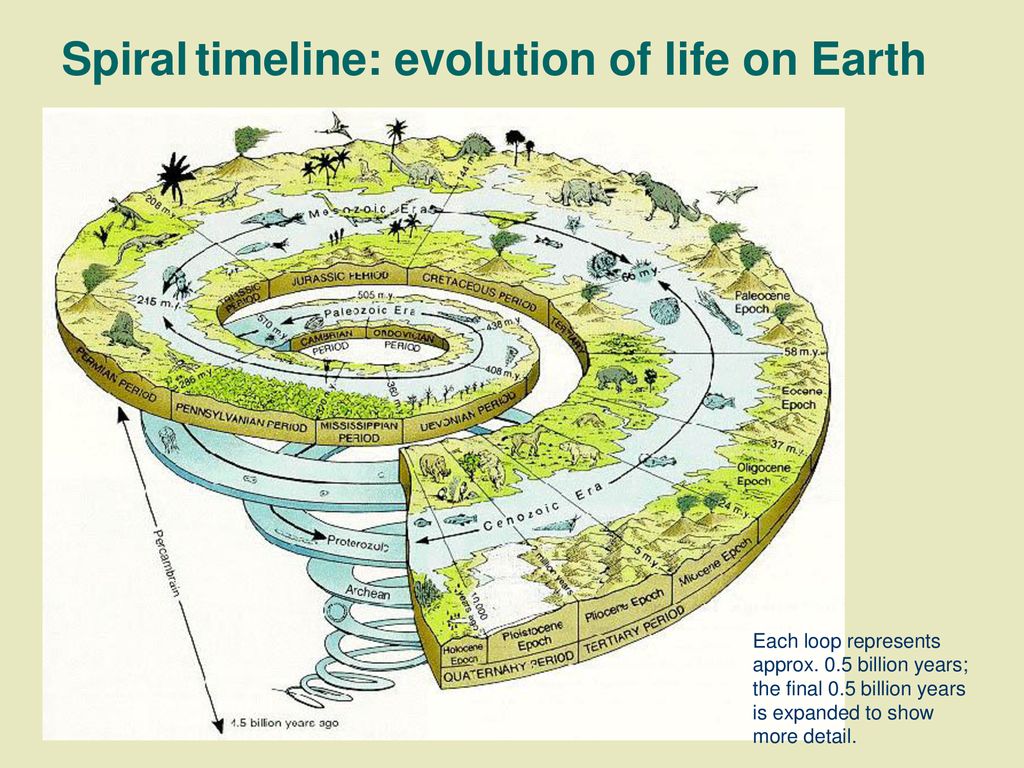
The long orange strip unfurled from the small roll at the end and then snaked across the entire wall. It changed colour from deep to light orange before morphing into a green strip and finally ending with a tiny four-inch blue coloured block at the end.

I was looking at a timeline representation of the start of life on earth, about three and a half billion years ago, culminating with the appearance of us humans two hundred thousand years back. That blue-coloured block highlighted the minuscule period ( around 0.006% of total )  that we humans have existed on mother earth as compared to all life.

Each loop represents approx. 0.5 billion years; the final 0.5 billion years is expanded to show more detail.

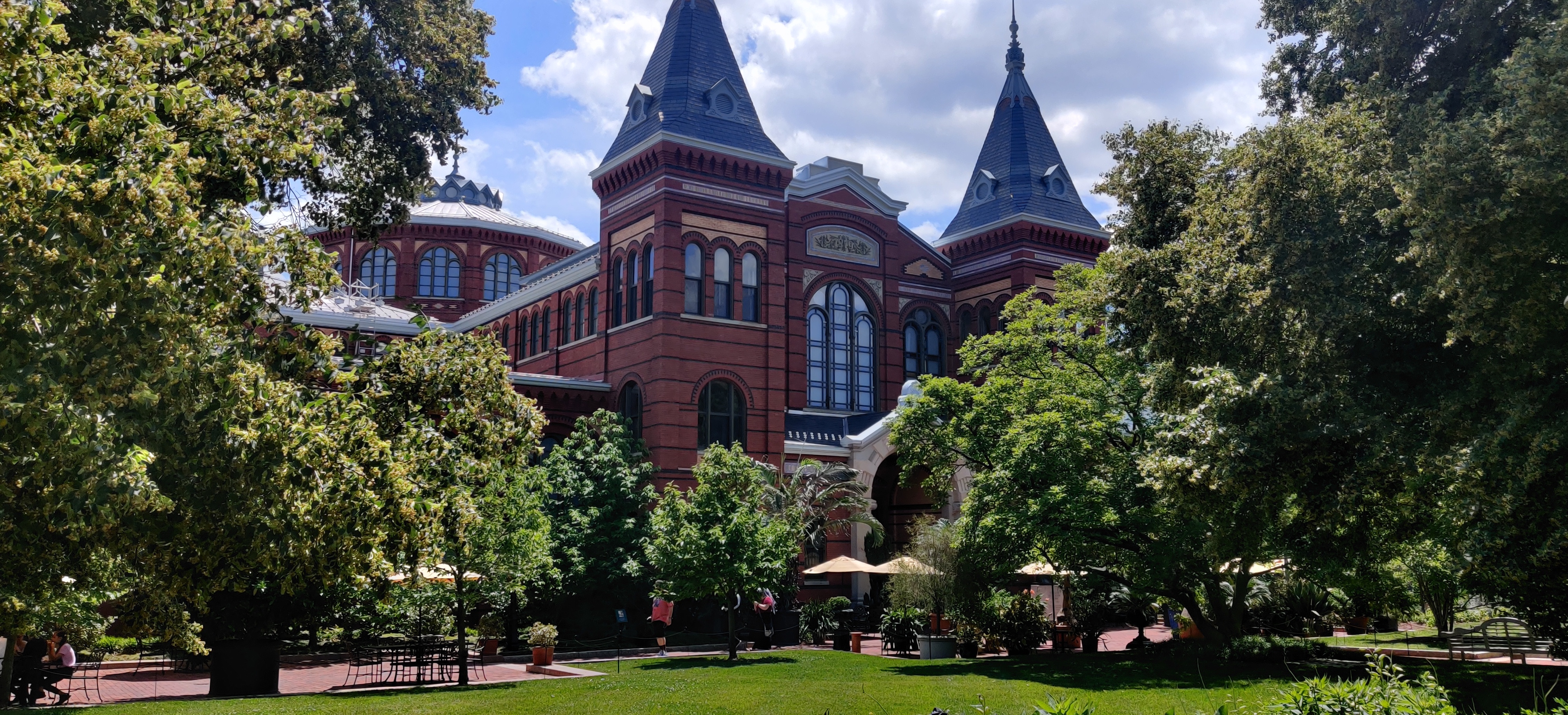
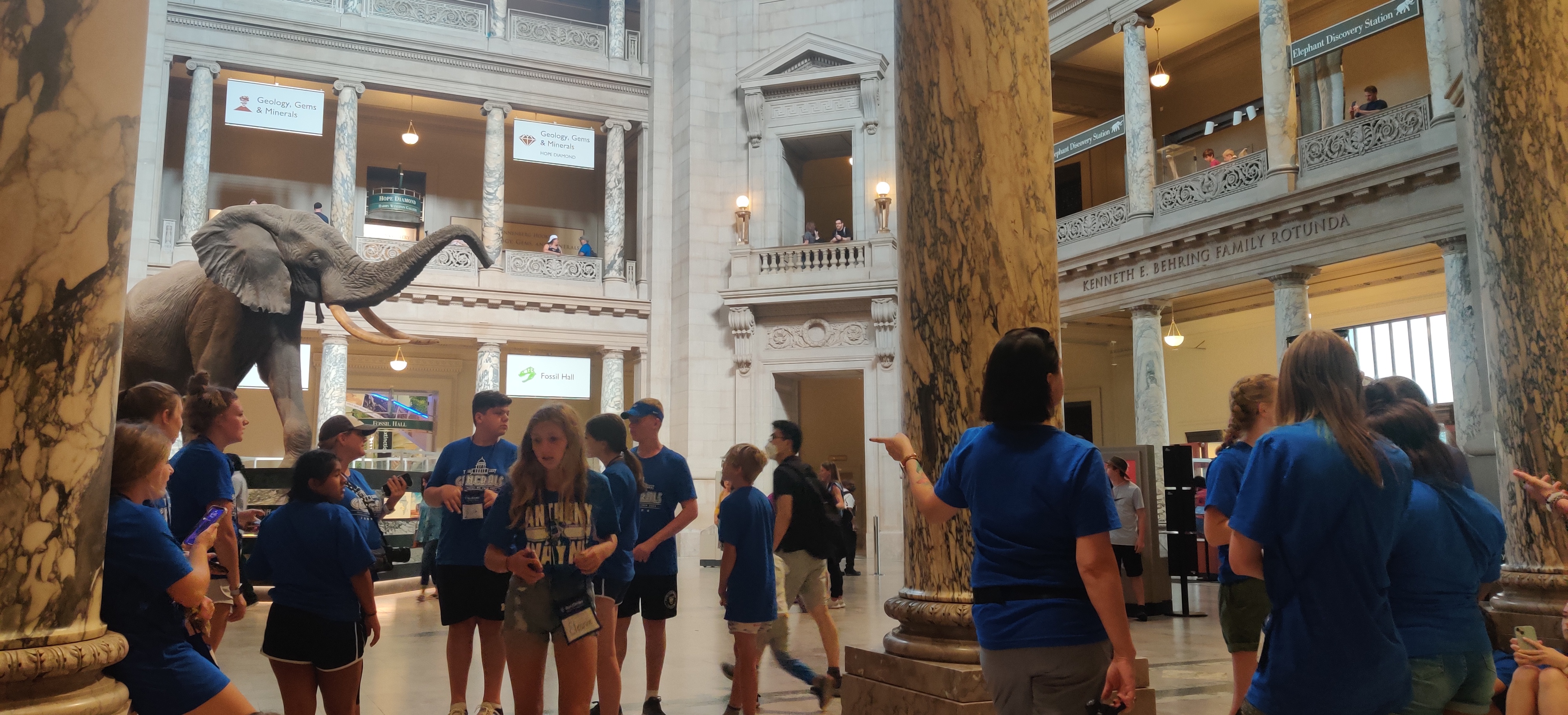
I was at the Smithsonian Museum of Natural History on a recent visit to Washington DC. Though the museum carries the same name as the more well-known American Museum of Natural History in New York, I was finding the format and the presentation refreshingly different.

As I looked at the representation, I was intrigued to see the periods of mass extinction that have taken place in the planet’s living history. There seem to have occurred around five major extinction events since earth cradled life. These were when between fifty to ninety-five percent of all living species died out. I got particularly interested in two such events.

The first was the one that led to the demise of the dinosaurs. I sat watching a video of what might have happened sixty-six million years back when the age of the dinosaurs ended. A large meteor comes hurtling from outer space and hits earth in the Mexican coastal region. The impact kills all life on land and sea for thousands of kilometers all around, its explosive power equivalent to billions of atomic bombs going off at the same time. And as if that is not enough, giant tsunamis and billions of tons of vaporized asteroid and terrestrial debris spew up into the atmosphere, envelop the earth and block out sunlight for years. Photosynthesis all over the world gets seriously impeded and the global climate alters leading to large-scale death of flora and subsequently the herbivores and carnivores going up the food chain.

It is estimated that three-quarters of all life on earth perished during what is today known as the Cretaceous–Paleogene extinction event. But the event also led to an interesting development. The age of the mammals commenced. Being smaller in size and with less need for sustenance, the surviving mammals who had existed on the peripheries during the dinosaur age got the planet to themselves and started flourishing. The evolutionary path over several subsequent million years took the necessary steps toward modern humans with the ability to walk on two legs.

Writes Rick Potts, the Director of Smithsonian Institute’s Human Origins Program, “East Africa was a setting in foment—one conducive to migrations across Africa during the period when Homo sapiens arose. It seems to have been an ideal setting for the mixing of genes from migrating populations widely spread across the continent. The implication is that the human genome arose in Africa. Everyone is African, and yet not from any one part of Africa.”

The second extinction event that intrigued me was the one in which the human species more or less vanished around seventy thousand years ago. Estimates range from a few hundred to a thousand humans who remained to fend for themselves in a dangerous world. The event is generally linked to a super volcanic eruption named Toba which went off in Indonesia and spewed a colossal amount of ash, debris and vapour into the atmosphere. The Sun got dimmed for years disrupting seasons, choking rivers and killing all vegetation in large parts of the planet.

Says Science writer Sam Kean, “There’s in fact evidence that the average temperature dropped 20-plus degrees in some spots,” after which the great grassy plains of Africa may have shrunk way back, keeping the small bands of humans small and hungry for hundreds, if not thousands of more years.So we almost vanished.”

As I continued to look at that unfurling orange strip and read about the extinction events, I found it indeed amazing how the present world stands dwarfed by close to eight billion of us humans. Even though our footprint remains that tiny blue coloured four-inch block on the timeline representation of life. The probability numbers about a meteor hitting or a super volcano erupting remain minuscule and clearly in our favour because of our small timeline footprint. But within that insignificant (fleeting?) footprint, we have managed to subjugate every other species, harnessing both flora and fauna to our needs. We have mastered science and technology in wondrous ways, improving our lot in every way conceivable. Be it food, be it energy, be it resources, be it our understanding of the Universe.  

But could it be that we are willy nilly walking on the extinction pathway of our own making? Stemming from our sheer numbers and our continued actions to reorder and realign nature to our own needs. Vulnerability to increased incidences of diseases and viruses. Vulnerability to our own selves as we fight for scarce resources. Vulnerability from the very technology which we believe we have harnessed.

Scientists and environmentalists are raising the alarm that we may be already at the extinction tipping point arising from global warming and climate change. A tipping point that might lead to the mass extinction of more than half of humanity with the collapse of social, political and economic structures. Once the tipping point is breached, the world could witness accelerating global warming and climate change with no way to control. Simulation studies point to an overall ecological disaster and collapse leading to the mass extinction of a large number of flora and fauna species; more than a million species are on track to go extinct in the coming decades. Would this be Judgment Day for Humanity and its cradle planet?

It seems to me that we have been plain lucky. There really is no certainty of our continuing the domination of the world beyond the so very tiny and fleeting ‘blue block four-inch’ period that we have done so. If our luck was to change, we might just have an epitaph written about us by someone in the distant future. Like the way we have written one about the dinosaurs.

Standing there I was left wondering whether we are creating the right luck for us.

Man who gave you life, man who gave you home
Man who gave you all you desire?
All you do is blight, all you do is waste
Don’t you see the ash of your fire?
Our mother’s crying, our mother’s dying
Our mother’s cancer is true
Mother we belied, mother we defiled
May your human child’s end be good for you

  by Oversense

In Musing………….                   Shakti Ghosal

Legends


I built me a castle
With dragons and kings
And I’d ride off with them
As I stood by my window
And looked out on those……

I walked leisurely on the pedestrian path.

Walkers and tourists milled around me, like me all moving at a leisurely pace. No one seemed to be in a hurry. A family led by Dad with the son on his shoulders passes me in the opposite direction. Just in front, a group of giggling young women were taking a barrage of selfies. It seemed one or the other was not satisfied with the result, be it one’s expression or the way the long cables and the end tower showed up in the photo. A quick joint review, some more giggles and someone in the group would volunteer to take a new selfie. I watched this microcosm of humanity flowing around me.

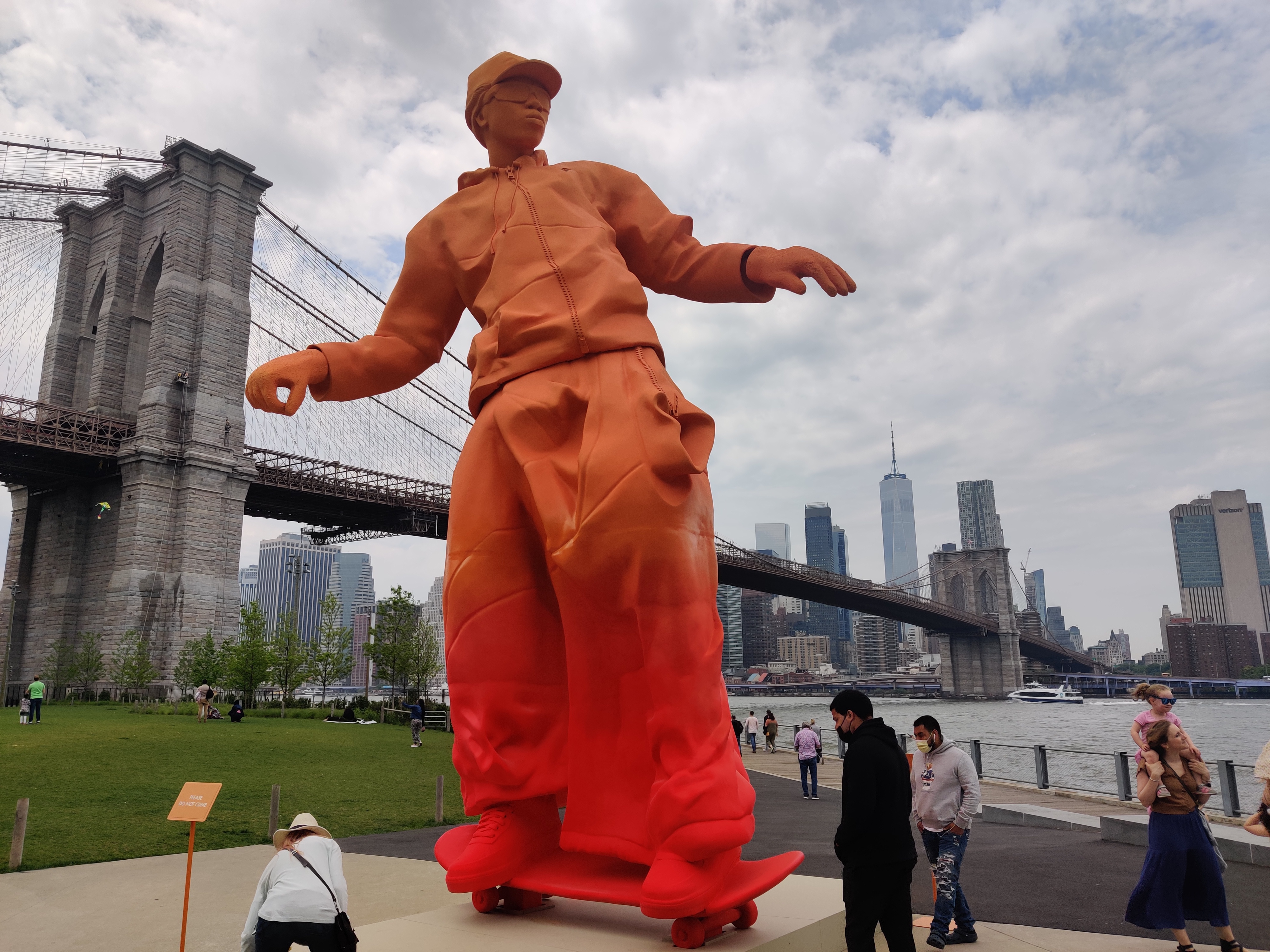
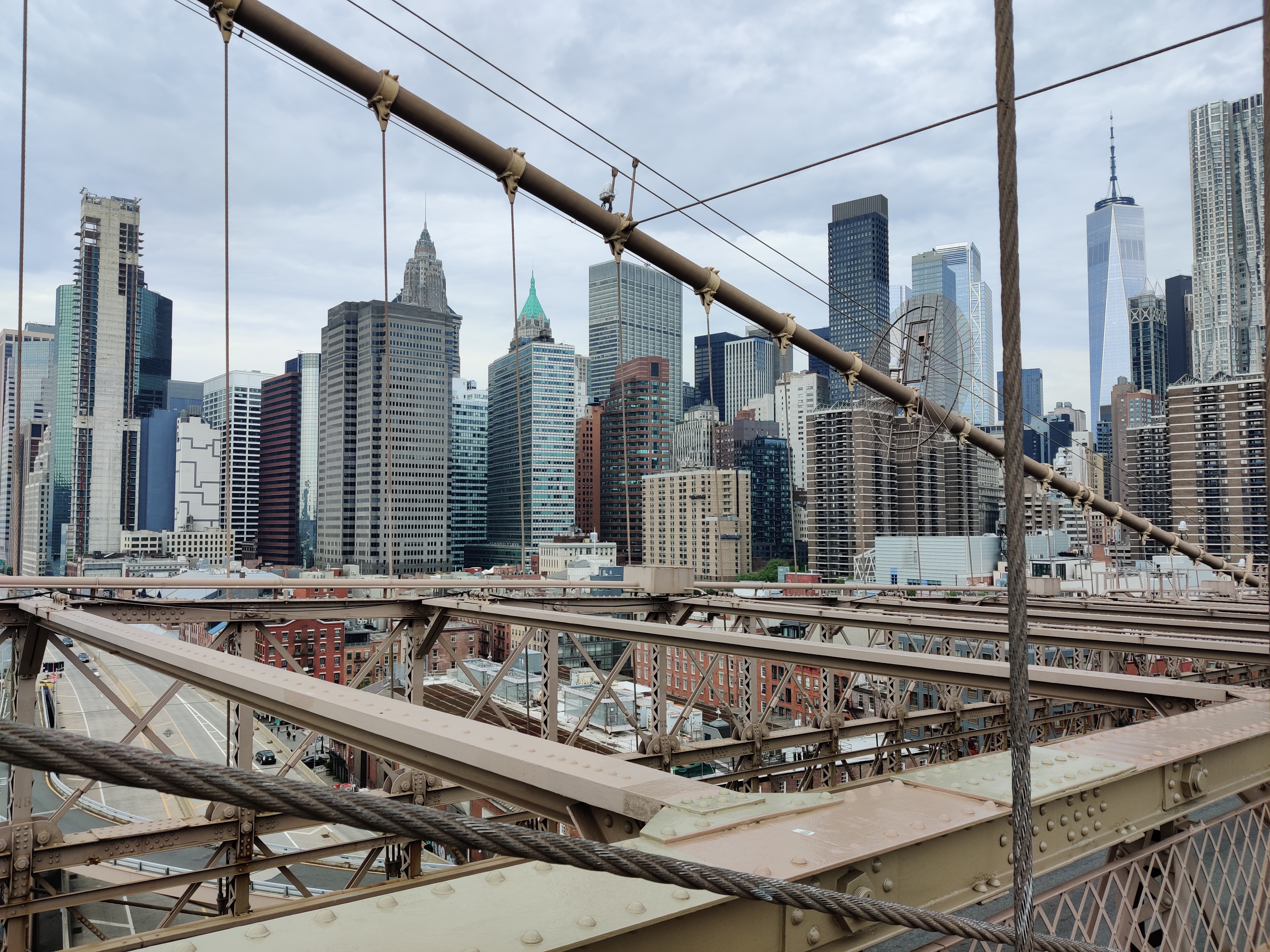
It was a beautiful sunny morning which had prompted us to venture out on a spot of sightseeing. I was on the pedestrian walkway of the legendary Brooklyn Bridge. Below me on both sides were the motorways with cars and SUVs moving in either direction between lower Manhattan and Brooklyn.

One had glorious views of the New York skyline as well as the leisurely flow of the East River below. To the right one could spot Governor’s Island and in the distance the Statue of Liberty. But as I stood looking around, my mind’s eye wandered off to another unforgettable vision involving the Brooklyn bridge. Powerful searchlights frantically flashing, sounds of helicopters, people jumping off the bridge into the waters below as a terrified News Reporter announces that all of us are going to die! One of the most emotional scenes from the blockbuster ‘I am Legend’ in which scientist Robert Neville (Will Smith) tries to evacuate his wife and daughter from pandemic ridden Manhattan, only to see them die as another helicopter crashes into theirs in the chaos. In the background, the Brooklyn Bridge is being blown up by military aircraft to contain the spread of the disease.

An iconic film showing visuals of an iconic bridge.

A hundred and forty years old structure, the Brooklyn Bridge was the world’s first and longest steel-wire suspension bridge at the time of its opening. What further distinguishes the bridge are the pair of gothic towers standing tall on either side, holding the steel wires in place. Legend has it that when the lead engineer and architect Washington Roebling, became sick and bedridden, his wife Emily, who knew nothing about engineering or architecture, took over the project. For the next ten years, till the project got done, she studied Engineering design and project management on her own and became the first person to cross the bridge upon completion. The following was said about Emily and the Brooklyn bridge:

“…an everlasting monument to the self-sacrificing devotion of a woman and of her capacity for that higher education from which she has been too long disbarred.”

A sad reminder of the fact that during Emily’s time, women were not allowed into Engineering institutions in the US.

Having walked the mile long stretch of the Bridge, we stepped onto the roads of Brooklyn. The neighbourhood in which Neil Diamond had grown up six decades back. With his baritone voice and wonderful songwriting capabilities, Neil Diamond has been my favourite pop and country musician and singer since youth. The singer reminisces about his childhood in that wonderful number, ‘Brooklyn Roads’:

‘Two floors above the butcher
First door on the right
Life filled to the brim
As I stood by my window
And I looked out of those
Brooklyn Roads……’

Neil Diamond

The place we were walking through had the curious name of DUMBO. I was left wondering whether it had anything to do with Disney’s Dumbo the flying elephant. Or was it about some presumed dumb folks who might have resided there in the past?

‘And report cards I was always
Afraid to show

Mama’d come to school
And as I’d sit there softly crying
Teacher’d say, “He’s just not trying
He’s got a good head if he’d apply it”
But you know yourself
It’s always somewhere else’

 I learnt that DUMBO was really the short nomenclature for ‘Down Under the Manhattan Bridge Overpass’. Ironically, the neighbourhood today is home to a large number of technology start-up companies with the earlier warehouses on the riverfront converted into quaint eating houses and pubs overlooking the waters.

A bridge, a musician and a neighbourhood came together as legends for me that morning. They came with tales that were anecdotal, possibly unverifiable but nonetheless remain ingrained in my mind.

In musing…………                                                       Shakti Ghosal

Acknowledgement: ‘Brooklyn Roads’ by Neil Diamond