
Ma Is Coming


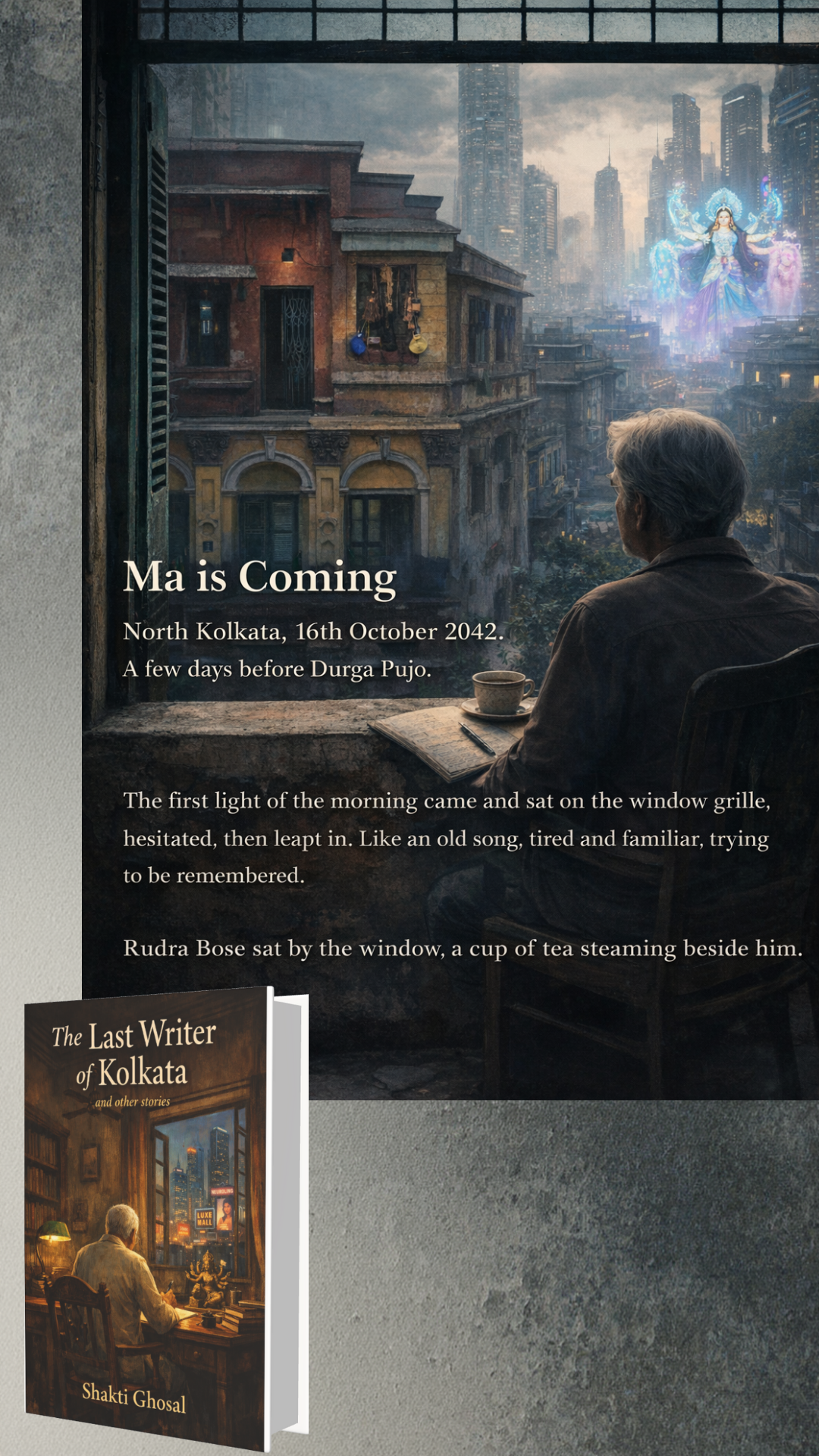
Ma is Coming

North Kolkata, 16th October 2042. A few days before Durga Pujo.

The first light of the morning came and sat on the window grille, hesitated, then leapt in. Like an old song, tired and familiar, trying to be remembered.

Rudra Bose sat by the window, a cup of tea steaming beside him. The cup was chipped, the saucer mismatched, the tea, a stubborn blend of milk, tea dust, and habit. Outside, the lane yawned into a waking slumber, its air thick with last night’s incense, stale samosa oil, and the ever-present, low-grade air pollution.

“Ma is coming,” he had heard someone shout on the street last evening.

She was, of course. Ma came every year. Only nowadays she arrived on a cloud of holograms, flanked by LED lions and thunderous drumbeats pouring through subwoofers. The city had found new ways to worship, more theatrical, more saleable.

Rudra shifted in his chair, his bones protesting like rusted hinges. In his lap, his journal lay open, an old pen resting across the page like a reluctant weapon. He hadn’t written yet. He was waiting, unsure of something. Was he waiting for a thought, a familiar smell, or the comfort of a Kolkata that seemed to slip further away each year?

Durga Pujo. Once, it had been magic.

As a boy, he had spent mornings watching Mashis, aunts and Boudis, sisters-in-law threading marigolds for the Pandal and Thakurer Bedi. In the afternoons it would be the decorators stringing up festoon lights of different colours all along the lane. Nights were all about rehearsing lines for the Natok, stage play they would perform on Nabami.

He had once accompanied his mother, walking barefoot to the river to collect Gangajal, the sacred waters of Ganga. He remembered his father reading out the Chandipath under a suffused light. Long buried memories of his parents surfaced and meandered.

“Rudra, you were born with too much silence,” his mother had once said, as she used a hand fan during load shedding. “You are eleven. Most boys your age chase dragonflies. You chase metaphors.”

“I like listening,” he had replied, “Words sound different when you don’t rush to answer them.”

His mother had turned towards him, “Then promise me, don’t let the noise teach you to forget what silence feels like.”

North Kolkata is the soul of the city, where the past isn’t just remembered—it’s lived. Often called “Babu Kolkata,” this region is a labyrinth of narrow lanes, grand 19th-century mansions, and centuries-old traditions that remain untouched by modernity. Historically, the British referred to the area inhabited by the native Bengali elite as the “Black Town,” in contrast to the “White Town” of Central Kolkata where the British lived.

North Kolkata features in the ‘Last writer of Kolkata’, part of my forthcoming book of the same name. Should you wish to receive exclusive previews and the chance of winning a free copy of the book, do write to me @ author.esgee@gmail.com

Shakti Ghosal
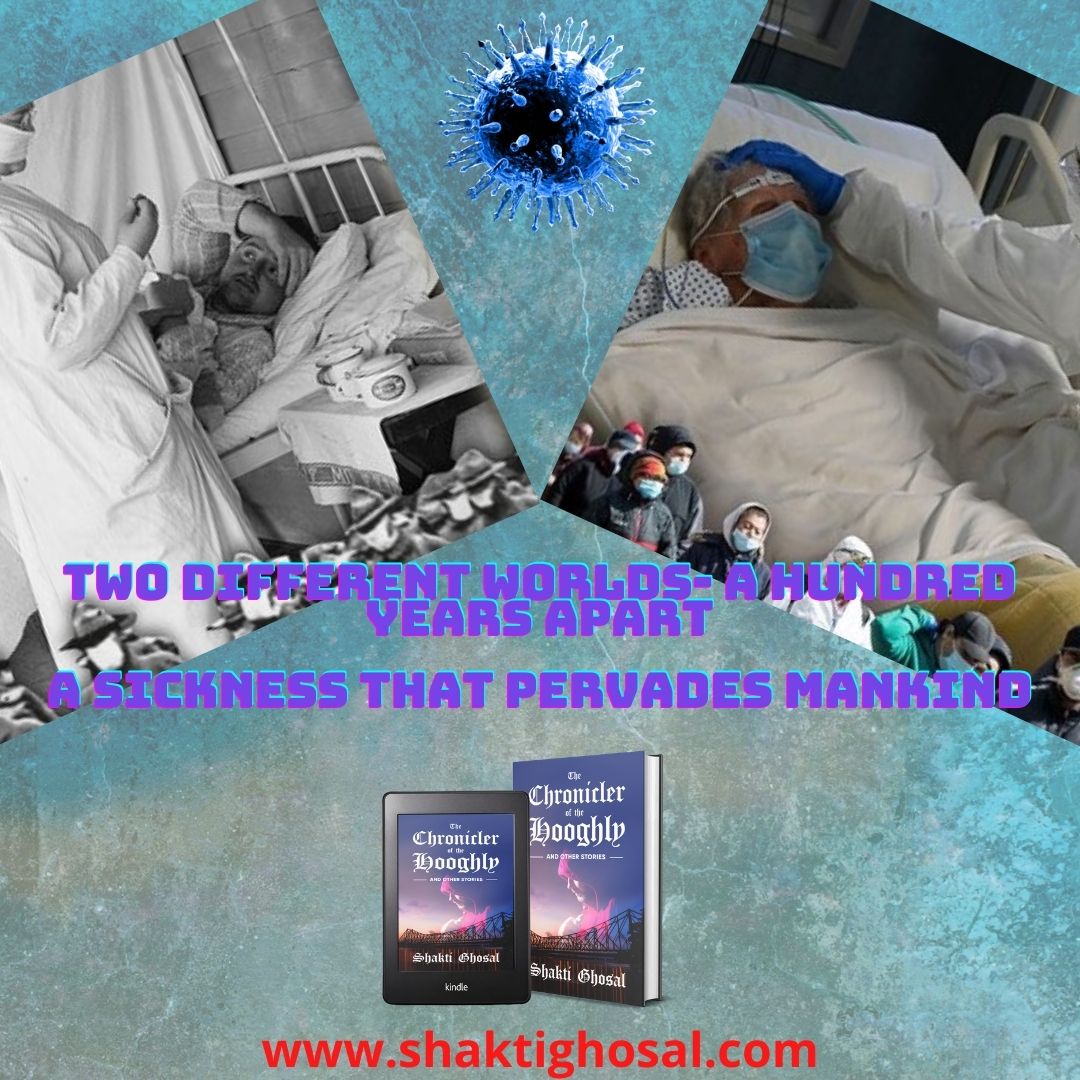
Spanning a century between the Pandemics of 1919 and 2020


Spanning a century between the pandemics of 1919 and 2020, Dipen and Indranil are confronted by tragedies under vastly different societal conditioning and development. What is their link spanning four generations which arises from an old and dilapidated palace and its massive Shiva linga?

Santosh Jami

Santosh Jami from Bengaluru writes……

Amazing book, very easy read.

Honestly I am not much into books lately but when I read the preface and the first few pages, I could not put it down, especially the parts where historical facts were interwoven into stories is real magic. The narration of battle of Plassey, events surrounding fall of Bengal when mixed with the characters in the stories – all of them came alive.And the mix of history with contemporary events is beautiful.

The open ending where the Chronicler slowly fades away is really thought provoking and leaves the reader with self reflection and space for introspection in a very subtle way.

Overall, an excellent read.

The book continues to make emotional waves worldwide with around one hundred and fifty excellent reviews and ratings on Amazon and Good Reads. Available on Amazon, Flipkart and leading bookstores.

www.shaktighosal.com

#chroniclerofthehooghly#shaktighosal#bookofthemonth#returntoreading

What a Master Coach says…..


Frank Marinko is a Leadership and Executive Coach and the Founder & Managing Partner of Empathinko. He resides in Melbourne, Australia.

Frank says this about the ‘Chronicler of the Hooghly and other stories’ :

Reading a Shakti Ghosal story is a thoroughly enjoyable experience. His stories are akin to the gossamer of a fine and delicate spiders web, subtle, alluring and surprisingly clever. The narrative expands with coherence and a subtle obliquity and yet as I read, the feeling is one of being comfortably lost in a vast and sumptuous tale of intrigue and mystery.

The way Shakti writes this story with grace and ease allows the reader to immerse themselves into the main character’s experience. One can easily become that character, plunged into the complexities of the circumstances as the story unfolds.

The book continues to make emotional waves worldwide with close to a hundred and fifty excellent ratings and reviews on Amazon and Good Reads.

www.shaktighosal.com

#chroniclerofthehooghly#shaktighosal#encourageauthorshakti#bookofthemonth#bookcommunity#bookaholic#bibliophile #shelfie#bookshelf#readers#bookoftheday#ilovereading#bookblog#bookgeek#bookalicious#readingforfun#ilovebooks#bookstagramfeature#booklife#bookaddiction#beautifulbooks#unitedbookstagram#bookishfeatures#bookgeek#bookprojects#readingforfun#addictedtobooks#readabook

The Last war…….


Sambit Daspatnaik is a man of many hues.

An Electronics Engineer and a MBA, Sambit is a Program Manager with Oracle. But this but the tip of his competence profile ‘iceberg’. He is an established author, a talented artist as well as a mentor.

Sambit had been kind enough to write a generous testimonial for my book, ‘The Chronicler of the Hooghly and other stories’ when it was under publication. His testimonial is part of the book.

I had the privilege to read his book, ‘The Last War and other stories’ which has just gone into a second edition.  I am delighted to provide my review here.

The Last War and other stories- Review

What would you say would happen if you were to take a dollop of Indian mythology, slices of long forgotten civilisations, a cupful of open-ended creativity and garnishing of science fiction and then mix all of that in a crucible ? What you are apt to get is a superb and rollicking tale called the ‘Last War’. This is what author Sambit Daspatnaik has served as the main fare in his book ‘The Last War and other stories’.

I do not want to give out much about the story and its context as that might spoil the surprise elements  for the reader. Suffice it is to mention that I found the story and the audaciousness of the plot thoroughly enjoyable.

Sambit’s depiction of the Last War, the scale and the wide-angle perspective he uses, brought for me shades of J.R. Tolkien and his Lord of the Rings view of the world, replete with its magic. As Sambit writes in his foreword, the great war of Mahabharat fought between the Kauravas and the Pandavas many millennia back, was but a forerunner of a much larger war to come. In the words of the author, “……. everyone was mistaken… it looked like the ancient magic was still around… new lessons were learned…old secrets were unveiled… new allies were made……”

Four other science fiction stories make up the book.

Genesis is all about a spectacular discovery of the ‘sphere’ made thousands of lights years away by a research expedition. But as they say, with every benefit or solution, there is a downside. In the ‘Holy temple of Eula’, an alien civilisation awaits the arrival of a new Messiah who would save them from the perils of a dying world. The story ‘Blink’ employs a wonderful context as it transports the reader into a star trek like space incident complete with a ‘who dunnit’ mystery. The last story, with the wonderfully appropriate title of ‘Resurrection’, transports the reader into the distant future of Mankind with a dying sun.

All in all, Sambit Daspatnaik uses a simple and racy style in his narrative and this, coupled with the excellent and imaginative plots, makes this book a delectable fare and  un-putdownable.

I would go with a rating of 4.5 out of 5 for the ‘Last War and other stories and would recommend it to the reader.

Shakti Ghosal

Author – ‘The Chronicler of the Hooghly and Other Stories’, Leadership Coach and incubator and Visiting Professor at IIMs.