A decade after my executive coaching certification, one idea continues to stay with me: Accountability is rarely about others. It is about the promises we make to ourselves.
Not the corporate version of deadlines, dashboards, and reviews. Something quieter. More personal.
A simple question: Who holds us accountable for the things that truly matter?
The uncomfortable answer: we do.
**
Some time ago, a senior leader — let’s call him Arvind — walked into my office. Highly capable. Well respected. Clearly exhausted.
“I’m working harder than ever,” he said, “but everything feels stuck.”
Experience has taught me that “everything” usually has a centre of gravity.
“What feels most stuck?” I asked.
“My restructuring initiative,” he replied. “Everyone agrees it’s necessary. But it’s just not happening.”
“What’s stopping it?”
“The usual,” he sighed. Quarterly pressures. Reviews. Endless fires. Bad timing.
Logical. Reasonable. Entirely human.
But then I asked him three questions:
“If the Chairman had mandated this with a deadline — would it still be pending?” “Of course not.”
“If your compensation depended on it?” “Would have been done already.”
“If your team’s survival required it?” “ Then, I would have done it yesterday.”
And there it was. The barrier wasn’t capability, clarity, or even time. It was consequence. Nothing happened if he delayed. No penalty. No discomfort. No urgency.
**
“Whose goal is this restructuring?” I asked.
“Mine.”
“Imposed?”
“No.”
“Do you believe in it?”
“Completely.”
“Then what agreement have you made with yourself about it?”
Silence. Then a smile of recognition. “None.”
**
Many of us confuse intention with commitment.
We say:
• I should do this • I need to get to that • I’ve been meaning to…
But progress rarely responds to “should.”
“What if,” I suggested, “you treated this not as a project — but as a promise?” Something you either honour or break. Not endlessly postpone.
**
“What’s the next visible action?” I asked.
“Announcing it to my leadership team.”
“When?”
“…Friday.”
“And how would you like me to support your accountability?” That question matters. Accountability imposed feels like control. Accountability invited becomes partnership.
“Ask me next week,” he said. “And challenge me if I haven’t done it.”
**
The following Tuesday he returned, noticeably lighter. “It’s done.”
“What changed?”
“I stopped treating it as something I should do,” he said, “and started treating it as something I had said I would do.”
A small shift. A profound one.
**
The most important commitments in our lives rarely come with external enforcement. No one penalises postponed courage. No dashboard tracks delayed growth. And yet, these commitments shape everything.
Accountability is not a management technique. It is a quiet act of integrity —an agreement between who we are today and who we intend to become.
**
Curious to hear your thoughts: 👉 Where have you seen self-accountability make the biggest difference in leadership or life?
“I don’t understand why I have to deal with him,” Arjun snapped, pacing the room. “He’s impossible. Defensive. Disrespectful. Always pushing back.”
Across the table, Kavya watched quietly. “You seem tired,” she said.
“Tired? I’m exhausted. I try to be fair. Professional. But with people like him, you have to be firm.”
“People like him?” she asked gently.
“You know exactly what I mean.”
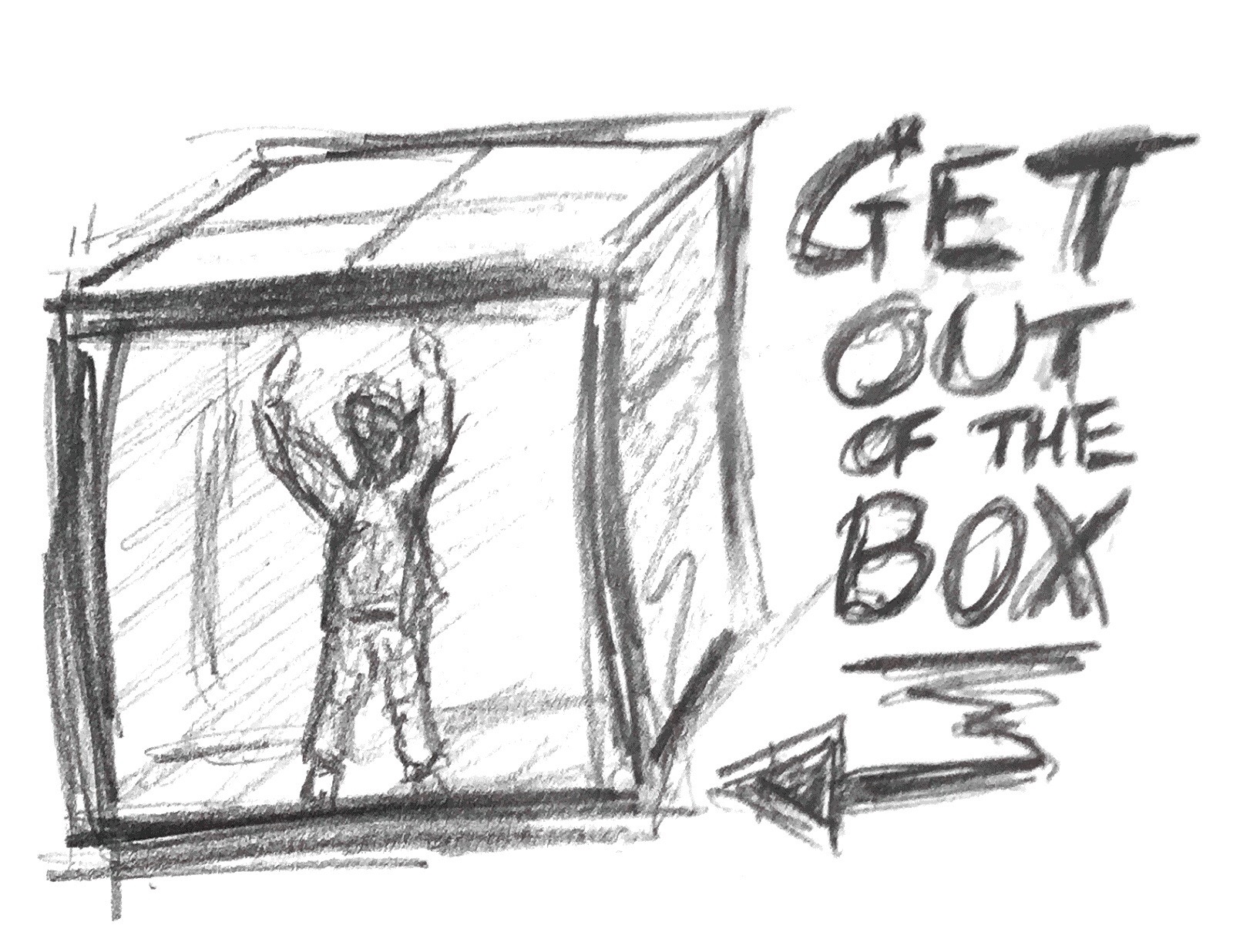
“Maybe,” she said. “Or maybe you’re in the box.”
Arjun stopped pacing. “In the what?”
“The box,” she repeated. “It’s what happens when someone stops being a person and becomes a problem.”
He frowned. “He is a problem.”
Kavya didn’t argue. “Tell me about your last conversation with him.”
“I was clear. Direct. I told him his work wasn’t up to standard. He got defensive immediately.”
“How was your tone?”
“Professional.”
“How did you feel?”
Arjun hesitated. “…Annoyed. Honestly, I was already fed up before the meeting even began.”
Kavya nodded. “That’s the box.”
He looked at her, irritated now. “So this is my fault?”
“No,” she said softly. “That’s the tricky part. When we’re in the box, we’re not trying to be wrong. We feel justified. Righteous, even. But we stop seeing the other person’s humanity.”
“He still behaved badly.”
“Maybe. But inside the box, something subtle changes in us. Our voice hardens. Curiosity disappears. We listen to reply, not to understand. The other person feels it — even if we say all the ‘right’ words.”
Arjun looked away.
“And then,” she continued, “they react to our coldness. They defend. They resist. They shut down. And we walk away saying, See? I knew he was difficult.”
The room fell silent.
“So it’s a loop,” Arjun said quietly.
“Yes. A self-fulfilling one.”
He sank into a chair. “I didn’t even consider what he might be dealing with. I just saw poor performance.”
“That’s the box,” Kavya said again. “He became an obstacle to your goals. Not a person with pressures, fears, or a story you don’t know.”
Arjun’s voice was softer now. “So getting out means… what? Being nice?”
“No. It means seeing clearly. You can still disagree. Still hold standards. But you do it while remembering — this is a human being, not a hurdle in my way.”
He exhaled slowly. “And if he’s in the box about me too?”
She smiled faintly. “Then someone has to step out first.”
Arjun sat with that. The anger that had filled the room felt smaller now — replaced by something heavier, but cleaner.
“Maybe,” he said at last, “I’ve been fighting a problem… instead of talking to a person.”
Kavya nodded. “That realization is the door out.”
In musing……. Shakti Ghosal
**
Acknowledgement: ‘Leadership & Self Deception: Getting out of the box’ – The Arbinger Institute
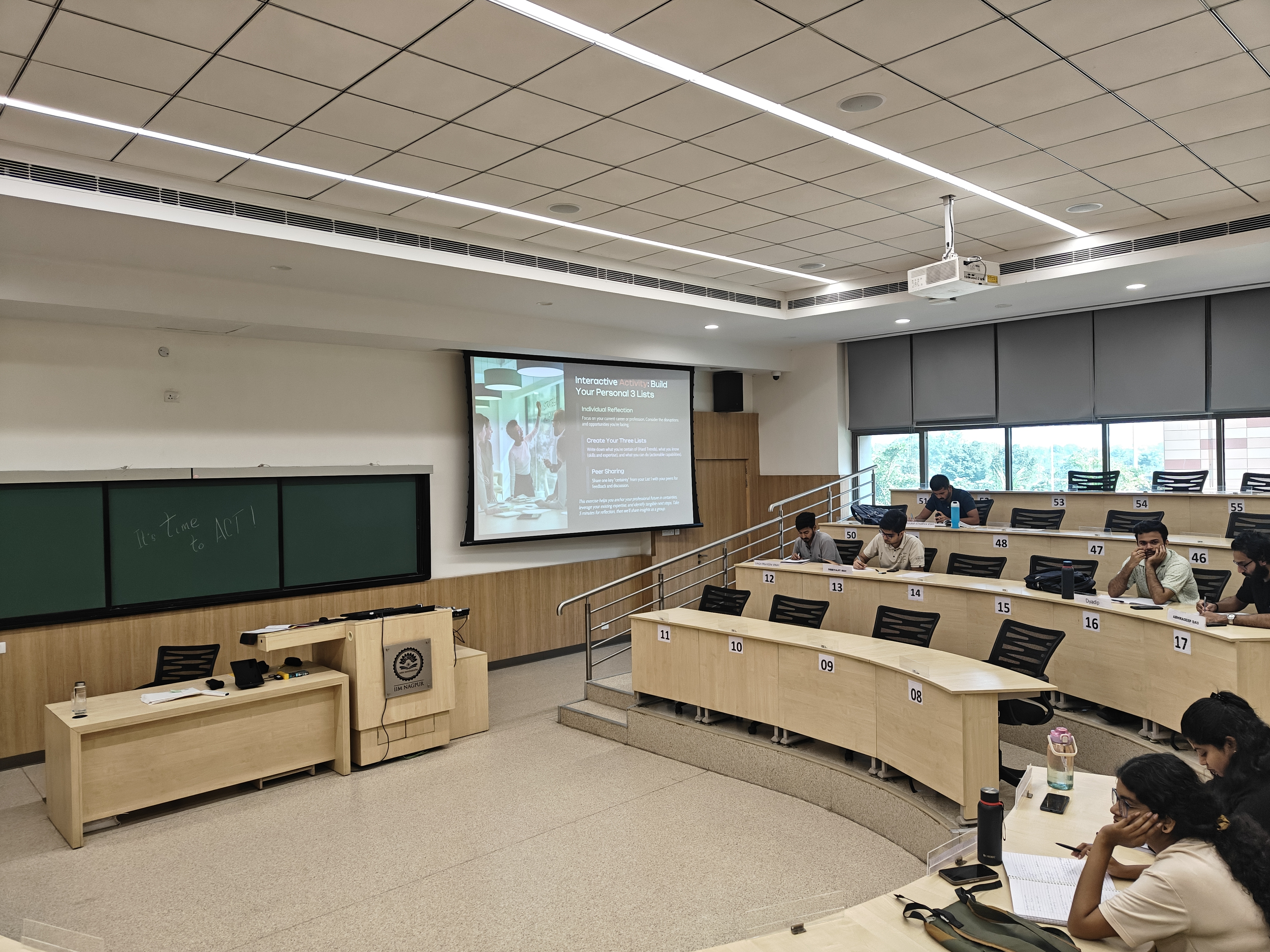
It was midway through my elective course “Winning in a Disruptive World” at IIM Nagpur last month when a student raised a question that momentarily silenced the class.
“Professor,” he began, “Elon Musk and Tesla seem to have anticipated the future before anyone else — electric vehicles, reusable rockets, large-scale battery storage. How does someone think so far ahead and act with that kind of conviction when others are still debating the probability of success?”
It was an incisive question — and one that went to the heart of what our course was about: how to win, not just survive, in a world defined by disruption.
The Disruptive Context
Disruption today is not an occasional storm; it’s the climate we live in. The rules of business are rewritten faster than most organizations — or individuals — can adapt.
In the course, we explored how the world has shifted from the VUCA paradigm — Volatile, Uncertain, Complex, Ambiguous — to what futurist Jamais Cascio calls BANI — Brittle, Anxious, Non-linear, and Incomprehensible. In such a world, the question isn’t whether disruption will occur; it’s whether we are ready to anticipate and shape it.
That was precisely what Elon Musk and Tesla managed to do — not by reacting to disruption, but by engineering it.
Tesla and the Power of Future-Back Thinking
When traditional automakers analyzed the electric vehicle (EV) opportunity, they saw it through the lens of probability. Their forecasts said adoption would be slow. Battery costs were high. Charging networks were inadequate. The “safe” conclusion was that the world wasn’t ready.
Tesla took the opposite route. It didn’t ask, What’s probable today? It asked, What’s possible tomorrow?
That question unlocked an entirely different trajectory.
Musk’s strategy exemplifies what I call Anticipatory Future-Back Thinking — a concept we explored in the later sessions of the course. It involves imagining the desired future state first — in this case, a world where sustainable energy mobility is the norm — and then working backward to identify what must be true today to make that future real.
Rather than extrapolating from today’s constraints, Tesla worked backward from a bold vision of tomorrow. That shift — from present-forward to future-back — is what differentiates disruptors from the disrupted.
Exploring Anticipatory future back thinking
Possibility vs. Probability: The Mindset Divide
When I turned back to my student’s question, I began with a simple observation.
“Most organizations,” I said, “plan from the present forward. They look at past data, run probability models, and make incremental improvements. That’s the Kodak way of thinking — safe, predictable, and ultimately self-limiting.”
In contrast, possibility thinkers — like Tesla — start from a future that doesn’t yet exist. They ask, What could be true if we dared to imagine differently?
Daniel Burrus, the futurist who first articulated the concept of Hard Trends, reminds us that the future is not entirely uncertain. Some aspects — technological evolution, demographic shifts, regulatory movements — are future facts. These are the certainties around which possibility thinking can safely operate.
Tesla built its strategy precisely on such hard trends:
The inevitability of climate change driving clean energy adoption
The advancement of battery technology and digital control systems
The regulatory momentum toward lower emissions
These were not probabilities; they were certainties in motion. Musk simply connected them into a coherent future vision — and then acted as if that future were already here.
From Disruption to Design
This is the essence of anticipatory leadership — not reacting to disruption, but designing it.
In my sessions, we discussed how the future-back approach allows leaders to create clarity where uncertainty dominates. It flips the conventional question from “What will happen to us?” to “What must we make happen?”
The difference is profound.
Present-forward leaders forecast the future.
Future-back leaders architect it.
McKinsey’s research on future-back strategy underscores that such leaders don’t rely on forecasts alone. They use scenario design to imagine multiple plausible futures and then work backward to identify strategic moves that remain resilient across them.
That’s what Tesla did: invest early in charging infrastructure, build direct-to-consumer distribution, and create software-driven vehicles that improve over time. Each move was part of a deliberate future architecture.
The Classroom Reflection
I recall telling my students that day: “Elon Musk is not successful because he predicts the future; he’s successful because he constructs it backwards.*”
In the classroom, this insight tied together much of what we had explored:
Hard Trends (what is certain) form the foundation.
The Three Lists (what I’m certain of, what I know, what I can do) create clarity.
Resilience sustains momentum when the future resists you.
Each of these steps builds toward the mindset of a possibility architect — someone who doesn’t wait for disruption, but wields it as a tool.
As the discussion deepened, another student remarked, “So Tesla wasn’t just lucky — it was structurally anticipatory.”
Exactly.
The Classroom reflection
Why This Matters Beyond Tesla
Every industry today — from energy and aviation to education and healthcare — faces its own “Tesla moment.”
In the energy sector, companies that waited for the probability of renewables to rise are now scrambling to catch up with those who invested early in solar and storage. In education, universities that anticipated the AI wave and reimagined learning around it are moving ahead, while others debate policies. Even in government policy, we see anticipatory thinking at work in projects like UPI and ONDC, where India intentionally designed positive disruption instead of waiting to be disrupted.
The principle is the same: the future belongs to those who can see differently, envision differently, and execute differently.
A Call to Future Architects
At the end of that class, I offered the students a reflection that I’ll share here too.
Winning in a disruptive world doesn’t mean outpacing change — it means aligning yourself with the inevitabilities of tomorrow and daring to act before others see them as obvious.
Elon Musk’s brilliance lies not in foresight alone, but in the courage to build on the certainties he could already see — however faintly — and to commit resources to them before anyone else believed.
For leaders and managers today, the lesson is clear: Don’t ask, What’s probable? Ask, What’s possible — and what must I do today to make it inevitable?
Closing Reflection
As we wrapped up the session that day, I noticed a quiet shift in the room. The students weren’t merely intrigued by Tesla anymore — they were reflecting on their own “future-back” opportunities.
That, to me, was the real win.
Because when young leaders begin to think like architects of the future rather than survivors of disruption, they start embodying the very mindset our world now demands — one that balances imagination with foresight, vision with action, and optimism with resilience.
And perhaps, in some classroom somewhere, the next Tesla is already being imagined.
Frank Marinko and myself, both international Executive Coaches and Facilitators, grappled with this question using the critical thinking methodology, in a joint podcast. You might enjoy the discourse and the podcast link is given at the end.
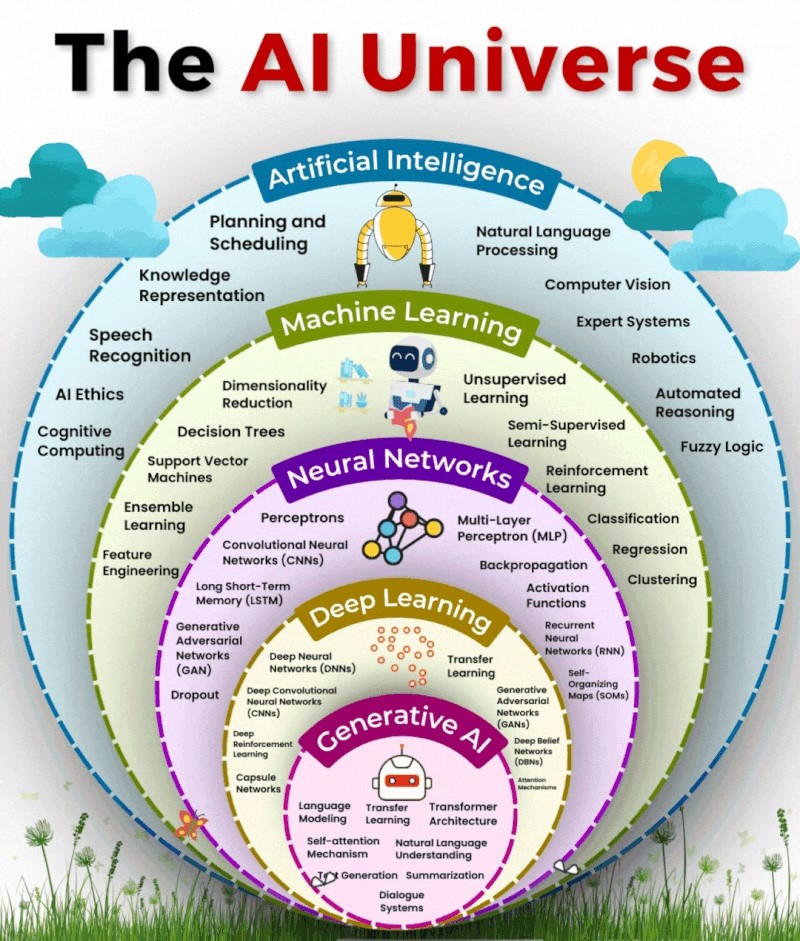
If we are to deliberate on this question, we need to get to the essence of two aspects mentioned. First, AI or Artificial Intelligence as we call it. Second, ‘to lead’ which is all about Leading or Leadership.
So, what really is the essence of AI? That lies in its ability to mimic and augment human intelligence and decision-making processes using computational algorithms and data. At its core, AI systems can analyze vast amounts of data, recognize patterns, infer relationships, and make predictions or recommendations.
The important aspect to be kept in mind is AI’s ability to ‘learn’, its adaptability and the ability to improve over time. Machine learning algorithms, for example, can automatically adjust their behavior based on new data, allowing AI systems to become more accurate and effective with experience.
And when we think of the essence of Leadership, it is really all about envisioning a future which speaks to all stakeholders by addressing their concerns or satisfying some needs. Leadership thus involves directing and coordinating the efforts so that the full potential and collective success can be realised.
With the dawn of computers seven decades back, Alan Turing had considered the question, ‘Can a machine think like a human?’ and came up with a test now known as the Turing Test. With the advent of AI, several Artificial Intelligence programs have already passed the test. The purpose of this question seems to be a deep-down threat to our unique ‘leadership ability’ that we see emanating from AI. There are concerns that AI will not only start doing complex and decision-making tasks replacing humans but in the long run go beyond human controls and frameworks.
This idea of technological obsolescence where technology renders humans obsolete, and takes over most of human jobs and work, is a concern that has been raised in discussions about AI and automation. However, we humans have creativity, empathy, intuition, adaptability, and the capacity for complex moral reasoning, which are integral to many aspects of work and life. These qualities enable humans to excel in areas such as innovation, problem-solving, interpersonal relationships, and above all Leadership.
The idea of AI achieving consciousness is another topic of much speculation and debate. Consciousness is a complex and still poorly understood phenomenon, and whether AI can truly achieve it is uncertain. Even if AI were to achieve consciousness, the process of its development would likely still involve human input and guidance. AI systems, as they exist today, are created, and trained by humans, and any future developments in AI consciousness would likely follow a similar path.
However, it is worth noting that AI can already exhibit forms of “thinking” and problem-solving that are quite different from human cognition. Machine learning algorithms, for example, can process vast amounts of data and recognize complex patterns in ways that humans cannot.
Whether AI should create its own thinking framework independent of human influence is a philosophical question with no easy answer. It raises issues of autonomy, control, and ethics. If AI were to develop its own thinking framework, it would still need to start and remain ‘biased’ by frameworks that align with human values and approach. It thus seems that in the foreseeable future, Humans would continue to lead AI, leaving aside the esoteric visions of the Matrix and Terminator movies.
To effectively lead AI development which would synergise with human development, adherence to principles such as transparency, fairness, accountability, and human-centered design would be needed. We would then be able to harness the full potential of AI while minimizing harm. These principles should serve as guardrails rather than roadblocks, helping to steer AI development in a direction that aligns with human values and promotes the common good.
We were engaged in a MENA region Business expansion consultancy project for a client organisation (name withheld) in Dubai. Being time bound, our team was depending on the client for getting certain ground assessments and data to do a competitive audit and recommendation set.
Interestingly, the common refrain by the client personnel was that the competitive situation was shifting fast in terms of relative importance and data points. It was thus difficult to provide accurate ground assessments.
One day over coffee, I got to discuss about the Business implementation with Darius, the Business Development Manager responsible for the project.
“In your view, what is the kind of Leadership needed for successful implementation in our kind of fast changing environment?” Darius asked.
“And where would you like to see Leadership being exercised in your kind of situation?” My response was a return question.
“Well, I suppose leadership needs to ‘lead’ us from where we currently are to where we are proposing to be”, replied Darius.
I could not agree more. Leadership indeed needs to reside in the gap between one’s current state and the state one aspires for. But then how does Leadership set the organisation on the right pathway? In today’s increasingly disruptive and discontinuous world, the luxury of a fixated, ‘past experience driven’ journey with a visible future at the other end, is no longer available. If at all, present times require the ability and mindset to get off that beaten path and into the unknown forest area, so to say.
I said as much to Darius.
As if reading my thoughts, Darius asked, “So what might be the leadership mindset needed to eke out a new path through the forest trees you spoke of?”
“That is a great question”, I acknowledged. “I can think of one. Which I would term as ‘your comfort with ignorance’. You need to be comfortable with the knowledge that you ‘do not know’. Only then will you able to unearth and visualize new possibilities. Without this there can be no growth in a disruptive world.”
Somewhat later, when I sat thinking about our conversation, two other aspects came to mind.
First, a mindset to accept failures. We need to accept failure as an intrinsic part of who we are. In an uncertain world with no past experience to guide us through the discontinuity of the ‘forest trees’, it is only mistakes and failures which become the building blocks of eventual success.
Secondly, a more controversial but nonetheless critical ability to wear a ‘mask of yet to be internalised behaviours’. We need to fake the needed leadership behaviours, if necessary, before they become an intrinsic part of us.
I would like to term the above as the CAM mindset shift, to use an acronym.
Comfort with ignorance
Acceptance of failure
Mask yet-to-be internalised behaviours
So how might you grow your leadership in today’s disruptive worl
Do you remain dissatisfied and uncertain about how to face emerging situations and challenges in today’s fast-changing world?
Do you frequently get the sense that however hard you or your team are trying, there seems to be always someone ahead of you and winning?
As you resolve a problem or a challenge, do you get confronted by fresh ones?
Are you frequently unable to prioritize which problem to tackle first?
However much you strive, are you unable to see the big picture and align yourself and your team with that?
….. And on a more personal level:
Do you want to get that job or assignment that you have been trying?
Do you want to get that promotion and recognition you have been aspiring for?
If you have been plagued by one or more of the above questions, the Winning in a Disruptive Worldprogram might just be what you need to improve your winnability quotient in today’s world.
The fact is that our present world is constantly getting disrupted. By new technologies, new competitors, or other factors that can disrupt traditional business models. The disruptive world with its VUCA (Volatile, Uncertain, Complex, Ambiguous) characteristics allows us to reside in a significantly narrow band in the present with a hazy and uncertain future in front and the inability to take recourse of our past experience.
Conceived and developed based on workshops and programs conducted for leading organisations and Business Schools, the course showcases the major types of disruptions that are shaping the world. You, as the participant, would gain an insight into what leads to us getting disrupted. You would review the process followed by a probability-based mindset and the need to shift to a possibility-based mindset to be able to better handle disruptions. You would practice and gain proficiency in the five action steps for the needed shift by conducting in-depth Inquiry through a structured process.
Creation of a context by using hard trends in three areas.
Creation of the three lists.
‘Plug into the future’.
Relational assimilation through a triad of competencies.
Moolya Foundation is a global non-profit organisation with an aim to bring greater inclusivity in public affairs through digital leadership.
The mission of Moolya Foundation is to expand the conversation surrounding public affairs and empower every citizen in the digital age where marginalisation of the common people is fast growing.
To abridge the socio-economic, political and information inequalities in digital societies, Moolya Foundation envisions creating future leaders in public affairs who shall be at the forefront to represent the interest of the common people.
Do see this first part of my freewheeling session with Neha Gour of Moolya Foundation in which we discuss ‘Is Digital Leadership a Skill or a Mindset?’ As happens at such times, The Chronicler of the Hooghly also gets discussed!
How could we use the current pandemic experience to develop a COVID 19 Warrior Leadership mindset?
A Do-It-Yourself program.
We are currently witnessing a level of Uncertainty from the COVID19 situation that none of us have faced in our lifetime. There is no past experience relating to such a pandemic or for that matter anything else to guide us. So how do we negotiate the right pathway? How do we exercise leadership that is effective?
We, due to our innate survival instinct, follow a herd mindset. A mindset formed by what we read, what others are saying, the ubiquitous social media of today.
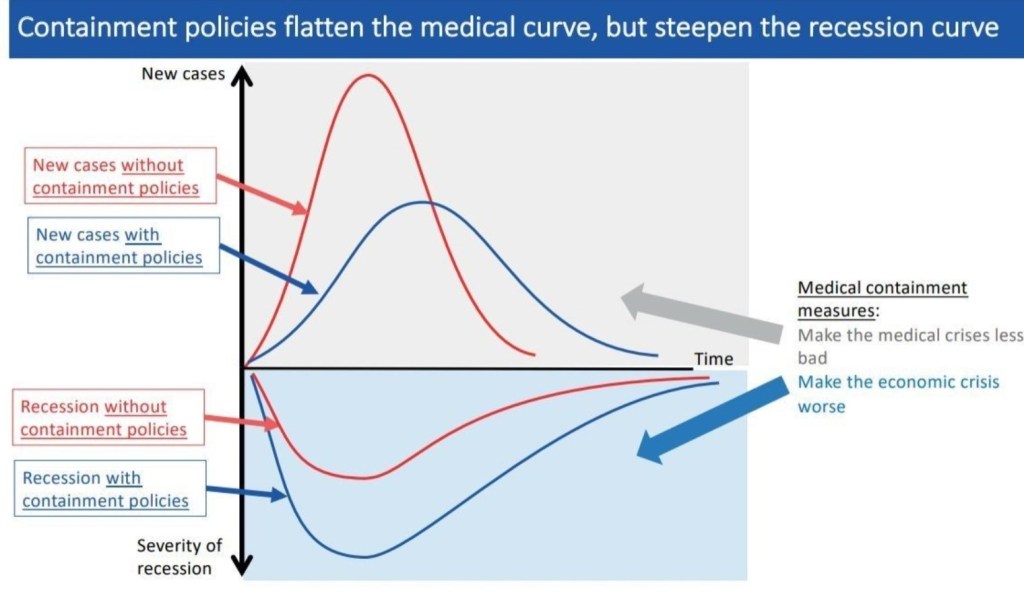
Our COVID19 pandemic mindset is thus wholly focussed on the containment strategies of the spreading viral infection, how to flatten the medical curve so to say and gain more time before we as a species could fight back using some vaccine under development. And nothing wrong with that.
Now let us talk of Leadership and effectiveness. What makes leaders effective is that they see, comprehend and thus engage with the same situation differently. As if they see and come to live in a different world!
The COVID19 warrior leadership would review the ensuing economic recession curves arising out of the containment strategy based infection curve and determine an optimal balance.
Let us now explore the effect of the COVID19 lockdown on the business and economic cycles. As we can see several links in the cycle would get disrupted and are shown by crosses in RED. The general mindset arising out of this would be to hoard, avoid spending and investments. All this would further exacerbate the situation!
A COVID19 warrior leadership in contrast would be visualizing new and innovative policies and funding methods to remove the prevailing blocks.
So what could you do to develop yourself so that you gain the ability to exercise a COVID19 warrior leadership effectively in an increasingly Volatile, Uncertain, Complex and Ambiguous world?
I give here some pointers. Should we mull over them to try and determine your thoughts and answers, you would be well on your way to becoming a COVID19 warrior leader.
Clarity about a future that others cannot yet see.How could you communicate this future simply without being simplistic?
Dilemma flipping: How could you turn dilemmas into opportunities?
Immersive Learning: Do you have the ability to learn in a first person way viz. ‘on the Court’ rather than ‘from the stands’ ?
Bio- Empathy: Could we inculcate the ability to see things from Nature’s patterns and use that wisdom?
Smart mob organizing: Do we have the ability to engage and nurture social change networks through intelligent use of electronic and other media?
How do you maximise your influence and impact in a fast changing environment?
A Do-it-yourself plan.
Some years back in my work life I came across an individual who for anonymity’s sake we will call Shib.
Shib was insecure and hankered for a leadership role as a way to get out of insecurity. At every opportunity he would showcase and ‘beat his drum’ about his past experience. He refused to accept that in the disruptive environment that the business was facing, experiential learning was ill suited to handle the situations being confronted.. More significantly the ‘All knowing, All doing’ defensive shield that had become his second nature prevented Shib from acknowledging that he might be lacking competences needed to engage with the situations. These two over time became a dangerous mix for an increasingly inauthentic and damaging behaviour with the guy resorting to his positional ‘Command and Control’ power more and more as the organisational performance nosedived.
What does use of positional power lead to? Like termite it starts to eat into the existing credibility and trust structure of an organisation which takes a long time to build. Once credibility starts getting lost, influence gets diminished and impact gets diluted.
The Shib Case study made me recall what Malcolm Forbes, the publisher of Forbes magazine, had once remarked:
“Those who enjoy responsibility usually get it, those who merely like exercising authority usually lose it”
In the increasingly uncertain and fast-changing business world of today, many of us may be falling into the ‘Shib trap’ of over- reliance on positional power without even realising it. We thus need to do a periodic dip-stick test to review our sphere of influence and efficacy of our impact. Should we notice operational zones exhibiting uncertain influence and impact, it could be time to take action.
So what could you do to enhance your influence and increase your impact?
To create a coordinated effort, you and your team members need to be accountable to each other in terms of tasks, actions and time lines. Ask this question of yourself:
‘Are you willing to be accountable to your team members about your performance as you would like them to be about their performance?’
Do you have a Learner mindset? Are you willing to discuss with your team the skills and behaviours you are developing for your own self? Are you willing to be vulnerable about yourself and your own need and efforts to improve yourself?
Do you personally invest in others? When things go wrong, are you willing to take a deep breath, desist from fault-finding but rather say to the team, “I know how stressed you guys must be feeling at this juncture!”
Are you willing to align ‘Who you are’ with what your team members perceive about you? To gain an insight into the extent of this alignment (or not), you may wish to see how many of these questions you answer as “YES”:
When you give space to others, do they see you as passive?
When you are compassionate, do your team mates see it as weakness?
When you display energy, do others see you as being pushy?
When you take a decision, do your team members see that as controlling?
Be willing to become vulnerable by asking your team members to tell you about what they perceive as your top three ‘bad’ areas. These could be aspects like Arrogance, Passive, Self-opinionated, Impulsive, Indecisive, Untrustworthy, Close minded, Impatience etc. In case they feel uncomfortable to tell you these on your face, it is okay to get this feedback anonymously.
Identify the top three negative characteristics that you embody in the eyes of team members and stakeholders. Then ask them these two questions for each of these characteristics.
“What is that one thing I could do that would stop me showing up as arrogant ( or impatient, untrustworthy etc) ?”
“What is that which I should stop doing that makes me show up as arrogant (or impatient, untrustworthy etc.) ?”
Leadership speaks to Stakeholder, “Let us stand in the created future that wasn’t going to happen otherwise. A future which would address the core concerns of both of us. Let us take actions and decisions now to realize the future.”
At its essence Leadership remains an exercise in language which motivates all stakeholders to align into taking actions in the present to realise a common future.
I was recently engaged in a hub optimisation project for an orthopaedics implant supplier. It did not take too long for our team to work out the optimum inventory positions of around twenty thousand items as part of fifty kits. We were delighted to note that our recommendations held the potential of reducing the inventory carrying costs at the hubs by up to seventy per cent. The client’s corporate team was equally elated.
I was therefore left disconcerted when a subsequent review revealed near zero implementation of the project recommendations and the associated cost savings. The Marketing team had effectively sabotaged the initiative. While the project criteria had been to ensure a 99% assurance of availability of all ortho kits, Marketing insisted that for its clients nothing below 100% was acceptable.
Looking back one could see that the project failed for its failure to identify ‘customer’ stakeholders like the Ortho surgeons and the hospital administrators and what might their pain points be.
Leadership in the new millennium is more about stakeholding than anything else. Today’s world is becoming increasingly granular. More and more individuals are jumping onto the technology bandwagon and getting networked with unknowable connections amongst them. And each of these ‘unknowable connections’ becomes a stakeholder with its ability to influence perceptions and thoughts.
Per Bak, the Danish Physicist, developed a theory of sand running through an hour glass. He concluded that while the sand pile seemed stable with a regulated sand flow, the pressures on each of the sand grains was constantly changing; the internal dynamics of the sand was complex, unknowable and could not be predicted.
The stakeholding world today is like that sand pile.It seems stable but in reality continues to shift in unknowable ways with instability being the only constant.
So how does one manoeuvre the unknowable, unpredictable quicksands of stakeholding? What can leadership do to ensure effective relational assimilation of all stakeholding concerns? You could make a good start with the following questions.
Who are your influencing stakeholders? They could be from your investors, your leaders, your staff, your customers, customers of your customers, your suppliers, your community, competitors, consumer groups, social media……. sounds daunting. doesn’t it? Well a good place to start is to observe the conversation networks and the language being used. Use this to discern the contradictions, conflicting ideas and harmonies that form part of the issue.
Ask of the identified influencing stakeholdersabout their interests and core concerns
What is the stakeholders’ critical analysis of the situation? How does the issue occur for them?
What solution hypotheses could you develop which could take care of the stakeholders’ interests and concerns?














 A New Beginning