“Did you read that piece I sent?” Arjun asked. Sameer frowned. “Who wrote it?”
“Why?” “Because that tells me everything.”
“So the argument doesn’t matter?” “Oh! it does matter,” Sameer said. “All folks who offer opinions always have an agenda.”
Arjun watched him quietly. “So we don’t examine the idea… we examine the person?”
Sameer shrugged. “Background. Bias. That’s how you know.”
Case closed.No thinking required. We like to believe we are rational. But most of the time, we are defenders, not thinkers.
Once a belief settles into the mind, it doesn’t stay a belief for long. It quietly becomes identity. And the moment that happens, any opposing idea stops feeling like information. It feels like an attack. Not on the argument. On us.
“Just look at the data,” Arjun said. “I already know the truth,” Sameer replied.That was the shift.His mind had stopped being a judge.It had become a lawyer. *Not asking, “What is true?”But, “How do I prove I’m right?”*
So the evidence hunt began: “I’ve read studies that agree with me.” “Experts support this.” “Your source must be flawed.”
And when facts refuse to cooperate? The mind does what skilled lawyers do. It bends them. Reframes them. Twists them — until they fit the story already believed.
“But you didn’t even consider it,” Arjun said. “I don’t need to,” Sameer replied. “I know the type.” That’s the final defense. If you can’t defeat the idea, discredit the person. “Who said it?” “What’s their background?” “What bias can we label them with?” Once a label is found, the argument is declared invalid. Comfort restored. Identity protected. This isn’t intelligence at work. This is ego guarding identity.
Psychology calls it confirmation bias — the tendency to search for evidence that supports what we already believe and dismiss what doesn’t. But deeper than that, it’s belief defense. The mind protecting its mental world from discomfort. Because being wrong doesn’t just feel incorrect. It feels like losing a piece of who we are.
Arjun said softly, “You know when real thinking starts?” Sameer looked at him. “When something challenges you… and you still choose to look.” A long pause. “That uncomfortable feeling?” Arjun added. “That’s the doorway most of us shut.”
Because growth never comes from defending what we already know. It comes from risking being wrong.
And in that small, silent moment —when we stop arguing and start examining — the mind takes off its lawyer’s coat…and remembers how to be a judge.
So we compress people into labels—rude, careless, incompetent.
And we expand ourselves into explanations—pressure, timing, constraints, intent.
This is the Perspective & Motivation Attribution Model.
From the outside, a person looks like a trait.
From the inside, a person feels like a situation.
Their one act becomes their identity.
Our one act becomes an exception.
Their failure becomes “who they are.”
Our failure becomes “what happened to us.”
And here’s the uncomfortable truth:
our reasoning is often not a search for what is true—
it is a search for what is forgivable.
The mind is not just a storyteller.
It is also a lawyer.
Wisdom begins when we offer others the same context, we demand for ourselves—
and hold ourselves to the same standards we casually apply to others.
So, what could be the road map forward?
Awareness is the start of moving forward. We start by noticing Perspective & Motivation in folks around us- through their articulations and behaviour. We then turn the searchlight onto our own selves. And we become observers of our own Perspective & Motivation afflictions…….
“In life, we meet two kinds of people—those who shine like the sun, radiating wisdom and energy, often challenging yet deeply inspiring; and those who, like planets, reflect borrowed light, offering comfort but little growth. Choice remains ours- whether we choose to orbit the suns, or chase reflections.”
Life is a cosmic dance, a vast expanse where we cross paths with many kinds of people. Some shine with their own light—bright, intense, and sometimes difficult to stand too close to. They challenge us, push us beyond our comfort zones, which might make us feel humiliated or insecure. However they do ignite sparks of transformation within us. These are the suns—radiant sources of wisdom, energy, and inspiration.
Then there are those who do not generate their own light but instead reflect the glow of others. Like planets orbiting a star, they offer comfort, familiarity, and predictability. Their borrowed light may bring temporary warmth, but it does not fuel real growth. They move in predefined paths, circling endlessly, never venturing beyond what is known.
The question before us is simple yet profound: whom do we choose to orbit? Do we dare to brave the brilliance of the suns, knowing that their intensity might burn, but also illuminate new possibilities? Or do we settle for the steady, reflected glow of planets, avoiding discomfort but also forsaking true transformation?
The Challenge of the Suns
Suns in our lives come in many forms—mentors who push us to excel, leaders who challenge conventional thinking, friends who demand authenticity, or experiences that shatter complacency. These forces can be unsettling, their intensity requiring us to adapt, to evolve, and sometimes to withstand discomfort.
Yet, it is from these sources that we learn the most. They force us to question our assumptions, face our fears, and tap into strengths we never knew we possessed. They inspire us to expand our horizons, to break free from the gravitational pull of mediocrity, and to blaze our own trails. As Kouzes and Posner (2017) suggest in The Leadership Challenge, transformative leaders create environments where individuals are encouraged to experiment, innovate, and grow beyond their limitations.
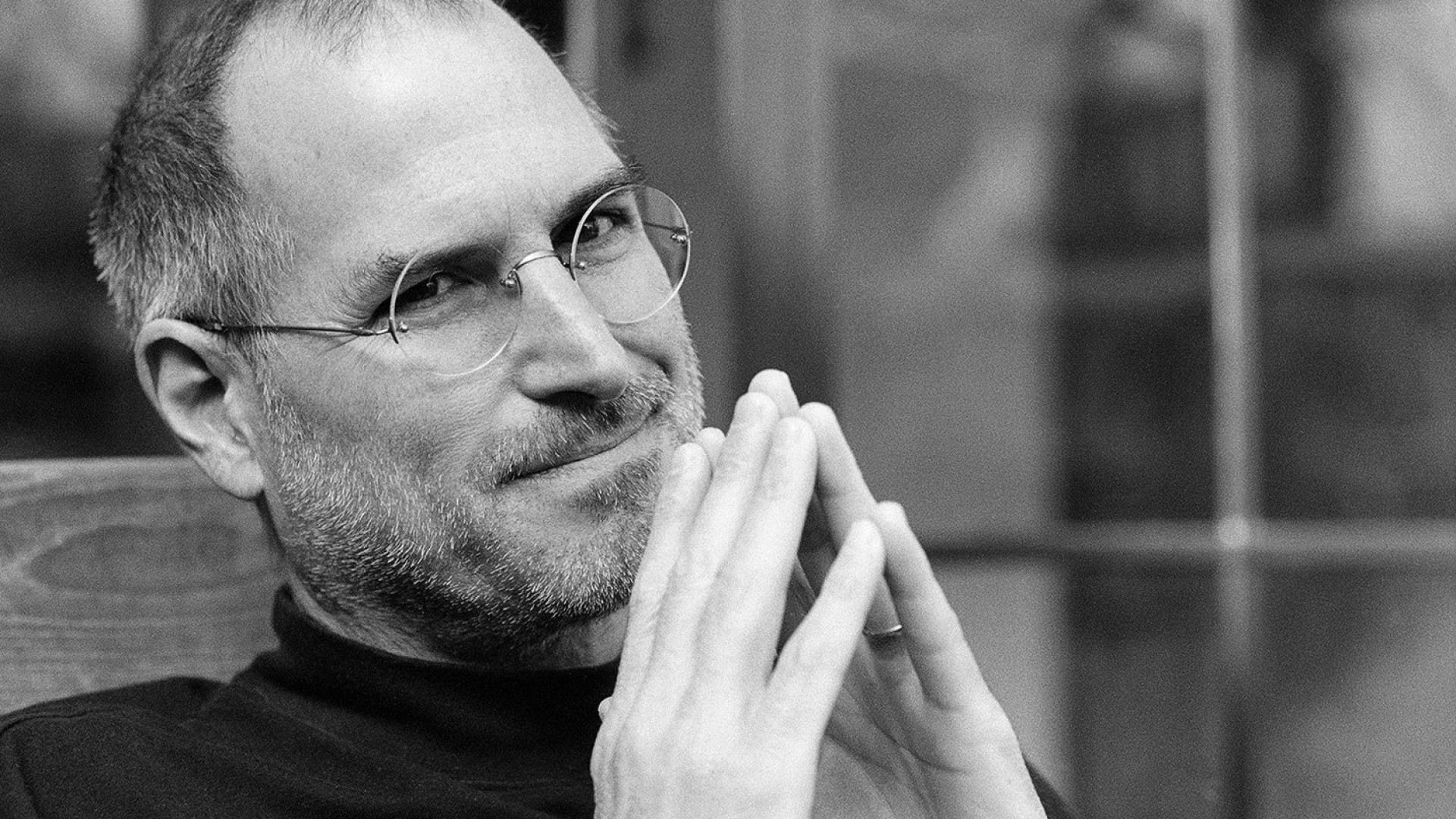
The Sun: Steve Jobs and the Apple Revolution
Steve Jobs was a quintessential “sun”—intense, visionary, and sometimes difficult to work with. He challenged the status quo, demanding excellence from those around him. Many who worked closely with Jobs describe the experience as transformative, albeit tough. His relentless pursuit of innovation forced others to think differently, step beyond their comfort zones, and achieve greatness. Those who chose to stay in his orbit were often pushed to their limits but emerged stronger, more creative, and capable of making an impact.
Lesson: Following the light of a “sun” can be difficult, but it leads to extraordinary growth.
The Comfort of the Planets
Planets, on the other hand, offer familiarity. They provide steady companionship, reassuring words, and a sense of belonging. Their presence is not without valuable— at times we do need the comfort of the known, the stability of routine, the ease of like-minded company. However, if we linger too long in their orbit, we stagnate. The pursuit of borrowed light may seem safe, but it rarely leads to personal evolution.
Consider the case of corporate career paths. Many professionals spend decades in the same organization, never venturing beyond predefined career trajectories. They are competent and reliable but do not challenge existing structures. Meanwhile, those who step outside their comfort zones—whether by switching industries, seeking disruptive mentors, or engaging in lifelong learning—often experience exponential growth. Carol Dweck (2006), in her seminal work Mindset: The New Psychology of Success, emphasizes the importance of a growth mindset—embracing challenges, learning from criticism, and persisting in the face of setbacks.
The Planet: The Comfort of Routine in Corporate Careers
Consider an employee who has spent two decades in the same corporate job, doing well but never pushing beyond the familiar. He is competent, reliable, and comfortable in his position. However, his growth is limited—he reflects the expectations of his environment rather than shaping it. While his job provides security, he misses out on opportunities to innovate, learn new skills, or challenge himself.
Lesson: Comfort is not always conducive to progress. Staying in the orbit of planets can lead to stagnation.
Making the Choice
There is no right or wrong answer—only awareness. There are times in life when we need the warmth of planets, moments of rest and reassurance. But growth happens when we dare to reach for the suns. It is in their radiance that we find our own light, forging our path not as mere reflections but as luminous beings in our own right.
The choice is ours. Do we settle for the comfortable glow of borrowed light, or do we embrace the challenge of the suns, knowing that their brilliance will shape us into something greater?
In the grand design of the universe, we are not bound to any orbit. We are free to choose our celestial path. The only question that remains is—where will we set our course?
The Choice: Malala Yousafzai’s Defiance of the Status Quo
Malala Yousafzai, a young Pakistani girl, had a choice—to accept the constraints imposed by her environment (where education for girls was restricted) or to challenge the norms. She chose to orbit the “sun” of enlightenment, education, and progress, even at great personal risk. Today, she is a global advocate for education, inspiring millions.
Lesson: Choosing to orbit the “suns” of wisdom and progress, even in the face of adversity, can lead to transformational impact.
Conclusion
The world is full of both suns and planets, but ultimately, we decide which forces shape our journey. The challenge is to recognize when we are merely reflecting light and when we are generating our own. Growth, transformation, and true impact come from stepping into the orbit of those who challenge us, inspire us, and push us beyond our perceived limits.
So, ask yourself—are you ready to seek the suns, even if their brilliance demands more of you? The answer will determine the trajectory of your life.
In Learning……. Shakti Ghosal
References
Dweck, C. S. (2006). Mindset: The New Psychology of Success. Random House.
Kouzes, J. M., & Posner, B. Z. (2017). The Leadership Challenge: How to Make Extraordinary Things Happen in Organizations. Wiley.
I had posted on a similar topic a couple of years back, but in a different context. It was based on an interaction I had with a participant in a workshop I had conducted then.
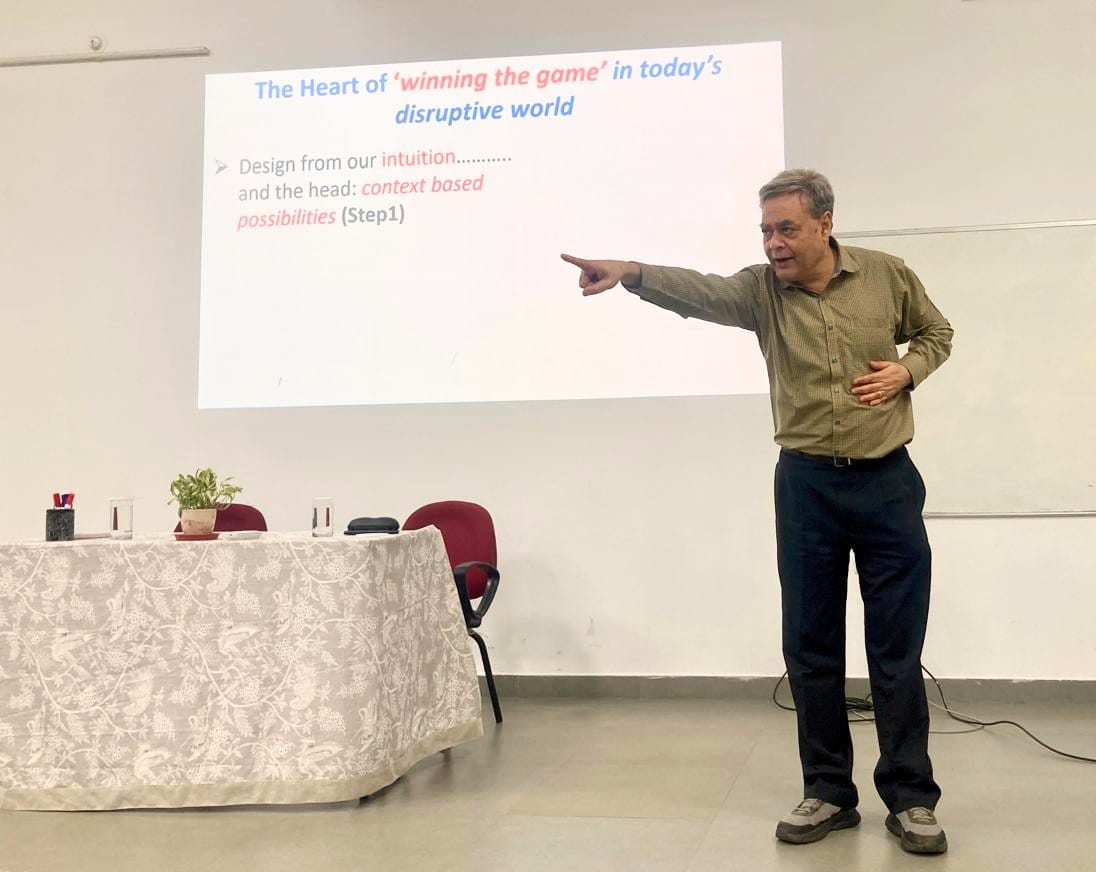
Interestingly, I was recently invited by the Goa Business School, Goa University to speak on the same topic. What we were really looking at is succeeding in an environment that is constantly changing and being disrupted. By new technologies like AI, new competitors, new business processes. The question for us was, ‘So what does one do to win?’
I related a story from my own professional life.
In a past assignment, I was managing a Travel & Destination services t company. One of our major customer accounts was the national petroleum development organisation and because of the large business quantum, we had an implant operation with a dedicated team. Our service and response levels were appreciated by the client.
As our contract period was ending, the company released a tender for a subsequent period. Believing the client was happy with us, we submitted our competitive offer in line with what we had done during our last successful bid. When the tender was finalised, we were shocked to know that we had lost. When we asked the client’s commercial team, we were informed that we had not complied with the technical terms of the bid. Going back to the drawing board, we found that in the tender document, there had been a small section requiring development and implementation of a Travel management Services, TMS in short, software as part of the client’s intranet, which we had not responded to.
Soon, we had the opportunity to bid against a tender released by the National Gas Company. We noticed that in this tender document too, there was a requirement of implementing a TMS software. This time we were careful enough to comply with the requirement by indicating our willingness to develop. But we again lost the tender! The winner was a competitor who already possessed a fully developed TMS module and had provided a live demonstration of the same to the client.
We had been disrupted. By a new technology, a new competitor, which together had disrupted our traditional business mode, a model which had worked well all these years. The world had shifted, the business need in the environment had changed and the earlier alignment which our company’s competence set had with the environment, had been lost.
**
In 1849, French writer Jean-Baptiste Alphonse Karr wrote, “plus ça change, plus c’est la même chose” which in English translates to “the more things change, the more they stay the same.”
The above perspective is possibly at the heart of why we get disrupted. The human mind loves continuity and certainty. These allow us to make sense of what we see as stuff we are familiar with, which our brain does using mind models based on our past experiences. But what happens when we are faced with something we have never encountered before? Our brains somehow try to force fit these unknown inputs into one of our mind models. Even though we remain unaware, this ‘force fit’ sense making process leads to the observed inputs getting distorted, some parts get amplified while others which do not fit, get discarded. Thus, when we probabilistically try to predict, often we fail and get disrupted.
The disruptive world allows us to reside in a narrow band in the present with a hazy and uncertain future in front and the inability to take recourse of the past. Thus to successfully negotiate we need to shift away from our usual probability-based mindset into a mindset of possibilities.
In the session I showcased certain action steps which would support us to do the shift.
I got around to explaining that the first Action step is to create a context for ourselves within our own domain through using hard trends in three areas viz. Demographics, Regulatory and Technology (DRT Context). The hard trends that we uncover become the framework of the context we are creating. Our context would allow us to view every situation in a particular manner.
At this juncture a participant asked for this step to be shown through a case study or live example. I elaborated using the example of the Aviation Industry.
Demographics: Major customer profile shift is occurring viz. growth of young budget traveller and the elderly. Communication technologies is leading to the decline of Business travel. Climate change is shifting the seasonality of leisure travel. Customer behavior is also changing, with short booking windows—often a week or two with fewer travelers making plans far in advance.
Regulatory: Climate change is leading to increased incidences of air borne diseases requiring changes in booking process e.g. Pre-flight testing, need for registration of previous and past travel etc. Technology is allowing airlines to have seamless connectivity within the travel ecosystem to increase demand + assist governments and regulators in creating worldwide / regional standards for hygiene as well as operations.
Technology: Integrated and contact less handling at the airport regarding access viz. boarding pass issual, traveller identification through eye scans, baggage check-in etc. Seat allotment keeping in mind traveler profile, past medical history etc.
Action Step 2 is about using our above created DRT context to make three lists. List of all that we are certain of, list of things we know, and list of things we can do. If we put in the requisite time to make the lists, new possibilities would start showing up for us, a reflection of our improved competence to shift into a possibility mindset.
Action Step 3 is about further sharpening the saw for possibility mindset creation. We do that by unplugging ourself from our present clutter and challenges, then plugging ourself into the future and then use the ‘hard trend’ context created in Step 1, the 3 lists of being certain, knowing and doing ability in Step 2 to do anticipatory & future back thinking through a structured enquiry.
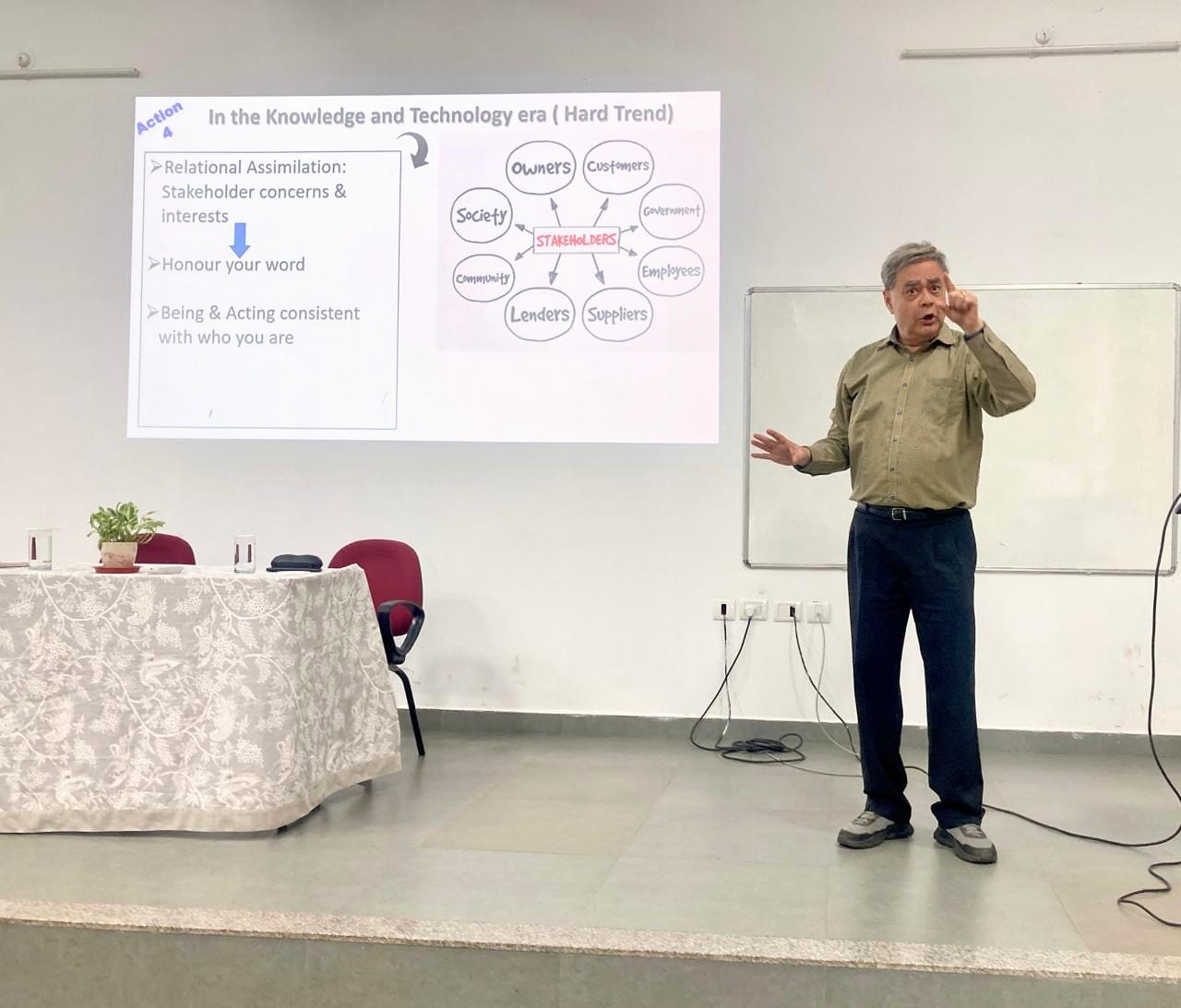
Action Step 4 is about Relational Assimilation which is identifying and defining groups relevant to our business and optimising the group boundary level interactions to advance our own interests. It thus is all about addressing stakeholder concerns. So, who are these stakeholders? They are wide ranging entities. Starting from the company Owners. Employees, who are the internal stakeholders to Customers, suppliers, our banks and financiers- our external stakeholders. But we also have environmental stakeholders viz. local community, society at large and the Government and regulatory authorities. Each of the stakeholders impact the organisation and ourselves in some way, some directly, others indirectly. To ensure effective relational assimilation, we need to exhibit certain qualities in our interactions.
Honouring or Integity of our word. Have we ever considered the fact that we are really equal to your word, nothing more , nothing less? We might see ourself as an individual with certain looks, qualifications, competencies etc. But to the outside world, we are perceived as our word. So, what is ‘Honouring our word’? This means keeping our word and as soon as we realize we are not able to do so, we need to inform all effected parties that we cannot keep our word within the time frame indicated earlier, offer a new time frame to do it and declare that we would take care of the consequences if any, of not keeping our word as per the earlier indicated time frame.
Can you see from what I just said that while it is not possible to keep our word under different situations, we can always ensure that we honour our word?
Being and acting consistent with who you are: This is all about being authentic. Bill George, former CEO, Medtronics and Professor of Leadership at Harvard Business School, concluded, “After years of studying leaders and their traits, I believe that Leadership begins and ends with authenticity.”
So how does one improve one’s own authenticity? Simply put, it is by being authentic about our inauthenticities’. We need to be publicly authentic about our inauthenticity with those around us for whom this inauthenticity matters.
Listening with no intention, no judgment, no Right or Wrong:. This is called Active Listening. A special kind of listening that we use to allow the speaker to articulate his or her own strongly held positions, views, rationalisations, justifications and unexamined beliefs. When we engage in active listening, we do it without colouring our own mind with our own intention, own judgments and our own views about what is being said being right or wrong. You could start with practicing active listening once a day and then slowly increasing the number till the trait becomes part of you.
As you make Integrity, Authenticity and Active Listening part of your repertoire for dealing with your stakeholders, you will see the significant upswing in empathy, respect and trust in your dealings. Action 4 is thus the catalyzing agent to ensure the achievement of the action steps you had created based on the first 3 actions.
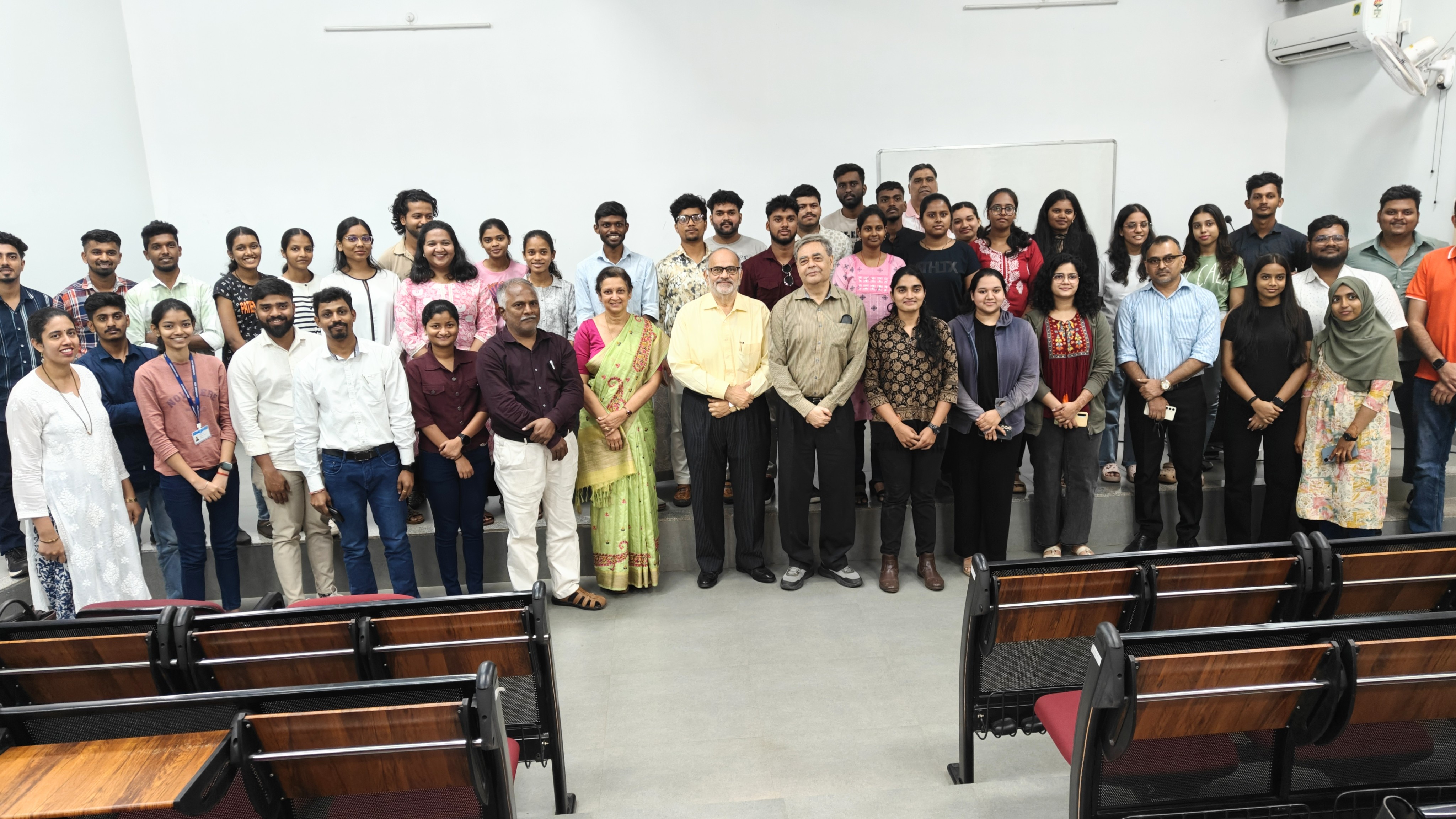
With the participants
**
In the ultimate analysis, Winning in a disruptive world is all about that ability to See, Comprehend & therefore Interact with life (and situation) differently than most people do. ‘Winners of a disruptive worldSEE….and come to live in a different world.
“The ability to observe without evaluating is the highest form of intelligence” – Jiddu Krishnamurti
Some years back, I did a course on Mindfulness. I did it more out of curiosity. The course turned out to be significantly experiential in nature, involving several practices.
So what is Mindfulness? At its core it is the practice of paying attention to the present moment with openness, curiosity, and without judgment. It is about being ‘in the moment’ with awareness of where one is, what one is doing. As one practices this, one reduces one’s reactiveness or being overwhelmed by situations, circumstances, and people.
When I think back, I realise that my first exposure to and experience of Mindfulness and intervention based on it was more than20 years back. I had participated in a week long “Art of Living” program. The essence of the program was a routine which consisted of ‘Pranayam, Bhrastika and Kriya”. All these practices were essentially breathing routines, heightened awareness of the flow of breath and culminating with a body scan. While it had not been mentioned then as being a Mindfulness practice, I realised subsequently that it was so.
After I started practicing Mindfulness through the Art of Living routine, I did start noticing a higher level of energy through the day as also being more at peace with my situation. By God’s grace, I have been able to avoid chronic health situations like hypertension, stress related ailments etc. I somehow sense that one of the contributing reasons for my being able to maintain good physical and mental health has been my continuing the practice of Mindfulness as elaborated above.
In a recent ‘Mindset Matters’ podcast, Executive Coach Frank Marinko and I had a lively conversation about what ‘Mindfulness’ is and its impact.
As I thought about this question, a workplace experience from the past showed up. In my first job, I was an Assistant Mechanical Engineer in an Electric Diesel Locomotive maintenance workshop of the Indian Railways. I seemed to be confronted with disparate and multiple problems like dirty work bays, breakdown of machines, the workers’ trade union raising different kinds of demands, and so on. As I tackled one issue, other workplace crises seemed to occur elsewhere. I was always firefighting with disparate problems with no overall improvements in terms of productivity and output.
Over time, I became demotivated with ‘loser mindset’ thoughts which kept circling in my head. These thoughts were like ‘I am doing the best I can’, ‘No point in trying hard, nothing will change’, “I have a wrong boss, bad subordinates’… and so on. A kind of workplace lethargy set in, a laziness to try newer ways and the unwillingness to get out of the rut.
My mind shifted during a footplate inspection when I experienced firsthand the problems faced by the travellers from locomotive failures. A context got created in my mind, ‘When we don’t operate timely schedules, people’s lives get effected’. As I brought this perspective as an overarching vision for myself, my day-to-day work focus, the language I would use, my handling of situations changed. I felt more energy flow, motivation, and excitement. What was more remarkable was that my team started aligning itself with the overarching vision. My passion seemed to be seeping into them as they perceived that the actions were also addressing their own concerns.
As I think back, I can say that what can motivate us most is our ability to create an overarching vision which excites and pulls us towards goal achievement as more and more stakeholders start seeing the vision meaningful, relevant, and addressing their own concerns.
Recently, in a ‘Mindset Matters’ podcast, while discussing the above subject, we came to a counterintuitive and interesting perspective that the sheer act of encouraging someone else can lead to our own selves being encouraged and motivated to achieve our own goals.
Should you wish to listen to the podcast, do DM me and I would be happy to send the link.
Some years back, I had a Divisional head join the team.
The guy had impressed the recruiting board with his talk of ‘track record’ and ‘ideas’ about how he planned to transform the business. When I got around to have a chat with him, he seemed to be all humility and spoke of his own self development through working and learning from me. But several subsequent events seemed to indicate that at the sniff of a challenge, his self-serving shield would go up, a lot of talk about blaming the environment and others in the team would emerge but not much action on the ground. In the meanwhile, the company kept losing competent and productive staff as well as customer accounts; his oft repeated declaration about ‘brickwalling’ them did not seem to be working.
To me it appeared that the Divisional Head did not know what he was working to develop; he was definitely not working on his own leadership. When I again had a chat with him, what came up were several blames. ‘That he had not bargained for the kind of work he was now being expected to do.’ ‘That I was failing to support him adequately.’ ‘That he was stuck with incompetent team members.’
In a nutshell, the job stank, I as the boss stank and the team stank! I did not have the heart to ask the guy that if the world all around stank, could it be that he himself was the problem?
How many of you have faced a similar situation at the workplace? If you have, have you wondered what one might need to do to transform the situation?
The world can shift when one shows up with authenticity and with humility.
Transformation:
When we see ourselves as the problem, we can be the solution too. We need to spend more time working on our own selves rather than trying to fix others.
Do we have the expectation that our team members should be the harbinger of good news and developments? We need to lower that expectation.
Empathy is a strong word; being empathetic is easier said than done. Nonetheless we need to practice putting ourselves in the shoes of others and seeing the world through their lens.
Gain the realization that others do not really humble us; we humble ourselves.
Show up as a servant leader. A leadership style that enables everyone in the organisation to feel empowered and thrive fearlessly as his / her authentic self.
Say ‘Thank you’ to three persons in a day. Look them in the eye and be specific. If someone is not around, send a thank you email or Whatsapp or make a call.
It was an economic downturn period with the attendant business concerns. In a management strategy meeting, team members were called upon to offer suggestions about how they would wish to ring fence one’s customer accounts, sustain revenues and margins, bring down expenses and so on. I got the sense that the participants were merely sticking to the safety of what we had been doing in the past; no creative suggestions were forthcoming. It seemed to me that in a perceived environment of insecurity, no one was willing to stick his / her neck out. All were hesitating, waiting to do what they would be told.
This set me thinking. Could it be that my seeking suggestions of what each team member plans to do in an adverse situation was being viewed as appraising and judgmental? Could it be that my stance smacked of arrogance, that I was putting others in a spot but was not willing to commit myself?
In a follow-up meeting, I decided to orient the conversation differently. Prior to the meeting, I sent a note to all participants inviting them to come into the meeting with an answer to a simple statement and a question:
You would like to ask me about _______________
What suggestion do you have about what I need to do?
The response was surprisingly overwhelming this time. Everyone chipped in with their frank assessment and the feedback I received were ‘I needed to be more of a team player, needed to be more accountable for team efforts’ and so on. Moreover, one could sense a renewed level of energy and vigour in the team’s declarations.
I thanked all for their frank inputs and avoided giving any explanations.
When later I thought about what had happened, I sensed that it all came down to my practicing humility in the meeting with vulnerability and the willingness to listen and learn. Without knowing it, I had shown up as a ‘Servant Leader’.
In ‘What Is Servant Leadership? A Philosophy for People-First Leadership’, author Sarah K. White, CIO says, ‘Servant leadership is a leadership style that prioritizes the growth, well-being, and empowerment of employees. It aims to foster an inclusive environment that enables everyone in the organization to thrive as their authentic self. it helps create a “psychological ethical climate” that allows employees to be authentic and not fear judgment from leadership for being themselves.’
Humility begins with authenticity. And the pathway to the practice of authenticity begins with ‘being authentic to your own self about your own inauthenticities’. This pathway has no end, it is the journey that we need to enjoy.
If we are not careful, a leadership role has this nasty tendency of making us arrogant. “I am a leader because I am better. I know what is good for the team, so it needs to be my way or highway” is the kind of thought that can sometimes circle inside us. And such thoughts manifest in our conversations and actions.
A way to grow one’s Leadership is through introspection. One needs to look back into one’s past and identify all that which contributed to one’s Leadership and performance development.
This may sound easy but it is not. As we move through work responsibilities and the corporate hierarchy, we tend to develop our own plethora of ‘what we believe made us succeed’ mechanisms consisting of inauthentic facades, assumptions and ‘need to impress the other guy’ behaviours. We also hone our survival instincts. So, when we do get down to ‘looking into our past’ and identifying all that which contributed to our development and growth, we tend to see stuff distorted by our facades, beliefs and impress the-other-guy behaviours.
The way to grow one’s leadership through introspection is to do the following practices.
Ask yourself, ‘Who were the people who changed you?’
When I thought about this question, I could identify two individuals.
The first was a senior colleague at the start of my career as an Assistant Mechanical Engineer in the Indian Railways. The quality that my colleague brought into our relationship was one of sunny optimism and a natural instinct to mentor without a self-serving mindset.
The second was my boss in Voltas Ltd, where I was handling HVAC projects. The quality that he brought into our relationship was one of down to earth openness and transparency.
I realise today that what allowed me to grow through the above relationships was to try and inculcate a non-self-serving mindset as also authenticity through openness and transparency.
Ask yourself, ‘What kind of people did you gravitate towards?’
When I thought about this question, I could again identify two individuals.
In my tenure in the Indian Railways, I had two workshop foremen report to me. The first was a kind of a ‘yes man’ guy. He made me at once comfortable through his unquestioning loyalty; he would do exactly what I asked him to. This was a great relationship for maintaining status quo about situations and other stuff.
The second was a guy who was a ‘shop floor rebel’. He would usually give a counter viewpoint to most stuff I would suggest, and at times speak uncomfortable truths based on his own past experience and arguments. I would often ‘see’ his approach as unwillingness to accept my authority or trying to prove me wrong. I would feel upset.
This did not seem to be the kind of relationship I would be comfortable with or gravitate towards at that point in time. But I realise today that the person who allowed me to grow was this ‘rebel’ guy as he shattered my comfort zone and forced me to look at uncomfortable possibilities.
So how might you grow your leadership in today’s disruptive world? How might you foster such growth in your team members?
Gain mastery about how to succeed in a business environment that is constantly changing and being disrupted. Do this free module:
The reign of the dinosaurs had long ended. Snuffed out by an unlikely asteroid strike. A fifteen kilometers wide piece of Iridium laced rock had struck near present day Mexico, creating a ten times wide crater and unleashing lava, ashes, smoke and gigantic waves around the world.
Though the mass extinction event exterminated most of the flora and fauna on the planet, the continental drift and shifts continued unhampered for millions of years thereafter. The active planetary crust led to the Indian land mass smashing into the Eurasian land plate. The resulting crumpling and buckling at the collision point led to what came to be known as the Himalayas, a veritable abode of the Gods, the tallest mountain range in the world. An awesome creation standing testimony to Earth’s inner energies.
The permanent glaciers and ice formations led to glacial water bodies being formed. This is how the lake came into being. Situated at a height of 18,000 feet within the mighty Himalayan range, the lake acquired a mystical aura for all men and religions who passed by. The waters remained mostly frozen due to the height and the overwhelming presence of the Dongmar glacier which nestled it. Thirsty men and animals could not quench their thirst. And so it came to pass that a Guru was passing by when he too felt the mystical aura of the lake. He put his hand in the lake and Lo and behold! The water stopped freezing and became available for all to quench their thirst. This subduing of the Dongmar glacier’s frozen might by the Guru gave the lake the name of Gurudongmar. The second highest lake in the world with water that no longer froze.
**
The Man was indeed getting on in years.
As a child, he had been precocious and so had been nicknamed. ‘Buro’, an old man. He was now precisely that, replete with the mindset of the elderly. Over the years, he had acquired a liking for travelling and seeing the world. Age had dimmed the eyes somewhat, but not that inner passion to set forth and discover new places.
When the Man first heard about the wondrous lake of Gurudongmar, his heart urged him to travel. His brain though was more circumspect; it counselled, “My dear chap, are you crazy? You suffer from vertigo. What might happen when you go up all those torturously winding roads?” His friends too cautioned; they related dire tales of folks collapsing from lack of oxygen in a no-Man’s land with medical facilities hard to come by.
“But when a Man makes up his mind, he is not made for defeat. He can lose out, even destroyed, but not defeated.”
The tug of war between thoughts continued. But the die had been cast, the travel plans stood finalised. Came the day of travel and the Man set forth armed with some basic medications, a quiet resolve and some raucous misgivings. A flight, several car rides through mountainous roads into the Himalayan kingdom and the day of reckoning arrived.
“This was not the time to think of what was not there. It was the time to think of what one could do with what was there.”
Six in the morning and after nursing a cup of hot tea, the Man set forth for his rendezvous with the lake.
The slow wafting mist seemed in perfect harmony with the biting chill outside the moving car.
Passing through the last army check post, the vehicle climbed to the Kala Pathar, black stone viewpoint.
The fresh snow from the previous night lay in gay abandon. The white mist drifted upwards, a curtain rising up from the snow flakes and into the low hanging clouds.
As the old man stood watching the shifting views of the Kala Pathar blackness through the whiteness of the entwining gaps in the mist, it seemed like a ballet being performed. Was it the Universe sending him a message of hope?
“Every day is a new day. It is better to think it would be lucky. So when luck does come, one would be ready.”
The climb towards the lake had begun. It was not on roads cut out on the mountainsides which the man had been used to. It was on a rising terrain with no roads or markings to provide a direction. It was all down to the driver and the vehicle, their combined experience and strength to negotiate the path.
And then, all of a sudden, the heavens opened up. Sunbeams splayed and sliced all around. The climb had now reached above the level of the clouds and mist, a surreal moment. The old man nibbled on slivers of ginger; he had been advised so by some friends. A final swerving climb over barren rocks and the vehicle stopped on a mound from where the lake could be seen.
The stillness of the blue waters seemed to beckon. ‘Come, partake of my mysticism.’ The sun shone in all its splendour. Was it trying to discover that mystical aura with all those reflections? At the far end of the waters, part shrouded by rising mists, towered the snow laden glacier. As the old man stood transfixed by the wondrous surroundings, the tug of thoughts took over. Was this the place where divinity was born? What made the pristine barrenness so unworldly? Was it the glacier with its whiteness, or the water with its blueness?
A needle pricked the cheek. Then some more. Shaken out of his stupor, the man looked around. The hitherto gentle breeze had gained in strength. Crested by a whirlwind, tiny pebbles and dust particles chased each other in an ethereal dance. As the needles borne by the wind swayed through the onlookers, a soft murmur of protest could be heard. The old man slowly turned and moved back towards the waiting vehicle.
In Learning…….. Shakti Ghosal
Disclosure: The Old Man in the post is the author himself.
Acknowledgement : ‘The Old Man and the Sea’ by Ernest Hemingway












 A New Beginning