To get commitment from one’s team towards achieving a common objective is a Leadership fundamental.
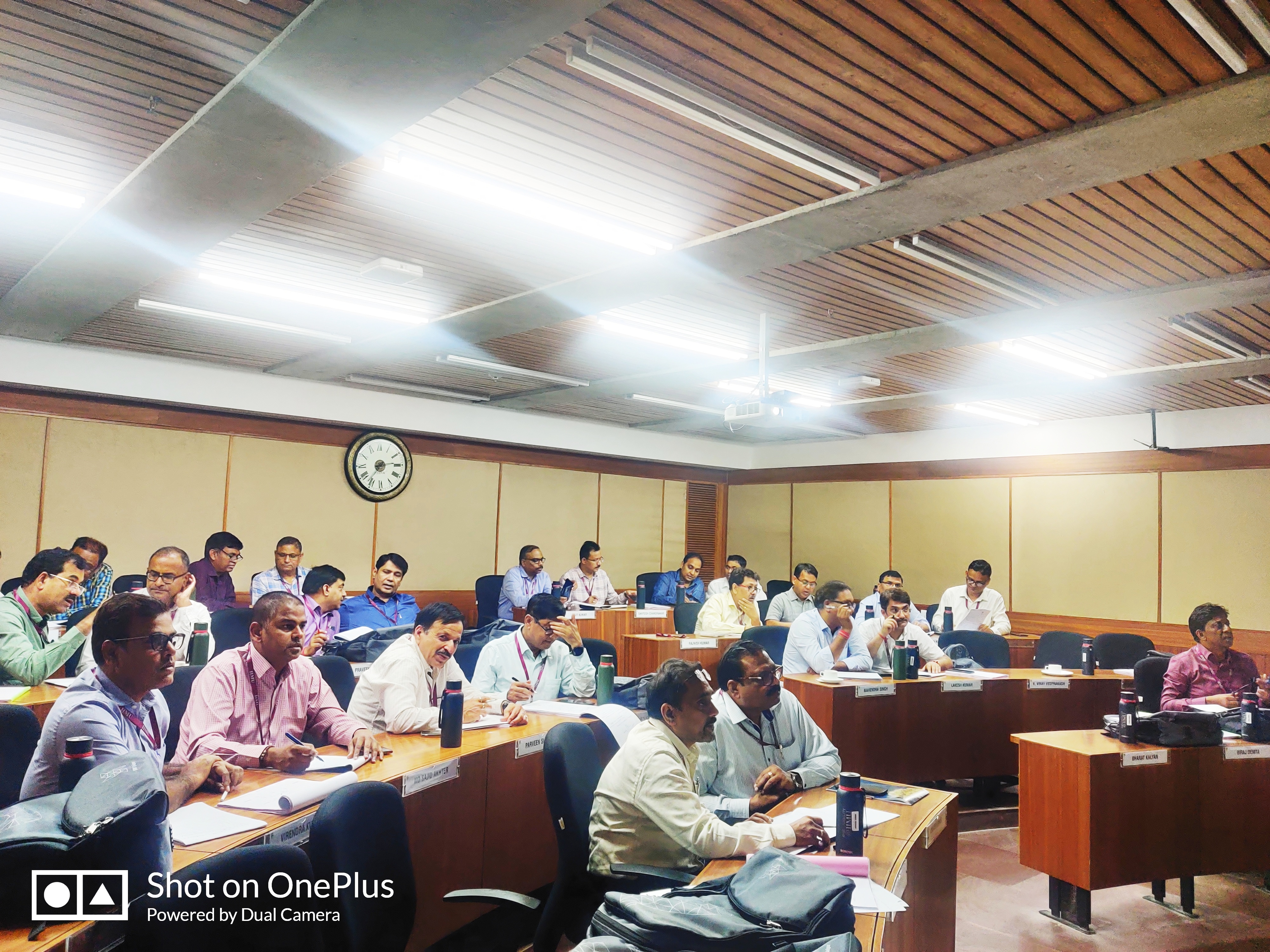
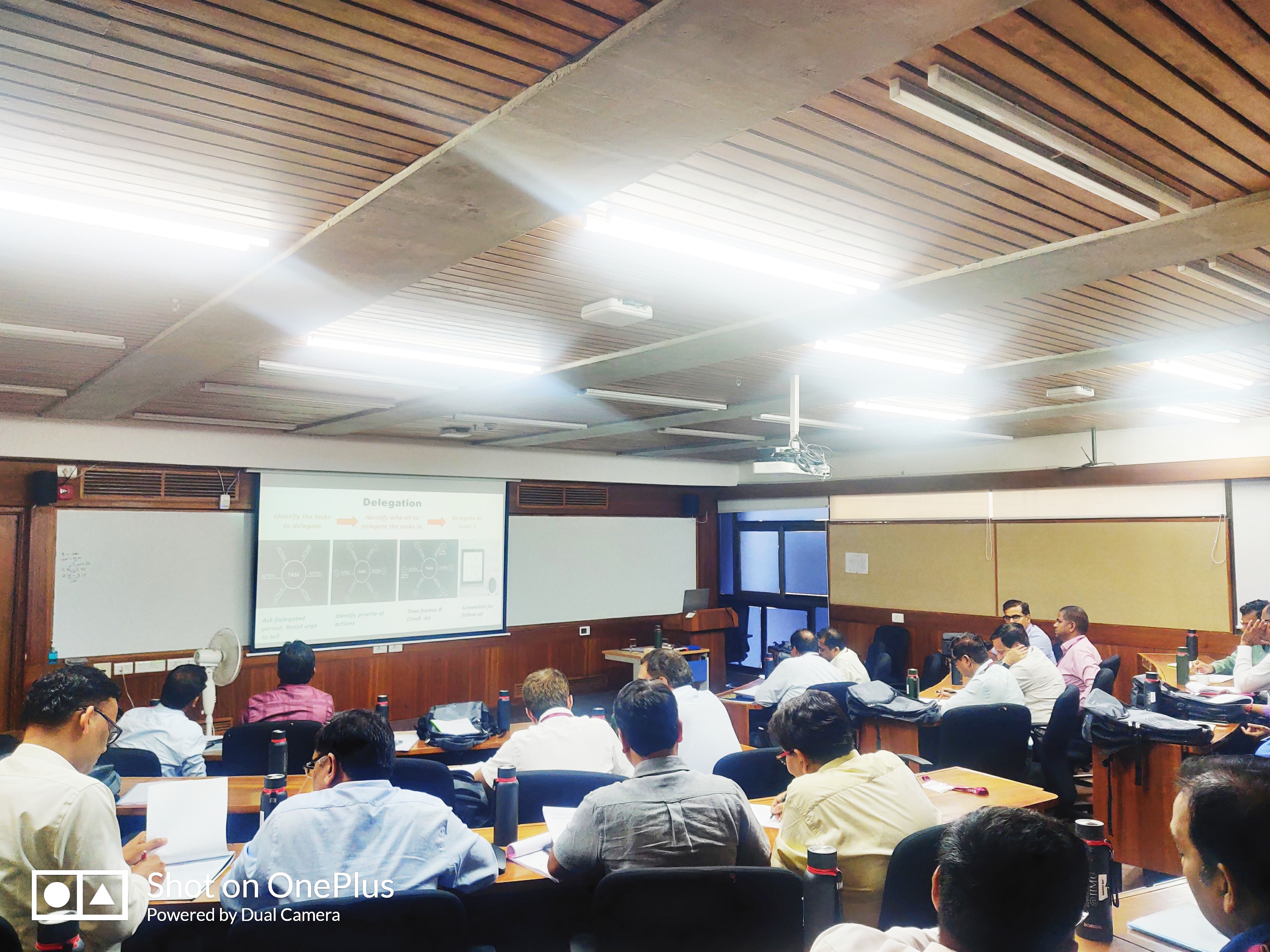
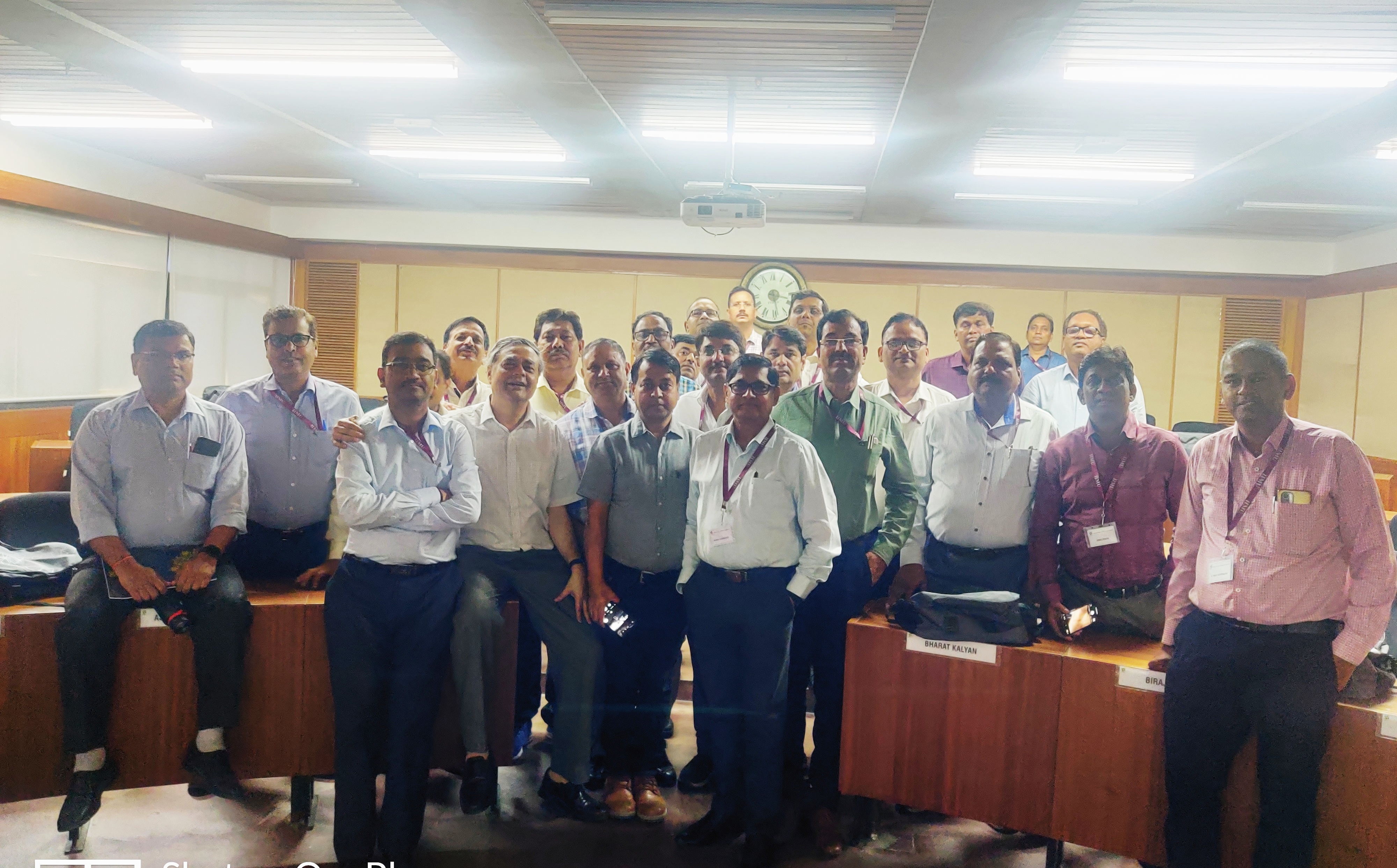
Recently, I was anchoring a Management Development program (MDP) for Senior Managers of National Hydroelectric Power Corporation. The program was designed to endow the participants with Leadership and Performance skills. An experiential aspect of the program required each participant to articulate a Leadership and / or Performance challenge which he is presently facing at the workplace. This challenge would then become the central aspect of learning and application as the participant would be required to apply the various Leadership contextual elements to discover a ‘move forward’ pathway for resolving the challenge.
All the participants could identify such a challenge except one individual. Noticing that the person was looking lost, I asked him as to what the issue was. The response was surprising; the participant after some probing said that he could not think of any challenge at his workplace!
I though persevered and asked, “You surely would have faced some challenge at your workplace in the past, have you not?”
The participant still hesitated and with some reluctance started writing about a past challenge. To me it seemed the gentleman was fearful of recognizing and then committing about the situation at his workplace.
What is that which blocks many of us from recognizing an issue and then making a commitment to resolve it? Even when we might realize that the said commitment is something which works in our favour.
Commitment for many of us is like walking a tightrope. It carries with it the fear of failing, being ridiculed, getting our vulnerabilities exposed. Some of our past life experiences lead us to instinctively ‘avoid’ when it comes to making a commitment; we get conditioned to equate the latter to a danger of failing and losing our ‘status’.
When I think back about the participant and his reluctance to even identify a challenge, I can sense his avoidance mindset. In his mind, he would have been linking recognition of a workplace challenge to a commitment that he might need to make to resolve. If one avoids looking at an issue, one avoids getting involved. Like the protagonist Neo in the movie Matrix, one can cozily sleep walk in one’s make-believe world without the need to accept the harsh realities that exist.
So, what else could I have done to make it easy for that reluctant participant to identify and commit?
I could have tried to empathise about the stress he might have been feeling. I could have said, “Confronting your challenge must be stressful for you”. I could have made a commitment to him that I would work with him to ensure that his challenge is resolved.
***
At the work place, we often wonder, “How can I get my team to do what I want them to do?” Commitment cannot be force fitted and that paradoxically remains a leadership tool which can disempower. The answer is people do what THEY want to do. This remains at the core of how we could Invite effective commitment.
At the core of effective commitment:
Leadership which is unselfish; one which is willing to make unsolicited commitment to and investments in people.
Working from a perspective that commitment is a two-sided street.
Information sharing with all team members who have committed. Keeping information away weakens commitment.
Transparent and open-hearted conversations build connections which empowers two way commitments.
Moving on the commitment pathway addresses a deep-seated concern of each team member
Lasting goal achievement success requires commitment, not coercion.
As a leader, how might you establish shared commitments?
As the current Israel Hamas war spirals up into the stratosphere, amidst the 24X7 clash of words and images on social media and TV channels, I turn to that iconic graphic novel ‘Palestine’ by Joe Sacco to re-read some parts. The American Book Award winner of 1996, the nine series compilation was based on the author spending months in the Gaza strip in 1991-92. For no amount of ‘from the stands’ perspective of a situation as articulated by news readers sitting in London, New York or even Tel Aviv can match a ‘on the court’ as lived feelings and impressions.
In 1849, French writer Jean-Baptiste Alphonse Karr wrote, “plus ça change, plus c’est la même chose”, which in English translates to “the more things change, the more they stay the same.” Three decades on after Joe Sacco’s as-lived experiences, perceptions and writings, these words seem so prophetically apt when it comes to Palestine.
I remember the six-day Arab Israel war in 1967 in which the latter came out on top, annexing the Sinai Peninsula and the Golan heights, even though it fought the war on three fronts with Egypt, Jordan and Syria. As a school kid in Delhi at that time, I recall being influenced by how the conflict was being projected in the newspapers, majorly a stance of the Indian Government being an Arab supporter. To my mind it was the Arabs who were fighting a just war! My childlike awareness failed to realize that here was a tiny country fighting for its very existence.
The 6 Day Arab Israel war 1967
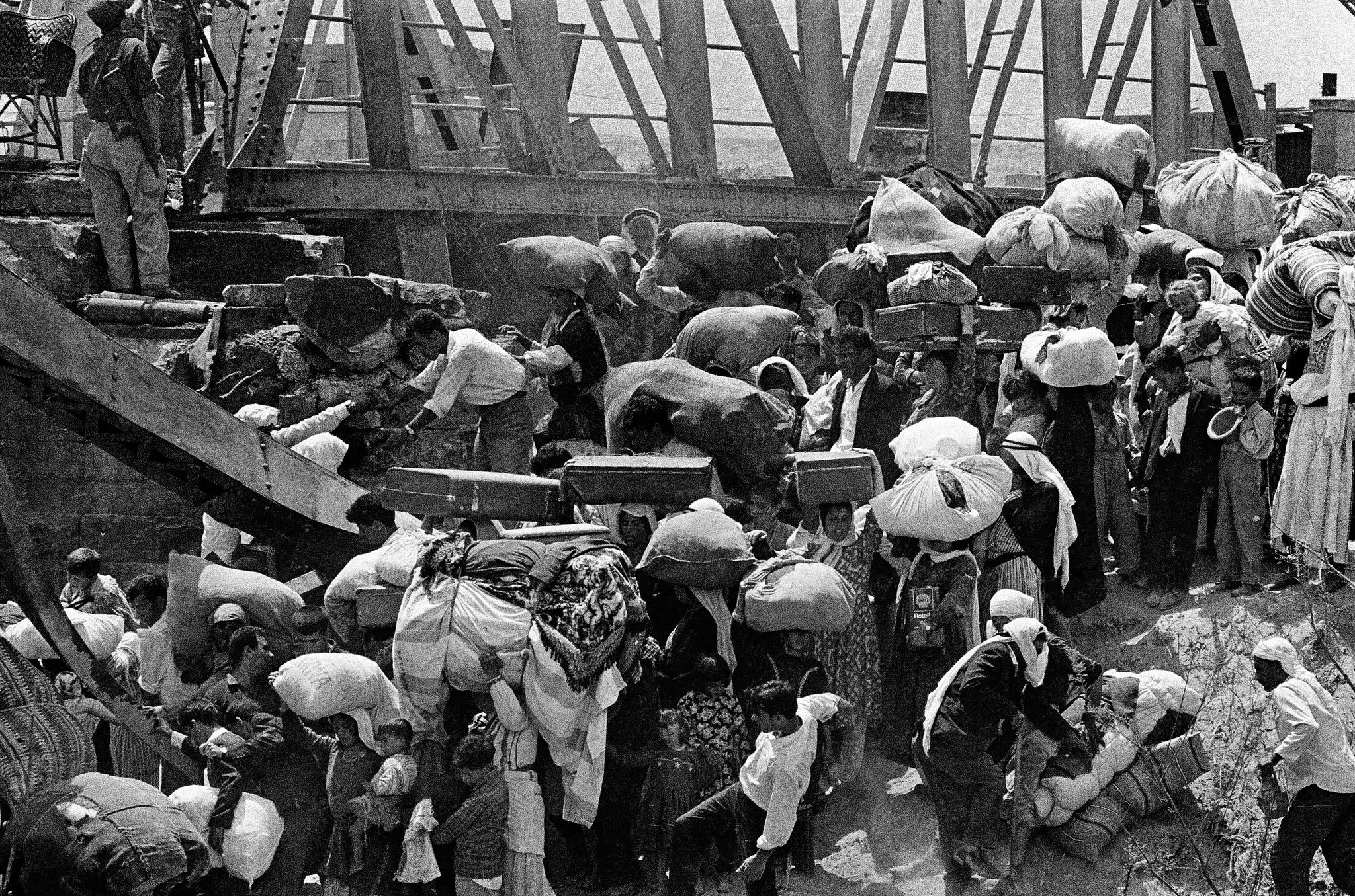
And a consequence which would hold huge implications for the future (and what we are evidencing today as Israel asks Palestinians to vacate North Gaza before the tanks roll in) was the displacement of three hundred thousand Palestinians and an additional hundred thousand Arabs. With victory came arrogance and this was aptly on display when the Israeli Premier Golda Meir remarked, ‘Palestinians did not exist!’
Palestenian Movement of 1967
Much water has flowed down the Suez since then. And with the water has flowed a succession of images (were they reflections of something deeper?), geo-political initiatives and newsbytes. The shifting of the Palestinian militancy into Lebanon and the Lebanese Civil war of the Nineteen Seventies. The Oslo Peace accord of the Nineties which led to the establishment of the Palestinian National Authority on the West Bank and Gaza. The Palestinian Parliamentary elections in Gaza in 2006, which Hamas won and took over control.
What is ironical is that in its early years, Hamas and its founder Sheikh Ahmed Yassin received patronage of Israel who saw the organisation as a counterweight to the other Palestinian movements. A déjà vu’ situation akin to the US support to the Afghan Mujahideen during the Soviet occupation years, leading to the rise of Osama Bin Laden who then became the former’s nemesis. In the nineteen seventies, Indian PM Indira Gandhi of the Congress party allowed, nay supported, Bhindranwale and his cult to become a Frankenstein’s monster, in a bid to weaken the Akali Party’s hold in Punjab. A horrible decision which spun out of control and sowed the seeds of the Khalistan movement. History is replete with such situations, spawned by political expediency, gone horribly wrong.
As I sit re-reading parts of Sacco’s Palestine, the graphics and the words seem to detach and swirl around, before coalescing with the world news’s images I have been seeing on the screen over the last week.
The more things change, the more they stay the same…….
A Narrative which seemed to be both connected and disconnected from the societal prejudices of race, class and religion. Be it the image of the Palestinians as rock and missile throwing fundamentalists. Or that of the Israelis as a harsh and superior force with an apartheid mindset.
The perception of the Gaza strip of being an intolerable world of quasi freedom, military occupation, demolished houses, torture and brute force to ensure compliance of arbitrary Do’s and Don’ts by the Palestinians. What do you say to the people when this happens to them at the place which they consider their home?
To be a Palestinian in Palestine…..
The Palestinians’ scanty existence, anxious with uncertainty and deprivation. A life without a seeming purpose within Gaza’s inhospitable confines, waiting for a better tomorrow which never comes.
In the book’s preface, Edward Said writes tellingly about the existential lived reality of the average Palestinian in Gaza:
“ ….The vacancy of time , the drabness not to say sordidness of everyday life in the refugee camps, the network of relief workers, bereaved mothers, unemployed young men. Teachers, police, hangers- on, the sense of confinement, permanent muddiness and ugliness conveyed by the refugee camps which is so iconic to the whole Palestinian experience….
….. the scrupulous rendering of the generations, how children and adults make their choices and live their meager lives, how some speak and some remain silent, how they are dressed in drab sweaters, miscellaneous jackets, and warm hattas of an impoverished life, on the fringes of their own homeland, in which they have become the saddest and most powerless and contradictory of creatures….”
The imagery created by the words in my mind are at once frenzied and halting.
“….. how some speak and some remain silent….” The telling graphic of the ubiquitous Israeli soldier refusing to let Palestinians through a roadblock at his whims and fancy because of a set of enormous, threatening teeth and a M-16 gun that he brandishes, flashes in my mind.
How some speak and some remain silent……
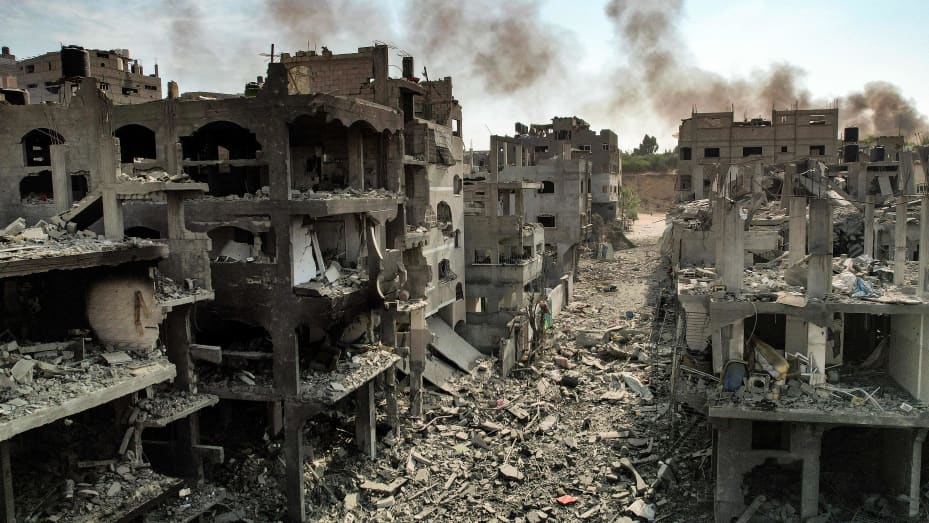
Images swirl on that daily screen in my bedroom. A detached view, I realize, is a blessed state. A state far beyond the reach of the Palestinians and the Israelis. A young Israeli girl being abducted from a Rave festival and taken away on a motor cycle by masked Hamas gunmen. The naked body of a female tourist being displayed on the back of a truck. The swerving billowy streaks of rockets and missiles. Neighbourhood after neighbourhood in Gaza being bombed out of existence by Israeli firepower. The danger of the entire Middle East region getting engulfed in the conflagration.
The abductions and the terror …….
Rockets & Missiles….
The bombings…….
What is it that has led to the situation spiraling out of control like this, I wonder.
Is it that slow but relentless turning of the screw by Israel on the hapless Palestinians by inflicting insults and hardships on an already miserable existence? Is it the Palestinian mindset that perceives only a hopeless and ‘no light at the end of the tunnel’ existence because of a world order which has turned its back on their right to a respectable and decent life? Has the Palestinian society being pushed to a point when life or death no longer matter, as long as they can hit back at their tormentors?
Or is it a surge of anger in Israel of having been outmaneuvered and upstaged by someone who has been perceives as weak and unequal all these decades? Is it frustration of being ‘caught with one’s pants down’ with one’s vulnerabilities on display?
Be as it may, methinks a way forward can never be achieved through horrendous acts of terror as a last-ditch attempt to gain the world’s attention. Nor through a revenge war to carpet bomb, smoke out and eliminate embedded ‘terrorists’. Both ways unfortunately lead to innocent citizens suffering collateral damage with unimaginable hardships and sorrow all around.
A way forward would require both Israel and Palestinians to eschew Amygdala hijacks, accept the ground reality of each other’s existence through negotiated give and takes. A complex and politically difficult task but not impossible if there is a will and vision. But will the world display such a will and Leadership at this juncture?
God of Comfort Send your Spirit to encompass all those whose lives are torn apart by violence and death in Israel and Palestine. You are the Advocate of the oppressed and the One whose eye is on the sparrow. Let arms reach out in healing, rather than aggression. Let hearts mourn rather than militarize.
Rose Marie Berger, Oct 9th 2023
In musing….. Shakti Ghosal
Acknowledgement : Palestine by Joe Sacco. Random House, London
Have you ever wondered about all the things you do not want, all the things you avoid? These may be at your workplace. Or they may be in your personal life or relationships. Do you realise that all the things you do not want can actually support you to move forward in life?
In the second year of my post graduation, we had to choose elective courses to achieve a minimum number of credits. I remained in my comfort zone by choosing electives which I had the ability to do with minimum effort. I avoided taking on courses in the Computer Science domain (then in its infancy and consequently a ‘black box’ to me) which I figured would require a lot of learning and effort. Was it a mere avoidance mindset or a deeper fear of failure? Most of my batchmates who ‘took the jump’ and majored in Computer Science subsequently did very well in their careers. Fear of failure can help us succeed.
Fear of failure can help us succeed
An aspect we do not want is frustration. Frustration is really our reaction to stuff we do not like or cannot control. The ugly underbelly of frustration is that we tend to vent it on folks who may have nothing to do with it. These folks may be our spouse, family members or colleagues at work place. Frustration shows up as anger, impatience or both. I can recall a particularly difficult meeting with a client about a service failure in which they threatened to cancel our contract. It was a situation outside our control but my reaction had been to call the service team and vent my frustration on them. What I had done was to further spread the cycle of exhausting negativity without finding a solution. The section head though was a guy with a cool temperament; leaving the meeting he did what was needed to be done to retrieve the situation. Frustration can be a good thing if we channel it to move towards solution finding.
Frustration can be a good thing……
We do not want to do ‘heavy lifting’, we succumb to the temptation of doing theoretical stuff. In a previous project assignment, I interacted with two kinds of people. The first set were those who were smart, articulate, detested leaving office and had theoretical solutions for all operational issues. The second set were those who were low profile, operated in the field and were hands-on with the project. I found it comforting to hang out with the first set and opinionate about what was needed to be done or not done; true to the perception I held I avoided going out into the field. However, I soon found that grit, resilience and character developed only when I got down to ‘digging ditches’ in the field to circumvent failures, prevent time over-runs and ensure project completion. Resilience and Character wait on the other side of our disappointment and failure ditch.
Resilience & Character wait on the other side of our failure & disappointment ditch
In the hurry-scurry of our work life, we tend to develop revolving -door relationships. Relationships that we create to achieve quick business objectives and which tend to get jettisoned soon after. Such relationships may seem energizing, even meaningful in the moment, but really build a shallow work life. How many of these questions can you answer in the affirmative?
Do you take genuine care of the people who pull alongside you?
Do you invest time with your team and other stakeholders beyond work related stuff?
Do you serve those who serve you?
The deeper we nurture relationships, the more valuable they become.
The deeper we nurture relationships, the more valuable they become.
A way to grow one’s Leadership is through introspection. One needs to look back into one’s past and identify all that which contributed to one’s Leadership and performance development.
This may sound easy but it is not. As we move through work responsibilities and the corporate hierarchy, we tend to develop our own plethora of ‘what we believe made us succeed’ mechanisms consisting of inauthentic facades, assumptions and ‘need to impress the other guy’ behaviours. We also hone our survival instincts. So, when we do get down to ‘looking into our past’ and identifying all that which contributed to our development and growth, we tend to see stuff distorted by our facades, beliefs and impress the-other-guy behaviours.
The way to grow one’s leadership through introspection is to do the following practices.
Ask yourself, ‘Who were the people who changed you?’
When I thought about this question, I could identify two individuals.
The first was a senior colleague at the start of my career as an Assistant Mechanical Engineer in the Indian Railways. The quality that my colleague brought into our relationship was one of sunny optimism and a natural instinct to mentor without a self-serving mindset.
The second was my boss in Voltas Ltd, where I was handling HVAC projects. The quality that he brought into our relationship was one of down to earth openness and transparency.
I realise today that what allowed me to grow through the above relationships was to try and inculcate a non-self-serving mindset as also authenticity through openness and transparency.
Ask yourself, ‘What kind of people did you gravitate towards?’
When I thought about this question, I could again identify two individuals.
In my tenure in the Indian Railways, I had two workshop foremen report to me. The first was a kind of a ‘yes man’ guy. He made me at once comfortable through his unquestioning loyalty; he would do exactly what I asked him to. This was a great relationship for maintaining status quo about situations and other stuff.
The second was a guy who was a ‘shop floor rebel’. He would usually give a counter viewpoint to most stuff I would suggest, and at times speak uncomfortable truths based on his own past experience and arguments. I would often ‘see’ his approach as unwillingness to accept my authority or trying to prove me wrong. I would feel upset.
This did not seem to be the kind of relationship I would be comfortable with or gravitate towards at that point in time. But I realise today that the person who allowed me to grow was this ‘rebel’ guy as he shattered my comfort zone and forced me to look at uncomfortable possibilities.
So how might you grow your leadership in today’s disruptive world? How might you foster such growth in your team members?
Gain mastery about how to succeed in a business environment that is constantly changing and being disrupted. Do this free module:
We were engaged in a MENA region Business expansion consultancy project for a client organisation (name withheld) in Dubai. Being time bound, our team was depending on the client for getting certain ground assessments and data to do a competitive audit and recommendation set.
Interestingly, the common refrain by the client personnel was that the competitive situation was shifting fast in terms of relative importance and data points. It was thus difficult to provide accurate ground assessments.
One day over coffee, I got to discuss about the Business implementation with Darius, the Business Development Manager responsible for the project.
“In your view, what is the kind of Leadership needed for successful implementation in our kind of fast changing environment?” Darius asked.
“And where would you like to see Leadership being exercised in your kind of situation?” My response was a return question.
“Well, I suppose leadership needs to ‘lead’ us from where we currently are to where we are proposing to be”, replied Darius.
I could not agree more. Leadership indeed needs to reside in the gap between one’s current state and the state one aspires for. But then how does Leadership set the organisation on the right pathway? In today’s increasingly disruptive and discontinuous world, the luxury of a fixated, ‘past experience driven’ journey with a visible future at the other end, is no longer available. If at all, present times require the ability and mindset to get off that beaten path and into the unknown forest area, so to say.
I said as much to Darius.
As if reading my thoughts, Darius asked, “So what might be the leadership mindset needed to eke out a new path through the forest trees you spoke of?”
“That is a great question”, I acknowledged. “I can think of one. Which I would term as ‘your comfort with ignorance’. You need to be comfortable with the knowledge that you ‘do not know’. Only then will you able to unearth and visualize new possibilities. Without this there can be no growth in a disruptive world.”
Somewhat later, when I sat thinking about our conversation, two other aspects came to mind.
First, a mindset to accept failures. We need to accept failure as an intrinsic part of who we are. In an uncertain world with no past experience to guide us through the discontinuity of the ‘forest trees’, it is only mistakes and failures which become the building blocks of eventual success.
Secondly, a more controversial but nonetheless critical ability to wear a ‘mask of yet to be internalised behaviours’. We need to fake the needed leadership behaviours, if necessary, before they become an intrinsic part of us.
I would like to term the above as the CAM mindset shift, to use an acronym.
Comfort with ignorance
Acceptance of failure
Mask yet-to-be internalised behaviours
So how might you grow your leadership in today’s disruptive worl
The reign of the dinosaurs had long ended. Snuffed out by an unlikely asteroid strike. A fifteen kilometers wide piece of Iridium laced rock had struck near present day Mexico, creating a ten times wide crater and unleashing lava, ashes, smoke and gigantic waves around the world.
Though the mass extinction event exterminated most of the flora and fauna on the planet, the continental drift and shifts continued unhampered for millions of years thereafter. The active planetary crust led to the Indian land mass smashing into the Eurasian land plate. The resulting crumpling and buckling at the collision point led to what came to be known as the Himalayas, a veritable abode of the Gods, the tallest mountain range in the world. An awesome creation standing testimony to Earth’s inner energies.
The permanent glaciers and ice formations led to glacial water bodies being formed. This is how the lake came into being. Situated at a height of 18,000 feet within the mighty Himalayan range, the lake acquired a mystical aura for all men and religions who passed by. The waters remained mostly frozen due to the height and the overwhelming presence of the Dongmar glacier which nestled it. Thirsty men and animals could not quench their thirst. And so it came to pass that a Guru was passing by when he too felt the mystical aura of the lake. He put his hand in the lake and Lo and behold! The water stopped freezing and became available for all to quench their thirst. This subduing of the Dongmar glacier’s frozen might by the Guru gave the lake the name of Gurudongmar. The second highest lake in the world with water that no longer froze.
**
The Man was indeed getting on in years.
As a child, he had been precocious and so had been nicknamed. ‘Buro’, an old man. He was now precisely that, replete with the mindset of the elderly. Over the years, he had acquired a liking for travelling and seeing the world. Age had dimmed the eyes somewhat, but not that inner passion to set forth and discover new places.
When the Man first heard about the wondrous lake of Gurudongmar, his heart urged him to travel. His brain though was more circumspect; it counselled, “My dear chap, are you crazy? You suffer from vertigo. What might happen when you go up all those torturously winding roads?” His friends too cautioned; they related dire tales of folks collapsing from lack of oxygen in a no-Man’s land with medical facilities hard to come by.
“But when a Man makes up his mind, he is not made for defeat. He can lose out, even destroyed, but not defeated.”
The tug of war between thoughts continued. But the die had been cast, the travel plans stood finalised. Came the day of travel and the Man set forth armed with some basic medications, a quiet resolve and some raucous misgivings. A flight, several car rides through mountainous roads into the Himalayan kingdom and the day of reckoning arrived.
“This was not the time to think of what was not there. It was the time to think of what one could do with what was there.”
Six in the morning and after nursing a cup of hot tea, the Man set forth for his rendezvous with the lake.
The slow wafting mist seemed in perfect harmony with the biting chill outside the moving car.
Passing through the last army check post, the vehicle climbed to the Kala Pathar, black stone viewpoint.
The fresh snow from the previous night lay in gay abandon. The white mist drifted upwards, a curtain rising up from the snow flakes and into the low hanging clouds.
As the old man stood watching the shifting views of the Kala Pathar blackness through the whiteness of the entwining gaps in the mist, it seemed like a ballet being performed. Was it the Universe sending him a message of hope?
“Every day is a new day. It is better to think it would be lucky. So when luck does come, one would be ready.”
The climb towards the lake had begun. It was not on roads cut out on the mountainsides which the man had been used to. It was on a rising terrain with no roads or markings to provide a direction. It was all down to the driver and the vehicle, their combined experience and strength to negotiate the path.
And then, all of a sudden, the heavens opened up. Sunbeams splayed and sliced all around. The climb had now reached above the level of the clouds and mist, a surreal moment. The old man nibbled on slivers of ginger; he had been advised so by some friends. A final swerving climb over barren rocks and the vehicle stopped on a mound from where the lake could be seen.
The stillness of the blue waters seemed to beckon. ‘Come, partake of my mysticism.’ The sun shone in all its splendour. Was it trying to discover that mystical aura with all those reflections? At the far end of the waters, part shrouded by rising mists, towered the snow laden glacier. As the old man stood transfixed by the wondrous surroundings, the tug of thoughts took over. Was this the place where divinity was born? What made the pristine barrenness so unworldly? Was it the glacier with its whiteness, or the water with its blueness?
A needle pricked the cheek. Then some more. Shaken out of his stupor, the man looked around. The hitherto gentle breeze had gained in strength. Crested by a whirlwind, tiny pebbles and dust particles chased each other in an ethereal dance. As the needles borne by the wind swayed through the onlookers, a soft murmur of protest could be heard. The old man slowly turned and moved back towards the waiting vehicle.
In Learning…….. Shakti Ghosal
Disclosure: The Old Man in the post is the author himself.
Acknowledgement : ‘The Old Man and the Sea’ by Ernest Hemingway
Do you remain dissatisfied and uncertain about how to face emerging situations and challenges in today’s fast-changing world?
Do you frequently get the sense that however hard you or your team are trying, there seems to be always someone ahead of you and winning?
As you resolve a problem or a challenge, do you get confronted by fresh ones?
Are you frequently unable to prioritize which problem to tackle first?
However much you strive, are you unable to see the big picture and align yourself and your team with that?
….. And on a more personal level:
Do you want to get that job or assignment that you have been trying?
Do you want to get that promotion and recognition you have been aspiring for?
If you have been plagued by one or more of the above questions, the Winning in a Disruptive Worldprogram might just be what you need to improve your winnability quotient in today’s world.
The fact is that our present world is constantly getting disrupted. By new technologies, new competitors, or other factors that can disrupt traditional business models. The disruptive world with its VUCA (Volatile, Uncertain, Complex, Ambiguous) characteristics allows us to reside in a significantly narrow band in the present with a hazy and uncertain future in front and the inability to take recourse of our past experience.
Conceived and developed based on workshops and programs conducted for leading organisations and Business Schools, the course showcases the major types of disruptions that are shaping the world. You, as the participant, would gain an insight into what leads to us getting disrupted. You would review the process followed by a probability-based mindset and the need to shift to a possibility-based mindset to be able to better handle disruptions. You would practice and gain proficiency in the five action steps for the needed shift by conducting in-depth Inquiry through a structured process.
Creation of a context by using hard trends in three areas.
Creation of the three lists.
‘Plug into the future’.
Relational assimilation through a triad of competencies.
Sometime back, in a Leadership workshop for Larsen & Toubro that I was conducting, one of the participants shared a challenge he was facing.
“Earlier I had been involved in direct sales of earthmoving equipment to institutional buyers. A year back I got promoted and was moved to product and market development. However even now a few of the clients continue to contact me on even small issues.”
“That only goes to show that they still have a lot of trust in your support to them, is it not?” I commented.
“True,” the participant agreed. “But it often leads to negativity and bad blood with my sales colleagues who think I am trying to throw my weight around and stepping on their toes.”
“So, what is stopping you from letting go and clearly informing your ex-clients suitably?” I asked.
“That is what I am finding difficult to do. I feel I might be letting my clients down” was the response.
“That surely is a good intention. But are you taking accountability of future sales to the client?” I asked.
Looking at me, the participant slowly shook his head to conveying that he was not.
***
Each one of us, in our career, would have faced a similar situation. The problem occurs because of the clash between our stated positive intention and the negative impact we are making. If we are not careful, we can get sucked into a black hole of spiraling negativity which ironically arises from an initial intention to help.
The authority being exercised in some manner (even with good intentions) without being accountable is really abuse. If we expect others to be accountable for the task at hand, and we get sucked in, we need to be equally accountable to them, even if hierarchically they are junior to us.
Simply put our impact and influence may move in contrary direction leading to minimal or nil positive outcome. We thus need to explore how these two may operate together in the same direction to maximise the positivity of the outcome. Think of a train being pulled by a set of double engines.
Jim Dougherty, CEO of a software company, writes in Harvard Business Review ( Dec 12, 2012 issue), “If you want to get an emotional connect with the people you are working with or with whom you have business relationships — you need to be willing to commit and be accountable to them , unsolicited and without direct hope of reward.”
Should you wish to move on the road to better influence and impact, I invite you to explore and answer these questions:
Are you willing to make personal investments in people?
Are you willing to share what you are learning?
Are you willing to empathise with the stresses and frustrations others feel?
Are you willing to work for a shared purpose, results and consequences?
What could you do to maximise the overall outcome from the influence and impact you make?
‘Baked earth temples, where the fired body is porous. How does this work? Monsoon rains drench all, But there they are, that should have melted wet in the wash And drained and dribbled away, solidified like candle wax, But they stand in their various stalwart clay red forms…..’
We boarded an early morning train from Santragachi Junction for our three-hour journey to Bishnupur, the temple town of West Bengal. We had heard tales of its heritage, architecture and fascinating terracotta artifacts.
Alighting at a quaint station, our waiting car whisked us to the Banphool treehouse resort in the Joypur forest area where we were booked to stay over the next few days. I was visiting the Bankura district for the first time and realised it had excellent forest cover.
Banphool Treehouse
Did you know that Bishnupur was the jewel in the crown of arguably one of the oldest-running kingdoms in the world? The Malla dynasty was founded in the 7th century and continued to exist till the beginning of the 20th! Moving along the narrow roads and lanes, I mused about this continuation of a single dynasty over a thousand years through the turbulence of India’s history. I could not think of any other kingdom of India which had replicated this feat. Waves of Muslim invasions through the Khyber pass, the might and spread of the Mughal empire, the colonization of the sub-continent by the British had ensured that the longevity of homegrown kingdoms remained limited. So how did the Malla kingdom continue the way it did? Was it because the Malla kings had the wisdom to be flexible and used diplomacy to ensure they were not conquered? Or was it because the focus of the invaders was on the fertile and revenue-generating Gangetic plains and the forest areas of Bankura and Bishnupur held little attraction? Or could it have been a combination of both?
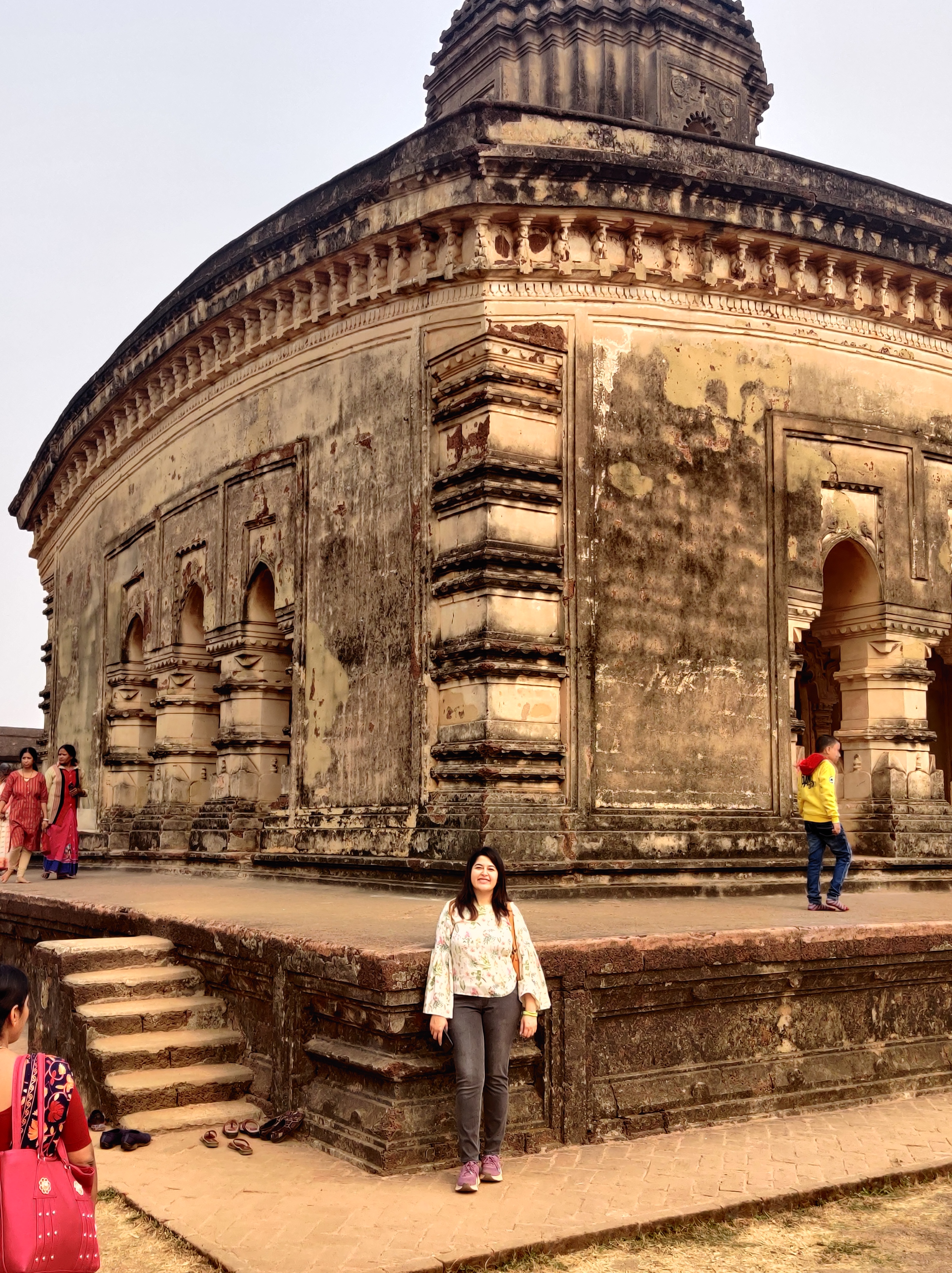
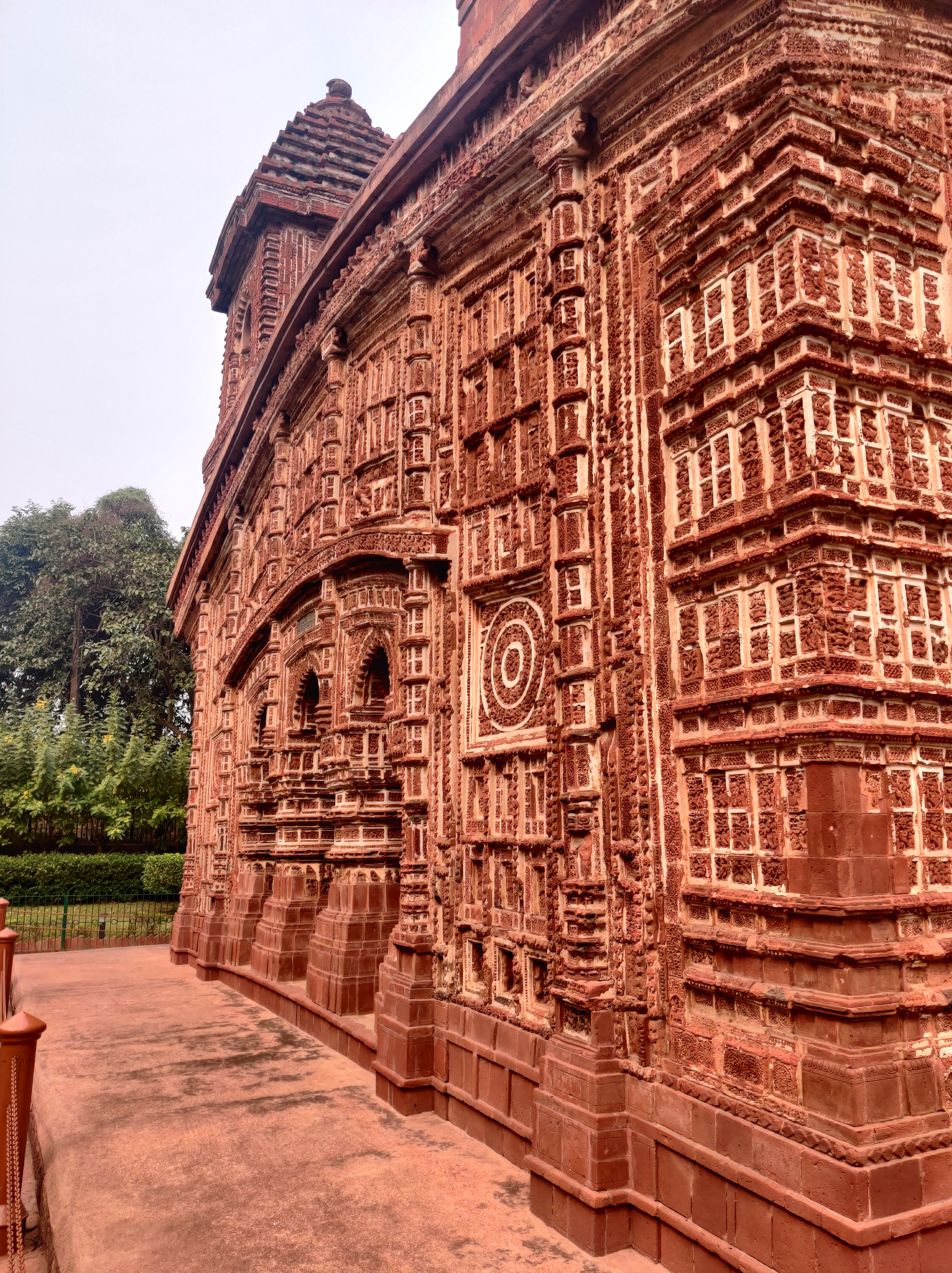
The uniqueness of Bisnupur’s architecture stems from the short supply of stones in the area. The local architects, centuries ago, found a way to build using the local ‘Laal Matti’ red clay; they used burnt bricks made of this. Incredibly the builders could use the interlocked red clay bricks to make roofs and overhanging arches without the need for concrete or other supporting structures. The temples and buildings made in this manner, using laal mathi bricks, locally available laterite blocks, and Terracotta overlays, have survived for centuries!
It is said that the kingdom of Mallabhum, in its heyday, extended far beyond Bankura. Encompassing as it did the districts of Burdwan, Birbhum, Midnapur, Purulia and going up to the southeast part of present-day Jharkhand state. What to me remains intriguing is the flowering of creativity manifested by the fascinating Terracotta art form, the Dokra craft on metal, the timeless beauty of Baluchari and Tassar sarees and the Hindustani classical music form known as Bishnupur Gharana. What is that which catalysed this huge upsurge of artistry in a forest land? What could have been the motivation to sustain such creativity against all odds?
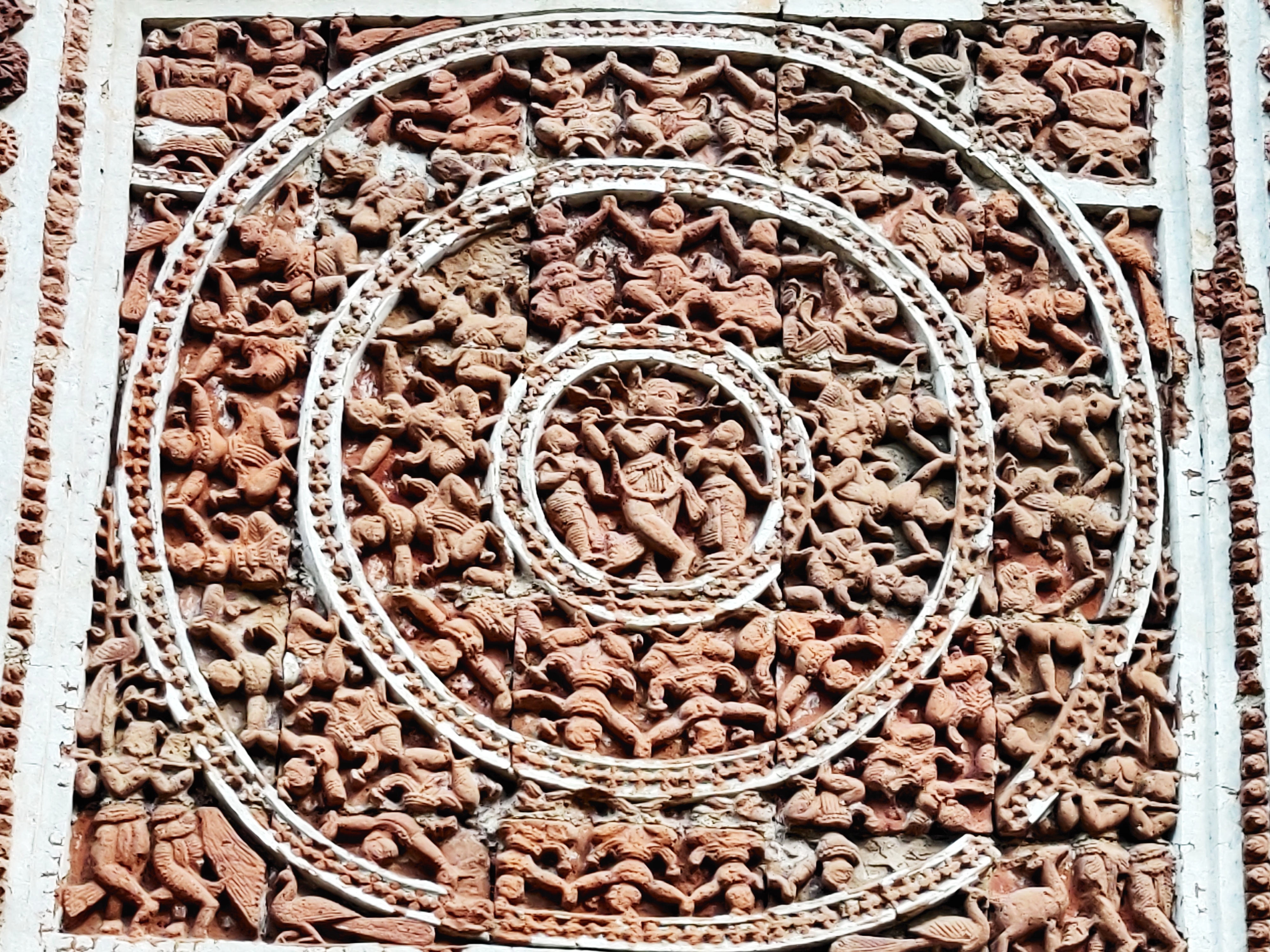
Which brings me to the Terracotta temples and the associated art form which the Malla rulers took to mesmerizing heights. The intricately chiselled terracotta panels stand out, depicting as they do, mostly incidents from Krishna and Radha’s liason, but to a lesser extent, important scenes from the Hindu epics Mahabharat and Ramayana.
Terracotta panel
The Rasmancha, a four-century old arched temple structure with a pyramid-like top. Replete with visions of Radha playing with Lord Krishna during Rash Purnima, that full moon night in November.
Rasmancha
The arcs and the arches…
The Shyam Rai temple, the only panch ratna or five pinnacle temple in Bishnupur with terracotta art on all four sides.
Shyam Rai temple
The Jor Bangla temple, with an innovative roof design akin to two thatched roofs joined together.
Jor Bangla temple
The Madan Mohan temple, a large structure with exceptionally detailed wall art depicting Krishna Leela.
Madan Mohan temple
‘…….Each one a sculpture, arcs and arched doorways, outer walls Of small framed panels, depicting: Ganesh, Siva, Varuna, men And women, carriages and animals, cows and collocations Of the visible world, elephants engaged in the act of coition, Mounted, each panel an astonishment, hundreds of them, On each side wall. One temple’s roof’s a pyramidal lift Of straight diagonal lines, converging; another’s is as swift A symmetrical curve as a scimitar’s blade, four curves, Balanced; another’s uses square shapes; all are brazen, Terra cotta red, and smell of cold earth. The air is wet and warm……’
Outer walls
Chiselled intricacy of Terracotta
In fact, I learned that the Bishnupur temples were inspired by those built in faraway Vrindavan, tales of which had been brought by travellers and vaishnavite disciples over the centuries. However, the architecture and forms remained distinct, following local traditions and innovations.
Nestled incongruously amongst the terracotta temples sits a large four-meter Dalmadol cannon. Legend has it that when attacked by Maratha marauders, the Malla ruler himself fired the cannon to save the region.
Dalmodol Cannon
I had gone to Bishnupur to see the temples. I returned reliving the entrancing tales of Mallabhum’s Rajas, their creative passion for architecture and their devotion to Lord Krishna. Do I still hear the sounds of Rasleela in the corridors of Rasmanch? Do the murmurs of Terracotta surround me whichever way I turn?
In Musing…….. Shakti Ghosal
Acknowledgement: Quoted verses are by Alan Riach, Scottish author and Academician.


















 A New Beginning