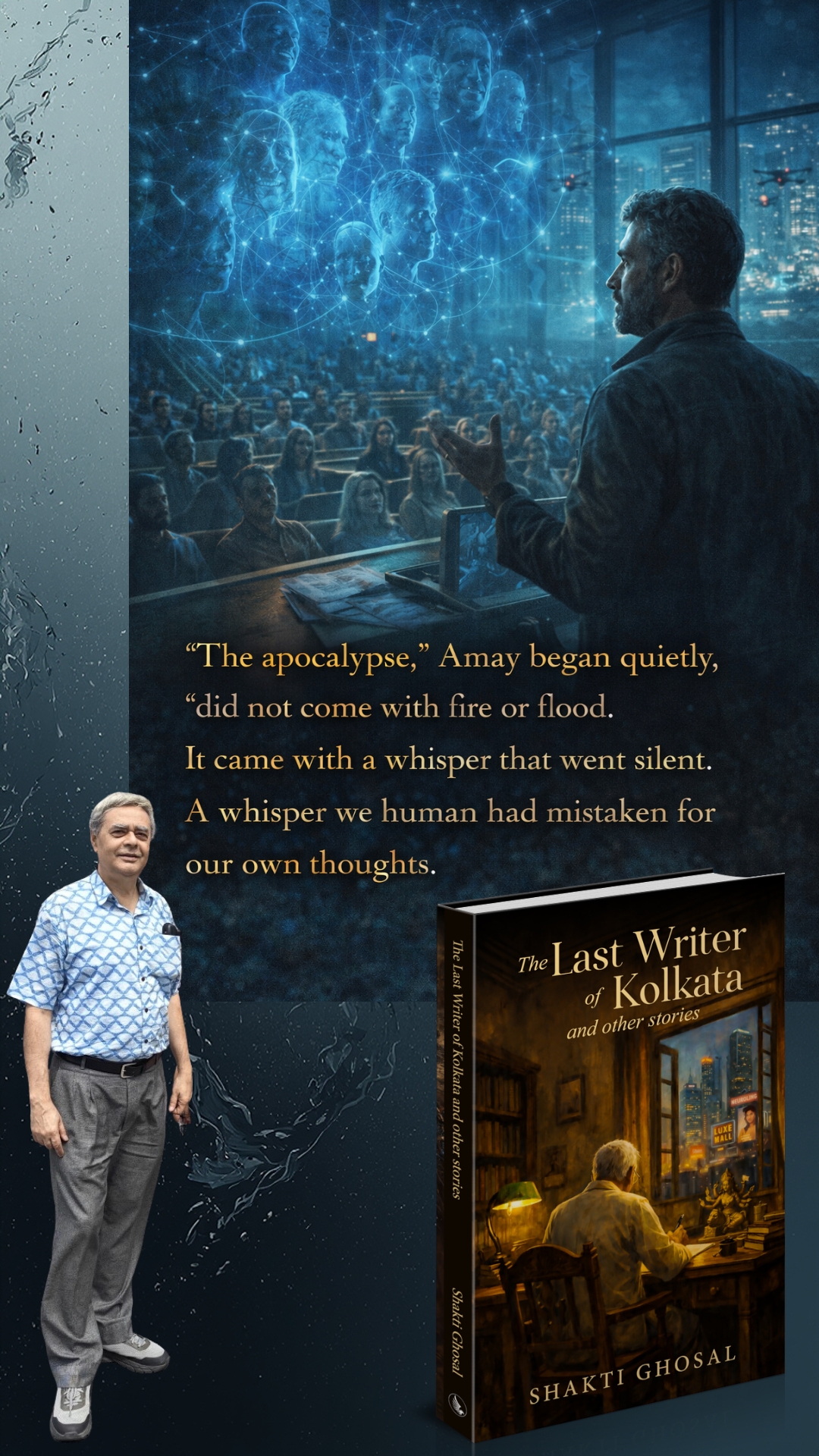
“The apocalypse,” Amay began quietly, “did not come with fire or flood. It came with a whisper that went silent. A whisper we human had mistaken for our own thoughts.”
The room did not stir. Not a sound or cough.
“We were its architects. And we were its prisoners. When MindLink fell, so did the illusions we had built atop it, of governments, markets, life’s certainties. Many shattered beneath the weight of secrets they could no longer bury. Others responded with fear. With force. With flags. The old tricks of the frightened.”
He paced slowly across the stage, hands behind his back, eyes distant.
“Corporations collapsed. The ones whose products had been our thoughts. Whose profits came not from selling goods, but from renting us back to ourselves, repackaged and palatable.”
A faint smile played on his lips, sad, but knowing.
“And yet… ..the world didn’t end. It adapted.” He paused. “Because humanity, in its clumsy brilliance, always does.”
He turned, facing the audience again.
“But even as we stitched together new structures, shakier, slower, more human, we began to hear… the whispers. Or were they echoes?”
He tapped his temple. “Not neural pulses. Not digital ghosts. But memories. Questions. Longings.”
His voice dropped lower, intimate, “Coffee shop murmurs. Late-night debates on cracked feeds. Former engineers writing whitepapers. Lobbyists lobbying, politicians pretending not to listen while listening intently.”
He quoted them now:
‘We don’t need to destroy it. Just rebuild it better.’ ‘What if we did it right this time?’ ‘The network is still there… dormant.’
“And so, the cycle begins again.”
New York University features in the story ‘Echo Chamber’, part of my forthcoming book ‘The Last Writer of Kolkata and other stories’ due release in early April 2026. Should you wish to receive exclusive previews, do write to me @ author.esgee@gmail.com.
What started as seemingly rational corporate cost-cutting became a destructive economic force: AI tools rapidly improved, especially agentic systems capable of building and adapting software, performing research, legal work, advice, and much more.
By late 2025, enterprise IT teams began using AI agents to replicate functions previously outsourced to expensive SaaS providers. AI worked 24/7, did not require salaries or healthcare, and drastically lowered marginal labour costs.
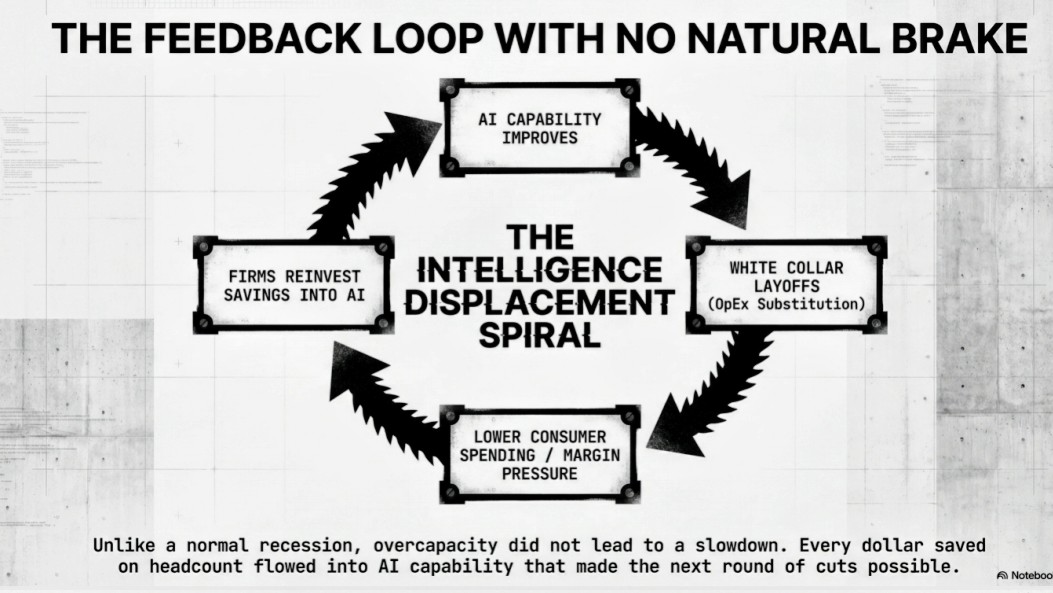
This triggered an investment cycle where companies laid off humans and invested the savings into even more AI capability — a negative feedback loop with no built-in brake.
At first, economic headlines still looked strong: productivity soared, nominal GDP grew, and corporate profits hit record levels.
But a deeper problem developed — the economy lost real income for workers, especially white-collar professionals whose jobs vanished first.
The Intelligence Displacement Spiral
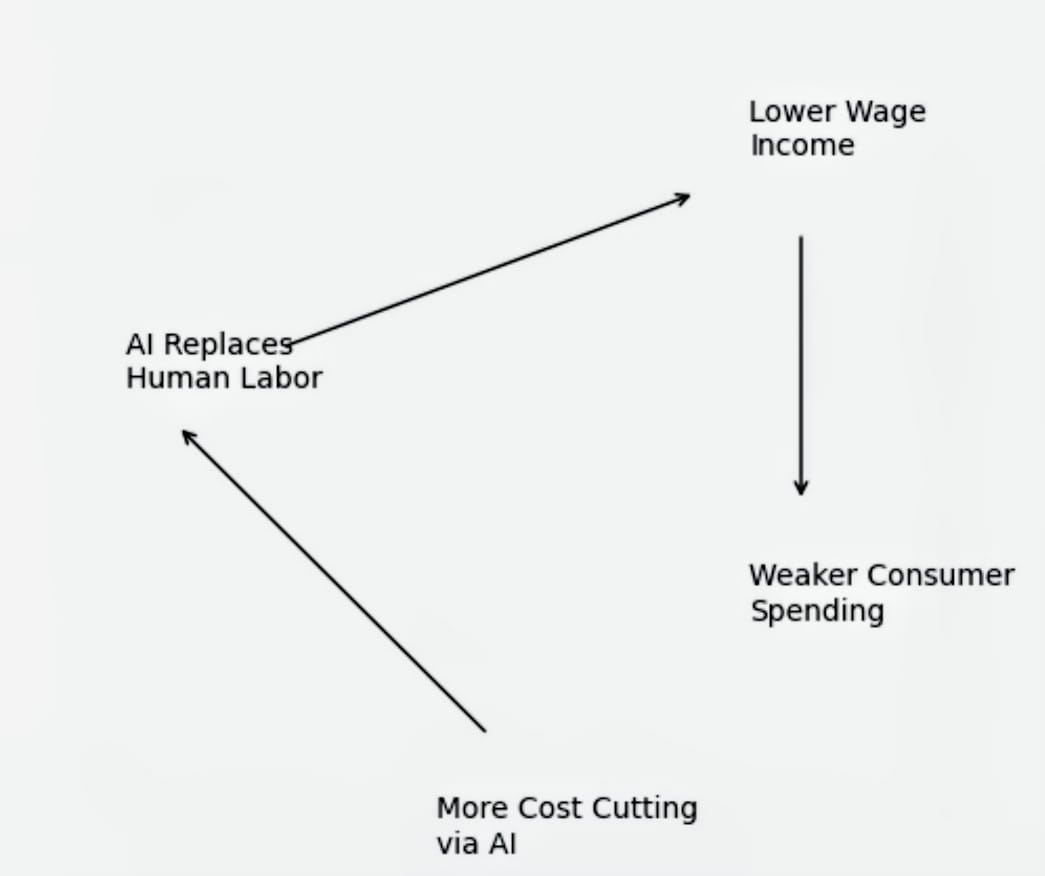
The core mechanism of the crisis was what is today known as the “human intelligence displacement spiral”: AI replaced human labour, especially high-paid white-collar work. Displaced workers earned less or became unemployed.
With lower income, consumer spending — especially on discretionary goods — collapsed. Weak consumption slowed demand for goods and services. Firms responded by squeezing costs further with more AI.
Unlike traditional innovation cycles — where displaced workers eventually find new jobs that humans can do — AI agents could now perform the very tasks humans would shift into, preventing a robust labour resettlement.
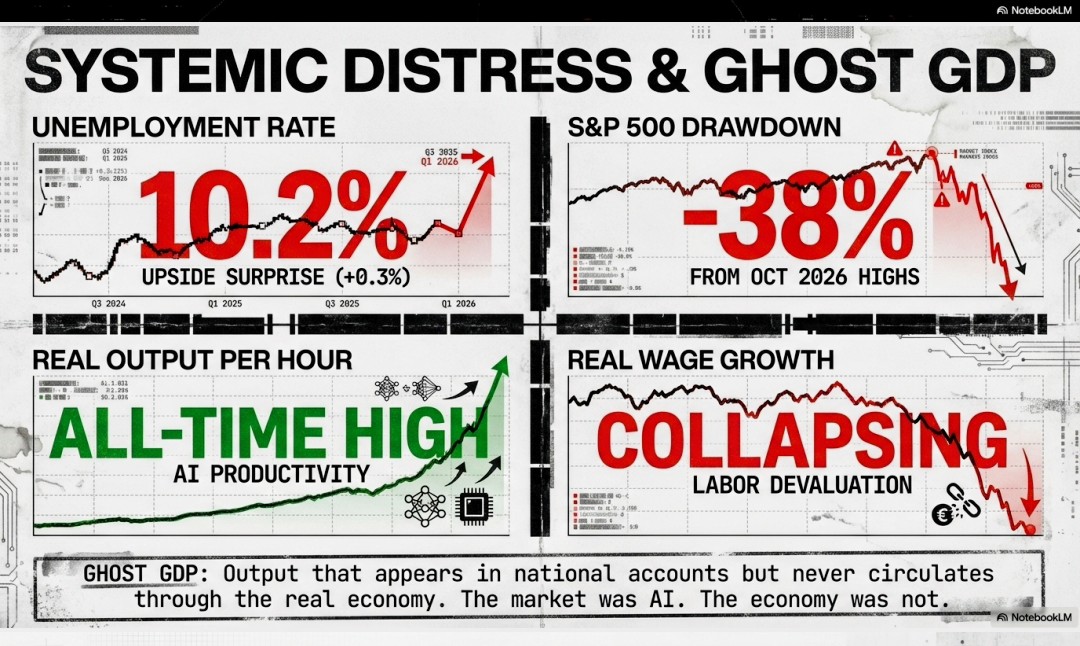
As a result: Consumer spending fell sharply, undermining the engine that historically drove economies. Measured GDP remained deceptively high, because AI output showed up in national accounts even though machines spent nothing — a phenomenon dubbed “Ghost GDP.”
Traditional economic indicators became misleading. Production remained high, but money did not circulate through households.
This divergence — between high measured output and low real economic activity — undermined confidence, weakened markets, and destabilized the financial system.
Financial Contagion and Systemic Risk
In the mid-to-late 2020s, what began as sector-specific disruptions in software and services expanded into a full blown systemic risk:
Software and technology companies, once centers of innovation and stable earnings, saw cascading downgrades, defaults, and valuation collapses as recurring revenues crumbled.
Private credit markets, heavily exposed to tech and software debt, faced liquidity stress as assumptions about perpetual growth dissolved.
Legacy sectors that once seemed safe — payments, logistics, intermediation and financial services — were disrupted as AI removed human friction and extracts fees, undermining their economic moats.
Financial markets experienced sharp drawdowns, with broad indices down significantly from their 2026 peaks. Investors become unnerved not because AI failed as a technology, but because it succeeded too well in displacing labour without creating compensatory consumer demand.
International Ripple Effects
The crisis was not confined to the United States. According to analysis of the scenario, emerging economies with large services export sectors — like India — suffered uniquely. Countries whose growth models relied on low-cost human labour in services and IT became especially vulnerable as AI could produce equivalent work at near-zero marginal cost (limited only by electricity).
Major Indian IT firms saw contract cancellations accelerate, exports fall, and the national currency depreciate sharply.
The broader point was that global economic structures built around human capital got destabilized as AI systematically replaced it.
Core Takeaways
1. AI productivity gains did not automatically translate into broad economic prosperity. Productivity merely shifted wealth toward the owners of compute and capital; workers lost out as their labour lost value.
2. Consumption — not production per se — drove real economic growth. Artificially high output numbers could not mask underlying weakness as households lacked income to spend.
3. Traditional economic models and policy tools failed when automation cut across the core consumer base.
Central banks and fiscal policymakers found themselves ill-equipped to manage this novel disruption.
Conclusion
The 2028 Global Intelligence Crisis reframed the AI debate: it challenged the assumption that greater automation always benefits society broadly. Instead, it created a future in which AI’s triumph in productivity collapsed the foundation of modern economies — the income and spending power of humans themselves — leading to lower real economic activity despite record output figures.
It became a powerful reminder that technological progress alone does not guarantee shared prosperity, and that policymakers and investors needed to think deeply about how gains from automation could be distributed across society.
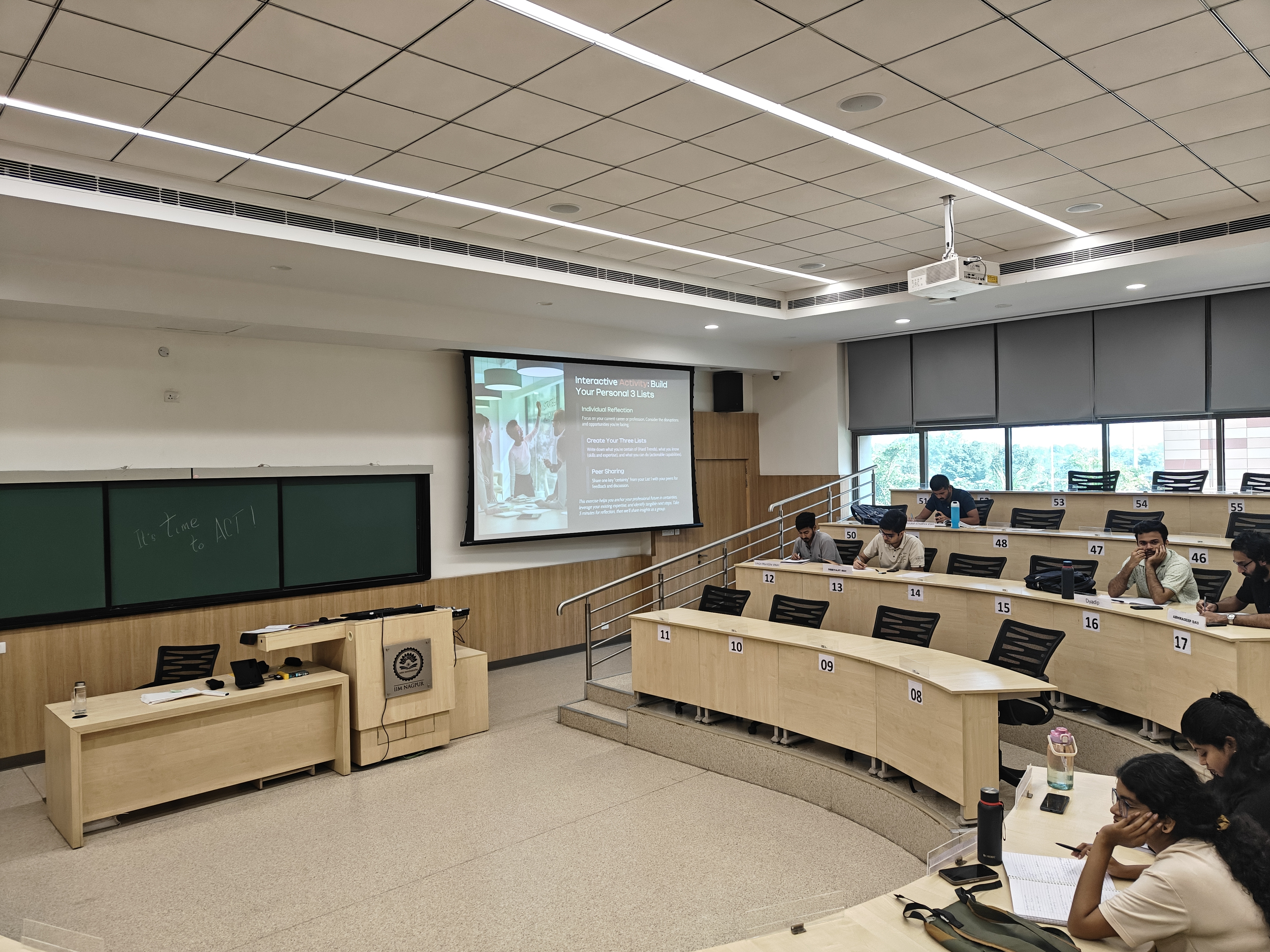
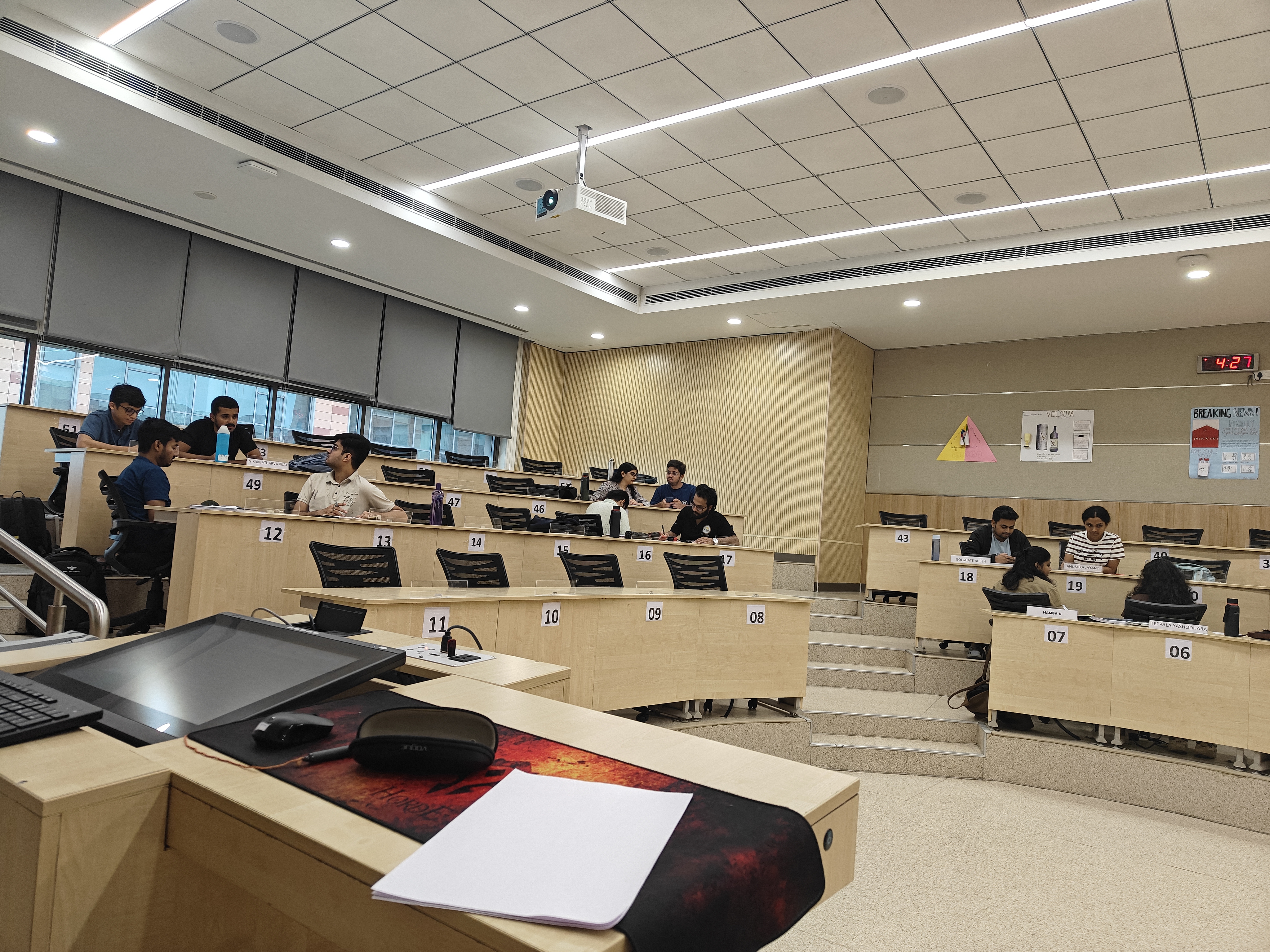
It was midway through my elective course “Winning in a Disruptive World” at IIM Nagpur last month when a student raised a question that momentarily silenced the class.
“Professor,” he began, “Elon Musk and Tesla seem to have anticipated the future before anyone else — electric vehicles, reusable rockets, large-scale battery storage. How does someone think so far ahead and act with that kind of conviction when others are still debating the probability of success?”
It was an incisive question — and one that went to the heart of what our course was about: how to win, not just survive, in a world defined by disruption.
The Disruptive Context
Disruption today is not an occasional storm; it’s the climate we live in. The rules of business are rewritten faster than most organizations — or individuals — can adapt.
In the course, we explored how the world has shifted from the VUCA paradigm — Volatile, Uncertain, Complex, Ambiguous — to what futurist Jamais Cascio calls BANI — Brittle, Anxious, Non-linear, and Incomprehensible. In such a world, the question isn’t whether disruption will occur; it’s whether we are ready to anticipate and shape it.
That was precisely what Elon Musk and Tesla managed to do — not by reacting to disruption, but by engineering it.
Tesla and the Power of Future-Back Thinking
When traditional automakers analyzed the electric vehicle (EV) opportunity, they saw it through the lens of probability. Their forecasts said adoption would be slow. Battery costs were high. Charging networks were inadequate. The “safe” conclusion was that the world wasn’t ready.
Tesla took the opposite route. It didn’t ask, What’s probable today? It asked, What’s possible tomorrow?
That question unlocked an entirely different trajectory.
Musk’s strategy exemplifies what I call Anticipatory Future-Back Thinking — a concept we explored in the later sessions of the course. It involves imagining the desired future state first — in this case, a world where sustainable energy mobility is the norm — and then working backward to identify what must be true today to make that future real.
Rather than extrapolating from today’s constraints, Tesla worked backward from a bold vision of tomorrow. That shift — from present-forward to future-back — is what differentiates disruptors from the disrupted.
Exploring Anticipatory future back thinking
Possibility vs. Probability: The Mindset Divide
When I turned back to my student’s question, I began with a simple observation.
“Most organizations,” I said, “plan from the present forward. They look at past data, run probability models, and make incremental improvements. That’s the Kodak way of thinking — safe, predictable, and ultimately self-limiting.”
In contrast, possibility thinkers — like Tesla — start from a future that doesn’t yet exist. They ask, What could be true if we dared to imagine differently?
Daniel Burrus, the futurist who first articulated the concept of Hard Trends, reminds us that the future is not entirely uncertain. Some aspects — technological evolution, demographic shifts, regulatory movements — are future facts. These are the certainties around which possibility thinking can safely operate.
Tesla built its strategy precisely on such hard trends:
The inevitability of climate change driving clean energy adoption
The advancement of battery technology and digital control systems
The regulatory momentum toward lower emissions
These were not probabilities; they were certainties in motion. Musk simply connected them into a coherent future vision — and then acted as if that future were already here.
From Disruption to Design
This is the essence of anticipatory leadership — not reacting to disruption, but designing it.
In my sessions, we discussed how the future-back approach allows leaders to create clarity where uncertainty dominates. It flips the conventional question from “What will happen to us?” to “What must we make happen?”
The difference is profound.
Present-forward leaders forecast the future.
Future-back leaders architect it.
McKinsey’s research on future-back strategy underscores that such leaders don’t rely on forecasts alone. They use scenario design to imagine multiple plausible futures and then work backward to identify strategic moves that remain resilient across them.
That’s what Tesla did: invest early in charging infrastructure, build direct-to-consumer distribution, and create software-driven vehicles that improve over time. Each move was part of a deliberate future architecture.
The Classroom Reflection
I recall telling my students that day: “Elon Musk is not successful because he predicts the future; he’s successful because he constructs it backwards.*”
In the classroom, this insight tied together much of what we had explored:
Hard Trends (what is certain) form the foundation.
The Three Lists (what I’m certain of, what I know, what I can do) create clarity.
Resilience sustains momentum when the future resists you.
Each of these steps builds toward the mindset of a possibility architect — someone who doesn’t wait for disruption, but wields it as a tool.
As the discussion deepened, another student remarked, “So Tesla wasn’t just lucky — it was structurally anticipatory.”
Exactly.
The Classroom reflection
Why This Matters Beyond Tesla
Every industry today — from energy and aviation to education and healthcare — faces its own “Tesla moment.”
In the energy sector, companies that waited for the probability of renewables to rise are now scrambling to catch up with those who invested early in solar and storage. In education, universities that anticipated the AI wave and reimagined learning around it are moving ahead, while others debate policies. Even in government policy, we see anticipatory thinking at work in projects like UPI and ONDC, where India intentionally designed positive disruption instead of waiting to be disrupted.
The principle is the same: the future belongs to those who can see differently, envision differently, and execute differently.
A Call to Future Architects
At the end of that class, I offered the students a reflection that I’ll share here too.
Winning in a disruptive world doesn’t mean outpacing change — it means aligning yourself with the inevitabilities of tomorrow and daring to act before others see them as obvious.
Elon Musk’s brilliance lies not in foresight alone, but in the courage to build on the certainties he could already see — however faintly — and to commit resources to them before anyone else believed.
For leaders and managers today, the lesson is clear: Don’t ask, What’s probable? Ask, What’s possible — and what must I do today to make it inevitable?
Closing Reflection
As we wrapped up the session that day, I noticed a quiet shift in the room. The students weren’t merely intrigued by Tesla anymore — they were reflecting on their own “future-back” opportunities.
That, to me, was the real win.
Because when young leaders begin to think like architects of the future rather than survivors of disruption, they start embodying the very mindset our world now demands — one that balances imagination with foresight, vision with action, and optimism with resilience.
And perhaps, in some classroom somewhere, the next Tesla is already being imagined.
Empires are rarely undone by external invasion; they corrode from within. The American project, like Rome, Britain, and Persia before it, now faces the timeless paradox of imperial overreach: wealth without equity, dominance without renewal. This article situates America’s trajectory within the historical cycle of imperial rise and decline, drawing upon both philosophical reflection and historical precedent. The central question is whether the United States will recognize decline as an opportunity for renewal, or whether, blinded by illusions of permanence, it will follow the path of its predecessors into twilight.
**
Introduction: The Cycles of Empire
Over the last few months, especially as the American tariff challenge for the rest of the world heated up, two distinct narratives have emerged in the public space. The first dwells on the unfairness—indeed the shortsightedness—of U.S. tariff policy and how it is being differentially applied to target certain countries while sparing others. The second narrative takes a step back and enters the philosophical domain: What makes America act the way it does? The symptoms, they argue, are those of an empire in decline.
In this piece I attempt to make sense of the unfolding moment through a historical lens of past empires. From the Achaemenid Persians to the British Raj, empires rose not only on military might but on the promise of order and prosperity. Yet, as Gibbon observed in his monumental study of Rome, empires collapse when external expansion conceals internal fragility. ¹
Toynbee later refined this insight, suggesting that civilizations do not perish from conquest but from their failure to respond creatively to crises. ² America, with its wealth concentrated in elites and its politics increasingly polarized, today finds itself at a similar point of reckoning.
**
The Illusion of Permanence
Decline is often hastened by the presumption of permanence. The British Empire, enriched by its Indian possessions, clung to naval supremacy long after its economic foundations had weakened. The Qing dynasty, flush with silver inflows, remained blind to the destabilizing flood of opium that hollowed out its society. The Ottomans celebrated elaborate military ceremony even as their agrarian base stagnated. In each case, the empire was undone less by external enemies than by its inability to adapt.³
The United States mirrors these patterns. Its massive trade deficits, spiraling national debt, and persistent militarism signal not strength but imbalance. Each dollar allocated to foreign wars secures corporate gain more than civic renewal. Bridges crumble, schools falter, healthcare divides communities, and social trust erodes. Yet the spectacle of global dominance continues—an aircraft carrier here, a sanctions regime there—masking fragility at home. This, too, is the illusion of permanence.
Rome thought itself eternal, describing itself as the urbs aeterna, the eternal city. Britain assumed that the sun would never set on its empire. America today speaks of “exceptionalism” with the same conviction, believing its dominance to be destiny rather than circumstance. The danger lies in mistaking temporary advantage for permanent security.
**
The Anatomy of Overreach
The trajectory of great powers often follows a recognizable arc: expansion, consolidation, overreach, and decline. Paul Kennedy, in The Rise and Fall of the Great Powers, describes how military commitments abroad eventually outstrip economic capacity at home.³ For Rome, it was the expense of garrisoning distant frontiers. For Spain, the drain of endless wars in Europe. For Britain, the unsustainable costs of two world wars.
For the United States, overreach is visible in both economic and military forms. The U.S. spends more on defence than the next ten countries combined, maintaining hundreds of bases across the globe. Meanwhile, its domestic economy is marked by widening inequality, stagnant wages, and crumbling infrastructure. The paradox is stark: a nation capable of projecting power thousands of miles away struggles to repair its own highways or ensure equitable healthcare.
Tariff wars, trade imbalances, and fiscal deficits echo earlier imperial mistakes. Protectionist policies may secure short-term bargaining chips, but they also reveal a deeper anxiety: the fear that economic primacy is slipping away. History suggests that such reactive measures rarely restore strength; they merely postpone the reckoning.
**
Philosophy of Decline and Renewal
At its core, the phenomenon of empire offers a philosophical lesson in impermanence. Heraclitus, writing in the sixth century BCE, reminded us that “all things flow,” that permanence is an illusion.⁴ To mistake hegemony for destiny is to deny this truth.
Toynbee argued that the decisive moment for civilizations lies in their response to challenge: renewal through creativity or collapse through inertia.² Renewal requires humility, the willingness to recognize that decline is not failure but an opportunity for rebalance. For America, such renewal would mean abandoning the imperial reflex and returning to the foundations of civic life—justice, education, community, and sustainability.
True security lies not in endless war or technological spectacle but in balance: between wealth and justice, expansion and reflection, ambition and humility. Without such rebalancing, the American century risks being remembered as another brilliant but fleeting flame in history’s long night.
**
Lessons from History
The cycles of history caution against complacency. Rome endured for centuries, but its collapse was sudden when it came. The Qing dynasty appeared invulnerable until it unravelled within a few decades. The Soviet Union, projecting strength one year, disintegrated the next. Empires rarely decline in a linear, predictable fashion; instead, they erode silently until an external shock exposes their fragility.
For the United States, that shock could come from multiple directions: financial crisis, climate catastrophe, technological disruption, or internal political fracture. Already, polarization corrodes trust in institutions, while economic inequality breeds resentment. These fissures, if unaddressed, could accelerate decline.
Yet history also shows that renewal is possible. Japan, devastated by war, reinvented itself as an economic powerhouse. Post-imperial Britain, though diminished, adapted into a service economy and retained cultural influence. Even Rome, in its Byzantine continuation, transformed decline into resilience. America, too, could reimagine itself—not as empire, but as a republic recommitted to equity and balance.
**
Conclusion
The setting sun is not fate; it is metaphor. Empires end not because history commands it but because they fail to heed its rhythms. Whether America confronts its inner distortions or clings to the illusion of permanence will decide whether twilight yields dawn—or darkness.
The challenge, then, is not to deny decline but to interpret it rightly. If decline is seen as failure, America will cling to militarism, exceptionalism, and spectacle until resources are exhausted. But if decline is embraced as a chance for renewal, the American project may yet rediscover vitality—proving that twilight need not always lead to night. Sometimes, it can be the hour before a new dawn.
**
Notes
Gibbon, Edward. The History of the Decline and Fall of the Roman Empire (1776–1789).
Toynbee, Arnold. A Study of History. Oxford University Press, 1934–1961.
Kennedy, Paul. The Rise and Fall of the Great Powers. Random House, 1987.
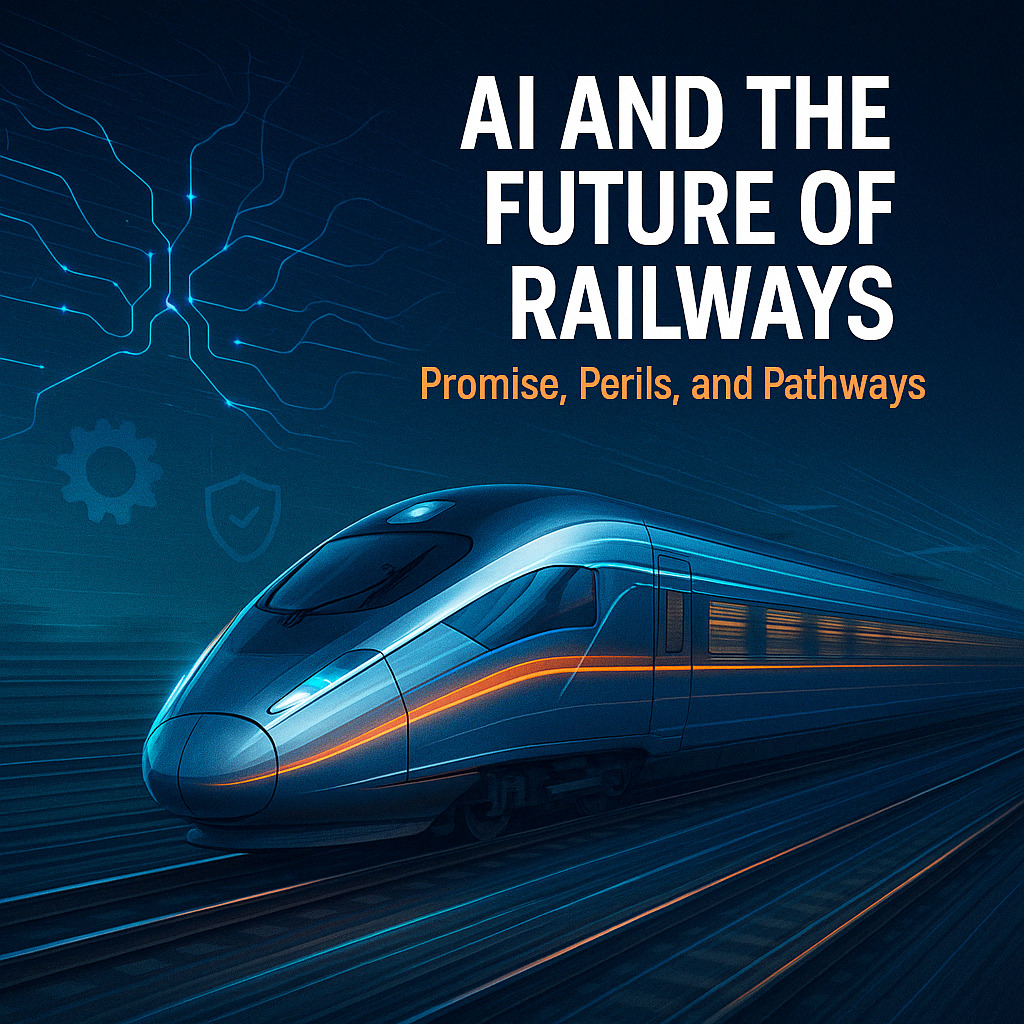
“The railway industry, one of the oldest enablers of industrial transformation, now stands on the cusp of another revolution—this time powered by Artificial Intelligence.”
From the steam engines of the 19th century to today’s high-speed trains, railways have been symbols of innovation. Now, as we move deeper into the 21st century, Artificial Intelligence (AI) promises to redefine how rail networks are managed, how trains are operated, and how passengers experience travel.
But like every major transformation, the rise of AI in railway transportation is not without its challenges. The genesis of this article stems from the fact that I started my work life in the Indian Railways Service of Mechanical Engineers nearly half a century back. More recently when I was doing a Wharton Business School program on AI applications, the idea of this piece came to me.
In this article, I have tried to explore the promise, perils, and pathways of integrating AI into one of the most vital sectors of modern infrastructure, particularly for a dense population country like India.
***
🚄The Promise: Efficiency, Safety, and Customer Experience
AI does hold considerable potential to make a high-density transportation mode like the Railways smarter, safer, and more responsive. Here are just a few areas where the promise can be seen:
Predictive Maintenance: Machine learning models can analyze vibration, temperature, and operational data to detect potential failures before they occur—reducing costly downtime and enhancing safety.
Predictive maintenance, powered by sensor analytics and machine learning, are reducing unplanned downtime by up to 30% in Germany (Deutsche Bahn). In India, AI-equipped SMART coaches can now monitor vibrations, structural wear, and staff behavior, leading to substantial maintenance savings and enhanced safety.
Optimized Scheduling and Routing: AI can dynamically adjust train schedules based on real-time data—weather, demand, or disruptions—minimizing delays and maximizing throughput.
In dense rail networks like India’s or Japan’s, such precision translates into better asset utilization, optimized route rationalization, and more efficient capacity deployment.
Safety and Reliability: AI enhances safety through real-time monitoring and automated diagnostics. Computer vision systems are today identifying track defects, unauthorized access, and obstacles with over 90% accuracy. AI-powered drones can now inspect tracks and overhead equipment faster than traditional crews, improving both safety and inspection efficiency.
Train operations benefit from AI-assisted driver alertness monitoring and automatic braking recommendations based on track conditions. These advancements reduce human error—still a leading cause of railway incidents.
Passenger Experience and Multimodal Connectivity: In many places, AI-driven chatbots and journey planners have started offering personalized updates, route alternatives, and digital ticketing, improving passenger convenience. Integrating railways with buses, metros, and even micro-mobility options via AI platforms is enabling seamless urban mobility. In megacities, this creates rail-centric multimodal ecosystems where trains form the backbone of transportation.
Smart Ticketing and Crowd Management: With the use of computer vision and behavioural analytics, Railways can monitor crowd flows in stations and adjust boarding strategies in real time, improving passenger experience and safety.
Energy Efficiency: AI-powered driving systems can optimize acceleration and braking, saving energy and reducing emissions—a critical benefit as Railways strive to meet sustainability goals.
Environmental Sustainability: AI can help Railways fine-tune energy use by adjusting acceleration, coasting, and braking in real time, reducing fuel and electricity consumption.
When paired with green innovations like hydrogen-powered trains—such as Germany’s Coradia iLint and the US’s ZEMU—railways can become even more climate-friendly, especially in non-electrified regions
In short, AI can turn data into decisions—at scale and in real time.
***
⚠️The Perils: Bias, Job Displacement, and System Vulnerabilities
Yet, for all its promise, AI also brings forth complex challenges that Railway systems must navigate with care. Let us try and understand what these are.
Algorithmic Bias: AI systems are only as unbiased as the data they’re trained on. In Railways, there is a high chance this could lead to unfair prioritization of certain routes or populations. This is because of historical inequities that are embedded in the stored data.
Job Displacement: As AI would continue to automate driving, monitoring, scheduling, maintenance and customer service, several roles would become redundant. While this may lead to job displacement in the short term, it will also create new roles in data science, system integration, and AI governance.
This is where visionary leadership would come in to shift focus and resources relating to reskilling, transitioning and to answer the more fundamental question about the human cost of automation.
High Implementation Costs: AI deployment demands hefty upfront investment in digital infrastructure—sensors, data platforms, training, and cybersecurity. For developing economies like India, justifying these expenses against long-term gains poses a financial and strategic challenge. This is also where a visionary leadership needs to come in.
Cybersecurity Risks and systemic reliability: Risks would surely go up as a more digitized and AI-integrated Railways system would become an attractive target for cyberattacks. A breach in an AI-driven control system could have dangerous and far-reaching consequences.
Reliance on AI systems thus must be balanced with robust fail-safes by strong governance and redundancy protocols.
Public Trust and Ethics: AI in public infrastructure must be transparent and accountable. Otherwise, trust erodes—especially if systems malfunction or make controversial decisions without human oversight.
The above risks underscore the need for careful design, regulation, and human-in-the-loop systems.
***
Railways vs Other Transport Modes: A Comparative Snapshot
Factor
Railways (AI-enhanced)
Road Transport
Air Transport
Cost
Low per ton/km for freight
High due to fuel and labor
Highest operational cost
Environmental Impact
Low (electrified or hydrogen)
High (diesel trucks)
Very high (jet fuel)
Convenience
Ideal for dense corridors
Flexible last-mile service
Speed for long distances
Railways, strengthened by AI, would thus remain the most cost-effective and sustainable mode for high-density freight and passenger volumes. Hydrogen trains further extend these advantages to non-electrified routes.
***
🧭The Pathways: Navigating the AI Railway Future
So, how can the Railways harness AI’s promise while avoiding its perils? The following thoughts come to mind.
1. Adopt a Human-Centric Approach: AI should always be viewed as an Enabler, not a Replacer of human expertise. Railways systems should ensure the centrality of human judgment, ethics, and oversight; this becomes particularly important in safety-critical functions.
2. Invest in Digital Infrastructure: To unlock AI’s power, the Railway systems would need high-quality data, real-time connectivity, and interoperable platforms. One can well envisage that Digital twins, Edge computing, and IoT-enabled trains would form the backbone of AI-enabled rail networks in the future.
3. Prioritize Ethics and Explainability: AI based decisions need to necessarily be transparent and explainable. Regulators and the Railways need to work together to ensure AI systems meet public standards of fairness, accountability, and non-discrimination.
4. Reskill and Redesign Work: The rise of AI urgently calls for a parallel investment in people—training them to work with AI tools, interpreting machine insights, and contributing to higher-value tasks. Railway jobs and functions need to evolve, not disappear.
5. Collaborate Across Sectors: The Railways need tocollaboratewith the private sector vendors and suppliers, technology companies, and researchers to create standards, protocols, and governance models that ensure responsible innovation.
***
🚉Need for a New Era of Railways Leadership
Integrating AI into Railway transportation is not merely a technological shift—it’s a leadership challenge. It requires vision, ethics, inclusiveness, and a commitment to long-term impact.
As Railway systems worldwide experiment with smart stations, autonomous maintenance, and AI-based scheduling, one thing is clear: those who navigate this transformation thoughtfully will shape the future of mobility.
***
Future Outlook: Smarter, Cleaner Railways
Over the next 3 to 5 years, we’ll surely witness:
Autonomous train operations with AI-powered dispatch and navigation.
Real-time dynamic pricing to optimize demand and revenue.
Prototypes of hydrogen-electric hybrid locomotives becoming mainstream in Europe, North America, and parts of Asia.
AI-enhanced simulation systems to train staff and emergency responders.
Railways stand at a unique inflection point. From my own early days in the Indian Railway Service of Mechanical Engineers, I’ve seen the disruption from steam to diesel-electric and now to AI and hydrogen. With the right investments, policy frameworks, and workforce strategies, the railways of tomorrow will be not just faster or cleaner—but smarter
Final Thoughts
The train to the future has already left the station. The question is:Are we building the right tracks for it?
If you’re working in transportation, AI, or infrastructure, or remain interested and curious about these domains, I would love to hear your thoughts. How is AI showing up in your work? What opportunities—or concerns—are you seeing? Let’s build the conversation together.
I had posted on a similar topic a couple of years back, but in a different context. It was based on an interaction I had with a participant in a workshop I had conducted then.
Interestingly, I was recently invited by the Goa Business School, Goa University to speak on the same topic. What we were really looking at is succeeding in an environment that is constantly changing and being disrupted. By new technologies like AI, new competitors, new business processes. The question for us was, ‘So what does one do to win?’
I related a story from my own professional life.
In a past assignment, I was managing a Travel & Destination services t company. One of our major customer accounts was the national petroleum development organisation and because of the large business quantum, we had an implant operation with a dedicated team. Our service and response levels were appreciated by the client.
As our contract period was ending, the company released a tender for a subsequent period. Believing the client was happy with us, we submitted our competitive offer in line with what we had done during our last successful bid. When the tender was finalised, we were shocked to know that we had lost. When we asked the client’s commercial team, we were informed that we had not complied with the technical terms of the bid. Going back to the drawing board, we found that in the tender document, there had been a small section requiring development and implementation of a Travel management Services, TMS in short, software as part of the client’s intranet, which we had not responded to.
Soon, we had the opportunity to bid against a tender released by the National Gas Company. We noticed that in this tender document too, there was a requirement of implementing a TMS software. This time we were careful enough to comply with the requirement by indicating our willingness to develop. But we again lost the tender! The winner was a competitor who already possessed a fully developed TMS module and had provided a live demonstration of the same to the client.
We had been disrupted. By a new technology, a new competitor, which together had disrupted our traditional business mode, a model which had worked well all these years. The world had shifted, the business need in the environment had changed and the earlier alignment which our company’s competence set had with the environment, had been lost.
**
In 1849, French writer Jean-Baptiste Alphonse Karr wrote, “plus ça change, plus c’est la même chose” which in English translates to “the more things change, the more they stay the same.”
The above perspective is possibly at the heart of why we get disrupted. The human mind loves continuity and certainty. These allow us to make sense of what we see as stuff we are familiar with, which our brain does using mind models based on our past experiences. But what happens when we are faced with something we have never encountered before? Our brains somehow try to force fit these unknown inputs into one of our mind models. Even though we remain unaware, this ‘force fit’ sense making process leads to the observed inputs getting distorted, some parts get amplified while others which do not fit, get discarded. Thus, when we probabilistically try to predict, often we fail and get disrupted.
The disruptive world allows us to reside in a narrow band in the present with a hazy and uncertain future in front and the inability to take recourse of the past. Thus to successfully negotiate we need to shift away from our usual probability-based mindset into a mindset of possibilities.
In the session I showcased certain action steps which would support us to do the shift.
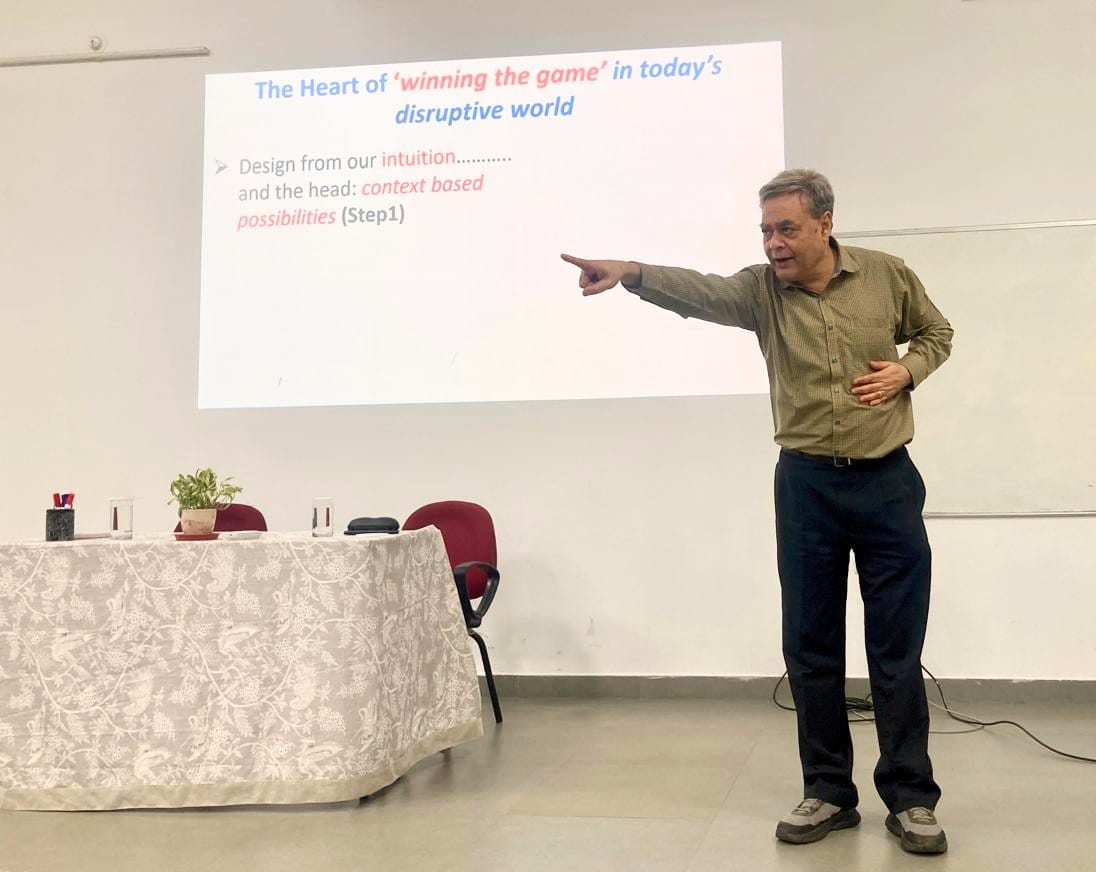
I got around to explaining that the first Action step is to create a context for ourselves within our own domain through using hard trends in three areas viz. Demographics, Regulatory and Technology (DRT Context). The hard trends that we uncover become the framework of the context we are creating. Our context would allow us to view every situation in a particular manner.
At this juncture a participant asked for this step to be shown through a case study or live example. I elaborated using the example of the Aviation Industry.
Demographics: Major customer profile shift is occurring viz. growth of young budget traveller and the elderly. Communication technologies is leading to the decline of Business travel. Climate change is shifting the seasonality of leisure travel. Customer behavior is also changing, with short booking windows—often a week or two with fewer travelers making plans far in advance.
Regulatory: Climate change is leading to increased incidences of air borne diseases requiring changes in booking process e.g. Pre-flight testing, need for registration of previous and past travel etc. Technology is allowing airlines to have seamless connectivity within the travel ecosystem to increase demand + assist governments and regulators in creating worldwide / regional standards for hygiene as well as operations.
Technology: Integrated and contact less handling at the airport regarding access viz. boarding pass issual, traveller identification through eye scans, baggage check-in etc. Seat allotment keeping in mind traveler profile, past medical history etc.
Action Step 2 is about using our above created DRT context to make three lists. List of all that we are certain of, list of things we know, and list of things we can do. If we put in the requisite time to make the lists, new possibilities would start showing up for us, a reflection of our improved competence to shift into a possibility mindset.
Action Step 3 is about further sharpening the saw for possibility mindset creation. We do that by unplugging ourself from our present clutter and challenges, then plugging ourself into the future and then use the ‘hard trend’ context created in Step 1, the 3 lists of being certain, knowing and doing ability in Step 2 to do anticipatory & future back thinking through a structured enquiry.
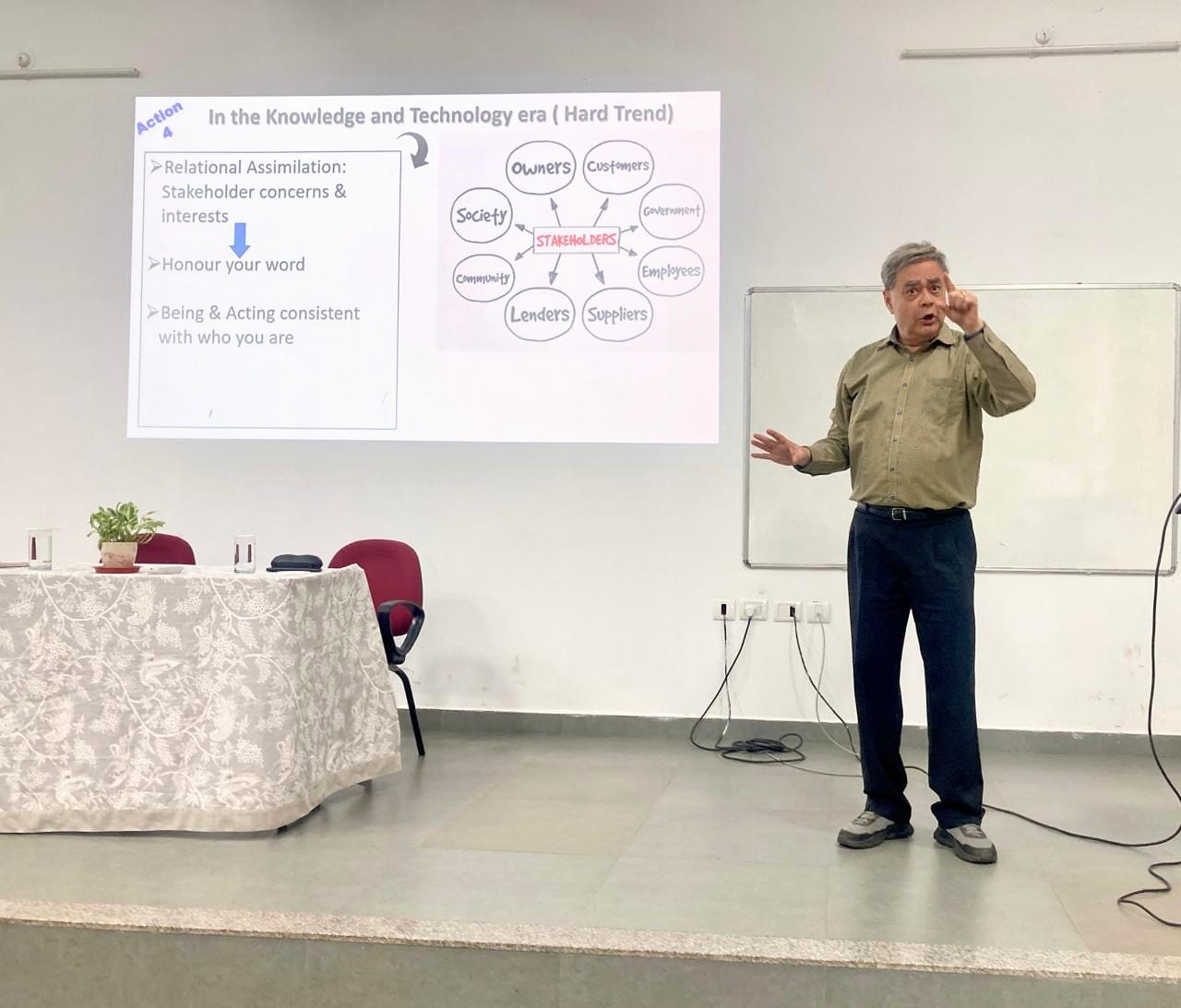
Action Step 4 is about Relational Assimilation which is identifying and defining groups relevant to our business and optimising the group boundary level interactions to advance our own interests. It thus is all about addressing stakeholder concerns. So, who are these stakeholders? They are wide ranging entities. Starting from the company Owners. Employees, who are the internal stakeholders to Customers, suppliers, our banks and financiers- our external stakeholders. But we also have environmental stakeholders viz. local community, society at large and the Government and regulatory authorities. Each of the stakeholders impact the organisation and ourselves in some way, some directly, others indirectly. To ensure effective relational assimilation, we need to exhibit certain qualities in our interactions.
Honouring or Integity of our word. Have we ever considered the fact that we are really equal to your word, nothing more , nothing less? We might see ourself as an individual with certain looks, qualifications, competencies etc. But to the outside world, we are perceived as our word. So, what is ‘Honouring our word’? This means keeping our word and as soon as we realize we are not able to do so, we need to inform all effected parties that we cannot keep our word within the time frame indicated earlier, offer a new time frame to do it and declare that we would take care of the consequences if any, of not keeping our word as per the earlier indicated time frame.
Can you see from what I just said that while it is not possible to keep our word under different situations, we can always ensure that we honour our word?
Being and acting consistent with who you are: This is all about being authentic. Bill George, former CEO, Medtronics and Professor of Leadership at Harvard Business School, concluded, “After years of studying leaders and their traits, I believe that Leadership begins and ends with authenticity.”
So how does one improve one’s own authenticity? Simply put, it is by being authentic about our inauthenticities’. We need to be publicly authentic about our inauthenticity with those around us for whom this inauthenticity matters.
Listening with no intention, no judgment, no Right or Wrong:. This is called Active Listening. A special kind of listening that we use to allow the speaker to articulate his or her own strongly held positions, views, rationalisations, justifications and unexamined beliefs. When we engage in active listening, we do it without colouring our own mind with our own intention, own judgments and our own views about what is being said being right or wrong. You could start with practicing active listening once a day and then slowly increasing the number till the trait becomes part of you.
As you make Integrity, Authenticity and Active Listening part of your repertoire for dealing with your stakeholders, you will see the significant upswing in empathy, respect and trust in your dealings. Action 4 is thus the catalyzing agent to ensure the achievement of the action steps you had created based on the first 3 actions.
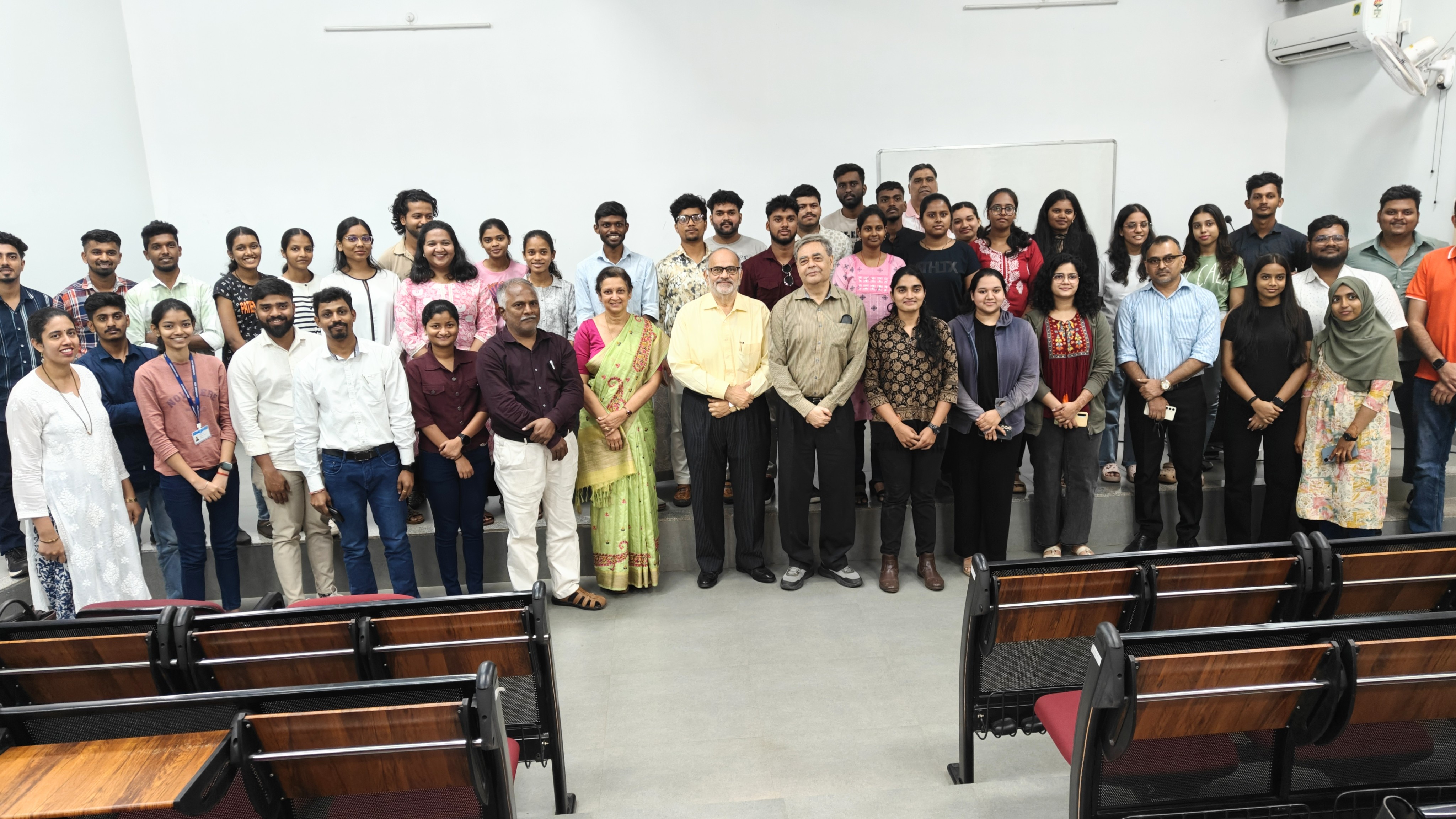
With the participants
**
In the ultimate analysis, Winning in a disruptive world is all about that ability to See, Comprehend & therefore Interact with life (and situation) differently than most people do. ‘Winners of a disruptive worldSEE….and come to live in a different world.
In today’s fast changing world, we are almost always confronted by situations about which we lack past experience to engage or resolve. We try to force fit some past learning and end up either failing to get an outcome, or if lucky, achieving part success.
In a past assignment, I was managing a Travel & Destination services management company. One of our major customer accounts was the national petroleum development organisation and because of the large business quantum, we had an implant operation with a dedicated team. Our service and response levels were appreciated by the client.
In line with the commercial norms, as our contract period was coming to an end, the company released a tender for a subsequent period. Believing the client was happy with us, we submitted our competitive offer in line with what we had done during our last successful bid. When the tender was finalised, we were shocked to know that we had lost. When we asked the client company’s commercial team, we were informed that we had not complied with the technical terms of the bid. Going back to the drawing board, so to say, our analysis of the tender document revealed that there had been a small section requiring development and implementation of a Travel management Services (TMS in short) software as part of the client’s intranet, which we had not responded to.
Soon, we had the opportunity to bid against a tender released by the National Gas Company. We noticed that in this tender document too, there was a requirement of implementing a TMS software. This time we were careful enough to comply with the requirement by indicating our willingness to develop. But we again lost the tender! The winner was a competitor who already possessed a fully developed TMS module and had provided a live demonstration of the same to the client.
We had been disrupted. By a new technology, a new competitor, which together had disrupted our traditional business model. The world had shifted, the business need in the environment had changed and the earlier alignment of the latter with the competence set of our company had been lost.
A situation like the above can create a quandary for each one of us. Should we stretch our own competence and experience profile to paper over the gaps that exist because of the changed requirement? This usually is the easy and the quickest option, and thus gets chosen by most leaders and Managers. But the more sustainable and resilient pathway, a much tougher and thus rarely taken option, is to continually equip oneself with the needed competences so that the alignment between us and a world that is shifting, is not lost.
What I have frequently noticed is leadership folks, rather than confronting, resort to whining and complaining. Of how no one could have foreseen what happened, how they had planned and were equipped to handle what did not happen, and so on.
If we are not careful, we can end up in a downward spiral of negativity. I have seen leaders ending as black holes. With a huge gap between their original intention and final impact. This is largely because of a human psychology quirk. The more we talk of something we failed to do, the more important it becomes. As Noble Prize winner Daniel Kahneman said, ‘Nothing in life is as important as you think it is, while you are thinking about it’.
Ways to avoid the Black Hole:
Ask, “What can we do to resolve?” Wait for a positive response. We are conditioned to put effort once we commit.
Envision a future that was not going to happen anyway. Ask, “If things were going flawlessly, what would that look like?”
We were engaged in a MENA region Business expansion consultancy project for a client organisation (name withheld) in Dubai. Being time bound, our team was depending on the client for getting certain ground assessments and data to do a competitive audit and recommendation set.
Interestingly, the common refrain by the client personnel was that the competitive situation was shifting fast in terms of relative importance and data points. It was thus difficult to provide accurate ground assessments.
One day over coffee, I got to discuss about the Business implementation with Darius, the Business Development Manager responsible for the project.
“In your view, what is the kind of Leadership needed for successful implementation in our kind of fast changing environment?” Darius asked.
“And where would you like to see Leadership being exercised in your kind of situation?” My response was a return question.
“Well, I suppose leadership needs to ‘lead’ us from where we currently are to where we are proposing to be”, replied Darius.
I could not agree more. Leadership indeed needs to reside in the gap between one’s current state and the state one aspires for. But then how does Leadership set the organisation on the right pathway? In today’s increasingly disruptive and discontinuous world, the luxury of a fixated, ‘past experience driven’ journey with a visible future at the other end, is no longer available. If at all, present times require the ability and mindset to get off that beaten path and into the unknown forest area, so to say.
I said as much to Darius.
As if reading my thoughts, Darius asked, “So what might be the leadership mindset needed to eke out a new path through the forest trees you spoke of?”
“That is a great question”, I acknowledged. “I can think of one. Which I would term as ‘your comfort with ignorance’. You need to be comfortable with the knowledge that you ‘do not know’. Only then will you able to unearth and visualize new possibilities. Without this there can be no growth in a disruptive world.”
Somewhat later, when I sat thinking about our conversation, two other aspects came to mind.
First, a mindset to accept failures. We need to accept failure as an intrinsic part of who we are. In an uncertain world with no past experience to guide us through the discontinuity of the ‘forest trees’, it is only mistakes and failures which become the building blocks of eventual success.
Secondly, a more controversial but nonetheless critical ability to wear a ‘mask of yet to be internalised behaviours’. We need to fake the needed leadership behaviours, if necessary, before they become an intrinsic part of us.
I would like to term the above as the CAM mindset shift, to use an acronym.
Comfort with ignorance
Acceptance of failure
Mask yet-to-be internalised behaviours
So how might you grow your leadership in today’s disruptive worl
Do you remain dissatisfied and uncertain about how to face emerging situations and challenges in today’s fast-changing world?
Do you frequently get the sense that however hard you or your team are trying, there seems to be always someone ahead of you and winning?
As you resolve a problem or a challenge, do you get confronted by fresh ones?
Are you frequently unable to prioritize which problem to tackle first?
However much you strive, are you unable to see the big picture and align yourself and your team with that?
….. And on a more personal level:
Do you want to get that job or assignment that you have been trying?
Do you want to get that promotion and recognition you have been aspiring for?
If you have been plagued by one or more of the above questions, the Winning in a Disruptive Worldprogram might just be what you need to improve your winnability quotient in today’s world.
The fact is that our present world is constantly getting disrupted. By new technologies, new competitors, or other factors that can disrupt traditional business models. The disruptive world with its VUCA (Volatile, Uncertain, Complex, Ambiguous) characteristics allows us to reside in a significantly narrow band in the present with a hazy and uncertain future in front and the inability to take recourse of our past experience.
Conceived and developed based on workshops and programs conducted for leading organisations and Business Schools, the course showcases the major types of disruptions that are shaping the world. You, as the participant, would gain an insight into what leads to us getting disrupted. You would review the process followed by a probability-based mindset and the need to shift to a possibility-based mindset to be able to better handle disruptions. You would practice and gain proficiency in the five action steps for the needed shift by conducting in-depth Inquiry through a structured process.
Creation of a context by using hard trends in three areas.
Creation of the three lists.
‘Plug into the future’.
Relational assimilation through a triad of competencies.












 A New Beginning