
How do you maximise Your Professional Success?

What is that which blocks you from achieving professional success? What practices could you adopt to remove such blocks and maximise your potential?


‘Your limitation – it’s only your imagination’

Are you aware of what professional success would look like for you in terms of your performance, career and life ? What is that which blocks you from achieving professional success? What practices could you adopt to remove such blocks and maximise your potential?

Maximising our professional success is never about what impacts us but our response to that. We never see the world as it is, we see it and respond to it as it occurs for us.

We remain unaware that our listening ( or for that matter seeing, understanding, interpreting) is not an empty vessel, not a blank slate. We assume that whatever someone says to us (that is, what enters our ears) registers in our listening (lands for us) exactly as it was said. This is never so and this is what constrains and distorts our perceptions and actions.

Professional Success is thus really about creating a context that could empower you towards a future that you would like to achieve. What could be the elements of such a context?

Professional Success is also about moving up the effectiveness ladder in terms of  how you contribute viz. Doing it under supervision to doing it independently to doing it through others to setting a strategic direction. As you move up in this manner, your contribution expands in terms of your influence, perspective,complexity and impact.
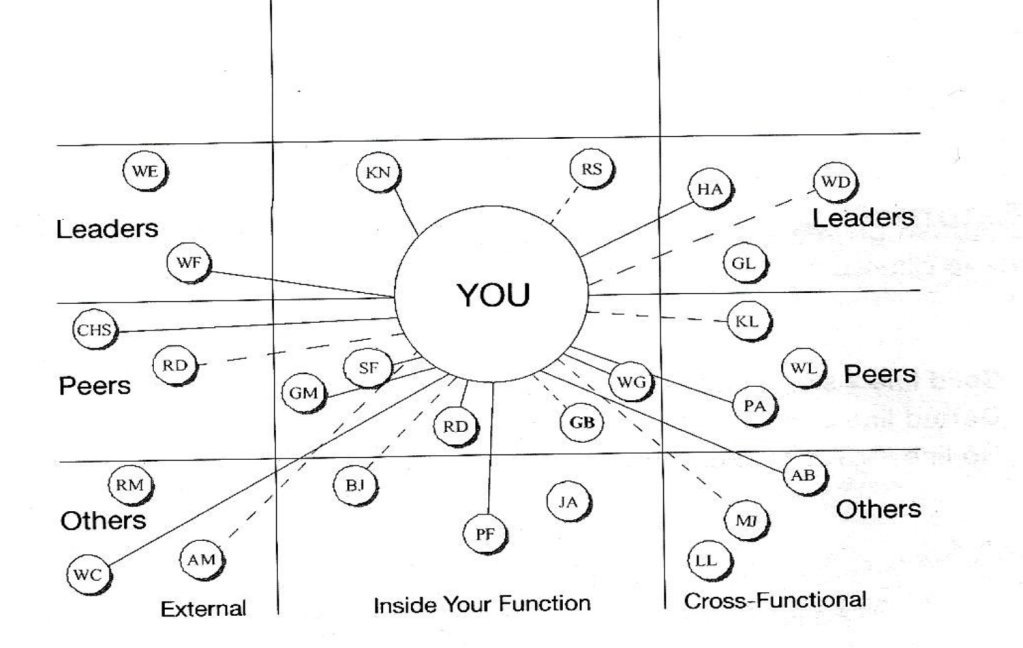
Your Stakeholding network

To maximise your professional success I invite you to deliberate and try and answer the following.

  • What mental attitude and skills would you need to develop to be able to progress through the above stages?  
  • What kind of a risk-taking style do you have and how does it support your development? How could you change your risk-taking style in order to further increase your effectiveness?
  • What patterns do you see among those with whom you have the strongest relationships? What patterns do you see among those with whom you do not have the strongest relationships, or any at all?
  • Think about a person in your network with whom you have a strong relationship. What can you leverage in your relationship with this person to help you build or strengthen your relationship with others?
  • Choose one key person inside your network who, if you had a stronger relationship, could better support your effectiveness. What is the benefit of improving this relationship? What is the cost if you don’t? What if anything is getting in the way?
  • Choose one key person outside your network who, if you had a stronger relationship, could better support your effectiveness. What is the benefit of improving this relationship? What is the cost if you don’t? What if anything is getting in the way?

Should you wish to engage more, do visit:

http://www.empathinko.in/workshops/

In Learning…..

Shakti Ghosal

http://www.empathinko.in

Environment, disruption and you….

How to be an effective leader during accelerating change and disruption


Change is the only Constant. Or is it?

In my previous post, ‘Heralding the Twenties’ I had spoken of the Change Trap. To cope with an ever accelerating pace of change, we need to become someone or something we were never before. Which in turn leads to a negative impact on our creativity, performance and engagement. I had outlined a practice to avoid this negative impact.

As a changing environment and disruption touches us, we need to have a flexible surface to engage. Which essentially means the need to jettison our past derived rigidity and mindset. With accelerating change, our surface is always in a state of flux. For many if not most of us, this surface flux permeates inwards and starts effecting our core consisting of our values, our passions and relationships. This is when we fall into the Change trap.

Effective leadership in the midst of accelerating change and disruption starts with that changeless core containing your values, passions and relationships. You hold an enhanced awareness of these aspects. You then use these as guiding posts in your language and relationships. This becomes the basis for your effective tango with change and disruption.

An un-fixed and possibility-based mindset allows you to use future-based (rather than past-based) language with others.

If you already know based on your past experience, there is no place to change.

Be willing to reach out to others even if they are not seeking you.

Be willing to speak about the uncomfortable elephant in the room even if it disturbs a cosy status quo.

I invite you to think of and answer these questions in your dealings within your organisation and with team members.

  • What gets in your way of helping others who have taken on new and unknown challenges?
  • What language might you use with others which would ignite transformation?
  • What did you do that encouraged others to perform?

…… and more importantly,

  • What did you do that drained the energy of others?

Care to discuss on the above aspects further?

In learning………

Shakti Ghosal

http://www.empathinko.in

Heralding the Twenties


This image has an empty alt attribute; its file name is 2020s.jpg

“To improve is to change; to be perfect is to change often.”

 —Winston Churchill

We remain days away from entering a brand new decade.

A hundred years back, it was called the roaring twenties. An era of economic boom. What kind of twenties are we going to have this time?

I invite you to ponder on the above as also these questions. How would work change? What would create wealth? How would the exponential growth in 24 X 7 human connectivity through social media impact us and our lives?

We are into a world which is changing at an ever increasing pace. We need to continually become someone or something we never were before.

So what happens when we continually become someone or something we never were before? We feel discomfort, fear, uncertainty; we are on edge. How we feel impacts how we act, how we work. So being on edge with negative feelings as above leads to loss of creativity, inability to take risks, loss of productivity and engagement. And herein lies the danger of becoming someone or something we never were before. I call this the Change Trap.

So what could we do to avoid the Change Trap? Since it is difficult to control our feelings, we need to see how we could shift its impact on how we act, how we perform. One way of doing this is to focus inwards – into the kind of changeless core that we are and what makes us tick. Our big vision about the world and our self, our competences, our passions and our relationships.   

In the New Year, I invite you to do this practice for just the first fortnight to empower yourself and avoid the Change Trap. Write down the following in your diary every day for 15 days before you go to bed.

  1. When you were at your best today, what were you doing?
  2. When you saw your energy going up, what were you involved in ?
  3. When you felt happy helping someone, what did you do?

Should you persevere with this practise for a fortnight, you will notice how its impact changes your life and the world around you!

I wish you Merry Christmas and a lovely 2020 ahead.

In Learning…….

Shakti Ghosal

http://www.empathinko.in

Stakeholding


We are moving from a chain of command to a web of connection, from competition to collaboration, from markets to networks and stockholders to stakeholders, and greed to green.

 – Anodea Judith

Author & Evolutionary activist

Leadership speaks to Stakeholder, “Let us stand in the created future that wasn’t going to happen otherwise. A future which would address the core concerns of both of us. Let us take actions and decisions now to realize the future.”

At its essence Leadership remains an exercise in language which motivates all stakeholders to align into taking actions in the present to realise a common future.

I was recently engaged in a hub optimisation project for an orthopaedics implant supplier. It did not take too long for our team to work out the optimum inventory positions of around twenty thousand items as part of fifty kits. We were delighted to note that our recommendations held the potential of reducing the inventory carrying costs at the hubs by up to seventy per cent. The client’s corporate team was equally elated.  

I was therefore left disconcerted when a subsequent review revealed near zero implementation of the project recommendations and the associated cost savings. The Marketing team had effectively sabotaged the initiative. While the project criteria had been to ensure a 99% assurance of availability of all ortho kits, Marketing insisted that for its clients nothing below 100% was acceptable.

Looking back one could see that the project failed for its failure to identify ‘customer’ stakeholders like the Ortho surgeons and the hospital administrators and what might their pain points be.

Leadership in the new millennium is more about stakeholding than anything else. Today’s world is becoming increasingly granular. More and more individuals are jumping onto the technology bandwagon and getting networked with unknowable connections amongst them. And each of these ‘unknowable connections’ becomes a stakeholder with its ability to influence perceptions and thoughts.

Per Bak, the Danish Physicist, developed a theory of sand running through an hour glass. He concluded that while the sand pile seemed stable with a regulated sand flow, the pressures on each of the sand grains was constantly changing; the internal dynamics of the sand was complex, unknowable and could not be predicted.

The stakeholding world today is like that sand pile.It seems stable but in reality continues to shift in unknowable ways with instability being the only constant.

So how does one manoeuvre the unknowable, unpredictable quicksands of stakeholding? What can leadership do to ensure effective relational assimilation of all stakeholding concerns? You could make a good start with the following questions.

  • Who are your influencing stakeholders? They could be from your investors, your leaders, your staff, your customers, customers of your customers, your suppliers, your community, competitors, consumer groups, social media……. sounds daunting. doesn’t it? Well a good place to start is to observe the conversation networks and the language being used. Use this to discern the contradictions, conflicting ideas and harmonies that form part of the issue.
  • Ask of the identified influencing stakeholders about their interests and core concerns
  • What is the stakeholders’ critical analysis of the situation? How does the issue occur for them?
  • What solution hypotheses could you develop which could take care of the stakeholders’ interests and concerns?

In Learning……

Shakti Ghosal

http://www.empathinko.in

The Dynamics of Arrogance


Dear Reader,

I wish you an empowering and purposeful New Year.

As we get set to usher in a brand new 2019, I would like you to reflect on the following.

What could we do in a fast changing and complex world that would satisfy issues faced by our team?  How could we develop our relational intelligence to gain traction with stakeholders?  How could we construct a dynamic game plan to get our organisation shift from the present to the created future?

What if I told you that the key to each of the above questions lies in one specific aspect of our own personality? 

To understand this some more, let me tell you my own story.

As the business head, I was the top dog in the organisational hierarchy. I felt cocooned by the warm comfort of managers, supervisors and executives being there to do my bidding. Somewhere along the way, this ‘being there’ feeling changed into a ‘better than’ mindset. And this is when my leadership problems started.

This image has an empty alt attribute; its file name is bad-leadership.jpg
The being there mindset

I began to think of myself as superior. I thought that as a Leader I had to be! And this led to my being arrogant. Over time this became my garb. ‘I had to use every opportunity to make all these little people understand that I was simply better than they were!’ I could just not afford not to know everything there was to know. So the arrogance led to my being inauthentic. Worse, the decision making increasingly started bordering on ‘my way or highway’. For accepting an outside possibility would undermine me would it not! This of course led to my becoming isolated.

Dynamics of Arrogance

My inauthenticity and isolation started eating into the organisation’s openness and team work. And when this impacted overall performance, the blame game hit the roof. With me of course doing most of the blaming!

The turning point came with the plummeting organisational performance. It took the shape of the following.

  • The advent of Self Awareness in me that “I need to curb this feeling of superiority that rears its head every time I interact”.
  • Getting my hands dirty by adopting a ‘walking and talking’ leadership style and thereby becoming curious about people, not results.
  • Practicing the Attitude of Gratitude, realizing how fortunate I have been in receiving support of others inspite of my shortcomings.
  • Leading with Generosity by jettisoning the fear of being taken advantage of. Realizing that even though I would be taken advantage of,  that would be better than being closed to openness and possibilities.

So in the New Year, what could each one of us do as leaders to jettison our superiority mindset and arrogance?

In Learning……..

Shakti Ghosal

Does learning lead to performance?


“An organization’s ability to learn, and translate that learning into action rapidly is the ultimate competitive advantage.” 

— Jack Welch, former General Electric CEO

In today’s disruptive and hyper competitive world, the need for learning new skills and competences come in continuous waves.  Such learning becomes more and more transitory as the skills and competences get replaced by new requirements and technology. There is widespread realisation that it is this increased capacity and hunger for such learning that provides Leadership with its “last frontier of business advantage”.

Because of the disruptive and accelerating changes all around, the capacity for self driven learning within a‘learning organisation’ culture could be the key differentiator. In the book‘The Six Disciplines of Breakthrough Learning’ its authors outline a process which they claim would add significant value to businesses through creation of such a ‘Learning culture’.

The 6D process goes through these stages.

  • Define Business outcomes rather than falling into the trap of defining Learning outcomes.
  • Design the Complete Experience rather than merely a learning event.
  • Deliver for application, which essentially means the learning in itself should motivate its application.
  • Drive Learning transfer. Possibly the most critical stage. This is when ‘Can I?’ shifts to ‘Will I?’
  • Deploy performance support to overcome the resistance mindset to change as one gets down to ‘doing it the new way’.
  • Document results. Did it achieve the results? Was it worth it?

 As I read the book, I am left pondering about what is it that stops organisations from adopting and applying the six disciplines as outlined.

Is it :

  • The absence of a link between what is learnt to how it would support one to personally succeed and get recognised?
  • The law of fast forgetting  one’s new learning  as one gets back into the comfortable rut of old ways?
  • The failure to shift from ‘Can I?’ to ‘Will I?’And the underlying reason for that?
  • The plethora of disparate factors  about one’s own motivation,  existing workflows and processes, the work place culture, the political, economic and social aspects?

If indeed there exist such a large number of factors which come in the way of learning transfer,what could be done to optimise performance? In such a situation, how could we shift people from being disengaged to be innovative, how could we transform an organisation to imbibe a learning mindset and be a leading edge innovator?

To be able to do the above Leadership too needs to Learn. Learn how to use future based generative language to articulate a future which addresses the concerns of all the above disparate stakeholders. A future into which everyone concerned comes to live into with learning and actions in the present to make the future happen.

In learning……..

Shakti Ghosal

Acknowledgement: “THE SIX DISCIPLINES OF BREAKTHROUGH LEARNING” How to Turn Training and Development Into Business Results by Calhoun W. Wick, Roy V. H. Pollock, Andrew Mc K. Jefferson, and Richard D. Flanagan. Published by John Wiley &Sons Inc., Hobokern, New Jersey 2015.

Does Leadership theory help Sales?


Leadership and Sales

Yesterday I got a call from the Training Manager of a leading pharmaceutical company. She wanted to know how a Leadership program could support the sales personnel to perform better.

“I do understand the importance of Leadership in rewriting the future of an organisation”, she said to me. “But to a sales guy all this seems airy fairy stuff with no value.  What he needs are tools and techniques which would allow him to effectively close some prospects and achieve his target.”

“So would that imply that the Sales personnel, in-spite of their selling experience and closeness to customers, are falling short of organisational expectations?”  I asked.

“Well that is what the corporate guys in Head Office seem to think”, the training manager confided.

I did not have the heart to tell her that the solution lay not in new tools and techniques but a shift in how and what shows up when confronted with a business challenge. And that in essence is what leadership is all about.

For a start, we need to un-hinge our self from a “fixated to the past” mindset.  To do that we need to first understand what this “fixated in the past” mindset is all about.

Our brains are hardwired to view an emerging situation through the lens of our past experiences.  What is merely needed is copy paste what worked in the past to find a solution in the future. We are thus conditioned to believe that a person with a ten year sales experience would perform better than someone with lesser experience.

But what the above mindset assumes is some kind of continuity of the environment and all that it represents.  The competition and its response. The buyer and his decision making behaviour. The technology and product gaps.  And so on.

The third millennium however is all about discontinuity, disruption and accelerating change. In every which way one could think of. Be it competition and emerging strategies, buyer psyche, technology and products. The beacons of our past experience are no longer effective to handle this.

So we come back to the aspects of Leadership that could support performance in this era of discontinuity, disruption and accelerating change. Be it in Sales or some other business domain.

  • The awareness that you do not know.  You cannot upgrade your performance if you already know all there is to know.
  • Say YES to being pushed away from the beaten track and into the discomfort of the unknown. It is such discomforts that unhinge you from fixated beliefs and mindsets.
  • Avoid assessments during a situation. This leads to hasty reactions based on the ‘what worked in the past’ mindset.   Effective reflection and assessment can only happen after a situation has occurred. And this is when the space for new learning opens up.


In Learning

Shakti Ghosal


The Millennial Leadership Series : How do you grow your leadership?


This is a question that I am frequently asked by the students of the two business schools where I am a visiting faculty. Knowing about my decades of corporate experience, they assume that I carry nuggets of experience based wisdom that can grow leadership. I do not have the heart to tell them that my so called “experience wisdom” seldom if at all played a role in my leadership initiatives. In fact if truth be told, my leadership situation most of the times was akin to, “I have no idea where I am going”.

Picture1

So how does one grow into great leadership?

Well for a start, one cannot think one’s way into great leadership.  It really comes down to putting our feet on the ground, being a “Do- er” under all situations, never mind the nay-sayers and doomsday prophets.  The essence really is “DOING”. We grow when we do things, as we tweak our path and approach intuitively.

Leadership is really about our impact on others. Many of us though confuse this with the great intentions that we hold.  But intentions, which is all about us, has little or no alignment with impact, which is all about others.  So how does one create this alignment? We do this by seeing our self through the eyes of those we serve. I like to see this as a kind of empathy working in reverse.

Literature is full of how empathy is an intrinsic part of great leadership.  Which is all about what we need to do with getting into the other person’s shoes and looking at a situation from his / her perspective. But how often do we think of allowing the other person to get into our shoes and providing a fresh perspective from our vantage point?

Feedback from others who watch our ability ( or otherwise!) to impact others is  really the fuel that can ignite our leadership transformation.

Ask the following questions of your team.

  • What did I do that led to a positive impact?
  • What did I do that negatively impacted the team’s initiative?
  • What Could I do better to encourage the team to perform?


………. In Learning

Shakti Ghosal


The Millennial Leadership Series : Core of Leadership transformation


The only way to change someone’s mind is to connect with them from the heart.”

– Rasheed Ogunlaru, Life Coach & Speaker


How-Well-Do-You-Use-the-Leadership-Skill-of-Empathy

Recently I had the opportunity to be a Master Mentor to a set of alumni mentors of a premier business school as part of its ambitious initiative to offer a Career Support Program for its graduating students.  As the master mentor, my role was really about ensuring the effectiveness of the mentoring process.

The alumni mentors had graduated from the same school few years back and were shaping up as young business leaders in the industry.

In one of my interactions, an alumni mentor mentioned that inspite of his efforts, he sensed a lack of openness and desire to engage from some of the students. I could sense his frustration of seeing his mentoring efforts becoming unproductive.

I asked, “What shows up when you think of your own leading ability?”

“Well, when I am able to influence and get things done”, he answered.

“… and when you see that happening, what behaviours do you display?” I continued.

Reflecting a bit, the mentor replied, “Well I believe I encourage people to take on new initiatives.”

I could sense the disparity between what the mentor believed he was committed to and the outcome that he was achieving. I avoided saying so.

Changing the track somewhat, I then asked, “What do you think gets in the way when you try to support others to take on new challenges?”

The alumni mentor responded almost immediately, “Well I think I need to be more empathetic and less of a stickler to holding people accountable.”

I thanked him for this great insight.

***********

As a Leader, Manager or Supervisor dealing with teams tasked to produce outcomes, we get conditioned to link results to all that is happening outside us. So tracking people, their performance and holding them accountable comes naturally to us. Very seldom do we look inside our own selves to determine whether the way we speak, listen and act could have a bearing on our team member’s performance. This is where the power of empathy steps in.

In the disruptive world that we live in, where past performance has less and less traction for the future, Leaders need to anchor more within, with empathy at the core of growth and transformation.

  • What might you do today to focus on building trust through empathy?
  • How could you be a ‘success enabler’ of people by proactively removing barriers out of their way?
  • How could you be a sounding board for people to come to, so that you could put them in a position to succeed?

In Learning

Shakti Ghosal


‘The more things change, the more they remain the same’


The more things change the more they remain the same


Have you been witness to the following situation in your workplace?

Team member speaks of things like: “We just do not have what it takes. It will not work out for us. We are more involved with internal politics and lack initiative. We are always behind and late in responding to competition. Our leaders just do not possess the calibre required.  We will only go down and down…….”

Leader responds with thoughts like : “ We have a mediocre set of people working here, they just do have the capability. We keep on training them , we involve them in decision making but they just don’t have any good ideas. We just cannot afford more expensive professionals so need to make do with such mediocrity. We are doing the best we can but our team is not upto the mark………….”

The perception about the problem and what is needed to remedy it is diametrically opposite in the minds of team member and the leader. What remains common for both the sides is the direction in which the organisation is heading, which is only downwards. Opposing perceptions, opposing prescriptions, same outcome!

In the words of Steve Zaffron and Dave Logan in The Three Laws of Performance:

“Everyone experiences a future in front of them, even though few could articulate it. The future lives at the gut level, we know it is what will happen. We call this the default future, and every person has one. And so does every organisation. We live into our default future unaware that by doing so, we are making it come about.

………….the same dynamic exists at the organisational level. Statistical evidence shows that most significant change efforts fail. This is because regardless of the Management interventions tried, the default futures of employees and leaders are still in place. The more things change, the more they stay the same.”

‘The more things change, the more they remain the same’

With the new millennium heralding an increasingly volatile, uncertain, complex and ambiguous (VUCA) environment, the tenets of Change Management as we know it, might not work.

So what is it that the millennial leader has to do to transform the situation and elevate performance?

 In Learning………………………………

Acknowledgement :  The Three Laws of Performance  by Steve Zaffron  & Dave Logan. Published by Jossey – Bass, CA , US.