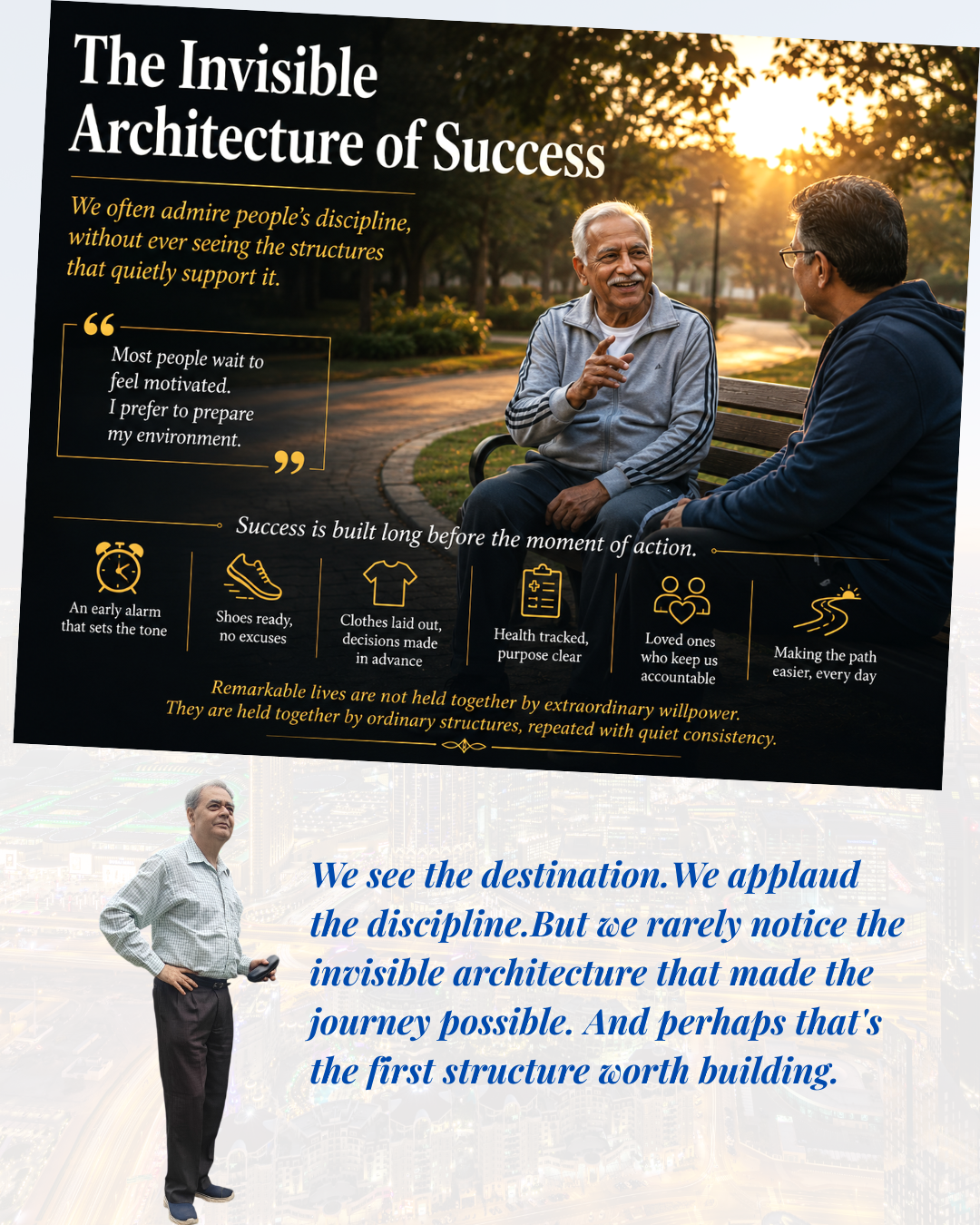

The Invisible Architecture of Success


We often admire people’s discipline, without ever seeing the structures that quietly support it.

Some months back, during my morning walks, I started noticing an elderly gentleman doing his exercises in the central garden of our residential complex.

He was there every day, almost at the same time and doing the same routine. For many mornings, I simply admired his discipline from a distance but one day, curiosity got the better of me. I wished  him ‘Good Morning’ and soon we were sitting on a nearby bench, I remarked, “I see that you have incredible willpower.”

At that, he laughed, “That’s what everyone thinks. But it isn’t really true. Not really.”

As I looked at him, puzzled, he pointed towards his wristwatch, “My alarm rings at five-thirty.”

“So does mine,” I smiled.

He continued, “My walking shoes are beside the bed every night. My exercise clothes are laid out before I go to sleep. My doctor expects to see my blood sugar readings every month. And my granddaughter has made me promise that I’ll be healthy enough to dance at her wedding.”

He paused, “Now tell me… where exactly does willpower come into the story?”

For a few moments, I didn’t have an answer. I seemed to have mistaken discipline for determination. What I was really seeing was structure.

As we got up to walk back to our respective towers, he said something that has stayed with me ever since, “Most people wait to feel motivated. I prefer to prepare my environment.”

That single sentence shifted my perspective. How often do we rely on willpower alone? We promise ourselves we’ll read more, exercise regularly, spend less time on our phones, learn a new skill. In my case, it is even, write that book. In your case, it might be to start that business.

Then, when our enthusiasm fades, we conclude that we lack discipline. Perhaps the problem isn’t our commitment. Perhaps, it’s our architecture. It became increasingly clear to me that our lives are already full of structures. Some quietly support the future we want. Others quietly support the habits we’re trying to leave behind.

Success is rarely built on one heroic act of determination. More often, it is built on dozens of small decisions made long before the moment of action arrives.

Before we parted, I thanked the gentleman for the conversation. He smiled and said, “People spend too much time trying to become stronger. They spend too little time making the path easier.”

As I walked home, I realised that remarkable lives are not held together by extraordinary willpower. They are held together by ordinary structures, repeated with quiet consistency. Perhaps that explains why success often looks effortless from a distance.

We see the destination.We applaud the discipline.But we rarely notice the invisible architecture that made the journey possible. And perhaps that’s the first structure worth building.

In musing…….                           Shakti Ghosal

Does learning lead to performance?


“An organization’s ability to learn, and translate that learning into action rapidly is the ultimate competitive advantage.” 

— Jack Welch, former General Electric CEO

In today’s disruptive and hyper competitive world, the need for learning new skills and competences come in continuous waves.  Such learning becomes more and more transitory as the skills and competences get replaced by new requirements and technology. There is widespread realisation that it is this increased capacity and hunger for such learning that provides Leadership with its “last frontier of business advantage”.

Because of the disruptive and accelerating changes all around, the capacity for self driven learning within a‘learning organisation’ culture could be the key differentiator. In the book‘The Six Disciplines of Breakthrough Learning’ its authors outline a process which they claim would add significant value to businesses through creation of such a ‘Learning culture’.

The 6D process goes through these stages.

  • Define Business outcomes rather than falling into the trap of defining Learning outcomes.
  • Design the Complete Experience rather than merely a learning event.
  • Deliver for application, which essentially means the learning in itself should motivate its application.
  • Drive Learning transfer. Possibly the most critical stage. This is when ‘Can I?’ shifts to ‘Will I?’
  • Deploy performance support to overcome the resistance mindset to change as one gets down to ‘doing it the new way’.
  • Document results. Did it achieve the results? Was it worth it?

 As I read the book, I am left pondering about what is it that stops organisations from adopting and applying the six disciplines as outlined.

Is it :

  • The absence of a link between what is learnt to how it would support one to personally succeed and get recognised?
  • The law of fast forgetting  one’s new learning  as one gets back into the comfortable rut of old ways?
  • The failure to shift from ‘Can I?’ to ‘Will I?’And the underlying reason for that?
  • The plethora of disparate factors  about one’s own motivation,  existing workflows and processes, the work place culture, the political, economic and social aspects?

If indeed there exist such a large number of factors which come in the way of learning transfer,what could be done to optimise performance? In such a situation, how could we shift people from being disengaged to be innovative, how could we transform an organisation to imbibe a learning mindset and be a leading edge innovator?

To be able to do the above Leadership too needs to Learn. Learn how to use future based generative language to articulate a future which addresses the concerns of all the above disparate stakeholders. A future into which everyone concerned comes to live into with learning and actions in the present to make the future happen.

In learning……..

Shakti Ghosal

Acknowledgement: “THE SIX DISCIPLINES OF BREAKTHROUGH LEARNING” How to Turn Training and Development Into Business Results by Calhoun W. Wick, Roy V. H. Pollock, Andrew Mc K. Jefferson, and Richard D. Flanagan. Published by John Wiley &Sons Inc., Hobokern, New Jersey 2015.