
When Silence Speaks: The Voiceless and the Silenced


In an age of selective hearing, understanding whose voices are ignored—and whose are feared—reveals the deeper politics of power and truth.

Abstract

In a world overflowing with voices, some are never heard. Some are never allowed to speak. This article explores the crucial difference between those who are voiceless and those who are deliberately silenced. One group is ignored, the other is feared. Understanding this difference helps us see the mechanics of power, injustice, and the politics of listening in today’s world. As Noam Chomsky famously said, “The smart way to keep people passive and obedient is to strictly limit the spectrum of acceptable opinion, but allow very lively debate within that spectrum.”

**

The idea of this piece came to me when in a social media group discussion about the unevenness of spiritual access in India based on class, caste and privilege, someone quoted author Arundhati Roy’s quote that “There’s really no such thing as the ‘voiceless’. There are only the deliberately silenced, or the preferably unheard.”

The more I thought about what Arundhati had opined, the more I sensed that she had lumped two discrete aspects of our society into one.

What is being Voiceless?

I recall the first few days of India’s response to the COVID – 19 pandemic and the lockdown that ensued. When the country literally shut down with just four hours’ notice, millions of workers—daily wage earners, domestic helpers, factory hands—were stranded without transport, money, or food. With no options available and with little support, around 40 million workers began walking hundreds of kilometres back to their villages. What came to be known as the great migrant crisis of the pandemic.

The workers weren’t silent, in fact far from it. They shared stories, walked in mass protests, called journalists. But their pain barely entered the official narrative. The crisis was, for a time, treated like an unfortunate footnote in a larger national story.

Migrant workers during pandemic

“The working class was not just unseen—they were not considered,” wrote Harsh Mander in The Indian Express. “It was a failure of both empathy and accountability.”

These were people whose voices weren’t suppressed, but simply didn’t count. That’s what it means to be voiceless.

As sociologist Michael Schudson put it, “Communication is a resource distributed as unequally as income or education.” Some voices simply don’t travel—not because they’re weak, but because the world refuses to hear them. This is indeed ironic in an age in which speaking up in fact has never been easier. Through the universal access to tweets, videos, blogs, and platforms are everywhere. But being heard? That’s something else entirely.

Being voiceless doesn’t mean someone has nothing to say. It means that what they say doesn’t register. Their stories don’t make the news. Their ideas don’t get invited to conferences. Their lives rarely shape policy decisions. They live in the blind spots of our systems. One of the main aspects which makes our society unequal.

Now let’s look at the aspect of those who Are the Silenced?

In 2017, the gruesome assassination of Gauri Lankesh hit the headlines in India. A fearless journalist and activist, Lankesh had been a sharp critic of communal violence, right-wing extremism, and state-sponsored misinformation. Her Kannada weekly, Gauri Lankesh Patrike, became a platform for truth-telling and resistance.

Gauri was shot dead outside her home in Bengaluru, her murder was not random—it was a warning.

Gauri Lankesh assassination

As journalist Rana Ayyub wrote: “Gauri’s crime was that she refused to be quiet.”

Gauri Lankesh had a platform. She was being heard. And that is exactly why she was targeted. She wasn’t voiceless. She was silenced because her voice made those in power uncomfortable. To those in power, Gauri’s voice had become too powerful; her words shone light on dark places, threatened the status quo, exposed inconvenient truths.

A recent report by the Committee to Protect Journalists ( CPJ) noted that a record number of journalists were jailed in 2022—not for false reporting, but for exposing the truth. As the CPJ observed: “Censorship is no longer enough; silencing must be enforced.”

Can we now see the intrinsic difference between those who are voiceless, and those who are deliberately silenced? Some people, no matter how loudly they speak, never seem to matter. Others are quickly shut down because what they say matters too much. The first are ignored. The second are suppressed. And both are symptoms of a far deeper crisis of listening in our times.

 Why the Difference Matters

At first glance, both the voiceless and the silenced seem to suffer the same fate: not being heard. But the reasons behind their invisibility are fundamentally different.

  • The voiceless are ignored because they’re deemed irrelevant.
  • The silenced are suppressed because they’re considered dangerous.

One is a symptom of systemic neglect. The other, of deliberate fear.

Understanding this distinction is vital. It helps us recognize the difference between absence and erasure, between invisibility and targeting.

The Role of Selective Listening

Today, listening has become selective and often algorithmic. Digital platforms and connectivities are amplifying outrage, repetition, and ideology—not complexity, dissent, or nuance. In such a space, it’s easy for the voiceless to disappear into the margins, and for the silenced to be made invisible through force or discrediting.

As Noam Chomsky famously said, “The smart way to keep people passive and obedient is to strictly limit the spectrum of acceptable opinion, but allow very lively debate within that spectrum.”. As I thought of this, I could see the Voiceless and the Silenced at the two ends of the truth spectrum. Both represent ‘uncomfortable truths’ for the political dispensation and the administration. It is the centre space which holds the ‘comfortable truth’ which the powers that be would always support and push to expand. The voiceless never make it into that spectrum. The silenced try to expand their end, encroach into the ‘comfortable truth’ space and unfortunately end up paying  the price

So what can each one of us do?

We need to recognize that the difference between the voiceless and the silenced also changes how we respond. We might decide to support in the following manner.

  • The voiceless need amplification. Their stories must be brought to the centre. This would require better representation, inclusive platforms, and ethical journalism.
  • The silenced need protection. They must be defended by laws, by solidarity, and by public pressure. Their speech is often a warning bell the rest of us ignore at our own peril.

Both are vital to a functioning democracy. But only one—the silenced—reminds us that truth still threatens power.

In musing…….                                                           Shakti Ghosal

References

  1. Schudson, Michael. The Sociology of News. W. W. Norton & Company, 2000.
  2. Committee to Protect Journalists. Record Number of Journalists Jailed Worldwide. CPJ, 2022. https://cpj.org/reports/2022
  3. Chomsky, Noam. Media Control: The Spectacular Achievements of Propaganda. Seven Stories Press, 1997.
  4. Mander, Harsh. “Locked Down and Left Behind.” The Indian Express, May 2020.
  5. Ayyub, Rana. “Gauri Lankesh’s Murder Was Not an Aberration.” The Washington Post, Sept 2017

The ‘Puppy Dog Wag tail’ Syndrome: When the Need to Belong Undermines Authenticity


Abstract:

This article explores the social behavior commonly referred to as “Puppy Dog Wag Tail Syndrome”—where older individuals attempt to gain acceptance from younger social groups through excessive compliance, self-effacement, or mimicry, wagging one’s tail so to say! While this behavior stems from a natural human desire for belonging, it often compromises one’s authenticity and self-respect. Drawing from research in social psychology, this piece delves into the emotional drivers behind such behavior and advocates for embracing authenticity across generational lines.


Have you ever witnessed an elderly individual awkwardly trying to “blend in” with a younger group? Perhaps they crack out-of-place jokes, adopt unfamiliar slang, or seem constantly eager to please — laughing too hard, offering unsolicited help, or nervously seeking approval. This performative effort to fit in, often at the cost of dignity and self-awareness, is what might be called Puppy Dog Syndrome. Much like an over-eager pet desperate for affection, the individual’s behavior becomes centered around pleasing others, often sacrificing self-expression and confidence in the process.

While it may appear superficial on the surface, this behavior is rooted in something deeply human: the need to belong. Social psychologists Roy Baumeister and Mark Leary (1995) identified belongingness as a fundamental human motivation. Regardless of age, people crave connection, approval, and inclusion. Yet, when belonging feels uncertain — especially in cross-generational settings where values, cultural references, and energy levels diverge — the fear of exclusion can drive compensatory behaviors.

Older individuals, particularly in youth-dominated spaces like workplaces, social media platforms, or casual gatherings, may feel a loss of relevance or influence. In such settings, some try to gain favor by imitating youth or subordinating themselves — often unconsciously — in exchange for social acceptance. But the cost of such behavior can be significant. Carl Rogers, the humanistic psychologist, referred to this pattern as living according to “conditions of worth” — behaving in ways that earn external validation rather than expressing one’s true self.

This misalignment can take a psychological toll. A 2006 study by Kernis and Goldman found that chronic inauthenticity is associated with lower self-esteem, increased anxiety, and reduced life satisfaction. It’s a hollow kind of belonging that demands constant performance, rather than one built on mutual respect and individuality.

What’s most tragic about Puppy Dog Syndrome is that it often masks the rich experience, insight, and stability that older individuals have to offer. Rather than chasing youth, they might be better served — and more appreciated — by showing up as their authentic selves, offering perspective rather than parody.

Intergenerational engagement works best not through mimicry but through mutual curiosity and honesty. Younger generations often value authenticity more than they let on. There’s strength in standing tall in one’s own identity, wisdom in speaking with one’s own voice, and grace in not needing to follow the crowd.

In a world obsessed with fitting in, perhaps the most radical act is simply being yourself — fully, unapologetically, and without the need for approval.


References

  • Baumeister, R. F., & Leary, M. R. (1995). The need to belong: Desire for interpersonal attachments as a fundamental human motivation. Psychological Bulletin, 117(3), 497–529.
  • Kernis, M. H., & Goldman, B. M. (2006). A multicomponent conceptualization of authenticity: Theory and research. Advances in Experimental Social Psychology, 38, 283–357.
  • Rogers, C. R. (1959). A theory of therapy, personality and interpersonal relationships as developed in the client-centered framework. In S. Koch (Ed.), Psychology: A Study of a Science, Vol. 3. McGraw-Hill.

In musing……… Shakti Ghosal

How to improve Power Listening in today’s Disruptive World


Introduction

In today’s dynamic and disruptive world, where change is the only constant, the ability to listen deeply and effectively—what we call ‘Power Listening’—has become an essential leadership and personal development skill. To many of us, Listening occurs as a passive process. No one notices when we tune off, we also retain the luxury of judging what we are hearing. This is also why Listening is a complex and demanding skill that needs conscious effort and self-awareness. I have always found it difficult to listen to what is being said with no intention, no judgment, no right or wrong.

In a landscape characterized by rapid technological advancements, shifting economic paradigms, and evolving workplace dynamics, power listening enables leaders, professionals, and individuals to navigate complexities with greater clarity, empathy, and strategic foresight.

According to Zenger and Folkman (2016) in their Harvard Business Review article What Great Listeners Actually Do, great listening goes beyond simply being silent while others speak. It involves active engagement, thoughtful questioning, and creating a safe space for open dialogue. Similarly, in The Power of Listening in Leadership (Forbes, 2021), Kevin Kruse emphasizes that effective listening strengthens leadership presence and fosters trust in professional relationships.

Understanding the Challenges of Listening

Despite its fundamental role in communication, listening is often overshadowed by speaking. Many assume they are good listeners, yet, as I have realized through personal introspection, listening is fraught with unconscious biases, preconceptions, and cognitive distractions. Each individual listens for different reasons and in unique ways, influenced by past experiences, emotions, and personal filters.

Reflecting on my own listening tendencies, I recognize that my ability to listen deeply is not always consistent. My engagement in a conversation depends largely on three factors: (1) my genuine interest and curiosity in the subject matter, (2) the perceived relevance and importance of the topic to me, and (3) the significance of the speaker in my personal and professional life. In the absence of these factors, I have observed a decline in my listening quality, often succumbing to perceptual blocks such as impatience, judgment, and the urge to prepare my response rather than truly absorbing the speaker’s message.

The Value of Power Listening

Power listening goes beyond hearing words—it involves deep engagement, empathy, and a conscious effort to understand the speaker’s perspective. I have personally found that when practiced effectively, power listening yields several benefits:

  1. Building Trust and Confidence: A powerful listener enhances the self-worth of others, creating an environment of psychological safety where individuals feel valued and heard.
  2. Enhancing Leadership Effectiveness: Leaders who listen powerfully cultivate stronger relationships, inspire loyalty, and encourage collaboration. Employees and stakeholders gravitate towards those who make them feel understood.
  3. Facilitating Problem-Solving and Innovation: Power listening fosters a collaborative and open atmosphere, enabling teams to engage in meaningful dialogue and address complex challenges effectively.
  4. Encouraging a Growth Mindset: When leaders listen without judgment, they instill confidence in others, encouraging a culture of learning, experimentation, and continuous improvement.

A Plan to Enhance Power Listening Skills

One might ask the question, ‘So what kind of a plan one needs to become a power listener?’ My plan included the following steps:

  1. Develop Self-Awareness: I continuously assessed my natural listening tendencies, acknowledged biases, and consciously worked to overcome them.
  2. Identify Communication Gaps: By reflecting on daily interactions, I could recognize patterns where my listening faltered and I needed to refocus back.
  3. Practice Active Listening: I needed to implement the following techniques in my conversations:
    1. Attentiveness: Focus on the speaker’s words, emotions, and underlying intent.
    1. Empathy: Place myself in the speaker’s position, avoiding premature judgment.
    1. Validation: Reflect back to the speaker meaningful insights to acknowledge and appreciate the speaker’s perspective.
    1. Mental Clarity: Train myself to resist formulating responses while listening.
    1. Patience: Allow space for the speaker to elaborate without interruption.
    1. Encouragement: Reinforce the speaker’s strengths and motivate action.

The Emotional Impact of Being Heard

Listening is not just a transactional activity—it is deeply emotional and relational. When I am truly listened to, I experience a profound sense of connection, self-worth, and trust. The act of being heard or having ‘being gotten’ fulfills an intrinsic human need, fostering intimacy and mutual respect. Philosophers have long argued that being listened to is one of the most powerful affirmations of one’s existence. It provides the confidence to articulate thoughts, process challenges, and move forward with clarity and purpose.

Conclusion

In an era where distractions are rampant and attention spans are shrinking, power listening stands as a critical skill that differentiates effective leaders and impactful professionals. It is a skill that must be cultivated with intentionality, self-reflection, and consistent practice. By refining our listening abilities, we could aspire to become a more empathetic, perceptive, and influential leader—one who not only hears but truly understands and empowers others. In doing so, one would contribute to a more engaged, collaborative, and resilient world.

In Learning……                                                   Shakti Ghosal

References

  • Zenger, J., & Folkman, J. (2016). What Great Listeners Actually Do. Harvard Business Review. Retrieved from https://hbr.org
  • Kruse, K. (2021). The Power of Listening in Leadership. Forbes. Retrieved from https://www.forbes.com

#powerlistening, #leadershipeffectiveness, #disruptiveworld, #Zengerandfolkman,#Kruse, #Innovation,#growthmindset,#selfawareness, #communicationgaps, #activelistening,#empathy

Suns vs. Planets: Navigating Your Life’s Influences


“In life, we meet two kinds of people—those who shine like the sun, radiating wisdom and energy, often challenging yet deeply inspiring; and those who, like planets, reflect borrowed light, offering comfort but little growth. Choice remains ours- whether we choose to orbit the suns, or chase reflections.”

Life is a cosmic dance, a vast expanse where we cross paths with many kinds of people. Some shine with their own light—bright, intense, and sometimes difficult to stand too close to. They challenge us, push us beyond our comfort zones, which might make us feel humiliated or insecure. However they do ignite sparks of transformation within us. These are the suns—radiant sources of wisdom, energy, and inspiration.

Then there are those who do not generate their own light but instead reflect the glow of others. Like planets orbiting a star, they offer comfort, familiarity, and predictability. Their borrowed light may bring temporary warmth, but it does not fuel real growth. They move in predefined paths, circling endlessly, never venturing beyond what is known.

The question before us is simple yet profound: whom do we choose to orbit? Do we dare to brave the brilliance of the suns, knowing that their intensity might burn, but also illuminate new possibilities? Or do we settle for the steady, reflected glow of planets, avoiding discomfort but also forsaking true transformation?

The Challenge of the Suns

Suns in our lives come in many forms—mentors who push us to excel, leaders who challenge conventional thinking, friends who demand authenticity, or experiences that shatter complacency. These forces can be unsettling, their intensity requiring us to adapt, to evolve, and sometimes to withstand discomfort.

Yet, it is from these sources that we learn the most. They force us to question our assumptions, face our fears, and tap into strengths we never knew we possessed. They inspire us to expand our horizons, to break free from the gravitational pull of mediocrity, and to blaze our own trails. As Kouzes and Posner (2017) suggest in The Leadership Challenge, transformative leaders create environments where individuals are encouraged to experiment, innovate, and grow beyond their limitations.

The Sun: Steve Jobs and the Apple Revolution

Steve Jobs was a quintessential “sun”—intense, visionary, and sometimes difficult to work with. He challenged the status quo, demanding excellence from those around him. Many who worked closely with Jobs describe the experience as transformative, albeit tough. His relentless pursuit of innovation forced others to think differently, step beyond their comfort zones, and achieve greatness. Those who chose to stay in his orbit were often pushed to their limits but emerged stronger, more creative, and capable of making an impact.

Lesson: Following the light of a “sun” can be difficult, but it leads to extraordinary growth.

The Comfort of the Planets

Planets, on the other hand, offer familiarity. They provide steady companionship, reassuring words, and a sense of belonging. Their presence is not without valuable— at times we do need the comfort of the known, the stability of routine, the ease of like-minded company. However, if we linger too long in their orbit, we stagnate. The pursuit of borrowed light may seem safe, but it rarely leads to personal evolution.

Consider the case of corporate career paths. Many professionals spend decades in the same organization, never venturing beyond predefined career trajectories. They are competent and reliable but do not challenge existing structures. Meanwhile, those who step outside their comfort zones—whether by switching industries, seeking disruptive mentors, or engaging in lifelong learning—often experience exponential growth. Carol Dweck (2006), in her seminal work Mindset: The New Psychology of Success, emphasizes the importance of a growth mindset—embracing challenges, learning from criticism, and persisting in the face of setbacks.

The Planet: The Comfort of Routine in Corporate Careers

Consider an employee who has spent two decades in the same corporate job, doing well but never pushing beyond the familiar. He is competent, reliable, and comfortable in his position. However, his growth is limited—he reflects the expectations of his environment rather than shaping it. While his job provides security, he misses out on opportunities to innovate, learn new skills, or challenge himself.

Lesson: Comfort is not always conducive to progress. Staying in the orbit of planets can lead to stagnation.

Making the Choice

There is no right or wrong answer—only awareness. There are times in life when we need the warmth of planets, moments of rest and reassurance. But growth happens when we dare to reach for the suns. It is in their radiance that we find our own light, forging our path not as mere reflections but as luminous beings in our own right.

The choice is ours. Do we settle for the comfortable glow of borrowed light, or do we embrace the challenge of the suns, knowing that their brilliance will shape us into something greater?

In the grand design of the universe, we are not bound to any orbit. We are free to choose our celestial path. The only question that remains is—where will we set our course?

The Choice: Malala Yousafzai’s Defiance of the Status Quo

Malala Yousafzai, a young Pakistani girl, had a choice—to accept the constraints imposed by her environment (where education for girls was restricted) or to challenge the norms. She chose to orbit the “sun” of enlightenment, education, and progress, even at great personal risk. Today, she is a global advocate for education, inspiring millions.

Lesson: Choosing to orbit the “suns” of wisdom and progress, even in the face of adversity, can lead to transformational impact.

Conclusion

The world is full of both suns and planets, but ultimately, we decide which forces shape our journey. The challenge is to recognize when we are merely reflecting light and when we are generating our own. Growth, transformation, and true impact come from stepping into the orbit of those who challenge us, inspire us, and push us beyond our perceived limits.

 So, ask yourself—are you ready to seek the suns, even if their brilliance demands more of you? The answer will determine the trajectory of your life.

In Learning…….                                                                     Shakti Ghosal

References

  • Dweck, C. S. (2006). Mindset: The New Psychology of Success. Random House.
  • Kouzes, J. M., & Posner, B. Z. (2017). The Leadership Challenge: How to Make Extraordinary Things Happen in Organizations. Wiley.

How to Thrive Amid Disruption: Key Insights


 I had posted on a similar topic a couple of years back, but in a different context. It was based on an interaction I had with a participant in a workshop I had conducted then.

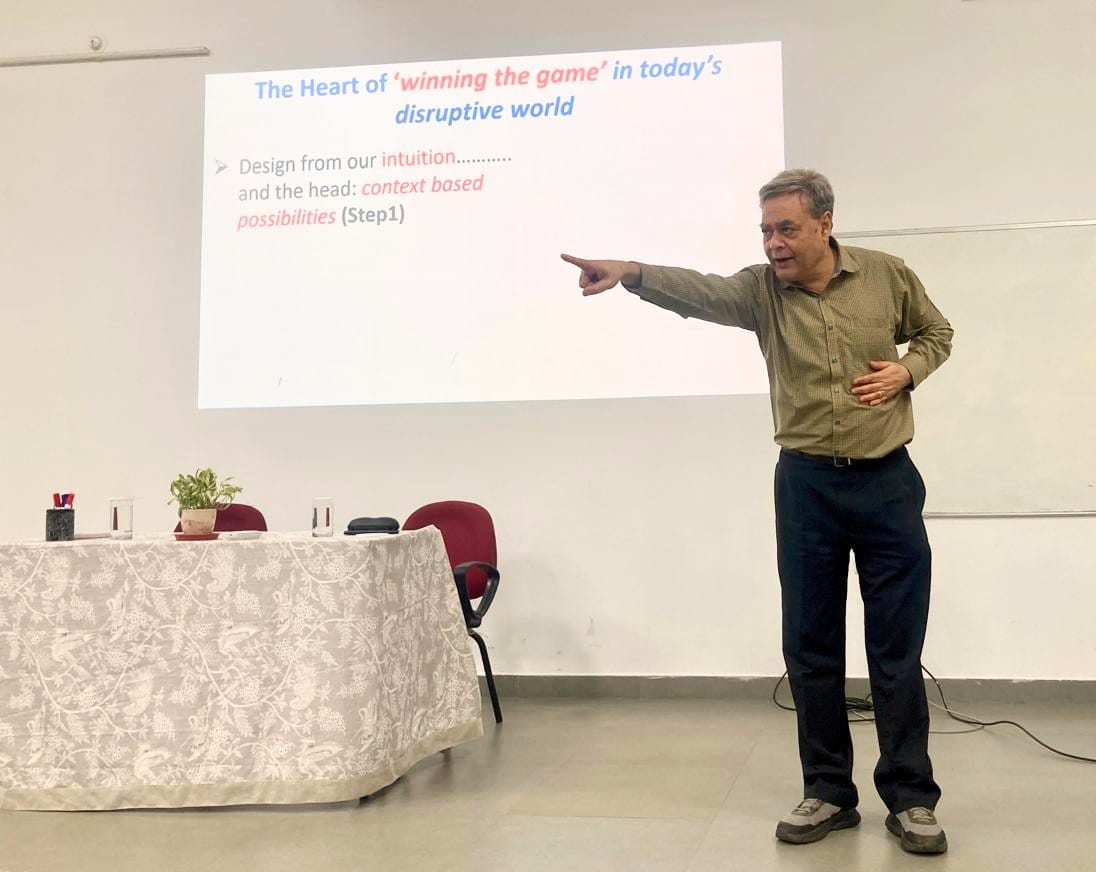
Interestingly, I was recently invited by the Goa Business School, Goa University to speak on the same topic.  What we were really looking at is succeeding in an environment that is constantly changing and being disrupted. By new technologies like AI, new competitors, new business processes. The question for us was, ‘So what does one do to win?’

I related a story from my own professional life.

In a past assignment, I was managing a Travel & Destination services t company. One of our major customer accounts was the national petroleum development organisation and because of the large business quantum, we had an implant operation with a dedicated team. Our service and response levels were appreciated by the client.

As our contract period was ending, the company released a tender for a subsequent period. Believing the client was happy with us, we submitted our competitive offer in line with what we had done during our last successful bid. When the tender was finalised, we were shocked to know that we had lost. When we asked the client’s commercial team, we were informed that we had not complied with the technical terms of the bid. Going back to the drawing board, we found that in the tender document, there had been a small section requiring development and implementation of a Travel management Services, TMS in short, software as part of the client’s intranet, which we had not responded to.

Soon, we had the opportunity to bid against a tender released by the National Gas Company. We noticed that in this tender document too, there was a requirement of implementing a TMS software. This time we were careful enough to comply with the requirement by indicating our willingness to develop. But we again lost the tender! The winner was a competitor who already possessed a fully developed TMS module and had provided a live demonstration of the same to the client.

We had been disrupted. By a new technology, a new competitor, which together had disrupted our traditional business mode, a model which had worked well all these years. The world had shifted, the business need in the environment had changed and the earlier alignment which our company’s competence set had with the environment, had been lost.

**

In 1849, French writer Jean-Baptiste Alphonse Karr wrote, “plus ça change, plus c’est la même chose” which in English translates to “the more things change, the more they stay the same.”

The above perspective is possibly at the heart of why we get disrupted. The human mind loves continuity and certainty. These allow us to make sense of what we see as stuff we are familiar with, which our brain does using mind models based on our past experiences. But what happens when we are faced with something we have never encountered before? Our brains somehow try to force fit these unknown inputs into one of our mind models. Even though we remain unaware, this ‘force fit’ sense making process leads to the observed inputs getting distorted, some parts get amplified while others which do not fit, get discarded. Thus, when we probabilistically try to predict, often we fail and get disrupted.

The disruptive world allows us to reside in a narrow band in the present with a hazy and uncertain future in front and the inability to take recourse of the past.  Thus to successfully negotiate we need to shift away from our usual probability-based mindset into a mindset of possibilities.

In the session I showcased certain action steps which would support us to do the shift.

I got around to explaining that the first Action step is to create a context for ourselves within our own domain through using hard trends in three areas viz. Demographics, Regulatory and Technology (DRT Context). The hard trends that we uncover become the framework of the context we are creating. Our context would allow us to view every situation in a particular manner.

At this juncture a participant asked for this step to be shown through a case study or live example. I elaborated using the example of the Aviation Industry.

Demographics: Major customer profile shift is occurring viz. growth of young budget traveller and the elderly. Communication technologies is leading to the decline of Business travel. Climate change is shifting the seasonality of leisure travel. Customer behavior is also changing, with short booking windows—often a week or two with fewer travelers making plans far in advance.

Regulatory: Climate change is leading to increased incidences of air borne diseases requiring changes in booking process e.g. Pre-flight testing, need for registration of previous and past travel etc. Technology is allowing airlines to have seamless connectivity within the travel ecosystem to increase demand + assist governments and regulators in creating worldwide / regional standards for hygiene as well as operations.

Technology: Integrated and contact less handling at the airport regarding access viz. boarding pass issual, traveller identification through eye scans, baggage check-in etc. Seat allotment keeping in mind traveler profile, past medical history etc.

Action Step 2 is about using our above created DRT context to make three lists. List of all that we are certain of, list of things we know, and list of things we can do. If we put in the requisite time to make the lists, new possibilities would start showing up for us, a reflection of our improved competence to shift into a possibility mindset.

Action Step 3 is about further sharpening the saw for possibility mindset creation. We do that by unplugging ourself from our present clutter and challenges, then plugging ourself into the future and then use the ‘hard trend’ context created in Step 1, the 3 lists of being certain, knowing and doing ability in Step 2 to do anticipatory & future back thinking through a structured enquiry.

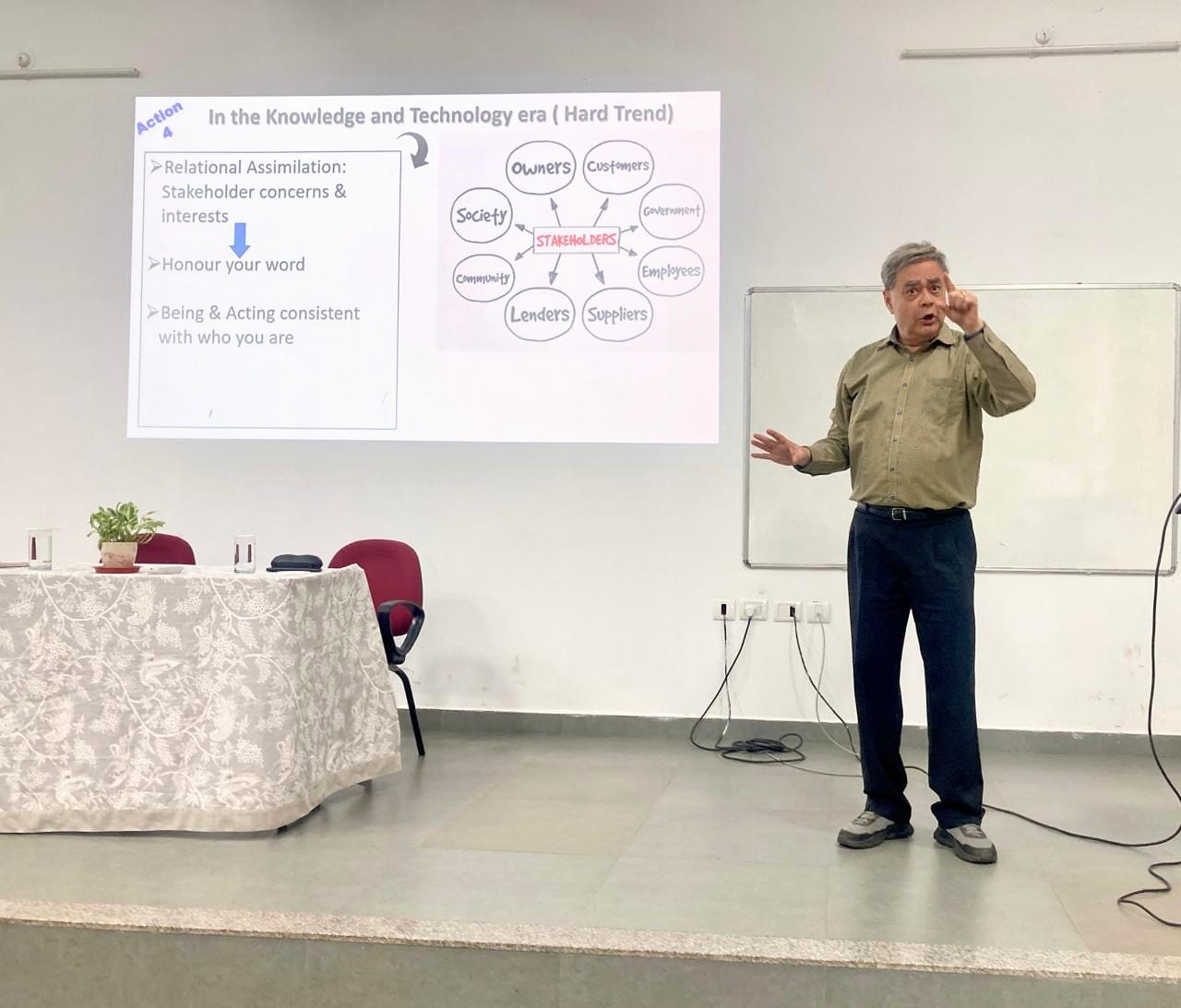
Action Step 4 is about Relational Assimilation which is identifying and defining groups relevant to our business and optimising the group boundary level interactions to advance our own interests. It thus is all about addressing stakeholder concerns. So, who are these stakeholders? They are wide ranging entities. Starting from the company Owners. Employees, who are the internal stakeholders to Customers, suppliers, our banks and financiers- our external stakeholders. But we also have environmental stakeholders viz. local community, society at large and the Government and regulatory authorities. Each of the stakeholders impact the organisation and ourselves in some way, some directly, others indirectly. To ensure effective relational assimilation, we need to exhibit certain qualities in our interactions.

  •  Honouring or Integity of our word. Have we ever considered the fact that we are really equal to your word, nothing more , nothing less? We might see ourself as an individual with certain looks, qualifications, competencies etc. But to the outside world, we are perceived as our word. So, what is ‘Honouring our word’? This means keeping our word and as soon as we realize we are not able to do so, we need to inform all effected parties that we cannot keep our word within the time frame indicated earlier, offer a new time frame to do it and declare that we would take care of the consequences if any, of not keeping our word as per the earlier indicated time frame.

Can you see from what I just said that while it is not possible to keep our word under different situations, we can always ensure that we honour our word?

  • Being and acting consistent with who you are: This is all about being authentic. Bill George, former CEO, Medtronics and Professor of Leadership at Harvard Business School, concluded, “After years of studying leaders and their traits, I believe that Leadership begins and ends with authenticity.”

So how does one improve one’s own authenticity? Simply put, it is by being authentic about our inauthenticities’. We need to be publicly authentic about our inauthenticity with those around us for whom this inauthenticity matters.

  • Listening with no intention, no judgment, no Right or Wrong:. This is called Active Listening. A special kind of listening that we use to allow the speaker to articulate his or her own strongly held positions, views, rationalisations, justifications and unexamined beliefs. When we engage in active listening, we do it without colouring our own mind with our own intention, own judgments and our own views about what is being said being right or wrong. You could start with practicing active listening once a day and then slowly increasing the number till the trait becomes part of you.

As you make Integrity, Authenticity and Active Listening part of your repertoire for dealing with your stakeholders, you will see the significant upswing in empathy, respect and trust in your dealings. Action 4 is thus the catalyzing agent to ensure the achievement of the action steps you had created based on the first 3 actions.

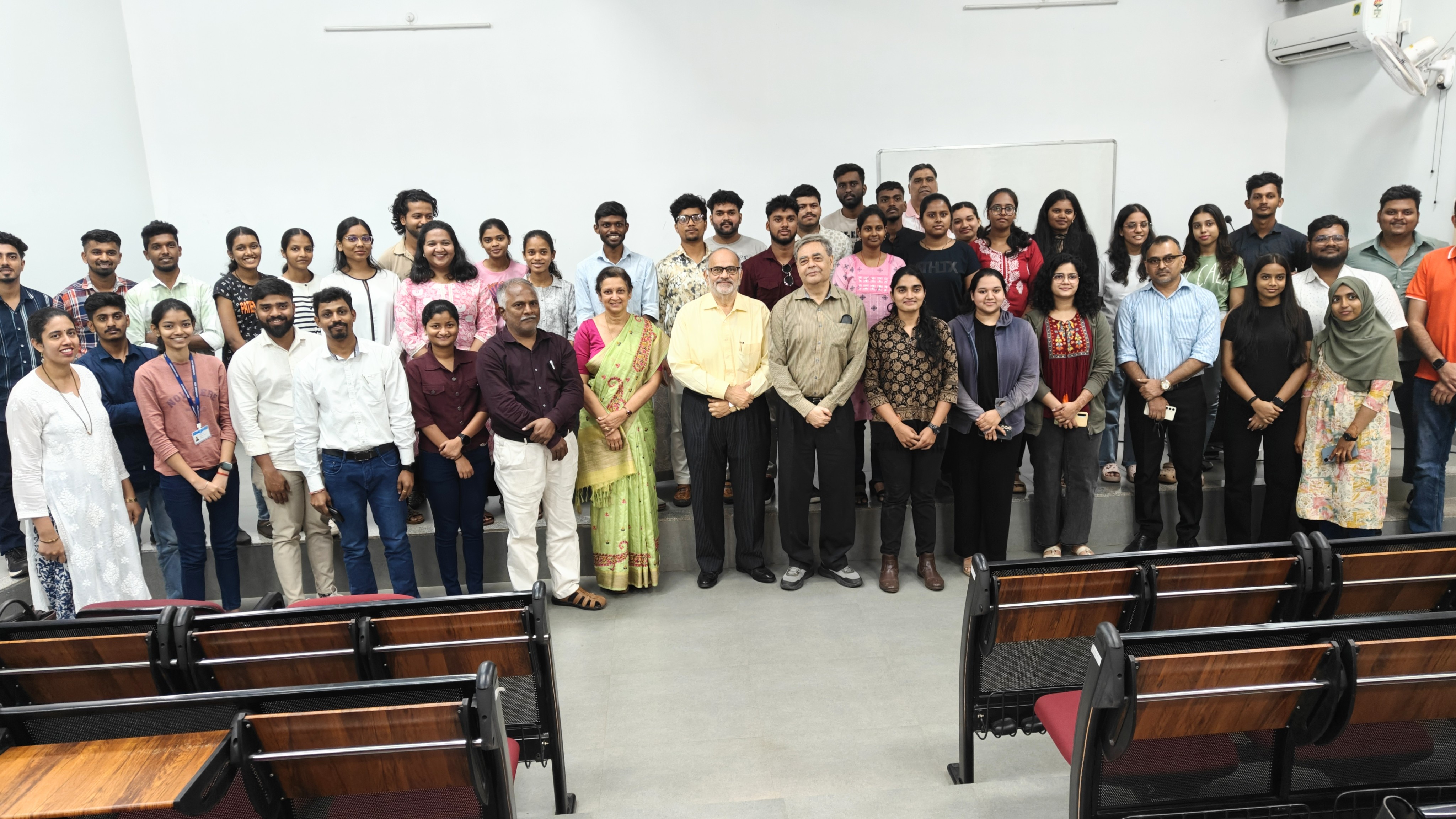
With the participants

**

In the ultimate analysis, Winning in a disruptive world is all about  that ability to See, Comprehend & therefore Interact with life (and situation) differently than most people do. ‘Winners of a disruptive world SEE….and come to live in a different world.

In Learning….. Shakti Ghosal

Mindful moments: Cultivating peace in a busy world


“The ability to observe without evaluating is the highest form of intelligence” – Jiddu Krishnamurti

Some years back, I did a course on Mindfulness. I did it more out of curiosity. The course turned out to be significantly experiential in nature, involving several practices.

So what is Mindfulness?  At its core it is the practice of paying attention to the present moment with openness, curiosity, and without judgment. It is about being ‘in the moment’ with awareness of where one is, what one is doing. As one practices this, one reduces one’s reactiveness or being overwhelmed by situations, circumstances, and people.

When I think back, I realise that my first exposure to and experience of Mindfulness and intervention based on it was more than20 years back.  I had participated in a week long  “Art of Living” program. The essence of the program was a routine which consisted of ‘Pranayam, Bhrastika and Kriya”.  All these practices were essentially breathing routines, heightened awareness of the flow of breath and culminating with a body scan. While it had not been mentioned then as being a Mindfulness practice, I realised subsequently that it was so.

After I started practicing Mindfulness through the Art of Living routine, I did start noticing a higher level of energy through the day as also being more at peace with my situation. By God’s grace, I have been able to avoid chronic health situations like hypertension, stress related ailments etc. I somehow sense that one of the contributing reasons for my being able to maintain good physical and mental health has been my continuing the practice of Mindfulness as elaborated above.

In a recent ‘Mindset Matters’ podcast, Executive Coach Frank Marinko and I had a lively conversation about what ‘Mindfulness’ is and its impact.

In Learning……… Shakti Ghosal

#Mindfulness #Artofliving #judgmentfree #awareness

Trust- A bulwark of relationships


Trust is a foundational element of relationships and interactions. My decades of working   in organisations and relating to people have made me realise that Trust flows out from three aspects of how we relate to people and how we interact with team members and others.

First and foremost is the Integrity of our word. We need to be clear to our own selves that the way others see us is how we ‘honour our word.’ Do we keep it and if we cannot, do we inform about that at the earliest opportunity and be willing to clear up any mess caused?

Second is the aspect of accountability. When we can own up to our own errors of judgement and take responsibility, we start creating an environment where others ‘feel safe’ to do the same.

And finally, is the aspect of transparency which builds credibility and shows others that we are willing to share information honestly, even when it is difficult.

What trust leads to is open communication and ‘risk taking’ initiatives with the potential to transform workplaces to becoming more supportive and innovative.

To showcase, how Trust works, I wish to relate the case of Johnson & Johnson and its Tylenol product crisis of 1982. The company faced a severe crisis when people in Chicago died after taking cyanide-laced capsules of Extra-Strength Tylenol, a top-selling, trusted pain reliever.

While Johnson & Johnson was not responsible for the tampering, it faced intense scrutiny and an immediate threat to the overall J & J brand.

The company made a series of bold decisions, guided by its corporate philosophy, which prioritized customers over all else. It immediately recalled over thirty million bottles of the product costing the company over $100 million. The company maintained open and honest communication with the public, issuing warnings and engaging with the media. This transparency helped rebuild public trust and showed they were prioritizing customer well-being.

 By placing consumer trust above profit and acting with integrity, Johnson & Johnson was able to rebuild and even strengthen their brand. In a matter of months, Tylenol regained a significant share of the pain-reliever market, and Johnson & Johnson became known as a company that values trust and ethics.

In a recent ‘Mindset Matters’ podcast, Executive Coach Frank Marinko and I deep dived into the fundamentals of what constitutes Trust and how what constitutes our word becomes so crucial in the matter.

In learning……….                                                Shakti Ghosal

Have you experienced the power of active listening?


Listening as an activity seems passive and an easy one. It is not. When someone speaks to us, we end up listening though a mesh of beliefs, prejudices, preconceived notions, and past relational baggage. What we end up really ‘hearing’ in our brains is a distorted version of what was communicated.

For listening to be effective, it needs to land for us with minimal distortion. To do that we need to master the art of Active Listening. Which is listening without intention, without judgment, without RIGHT or WRONG.

I would like to relate an incident of an irate customer from a previous assignment. He was a regular buyer of our services but on that day, he came to book a family holiday and said he would pay once he returned. Such credit to individuals was not allowed as per company policy. The counter supervisor tried to reason with him but he got even more upset and stormed into my office.

Customer: “I can’t believe this, the way I have been treated just now. After all these years, are you guys telling me you don’t trust me? I have tried to explain to your supervisor but he throws the rule book at me.”

Sensing the anger and upset, I decided against trying to explain and opted to listen empathetically. As the customer continued to rant, I maintained eye contact, nodded sympathetically, and made verbal assertions like, ‘I see’, ‘I understand’.

When the customer finally stopped, I said, “I heard what you said and realise how upset and unacknowledged you must be feeling. You mentioned that you wish to make the payment of your much awaited holiday package after your return. Have I understood you right?”

The customer for the first time cooled down. “Yes, that is correct. I find it demeaning that your company does not trust me.”

“Okay, this is what we could do,” I said. “You could give us a post-dated cheque and I will authorize its acceptance as a special case.”

Now, this was not at all an innovative solution and could have been offered earlier also. So what could have been the reason for this not happening? Clearly, the engagement had been more about protecting one’s own turf and resolution had not been part of the mindsets.

As I think back to that situation, I can see that the active listening demonstrated in that interaction is what resolved the situation. The eye contact and nods, the acknowledgement of emotions, the paraphrasing and the offer of a solution is what allowed the customer to be heard, valued and reassured and be willing to co-create a resolution with me.

In Learning……………….. Shakti Ghosal

Do your Leadership choices upset your stakeholders?


This was the question that was debated during a podcast which I did recently with Executive Coach Frank Marinko in Australia.

All of us know that leadership is all about making choices. It is about aligning the organisation and its underlying stakeholder relationships with an overarching vision and intrinsic values. However, the prism that each stakeholder uses to evaluate decisions and decide on a roadmap could be significantly different from one another. We might hold complete clarity, based on our own belief and experience-based prism, about what and how something needs to be done. This is where the pitfall of a ‘My way or highway’ mindset lies.

Based on market conditions and the need to do a strategic shift, you might need to cut costs by reducing the workforce. But this could lead to employee insecurity and negative publicity. You might decide to use certain material to improve product quality but that might bring a backlash from environmentalists. A tradeoff between shareholder profits and employee benefits might lead to morale drop and lower productivity. Such a list of potential pitfalls can be long.

So how could you as a leader successfully negotiate and mitigate the above risks?

In this context, you might wish to listen to the two podcasts which are in the laser coaching realm.

In Learning…….. Shakti Ghosal

The Mantra of Personal Mastery


Recently at an IIM Udaipur conducted Management Development Program (MDP) for Indus Towers managers, I anchored four sessions. We started with the overarching perspective of Leadership and personal mastery before drilling down to specifics of Power & influence in teams, Managing high performance teams and the Feedback & Delegation aspects in Team Dynamics. We ensured a surfeit of activities, Role Plays and Case Studies to deepen the learning through practice and Ideation.

oplus_262144

In one of the sessions, we were in discussion of the aspects of ‘Honouring one’s word’ and ‘Being Authentic’ as performance accelerators of a team. Several participants mentioned their reservations about this, as under:

“If we become authentic and honour our word and others in the team do not do it, we would be taken advantage of and would be forced to do the work of others”

“All this is good theory but just does not work in real life. The fact is the Management has perceptions of who are good versus who are bad and irrespective of whether we honour our word or not, the favoured ones would get rewarded in terms of promotions and bonus”

In life, we are conditioned to judge others on moral and ethical yardsticks but remain quick to rationalize our own failings against the same yardsticks. We look around to try and determine who all are ‘honouring their word’ and tell ourselves that we would wait for others to honour and keep their word before we keep our own. As Chris Argyris had said about self-deception, ‘Put simply, people consistently act inconsistently, unaware of the contradiction between the way they think they are acting and the way they really act.’

 To gain the ability to honour our own word, we should be prepared to deeply deliberate and answer the question, ‘Where is my word when it comes time for me to keep my own word?’  In the ultimate analysis, there is a simple but inviolable equation of workability which is YOU are equal to YOUR WORD.

As I explained to the participants, team performance has very little to do with peering over shoulders to ascertain who is doing what. It has almost everything to do with how we can create trust of others in us. And creating trust has everything to do about Integrity viz. honouring our word and being authentic about how we show up for others. While some may try and take advantage of your trust in the short term, the aura of trust leads to team members gravitating towards you, working with you as you shift into being a natural leader.

How might you incorporate ‘Honouring your word’ and ‘Being authentic’ as part of how you show up tomorrow with your stakeholders?

In Learning……. Shakti Ghosal

Further Reading: ‘Integrity is a matter of a person’s word- nothing more, nothing less’– Michael Jensen, Professor Emeritus, Harvard Business School. Revised March 28, 2014.

Note : Indus Towers is India’s largest mobile tower installation company.  In India, 3 out of every 5 calls made are through an Indus site. https://www.industowers.com/