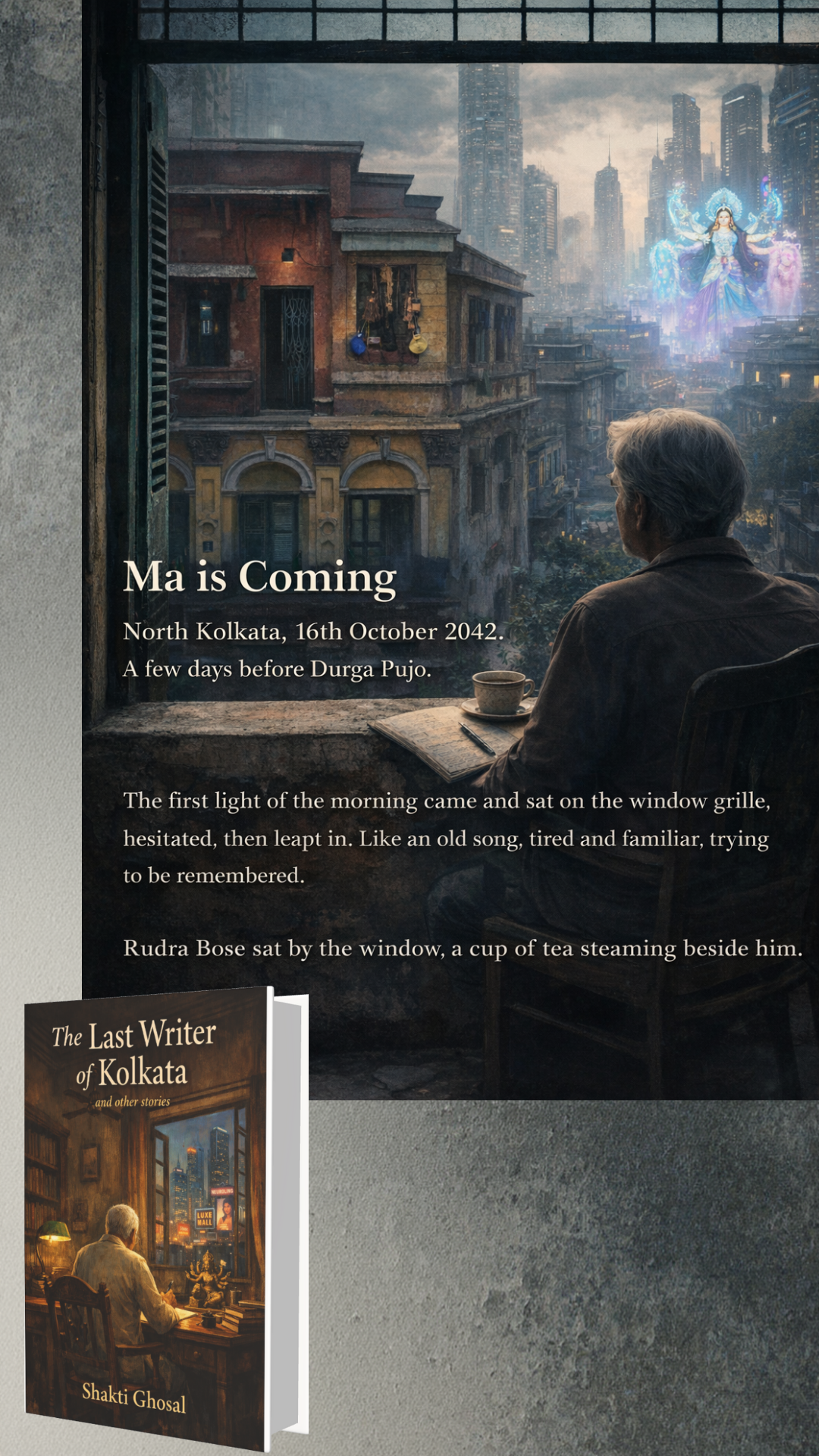
North Kolkata, 16th October 2042. A few days before Durga Pujo.
The first light of the morning came and sat on the window grille, hesitated, then leapt in. Like an old song, tired and familiar, trying to be remembered.
Rudra Bose sat by the window, a cup of tea steaming beside him. The cup was chipped, the saucer mismatched, the tea, a stubborn blend of milk, tea dust, and habit. Outside, the lane yawned into a waking slumber, its air thick with last night’s incense, stale samosa oil, and the ever-present, low-grade air pollution.
“Ma is coming,” he had heard someone shout on the street last evening.
She was, of course. Ma came every year. Only nowadays she arrived on a cloud of holograms, flanked by LED lions and thunderous drumbeats pouring through subwoofers. The city had found new ways to worship, more theatrical, more saleable.
Rudra shifted in his chair, his bones protesting like rusted hinges. In his lap, his journal lay open, an old pen resting across the page like a reluctant weapon. He hadn’t written yet. He was waiting, unsure of something. Was he waiting for a thought, a familiar smell, or the comfort of a Kolkata that seemed to slip further away each year?
Durga Pujo. Once, it had been magic.
As a boy, he had spent mornings watching Mashis, aunts and Boudis, sisters-in-law threading marigolds for the Pandal and Thakurer Bedi. In the afternoons it would be the decorators stringing up festoon lights of different colours all along the lane. Nights were all about rehearsing lines for the Natok, stage play they would perform on Nabami.
He had once accompanied his mother, walking barefoot to the river to collect Gangajal, the sacred waters of Ganga. He remembered his father reading out the Chandipath under a suffused light. Long buried memories of his parents surfaced and meandered.
“Rudra, you were born with too much silence,” his mother had once said, as she used a hand fan during load shedding. “You are eleven. Most boys your age chase dragonflies. You chase metaphors.”
“I like listening,” he had replied, “Words sound different when you don’t rush to answer them.”
His mother had turned towards him, “Then promise me, don’t let the noise teach you to forget what silence feels like.”
North Kolkata is the soul of the city, where the past isn’t just remembered—it’s lived. Often called “Babu Kolkata,” this region is a labyrinth of narrow lanes, grand 19th-century mansions, and centuries-old traditions that remain untouched by modernity. Historically, the British referred to the area inhabited by the native Bengali elite as the “Black Town,” in contrast to the “White Town” of Central Kolkata where the British lived.
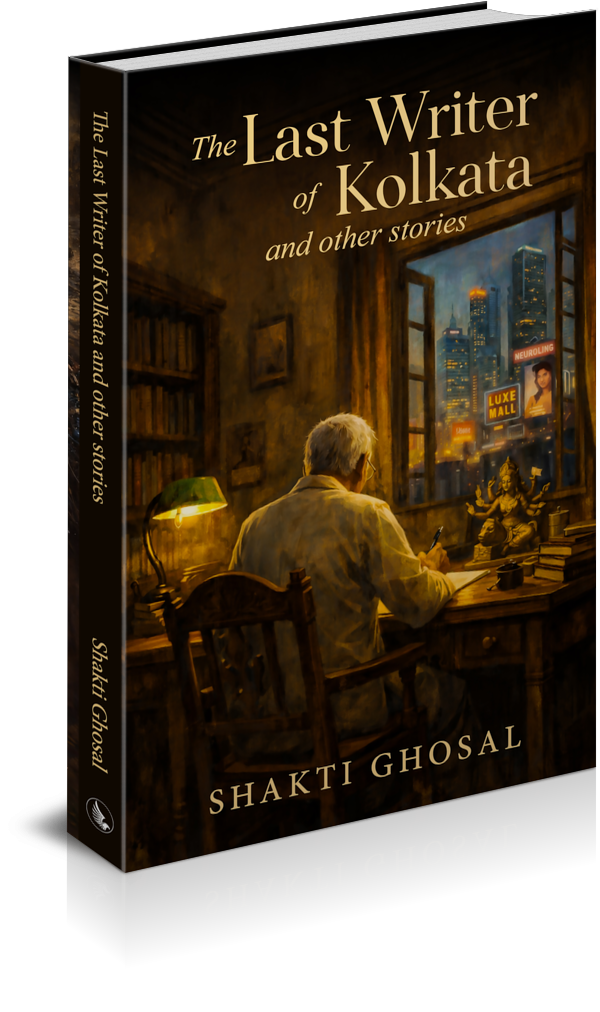
North Kolkata features in the ‘Last writer of Kolkata’, part of my forthcoming book of the same name. Should you wish to receive exclusive previews and the chance of winning a free copy of the book, do write to me @ author.esgee@gmail.com
The future does not arrive all at once. It seeps in quietly — through our cities, our screens, our climate, our homes, and our hearts.
Set in a near future shaped by forces already gathering momentum, this compelling collection explores what happens when irreversible hard trends collide with ordinary human lives. When familiar worlds tilt just enough to reveal what has already begun to change, they become recognisable tomorrows, shaped by powerful forces. A writer watches memory become a commodity in a digitised culture. An environmentalist confronts the fury of a climate unbound. Minds are shaped inside engineered echo chambers. An aging couple discovers that love, not technology, is the last refuge of belonging. These are not science fiction tales of spectacular collapse, but of subtle reckonings—where survival lies not in resistance alone, but in choosing what must still be remembered, protected, and passed on.
At once intimate and expansive, the stories follow ordinary people navigating extraordinary transitions — holding on to memory, dignity, connection, and hope as the ground beneath them shifts.
Blending imagination with insight, this book offers fiction as a lens — an exploration not of what gadgets we will build, but of who we may become.
I chanced upon a news item of a buried ship in one of the world’s driest deserts in Namibia, with a haul of centuries old treasure, untouched by centuries.
The discovery of the sunken ship was made in 2008, in the southern expanse of Namibia’s desolate Sperrgebiet, forbidden territory. Later identified as the Bom Jesus, a Portuguese vessel which was lost five hundred years back during a trade voyage to India. The ship represented the Portuguese maritime empire’s pivot towards India and the east at the height of the Age of Discovery.
Led by Dr. Dieter Noli, a South African archaeologist of repute, the excavating team uncovered more than 2000 gold coins, ivory tusks, copper ingots, and weapons, all in a remarkable state of preservation. Unlike most coastal shipwrecks degraded or looted over time, the Bom Jesus had been pushed inland over centuries by geological forces, and combined with wind blown sediment, it had remained sealed in a natural sarcophagus.
“The sea forgets no soul — it only waits for their return.”
They called it the Age of Discovery. But for those of us who sailed it, it was the Age of Reckoning.
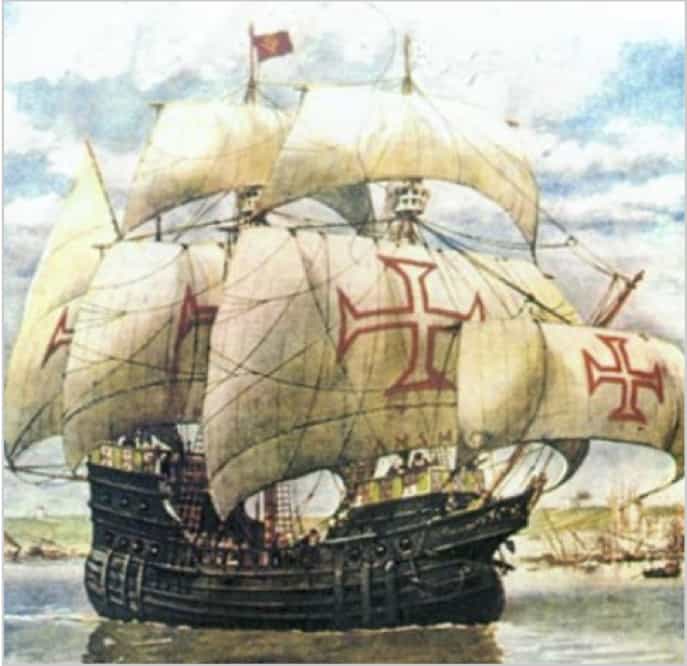
It was the year of Our Lord 1533 when Bom Jesus set forth from Lisbon. She was a three-masted carrack of near 120 feet, her hull of oak black with pitch, her sails heavy canvas stitched in gold thread with the Cross of Christ. She carried five decks — the lower hold stacked with copper ingots from Augsburg and elephant tusks from Sierra Leone, the middle filled with gold and trade wares bound for Goa, and above, our cramped berths where men slept beside their sins.
I was the ship’s Chronicler — João Mendes, son of no one worth naming — tasked by the Casa da Índia to record the journey. I fancied myself a man of words, not of winds; I soon learned the sea had its own grammar.
We departed on Ascension Day, bells tolling from the Sé Cathedral, the scent of incense mixing with tar and brine. Captain Dom Diogo Pereira, a veteran of the Carreira da Índia, Portuguese East India Company, stood on the quarterdeck, broad-shouldered and proud, his hand resting on the hilt of his Toledo blade.
“Men of Portugal!” he thundered. “We sail for God and the King! For gold, glory — and for home, if He wills it!”
“Deus nos guie! God guide us!” we cried back, and the Bom Jesus glided down the Tagus into destiny.
Our route was the old one — past Cape Verde to the Gulf of Guinea, then around the Cape of Good Hope, across the endless Indian Ocean to Cochin and Goa. Ten thousand miles of wind, wave, and unseen graves of adventurers.
The first few weeks were kind. Trade winds filled our foresails; flying fish glittered beside the hull. We dined on hardtack, dried cod, and the Captain’s pride. At night I climbed the forecastle to watch the stars wheel — the Southern Cross like a torch over the horizon. The helmsman, old Mateus, would nod at it and murmur, “Mesmo o céu muda para quem navega.Even the heavens shift for those who sail.”
But the sea does not love those who sail it for long.
Near Cape Verde, the wind changed. The compass began to shudder though the sky looked clear. In the hold, a carpenter found an unlisted chest, iron-bound, its seal a reversed cruciform sigil.
The Captain frowned. “No such cargo was declared,” he muttered.
The priest, Father Almeida, whispered, “It bears the mark of the Templários, Templars. Heresy!”
“Open it,” the Captain ordered.
We broke the seal. Inside lay a crucifix of black gold, the figure inverted. It was a Satanic symbol! The air turned cold, though the day outside burned hot. The priest crossed himself. The Captain ordered it resealed and hidden. That night, lightning struck our mainmast.
An inverted, old, gold, satanic cross
Superstition spreads faster than scurvy. The men whispered that we carried a relic damned by God. One swore he heard chanting beneath the deck. Another said he saw a man in robes walking the gunwale at midnight, his feet never touching the wood.
Still, we sailed on — south past Angola, into seas uncharted. The coast grew barren; dunes stretched like the bones of the world. The charts called it Costa dos Esqueletos — the Skeleton Coast. We knew that even the seagulls avoided it.
Then the fog came. It was thick, white, soundless, relentlessly surrounding us. The lookout cried, “Land! Sand ahead!”
“Hard to larboard!” shouted the Captain.
But the current seemed to seize us like a claw. The keel scraped something unseen. The Bom Jesus groaned, a deep, living sound. Below, the ballast shifted; the copper ingots sliding here and there. The ship’s stability seemed to be teetering.
“Drop anchor!” cried Mateus. “Santa Maria, tem Piedade! Saint Mary, have mercy!”
The anchor vanished into the mist. The ship tilted. The priest clutched his crucifix and began to pray, though the words seemed to be coming out backwards.
I stumbled to the hold to rescue my journals. The water flooding in seemed to glow faintly green. I saw that the sealed chest had burst open. The inverted crucifix floated upright, its eyes gleaming red as coals. Around it, the gold coins trembled, rising and falling as if breathing. I remember shouting, “Capitão! Venha ver isto!, Captain, come see this!”
He never did. The hull split. Sand and water surged in. The ship screamed as if alive, ribs cracking, decks collapsing. I clung to a beam as men were swept into the dunes that moved like tides.
Through the maelstrom I saw — or dreamt I saw — a figure standing on the water’s surface, face hidden by a cowl, hand raised in benediction. The bell tolled, though no man rang it. Then all went black.
When I awoke, the world was silent. I lay on a dune, the wreckage scattered around me, half-buried in glittering sand. No ship. No men. Only the wind’s long sigh.
I found my quill and a scrap of parchment. The ink had turned thick with salt. I began to write. I needed to remember, to exist. The days blurred. The sun moved, the dunes shifted. Sometimes I would see the broken ribs of the Bom Jesus thrust through the sand like bones. Once, I heard laughter carried on the wind. The laughter of men long drowned.
At night, a pale glow rises from the sea. I hear the toll of the bell, steady, patient. When the fog drifts inland, I glimpse lanterns bobbing on the horizon. Our ship sailing still, her sails tattered, her decks empty. I know her. She calls out to me.
Perhaps I never left her. Perhaps I am still aboard, walking the splintered deck, quill in hand, scratching words no living eye will read.
If you find this parchment, if by some fate the sands give it back, take heed: do not seek the Bom Jesus. Her treasures lie where faith and greed collide, guarded by the sea’s own curse.
And should you hear a bell tolling across a calm shore, do not answer. For the Bom Jesus sails yet. And her chronicler still writes. Though his hands are bone, and his words drift like mist upon the tide.
“In every wave sleeps a memory, and in every wreck, a prayer unfinished.”
“The adventure begins at the edge of the Shire — welcome to Hobbiton!”
As long-time admirers of The Lord of the Rings and The Hobbit trilogies, visiting the real-life locations where these epic tales were brought to life had always been a dream. So, when we planned our trip to New Zealand, a visit to Hobbiton — the iconic Shire of Frodo and Bilbo Baggins — was a non-negotiable stop. We simply couldn’t leave Middle-earth behind without stepping into its most charming corner.
Hobbiton is nestled in the heart of Matamata, a region of lush pastures and gently rolling hills on New Zealand’s North Island. It was here, in the late 1990s, that director Peter Jackson conducted aerial surveys in search of the perfect location for the Shire. Legend has it that when his team spotted the Alexander family farm, it was love at first sight. The unspoiled beauty of the land — its sweeping meadows, mature trees, and bucolic charm — was exactly what Tolkien had described in his books.
“A view straight out of Tolkien’s imagination — rolling hills dotted with hobbit homes.”
Initially, the Alexanders weren’t too keen on turning part of their farm into a movie set. But with some persuasion (and an undisclosed agreement), they eventually agreed. And so, the world’s most beloved village of hobbits came into being. One delightful piece of trivia we learned during our visit was that Peter Jackson ran out of funds during the initial stages of development. To keep the project going, he approached the New Zealand government, who in turn had the New Zealand Army assist with the early groundwork — an unusual but heartwarming collaboration that helped build movie magic.
Our tour began with a tranquil ride in a golf cart through the countryside. As we crested a hill and caught our first glimpse of the Shire, a wave of excitement washed over us. There they were — the familiar round doors, grassy rooftops, and colorful gardens tucked into the hillsides. Every corner of Hobbiton was bursting with life and detail, from miniature wheelbarrows and rustic lanterns to tiny clotheslines with hobbit-sized laundry flapping in the breeze.
“Every round door tells a story — could this be a baker’s home or a gardener’s cottage?”
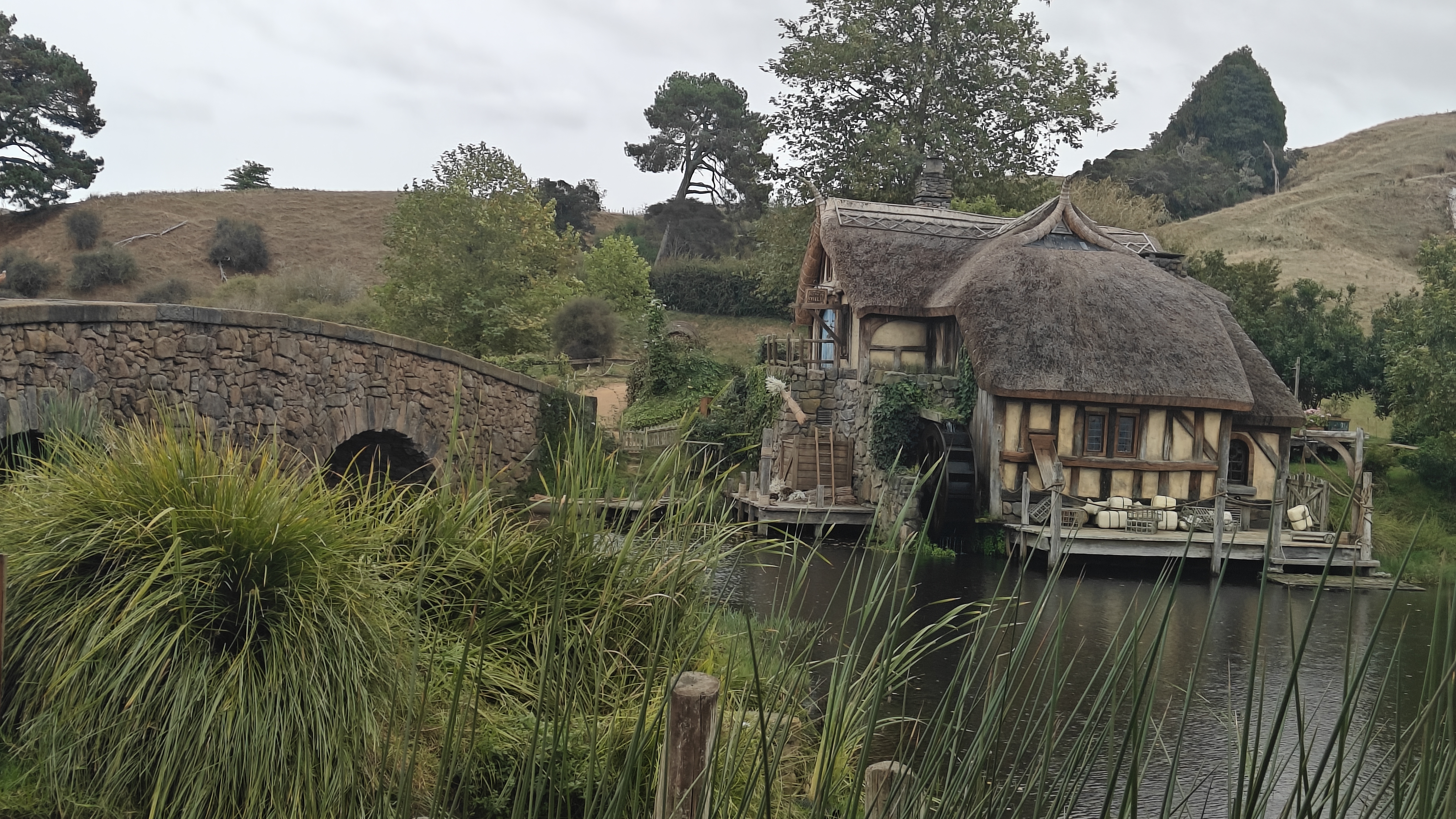
We explored the Shire with childlike wonder, moving from one hobbit hole to the next. Each home had its own character and charm — some for bakers, some for fishmongers, each with a story hinted at through props and signs. The stone bridge with its iconic double arches, the waterwheel gently turning by the mill, and the peaceful lake all brought scenes from the films vividly to mind.
“The iconic bridge where Gandalf once rode into the Shire — picture perfect.”
A true highlight was visiting the inside of Frodo Baggins’ house. Walking through the rooms, we could almost imagine him pacing about, deep in thought, the weight of the Ring heavy in his pocket.
“Stepping into Frodo’s world — the journey truly begins here.”
Although we couldn’t go inside Bilbo’s house, Bag End, just seeing it up close — with its iconic green door and lush garden — was magical in itself.
“Bag End in all its glory — the green door that launched an adventure.”
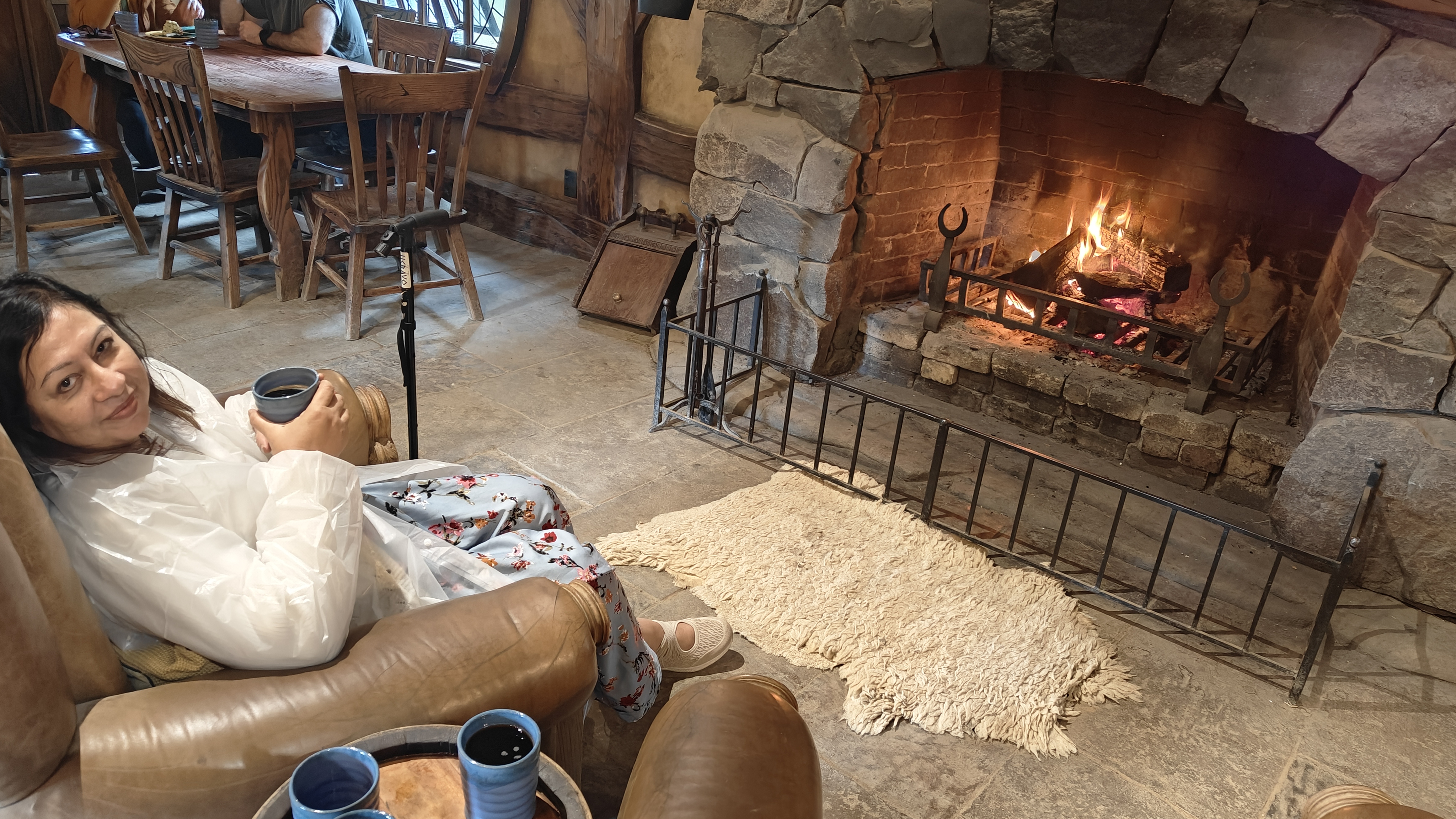
And then came the perfect ending: a visit to the Green Dragon Inn. Stepping inside, we were welcomed by a roaring fire, wooden beams, and the unmistakable coziness of a true hobbit gathering place. We ordered a round of their specially brewed ales and sat by the hearth, sipping slowly and soaking in the atmosphere. It truly felt like we had been transported into Tolkien’s world.
Raising a mug of Hobbit ale at the Green Dragon — a toast to the Shire!”
Our visit to Hobbiton was not just a tour — it was an experience, a nostalgic walk through a world that had enchanted us for years. If you’re ever in New Zealand, take the detour to Matamata. Whether you’re a die-hard fan or just someone who appreciates storytelling, nature, and craftsmanship, the Shire will leave you spellbound.
“One for the memory books — peace, beauty, and a touch of magic.”
“Non nobis, Domine, non nobis, sed Nomini tuo da gloriam“ ( Latin). In English it translares to : Not to us, Lord, not to us, but to Thy name give the glory
Tomar in the heart of Portugal, is a town steeped in history, mystery, and legend. During our recent visit, it transported us back to the era of the Knights Templar, the Crusades, and the Church Order.
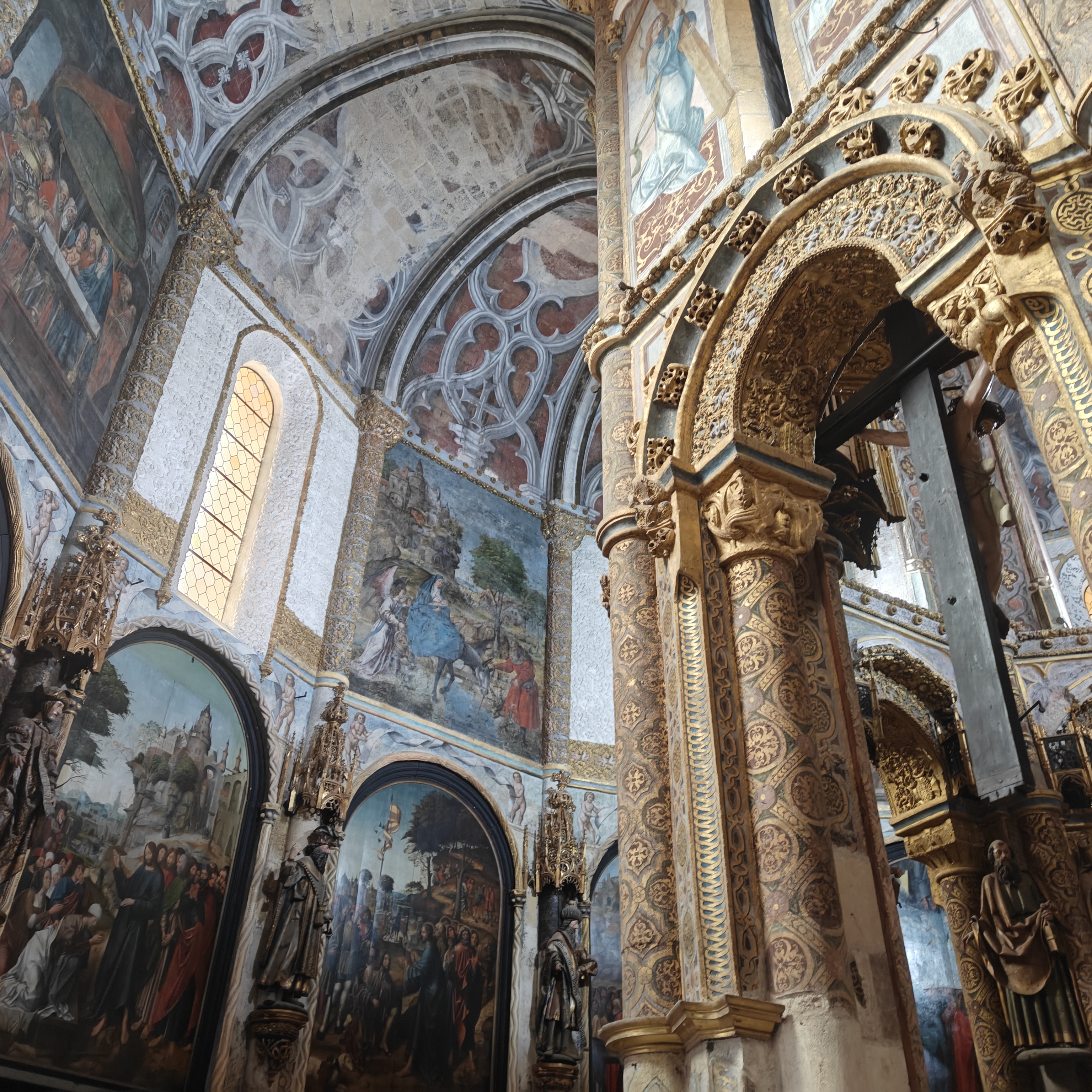
The Convent of Christ, a UNESCO World Heritage Site, is a masterpiece of medieval architecture. A Templar stronghold, it was both a church and a fortress with a unique blend of Romanesque, Gothic, and Renaissance styles.
We entered the Convent and as we walked through the corridors, we could almost see in our mind’s eye the knights riding in. As the legend goes, the knights would even pray while on horseback as they chose never to be caught off guard and remained ever ready to fight on behalf of the church. This was the reason for the spectacular Templar’s round church with its high archways being built in the heart of the convent.
oplus_262176
The Convent of Christ and its structure was inspired by the Church of the Holy Sepulchre in Jerusalem. The latter had been built at the traditional site of Jesus’ crucifixion and burial and thus it is no surprise that it was in this city that the legend of the Knights Templar started.
The Knights in their white mantles and a Red Cross emblazoned on the chest were arguably the best fighting units on the side of Christianity in the Crusades. For centuries they remained committed to defending Jerusalem as also offering safe passage to Christian pilgrims travelling to the Holy Land.
The Knight Templars achieved the zenith of their fame in the 12th century when in the Battle of Montgisard, six hundred odd knights beat the redoubtable Muslim general Saladin and his army numbering twenty-six thousand!
The other noteworthy aspect of the Templars Order was that it became the banker to Europe from a Papal sanction. Knights desirous of joining the order donated large amounts, nobles going to Crusades would place their wealth and businesses with the Templars for safe keeping. This huge aggrandizement of wealth though led to its eventual downfall. It is said that in the early fourteenth century, the French Monarch Philip IV, deeply indebted to the Templars and unable to pay back, started to arrest, torture, and execute the French knights.
After the dissolution of the Order, the Templars found refuge in Portugal under a new ‘Order of Christ.’ Our guide spoke of the secret knowledge the order brought in and how that influenced Portugal’s Age of Discoveries, including Vasco da Gama’s travel to India. Ostensibly, much of the so called ‘secret knowledge’ of the Templars had been acquired from Arabs during their travels to Jerusalem and beyond.
For us, Tomar wasn’t just about history; it was more about the Knights Templars’ valour and enduring legacy. Their closely guarded secrets included that of the Holy Grail which forms the basis of Dan Brown’s famed thriller ‘The Da Vinci Code’. In the book, the Knights Templar order is portrayed as the guardians of vital information relating to Christianity spanning over one millennia.
I am delighted to mention that on its first anniversary, Amazon has released this brand video of my book, ‘The Chronicler of the Hooghly and other stories’.
Turning, he called out to the guard outside, “Ask my special guards to meet me”.
Two robed men came in. Omichand commanded, “Follow that ayah who accompanied the English woman. Find out all that the woman knows and who all she has met over the last few days. Do what you need to do but ensure that details of Joba’s movements do not get around”.
The next morning, the Captain Commandant’s household was in a tizzy. His wife’s trusted ayah had vanished in the night. Initial suspicion that she had run away with some valuables was quickly dispelled when nothing was found to be missing. Jim got the fort security to investigate but they came up with no answers. The mystery got solved after a few days in a rather gruesome manner when the ayah’s dead body was found floating in the Lal Dighi with her throat slit.
The above is an excerpt from the award-winning, ‘The Chronicler of the Hooghly’.
‘The fire of communal violence was spreading. There existed enough baggage of distrust and enmity between two of the major communities in the country to fan it.
News trickled in about the incendiary speech made by the Bengal Chief Minister Shaheed Suhrawardy and the ensuing cycle of violence which would later come to be known as the Great Calcutta Killings. Since both their larger families were in Bengal, Sujit and Bina were concerned and sent postcards enquiring about the safety and health of everyone. They even offered family members to leave Calcutta for some time and come and stay with them in New Delhi. Mercifully, they got back replies by post that there was nothing to worry about at the moment and all were safe.
But the Calcutta killings and the subsequent incidents of communal violence that followed in several parts of North India were but a trailer of what was to come…………..’
The above is an excerpt from the story Ashtami, part of the Chronicler of the Hooghly.
Book of the Month, Nazm -e- Hayat literary award winner. Available worldwide on Amazon.














 A New Beginning