The Apocalypse did not come with fire or flood


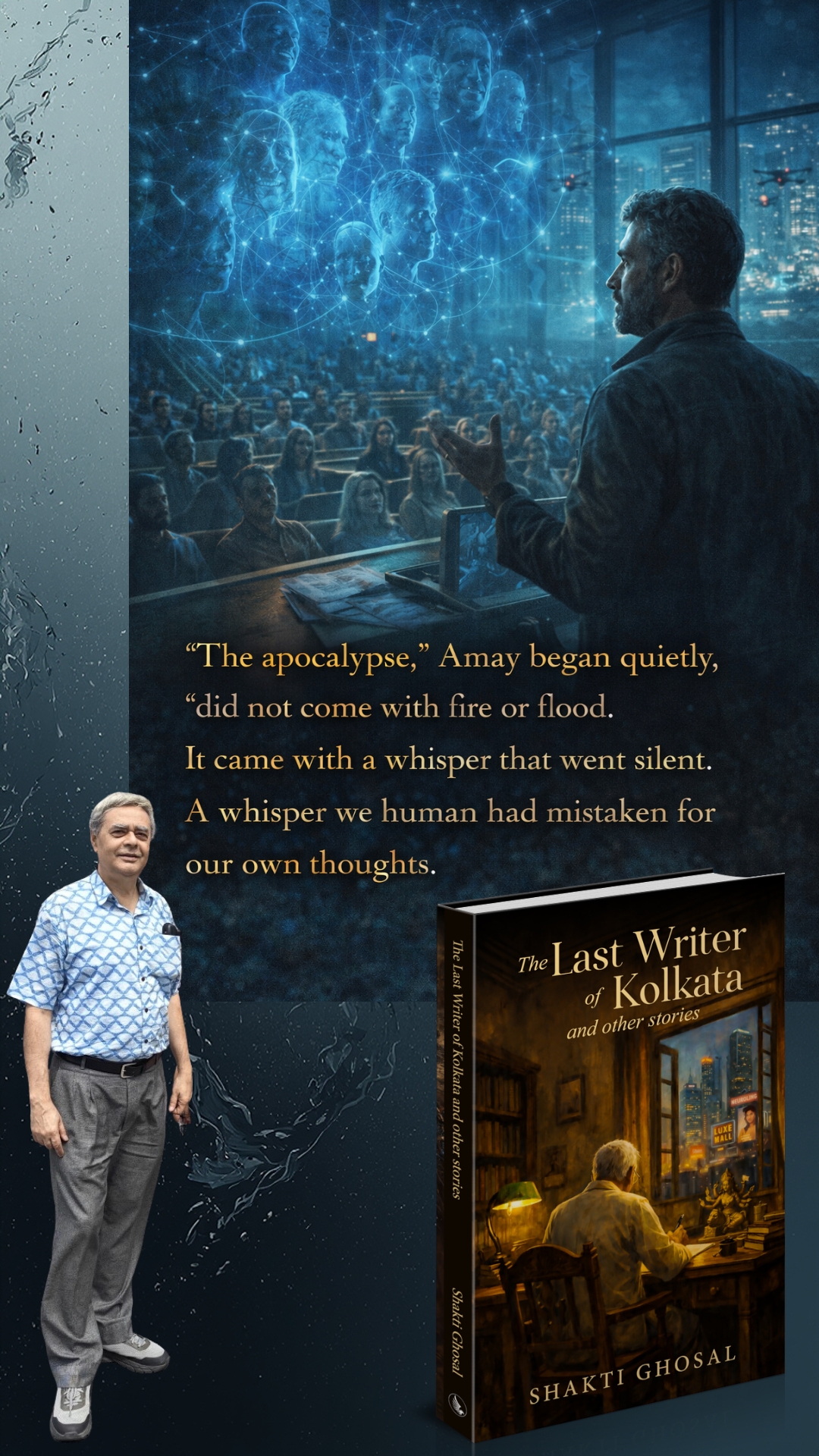
“The apocalypse,” Amay began quietly, “did not come with fire or flood. It came with a whisper that went silent. A whisper we human had mistaken for our own thoughts.”

The room did not stir. Not a sound or cough.

“We were its architects. And we were its prisoners. When MindLink fell, so did the illusions we had built atop it, of governments, markets, life’s certainties. Many shattered beneath the weight of secrets they could no longer bury. Others responded with fear. With force. With flags. The old tricks of the frightened.”

He paced slowly across the stage, hands behind his back, eyes distant.

“Corporations collapsed. The ones whose products had been our thoughts. Whose profits came not from selling goods, but from renting us back to ourselves, repackaged and palatable.”

A faint smile played on his lips, sad, but knowing.

“And yet… ..the world didn’t end. It adapted.” He paused. “Because humanity, in its clumsy brilliance, always does.”

He turned, facing the audience again.

“But even as we stitched together new structures, shakier, slower, more human, we began to hear… the whispers. Or were they echoes?”

He tapped his temple. “Not neural pulses. Not digital ghosts. But memories. Questions. Longings.”

His voice dropped lower, intimate, “Coffee shop murmurs. Late-night debates on cracked feeds. Former engineers writing whitepapers. Lobbyists lobbying, politicians pretending not to listen while listening intently.”

He quoted them now:

‘We don’t need to destroy it. Just rebuild it better.’
‘What if we did it right this time?’
‘The network is still there… dormant.’

“And so, the cycle begins again.”

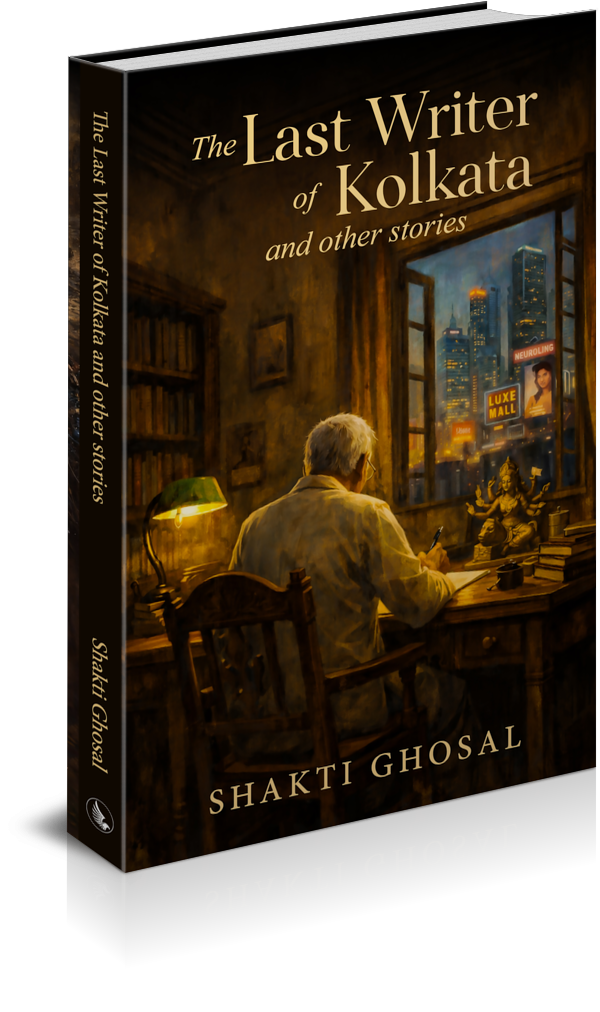
New York University features in the story ‘Echo Chamber’, part of my forthcoming book ‘The Last Writer of Kolkata and other stories’ due release in early April 2026. Should you wish to receive exclusive previews, do write to me @ author.esgee@gmail.com.

In musing…….. Shakti Ghosal
Ma Is Coming


Ma is Coming

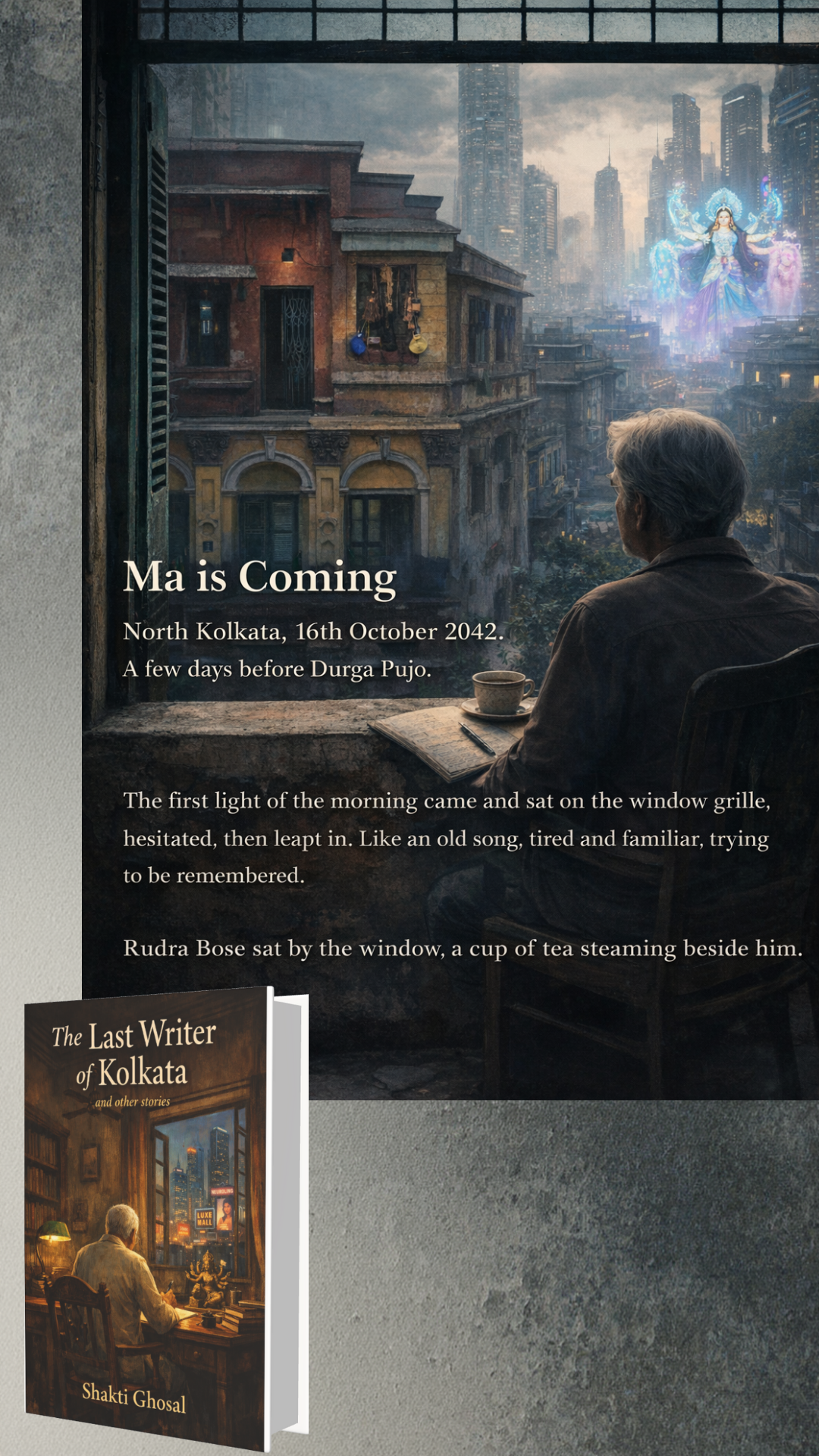
North Kolkata, 16th October 2042. A few days before Durga Pujo.

The first light of the morning came and sat on the window grille, hesitated, then leapt in. Like an old song, tired and familiar, trying to be remembered.

Rudra Bose sat by the window, a cup of tea steaming beside him. The cup was chipped, the saucer mismatched, the tea, a stubborn blend of milk, tea dust, and habit. Outside, the lane yawned into a waking slumber, its air thick with last night’s incense, stale samosa oil, and the ever-present, low-grade air pollution.

“Ma is coming,” he had heard someone shout on the street last evening.

She was, of course. Ma came every year. Only nowadays she arrived on a cloud of holograms, flanked by LED lions and thunderous drumbeats pouring through subwoofers. The city had found new ways to worship, more theatrical, more saleable.

Rudra shifted in his chair, his bones protesting like rusted hinges. In his lap, his journal lay open, an old pen resting across the page like a reluctant weapon. He hadn’t written yet. He was waiting, unsure of something. Was he waiting for a thought, a familiar smell, or the comfort of a Kolkata that seemed to slip further away each year?

Durga Pujo. Once, it had been magic.

As a boy, he had spent mornings watching Mashis, aunts and Boudis, sisters-in-law threading marigolds for the Pandal and Thakurer Bedi. In the afternoons it would be the decorators stringing up festoon lights of different colours all along the lane. Nights were all about rehearsing lines for the Natok, stage play they would perform on Nabami.

He had once accompanied his mother, walking barefoot to the river to collect Gangajal, the sacred waters of Ganga. He remembered his father reading out the Chandipath under a suffused light. Long buried memories of his parents surfaced and meandered.

“Rudra, you were born with too much silence,” his mother had once said, as she used a hand fan during load shedding. “You are eleven. Most boys your age chase dragonflies. You chase metaphors.”

“I like listening,” he had replied, “Words sound different when you don’t rush to answer them.”

His mother had turned towards him, “Then promise me, don’t let the noise teach you to forget what silence feels like.”

North Kolkata is the soul of the city, where the past isn’t just remembered—it’s lived. Often called “Babu Kolkata,” this region is a labyrinth of narrow lanes, grand 19th-century mansions, and centuries-old traditions that remain untouched by modernity. Historically, the British referred to the area inhabited by the native Bengali elite as the “Black Town,” in contrast to the “White Town” of Central Kolkata where the British lived.

North Kolkata features in the ‘Last writer of Kolkata’, part of my forthcoming book of the same name. Should you wish to receive exclusive previews and the chance of winning a free copy of the book, do write to me @ author.esgee@gmail.com

Shakti Ghosal

The Last Writer of Kolkata


The future does not arrive all at once.
It seeps in quietly — through our cities, our screens, our climate, our homes, and our hearts.

Set in a near future shaped by forces already gathering momentum, this compelling collection explores what happens when irreversible hard trends collide with ordinary human lives. When familiar worlds tilt just enough to reveal what has already begun to change, they become recognisable tomorrows, shaped by powerful forces. A writer watches memory become a commodity in a digitised culture. An environmentalist confronts the fury of a climate unbound. Minds are shaped inside engineered echo chambers. An aging couple discovers that love, not technology, is the last refuge of belonging. These are not science fiction tales of spectacular collapse, but of subtle reckonings—where survival lies not in resistance alone, but in choosing what must still be remembered, protected, and passed on.

At once intimate and expansive, the stories follow ordinary people navigating extraordinary transitions — holding on to memory, dignity, connection, and hope as the ground beneath them shifts.

Blending imagination with insight, this book offers fiction as a lens — an exploration not of what gadgets we will build, but of who we may become.

The future is coming.

But the human story is still being written.

In musing…….. Shakti Ghosal