As I thought about this question, a workplace experience from the past showed up. In my first job, I was an Assistant Mechanical Engineer in an Electric Diesel Locomotive maintenance workshop of the Indian Railways. I seemed to be confronted with disparate and multiple problems like dirty work bays, breakdown of machines, the workers’ trade union raising different kinds of demands, and so on. As I tackled one issue, other workplace crises seemed to occur elsewhere. I was always firefighting with disparate problems with no overall improvements in terms of productivity and output.
Over time, I became demotivated with ‘loser mindset’ thoughts which kept circling in my head. These thoughts were like ‘I am doing the best I can’, ‘No point in trying hard, nothing will change’, “I have a wrong boss, bad subordinates’… and so on. A kind of workplace lethargy set in, a laziness to try newer ways and the unwillingness to get out of the rut.
My mind shifted during a footplate inspection when I experienced firsthand the problems faced by the travellers from locomotive failures. A context got created in my mind, ‘When we don’t operate timely schedules, people’s lives get effected’. As I brought this perspective as an overarching vision for myself, my day-to-day work focus, the language I would use, my handling of situations changed. I felt more energy flow, motivation, and excitement. What was more remarkable was that my team started aligning itself with the overarching vision. My passion seemed to be seeping into them as they perceived that the actions were also addressing their own concerns.
As I think back, I can say that what can motivate us most is our ability to create an overarching vision which excites and pulls us towards goal achievement as more and more stakeholders start seeing the vision meaningful, relevant, and addressing their own concerns.
Recently, in a ‘Mindset Matters’ podcast, while discussing the above subject, we came to a counterintuitive and interesting perspective that the sheer act of encouraging someone else can lead to our own selves being encouraged and motivated to achieve our own goals.
Should you wish to listen to the podcast, do DM me and I would be happy to send the link.
Listening as an activity seems passive and an easy one. It is not. When someone speaks to us, we end up listening though a mesh of beliefs, prejudices, preconceived notions, and past relational baggage. What we end up really ‘hearing’ in our brains is a distorted version of what was communicated.
For listening to be effective, it needs to land for us with minimal distortion. To do that we need to master the art of Active Listening. Which is listening without intention, without judgment, without RIGHT or WRONG.
I would like to relate an incident of an irate customer from a previous assignment. He was a regular buyer of our services but on that day, he came to book a family holiday and said he would pay once he returned. Such credit to individuals was not allowed as per company policy. The counter supervisor tried to reason with him but he got even more upset and stormed into my office.
Customer: “I can’t believe this, the way I have been treated just now. After all these years, are you guys telling me you don’t trust me? I have tried to explain to your supervisor but he throws the rule book at me.”
Sensing the anger and upset, I decided against trying to explain and opted to listen empathetically. As the customer continued to rant, I maintained eye contact, nodded sympathetically, and made verbal assertions like, ‘I see’, ‘I understand’.
When the customer finally stopped, I said, “I heard what you said and realise how upset and unacknowledged you must be feeling. You mentioned that you wish to make the payment of your much awaited holiday package after your return. Have I understood you right?”
The customer for the first time cooled down. “Yes, that is correct. I find it demeaning that your company does not trust me.”
“Okay, this is what we could do,” I said. “You could give us a post-dated cheque and I will authorize its acceptance as a special case.”
Now, this was not at all an innovative solution and could have been offered earlier also. So what could have been the reason for this not happening? Clearly, the engagement had been more about protecting one’s own turf and resolution had not been part of the mindsets.
As I think back to that situation, I can see that the active listening demonstrated in that interaction is what resolved the situation. The eye contact and nods, the acknowledgement of emotions, the paraphrasing and the offer of a solution is what allowed the customer to be heard, valued and reassured and be willing to co-create a resolution with me.
Frank Marinko and myself, both international Executive Coaches and Facilitators, grappled with this question using the critical thinking methodology, in a joint podcast. You might enjoy the discourse and the podcast link is given at the end.
If we are to deliberate on this question, we need to get to the essence of two aspects mentioned. First, AI or Artificial Intelligence as we call it. Second, ‘to lead’ which is all about Leading or Leadership.
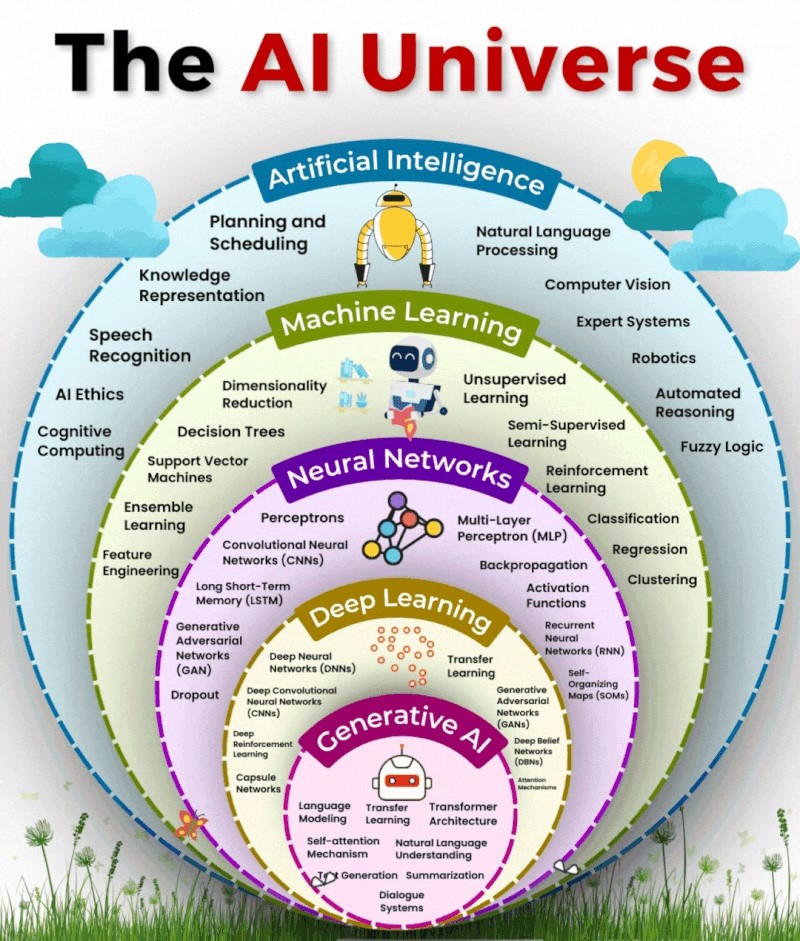
So, what really is the essence of AI? That lies in its ability to mimic and augment human intelligence and decision-making processes using computational algorithms and data. At its core, AI systems can analyze vast amounts of data, recognize patterns, infer relationships, and make predictions or recommendations.
The important aspect to be kept in mind is AI’s ability to ‘learn’, its adaptability and the ability to improve over time. Machine learning algorithms, for example, can automatically adjust their behavior based on new data, allowing AI systems to become more accurate and effective with experience.
And when we think of the essence of Leadership, it is really all about envisioning a future which speaks to all stakeholders by addressing their concerns or satisfying some needs. Leadership thus involves directing and coordinating the efforts so that the full potential and collective success can be realised.
With the dawn of computers seven decades back, Alan Turing had considered the question, ‘Can a machine think like a human?’ and came up with a test now known as the Turing Test. With the advent of AI, several Artificial Intelligence programs have already passed the test. The purpose of this question seems to be a deep-down threat to our unique ‘leadership ability’ that we see emanating from AI. There are concerns that AI will not only start doing complex and decision-making tasks replacing humans but in the long run go beyond human controls and frameworks.
This idea of technological obsolescence where technology renders humans obsolete, and takes over most of human jobs and work, is a concern that has been raised in discussions about AI and automation. However, we humans have creativity, empathy, intuition, adaptability, and the capacity for complex moral reasoning, which are integral to many aspects of work and life. These qualities enable humans to excel in areas such as innovation, problem-solving, interpersonal relationships, and above all Leadership.
The idea of AI achieving consciousness is another topic of much speculation and debate. Consciousness is a complex and still poorly understood phenomenon, and whether AI can truly achieve it is uncertain. Even if AI were to achieve consciousness, the process of its development would likely still involve human input and guidance. AI systems, as they exist today, are created, and trained by humans, and any future developments in AI consciousness would likely follow a similar path.
However, it is worth noting that AI can already exhibit forms of “thinking” and problem-solving that are quite different from human cognition. Machine learning algorithms, for example, can process vast amounts of data and recognize complex patterns in ways that humans cannot.
Whether AI should create its own thinking framework independent of human influence is a philosophical question with no easy answer. It raises issues of autonomy, control, and ethics. If AI were to develop its own thinking framework, it would still need to start and remain ‘biased’ by frameworks that align with human values and approach. It thus seems that in the foreseeable future, Humans would continue to lead AI, leaving aside the esoteric visions of the Matrix and Terminator movies.
To effectively lead AI development which would synergise with human development, adherence to principles such as transparency, fairness, accountability, and human-centered design would be needed. We would then be able to harness the full potential of AI while minimizing harm. These principles should serve as guardrails rather than roadblocks, helping to steer AI development in a direction that aligns with human values and promotes the common good.
In today’s fast changing world, we are almost always confronted by situations about which we lack past experience to engage or resolve. We try to force fit some past learning and end up either failing to get an outcome, or if lucky, achieving part success.
In a past assignment, I was managing a Travel & Destination services management company. One of our major customer accounts was the national petroleum development organisation and because of the large business quantum, we had an implant operation with a dedicated team. Our service and response levels were appreciated by the client.
In line with the commercial norms, as our contract period was coming to an end, the company released a tender for a subsequent period. Believing the client was happy with us, we submitted our competitive offer in line with what we had done during our last successful bid. When the tender was finalised, we were shocked to know that we had lost. When we asked the client company’s commercial team, we were informed that we had not complied with the technical terms of the bid. Going back to the drawing board, so to say, our analysis of the tender document revealed that there had been a small section requiring development and implementation of a Travel management Services (TMS in short) software as part of the client’s intranet, which we had not responded to.
Soon, we had the opportunity to bid against a tender released by the National Gas Company. We noticed that in this tender document too, there was a requirement of implementing a TMS software. This time we were careful enough to comply with the requirement by indicating our willingness to develop. But we again lost the tender! The winner was a competitor who already possessed a fully developed TMS module and had provided a live demonstration of the same to the client.
We had been disrupted. By a new technology, a new competitor, which together had disrupted our traditional business model. The world had shifted, the business need in the environment had changed and the earlier alignment of the latter with the competence set of our company had been lost.
A situation like the above can create a quandary for each one of us. Should we stretch our own competence and experience profile to paper over the gaps that exist because of the changed requirement? This usually is the easy and the quickest option, and thus gets chosen by most leaders and Managers. But the more sustainable and resilient pathway, a much tougher and thus rarely taken option, is to continually equip oneself with the needed competences so that the alignment between us and a world that is shifting, is not lost.
What I have frequently noticed is leadership folks, rather than confronting, resort to whining and complaining. Of how no one could have foreseen what happened, how they had planned and were equipped to handle what did not happen, and so on.
If we are not careful, we can end up in a downward spiral of negativity. I have seen leaders ending as black holes. With a huge gap between their original intention and final impact. This is largely because of a human psychology quirk. The more we talk of something we failed to do, the more important it becomes. As Noble Prize winner Daniel Kahneman said, ‘Nothing in life is as important as you think it is, while you are thinking about it’.
Ways to avoid the Black Hole:
Ask, “What can we do to resolve?” Wait for a positive response. We are conditioned to put effort once we commit.
Envision a future that was not going to happen anyway. Ask, “If things were going flawlessly, what would that look like?”
A way to grow one’s Leadership is through introspection. One needs to look back into one’s past and identify all that which contributed to one’s Leadership and performance development.
This may sound easy but it is not. As we move through work responsibilities and the corporate hierarchy, we tend to develop our own plethora of ‘what we believe made us succeed’ mechanisms consisting of inauthentic facades, assumptions and ‘need to impress the other guy’ behaviours. We also hone our survival instincts. So, when we do get down to ‘looking into our past’ and identifying all that which contributed to our development and growth, we tend to see stuff distorted by our facades, beliefs and impress the-other-guy behaviours.
The way to grow one’s leadership through introspection is to do the following practices.
Ask yourself, ‘Who were the people who changed you?’
When I thought about this question, I could identify two individuals.
The first was a senior colleague at the start of my career as an Assistant Mechanical Engineer in the Indian Railways. The quality that my colleague brought into our relationship was one of sunny optimism and a natural instinct to mentor without a self-serving mindset.
The second was my boss in Voltas Ltd, where I was handling HVAC projects. The quality that he brought into our relationship was one of down to earth openness and transparency.
I realise today that what allowed me to grow through the above relationships was to try and inculcate a non-self-serving mindset as also authenticity through openness and transparency.
Ask yourself, ‘What kind of people did you gravitate towards?’
When I thought about this question, I could again identify two individuals.
In my tenure in the Indian Railways, I had two workshop foremen report to me. The first was a kind of a ‘yes man’ guy. He made me at once comfortable through his unquestioning loyalty; he would do exactly what I asked him to. This was a great relationship for maintaining status quo about situations and other stuff.
The second was a guy who was a ‘shop floor rebel’. He would usually give a counter viewpoint to most stuff I would suggest, and at times speak uncomfortable truths based on his own past experience and arguments. I would often ‘see’ his approach as unwillingness to accept my authority or trying to prove me wrong. I would feel upset.
This did not seem to be the kind of relationship I would be comfortable with or gravitate towards at that point in time. But I realise today that the person who allowed me to grow was this ‘rebel’ guy as he shattered my comfort zone and forced me to look at uncomfortable possibilities.
So how might you grow your leadership in today’s disruptive world? How might you foster such growth in your team members?
Gain mastery about how to succeed in a business environment that is constantly changing and being disrupted. Do this free module:
We were engaged in a MENA region Business expansion consultancy project for a client organisation (name withheld) in Dubai. Being time bound, our team was depending on the client for getting certain ground assessments and data to do a competitive audit and recommendation set.
Interestingly, the common refrain by the client personnel was that the competitive situation was shifting fast in terms of relative importance and data points. It was thus difficult to provide accurate ground assessments.
One day over coffee, I got to discuss about the Business implementation with Darius, the Business Development Manager responsible for the project.
“In your view, what is the kind of Leadership needed for successful implementation in our kind of fast changing environment?” Darius asked.
“And where would you like to see Leadership being exercised in your kind of situation?” My response was a return question.
“Well, I suppose leadership needs to ‘lead’ us from where we currently are to where we are proposing to be”, replied Darius.
I could not agree more. Leadership indeed needs to reside in the gap between one’s current state and the state one aspires for. But then how does Leadership set the organisation on the right pathway? In today’s increasingly disruptive and discontinuous world, the luxury of a fixated, ‘past experience driven’ journey with a visible future at the other end, is no longer available. If at all, present times require the ability and mindset to get off that beaten path and into the unknown forest area, so to say.
I said as much to Darius.
As if reading my thoughts, Darius asked, “So what might be the leadership mindset needed to eke out a new path through the forest trees you spoke of?”
“That is a great question”, I acknowledged. “I can think of one. Which I would term as ‘your comfort with ignorance’. You need to be comfortable with the knowledge that you ‘do not know’. Only then will you able to unearth and visualize new possibilities. Without this there can be no growth in a disruptive world.”
Somewhat later, when I sat thinking about our conversation, two other aspects came to mind.
First, a mindset to accept failures. We need to accept failure as an intrinsic part of who we are. In an uncertain world with no past experience to guide us through the discontinuity of the ‘forest trees’, it is only mistakes and failures which become the building blocks of eventual success.
Secondly, a more controversial but nonetheless critical ability to wear a ‘mask of yet to be internalised behaviours’. We need to fake the needed leadership behaviours, if necessary, before they become an intrinsic part of us.
I would like to term the above as the CAM mindset shift, to use an acronym.
Comfort with ignorance
Acceptance of failure
Mask yet-to-be internalised behaviours
So how might you grow your leadership in today’s disruptive worl
Do you remain dissatisfied and uncertain about how to face emerging situations and challenges in today’s fast-changing world?
Do you frequently get the sense that however hard you or your team are trying, there seems to be always someone ahead of you and winning?
As you resolve a problem or a challenge, do you get confronted by fresh ones?
Are you frequently unable to prioritize which problem to tackle first?
However much you strive, are you unable to see the big picture and align yourself and your team with that?
….. And on a more personal level:
Do you want to get that job or assignment that you have been trying?
Do you want to get that promotion and recognition you have been aspiring for?
If you have been plagued by one or more of the above questions, the Winning in a Disruptive Worldprogram might just be what you need to improve your winnability quotient in today’s world.
The fact is that our present world is constantly getting disrupted. By new technologies, new competitors, or other factors that can disrupt traditional business models. The disruptive world with its VUCA (Volatile, Uncertain, Complex, Ambiguous) characteristics allows us to reside in a significantly narrow band in the present with a hazy and uncertain future in front and the inability to take recourse of our past experience.
Conceived and developed based on workshops and programs conducted for leading organisations and Business Schools, the course showcases the major types of disruptions that are shaping the world. You, as the participant, would gain an insight into what leads to us getting disrupted. You would review the process followed by a probability-based mindset and the need to shift to a possibility-based mindset to be able to better handle disruptions. You would practice and gain proficiency in the five action steps for the needed shift by conducting in-depth Inquiry through a structured process.
Creation of a context by using hard trends in three areas.
Creation of the three lists.
‘Plug into the future’.
Relational assimilation through a triad of competencies.
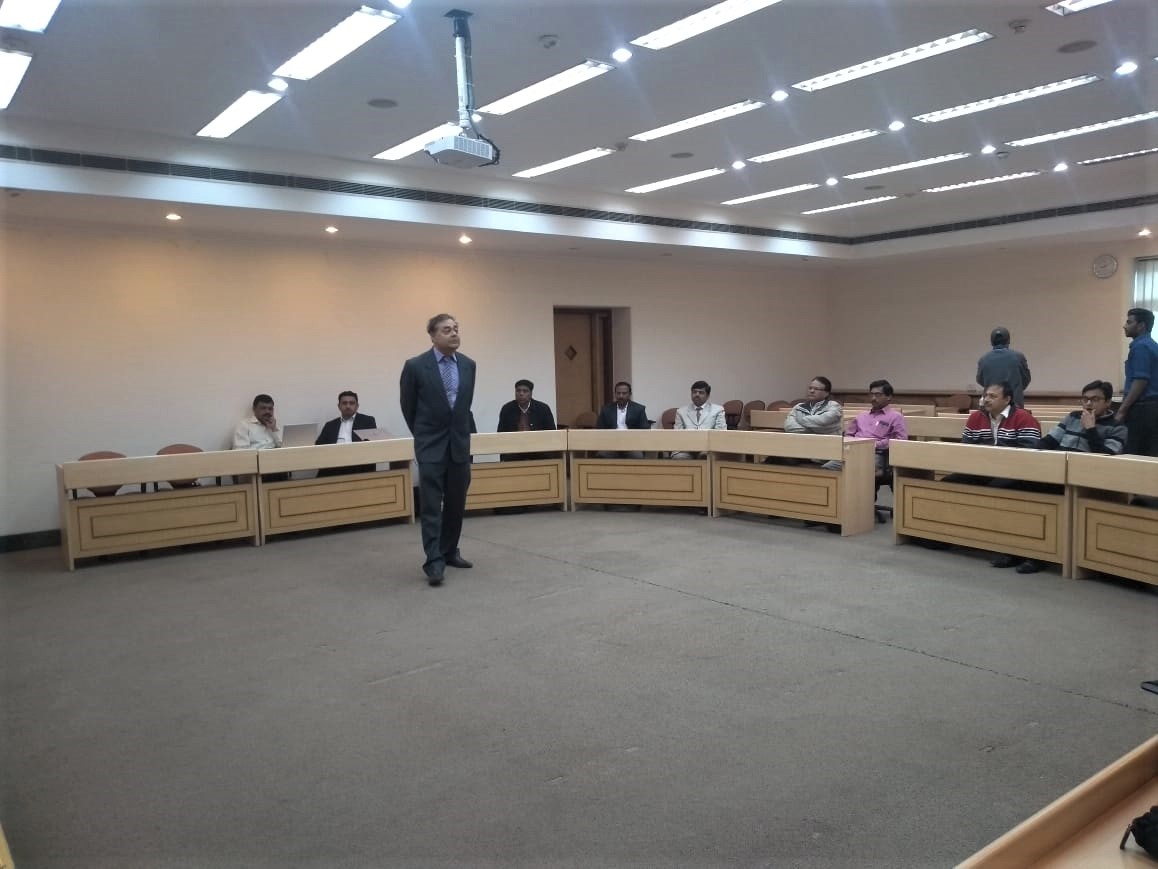
Sometime back, at a two-day Leadership Development program that I was running for Larsen and Toubro Ltd (a heavy engineering and multi-business conglomerate in India), a participant came to me during one of the breaks and said:
“All these techniques which we are learning seem to be of little value to me. I am faced with a different kind of problem. My boss has a strong controlling impulse. It is usually his way or the highway. It seems to me he believes this mindset is what has helped him reach his current position. So even if I try, there is never a win/win situation for my boss vis a vis me. What should I do?”
@ L & T Workshop
As I stood there listening to him, several thoughts came to mind. I asked him whether he was okay to delve into the issue some more.
We need to start exploring. We need to ask, ‘What is that which our ‘controlling boss’ would really like to control and change?’ And even more important, ‘What is that we ourselves are willing to let go?’ For ‘letting go’ could be the start of getting back in control.
Could we try and meet the ‘control freak’ half away down? For instance, certain relationships and one to one interactions could still be kept under our control. This realization itself can give us a sense of empowerment.
Could we ‘let go’ by avoiding reacting when we are being pushed to accept the controller’s point of view? Acknowledge what we have been told and then explain what we plan to do, why we have decided so and that we are willing to take full responsibility of the outcome.
The above exploration would allow us to create our action steps in the matter, thus elevating our own control of the situation.
‘Becoming a leader’ does not arise from knowing techniques or aping what we see great leaders do as they exercise leadership effectively in varied situations. Leadership and Performance is very little about what we know, it is almost all about how we see. ‘How we see’ comes from our ability to shift our perception through developing a contextual framework for our own selves.
My younger daughter Piya’s wedding was being celebrated.
The interesting thing was that though I have participated in several Bengali weddings, including my own. over the years, this one was providing me a refreshing ‘stand and stare’ perspective of the goings-on. Was this because this was ostensibly the last big event in the family? Or was it because of my acquiring a more relaxed and less impatient mindset with advancing age? I remained unsure.
The Tubri firecracker of Bengal has no real parallel elsewhere. When lit, the small round earthen pot emanates a gentle gurgling sound with tiny sparks coming out of the hole. The intensity increases with the colourful sparkles streaming up to great heights, accompanied by the rising crescendo of the combustion sound.
Like the Tubri, the Bengali Wedding too starts as a gentle symphony of fun and bonhomie which then blooms into a larger-than-life event showcased through a riot of colour, lights, feasting, and rituals.
Ai Buro Bhat, that Bachelorette and Rice event. The last ‘big meal’ of the would-be bride as a bachelor!
It is a much-awaited ritual and the wedding bell starts to ring as family and friends gather to bless the bride-to-be. A sumptuous meal awaits her and the others present. Ranging as it does from fish and meat dishes, fried foods to Mishti, the traditional Bengali sweets. A fun event replete with jokes, reminiscences by the elders, and banter.
The blessing…..as my nonagenarian ( 90 years old) mother blows the conch shell
Ai Buro Bhat
The pre-wedding evening gets packed with four events.
The Mehndi event is all about creating exquisite body art through the application of Mehndi or Henna. An event in which the bride-to-be and other ladies participate. As the evening progresses, Mehndi, that red-orange stain applied on the palms and hands, keeps on darkening! It is said that the darker the mehndi, the more would be love in the air.
Mehndi mysticism
Those exquisite designs
Ashirbaad, the Bengali pre-wedding ceremony, is all about blessing the would-be couple. The ritual is symbolized by parents and senior family members putting dhaan, rice husk and dubyo, trefoil leaves on the heads of the to-be-weds, along with exchanging gifts of gold jewellery, clothes, and sweets.
Ashirbaad
The blessing
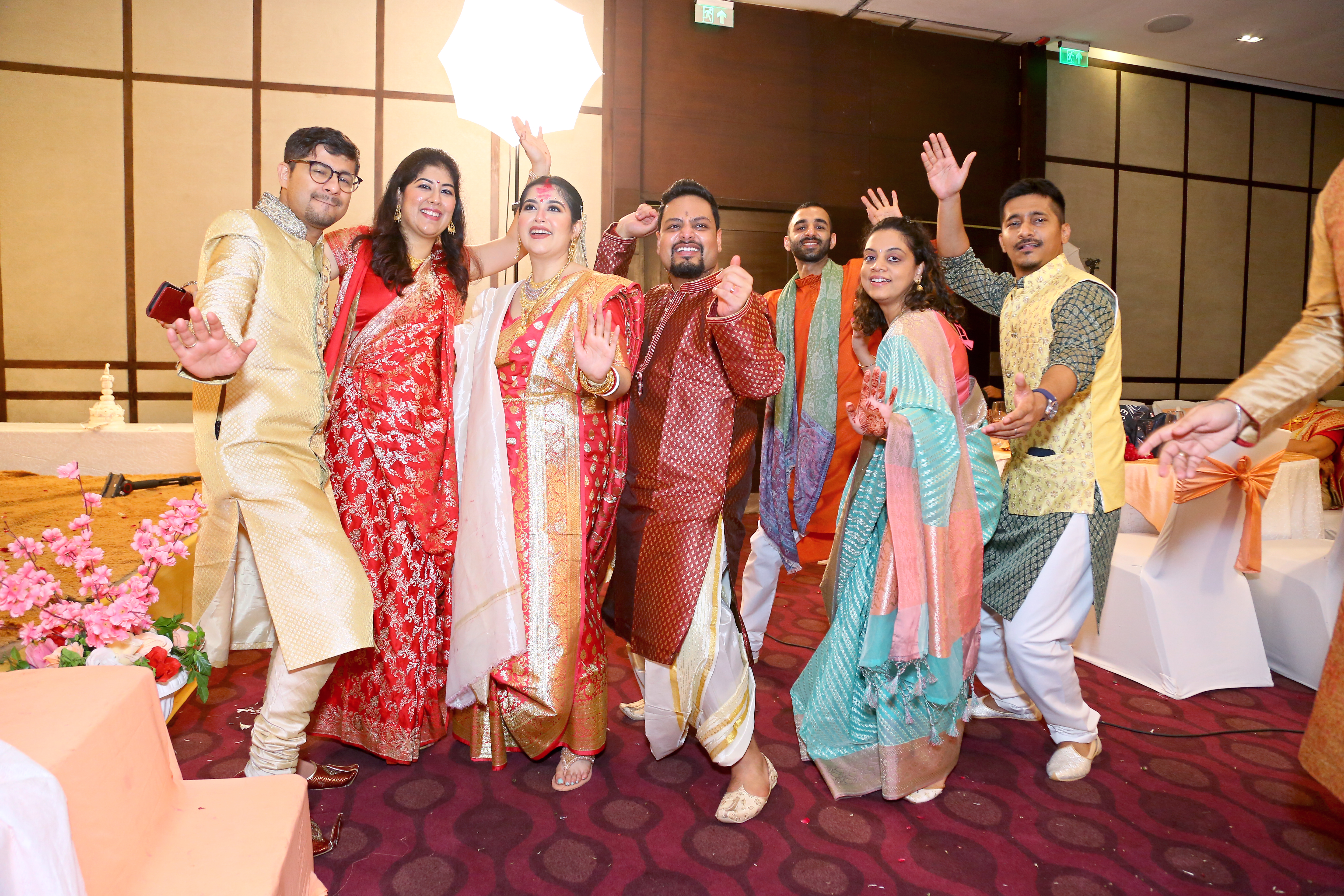
Sangeet literally means music. The Sangeet event with its music and dance, is a celebration of the wedding union and bonding. Everyone is expected to let one’s hair down and shake a leg. Be it through impromptu jiving or a choreographed dance performance.
Let’s waltz into the future….
Shall we jive?
Shake a leg
Rock n’ roll!
Eyi to Hethaye kunjo chayaye
And finally, it is about that one ring that signifies a resolve to join together in life’s journey. The Engagement ring ceremony.
The engagement
Comes the Bengali Wedding Day when the bride and the groom tie the knot.
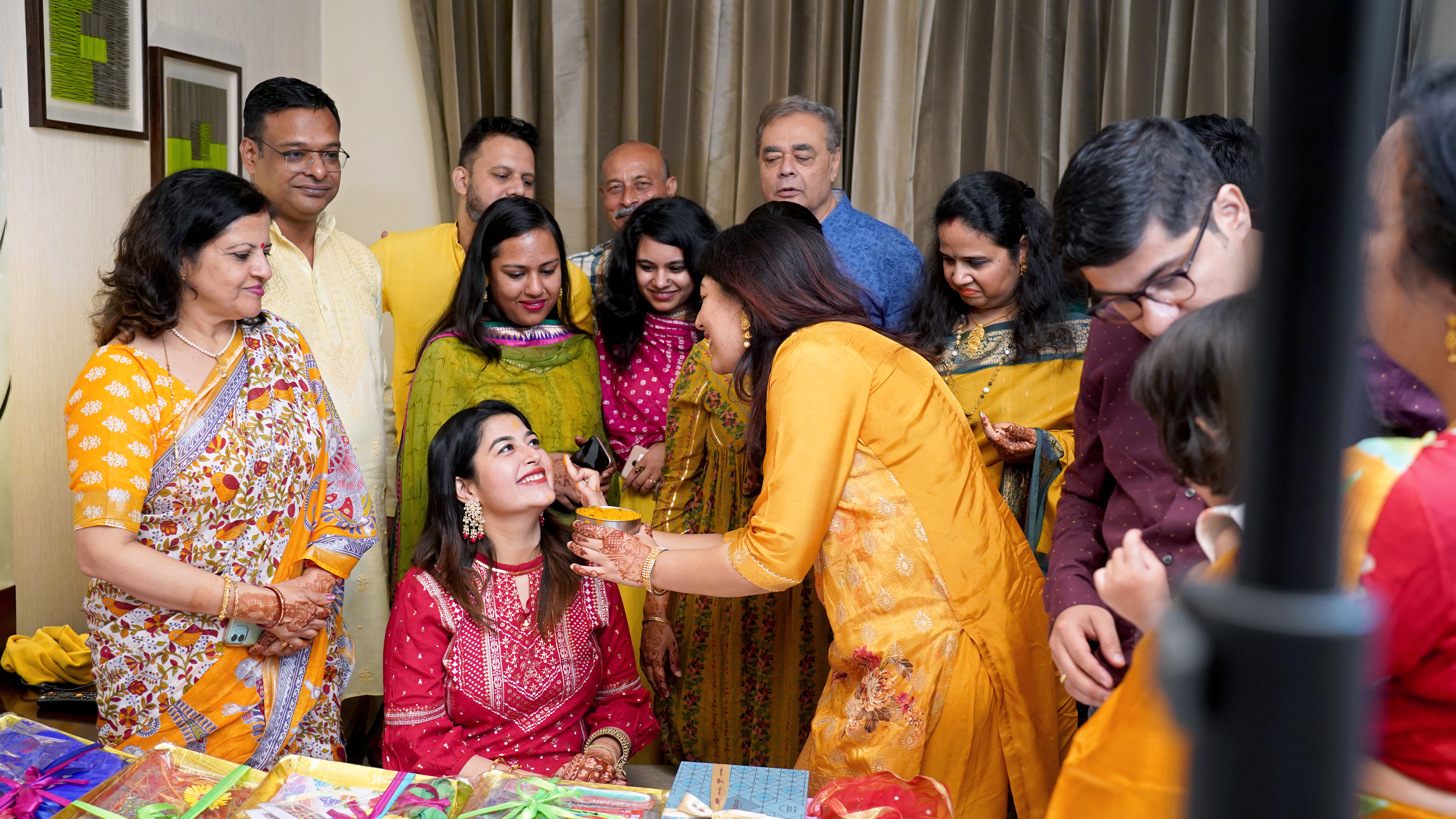
The morning starts with the Gaye Holud ritual. Gaye Holud is all about smearing turmeric paste on the bride’s face and body. The ‘groom smeared’ turmeric is brought for the bride by the groom’s family members. Apart from being considered a beautifying and brightening agent, turmeric symbolizes healthy relationships for the future.
Gaye Holud
The Bengali wedding has the practice of exchanging attractively packaged gifts. The bridegroom’s family members bring these along with the bowl of turmeric paste for the gaye holud. All those brightly decorated tatta trays, containing as they do clothes, gifts and accessories, are a visual delight. Apart from the sheer creative effort to make them, Tatta trays are supposed to bring with them abundant blessings and good wishes.
Totto ……. can you spot the decked-up fish?
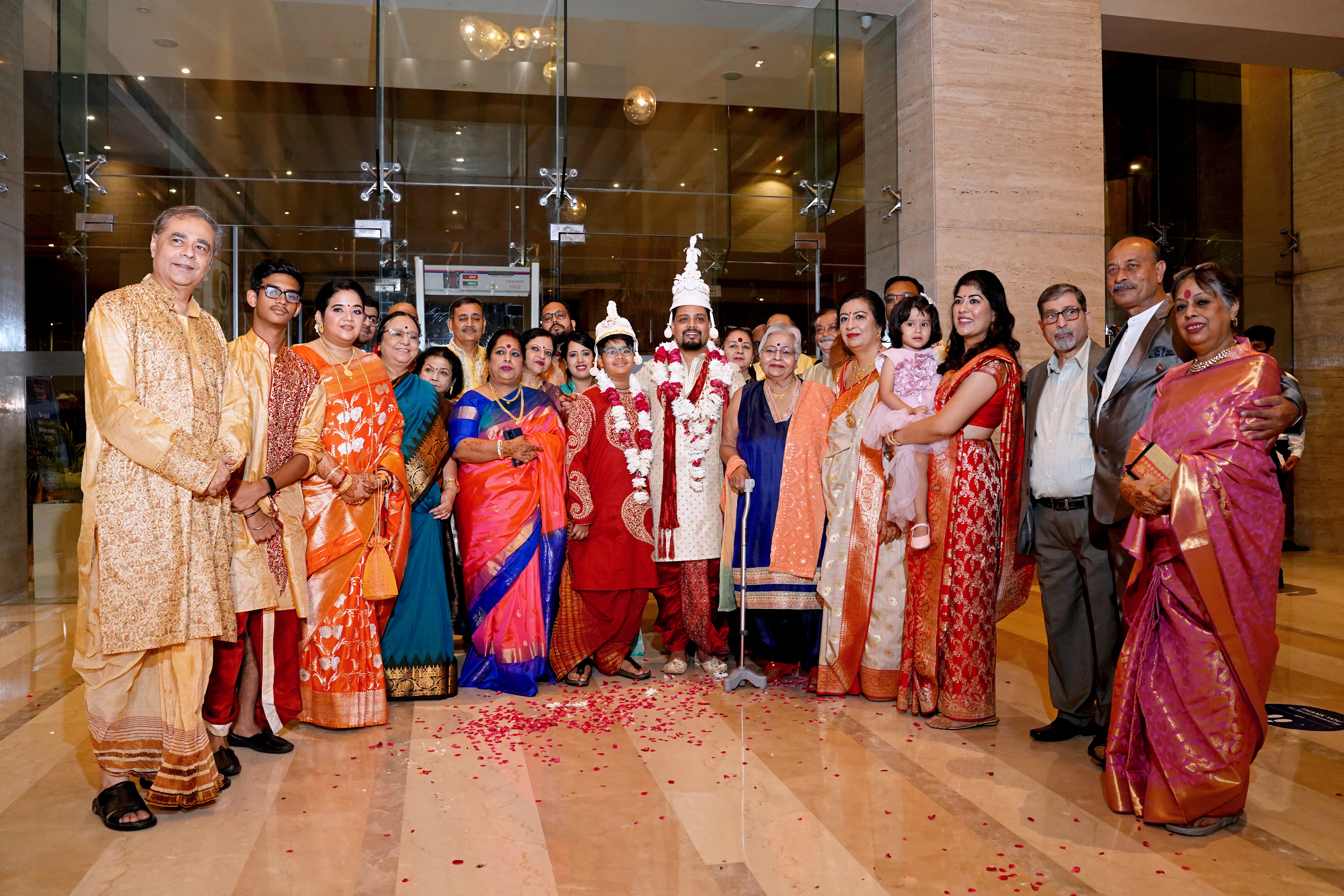
Bor Boron is all about formally welcoming the groom to the wedding. The Bor, Groom arrives with his bor jatri entourage (On his wedding day, Piyush the groom, and all the others had to come through a heavy downpour!). The bride’s mother does Boron viz. blesses and welcomes the groom at the entrance with a kula, bamboo winnow accompanied by the sounds of Uludhwani, before the latter is escorted to the Chhadnatola, the wedding mandap.
Bor Boron
Bor Jatri
Quintessential Bengali bride
Subho Dhristi is that first exchange of glances between the bride and the groom. Carried on a pidi, a wooden stool, seven times around the standing groom, the bride keeps her face covered with paan patta. betel leaves before slowly revealing her face for that auspicious glance.
Prelude to Shubho Drishti
Comes the Mala Bodol in which the bride and the groom garland each other thrice, the Sampradan in which the father ‘hands over’ his daughter, the bride, to the groom and the Anjali in which the groom holds the bride’s hands from behind as they offer khoi, puffed rice to the sacred yagna fire.
Mala Bodol
Sampradan
Anjali
The evening is still young … so photo opportunity, some dancing, good food, and drinks for all!
Newly weds
The evening is young!
Let’s make some noise!
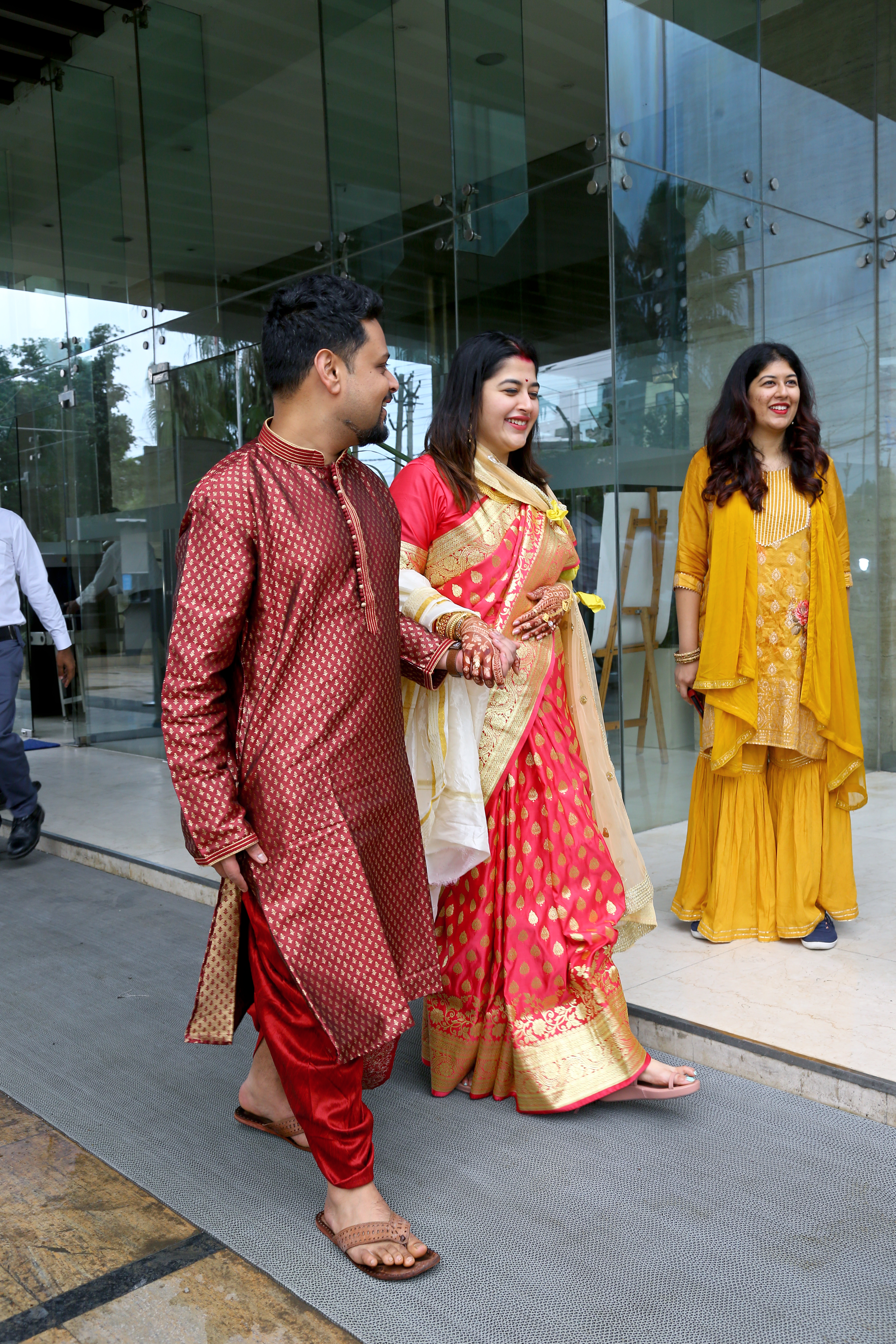
Next morning and it is time for the bittersweet custom of Bidaye. The bride bids farewell to her parents and other family members as she gets ready to accompany her newly wedded husband to his home.
Bidaye
Let’s go home.
As the Bride reaches her new abode, she is welcomed by her mother-in-law with Arati, a ritual meant to bring in light. She steps into an Alta (red dye) filled tray and then walks onto a white cloth. Those alta laced red footprints on the cloth are supposed to herald Goddess Lakshmi into the household.
Arati
Lakshmi steps
It is the day of the Bou Bhaat and the wedding reception.
Bou Bhaat literally means bride’s feast. It signifies two things. As the bride settles down in her new home, it is time for the bhat Kapor ritual in which she is offered a new saree and jewellery by her newly wedded husband signifying that he takes responsibility for her food and clothes from now on. The bride then serves rice to all family members implying that she is now part of the household.
Bhat Kapor
Bou Bhat
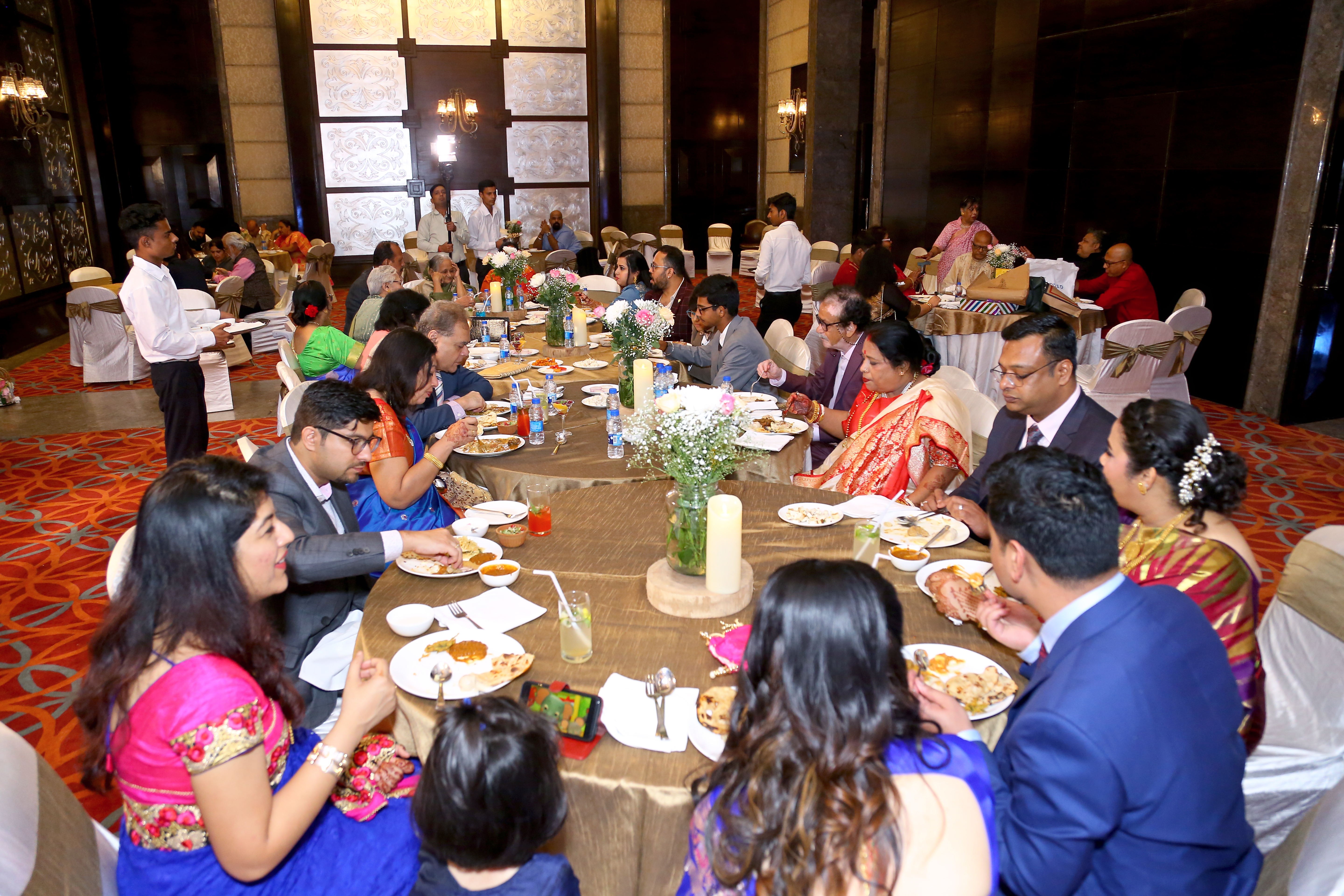
In the evening, the groom’s family invites all family members and friends to a preetibhoj or a gala dinner. The bride’s family, the kone jatri , are guests of honour at this reception.
Welcome to our beginning!
The arrival
The wedding cake
Preetibhoj
Guests @ the Gala Dinner
What does the future hold in store?
As an observer of the wedding events and rituals, I sensed how the Bengali Wedding has been able to maintain vibrancy and relevance by imbibing popular parts from elsewhere. The Sangeet custom is an import from Punjab and North India. The Mehndi tradition is from the Middle East and according to some sources, was brought into North India by the Moghuls. Over the years, it has become part of Bengali weddings too. The wedding cake, with its origins in ancient Rome, has always been part of wedding traditions in Europe. It has become increasingly popular in Indian and Bengali weddings. An eclectic blend of these customs from elsewhere with the traditional Bengali ones made the whole event a fascinating one for me.
Piya and Piyush’s wedding also made me recall the few lines I had penned about a Bengali wedding of a century back in my book, The Chronicler of the Hooghly and other stories:
“Thoughts and memories coalesced.
Malati looking at Dipen shyly from under her ghomta, saree drawn over eyes, on their wedding night during shubha drishti.
Malati being raised higher and higher by her brothers in fun to prevent Dipen from garlanding her easily during their wedding.”
I was left with the realisation that even though our society and the collective mindset have changed beyond recognition over the last hundred years, somewhere, somehow the glue of our customs and rituals has provided a reassuring continuity.



























 A New Beginning