The Royal Bengal Tiger was always just beyond the frame—a whisper in mangroves, a rumour in grasslands, a story told by guides with knowing smiles.
In the Sundarbans, they warned us, “Don’t look too hard. If you see one, chances are you won’t be seen after.” We looked anyway. We saw nothing.
At Ranthambore National Park, dawn and dusk gave us….. Pugmarks, droppings, and growing humility.
At Periyar Wildlife Sanctuary, they didn’t even pretend. “Forget it,” they said kindly.
And then— it was the turn of Tadoba Tiger Reserve……where, quite unexpectedly, fortune decided to shift…. and behave like Lucknow hospitality.
It began like a well-directed play. Our jeep was rolling lazily when the guide suddenly sprang up, as if the forest had whispered directly into his spine— “Look behind!”
And there she was. A tigress. Standing squarely on the road. Unhurried. Unapologetic. Entirely in charge.
She gazed past us, not at us— as though we were merely an inconvenient paragraph in her story. A low, resonant rumble followed. And then another and another.
“That,” the guide declared with reverence, “is the mother calling her children.”
Of course she was. Even in the wild, mothers don’t wait forever.
What then transpired in front of our eyes was akin to a screenplay. But of the most elegant kind.
As we continued to be transfixed by the one behind, the guide shouted again and pointed. From the front, another tigress appeared—a sibling, perhaps…….She carried a prey in her jaws with the nonchalance of someone bringing snacks to a gathering.
The mother’s rumble deepened.
Translation (we imagined): “Food is fine. But where are the children?”
And then we saw them again. Three grown cubs, walking in a line— like reluctant teenagers responding to a call they had heard thrice already.
They were magnificent. And mildly disobedient.
The mother paced the shoreline now, her calls shifting between soft persuasion and unmistakable authority. It was a language older than words— half love, half command. The forest listened. So did we.
One cub made the first move. It slipped into the water, cutting through it with quiet determination—towards the waiting mother. The other two paused. Of course they did. Every family has those who hesitate at the edge.
The mother, now joined by the brave one, turned and looked back at the rest of the family on the other side. A decision was made and the mother and cub swam again. Not away, but towards the uncertain. And then, as if reminded of something fundamental, the remaining two followed.
For a moment, time forgot to move. Four tigers. Water rippling. Sunlight holding its breath. And us— utterly irrelevant, yet impossibly privileged.
We had spent years trying to see a tiger. This time we were seeing something else. Not power. Not danger. Not even wilderness. We merely saw a mother trying to gather her children.
And in that quiet, persistent calling, echoing across water and time, the jungle revealed its oldest truth:In every world, wild or civilised, the fiercest force is not the hunt—it is the pull of belonging.
More than a decade after my coaching certification, certain ideas still return to me with surprising clarity. One of them is deceptively simple:
The difference between reacting and responding.
Most leaders intellectually understand this distinction. Few recognise how profoundly it shapes their daily impact.
I was reminded of this during a coaching conversation with a senior executive — let me call him Raghav. Raghav was known for his brilliance and intensity. Quick thinker. Decisive. Deeply committed. But his team described him using another word, offered cautiously and repeatedly: “Intimidating.”
When he came into coaching, his concern was framed differently. “My team has become strangely silent,” he told me. “Meetings lack energy. No one challenges anything. It’s frustrating.”
Frustration, I have learned, is often an interesting doorway.
“What usually happens when someone disagrees with you?” I asked. He looked puzzled. “Nothing unusual. We discuss.”
But leaders rarely observe their own behavioural patterns with accuracy. Our reactions are invisible to us precisely because they are so familiar. So, I asked him to walk me through a recent meeting.
He described a discussion where a junior manager questioned a proposal. As he narrated the incident, something subtle appeared — not in his words, but in his tone. “I explained why the idea wouldn’t work,” he said.
Then after a pause: “Perhaps a bit sharply.” “What do you think the manager experienced in that moment?” I asked. He shrugged. “Direct feedback.” “And if we asked them?” Silence.
The human mind is wonderfully efficient at justifying its own reactions.
**
In coaching, reactions are rarely the real story. Triggers are.
“What specifically triggered your response?” I asked. “The suggestion didn’t make sense.” “Was it the quality of the idea,” I continued, “or the fact that it challenged yours?”
That question lingered longer. Eventually he smiled — the kind that signals reluctant insight. “I don’t like being questioned in areas I know well.”
There it was. A deeply human pattern. Trigger → irritation → sharp dismissal.
Repeated often enough, reactions harden into leadership style. Unexamined long enough, they reshape culture.
We explored a small experiment. “Next time you feel that familiar irritation,” I said, “don’t change your opinion. Don’t soften your standards. Simply pause.”
“Pause?”
“Four seconds,” I suggested. “One breath. No words.” He laughed. “That sounds trivial.” “It is trivial,” I agreed. “And extremely difficult.”
Because reactions are automated. Responses are chosen.
**
Several weeks later, Raghav returned with an observation that genuinely surprised him. “The meetings feel different,” he said.
“What changed?”
“I haven’t changed my decisions,” he clarified. “But I’ve started noticing the moment before I speak.”
“And?”
“The irritation is still there,” he admitted. “But the pause stops me from firing.” That single gap — barely a few seconds — had altered the emotional climate of his interactions.
People spoke more. Defensiveness reduced. Energy returned. Nothing structural had changed. Only awareness.
**
Reacting is effortless because it is borrowed from the past — old patterns, old triggers, old conditioning.
A decade after my executive coaching certification, one idea continues to stay with me: Accountability is rarely about others. It is about the promises we make to ourselves.
Not the corporate version of deadlines, dashboards, and reviews. Something quieter. More personal.
A simple question: Who holds us accountable for the things that truly matter?
The uncomfortable answer: we do.
**
Some time ago, a senior leader — let’s call him Arvind — walked into my office. Highly capable. Well respected. Clearly exhausted.
“I’m working harder than ever,” he said, “but everything feels stuck.”
Experience has taught me that “everything” usually has a centre of gravity.
“What feels most stuck?” I asked.
“My restructuring initiative,” he replied. “Everyone agrees it’s necessary. But it’s just not happening.”
“What’s stopping it?”
“The usual,” he sighed. Quarterly pressures. Reviews. Endless fires. Bad timing.
Logical. Reasonable. Entirely human.
But then I asked him three questions:
“If the Chairman had mandated this with a deadline — would it still be pending?” “Of course not.”
“If your compensation depended on it?” “Would have been done already.”
“If your team’s survival required it?” “ Then, I would have done it yesterday.”
And there it was. The barrier wasn’t capability, clarity, or even time. It was consequence. Nothing happened if he delayed. No penalty. No discomfort. No urgency.
**
“Whose goal is this restructuring?” I asked.
“Mine.”
“Imposed?”
“No.”
“Do you believe in it?”
“Completely.”
“Then what agreement have you made with yourself about it?”
Silence. Then a smile of recognition. “None.”
**
Many of us confuse intention with commitment.
We say:
• I should do this • I need to get to that • I’ve been meaning to…
But progress rarely responds to “should.”
“What if,” I suggested, “you treated this not as a project — but as a promise?” Something you either honour or break. Not endlessly postpone.
**
“What’s the next visible action?” I asked.
“Announcing it to my leadership team.”
“When?”
“…Friday.”
“And how would you like me to support your accountability?” That question matters. Accountability imposed feels like control. Accountability invited becomes partnership.
“Ask me next week,” he said. “And challenge me if I haven’t done it.”
**
The following Tuesday he returned, noticeably lighter. “It’s done.”
“What changed?”
“I stopped treating it as something I should do,” he said, “and started treating it as something I had said I would do.”
A small shift. A profound one.
**
The most important commitments in our lives rarely come with external enforcement. No one penalises postponed courage. No dashboard tracks delayed growth. And yet, these commitments shape everything.
Accountability is not a management technique. It is a quiet act of integrity —an agreement between who we are today and who we intend to become.
**
Curious to hear your thoughts: 👉 Where have you seen self-accountability make the biggest difference in leadership or life?
Ma passed away a few days ago. In her 93rd year, the end came quietly, almost imperceptibly—an erratic pulse, two deep breaths, and then a stillness that felt like both departure and arrival. As I sat with the silence that followed, I realised that Ma, my mother, had been throughout her life a bridge—between worlds, between the slow rhythm of yesterday and the unrelenting urgency of today.
She was born into a Bengal still rooted in an older order, one among eight siblings, the third successive daughter in a family that longed for sons. Her given name, “China,” carried within it a wound of social prejudice. In colloquial Bengali, it implied “not wanted,” a stark reminder of how deeply patriarchal values once diminished the worth of a girl child. Yet, rather than allowing that name to define her, she infused it with dignity through the life she lived.
Her childhood belonged to a world we can barely imagine today—a house with a cowshed, a manual hand pump for water, and a pukur, a pond at the back where the family bathed. Dirt roads wound between houses, lanterns cast the evening glow, and chalk on slate was the beginning of literacy. But this simplicity was not untouched by history’s turbulence. Ma was a child when Japanese planes dropped bombs over Kolkata during the Second World War. She saw emaciated villagers streaming into the city during the Bengal famine of 1943, begging for fyan, the water from boiled rice, which households discarded. She was there when the horror of the Calcutta killings unfolded in 1946, a prelude to the traumatic Partition that would tear the subcontinent apart.
At nineteen, she married my father, more than a decade older, in the manner common to her time, seeing him for the first time on her wedding day, then journeying more than a thousand kilometers away to Delhi. Communication with her family in Calcutta became an exercise in patience: hand-written postcards, inland letters slipped into red post boxes, and the long wait for the postman that brought replies.
Her early years as a young bride unfolded in a government quarter on Punch Quin Road. Delhi summers were hot and dry, cooled only by the hum of ceiling fans and open windows. Even though she had to pick up the new language of Hindi, she formed easy friendships with neighbours, women bound together by proximity and mutual reliance. If she ran out of salt or turmeric while cooking, she would simply knock on a door and borrow. Life was slow, and its pace cultivated the virtue of patience. Waiting was not an inconvenience—it was a way of life. Waiting for letters, waiting for the dairy gate to open, waiting for a favourite song to emerge from the crackling radio.
As the years passed, her single-minded focus of her family became what defined her. She bore two sons and lived for her husband, her children, and later, grandchildren. Days blended into one another, but in that blending was the rhythm that gave her life meaning.
Meanwhile, the world outside was changing with increased speed. She saw the milk delivered warm from a cow at the dairy replaced by cold cartons stacked on supermarket shelves. She watched neighbourhood grocers, who once weighed vegetables on balance scales, give way to supermarkets where barcodes replaced conversation. She moved from the clunky rotary-dial telephone, whose every call was deliberate, to the age of the smartphone, where continents could collapse into a single video call. She saw handwriting, once a vital art, yield to text typed on computers and phones.
But what stands out most is how Ma absorbed these changes, without losing herself. She adapted, yet never forgot the cadence of the world she came from. She could marvel at a video call and also leaf through old preserved letters kept between the pages of the Panjika, the Bangla almanac that dictated her daily rituals. She delighted at the convenience and taste of instant noodles yet remained a reference point of how meals could be cooked slowly and better over coal or wood-based fire. In her, two worlds seemed to coexist, not in conflict, but in harmony. She was a living reminder that adaptation need not mean erasure, that continuity and change can inhabit the same soul.
Ma bore witness to the eradication of dreaded diseases like smallpox and polio, but also endured the arrival of Covid-19. She celebrated the births of grandchildren and great-grandchildren, while also grieving the loss of friends and siblings.
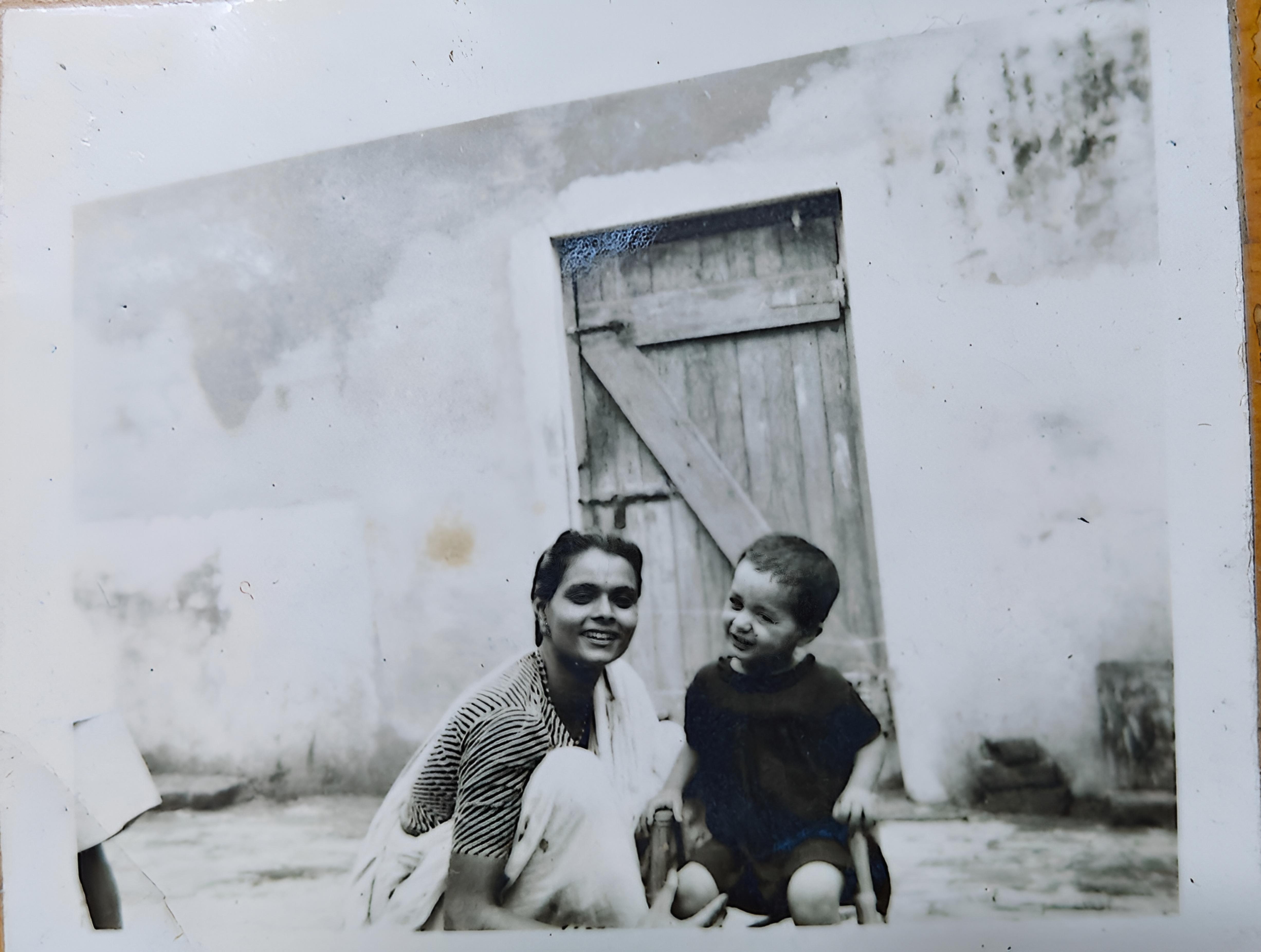
Four generations
Over the years, her own family shrank, with the passing of my father and brother. She increasingly withdrew into a world of her own inhabited by Jap, piety and meditation. During the last couple of years, she would hold my hand in silence, after blowing her shank, conch shell every evening. A mute reminder that I was the only one left of the family she had been devoted to.
Now, as I try to understand what she has left behind, I realise she was more than a mother; she was the bridge between what was and what will be. She connected the slow, earthy world of ponds, lanterns, and letters to the digital age of instant gratification and restless speed. She stood between fading traditions and emerging futures, carrying forward love, devotion, and humanity as constants amidst change. In her, I saw that resilience is not loud or forceful but quiet, steady, and accepting.
To live ninety-two years is to live many lives within one. As I look back at her long journey, I feel gratitude more than grief. For in her passing, she has not left me empty-handed. She has given me the assurance that change can be embraced without losing one’s essence. And she has shown me that love, patience, and quiet resilience are the true bridges between the worlds we inherit and the worlds we leave behind.
The Liberty of the Seas was slipping gracefully through the turquoise waters of the Atlantic, teasing us with views of emerald islets dotting the horizon. As land loomed closer, so did our anticipation. Bermuda—a name that evoked equal parts paradise and paranormal. Our stateroom window framed the unfolding spectacle of the approaching land, pastel-painted resorts on the sea front and the occasional home peeking from behind palm fronds.
A Bermuda resort
We docked at the Royal Naval Dockyard. Once a formidable British naval base after they were unceremoniously booted out of North America, it now plays host to cruise ships instead of battle cruisers. Think of it as the colonial version of “I’ll be back!”—except the British came back with museums, not muskets.
Royal Naval Dockyard
Once ashore, as we looked around for a suitable transportation, we were greeted by Darrel, a local guide and driver. Silver-haired, sun-tanned, and equipped with the storytelling prowess of a Caribbean mistrel, Darrel introduced himself with a flourish:
“Ninth-generation Bermudian! My ancestor came here as a slave. And now I drive tourists through my island. We’ve come full circle, haven’t we?”
We chuckled, unsure whether to be impressed or introspective. As it turned out, Darrel was about to take us on a version of Bermuda that the glossy brochures never dared to print.
A Personal Bermuda
Darrel wasn’t one for those touristy places. Instead, he showed us his own Bermuda. We were soon snaking past old churches and vintage homes, zigzagging across narrow causeways which connected Bemuda’s islands like hesitant footbridges between old memories.
He took us to his ancestral home; a weathered house nestled on a hillside shaded by cedar trees. “This is where I was born,” he said. There was pride in his voice, not nostalgia. He wasn’t just showing us a place, but offering us a piece of his DNA.
As we crisscrossed the islands, almost missing the transitions thanks to seamless causeways, Darrel pointed out the unique Bermudian water storage systems. There are no freshwater lakes or rivers in Bermuda; every roof thus is designed to catch rainwater and store it in underground tanks. “It’s not just eco-friendly,” Darrel declared, “It’s that, or die thirsty!”
Exploring the Bermuda water storage system
We stopped at an old fort with low embankments, a relic from World War II. What was interesting was that it was armed with British, American, and Canadian gun emplacements. A curious cross-national collaboration.
“They were allies here before NATO was cool,” I quipped. Darrel grinned, “Yeah, and those guns haven’t fired in anger—only in memory.”
Shopping Malls, Lighthouses & Cost Shock
Next came the capital city, Hamilton, gleaming with shopping arcades, business hubs, and enough boutiques to bankrupt a Kardashian. “Don’t be fooled,” Darrel warned, “This is more for you tourists and offshore finance folks than for us locals.”
We could believe it. A loaf of bread cost more than a good bottle of rum back home. Bermuda, it seemed, was as expensive as it was beautiful—a tax haven with a sun-kissed poker face.
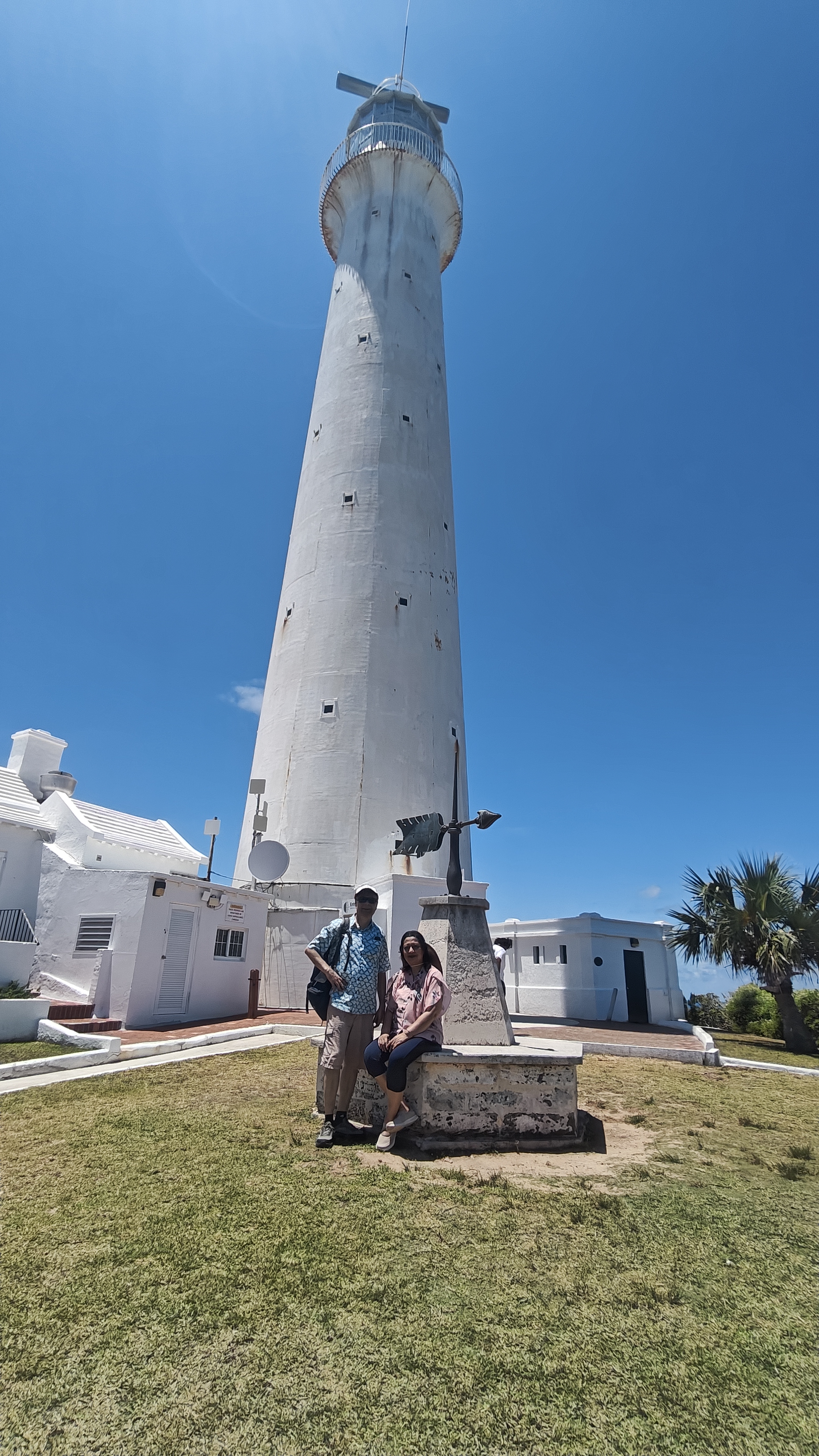
We also visited the Gibbs Hill Lighthouse, where the view from the base was majestic enough to spare us the knees wrecking climb to the top. From there, the Atlantic spread out like an endless blue silk sheet, dotted with hints of human habitation—each island a whisper in the sea.
Gibbs Hill Lighthouse
Of Pink Sands and Rose Hearts
By afternoon, the sun had cast a golden glaze on the island. The temperature was perfect for what we came for: Bermuda’s legendary beaches.
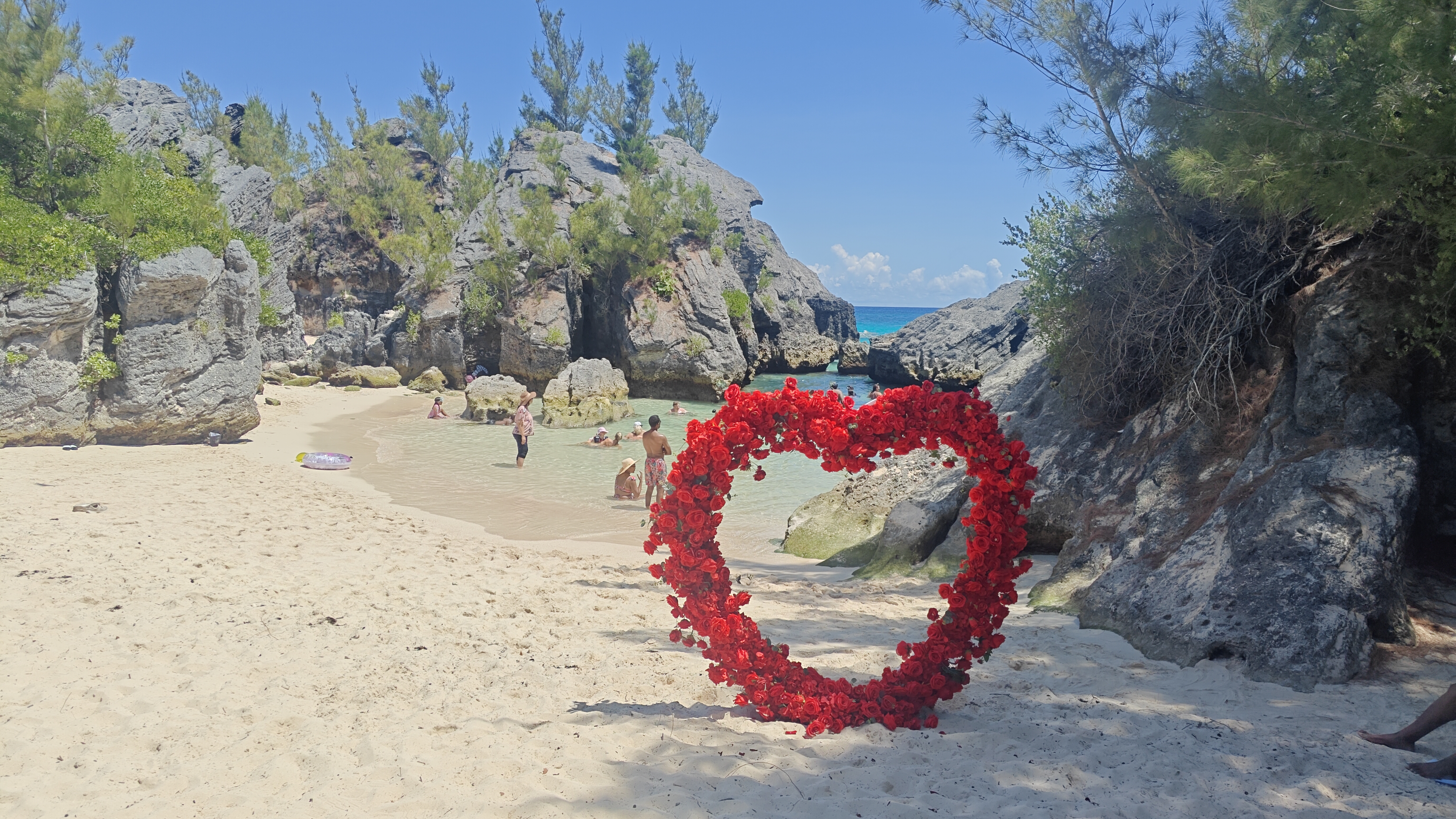
We skipped the Instagram-flooded Horseshoe Bay (thanks to Darrel’s insider intel of it being overcrowded!) and headed to a more secluded beach nearby. And what a choice that turned out to be! Powdery pink sand caressed by clear turquoise water, gentle waves that beckoned instead of bullied, and—most intriguingly—a giant heart-shaped installation of roses left behind from what looked like a beach wedding. Darrel, never missing a beat, winked and said, “That’s either love… or excellent marketing.”
Love….. or marketing?
We did what anyone would do: took photos, dipped into the sea, and pretended we had discovered the place ourselves.
The Triangle of Terror… or Hype?
As the sun began its descent, we finally popped the question everyone avoids until dessert, about the Bermuda Triangle.
“So Darrel… any strange goings-on out there?”
He glanced at the ocean and said, “Let me tell you something. Some days, you see gas bubbles rising out of nowhere. Big ones. Not your usual air pockets. These are… different.”
He paused. “Could be alien. Could be methane. Could be the sea having gas. But small boats and aircraft? They don’t always like those bubbles.”
In search of Bermuda triangle…..
Darrel’s casual eeriness reminded me of the book I’d devoured in my Jamalpur college days: Charles Berlitz’s “The Bermuda Triangle.” The author had chronicled the infamous disappearance of Flight 19, a squadron of five US Navy torpedo bombers in 1945. The flight leader’s last radio transmission still rings like a Lovecraftian riddle:
“We cannot be sure of any direction… everything is strange… the ocean doesn’t look as it should.”
Some say it was magnetic anomalies. Others blame pirates, aliens, or even the lost city of Atlantis. Even National Geographic weighed in years later, shrugging off the mystery with a headline that felt like a sigh: “No, the Bermuda Triangle isn’t real. Let’s move on.” (Source: National Geographic, 2017)
But standing on a beach where the sand is pink and the stories are surreal; logic starts to feel a bit… overrated.
A Farewell in Technicolour
As we returned to the Liberty of the Seas, the ship shimmering under the evening sun, Bermuda felt like a dream—equal parts sunshine and superstition.
Liberty of the Seas
Darrel dropped us at the dock, gave us a conspiratorial wink and said, “Now you know our secrets. Keep them safe.”
Bermuda had shown us its history, its heart, and maybe even a hint of its hauntings. Whether you believe in vanishing ships or just overpriced sandwiches, it’s a place that lingers.In your mind, in your phone camera, and if Darrel’s right, maybe even in your magnetic compass.
From the sun-drenched vineyards of Hawke’s Bay to the Art Deco charms of Napier and the cultured vibes of Wellington, our North Island journey in New Zealand was a heady blend of scenic beauty, fine wine, coastal elegance, and urban character. Here’s a glimpse of three unforgettable days soaking in the essence of Kiwi culture, cuisine, and charm.
Pacific Coastline
**
New Zealand often conjures images of snow-capped peaks, sheep-dotted meadows, and fjord-streaked landscapes. But on the North Island’s eastern edge lies a less-trumpeted triad of experiences that seduce the senses in a quieter, more intimate way: the sun-drenched vineyards of Hawke’s Bay, the Art Deco elegance of Napier, and the cosmopolitan charm of Wellington.
We began the day heading toward Hawke’s Bay, a region known for its Mediterranean climate, rich soils, and status as one of New Zealand’s finest wine-producing areas. The road wound through rolling hills and vineyard vistas that stretched out like pages from a postcard. It’s no wonder that Lonely Planet calls Hawke’s Bay “a food and wine lover’s paradise… where long sunny days and fertile plains create the perfect recipe for indulgence.”
Hawke’s Bay
Our stop at Mission Estate Winery—New Zealand’s oldest established winery dating back to 1851—was the highlight of our visit. The elegant colonial-era structure welcomed us like an old friend, and we quickly found ourselves immersed in a world of subtle textures and fragrant bouquets. The Sauvignon Blanc stood out with its crisp minerality, but it was the velvety Syrah that stayed with us long after the last sip. A relaxed lunch followed in a shaded courtyard adorned with trellises, garden blooms, and birdsong. It felt more like a countryside dream than a scheduled stop.
Mission Estate Winery
The next chapter of our journey took us to Napier, a gem of a coastal town shaped by both tragedy and triumph. Rebuilt in the 1930s following a devastating earthquake, the town now proudly showcases one of the most concentrated collections of Art Deco architecture in the world. A stroll down its palm-lined promenade revealed a town wrapped in pastel tones and whimsical curves, as if time itself had taken a gentler turn here.
Art Deco
Condé Nast Traveler once described Napier as “a place where you’ll want to slow down and look up,” and that’s exactly what I did. As I meandered through the town, every façade seemed to carry a story—of resilience, rebirth, and remarkable aesthetic unity. Our hotel, perched with unobstructed views of the Pacific Ocean, felt like a poetic pause in this narrative. The sea, ever restless, offered a calming counterpoint to the symmetry of the streets.
The following morning, we descended further south to Wellington, the capital city nestled between rolling hills and a sparkling harbour. Where Napier wore nostalgia on its sleeve, Wellington was vibrantly alive—a city that fused culture and creativity with surprising sophistication. Its streets, both parallel and sloped, gave it a geometric charm, while cafés spilled out onto sidewalks filled with young creatives, office-goers, and the occasional street performer.
There’s something beautifully paradoxical about Wellington—it’s compact yet buzzing, orderly yet expressive. The Wellington Marina invited us to pause and breathe in the city’s rhythm. Boats bobbed gently in their berths, while locals wandered past us with wind-blown hair and takeaway coffees. No surprise then that the BBC once referred to Wellington as “the coolest little capital in the world.”
Wellington Marina
Dinner was a quiet affair, but we couldn’t resist passing by the city’s political heart—the Beehive, a part of the New Zealand Parliament complexes. The building’s modernist circular form is either intriguing or awkward, depending on your point of view. I found it oddly compelling, a symbol perhaps of the country’s bold architectural spirit, unafraid to provoke a reaction.
As we wound down our day in Wellington, I couldn’t help but reflect on the journey. Each place had offered something distinct: Hawke’s Bay’s pastoral elegance, Napier’s vintage soul, and Wellington’s urban charisma. Yet all were stitched together by a common Kiwi thread—warmth, nature, and quiet sophistication.
In a world where travel often tries to impress through spectacle, this journey stood out for its graceful subtlety. It didn’t shout; it sang.
Abstract :Volcanoes, Redwoods, Maori traditions, and turquoise waterfalls—our journey through Rotorua, Murupara, and Taupo was like walking through nature’s raw and sacred diary. From the haunting silence of a buried village to the fiery hiss of boiling mud pools, and the warmth of a traditional Maori Hangi—New Zealand never stops surprising. 🌋🌲🌊
We skirted the edge of Lake Rotorua in hopeful anticipation, eyes squinting past the mist, searching for the silhouette of the legendary Mount Tarawera. But nature had other plans. Clouds draped the landscape like a reluctant curtain, denying us a view of the volcano that, in 1886, tore apart an entire region in a violent, unforgettable eruption.
Lake Rotorua
As we moved closer to the remnants of this catastrophe, we reached the Buried Village of Te Wairoa. It was haunting, almost sacred. Buildings lie preserved in ash, stories frozen in time, and silence whispered louder than words. Our guide painted a vivid picture of the night the earth roared—of ash raining down, of craters splitting open, and lives changed forever. According to the Buried Village site, it is “New Zealand’s most visited archaeological site, where stories of resilience and survival rise from the earth.” (Reference 1) And indeed, walking among the ruins, one feels that spirit deeply.
Buried village of Te Wairoa
From volcanic scars, we sought the solace of trees—and what trees they were! The Whakarewarewa Forest, just outside Rotorua, offered a surreal contrast. We wandered under towering Redwoods—some over 100 years old—and marveled at the magnificence of Douglas Firs and the ethereal grace of silver ferns, New Zealand’s national icon. Walking in their shadow, one feels both infinitely small and impossibly privileged. As described by Whakarewarewa Village, this forest is home to “majestic trees from California alongside native species in a uniquely Kiwi blend,” and the harmony between old world and new world flora is breathtaking.
Those Redwoods of Whakarewarewa
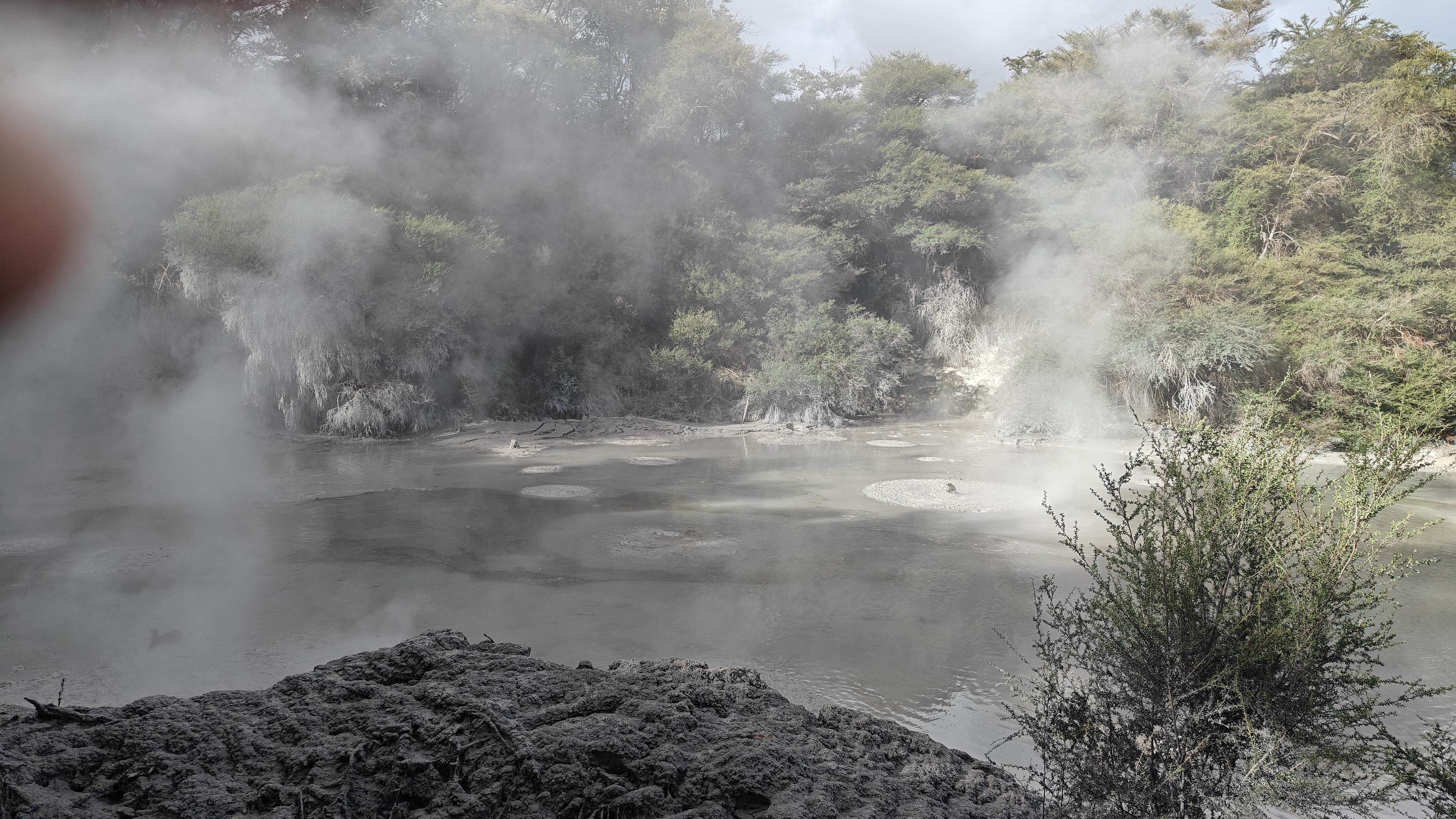
Yet Rotorua wasn’t done with its drama. The ground here breathes fire. Boiling mud pools gurgled around us, sending plumes of steam into the crisp morning air. Lakes hissed and steamed as though conversing with ancient gods. The smell of sulphur lingered, sharp and earthy. And yes, the unsettling thought did strike—what if another eruption lay dormant beneath our very feet?
Boiling mudpools of Rotorua
From geothermal energy to spiritual energy, we travelled onward to Lake Aniwhenua in Murupara. Here, the journey took a cultural turn. We were welcomed by the Māori people in a traditional ceremony that blended chants, fierce expressions, and deep respect. Though the language was unfamiliar, the sincerity needed no translation.
Maori temple
The highlight was witnessing the preparation of a traditional Hāngi meal—an earth-oven cooking method that has nourished Māori communities for centuries. Watching the fire-heated stones laid into a pit, food wrapped and buried under earth, felt remarkably similar to the tandoor cooking I’ve seen in North India. Different continents, similar soul food.
Hangi preparation
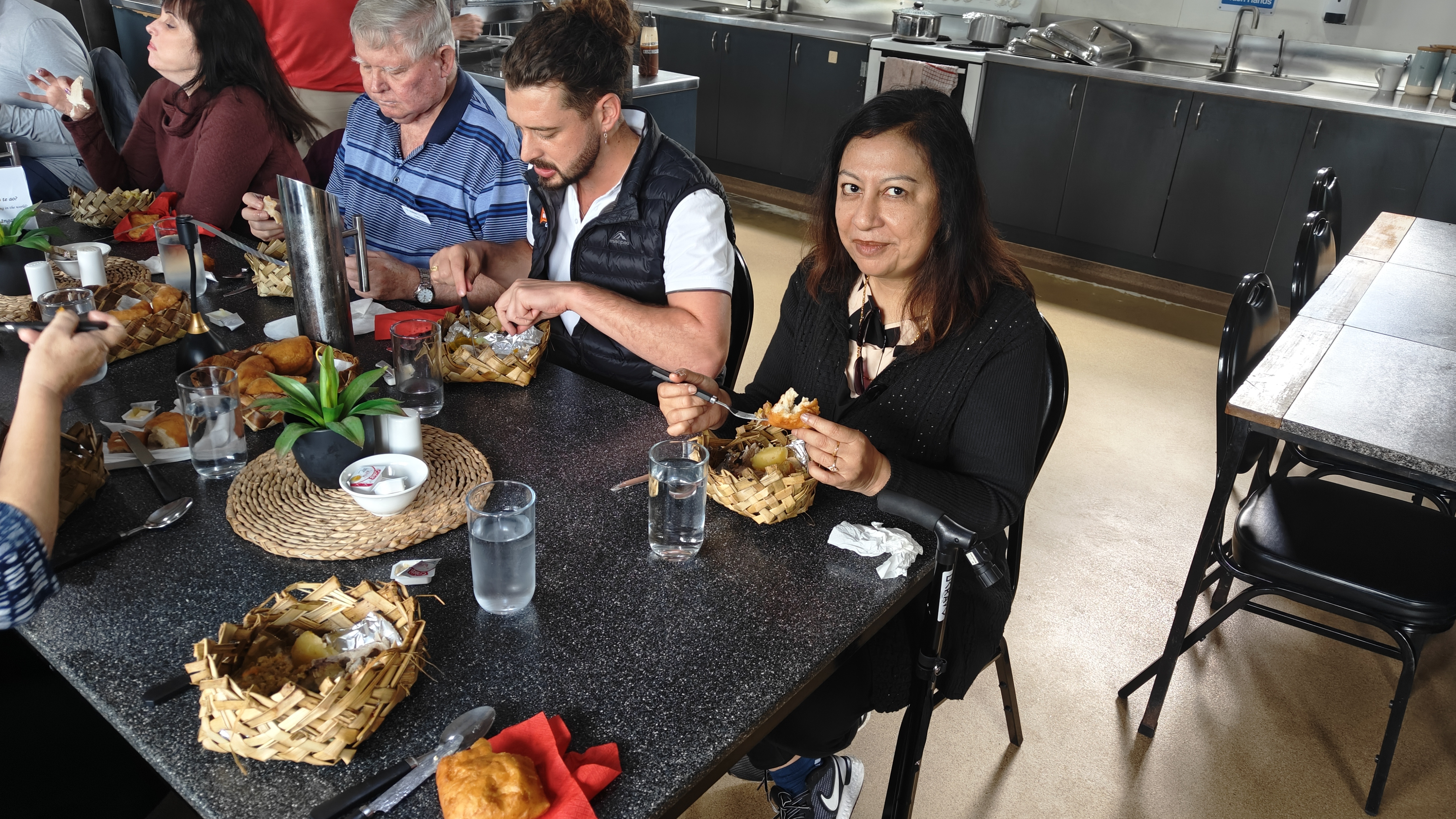
Later that afternoon at the Māori lodge, as the Hāngi was unveiled and its earthy aroma filled the air, it felt like we were not just eating a meal—we were partaking in a ceremony of memory, tradition, and togetherness. As the village itself puts it, “Whakarewarewa is more than just a village—it is a living legacy of Māori culture and community,” (Reference 2) and every moment we spent there reinforced that truth.
Traditional Maori meal
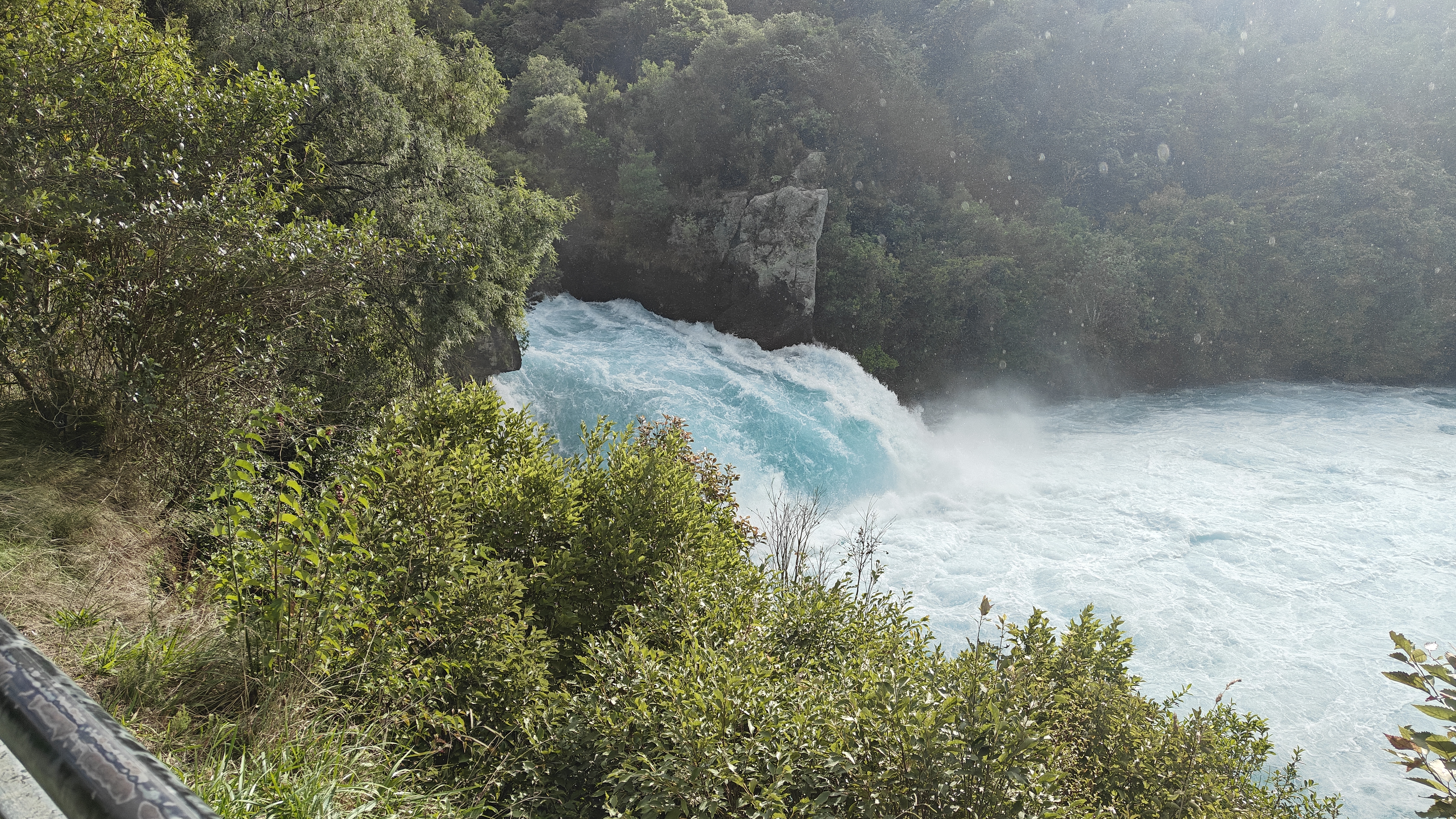
The final leg of this segment took us to Taupo, but not before a breathtaking interlude at the Huka Falls. The water there doesn’t just fall—it thunders. A hypnotic blue torrent squeezes through a narrow gorge before erupting into a frothy cascade. According to LoveTaupo.com, this “220,000 litres per second of crystal clear water” ( Reference 3) surging through the Waikato River is one of New Zealand’s most visited natural attractions—and for good reason. It’s power and poetry in motion.
The blue torrents of Huka
As we stood watching the falls, droplets misting our faces, I realised New Zealand isn’t just a destination—it’s an emotion. It stirs awe and respect in equal measure. One moment it shows you the fury of nature, and the next, it cradles you in cultural warmth.
And so, this chapter of our journey closed—not with an exclamation, but a deep, quiet breath of gratitude.
“The adventure begins at the edge of the Shire — welcome to Hobbiton!”
As long-time admirers of The Lord of the Rings and The Hobbit trilogies, visiting the real-life locations where these epic tales were brought to life had always been a dream. So, when we planned our trip to New Zealand, a visit to Hobbiton — the iconic Shire of Frodo and Bilbo Baggins — was a non-negotiable stop. We simply couldn’t leave Middle-earth behind without stepping into its most charming corner.
Hobbiton is nestled in the heart of Matamata, a region of lush pastures and gently rolling hills on New Zealand’s North Island. It was here, in the late 1990s, that director Peter Jackson conducted aerial surveys in search of the perfect location for the Shire. Legend has it that when his team spotted the Alexander family farm, it was love at first sight. The unspoiled beauty of the land — its sweeping meadows, mature trees, and bucolic charm — was exactly what Tolkien had described in his books.
“A view straight out of Tolkien’s imagination — rolling hills dotted with hobbit homes.”
Initially, the Alexanders weren’t too keen on turning part of their farm into a movie set. But with some persuasion (and an undisclosed agreement), they eventually agreed. And so, the world’s most beloved village of hobbits came into being. One delightful piece of trivia we learned during our visit was that Peter Jackson ran out of funds during the initial stages of development. To keep the project going, he approached the New Zealand government, who in turn had the New Zealand Army assist with the early groundwork — an unusual but heartwarming collaboration that helped build movie magic.
Our tour began with a tranquil ride in a golf cart through the countryside. As we crested a hill and caught our first glimpse of the Shire, a wave of excitement washed over us. There they were — the familiar round doors, grassy rooftops, and colorful gardens tucked into the hillsides. Every corner of Hobbiton was bursting with life and detail, from miniature wheelbarrows and rustic lanterns to tiny clotheslines with hobbit-sized laundry flapping in the breeze.
“Every round door tells a story — could this be a baker’s home or a gardener’s cottage?”
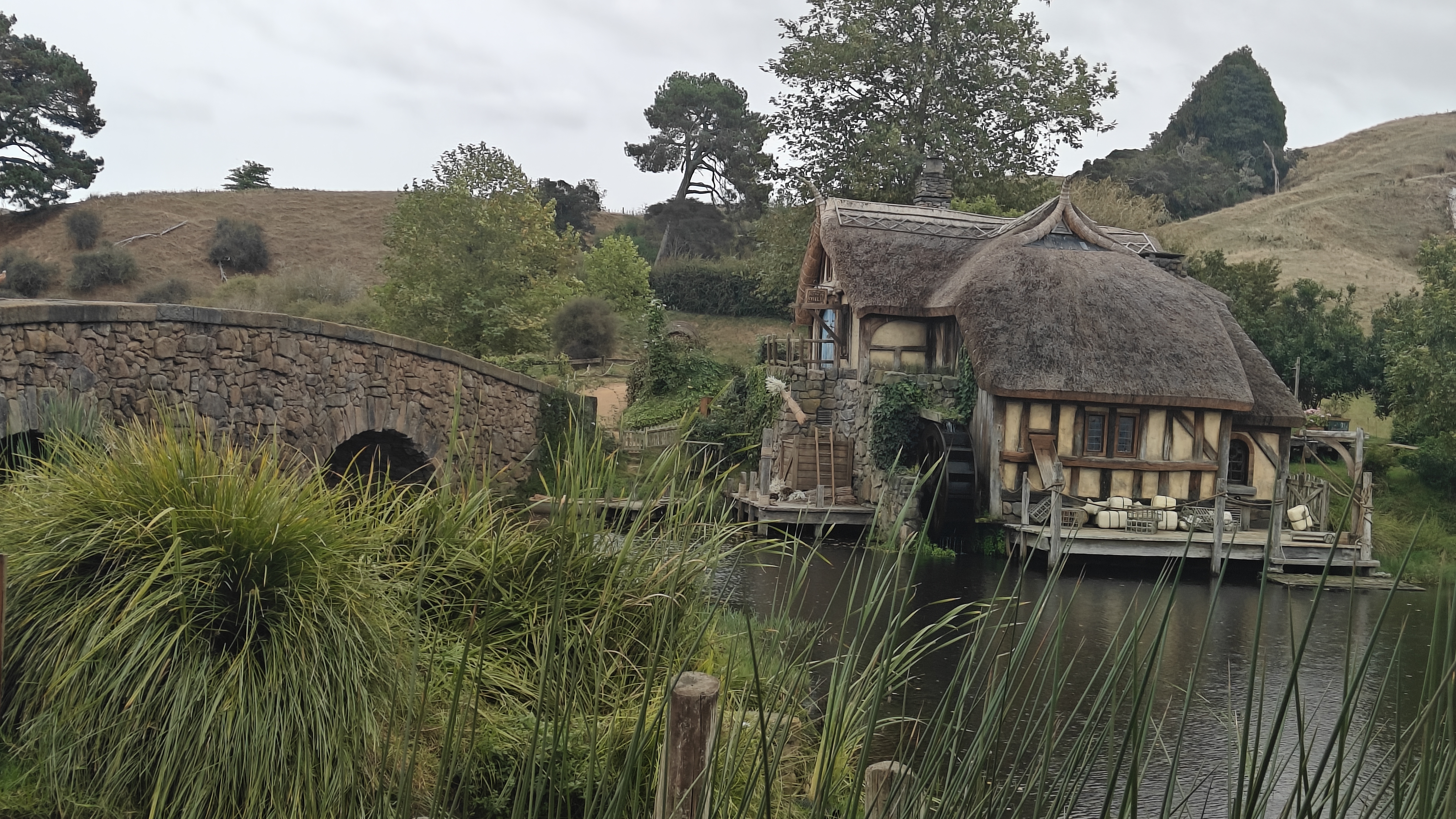
We explored the Shire with childlike wonder, moving from one hobbit hole to the next. Each home had its own character and charm — some for bakers, some for fishmongers, each with a story hinted at through props and signs. The stone bridge with its iconic double arches, the waterwheel gently turning by the mill, and the peaceful lake all brought scenes from the films vividly to mind.
“The iconic bridge where Gandalf once rode into the Shire — picture perfect.”
A true highlight was visiting the inside of Frodo Baggins’ house. Walking through the rooms, we could almost imagine him pacing about, deep in thought, the weight of the Ring heavy in his pocket.
“Stepping into Frodo’s world — the journey truly begins here.”
Although we couldn’t go inside Bilbo’s house, Bag End, just seeing it up close — with its iconic green door and lush garden — was magical in itself.
“Bag End in all its glory — the green door that launched an adventure.”
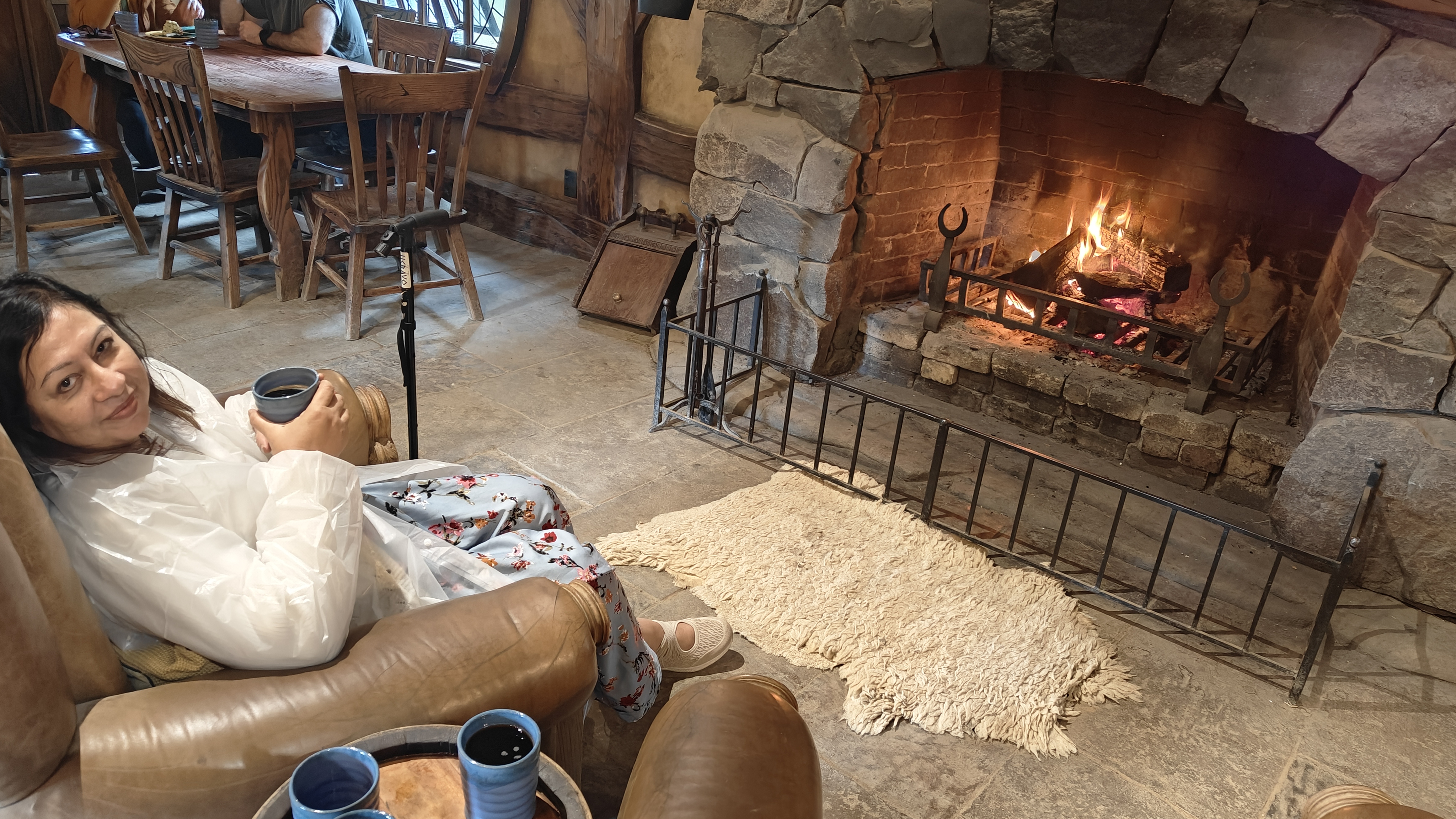
And then came the perfect ending: a visit to the Green Dragon Inn. Stepping inside, we were welcomed by a roaring fire, wooden beams, and the unmistakable coziness of a true hobbit gathering place. We ordered a round of their specially brewed ales and sat by the hearth, sipping slowly and soaking in the atmosphere. It truly felt like we had been transported into Tolkien’s world.
Raising a mug of Hobbit ale at the Green Dragon — a toast to the Shire!”
Our visit to Hobbiton was not just a tour — it was an experience, a nostalgic walk through a world that had enchanted us for years. If you’re ever in New Zealand, take the detour to Matamata. Whether you’re a die-hard fan or just someone who appreciates storytelling, nature, and craftsmanship, the Shire will leave you spellbound.
“One for the memory books — peace, beauty, and a touch of magic.”
In today’s dynamic and disruptive world, where change is the only constant, the ability to listen deeply and effectively—what we call ‘Power Listening’—has become an essential leadership and personal development skill. To many of us, Listening occurs as a passive process. No one notices when we tune off, we also retain the luxury of judging what we are hearing. This is also why Listening is a complex and demanding skill that needs conscious effort and self-awareness. I have always found it difficult to listen to what is being said with no intention, no judgment, no right or wrong.
In a landscape characterized by rapid technological advancements, shifting economic paradigms, and evolving workplace dynamics, power listening enables leaders, professionals, and individuals to navigate complexities with greater clarity, empathy, and strategic foresight.
According to Zenger and Folkman (2016) in their Harvard Business Review article What Great Listeners Actually Do, great listening goes beyond simply being silent while others speak. It involves active engagement, thoughtful questioning, and creating a safe space for open dialogue. Similarly, in The Power of Listening in Leadership (Forbes, 2021), Kevin Kruse emphasizes that effective listening strengthens leadership presence and fosters trust in professional relationships.
Understanding the Challenges of Listening
Despite its fundamental role in communication, listening is often overshadowed by speaking. Many assume they are good listeners, yet, as I have realized through personal introspection, listening is fraught with unconscious biases, preconceptions, and cognitive distractions. Each individual listens for different reasons and in unique ways, influenced by past experiences, emotions, and personal filters.
Reflecting on my own listening tendencies, I recognize that my ability to listen deeply is not always consistent. My engagement in a conversation depends largely on three factors: (1) my genuine interest and curiosity in the subject matter, (2) the perceived relevance and importance of the topic to me, and (3) the significance of the speaker in my personal and professional life. In the absence of these factors, I have observed a decline in my listening quality, often succumbing to perceptual blocks such as impatience, judgment, and the urge to prepare my response rather than truly absorbing the speaker’s message.
The Value of Power Listening
Power listening goes beyond hearing words—it involves deep engagement, empathy, and a conscious effort to understand the speaker’s perspective. I have personally found that when practiced effectively, power listening yields several benefits:
Building Trust and Confidence: A powerful listener enhances the self-worth of others, creating an environment of psychological safety where individuals feel valued and heard.
Enhancing Leadership Effectiveness: Leaders who listen powerfully cultivate stronger relationships, inspire loyalty, and encourage collaboration. Employees and stakeholders gravitate towards those who make them feel understood.
Facilitating Problem-Solving and Innovation: Power listening fosters a collaborative and open atmosphere, enabling teams to engage in meaningful dialogue and address complex challenges effectively.
Encouraging a Growth Mindset: When leaders listen without judgment, they instill confidence in others, encouraging a culture of learning, experimentation, and continuous improvement.
A Plan to Enhance Power Listening Skills
One might ask the question, ‘So what kind of a plan one needs to become a power listener?’ My plan included the following steps:
Develop Self-Awareness: I continuously assessed my natural listening tendencies, acknowledged biases, and consciously worked to overcome them.
Identify Communication Gaps: By reflecting on daily interactions, I could recognize patterns where my listening faltered and I needed to refocus back.
Practice Active Listening: I needed to implement the following techniques in my conversations:
Attentiveness: Focus on the speaker’s words, emotions, and underlying intent.
Empathy: Place myself in the speaker’s position, avoiding premature judgment.
Validation: Reflect back to the speaker meaningful insights to acknowledge and appreciate the speaker’s perspective.
Mental Clarity: Train myself to resist formulating responses while listening.
Patience: Allow space for the speaker to elaborate without interruption.
Encouragement: Reinforce the speaker’s strengths and motivate action.
The Emotional Impact of Being Heard
Listening is not just a transactional activity—it is deeply emotional and relational. When I am truly listened to, I experience a profound sense of connection, self-worth, and trust. The act of being heard or having ‘being gotten’ fulfills an intrinsic human need, fostering intimacy and mutual respect. Philosophers have long argued that being listened to is one of the most powerful affirmations of one’s existence. It provides the confidence to articulate thoughts, process challenges, and move forward with clarity and purpose.
Conclusion
In an era where distractions are rampant and attention spans are shrinking, power listening stands as a critical skill that differentiates effective leaders and impactful professionals. It is a skill that must be cultivated with intentionality, self-reflection, and consistent practice. By refining our listening abilities, we could aspire to become a more empathetic, perceptive, and influential leader—one who not only hears but truly understands and empowers others. In doing so, one would contribute to a more engaged, collaborative, and resilient world.
In Learning…… Shakti Ghosal
References
Zenger, J., & Folkman, J. (2016). What Great Listeners Actually Do. Harvard Business Review. Retrieved from https://hbr.org
Kruse, K. (2021). The Power of Listening in Leadership. Forbes. Retrieved from https://www.forbes.com
As I thought about this question, a workplace experience from the past showed up. In my first job, I was an Assistant Mechanical Engineer in an Electric Diesel Locomotive maintenance workshop of the Indian Railways. I seemed to be confronted with disparate and multiple problems like dirty work bays, breakdown of machines, the workers’ trade union raising different kinds of demands, and so on. As I tackled one issue, other workplace crises seemed to occur elsewhere. I was always firefighting with disparate problems with no overall improvements in terms of productivity and output.
Over time, I became demotivated with ‘loser mindset’ thoughts which kept circling in my head. These thoughts were like ‘I am doing the best I can’, ‘No point in trying hard, nothing will change’, “I have a wrong boss, bad subordinates’… and so on. A kind of workplace lethargy set in, a laziness to try newer ways and the unwillingness to get out of the rut.
My mind shifted during a footplate inspection when I experienced firsthand the problems faced by the travellers from locomotive failures. A context got created in my mind, ‘When we don’t operate timely schedules, people’s lives get effected’. As I brought this perspective as an overarching vision for myself, my day-to-day work focus, the language I would use, my handling of situations changed. I felt more energy flow, motivation, and excitement. What was more remarkable was that my team started aligning itself with the overarching vision. My passion seemed to be seeping into them as they perceived that the actions were also addressing their own concerns.
As I think back, I can say that what can motivate us most is our ability to create an overarching vision which excites and pulls us towards goal achievement as more and more stakeholders start seeing the vision meaningful, relevant, and addressing their own concerns.
Recently, in a ‘Mindset Matters’ podcast, while discussing the above subject, we came to a counterintuitive and interesting perspective that the sheer act of encouraging someone else can lead to our own selves being encouraged and motivated to achieve our own goals.
Should you wish to listen to the podcast, do DM me and I would be happy to send the link.































 A New Beginning