In Ashtami Sujit, a Junior Clerk in the British administration in Calcutta, with his young wife Bina, is forced to migrate to distant and dusty Delhi as the capital of the British Raj shifts. Shanti, born of a forcep delivery process gone horribly wrong, comes into their lives, physically and mentally challenged.
“Shanti sat there in the engulfing darkness desperately holding his dying brother’s hand. A low pitched moan emanated from him; a sound of utter helplessness that ricocheted on the closed doors and windows of the nearby houses, and failing to open them, got lost into the night…”.
Ashtami is part of my forthcoming book, ‘The Chronicler of the Hooghly and other stories’. Should you wish to receive exclusive previews and the chance of winning a free copy of the book, do write to me @ author.esgee@gmail.com
In the Pandemic, the events span a century between the pandemics of 1919 to 2020; between Dipen and Indranil who have a tenuous link over four generations and arising from an old and decrepit palace and its Shiva linga.
When confronted by tragedy, the vastly different societal conditioning and development of a hundred years, cannot detract from the eerily similar impact.
“The pandemic did go away. But it left in its wake corpses, both dead and living”.
The above is a blurb from Pandemic, one of the four stories of my forthcoming book, ” The Chronicler of the Hooghly”.
Should you wish to receive exclusive previews and free copy of the book, do write to me @ author.esgee@gmail.com.
When Samir embarks on a sunset cruise to ‘get away from it all’, he had not bargained on meeting the enigmatic Chronicler. As the Cruise travels up the Hoogly, the Chronicler travels with Samir through two and a half centuries of events, surrounding the curse of a fabled pearl necklace, as mentioned by his dying mother.“The Hooghly has seen it all. The ebbs and flows of history as well as life itself. From the greatest betrayal in History to becoming the crown jewel of the biggest colonial empire the world has ever seen….”.
The above is a blurb from one of the four stories of my forthcoming book, ” The Chronicler of the Hooghly”.
Should you wish to receive exclusive previews and free copy of the book, do write to me @ author.esgee@gmail.com.
At my ripe age and stage in life, I have finally achieved what I have been wanting to do for the last couple of decades. Which is author a book. The book, a collection of four stories, is my maiden foray into the world of fiction. ‘The Chronicler of the Hooghly and other stories” is currently under publication. I seek guidance and good wishes of all my acquaintances. As a start may I request you to visit my Author Page on Facebook, like, comment and share it.
The Three Horizon methodology was developed by Bill Sharpe to provide a simple framework to envision the future and how to engage in constructive conversations about how to achieve that future, This becomes all the more critical in an environment which is uncertain and complex.
The three Horizons framework, to me, is a powerful reboot tool which we need to keep in our toolbox for an environment that we are currently into.. It allows us to coordinate disruptive innovations and create transformative change which has the best chance to succeed.
As per the methodology, envisioning the future always needs to deal with three horizons at play, which are always there, with the capacity to impact the future.
Y Axis is the dominant thinking or WorldView.
The first horizon ‘H1’ is all about how business is done at present, but there is something in it which is not fit for the future. It thus contains the seed of its own demise over a period of time.
The third horizon ‘H3’ is the future we desire and there do exist green shoots of that today. We would like them to grow and become the predominant way of doing business in future, replacing and improving upon H1.
The second horizon ‘H2’ is the most interesting space as this is where disruptive innovation takes place. Disruption can take many forms. It could be technology fueled like the Electric car, it could be event fueled like the current COVID19 pandemic or it could socially fueled like Occupy. Disruptions usually lead to innovations, new ways of Doing or Being. The opportunity of change actually exists in the space between the crests of H1 and H3.
The key question would be, “How would the disruptive innovation effect the transformation between H1 and H3?” To answer this, we will take the example of the current predominant transportation technology using the Internal Combustion engine. This is a H1 model which has survived over a century with its negative impact of Carbon footprint and Climate Change.
Now let us look at the disruptive innovation of Hybrid Technology. This technology actually is the creation of the old world H1 horizon. The problems of H1 are somewhat reduced in this innovation but remain; they in fact get accentuated by addition of another layer of technology on top of the existing one with suboptimal utilisation of either of them. This is called the “H2-” innovation as it is captured by old dominant structures to extend the life of H1 horizon. Why we are using the word ‘capture’ here is because its innovative energy is not being used to help the H3 horizon to emerge.
In contrast now let us consider the same disruptive innovation technology but now paired with the H3 horizon, to support the emerging future to emerge and help to hasten the decline of H1. It would be the pure Electric car technology of Tesla, which essentially is a transformative exercise of building some kind of a computer on wheels; it is envisaging the future ground up. This is called “H2+”.
For the 3 Horizons Reboot tool to be effective, we need to do an enquiry based on three questions:
What is being born and how could we support it emerge and succeed?
What is dying and how can we help it to let go?
What is being disrupted and how can we harness it as in H2+, not be captured as in H2- ?
Enquiry questions for conversation about how to achieve the future:
H1 Horizon :
What is business as usual, the key characteristics of the prevailing system?
How did we get here, what values, cultures, regulations, events led to this?
Why do we believe it is failing its purpose and no longer a good fit? How fast do we want to see its decline?
Is there anything about the old system that we would wish to retain rather than lose?
H3 Horizon:
What is the future that we would like to bring about, its key characteristics, how it looks like, feels like to be there?
What are the green shoots of that future visible in the present?
Whose ideas and work are the present possibilities built on? What history, values, culture are they embedded upon?
How can the possibilities be scaled and spread?
What are the competing visions of the future being pursued by others? Can we collaborate with them or are these essentially competing visions? If the latter, how do we prevent their vision from derailing ours?
H2 Horizon:
What is being disruptive in terms of technology, social, economic, ecological and cultural aspects? What are the roots of those disruptions? For each of those identified, what would it look like if captured as in H1-? Or harnessed as in H2+? What could be strategically done to ensure it is harnessed?
If you are a disruptive actor viz, Tech. Innovator, social movement etc. what kind of guidance can you set for yourself to ensure that your disruption is harnessed under H3 ( H2+) rather than captured under H1 )H1-)? What allies will you seek, what actions will you take, how will you assess potential offers of collaboration or finance?
As we Reboot and enter a world with a new normal, we need to know that Uncertainty and Unpredictability would be part of that normal.
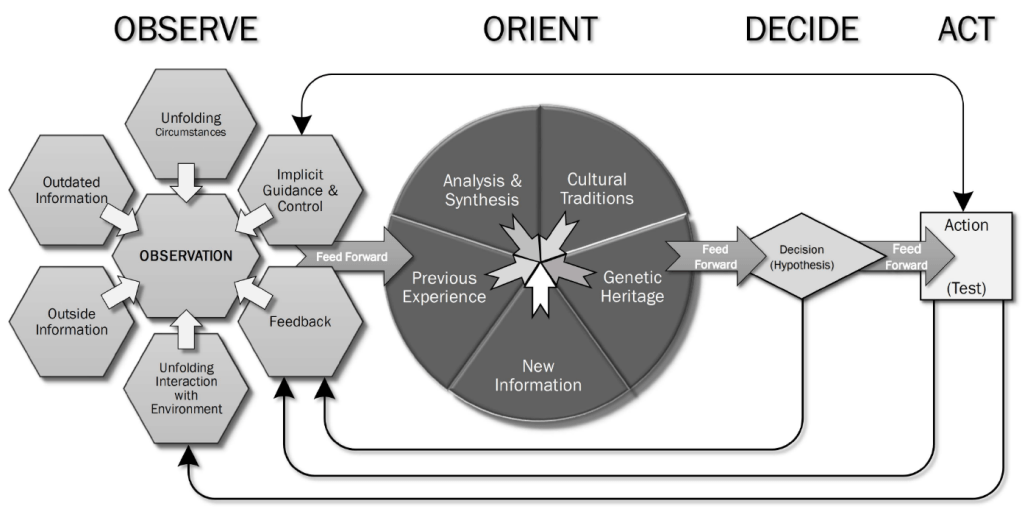
A great tool to use in under Uncertainty and Unpredictability is the OODA Loop, first articulated by US Colonel John Boyd in the context of air combats. In its simplest form it consists of the four stages of OBSERVE, ORIENT, DECIDE and ACT, looped as under.
OODA Premises :
When circumstances change, we often fail to shift our perspective and instead continue to try to see the world as we feel it should be. We need to shift our “mind models” to make sense of the changing world – in order to deal with the new reality.
As we make specific observations about something, we would experience more uncertainty about another; this is the limitation of our ability to observe reality with precision.( Heisenberg’s Uncertainty Principle).
Closed Systems viz. individuals or organizations that are cut off from the outside and new information would experience increasing mental entropy or disorder ( Second Law of Thermodynamics)
I propose to use an Airline, it could be Indigo, Air India or even Emirates, to showcase the OODA tool.
A more detailed model of the OODA Loop is shown below.
Stage -1 Observe :
We must focus on external parameters and quickly filter out what is important. In this data collection stage we seek and absorb and evaluate all manner and forms of data to gain a more accurate insight.
What shifts in demography, buyer behaviour, traveller behaviour, Regulations and Technology are taking place that might directly affect our airline?
What changes in the environment are taking place that might impact our airline and its business? Now or later on?
What information do we have in terms of : (1) Routing options (2) Capacity deployment (3) Alliance opportunities (4) Marketing strategy (5) Gross revenue, costs and profits.
Mechanics of Observe: As we consider new information based on above questions, our minds move from being closed to becoming an open system. We thus start forming new mind models and gain the ability to “see” the emerging situation differently. We overcome confusion inducing mental entropy of closed systems.
Stage- 2 Orient :
Orient is the heart of the OODA Loop because that’s where our mental models exist, our mental models shape how everything in the OODA Loop works.
So how does one orient oneself in a rapidly changing environment?
We constantly have to do “destructive deduction” i.e. break apart our old paradigms and then do “Creative Induction” by using these old fragments to form new mental concepts that more closely align with what is really happening around us.
In the context of shifting customer profile, buying and travelling behaviours, how do we :
3. In view of shifting customer mindset relating to travel, how do we :
(a) Optimise route network?
(b) Deploy Capacity on routes?
(c) Enter into alliances with other airlines and associated service providers?
(d) Marketing partnerships with hotels, ground transportation, destination services?
4. In view of emergence of new regulatory frameworks,how do we:
(a) Engage with and support Governments and Regulatory authorities for creating worldwide / regional standards for hygiene and operations?
(b) Ensure an overall smooth and consistent customer experience?
Mechanics of Orient: We formulate new approaches using refreshed mental models and paradigms. As we analyze the data collected in the Observe stage, we deep dive into our business’ internal capabilities to assess our current reality.
Stage-3 Decide :
We choose among the various alternatives generated in the Orient stage to move forward with our best hypothesis viz. “possibility” about which mental model(s) will work.
What booking process will we roll out to inspire customer confidence in terms of fairness and transparency in pricing, adherence to regulations and ease of use and refunds?
What Airport Check-in process should we implement which will ensure ease of passenger handling, customer comfort, adherence to safety protocols, improved operational efficiency and aircraft turnaround time?
What routes, frequency and aircraft capacities should we deploy?
What internal resource group do we need to create to work with Governments and Regulators to ensure smooth, consistent and safe customer experience?
What Alliances and Marketing partnerships have we shortlisted?
Mechanics of Decide : As we start deciding on the courses of action, we need to be aware that Success or failure will be based on our competences, our practised experience and the quality of our observations and orientation. For every trip around the OODA loop, new data will be transformed into new information, driving new suggestions, giving us opportunities to modify our decisions and drive subsequent actions.
Stage – 4 Act (Test) :
Why “Test” has been put next to “Act,” is to emphasise that the OODA Loop is not only an execution decision process, but also a learning system; we get to perpetually test our new hypotheses in a shifting world. Action stage is where we find out if our mental models are correct. If they are, we achieve the objective; if they aren’t, then we start the OODA Loop again using our newly observed data and modified models.
Evaluation and reporting of the following parameters:
Revenue and Expense accounting
Interline billing of alliance partner airlines
Proration and fare audit
Loyalty and marketing program effectiveness
Mechanics of Act: . Making a decision and taking action will have an impact on the data you have observed, which drives the information you’ve created and influences the decisions you have made.The loop perpetuates until the opportunity is fully resolved by either completion or disengagement.
How we could use OODA Looping speed ( tempo) to gain competitive advantage:
In an uncertain and volatile environment, mission does not solely end with deploying the OODA loop effectively. It is also about how relevant our organisation ( airline) can remain in comparison to other airlines under constantly shifting parameters.
An organisation should operate at a faster tempo or rhythm than its competitors or, preferably, get inside the competitor’s decision time cycle ( OODA Loop) to gain an advantage.
Analytics: Our Airline system generates a large volume of data at a very high velocity. How could we use Analytics to collate and analyse this data in the subsequent looped Observe (1) and Orient (2) stages ?
How could we synchronise our pre-departure processes like Check-in, flight operations, airport operations, transit services, post travel issues etc.with real time shifts in market conditions and own performance?
How could we do inventory based dynamic pricing upto flight departure to force competitors review their pricing strategy ( Observe & Orient stages)?
Mechanics of Looping Speed ( Tempo)
By continuously collecting, connecting and testing data that is generated the airline would create a data repository for use in any phase of its decision process (Strategic or Tactical). This would also enable an upstream and downstream impact analysis of all decisions.
How can you apply the OODA Loop to your own domain and business? Feel free to reach out to me.
In Learning…….
Shakti Ghosal
Acknowledgement: The Tao of Boyd: How to Master the OODA LoopByBrett & Kate McKay, May, 2019
It was a simple idea that brought in the Reboot Toolbox. An idea about how to support our own-selves (as well as others) to remain relevant in a world with a new normal?
As part of the Reboot Toolbox initiative, a Webinar titled “Pandemic and how to plug-in to the future” has been showcased over the last couple of weeks to alumni associations, students and employees of Leading B Schools and organisations. The Webinar underlined the premise that different skill sets and way of looking at situations would be needed in the new normal. The webinar introduced to the participants practices using the 4 Action Stage initiatives framework and a Resilience Tool.
how to support our own-selves (as well as others) to remain relevant in a world with a new normal?
The Reboot Toolbox is about a vision to upgrade Leadership and Performance in a world with a new normal. A world in which Uncertainty and Volatility would be the norm. The Reboot Toolbox would strive to bring new thoughts and practices aligned to the new normal.
As part of the vision, I invite you to join the Cause. You could do that in the following manner.
(1) Engage in discussions on the forum.
(2) Contribute thoughts, articles and tools to support others in the journey.
(3) Spread the word about the Reboot Toolbox Webinars within your organisation as also to others. They come Free of Cost!
Should the Reboot Toolbox and its vision resonate for you, do reply back to me Offline on : shakti.ghosal@gmail.com
There is going to be a post Pandemic world. That is a certainty. What is also certain is that the post Pandemic world would require significantly different perspectives and competence set.
“The one thing I’ve personally learned is you’ve got to get ahead of the curve, don’t try to deny it or put your head in the sand, and wish for the best. These are the times when a culture and an organization gets tested”
– Michael Hansen, CEO, Cengage
There is going to be a post Pandemic world. That is a certainty. What is also certain is that the post Pandemic world would require significantly different perspectives and competence set; we would come to live in a world with a new normal.
The pandemic is a black swan event. What that implies is that none of us have faced anything like it before. What happens when we are confronted with something about which we know nothing about? We become like the caveman in the dark of the night, neither able to see the path to the safety of our cave nor know whether a saber tooth is lurking nearby waiting to pounce. Neurochemicals flood our brain, we become geared to fight or take flight.
In the present day context, a black swan event leads to our primal brain conditioning kicking in. We get drawn into the uncertain and the total lack of knowledge aspects of the event. The more we try, the more we fail to make sense. We feel dis-empowered, make assumptions and frequently adopt high risk strategy without much thought or evaluation. When we fail we are quick to blame the VUCA (the volatility, Uncertainty, Complexity and Ambiguity) inherent in the environment. In short we are disrupted.
Why do we get disrupted? Because we keep on trying to predict what would happen in the future. We keep on working with probabilities. But since a black swan event has no precedence, allowing no experience from our past to guide us, we fail.
In a post pandemic world, we need to shift into a mindset of possibilities.
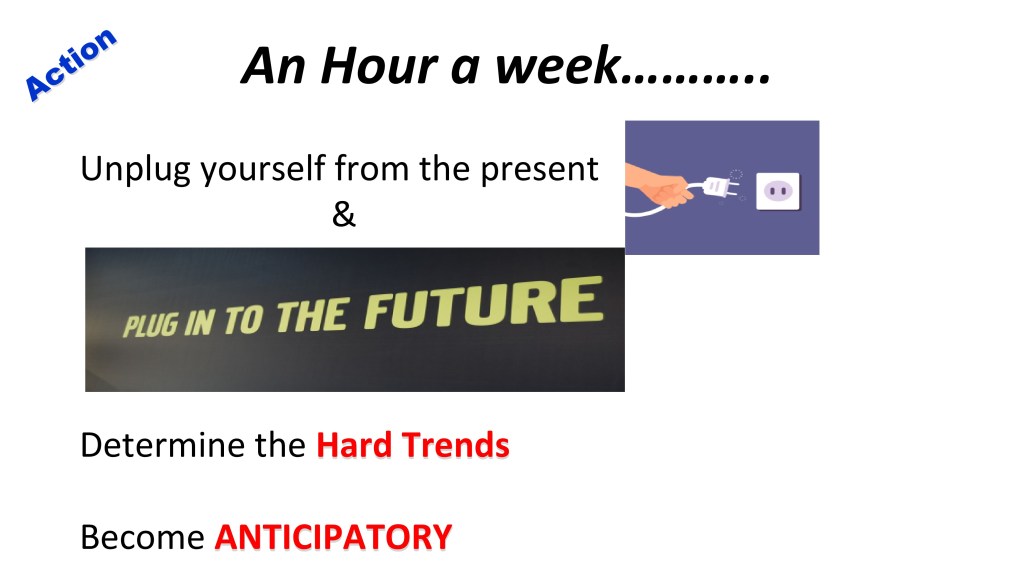
I invite you to do this practise for just one hour a week. During this hour, unplug yourself from the present. Unplug from all your existing challenges and apprehensions. Unplug from your inherent belief system which is telling you that once things normalise, you would go back to how things were in the past. This is where the fallacy lies and you need to be aware of that.
Then plug yourself into the future. How do you do that? You do that by establishing hard trends about which you do have significant certainty and do know some facts.
Your One hour a Week practice to plug into the future
You make three lists.
The first list is of all things you are certain of.
The second list is of all those things and aspects which you know, which are part of your competences.
The final list is of all things you can do.
This very act of making these lists would shift your mindset and open up possibilities. This leaves you empowered, you evaluate to choose low risk strategy, thereby gaining confidence and focus. As you succeed, you become a disruptor in the new world.
As you practise, you would become more proficient to determine the hard trends. You would become Anticipatory as you develop the capacity for future back thinking. You stand in the created future and look back to establish what actions and strategy you need to work on today to make the future happen.
How might you deliver business and revenue goals, organisational growth and marketplace success in a post pandemic environment?
How would you make sense of what might put brakes on organizational velocity in the post pandemic environment and how to un-brake?
How might you get high performance from team members in the uncertainty of the post pandemic world ?
How could we use the current pandemic experience to develop a COVID 19 Warrior Leadership mindset?
A Do-It-Yourself program.
We are currently witnessing a level of Uncertainty from the COVID19 situation that none of us have faced in our lifetime. There is no past experience relating to such a pandemic or for that matter anything else to guide us. So how do we negotiate the right pathway? How do we exercise leadership that is effective?
We, due to our innate survival instinct, follow a herd mindset. A mindset formed by what we read, what others are saying, the ubiquitous social media of today.
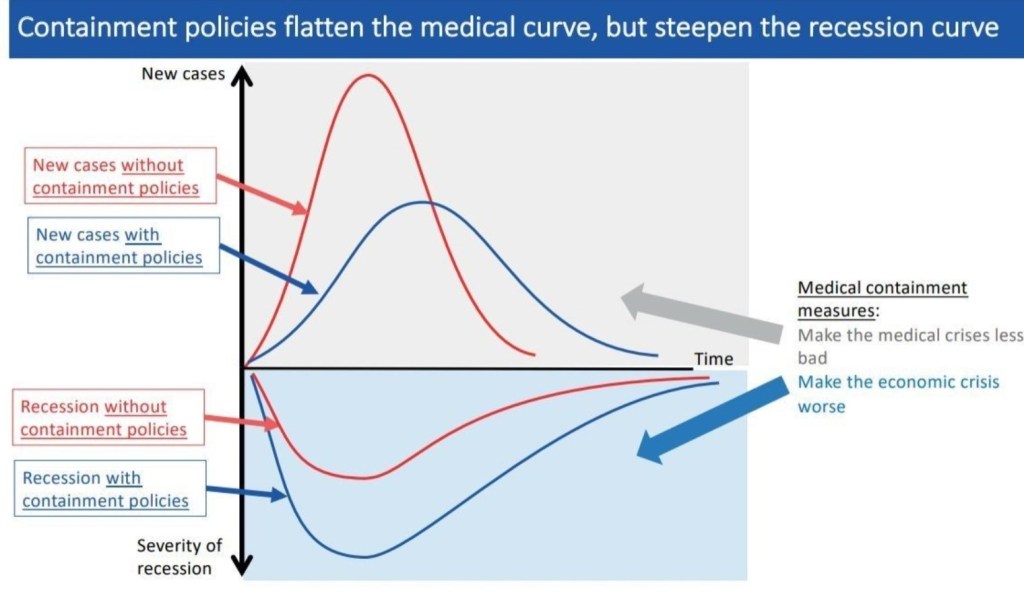
Our COVID19 pandemic mindset is thus wholly focussed on the containment strategies of the spreading viral infection, how to flatten the medical curve so to say and gain more time before we as a species could fight back using some vaccine under development. And nothing wrong with that.
Now let us talk of Leadership and effectiveness. What makes leaders effective is that they see, comprehend and thus engage with the same situation differently. As if they see and come to live in a different world!
The COVID19 warrior leadership would review the ensuing economic recession curves arising out of the containment strategy based infection curve and determine an optimal balance.
Let us now explore the effect of the COVID19 lockdown on the business and economic cycles. As we can see several links in the cycle would get disrupted and are shown by crosses in RED. The general mindset arising out of this would be to hoard, avoid spending and investments. All this would further exacerbate the situation!
A COVID19 warrior leadership in contrast would be visualizing new and innovative policies and funding methods to remove the prevailing blocks.
So what could you do to develop yourself so that you gain the ability to exercise a COVID19 warrior leadership effectively in an increasingly Volatile, Uncertain, Complex and Ambiguous world?
I give here some pointers. Should we mull over them to try and determine your thoughts and answers, you would be well on your way to becoming a COVID19 warrior leader.
Clarity about a future that others cannot yet see.How could you communicate this future simply without being simplistic?
Dilemma flipping: How could you turn dilemmas into opportunities?
Immersive Learning: Do you have the ability to learn in a first person way viz. ‘on the Court’ rather than ‘from the stands’ ?
Bio- Empathy: Could we inculcate the ability to see things from Nature’s patterns and use that wisdom?
Smart mob organizing: Do we have the ability to engage and nurture social change networks through intelligent use of electronic and other media?
How do you maximise your influence and impact in a fast changing environment?
A Do-it-yourself plan.
Some years back in my work life I came across an individual who for anonymity’s sake we will call Shib.
Shib was insecure and hankered for a leadership role as a way to get out of insecurity. At every opportunity he would showcase and ‘beat his drum’ about his past experience. He refused to accept that in the disruptive environment that the business was facing, experiential learning was ill suited to handle the situations being confronted.. More significantly the ‘All knowing, All doing’ defensive shield that had become his second nature prevented Shib from acknowledging that he might be lacking competences needed to engage with the situations. These two over time became a dangerous mix for an increasingly inauthentic and damaging behaviour with the guy resorting to his positional ‘Command and Control’ power more and more as the organisational performance nosedived.
What does use of positional power lead to? Like termite it starts to eat into the existing credibility and trust structure of an organisation which takes a long time to build. Once credibility starts getting lost, influence gets diminished and impact gets diluted.
The Shib Case study made me recall what Malcolm Forbes, the publisher of Forbes magazine, had once remarked:
“Those who enjoy responsibility usually get it, those who merely like exercising authority usually lose it”
In the increasingly uncertain and fast-changing business world of today, many of us may be falling into the ‘Shib trap’ of over- reliance on positional power without even realising it. We thus need to do a periodic dip-stick test to review our sphere of influence and efficacy of our impact. Should we notice operational zones exhibiting uncertain influence and impact, it could be time to take action.
So what could you do to enhance your influence and increase your impact?
To create a coordinated effort, you and your team members need to be accountable to each other in terms of tasks, actions and time lines. Ask this question of yourself:
‘Are you willing to be accountable to your team members about your performance as you would like them to be about their performance?’
Do you have a Learner mindset? Are you willing to discuss with your team the skills and behaviours you are developing for your own self? Are you willing to be vulnerable about yourself and your own need and efforts to improve yourself?
Do you personally invest in others? When things go wrong, are you willing to take a deep breath, desist from fault-finding but rather say to the team, “I know how stressed you guys must be feeling at this juncture!”
Are you willing to align ‘Who you are’ with what your team members perceive about you? To gain an insight into the extent of this alignment (or not), you may wish to see how many of these questions you answer as “YES”:
When you give space to others, do they see you as passive?
When you are compassionate, do your team mates see it as weakness?
When you display energy, do others see you as being pushy?
When you take a decision, do your team members see that as controlling?
Be willing to become vulnerable by asking your team members to tell you about what they perceive as your top three ‘bad’ areas. These could be aspects like Arrogance, Passive, Self-opinionated, Impulsive, Indecisive, Untrustworthy, Close minded, Impatience etc. In case they feel uncomfortable to tell you these on your face, it is okay to get this feedback anonymously.
Identify the top three negative characteristics that you embody in the eyes of team members and stakeholders. Then ask them these two questions for each of these characteristics.
“What is that one thing I could do that would stop me showing up as arrogant ( or impatient, untrustworthy etc) ?”
“What is that which I should stop doing that makes me show up as arrogant (or impatient, untrustworthy etc.) ?”















 A New Beginning