The Turn of the Screw


“Change is hard because people overestimate the value of what they have—and underestimate the value of what they may gain by giving that up.”

by James Belasco and Ralph Stayer in Flight of the Buffalo,1994

Turn of the screw

China seems to be more and more in the news of late. Well I suppose with its clout as the second largest economic powerhouse in the world, that is hardly unusual. A couple of months back, the country unilaterally devalued its currency Yuan by about five percent to combat declining exports and economic slowdown. More recently the Chinese communist party at its annual conclave announced the end of the controversial ‘One child’ policy, allowing couples to have two children for the first time in thirty-five years. In an environment of economic slowdown, this underlines a heightened fear of loss of competitiveness to countries with better demography.

China degrowth

The Turn of the Screw…….

As Oil prices drop from above one hundred dollars to around forty dollars per barrel, the oil producing nation states in the Middle East led by Saudi Arabia seem to be stumbling, with fiscal deficit rapidly rising to unsustainable 20% of GDP levels. As these countries frantically dip into their reserves to balance the deficit, they fervently hope for oil prices to start climbing up again.

Oil and Gas

The Turn of the Screw……..

I suppose majority of the world believes, just as China and the Middle East hope for, that the economic and oil prices downturn are temporary and the ‘screw would turn back’. China would continue its rise, oil prices would climb back and all would be well with the world again.

My thoughts go back to that prescient article “Marketing Myopia” written by Professor Theodore Levitt of Harvard Business School more than half a century back. The central argument in that was “the history of every dead and dying ‘growth’ shows a self-deceiving cycle of bountiful expansion and undetected decay.” Professor Levitt goes on to say that with the ‘turn of the screw’ in terms of the environment, market and technology, there is always a small timeframe ‘window’ allowing an optimal match between these and an entity’s intrinsic competences. As the screw turns, that fit between such competences and the environment, market and technology starts getting lost. What is needed then is to rediscover and reinvent oneself in terms of ‘What business we are in?’ While Professor Levitt essentially wrote the article from an organisational and industry perspective, I see his concept much more universal and having relevance to nations and Global trends.

myopia

So how do I see the future trending?

For decades, manufacturing from the developed world has been migrating to China, attracted by low costs and productivity. But rising costs in China and development of sophisticated automation are tipping the scales back. Realizing the need to automate to remain competitive, China is implementing advanced robotics. It is constructing the first “Zero human labour” factory in Guangdong which would use a thousand robots to do the work of two thousand humans! But does this not run contrary to the effort to increase the Chinese work force by allowing a two child policy? And what happens to the Chinese manufacturing competitiveness as and when the US and Europe also employ similar robotics to manufacture? Allowing same costs but less the shipping time and transportation costs. Clearly, manufacturing is headed back to the consuming countries themselves. Once again a manifestation of the turn of the screw.

And what about the Middle East and its oil lifeline? For decades now, this region has been enjoying windfall profits from Oil and Gas and resorting to heavy subsidization of its citizenry. Says Meghan L. O’Sullivan, director of the Geopolitics of Energy project at Harvard Business school, “The expensive social contract existing between the Rulers and citizens in the gulf states will get more difficult, and eventually impossible to sustain if oil prices don’t recover”. (A few years back, during the days of the Arab Spring, I had deliberated on this ‘Social Contract’ aspect in my post, “Childhood’s End?”). The question that brooks an answer is when will the oil prices recover? More and more experts in the Energy sector are of the view that with improved energy efficiencies brought in by new technologies and the fracking industry waiting on the sidelines, there is no way oil prices can go up to earlier levels. This coupled with clean energy technologies like the Solar and Wind advancing exponentially means that the fossil fuel industry is headed the way of the dinosaurs. Yet another manifestation of the turn of the screw!

One might wonder that with such inevitable turn of the screw, what is the kind of leadership that would succeed in the world. As I think of this, I realise that such leadership needs to have the ability to envision and embrace a future unencumbered by the present- be it the technology, the geopolitics or the economics. A future which addresses core concerns rather than transitory symptoms. And a leadership which comes to live into such a future as it empowers others to deal with the socio-economic and other changes needed to realise that envisioned future. A future that was not going to happen anyways……….

In learning………….. Shakti Ghosal

Reference: Marketing Myopia by Theodore Levitt, HBR July-Aug 1960.

Robben Island and a perspective shift


“I was made, by the law, a criminal, not because of what I had done, but because of what I stood for, because of what I thought, because of my conscience.”

Nelson Mandela, 1962

We embarked on our tour to Robben Island from the V & A waterfront in Capetown.

The ferry starts from the Nelson Mandela museum and one gets the opportunity to see a range of photographs about the early settlements and the apartheid era of South Africa before one embarks on the ten odd kilometer boat ride.

Nelson Mandela Gateway museum on the V & A Waterfront, Capetown

For me the trip attraction lay in getting a glimpse of the apartheid days and how Nelson Mandela lived eighteen of his twenty-seven years of imprisonment in that place. Interestingly, something I had not been aware of earlier but came to know during the visit was that apart from Mandela, two other post apartheid South African presidents, including the present one, were imprisoned there.

Robben Island
Robben Island

The island trip consists of a guided bus tour of the infamous lime quarry where Nelson Mandela did hard labour and progressively lost his vision, a leper colony which had existed on the island more than a century back and the military fortifications made during the Second World War. The highlight however was clearly the tour of the maximum security prison for which our guide was Henry, an ex-political prisoner who had spent six years in the island prison during the time Mandela was incarcerated there.

The lime quarry where Mandela did hard labour

An interesting insight which Henry offered was about the elaborate cover up the apartheid government resorted to in front of international media and United Nations in those days. To the outside world, the prison administration declared that political prisoners like Nelson Mandela, keeping in mind their educated background, were only assigned ‘skilled’ activities inside the prison complex like construction work etc. While the hard labour of working in the limestone quarry, cutting stones etc. were reserved for prisoners who had been sentenced for criminal charges like murder, robbery etc. While in actual practice it was the other way round! The apartheid thinking was that while there was a chance to teach skills to criminals to enable them get absorbed back into the South African society, there was no such possibility for the political prisoners.

The Prison
The Prison
Maximum security zone of the apartheid era

The cell which was home to Mandela

As the tour ended and as we walked back to the quayside to board our ferry, I overheard a conversation between Henry and a tourist.

‘So Henry, as you look back to your days in this prison, what kind of anger or regret do you feel?’

‘Well, when I was first brought here forty years back, I did feel anger and frustration at the sheer injustice of it all. But interestingly, after a while that went away and I became more calm and accepting. This is something which most political prisoners learnt to do when here. This was important for our own well being.’

‘That’s interesting. And what did you learn to be able to do that?’

‘Well what I learnt was to shift my perspective about the situation. My perspective about what made the Government and the administration do what they were doing.’

‘And what perspective was that?’

‘Well I realised that the reason for my being imprisoned on an island like this was not because I had done anything wrong as the authorities would have me believe. Rather they were afraid and insecure about me and the ideas I stood for. So why I was being tormented physically was because I and what I stood for were tormenting them much more mentally. So it was really a quid pro quo and I had nothing to feel angry or upset about.’

Boarding the ferry I looked around to see Henry walking back slowly towards the prison. I understood how that four decade old perspective has allowed him to make peace with his own self and the world. How it keeps pulling him back to Robben Island, the place of his earlier torment, year after year and speak about it to countless visitors like me.

With the ferry speeding back towards the mainland and the Table Mountain visible on the horizon, a thought kept coming back to me.
table-mountain-cape-town

What stops Henry’s perspective from being created in so many places in the world where anger, torment and fear continue to create violence and unhappiness?

What could each one of us do to spread that perspective?

In Learning…….. Shakti Ghosal

Air to the bird, water to the fish……


‘The three great mysteries: Air to a bird, water to a fish, Man to himself.’
– A Hindu proverb

What are the kind of situations which bring out the worst of reactive thoughts in us? I offer a few personal examples here.

**

I am driving back from office. Mind laden with the ‘To do’ stuff for tomorrow, interspersed with unrelated thoughts from the past. I get yanked back to the ‘now and here’ by a black SUV suddenly crossing the lane from the wrong side. Slamming the brakes, I curse.
Drivers Beware!

**

In a hurry to get back home, I rush into the Al Fair supermarket to pick up a few items which my wife had asked me to. Though the place seems fairly crowded with folks like me trying to squeeze in some grocery shopping, my check-out queue moves briskly till I reach second spot. It is then that the guy in front of me gets into a long drawn discussion with the counter lady on the intricacies of some redeemable voucher. Impatiently standing there, I see rage and anger building up inside me.
Supermarket queue
**

I notice an office colleague not complying with my instructions. When asked, he voices disagreement. I see this as trying to undermine me, or worse, an attempt to derail what I propose to do. I react by knit picking on the guy, by micro-managing at the activity level and in my anxiety to enforce, I end up hurting and demeaning. In all this, both of us have lost the big picture of what we had set out to achieve.
Office disagreement
**

Now these are my examples but I can wager you would have seen one or more of these playing out in your own lives. So what is it really that brings up these reactions in us?

As I ponder over this question, I start seeing aspects of my own self-centeredness. A ‘Self centering’ that I am at the center of the world for myself and somehow my immediate needs and feelings should determine how things should operate in the world. A ‘Self centering’ which then becomes a slew of learned reactive thoughts and behaviours to make that happen. Reactive thoughts and behaviours which have got hard-wired within to the extent that it is now a default setting, a who I am wound up being.

So the guy who I am wound up being is now conditioned to curse when someone drives wrongly on the road. Or to get into a rage when someone delays completing some work. Or to hurt and demean when the other guy does not do things ‘my way’.

Chris Argyris, Professor Emeritus at Harvard Business School, and a Thought Leader at Monitor Group, after four decades of studying individuals and organisations, concluded that, ‘… people consistently act inconsistently, unaware of the contradiction between their espoused theory and their theory-in-use, between the way they think they are acting and the way they really act.’

In real life, we might be completely aware of the right and wrong way of speaking, dealing with people and behaving. But come a situation or someone else’s behaviour that triggers our inner hard wiring, our reactive self takes over, ready to protect our turf at any cost. The interesting thing is that post the event, we remain hardly aware of how our reactive behaviour and actions were so much in variance to what we generally believe our actions and behaviour to be. A veritable Dr. Jekyll and Mr. Hyde manifestation within us!

Have you ever wondered what makes it so hard for us to stop that reactive “Dr. Jekyll” self from taking over? This is because we mistake ‘Who we have wound up being’ as ‘Who we are’. This prevents us from seeing, as Chris Argyris surmised, the gap between the way we think we are acting and the way we really act. What is undistinguished begins to control us. Just like Air to the bird and Water to the fish!

So how could we start seeing the air and the water? What could we do to distinguish and remove all that acquired fluff of how we have wound up being to get down to the essence of who we are?

I believe we can make a start by holding the consciousness that we have a choice when confronted with a reaction generating situation or person. For example, what if I chose to think that the guy in that SUV who crossed the lane wrongly was rushing to the hospital where his wife was critically ill? What if I chose to believe that the guy trying to redeem those Al Fair vouchers was doing it to buy provisions for an orphanage? What if I chose to believe that the office colleague is as dedicated as me to achieve the overall objective?

The next step is to distinguish those aspects which have become part of ‘Who we have wound up being’. Read the language constructs below:

“ I Am….”

I am intelligent and smart.
I am disciplined and orderly.
I am competitive.
I am impatient with others.
I am a perfectionist and do not suffer fools.

“The way I wound up being….”

The way I wound up being is believing I am intelligent and smart.
The way I wound up being is disciplined and orderly.
The way I wound up being is competitive.
The way I wound up being is being impatient with others.
The way I wound up being is a perfectionist and who does not suffer fools.

What do you notice?

Do you notice that as the language construct shifts away from “I Am……” you gain the ability to distinguish the several traits you have acquired from who you intrinsically are?

Do you see that unlike the birds and the fishes, you are now able to discern the air and water around you?

Do you realise that you now have a choice?

***

There are these two young fish swimming along, and they happen to meet an older fish swimming the other way, who nods at them and says,” Morning, boys, how’s the water?” And the two young fish swim on for a bit, and then eventually one of them looks over at the other and goes,” What the hell is water?”

David Foster Wallace in ‘This is Water’, commencement speech, 2005

Acknowledgement:
“Being A Leader And The Effective Exercise Of Leadership: An Ontological / Phenomenological Model” by Werner Erhard, Independent & Michael Jensen, Jesse Isidor Straus Professor of Business Administration Emeritus, Harvard Business School.

Listening into the future


“Listening is the oldest and perhaps the most powerful tool of healing. It is often through the quality of our listening and not the wisdom of our words that we are able to effect the most profound changes on the people around us.”
Rachel Naomi Remen, American author, teacher and ‘Integrative medicine’ pioneer.

How many of us really give a thought to how we listen? Listening, for most of us, is something taken for granted. Just as seeing or breathing. But what if I were to tell you that there exists a special kind of listening that can create a new future, both for the speaker and the listener?

Consider the following.

You: “Are you planning to see a movie this weekend? I am looking for someone to go with”
Me : “Can’t say for sure. Maybe, maybe not.”
You: “Hmm! Okay, will you let me know once you make up your mind.”
Me : “ Sure, shall do.”

What would you say about the above conversation? Seems to be pretty straight forward and ordinary does it not. But if you look at it again, you would notice two aspects. First, the exchange has been about my hearing the words and then responding based on my interpretation of the same. Second, how the interpretation impacts what exists as concerns for me, allows me to agree or disagree.

Now, let’s consider another exchange.

You: “I do not agree with your handling of the situation. I feel that might create a bigger problem.”
Me: “I have tried to do the best I can. I believe what I did was the best under the circumstances.”
You: “Well, what you failed to do was consider other options which would have been better.”

Do you notice that in this hearing I have interpreted your words as judging me and have immediately reacted by justifying myself and my actions?

Like the other senses, hearing remains a meaning making activity. Essential to interpret what is happening out there and how it might conceivably impact us. Hearing remains essential to survive. We thus become adept and skilled in hearing and do it all the time. Hearing though is not listening.

So what is listening? It is an art and may not come easily to most of us. It is really about when we listen, we do so without interpretation, without judging it against what we know, what we believe, what we assume. If this leaves you wondering whether you have ever listened at all to anything, welcome to the gang! For this remains true for all of us.

listening image

So what is it that stops us from listening? As I dwell with this question, I come to a surprising realisation. Which is that I do not want to listen since I find it dangerous. I remain afraid that listening might force me to let go of my beliefs and biases, shatter some of the perspectives I hold dear, that I am accustomed to. So how do we remove this fear and apprehension that our listening might endanger our beliefs, shatter our long-held perspectives?

Well, we can make a start by practicing to ‘listen authentically’. We do this by being alert to any inauthenticity that we find creeping in. For example, while listening I might notice a need for me to look good or needing to be liked. Or an evaluation or judgment swirling in my mind about what the other person is saying. Noticing this in itself brings up that self awareness that I have listened inauthentically. It then allows me the opportunity and access to train myself to listen without that inauthenticity.

You might wonder, ‘But is it not critical for us to bring judgment and perceptions from past situations to be able to make meaning of what is being said? Why should we dispense all that just to listen authentically? And what is the advantage we would gain by doing that?’

So we get back to understanding the nuts and bolts of ‘listening authentically’. What we saw above was what we need to do at our (listener) end in terms of being non-judgmental and being alert to our inauthenticities creeping in. Now let us understand how ‘listening authentically’ manifests for the guy who is speaking. Well what it does is let the speaker say everything he has to say until he has nothing else to say about what he was saying.

And this is when the magic happens!

The speaker has the experience that he has actually been gotten. He and we may not realise it but our ‘listening’ has supported him to table all his concerns, his fears and allowed him to put all that behind him. The concerns, the fears from the past that had put him “on the rails” towards a future which was cluttered with and an extension of his own past. With the past clutter gone, a blank space has been created. A space waiting for a new future to be born. A future that was not going to happen otherwise.

The listener at the other end, shorn that he has chosen to be, of all judgments and interpretations, also finds himself no longer “on the rails” and no longer being held hostage by his own beliefs, biases, prejudices and taken-for-granted assumptions. Old resistances and blocks go and he too becomes part of the blank space. A space now open for new possibilities, new conversation and a new future.

Dear Reader, do you see how simply listening authentically transports both the speaker and the listener into a new space? A space which holds the key to releasing both sides from the bondages of the past? A space which allows both sides to write a new future? A future created which was not going to happen anyway?

Created future

Dear Reader, are you willing to make that commitment to listening to have the magic happen for you?

***
Ester asked why people are sad.

“That’s simple,” says the old man. “They are the prisoners of their personal history. Everyone believes that the main aim in life is to follow a plan. They never ask if that plan is theirs or if it was created by another person. They accumulate experiences, memories, things, other people’s ideas, and it is more than they can possibly cope with. And that is why they forget their dreams.”
-Paulo Coelho in ‘The Zahir’, 2006

In learning……. Shakti Ghosal

That never-ending cycle of our problems and solutions…….


“We cannot solve our problems with the same level of thinking that created them”
                                                                                                         – Albert Einstein

 Problems-Solutions-2098789

As I look at what all is making the news in the world today, I am struck by an interesting trend.

  • No sooner did nations heave a sigh of relief that the war against Global terrorism viz.Al Qaeeda in Afghanisatan had been won, one is witness to the rise of other terror groups like the Islamic State (IS) and Boko Haram in Iraq and Nigeria.
  • Initially hailed as a path breaking positive development in terms of spread of people’s power and democracy in the Middle East, the Arab Spring now faces criticism for the collapse of Governance and societal structures in a large swathe of countries like Egypt, Iraq, Libya, Syria,Yemen and so on.
  • As the US and Iran engage in serious talks around international controls on the latter’s nuclear plants and technology, Israel claims this is leading to a heightened risk of war in the region.
  • As oil prices collapse and the oil consuming nations of the world rejoice, the funding of green technologies and their implementation for climate change initiatives takes a back seat.

What is it that, in spite of the best intentions and efforts of nations and leaders, the world seems to perennially lurch from one negative occurrence to another? Occurrences that seem to encompass every aspect of our existence- Terrorism, Threat of War, Governance, Climate change and what have you.

Strangely, I am witness to a similar trend as I shift gears and go down to my organisational and personal level.

  • I implement an incremental volume based pricing strategy to gain a new business account. However information about this gets known to an existing customer  who then threatens to shift business away if the same low pricing is not offered. The result: lower profitability even with higher sales.
  • I recommend deviation from the company’s HR policy to help a staff faced with the settlement of high medical bills. Though I succeed with my recommendation, this opens up a Pandora’s Box of complaints about discrimination and how other similar cases got rejected in the past.
  • Based on my directive, the sales team resort to focussed selling of identified products to maximize revenues. While this gets achieved, the sales of other products suffer leading to some Principals and suppliers getting upset.

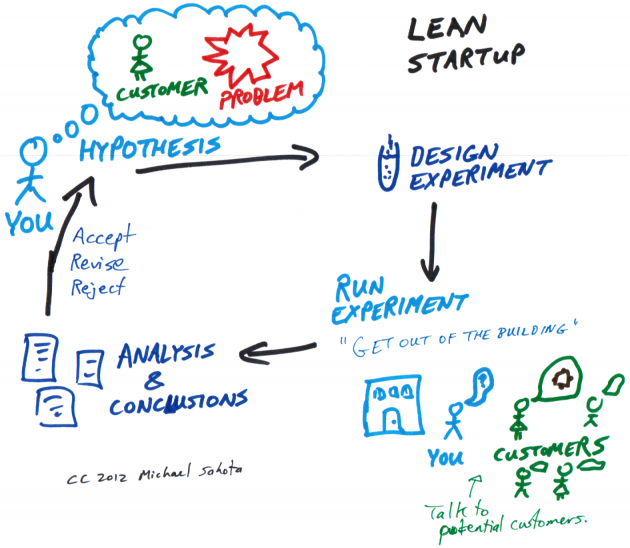
Lean-Startup-630x548

Do you notice how, inspite of the best intentions and competence, solution to an existing problem somehow becomes the harbinger of a new problem? It is as if we are in the midst of situations akin to that of a worn pipe prone to leaks. As a leak is patched at one place and pressure is put back, the pipe cracks at another place and the leakage starts again.

So, what is it really that leads to well thought out problem solving strategies heralding a fresh bout of new problems?

Steve Zaffron and Dave Logan, in their bestseller ‘The Three Laws of Performance’ (TLOP), have not only provided an answer but also a sustainable way forward approach.

As part of our survival instinct, we are conditioned to take aspects of our life experiences, of what worked and what did not, fears of what might go wrong and so on…and store them in a place so that we could refer to them, when needed, in the future. As we go through life, we keep on storing more and more such stuff in that place of ours. What do you think happens? Without us even realizing, our actions and performance get restricted to what is allowed by all that stuff we have stored from the past. We end up being on ‘safe rails’ and doing more of what we have always done. In effect we become blindsided to everything else which somehow was not in our past. Authors Steve and Dave refer to this human tendency as they argue that our thoughts, strategies and actions arise from the future as “given by our past”. They call that place where we store our past our default future.

Steve and Dave go on to explain why solutions implemented lead to new problems. They show us the trap we are liable to get into as soon as we envisage a solution. We remain blinded to the fact that the only solutions to a problem that occur for us in fact arise out  of our default future where all our past is stored. This only allows us to do what we did in the past which in fact created the problem in the first place. We thus get sucked into the never ending cycle of problems, solutions based on the past…. leading to more problems

The TLOP holds the promise of getting us out of the above problem- solution trap. So how could we do that?

First, we uncover the default futures- all that past stuff that we hold onto, consciously and sub-consciously, that exist for us as well as other stakeholders and how that clutters our thoughts in the present. In effect we start understanding how this past driven default future actually impacts how situations occur- for us and others, and how that correlates to actions and performance. So as a situation occurs negatively for us, the actions and performance correspondingly suffer.

The TLOP further state that the way to dramatically upscale our actions and performance is to alter how situations occur for us. This can be achieved through use of certain kind of language. As we gain mastery over use of this kind of language, we are able to do two things. First, we are able to close past issues and upsets, remove these out of the default future where we had carried them into and put them back where they belong, the past. Second we begin opening up space for a new Created future, a blank canvas in which we can envision something radically new, something no longer constrained and dictated by our past.

A future that addresses the concerns of all.

A future in which everyone joyfully comes to live into.

A future that now no longer needs to follow the never-ending cycle of problems and solutions.

In learning………….                                                                  Shakti Ghosal

Acknowledgement: The Three Laws of Performance: Rewriting the future of your organisation and your life by Steve Zaffron & Dave Logan, 2011

How can I use my Context?


untitled

In my last post ‘My Context uses me’, I had dwelled on how my Context, that omnipresent meaning making machine in all my situations, uses me. How my context wields the power to put me on rails and makes me react in predictable failing ways. I was left wondering whether I could do something about shifting away from such almost certain failures.

The “Being a Leader” course, attended by me recently, revealed a pathway.

As we saw in the last post, our context does function as a cognitive lens, a filter so to speak, through which we view the world, others and interestingly, even our own selves. As we look at a situation, our context highlights some aspects, dims a few and even blanks out yet other aspects. So what makes up our context? It’s our Worldview and frame of reference for the situation at hand. It is our beliefs, biases, prejudices and assumptions which play a part in the context’s meaning making and filtering process.

Cognitive-Distortions-Skew-Your-Perceptions

Now let’s consider what constitutes our beliefs, biases, prejudices and assumptions. In a nutshell, it is our past experiences. Our brains are adept at using this past to create a default context which comes automatically with the situation at hand. This default context, coloured as it is by our past concerns and fears, restricts us and our actions. As the context is decisive, one can see the wisdom of the old French proverb, “The more things change, the more they stay the same”.

The “Being a Leader” course went on to show that a critical part of our effectiveness in leadership and life arises from our ability to replace the default context by a created context for the same situation. This created context, unencumbered by anything from the past, allows us to see possibilities which were not being allowed so long by our past.

So how does the above work? To understand that let us revisit the situation which we had talked about in the earlier post, ‘My Context uses me’.

“Whenever I notice someone, be it a family member, relative, office colleague etc. not doing it ‘my way’ or voicing disagreement about my way or style of functioning, I feel that the person is actually trying to prove me wrong , undermine me, not giving me the respect which I deserve etc.”

.My default context was, ‘Disagreeing with me implies proving me wrong, undermining me, disrespecting me etc’. This context led to situations occurring for me negatively and made me react in negative, hurtful ways.

As I review the above situation, I realise that I do hold the power to create a new context for myself. A context which says, ‘Getting the job done is what counts and it really doesn’t matter if the way adopted by others is different to mine so long as the job is done’.

As I think of this created context, I can see that it allows me to hold the big picture of getting the job done and get people to align their focus and actions to that. I also begin to see that with this context, I am no longer getting undermined, proved wrong and getting disrespected.
I now see that I hold the power to use my context to my advantage.
***
On a lighter note, I append below an extract from the ‘The Phantom Tollbooth’ by Norton Juster, which highlights how one could mis-use the context to the other person’s disadvantage!

“I don’t think you understand,” said Milo timidly as the watchdog growled a warning. “We’re looking for a place to spend the night.”
“It’s not yours to spend,” the bird shrieked again, and followed it with the same horrible laugh.
“That doesn’t make any sense, you see—” he started to explain.
“Dollars or cents, it’s still not yours to spend,” the bird replied haughtily.
“But I didn’t mean—” insisted Milo.
“Of course you’re mean,” interrupted the bird, closing the eye that had been open and opening the one that had been closed. “Anyone who’d spend a night that doesn’t belong to him is very mean.”
“Well, I thought that by—” he tried again desperately.
“That’s a different story,” interjected the bird a bit more amiably. “If you want to buy, I’m sure I can arrange to sell, but with what you’re doing you’ll probably end up in a cell anyway.”
“That doesn’t seem right,” said Milo helplessly, for, with the bird taking everything the wrong way, he hardly knew what he was saying.
“Agreed,” said the bird, with a sharp click of his beak, “but neither is it left, although if I were you I would have left a long time ago.”

In learning…….. Shakti Ghosal

Acknowledgements:
1) “Being A Leader And The Effective Exercise Of Leadership: An Ontological / Phenomenological Model” by Werner Erhard, Independent & Michael Jensen, Jesse Isidor Straus Professor of Business Administration Emeritus, Harvard Business School.

My Context uses me.


“For me context is the key- from that comes the understanding of everything.”
– Kenneth Noland, American contemporary artist.

context-img4

Interestingly, my first acquaintance with ‘Context’ was from an experience with something which is opposite, that is ‘Out of Context’. I was in junior school when one of the girls in my class came running to the teacher and exclaimed loudly, “Miss! Miss! Dilip is saying he will kill someone!” When Dilip was called in for his explanation, it transpired that during lunch, he had remarked, “It is so hot. I feel like killing that person and sitting in his place in the air-conditioned school office.” Here was a case of a young mind taking some words out of context. The listener, listening to the specific set of words without the benefit of the context in which they were spoken, however derived a different meaning altogether.

As I go through life, the power of context continues to be revealed to me. I am witness to myriad claims and counterclaims in the realms of politics, media and entertainment in which politicians and celebrities, when confronted with some of their past utterances, resort to saying, “I never said that, I was quoted out of context”. Stating this, the individual is quick to articulate a context which completely shifts the meaning of what he /she had said.

The dictionary meaning of Context is ‘the circumstances that form the setting for an event, statement and idea, and in terms of which it can be fully understood and assessed’.Said another way, Context is something which interweaves into a situation to provide meaning. While we may not be conscious when we look at a situation, there is always a context that we hold that generates for us the sense that we make of what we see. A situation in a vacuum is apt to lose much of what it might mean or imply for us.

How a context can shape the way of being and actions of people is wonderfully portrayed in “The Life of Brian”, the 1979 British Comedy film. Tired of masquerading as a phony messiah, Brian tries to run away from the crowds following him and loses one of his shoes in the process. To the crowd however, the context is one of ‘every word and action of Brian is a point of doctrine’. The accidentally lost shoe of ‘Messiah’ Brian is held up as such. This is humour and satire at its best!

***

As I start distinguishing the contexts in my own life, I see a particular situation playing out repeatedly.

Whenever I notice someone, be it a family member, relative, office colleague etc. not doing it ‘my way’ or voicing disagreement about my way or style of functioning, I feel that the person is actually trying to prove me wrong , undermine me, not giving me the respect which I deserve etc.

I thus see all such situations from a context of ‘Disagreeing with me implies proving me wrong, undermining me, disrespecting me etc’.

As I hold this context, the situations occur for me negatively. This negative occurring impacts my mental state, emotions and thoughts as also the actions I contemplate. So how do I react? I tend to lose sight of the big picture. I justify myself by knit picking on the right or wrong ways of doing things from my perspective. I get down to micromanaging and in my anxiety to enforce, end up in confrontation, acrimony, blame game and what have you. So even though I started trying to get something done, I have really ended up fanning dissent, demotivation and unworkability.

I can see now how my context has been using me. How, time and again, it puts me on rails and makes me react in a predictable, disempowering manner. How my reaction gets based on how the situation, shaped and coloured by my context, shows up for me.

So if my context uses me thus, can I shift away from it to avoid my disempowerment and failure to get the job done?

I am left wondering about what kind of practices I need to adopt to shift away from disempowering contexts to empowering ones for myself……to be continued…….

In learning……… Shakti Ghosal

Leadership and Choice


“Leaders live by choice, not by accident.” Mark Gorman, author.

untitled
Choice. A simple, easygoing word which leads most of us to trivialize its importance. But nonetheless it holds enormous power in the exercise of Leadership as well as life in general.
***
In a recent Leadership course, I gained a powerful perspective from the following classroom experiment relating to ‘Choice’. The experiment required of us the following.

1. Identify what there is for you to do in your life that you feel obligated to do, or that you are doing based on a set of reasons for doing them, and write it down.
2. As an experiment, choose to do the thing it would be legitimate to say you are obligated to do (or have no “choice” about doing), and now write them down as what you are choosing to do. (“I choose to …”.)
3. Now check and see whether your experience of the item occurs for you (shows up for you) differently.

One aspect in my life that occurs to me as an obligation is, ‘Hang onto my current job, work profile and industry’.

I then experimented with rewriting the above aspect as a free choice of mine, which then became, ‘I choose to be in my current job, work profile and industry in an empowering, relevant and effective manner.’

I was taken aback by the remarkable shift in the way the situation occurred for me by the mere change in the language as above.

I could see that when I exercise ‘Choice’, it is intrinsically me, my inner convictions and I start ‘owning’ that choice; it occurs less burdensome. I start feeling heightened energy, passion and confidence. I can sense more possibilities and way forward opportunities apart from an intrinsic commitment to do the best I can.

Contrast this with when I used the language of obligation and the burden that brings in, constraining possibilities and pathways. I then see myself in a space of forcible acceptance, fearful of consequences. I go through the motions, rely on instructions to proceed, avoid risks etc. I see a drag and loss of energy.

I started seeing the power residing within the ‘language of Choice’.
***

I recall a couple of situations in which the way I perceived making a choice impacted both myself and others in a positive or negative way.

One time when I had to treat my family out to dinner, my wife and daughters left the choice of selecting the restaurant to me. Post dinner, my wife remarked that she had not enjoyed the Italian cuisine all that much and how she wished, I had chosen an Indian restaurant. I remember reacting back angrily as to what had stopped her from giving this preference earlier on. I then tried to justify my selection based on good word of mouth feedback of friends. Basically I ended up not taking responsibility of my own choice and putting the blame on my friends instead. To evade criticism of my choice, I had painted myself into a ‘victim’ corner.

Another time, my family left the choice of selecting which movie we should go to. After the movie, my wife and daughter were unanimous in rating the movie as terrible. On this occasion however, I stood firm as I declared, “Because of its philosophical insights, I wanted all of us to watch and learn from this movie.” Without really realizing it at that point in time, I showed up as having made a choice of my own free will and held the courage to take responsibility for it. As I articulated my choice in this manner, I felt empowered.

Do we realise that at its very essence, Leadership is a choice? Just as is living life. Everything about Leadership, as with life, begins with a choice. A choice which we make.
***

In literature, Leadership and decision making appear to be near synonymous. We tend to overlook the fact that any decision really comprises of a chain of small but significant choices. Even when we bring in our biases, perceptions and assumptions and rationalize and justify based on these, that is our choice too. Our choice, and the corresponding decision flowing out of that, further gets coloured and shaped (or shall I use the word forced?) by our positional, inter-personal or cultural compulsions. We remain largely unaware of this aspect, falsely believing that how the situation occurs for us is how it really is and that our reaction is correct and logical. We fail to see that we in fact have got onto rails and are unable to exercise any freedom relating to other possibilities available to us to deal with what is at hand. A far cry from effective leadership which is all about opening up choices and possibilities, not limiting them.
***

Richard J. Leider, the author of the international bestseller, ‘ The Power of Purpose’ writes that in twenty years of his interviewing elderly leaders aged over 65, he discovered something profound relating to ‘Choices’. To his question, “If you could live your life over again, what would you choose to do differently?”, he heard the articulation of three themes getting repeated over and over again.

“I would choose to be more reflective, take time to think because life passes so quickly and I was too busy doing to think adequately.”

• “I would choose to be more courageous, take more risks; I played it too close to the vest”.

• “I would choose to be clear, far earlier, on what my purpose was in life”.

In learning….. Shakti Ghosal

Acknowledgements:

1) “Being A Leader And The Effective Exercise Of Leadership: An Ontological / Phenomenological Model” by Werner Erhard, Independent & Michael Jensen, Jesse Isidor Straus Professor of Business Administration Emeritus, Harvard Business School.
2) “The Power of Purpose” by Richard J. Leider, May, 2010.

My Already- Always listening


“Effective listeners remember that “words have no meaning – people have meaning.” The assignment of meaning to a term is an internal process; meaning comes from inside us. And although our experiences, knowledge and attitudes differ, we often misinterpret each other’s messages while under the illusion that a common understanding has been achieved.”
— Dr. Larry L. Barker, Author & Executive Coach

Already Always listening

I think of a few people engagements I have had in the recent past.

An office colleague comes in to discuss a problem that is likely to arise because of depressed business and enquiry levels from the Middle East markets. Our dependence on these markets has been high historically and remains crucial to meet our budgets. This upsets me. Time and again I had suggested that the division plans Sales trips to the region well in advance to renew our contacts with existing clients and meet new prospects. I sense this has not been done. A voice inside screams, “This guy is casual and lazy to plan in advance. He did not take my suggestions seriously and now when things have gone out of hand, he is running back to me with excuses. Why should I listen to him now?”

The other day, I hear that a market competitor has rolled out a series of innovative business initiatives in order to gain market stature and share. The CEO, known to me well, is a high school drop-out and has clawed up his way in the industry over the years. The inner voice returns, “There seems to be something wrong here. How on earth could this guy come up with such better initiatives than me when he has been so below me in scholastics? This is an affront and this guy, with such initiatives, is trying to undermine me.”

I am at this workshop and I meet an ex junior colleague who left our company some years back. I get to know that in the interim, he did his Masters and is now an Assistant Professor at a Business school. During his presentation, he waxes eloquent on Leadership and the need to envision a future that excites. While I cannot find fault with what he says, my earlier perception about him as a mere desk worker seems to stop me from embracing the concepts he speaks of. That voice inside whispers, “How could this guy, so much younger and less experienced than me, know more and teach me leadership concepts? Accepting and acknowledging what he says would put me down. I can’t do that! I need to think of how I could disagree with him.”

Do you see how that voice inside me is my Already- Always listening?

Do you see how my Already- Always listening has led me to have preconceived interpretations of what is being said even before it is said?

Do you see how such interpretations create judgments and opinions in me even before the other guy has opened his mouth?

Do you see how these judgments and opinions constrain and limit my listening, my thoughts, my actions and even the possibilities I am willing to consider?

It is as if I get onto rails which then allow me to think and act in only set ways. So when my colleague approached me to discuss what could be various options available to improve business from middle East markets, my reaction was to blame him for not having considered my earlier suggestions. In the second case, rather than critically reviewing the business initiatives of the competitor to learn and initiate effective response, my reaction was one of non-acceptance and making the competitor CEO ‘vanish’. And in the final case, rather than gaining insight from my ex-colleague’s presentation, I had closed my mind to much else except look for logic to make him wrong in my own perception.

Dear Reader, can you identify similar experiences in your life? If so, do you see how our Already-Always listening constrains and restricts us from achieving that big picture empowered way of being that we envision?

What is it that sustains such Already-Always listening and the related interpretations within us? This happens because almost all of us are not even aware of the distortion that exists between what is said to us and what we end up listening. Since we are not aware, we also cannot comprehend how our interpretations may be distorting our perceptions. So we end up assigning disparate causes to our relationship breakdowns and suboptimal performance but never the core issue of how our way of being and acting have being negatively impacted from the distortion that landed for us in our brains based on the Already-always listening and interpreting we did. We then try and ‘fix’ this false cause, which is really an effect, leading us to go through life trying to put out one fire after another.

Does this look or sound familiar?

So what could we do to distinguish and become aware of our Already-Always listening so that it loses its ability to run us and our lives?

In learning…………. Shakti Ghosal

Acknowledgement: “Being A Leader And The Effective Exercise Of Leadership:
An Ontological / Phenomenological Model” by Werner Erhard
, Independent & Michael Jensen, Jesse Isidor Straus Professor of Business Administration Emeritus, Harvard Business School.

My Life Sentence


“Everyone thinks of changing the world, but no one thinks of changing himself’.

Leo Tolstoy, Russian mystic & novelist. 1828-1910

jail_life sentence

At the age of ten, I had the first realization of what a gang was and what it could do to me. I do not recall how it started but one thing led to another and soon all my neighbourhood friends and playmates had ganged up against me. One evening, I had climbed up on the roof of our house with our servant as he was fixing the radio antenna. I saw my ex friends and playmates holding hands, dancing and skipping together and then with a shock, I heard their voices mocking, mimicking and making fun of me. In that moment I heard an inner voice saying, ‘There is something wrong here. There is something wrong with me.’

I remember telling myself, ‘I don’t belong’. I became a loner, did things on my own and showed up with a ‘I do not really care to belong’ persona to my erstwhile friends and the world. Even after a few weeks when all became well again and I was back with my friends, my self imposed life sentence ‘I don’t belong’ continued to reside inside me.

I time travel a few years ahead to when I am in my mid teens. I see myself having a great time with a bunch of friends at school. Sharing books and comics, watching movies and developing views of the world together. Being cool was all about hanging out together; classes and the need to master what was being taught took a back seat. I justified to myself, ‘I am smart and I can always make up my studies before the exams’. So it came as a shock when my final examination grades plummeted. That inner voice returned, ‘There is something wrong here. There is something wrong with me.’

I recall my father telling me, “You have become a mediocre. Mediocre people do not succeed in life”. In that moment of humiliation and self-doubt, I said to myself, ‘Life success depends on scholastic success.’ As this got ingrained in me as a life sentence, I got back to being a loner and focusing on scholastics. Over the years, as I went on to achieve one scholastic peak after another, to the outside world I was smart and successful. But somewhere inside, those vestiges of childhood humiliation and self doubt remained and my view of the world and behaviour towards other people continued to be guided by ‘Life success depends on scholastic success.’

Today as I think of myself, I sense how the life sentences I had imposed on myself during moments of shock and bewilderment those many years back, have so become part of who I am. It is as if there are several ‘me’s enacting different roles here. There is the judge ‘me’ along with the jury ‘me’ who have sentenced the accused ‘me’ to live out my life in a cell. A cell whose walls, ceilings and floor are composed of my own life sentences. Like inmates of an actual prison, I have devised my own winning and self-serving formulas to cope with the constraints of my prison life. Ironically though and unlike the actual prison inmates who try to get out into the free world, I don’t see the need to do so as my life sentence created prison bars have so become part of my persona and who I am.

And so I continue to go through Life carrying my life sentences. In many situations, I cope and come out the winner In others I feel like a ‘thrown dice’, caught up in unfolding events, clinging onto the ways from my past but yet failing to call the shots. I am left wondering who or what is leading my life.

Can I presume you, dear reader, also feel the same?

So how could we build our lives around our ‘real’ self, free of our life sentences and the persona we have created to cope? In their path breaking book, ‘The Three Laws of Performance’, authors Steve Zaffron and Dave Logan deep dive into this aspect. They point to a way of overturning our life sentences to free ourselves of these.

We need to start by showing compassion to that little guy within each of us who has been carrying the burden of the life sentences all these years. That guy who did his best to cope with life and produce results by trying to make up for what we have perceived as wrong with us. By hiding from others, even from our own selves. By conditioning ourselves to be different from who we think we are.

The authors then recommend that we create a crisis of authenticity within ourselves. A crisis of the real ‘we’ against the persona created by our life sentence. To create such a crisis ‘we need to locate where our foot has got nailed to the floor’. We do this by engaging ourselves with the following queries:

•Where in your life is something not working or not working as well as you want?
•In what areas of your life do you feel a loss of power, freedom, fulfillment or self expression?
•In those areas of life you just identified, how are you being inauthentic- what are you pretending, avoiding, not taking responsibility for?
•What can you see has been the impact, the limitations, of your having been inauthentic in those areas?

Dear Reader, are you ready to overturn your life sentence?

***

Two Wolves – A Cherokee Parable

2 wolves
An old Cherokee chief was teaching his grandson about life…

“A fight is going on inside me,” he said to the boy. “It is a terrible fight and it is between two wolves.

“One is evil – he is anger, envy, sorrow, regret, greed, arrogance, self-pity, guilt, resentment, inferiority, lies, false pride, superiority, self-doubt, and ego.

“The other is good – he is joy, peace, love, hope, serenity, humility, kindness,
benevolence, empathy, generosity, truth, compassion, and faith.

“This same fight is going on inside you – and inside every other person, too.”

The grandson thought about it for a minute and then asked his grandfather,
“Which wolf will win?”

The old chief simply replied, “The one you feed…”

***

In Learning…….. Shakti Ghosal

Acknowledgement: The Three Laws of Performance: Rewriting the future of your organisation and your life by Steve Zaffron & Dave Logan, 2011. Chapter 6, Pages 143-168.