Mind Shift


“Whatever we are waiting for – peace of mind, contentment, grace, the inner awareness of simple abundance – it will surely come to us, but only when we are ready to receive it with an open and grateful heart.” ~Sarah Ban Breathnach, American author.

Everest

The morning of Saturday, 25th April dawned at the base camp of the Mount Everest expedition like any other. Just before noon, Sherpa Bahadur was attempting to establish contact with the expedition team up on the slope when he was non-plussed to see the snow covered ground shift and rise like a living apparition. The last thing he remembered was an ear-splitting sound and being swept away by the shifting ground under his feet.

nepal-earthquake-avalanche-ap855095418230
For days and weeks earlier, unknown to the Sherpa and his expedition mates, two pieces of the cracked Earth’s crust below, had been moving and pressing against each other, like they have been wont to do periodically for millions of years. The heat and the churning currents of the molten rocks underneath was leading to the crust crumbling and buckling with intense pressure points being created. Something had to give. And that is what happened on that fateful Saturday. As the pressure propelled the molten rocks below the crust to shift and move like a jumble of conveyor belts in disrepair, it manifested as a powerful earthquake of 7.9 magnitude on the Richter scale all over the Himalayan regions of Nepal and North India.

Witnesses later reported that the shifting avalanche began on Mount Kumori, a 7,000-meter high mountain just a few kilometers from Everest, gathered strength as it totally engulfed the base camp in the lower reaches of Everest.

For Sherpa Bahadur, a survivor of this immense natural tragedy, the shift of Earth’s tectonic plates led to a mind shift in terms of a change of focus and perception. What really mattered in terms of his relationships with his missing colleagues, the memories of all the great times they had had as they had planned for and painstakingly executed the expedition together came crowding into the mind. The pettiness of behaviours, the jealousies, the selfishness, all part of the way he had wound up being, seemed to recede. Standing amidst the destruction, carnage and sorrow, he found himself surprisingly engulfed by a peace of mind and an inner awareness of commitment.

Little did he realise it in that moment but Sherpa Bahadur had come through a Crucible event. A transformative experience that had given him an altered sense of identity and purpose. As he set about initiating efforts to rescue his missing team members, folks around him could not help but notice his strength of purpose and the nobility of his selflessness.

A crucible experience is a trial and test, a shifting of the ‘tectonic plates’ of our mind, opening us up to entirely new ways of being, of thinking and acting. As we do this, we can turn our life completely.

Steve Chandler, the author of “Shift your mind: shift the world”, says, ‘When the mind is open, it will shift. When that happens all of life becomes, momentarily, light as a feather. Light as a breeze. Beautiful! You go up to the next level of consciousness, and creativity, energy, vibration ó whatever you want, you’ve got it.’

So what is that mind shift Steve is talking about and what could one do to make it happen?

Well for a starter, we need to bring in a heightened awareness of our way of being. Only with such awareness can we hope to achieve some of the mind shifts given below.

MindShift

* A Gratitude Mind Shift: ‘Do you carry that nagging feeling that somehow you have less than the other guy? Could you shift your way of being to see all that you have as a blessing?’

* A Self-Creation Mind Shift: ‘Do you find yourself blaming others and the circumstances when faced with a problem? Could you shift your way of being to seek opportunities for self creation and development when confronted with pain or difficulties?’

* Being Cause in the matter Mind Shift: ‘Do you find yourself resisting or denying problems when they arise in your life? Could you shift your way of being to acknowledge that somehow, somewhere your choices and actions might have caused these?’

* A Self-Trust Mind Shift: ‘Do you find yourself doubting your own self and seeking answers from others? Could you shift your way of being to trust your own intuition and wisdom?’

* Being committed to something bigger than yourself mind shift: ‘Do you find yourself embroiled within your own self-serving pettiness and fears? Could you shift your way of being to embrace a cause bigger than yourself and choose to be fully alive and engaged to that?’

* An Initiative-Taking Mind Shift: ‘Do you find yourself waiting for someone else to take the lead? Could you shift your way of being to be the creator, the fire starter?’

* A Present Moment Mind Shift: ‘Do you see yourself being held back by your past? Could you shift your way of being to drop that story that is holding you back so that you could recreate yourself every day?’

That crucible experience that Sherpa Bahadur had on the lower slopes of Mount Everest on that fateful day was really about a very fundamental realization. Which is this. All that we perceive and take for granted, who we know our self to be, what we assume to be true about us, others and the world in general, is not the only reality. It is this realization that allows us to achieve heightened awareness and transform ‘the way we have wound up being’, allowing us to enter a new world. It is this realization that allows us to open our mind (and heart!) to the Shifts we have spoken of.

My invitation to you, dear reader, is this. Today, right now, pick one of the above Mind Shifts that most resonates with you. Gently place it inside your psyche and begin living it. Come on, give it a try! As you open your mind to embrace, you might be astonished with the results.

In Learning……… Shakti Ghosal

Post script: The post alludes to the recent devastating earthquake in Nepal. However Sherpa Bahadur is a fictional character and has no bearing to any living person. I however have no doubt that in reality there are innumerable individuals out there, who faced with a crucible experience arising out of the earthquake, have risen to the occasion with their untiring efforts. I offer this post as an acknowledgement and homage to all such brave and selfless individuals who have been working tirelessly on the ground to support the shattered communities.

Acknowledgements:

1) ‘Crucibles of Leadership’ by Warren G. Bennis & Robert J. Thomas, Harvard Business Review,
September 2002.
2) ‘Shift your Mind: Shift the World’ by Steve Chandler, Robert Reed publishers, February 2010.

That never-ending cycle of our problems and solutions…….


“We cannot solve our problems with the same level of thinking that created them”
                                                                                                         – Albert Einstein

 Problems-Solutions-2098789

As I look at what all is making the news in the world today, I am struck by an interesting trend.

  • No sooner did nations heave a sigh of relief that the war against Global terrorism viz.Al Qaeeda in Afghanisatan had been won, one is witness to the rise of other terror groups like the Islamic State (IS) and Boko Haram in Iraq and Nigeria.
  • Initially hailed as a path breaking positive development in terms of spread of people’s power and democracy in the Middle East, the Arab Spring now faces criticism for the collapse of Governance and societal structures in a large swathe of countries like Egypt, Iraq, Libya, Syria,Yemen and so on.
  • As the US and Iran engage in serious talks around international controls on the latter’s nuclear plants and technology, Israel claims this is leading to a heightened risk of war in the region.
  • As oil prices collapse and the oil consuming nations of the world rejoice, the funding of green technologies and their implementation for climate change initiatives takes a back seat.

What is it that, in spite of the best intentions and efforts of nations and leaders, the world seems to perennially lurch from one negative occurrence to another? Occurrences that seem to encompass every aspect of our existence- Terrorism, Threat of War, Governance, Climate change and what have you.

Strangely, I am witness to a similar trend as I shift gears and go down to my organisational and personal level.

  • I implement an incremental volume based pricing strategy to gain a new business account. However information about this gets known to an existing customer  who then threatens to shift business away if the same low pricing is not offered. The result: lower profitability even with higher sales.
  • I recommend deviation from the company’s HR policy to help a staff faced with the settlement of high medical bills. Though I succeed with my recommendation, this opens up a Pandora’s Box of complaints about discrimination and how other similar cases got rejected in the past.
  • Based on my directive, the sales team resort to focussed selling of identified products to maximize revenues. While this gets achieved, the sales of other products suffer leading to some Principals and suppliers getting upset.

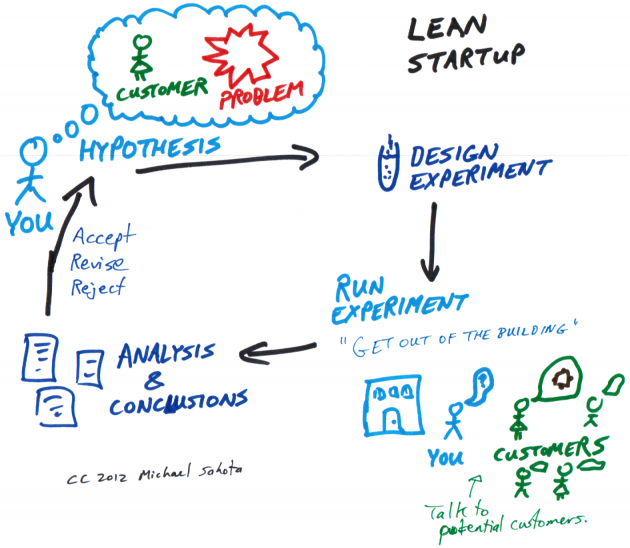
Lean-Startup-630x548

Do you notice how, inspite of the best intentions and competence, solution to an existing problem somehow becomes the harbinger of a new problem? It is as if we are in the midst of situations akin to that of a worn pipe prone to leaks. As a leak is patched at one place and pressure is put back, the pipe cracks at another place and the leakage starts again.

So, what is it really that leads to well thought out problem solving strategies heralding a fresh bout of new problems?

Steve Zaffron and Dave Logan, in their bestseller ‘The Three Laws of Performance’ (TLOP), have not only provided an answer but also a sustainable way forward approach.

As part of our survival instinct, we are conditioned to take aspects of our life experiences, of what worked and what did not, fears of what might go wrong and so on…and store them in a place so that we could refer to them, when needed, in the future. As we go through life, we keep on storing more and more such stuff in that place of ours. What do you think happens? Without us even realizing, our actions and performance get restricted to what is allowed by all that stuff we have stored from the past. We end up being on ‘safe rails’ and doing more of what we have always done. In effect we become blindsided to everything else which somehow was not in our past. Authors Steve and Dave refer to this human tendency as they argue that our thoughts, strategies and actions arise from the future as “given by our past”. They call that place where we store our past our default future.

Steve and Dave go on to explain why solutions implemented lead to new problems. They show us the trap we are liable to get into as soon as we envisage a solution. We remain blinded to the fact that the only solutions to a problem that occur for us in fact arise out  of our default future where all our past is stored. This only allows us to do what we did in the past which in fact created the problem in the first place. We thus get sucked into the never ending cycle of problems, solutions based on the past…. leading to more problems

The TLOP holds the promise of getting us out of the above problem- solution trap. So how could we do that?

First, we uncover the default futures- all that past stuff that we hold onto, consciously and sub-consciously, that exist for us as well as other stakeholders and how that clutters our thoughts in the present. In effect we start understanding how this past driven default future actually impacts how situations occur- for us and others, and how that correlates to actions and performance. So as a situation occurs negatively for us, the actions and performance correspondingly suffer.

The TLOP further state that the way to dramatically upscale our actions and performance is to alter how situations occur for us. This can be achieved through use of certain kind of language. As we gain mastery over use of this kind of language, we are able to do two things. First, we are able to close past issues and upsets, remove these out of the default future where we had carried them into and put them back where they belong, the past. Second we begin opening up space for a new Created future, a blank canvas in which we can envision something radically new, something no longer constrained and dictated by our past.

A future that addresses the concerns of all.

A future in which everyone joyfully comes to live into.

A future that now no longer needs to follow the never-ending cycle of problems and solutions.

In learning………….                                                                  Shakti Ghosal

Acknowledgement: The Three Laws of Performance: Rewriting the future of your organisation and your life by Steve Zaffron & Dave Logan, 2011

How can I use my Context?


untitled

In my last post ‘My Context uses me’, I had dwelled on how my Context, that omnipresent meaning making machine in all my situations, uses me. How my context wields the power to put me on rails and makes me react in predictable failing ways. I was left wondering whether I could do something about shifting away from such almost certain failures.

The “Being a Leader” course, attended by me recently, revealed a pathway.

As we saw in the last post, our context does function as a cognitive lens, a filter so to speak, through which we view the world, others and interestingly, even our own selves. As we look at a situation, our context highlights some aspects, dims a few and even blanks out yet other aspects. So what makes up our context? It’s our Worldview and frame of reference for the situation at hand. It is our beliefs, biases, prejudices and assumptions which play a part in the context’s meaning making and filtering process.

Cognitive-Distortions-Skew-Your-Perceptions

Now let’s consider what constitutes our beliefs, biases, prejudices and assumptions. In a nutshell, it is our past experiences. Our brains are adept at using this past to create a default context which comes automatically with the situation at hand. This default context, coloured as it is by our past concerns and fears, restricts us and our actions. As the context is decisive, one can see the wisdom of the old French proverb, “The more things change, the more they stay the same”.

The “Being a Leader” course went on to show that a critical part of our effectiveness in leadership and life arises from our ability to replace the default context by a created context for the same situation. This created context, unencumbered by anything from the past, allows us to see possibilities which were not being allowed so long by our past.

So how does the above work? To understand that let us revisit the situation which we had talked about in the earlier post, ‘My Context uses me’.

“Whenever I notice someone, be it a family member, relative, office colleague etc. not doing it ‘my way’ or voicing disagreement about my way or style of functioning, I feel that the person is actually trying to prove me wrong , undermine me, not giving me the respect which I deserve etc.”

.My default context was, ‘Disagreeing with me implies proving me wrong, undermining me, disrespecting me etc’. This context led to situations occurring for me negatively and made me react in negative, hurtful ways.

As I review the above situation, I realise that I do hold the power to create a new context for myself. A context which says, ‘Getting the job done is what counts and it really doesn’t matter if the way adopted by others is different to mine so long as the job is done’.

As I think of this created context, I can see that it allows me to hold the big picture of getting the job done and get people to align their focus and actions to that. I also begin to see that with this context, I am no longer getting undermined, proved wrong and getting disrespected.
I now see that I hold the power to use my context to my advantage.
***
On a lighter note, I append below an extract from the ‘The Phantom Tollbooth’ by Norton Juster, which highlights how one could mis-use the context to the other person’s disadvantage!

“I don’t think you understand,” said Milo timidly as the watchdog growled a warning. “We’re looking for a place to spend the night.”
“It’s not yours to spend,” the bird shrieked again, and followed it with the same horrible laugh.
“That doesn’t make any sense, you see—” he started to explain.
“Dollars or cents, it’s still not yours to spend,” the bird replied haughtily.
“But I didn’t mean—” insisted Milo.
“Of course you’re mean,” interrupted the bird, closing the eye that had been open and opening the one that had been closed. “Anyone who’d spend a night that doesn’t belong to him is very mean.”
“Well, I thought that by—” he tried again desperately.
“That’s a different story,” interjected the bird a bit more amiably. “If you want to buy, I’m sure I can arrange to sell, but with what you’re doing you’ll probably end up in a cell anyway.”
“That doesn’t seem right,” said Milo helplessly, for, with the bird taking everything the wrong way, he hardly knew what he was saying.
“Agreed,” said the bird, with a sharp click of his beak, “but neither is it left, although if I were you I would have left a long time ago.”

In learning…….. Shakti Ghosal

Acknowledgements:
1) “Being A Leader And The Effective Exercise Of Leadership: An Ontological / Phenomenological Model” by Werner Erhard, Independent & Michael Jensen, Jesse Isidor Straus Professor of Business Administration Emeritus, Harvard Business School.

My Context uses me.


“For me context is the key- from that comes the understanding of everything.”
– Kenneth Noland, American contemporary artist.

context-img4

Interestingly, my first acquaintance with ‘Context’ was from an experience with something which is opposite, that is ‘Out of Context’. I was in junior school when one of the girls in my class came running to the teacher and exclaimed loudly, “Miss! Miss! Dilip is saying he will kill someone!” When Dilip was called in for his explanation, it transpired that during lunch, he had remarked, “It is so hot. I feel like killing that person and sitting in his place in the air-conditioned school office.” Here was a case of a young mind taking some words out of context. The listener, listening to the specific set of words without the benefit of the context in which they were spoken, however derived a different meaning altogether.

As I go through life, the power of context continues to be revealed to me. I am witness to myriad claims and counterclaims in the realms of politics, media and entertainment in which politicians and celebrities, when confronted with some of their past utterances, resort to saying, “I never said that, I was quoted out of context”. Stating this, the individual is quick to articulate a context which completely shifts the meaning of what he /she had said.

The dictionary meaning of Context is ‘the circumstances that form the setting for an event, statement and idea, and in terms of which it can be fully understood and assessed’.Said another way, Context is something which interweaves into a situation to provide meaning. While we may not be conscious when we look at a situation, there is always a context that we hold that generates for us the sense that we make of what we see. A situation in a vacuum is apt to lose much of what it might mean or imply for us.

How a context can shape the way of being and actions of people is wonderfully portrayed in “The Life of Brian”, the 1979 British Comedy film. Tired of masquerading as a phony messiah, Brian tries to run away from the crowds following him and loses one of his shoes in the process. To the crowd however, the context is one of ‘every word and action of Brian is a point of doctrine’. The accidentally lost shoe of ‘Messiah’ Brian is held up as such. This is humour and satire at its best!

***

As I start distinguishing the contexts in my own life, I see a particular situation playing out repeatedly.

Whenever I notice someone, be it a family member, relative, office colleague etc. not doing it ‘my way’ or voicing disagreement about my way or style of functioning, I feel that the person is actually trying to prove me wrong , undermine me, not giving me the respect which I deserve etc.

I thus see all such situations from a context of ‘Disagreeing with me implies proving me wrong, undermining me, disrespecting me etc’.

As I hold this context, the situations occur for me negatively. This negative occurring impacts my mental state, emotions and thoughts as also the actions I contemplate. So how do I react? I tend to lose sight of the big picture. I justify myself by knit picking on the right or wrong ways of doing things from my perspective. I get down to micromanaging and in my anxiety to enforce, end up in confrontation, acrimony, blame game and what have you. So even though I started trying to get something done, I have really ended up fanning dissent, demotivation and unworkability.

I can see now how my context has been using me. How, time and again, it puts me on rails and makes me react in a predictable, disempowering manner. How my reaction gets based on how the situation, shaped and coloured by my context, shows up for me.

So if my context uses me thus, can I shift away from it to avoid my disempowerment and failure to get the job done?

I am left wondering about what kind of practices I need to adopt to shift away from disempowering contexts to empowering ones for myself……to be continued…….

In learning……… Shakti Ghosal

Whose Business are we really in?


Whose business are you in

“No one can give you freedom but you……”
―Byron Katie

My daughter was coming home for her Diwali vacation and had to catch an evening flight from Mumbai. Her cab got caught in an awful traffic jam a couple of kilometers from the airport. Almost an hour passed and the cab had barely moved a few meters. Visions of her missing her flight, not knowing what to do and not having a place to stay wrestled with each other in my mind. In a panic state, I started calling my daughter as well as the driver of the cab repeatedly. Little realizing that I was offering no support or suggestions, only communicating my panic to both of them. Making their situation worse, reducing their ability to think clearly and consider other options.
***
During a review, I found that a team handling a critical project with a deadline, had totally overlooked the time schedule of a specific activity. In the ensuing brain storming session, a plan was formulated whose proper execution would get the project through. My apprehension about whether the plan would be handled properly led me to try and micro-manage the team members at every step. But what this led to was resentment , loss of the team’s initiative taking and working together ability and members blaming each other.
***
I am a stickler for orderliness. Specially at home, I know where things are kept and stored. So when I see my wife and daughters taking out and using something, I expect that afterwards they would put it back where I believe it should be kept. Alas! This seems to be hardly their priority and so things taken from somewhere are kept back somewhere else. I intensely dislike this and therefore become more strident and possessive about how things need to be used and kept. I need hardly add that neither my wife nor daughters have been able to come to terms with this trait of mine.
***
As I look back at the above situations, I realise that in every case, my thoughts and the consequent behaviour and action, have led to more stress, both for me and others. I sense that in some way, my thoughts and consequently myself, are not willing to accept the reality of ‘What Is’. So what is the genesis of such thoughts and behaviour?

Byron Katie, American speaker and author, in her self enquiry method ‘The Work’, provides an interesting perspective and insight. She identifies three kinds of business in the Universe: Our own, other peoples’ and God’s. God’s business is really about the reality that exists. So when we are unwilling to accept such reality, we are really into God’s business. When we hold fear or expectations about other people, we are living into these other peoples’ business. As per Katie, every time we start mentally living in God’s or other peoples’ business, we are no longer in our own business. We separate from our own selves and this is what leads to the stress we experience.

In the words of Byron Katie:

“If you understand the three kinds of business enough to stay in your own business, it could free your life in a way that you can’t even imagine. The next time you’re feeling stress or discomfort, ask yourself whose business you’re in mentally, and you may burst out laughing. That question can bring you back to yourself. And you may come to see that you’ve never really been present, that you’ve been mentally living in other people’s business all your life. Just to notice that you’re in someone else’s business can bring you back to your own wonderful self”.

In Learning………… Shakti Ghosal

Acknowledgement: The Work of Byron Katie. http://www.byronkatie.com

My Already- Always listening


“Effective listeners remember that “words have no meaning – people have meaning.” The assignment of meaning to a term is an internal process; meaning comes from inside us. And although our experiences, knowledge and attitudes differ, we often misinterpret each other’s messages while under the illusion that a common understanding has been achieved.”
— Dr. Larry L. Barker, Author & Executive Coach

Already Always listening

I think of a few people engagements I have had in the recent past.

An office colleague comes in to discuss a problem that is likely to arise because of depressed business and enquiry levels from the Middle East markets. Our dependence on these markets has been high historically and remains crucial to meet our budgets. This upsets me. Time and again I had suggested that the division plans Sales trips to the region well in advance to renew our contacts with existing clients and meet new prospects. I sense this has not been done. A voice inside screams, “This guy is casual and lazy to plan in advance. He did not take my suggestions seriously and now when things have gone out of hand, he is running back to me with excuses. Why should I listen to him now?”

The other day, I hear that a market competitor has rolled out a series of innovative business initiatives in order to gain market stature and share. The CEO, known to me well, is a high school drop-out and has clawed up his way in the industry over the years. The inner voice returns, “There seems to be something wrong here. How on earth could this guy come up with such better initiatives than me when he has been so below me in scholastics? This is an affront and this guy, with such initiatives, is trying to undermine me.”

I am at this workshop and I meet an ex junior colleague who left our company some years back. I get to know that in the interim, he did his Masters and is now an Assistant Professor at a Business school. During his presentation, he waxes eloquent on Leadership and the need to envision a future that excites. While I cannot find fault with what he says, my earlier perception about him as a mere desk worker seems to stop me from embracing the concepts he speaks of. That voice inside whispers, “How could this guy, so much younger and less experienced than me, know more and teach me leadership concepts? Accepting and acknowledging what he says would put me down. I can’t do that! I need to think of how I could disagree with him.”

Do you see how that voice inside me is my Already- Always listening?

Do you see how my Already- Always listening has led me to have preconceived interpretations of what is being said even before it is said?

Do you see how such interpretations create judgments and opinions in me even before the other guy has opened his mouth?

Do you see how these judgments and opinions constrain and limit my listening, my thoughts, my actions and even the possibilities I am willing to consider?

It is as if I get onto rails which then allow me to think and act in only set ways. So when my colleague approached me to discuss what could be various options available to improve business from middle East markets, my reaction was to blame him for not having considered my earlier suggestions. In the second case, rather than critically reviewing the business initiatives of the competitor to learn and initiate effective response, my reaction was one of non-acceptance and making the competitor CEO ‘vanish’. And in the final case, rather than gaining insight from my ex-colleague’s presentation, I had closed my mind to much else except look for logic to make him wrong in my own perception.

Dear Reader, can you identify similar experiences in your life? If so, do you see how our Already-Always listening constrains and restricts us from achieving that big picture empowered way of being that we envision?

What is it that sustains such Already-Always listening and the related interpretations within us? This happens because almost all of us are not even aware of the distortion that exists between what is said to us and what we end up listening. Since we are not aware, we also cannot comprehend how our interpretations may be distorting our perceptions. So we end up assigning disparate causes to our relationship breakdowns and suboptimal performance but never the core issue of how our way of being and acting have being negatively impacted from the distortion that landed for us in our brains based on the Already-always listening and interpreting we did. We then try and ‘fix’ this false cause, which is really an effect, leading us to go through life trying to put out one fire after another.

Does this look or sound familiar?

So what could we do to distinguish and become aware of our Already-Always listening so that it loses its ability to run us and our lives?

In learning…………. Shakti Ghosal

Acknowledgement: “Being A Leader And The Effective Exercise Of Leadership:
An Ontological / Phenomenological Model” by Werner Erhard
, Independent & Michael Jensen, Jesse Isidor Straus Professor of Business Administration Emeritus, Harvard Business School.

My Life Sentence


“Everyone thinks of changing the world, but no one thinks of changing himself’.

Leo Tolstoy, Russian mystic & novelist. 1828-1910

jail_life sentence

At the age of ten, I had the first realization of what a gang was and what it could do to me. I do not recall how it started but one thing led to another and soon all my neighbourhood friends and playmates had ganged up against me. One evening, I had climbed up on the roof of our house with our servant as he was fixing the radio antenna. I saw my ex friends and playmates holding hands, dancing and skipping together and then with a shock, I heard their voices mocking, mimicking and making fun of me. In that moment I heard an inner voice saying, ‘There is something wrong here. There is something wrong with me.’

I remember telling myself, ‘I don’t belong’. I became a loner, did things on my own and showed up with a ‘I do not really care to belong’ persona to my erstwhile friends and the world. Even after a few weeks when all became well again and I was back with my friends, my self imposed life sentence ‘I don’t belong’ continued to reside inside me.

I time travel a few years ahead to when I am in my mid teens. I see myself having a great time with a bunch of friends at school. Sharing books and comics, watching movies and developing views of the world together. Being cool was all about hanging out together; classes and the need to master what was being taught took a back seat. I justified to myself, ‘I am smart and I can always make up my studies before the exams’. So it came as a shock when my final examination grades plummeted. That inner voice returned, ‘There is something wrong here. There is something wrong with me.’

I recall my father telling me, “You have become a mediocre. Mediocre people do not succeed in life”. In that moment of humiliation and self-doubt, I said to myself, ‘Life success depends on scholastic success.’ As this got ingrained in me as a life sentence, I got back to being a loner and focusing on scholastics. Over the years, as I went on to achieve one scholastic peak after another, to the outside world I was smart and successful. But somewhere inside, those vestiges of childhood humiliation and self doubt remained and my view of the world and behaviour towards other people continued to be guided by ‘Life success depends on scholastic success.’

Today as I think of myself, I sense how the life sentences I had imposed on myself during moments of shock and bewilderment those many years back, have so become part of who I am. It is as if there are several ‘me’s enacting different roles here. There is the judge ‘me’ along with the jury ‘me’ who have sentenced the accused ‘me’ to live out my life in a cell. A cell whose walls, ceilings and floor are composed of my own life sentences. Like inmates of an actual prison, I have devised my own winning and self-serving formulas to cope with the constraints of my prison life. Ironically though and unlike the actual prison inmates who try to get out into the free world, I don’t see the need to do so as my life sentence created prison bars have so become part of my persona and who I am.

And so I continue to go through Life carrying my life sentences. In many situations, I cope and come out the winner In others I feel like a ‘thrown dice’, caught up in unfolding events, clinging onto the ways from my past but yet failing to call the shots. I am left wondering who or what is leading my life.

Can I presume you, dear reader, also feel the same?

So how could we build our lives around our ‘real’ self, free of our life sentences and the persona we have created to cope? In their path breaking book, ‘The Three Laws of Performance’, authors Steve Zaffron and Dave Logan deep dive into this aspect. They point to a way of overturning our life sentences to free ourselves of these.

We need to start by showing compassion to that little guy within each of us who has been carrying the burden of the life sentences all these years. That guy who did his best to cope with life and produce results by trying to make up for what we have perceived as wrong with us. By hiding from others, even from our own selves. By conditioning ourselves to be different from who we think we are.

The authors then recommend that we create a crisis of authenticity within ourselves. A crisis of the real ‘we’ against the persona created by our life sentence. To create such a crisis ‘we need to locate where our foot has got nailed to the floor’. We do this by engaging ourselves with the following queries:

•Where in your life is something not working or not working as well as you want?
•In what areas of your life do you feel a loss of power, freedom, fulfillment or self expression?
•In those areas of life you just identified, how are you being inauthentic- what are you pretending, avoiding, not taking responsibility for?
•What can you see has been the impact, the limitations, of your having been inauthentic in those areas?

Dear Reader, are you ready to overturn your life sentence?

***

Two Wolves – A Cherokee Parable

2 wolves
An old Cherokee chief was teaching his grandson about life…

“A fight is going on inside me,” he said to the boy. “It is a terrible fight and it is between two wolves.

“One is evil – he is anger, envy, sorrow, regret, greed, arrogance, self-pity, guilt, resentment, inferiority, lies, false pride, superiority, self-doubt, and ego.

“The other is good – he is joy, peace, love, hope, serenity, humility, kindness,
benevolence, empathy, generosity, truth, compassion, and faith.

“This same fight is going on inside you – and inside every other person, too.”

The grandson thought about it for a minute and then asked his grandfather,
“Which wolf will win?”

The old chief simply replied, “The one you feed…”

***

In Learning…….. Shakti Ghosal

Acknowledgement: The Three Laws of Performance: Rewriting the future of your organisation and your life by Steve Zaffron & Dave Logan, 2011. Chapter 6, Pages 143-168.

I = My Word


You may choose your words like a connoisseur, And polish it up with art, But the word that sways, and stirs, and stays, Is the word that comes from the heart.

Ella Wheeler Wilcox, American author and poetess, 19th century

I recall the 1970s supernatural classic, ‘The Exorcist’ in which the possessed Regan, when asked “Who are you?” replies in a demonic voice, “Nowonmai”. Initially thought to be something in a foreign dialect, the reply is later deciphered to be, ‘I am no one’, when read backwards.

Regan in The Exorcist

What is it that makes us ask the question, “Who are you?” It seems to support us to create a fix about the other person. About his characteristics, about his viewpoint, about his intentions. We try to determine the authentic self in the person which then allows us to engage with him powerfully.

At the other end, the enquiry ‘Who am I’ allows us to present a perspective of ourselves which we feel offers the best chance for engagement and success. Said another way, we show up, not as our authentic self, but in the best manner possible to get the job done. Clearly, over time, our ‘Who am I’ face does become a talent for deception.

It is in the attempted matching between the “Who are you” gained perspective and “Who am I” put on mask that the effectiveness of engagement and relationship between two individuals lies.
untitled
Who am I? I remember those times as a child when having nothing better to do, I would stare into the mirror and wonder, “How is that me?” Am I me because of the name which my parents christened me with? Or because of how I look? Or because of how I think, speak, act? Or because of how I behave with others? After all these decades today, when I think back to those questions, I yet remain uncertain of the answers.

Who am I? Why do I experience this sense of self? Is it a natural function of my mind? Or is it some spiritual awareness that keeps tugging at me? The fact remains that with every passing day, I keep changing. Every day I change into the person I become in the moment. As I sift through photographs and memories, I am confronted with the realisation that I am a person who is significantly different from the person I had been at an earlier time. Both physically and mentally, I see myself changing, adding, subtracting, becoming …..Me.

But if I am always changing, adding, subtracting, becoming, where does the assurance of ‘Who am I’ lie? For is this assurance not critical to my engagement and effectiveness in the world? As I muse on this, my thoughts shift to a webinar series titled ‘Integrity: Without it nothing works’ which I participated in recently. In it, author Mike Jensen concludes that the foundation for being a high performance individual is to declare “Who I am is my word”. He goes on to say that within his own organisation, a perspective shift to ‘I am my word’ amongst employees led to a 300% improvement in performance with no additional inputs.

As per Mike, since I am my word, I become whole and complete only when my word is whole and complete. And how does my word become whole and complete? This happens when I honour my word. I can do this in two ways. First by doing what I said and in case I am unable to do so, I inform about this to all the people counting on me and be willing to clean up any mess that might get created.
Broken_Promises_by_HerrFous

Why does honouring my word become important? Because it makes my word, and thereby me the person, whole and complete. This is what goes a long way to improve the potential of my performance. To understand this some more, let us look at the example of a car. For optimum performance, it needs to have been designed right, all its components need to be in place and functioning and you, the owner, drive it correctly. Should any of these aspects be missing or not right, the car would malfunction, become unreliable and essentially would lack integrity. So it is true with me (or you). When my word and therefore I, am whole and complete and therefore in Integrity, I radiate an empowered and trustworthy persona and my actions get perceived as reliable and consistent. This then becomes the core of ‘Who I am’ which does not change even when I change physically and mentally. The power of “I AM equal to MY WORD” lies in this. As my word gets perceived as that changeless anchor I am to which everyone around me can tie their knots of trust and faith to.
integrity
As I muse of all the difficult-to-handle aspects ranging from self deception about not honouring my word ‘ Do I really need to if no one is looking’ to fear of acknowledging that I would not be able to keep my word ‘How on earth would I clean all the mess that would ensue’, I realise the best place to start is to give my word to myself that I would be my word.

In Learning…….. Shakti Ghosal

Acknowledgement :‘Integrity: Without it nothing works’. Harvard Negotiation, Organisation and Market Research Paper No. 10-042 by Michael C. Jensen,Jessie Isidor Straus Professor Emeritus, Harvard Business School, April 3, 2014.

The Audacity of Who I am


“High above the noise and fear mongering of critics and cynics softly speaks your true self.”
– Mollie Marti, Psychologist, Lawyer & Coach, USA

The other day, I watched the Bollywood movie Queen. In it Rani, a girl from Delhi, travels to Europe after being spurned by her fiancé. The movie then goes on to explore Rani’s ‘World view’ as dictated by her Indian middle class values and how that alters, as her biases and prejudices fall away, as she is confronted by radically different value systems and perspectives. A journey of self discovery in surroundings where she is no longer weighed down by others’ expectations and diktats. As she morphs, she confuses and pisses off many people including herself. Rani emerges from this crucible of experience as a more authentic human being. As she chooses to be ‘who she is for herself and for others’, she symbolises courage as well as resistance. Walking out of the theatre, I could not help but acknowledge how Rani’s awareness and acceptance of ‘who she is for herself and for others’ left her more empowered and in control of her destiny.

Kangana Ranaut in Queen

Who I am for myself and for others? How many of us are willing to make this query a daily practice as we loosen the constraints imposed by our world-view, let go of who we believe we should show up as and embrace who we really are?

What is it that makes me avoid being who I am for myself and for others? I can see this stemming from my desperation to be admired, liked and looking good. My life experiences have conditioned me to avoid being straightforward and veer towards being diplomatic if I perceive it is the latter which makes me look good. I have also been guilty of the corporate lie. On occasions I have stretched the truth about my company and its services, hidden what could have been embarrassing. On other occasions I have manipulated situations and people. All this to succeed, be admired, look good.

I muse. Have my efforts to gain admiration and look good empowered me to greater heights? Have I succeeded in engaging in my life from a place of worthiness? I remain increasingly unsure.

So if avoiding ‘who I am for myself and for others’ has not worked for me, how could I embrace it? As I think of this, I begin to see what being who I am for myself and for others could mean for me.
Who I am 1

It would mean the audacity to show up as the ‘imperfect me’ that I am and the willingness to be vulnerable.

It would mean the audacity to let my hair down and allow myself to truly belong with the folks I choose.

It would mean the audacity to be compassionate and loving even when I hold the fear of not being good enough.

It would mean the audacity to be authentic about my own inauthenticities.

Am I committed to being this audacious?

***

“Real isn’t how you are made,’ said the Skin Horse.’ It’s a thing that happens to you. When a child loves you for a long, long time, not just to play with, but REALLY loves you, then you become Real.’

‘Does it hurt?’ asked the Rabbit.

‘Sometimes,’ said the Skin Horse, for he was always truthful. ‘When you are Real you don’t mind being hurt.’

‘Does it happen all at once, like being wound up,’ he asked, ‘or bit by bit?’

‘It doesn’t happen all at once,’ said the Skin Horse. ‘You become. It takes a long time. That’s why it doesn’t happen often to people who break easily, or have sharp edges, or who have to be carefully kept. Generally, by the time you are Real, most of your hair has been loved off, and your eyes drop out and you get loose in the joints and very shabby. But these things don’t matter at all, because once you are Real you can’t be ugly, except to people who don’t understand.”

Excerpt from ‘The Velveteen Rabbit’ by Margery Williams

In Learning….. Shakti Ghosal

Sagrada Familia and the Power of Intentions


“Inspiration is intention obeyed.” Emily Carr, Canadian artist and writer, early twentieth century

Coming into Barcelona by the high speed AVE train, we disembark at Barcelona Sants and proceed to our hotel. Check-in over, I enquire about how to go to Sagrada Familia and am delighted to learn that it is a mere ten minutes away by walk.

My pre-visit reading up on the Sagrada Familia basilica does not stop me from gasping in wonderment as I first set my eyes on the structure from across the park in front. At once imposing due to an unorthodox modernistic architecture and at the same time incongruous due to the plethora of construction platforms and jib cranes.
IMG_1887
This Antoni Gaudi creation has been a work in process for one hundred and thirty years now, having survived the World Wars and the much more vicious Spanish Civil War. Termed as the most ambitious cathedral in human history and the work completion still uncertain, the gargantuan structure continues to attract generations of architects and sculptors from across the world.
IMG_1890
Stepping inside the interiors of the main tower, I am astounded by the myriad forked columns going up to create a network which resembles a forest cover. Is this how the creator visualised this I wonder? So what was the final image that Gaudi held when he passed away close to a century back leaving behind a fraction of what he had set out to make?
IMG_1910
IMG_1900
Near the rear façade, I overhear a guide telling a bunch of tourists that the reason why Antonio Gaudi had not been able to make progress with the construction over more than four decades of his personal involvement was because he was always improvising and making design changes even when the construction was on. And some of the complex architecture he envisioned required technologies and processes not then conceived.
IMG_1905
IMG_1896
I stroll away musing. What was it that had motivated Gaudi to keep on improvising and changing thus to hamper the progress of what he wanted to create? Strange as it may seem, could it be that Gaudi was not oriented toward a time specific goal? Could he have been following a path that only focussed on ‘how he was being in that moment’? Could he have set his intentions to align away from the actual work completion and more with his inner values?

Contrary to what we generally believe, our intentions can be significantly different from our goals. The whole concept of goal achievement can be seen as a cause and effect relationship. Something like an Action- Reaction with the goal being the final effect; the reason why goal achievements need action plans. With the increasing hype and obsession with goals, we see our actions as the cause that lead us to the goal. But brickwalling our thinking thus prevents us from probing deeper for the real cause and we are frequently frustrated to see set Goals not being achieved. A misalignment of externally motivated goals and our true inner intentions. A century ago, was Gaudi too a victim of such misalignment, I wonder?

So how do we align our goals with our true intentions? How could we simply plant an intention and watch it grow into a desired goal? Dr. Wayne Dyer, the renowned speaker in the field of self-improvement, says, “You have to just be. You have to let go. You have to allow. You have to be free and make this your consciousness.” He continues, “Basically, what you would see is a frequency (of energy) that manifests itself through the process of giving, of allowing, of offering and of serving. It asks nothing back. This is the power of intention.” According to Dr. Dyer, the process of allowing, just being and embracing this heightened level of consciousness, goes back not to attracting what you want, but attracting what you are.

Walking away, I look back one last time at Gaudi’s magnum opus in the fading evening light. I sense the power of intention which allowed Gaudi and the scores of architects and sculptors after him for more than a century, to only “give, allow, serve” asking nothing in return as they continued their journey of “being”.

In learning…….. Shakti Ghosal

Acknowledgement: The Power of Intention- Learning to co-create your World your Way
by Dr. Wayne W. Dyer, 2010. A Hay House Inc. publication.