Dr. Viraj P. Thacker, the best-selling author of ‘The Myth of prosperity: Globalisation and the South’, has remained passionate about continuing his Late Mother’s work of a lifetime in the areas of Women & Children, the Environment, Sustainability & Social Justice. This has also led him to set up ‘Manushi for sustainable development’ of which he is the international executive director.
I am sharing a collage of the events associated with the above initiative as well as a thought-provoking article on Globalisation that he has published recently.
Environment, sustainability and Climate Change are areas I remain passionate about. My next book might just be in this area…..
Blogger Archana speaks of my profound way of articulating the tragedies of life.
I believe this articulation comes from seeing it as ‘Life Is’. The way we see situations as good or bad, tragedies or otherwise is really our perspective based on the experience lens we use to look at and make sense of them.
Moolya Foundation is a global non-profit organisation with an aim to bring greater inclusivity in public affairs through digital leadership.
The mission of Moolya Foundation is to expand the conversation surrounding public affairs and empower every citizen in the digital age where marginalisation of the common people is fast growing.
To abridge the socio-economic, political and information inequalities in digital societies, Moolya Foundation envisions creating future leaders in public affairs who shall be at the forefront to represent the interest of the common people.
Do see this first part of my freewheeling session with Neha Gour of Moolya Foundation in which we discuss ‘Is Digital Leadership a Skill or a Mindset?’ As happens at such times, The Chronicler of the Hooghly also gets discussed!
Admitted to the hospital with severe injuries from a gas explosion, Anjan keeps meeting Savio, a friend from his childhood. In the interactions, Savio holds up the moral mirror for Anjan to come face to face with the private demons from his past.
The explosion unearths a long lost letter which explodes his relationship with his wife Jaya.
“From Jaya’s diary: What do you say when all that which gave meaning to your life lie broken and anguished in the space-time continuum which was once your own?”
Fault Lines is part of my forthcoming book, ‘The Chronicler of the Hooghly and other stories’. Should you wish to receive exclusive previews and the chance of winning a free copy of the book, do write to me @ author.esgee@gmail.com
The Three Horizon methodology was developed by Bill Sharpe to provide a simple framework to envision the future and how to engage in constructive conversations about how to achieve that future, This becomes all the more critical in an environment which is uncertain and complex.
The three Horizons framework, to me, is a powerful reboot tool which we need to keep in our toolbox for an environment that we are currently into.. It allows us to coordinate disruptive innovations and create transformative change which has the best chance to succeed.
As per the methodology, envisioning the future always needs to deal with three horizons at play, which are always there, with the capacity to impact the future.
Y Axis is the dominant thinking or WorldView.
The first horizon ‘H1’ is all about how business is done at present, but there is something in it which is not fit for the future. It thus contains the seed of its own demise over a period of time.
The third horizon ‘H3’ is the future we desire and there do exist green shoots of that today. We would like them to grow and become the predominant way of doing business in future, replacing and improving upon H1.
The second horizon ‘H2’ is the most interesting space as this is where disruptive innovation takes place. Disruption can take many forms. It could be technology fueled like the Electric car, it could be event fueled like the current COVID19 pandemic or it could socially fueled like Occupy. Disruptions usually lead to innovations, new ways of Doing or Being. The opportunity of change actually exists in the space between the crests of H1 and H3.
The key question would be, “How would the disruptive innovation effect the transformation between H1 and H3?” To answer this, we will take the example of the current predominant transportation technology using the Internal Combustion engine. This is a H1 model which has survived over a century with its negative impact of Carbon footprint and Climate Change.
Now let us look at the disruptive innovation of Hybrid Technology. This technology actually is the creation of the old world H1 horizon. The problems of H1 are somewhat reduced in this innovation but remain; they in fact get accentuated by addition of another layer of technology on top of the existing one with suboptimal utilisation of either of them. This is called the “H2-” innovation as it is captured by old dominant structures to extend the life of H1 horizon. Why we are using the word ‘capture’ here is because its innovative energy is not being used to help the H3 horizon to emerge.
In contrast now let us consider the same disruptive innovation technology but now paired with the H3 horizon, to support the emerging future to emerge and help to hasten the decline of H1. It would be the pure Electric car technology of Tesla, which essentially is a transformative exercise of building some kind of a computer on wheels; it is envisaging the future ground up. This is called “H2+”.
For the 3 Horizons Reboot tool to be effective, we need to do an enquiry based on three questions:
What is being born and how could we support it emerge and succeed?
What is dying and how can we help it to let go?
What is being disrupted and how can we harness it as in H2+, not be captured as in H2- ?
Enquiry questions for conversation about how to achieve the future:
H1 Horizon :
What is business as usual, the key characteristics of the prevailing system?
How did we get here, what values, cultures, regulations, events led to this?
Why do we believe it is failing its purpose and no longer a good fit? How fast do we want to see its decline?
Is there anything about the old system that we would wish to retain rather than lose?
H3 Horizon:
What is the future that we would like to bring about, its key characteristics, how it looks like, feels like to be there?
What are the green shoots of that future visible in the present?
Whose ideas and work are the present possibilities built on? What history, values, culture are they embedded upon?
How can the possibilities be scaled and spread?
What are the competing visions of the future being pursued by others? Can we collaborate with them or are these essentially competing visions? If the latter, how do we prevent their vision from derailing ours?
H2 Horizon:
What is being disruptive in terms of technology, social, economic, ecological and cultural aspects? What are the roots of those disruptions? For each of those identified, what would it look like if captured as in H1-? Or harnessed as in H2+? What could be strategically done to ensure it is harnessed?
If you are a disruptive actor viz, Tech. Innovator, social movement etc. what kind of guidance can you set for yourself to ensure that your disruption is harnessed under H3 ( H2+) rather than captured under H1 )H1-)? What allies will you seek, what actions will you take, how will you assess potential offers of collaboration or finance?
How do you maximise your influence and impact in a fast changing environment?
A Do-it-yourself plan.
Some years back in my work life I came across an individual who for anonymity’s sake we will call Shib.
Shib was insecure and hankered for a leadership role as a way to get out of insecurity. At every opportunity he would showcase and ‘beat his drum’ about his past experience. He refused to accept that in the disruptive environment that the business was facing, experiential learning was ill suited to handle the situations being confronted.. More significantly the ‘All knowing, All doing’ defensive shield that had become his second nature prevented Shib from acknowledging that he might be lacking competences needed to engage with the situations. These two over time became a dangerous mix for an increasingly inauthentic and damaging behaviour with the guy resorting to his positional ‘Command and Control’ power more and more as the organisational performance nosedived.
What does use of positional power lead to? Like termite it starts to eat into the existing credibility and trust structure of an organisation which takes a long time to build. Once credibility starts getting lost, influence gets diminished and impact gets diluted.
The Shib Case study made me recall what Malcolm Forbes, the publisher of Forbes magazine, had once remarked:
“Those who enjoy responsibility usually get it, those who merely like exercising authority usually lose it”
In the increasingly uncertain and fast-changing business world of today, many of us may be falling into the ‘Shib trap’ of over- reliance on positional power without even realising it. We thus need to do a periodic dip-stick test to review our sphere of influence and efficacy of our impact. Should we notice operational zones exhibiting uncertain influence and impact, it could be time to take action.
So what could you do to enhance your influence and increase your impact?
To create a coordinated effort, you and your team members need to be accountable to each other in terms of tasks, actions and time lines. Ask this question of yourself:
‘Are you willing to be accountable to your team members about your performance as you would like them to be about their performance?’
Do you have a Learner mindset? Are you willing to discuss with your team the skills and behaviours you are developing for your own self? Are you willing to be vulnerable about yourself and your own need and efforts to improve yourself?
Do you personally invest in others? When things go wrong, are you willing to take a deep breath, desist from fault-finding but rather say to the team, “I know how stressed you guys must be feeling at this juncture!”
Are you willing to align ‘Who you are’ with what your team members perceive about you? To gain an insight into the extent of this alignment (or not), you may wish to see how many of these questions you answer as “YES”:
When you give space to others, do they see you as passive?
When you are compassionate, do your team mates see it as weakness?
When you display energy, do others see you as being pushy?
When you take a decision, do your team members see that as controlling?
Be willing to become vulnerable by asking your team members to tell you about what they perceive as your top three ‘bad’ areas. These could be aspects like Arrogance, Passive, Self-opinionated, Impulsive, Indecisive, Untrustworthy, Close minded, Impatience etc. In case they feel uncomfortable to tell you these on your face, it is okay to get this feedback anonymously.
Identify the top three negative characteristics that you embody in the eyes of team members and stakeholders. Then ask them these two questions for each of these characteristics.
“What is that one thing I could do that would stop me showing up as arrogant ( or impatient, untrustworthy etc) ?”
“What is that which I should stop doing that makes me show up as arrogant (or impatient, untrustworthy etc.) ?”
What is that which blocks you from achieving professional success? What practices could you adopt to remove such blocks and maximise your potential?
‘Your limitation – it’s only your imagination’
Are you aware of what professional success would look like for you in terms of your performance, career and life ? What is that which blocks you from achieving professional success? What practices could you adopt to remove such blocks and maximise your potential?
Maximising our professional success is never about what impacts us but our response to that. We never see the world as it is, we see it and respond to it as it occurs for us.
We remain unaware that our listening ( or for that matter seeing, understanding, interpreting) is not an empty vessel, not a blank slate. We assume that whatever someone says to us (that is, what enters our ears) registers in our listening (lands for us) exactly as it was said. This is never so and this is what constrains and distorts our perceptions and actions.
Professional Success is thus really about creating a context that could empower you towards a future that you would like to achieve. What could be the elements of such a context?
Professional Success is also about moving up the effectiveness ladder in terms of how you contribute viz. Doing it under supervision to doing it independently to doing it through others to setting a strategic direction. As you move up in this manner, your contribution expands in terms of your influence, perspective,complexity and impact.
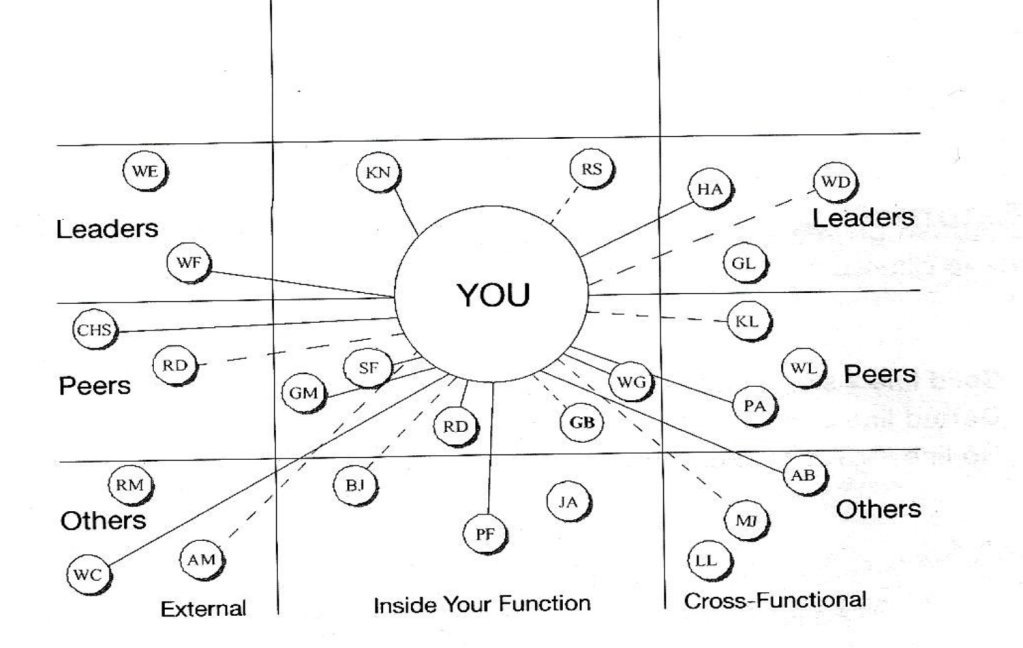
Your Stakeholding network
To maximise your professional success I invite you to deliberate and try and answer the following.
What mental attitude and skills would you need to develop to be able toprogress through the above stages?
What kind of a risk-taking style do you have and how does it support your development? How could you change your risk-taking style in order to further increase your effectiveness?
What patterns do you see among those with whom you have the strongest relationships? What patterns do you see among those with whom you do not have the strongest relationships, or any at all?
Think about a person in your network with whom you have a strong relationship. What can you leverage in your relationship with this person to help you build or strengthen your relationship with others?
Choose one key person inside your network who, if you had a stronger relationship, could better support your effectiveness. What is the benefit of improving this relationship? What is the cost if you don’t? What if anything is getting in the way?
Choose one key person outside your network who, if you had a stronger relationship, could better support your effectiveness. What is the benefit of improving this relationship? What is the cost if you don’t? What if anything is getting in the way?
How to be an effective leader during accelerating change and disruption
Change is the only Constant. Or is it?
In my previous post, ‘Heralding the Twenties’ I had spoken of the Change Trap. To cope with an ever accelerating pace of change, we need to become someone or something we were never before. Which in turn leads to a negative impact on our creativity, performance and engagement. I had outlined a practice to avoid this negative impact.
As a changing environment and disruption touches us, we need to have a flexible surface to engage. Which essentially means the need to jettison our past derived rigidity and mindset. With accelerating change, our surface is always in a state of flux. For many if not most of us, this surface flux permeates inwards and starts effecting our core consisting of our values, our passions and relationships. This is when we fall into the Change trap.
Effective leadership in the midst of accelerating change and disruption starts with that changeless core containing your values, passions and relationships. You hold an enhanced awareness of these aspects. You then use these as guiding posts in your language and relationships. This becomes the basis for your effective tango with change and disruption.
An un-fixed and possibility-based mindset allows you to use future-based (rather than past-based) language with others.
If you already know based on your past experience, there is no place to change.
Be willing to reach out to others even if they are not seeking you.
Be willing to speak about the uncomfortable elephant in the room even if it disturbs a cosy status quo.
I invite you to think of and answer these questions in your dealings within your organisation and with team members.
What gets in your way of helping others who have taken on new and unknown challenges?
What language might you use with others which would ignite transformation?
What did you do that encouraged others to perform?
…… and more importantly,
What did you do that drained the energy of others?
“To improve is to change; to be perfect is to change often.”
—Winston Churchill
We remain days away from entering a brand new decade.
A hundred years back, it was called the roaring twenties. An era of economic boom. What kind of twenties are we going to have this time?
I invite you to ponder on the above as also these questions. How would work change? What would create wealth? How would the exponential growth in 24 X 7 human connectivity through social media impact us and our lives?
We are into a world which is changing at an ever increasing pace. We need to continually become someone or something we never were before.
So what happens when we continually become someone or something we never were before? We feel discomfort, fear, uncertainty; we are on edge. How we feel impacts how we act, how we work. So being on edge with negative feelings as above leads to loss of creativity, inability to take risks, loss of productivity and engagement. And herein lies the danger of becoming someone or something we never were before. I call this the Change Trap.
So what could we do to avoid the Change Trap? Since it is difficult to control our feelings, we need to see how we could shift its impact on how we act, how we perform. One way of doing this is to focus inwards – into the kind of changeless core that we are and what makes us tick. Our big vision about the world and our self, our competences, our passions and our relationships.
In the New Year, I invite you to do this practice for just the first fortnight to empower yourself and avoid the Change Trap. Write down the following in your diary every day for 15 days before you go to bed.
When you were at your best today, what were you doing?
When you saw your energy going up, what were you involved in ?
When you felt happy helping someone, what did you do?
Should you persevere with this practise for a fortnight, you will notice how its impact changes your life and the world around you!
I wish you Merry Christmas and a lovely 2020 ahead.
Leadership speaks to Stakeholder, “Let us stand in the created future that wasn’t going to happen otherwise. A future which would address the core concerns of both of us. Let us take actions and decisions now to realize the future.”
At its essence Leadership remains an exercise in language which motivates all stakeholders to align into taking actions in the present to realise a common future.
I was recently engaged in a hub optimisation project for an orthopaedics implant supplier. It did not take too long for our team to work out the optimum inventory positions of around twenty thousand items as part of fifty kits. We were delighted to note that our recommendations held the potential of reducing the inventory carrying costs at the hubs by up to seventy per cent. The client’s corporate team was equally elated.
I was therefore left disconcerted when a subsequent review revealed near zero implementation of the project recommendations and the associated cost savings. The Marketing team had effectively sabotaged the initiative. While the project criteria had been to ensure a 99% assurance of availability of all ortho kits, Marketing insisted that for its clients nothing below 100% was acceptable.
Looking back one could see that the project failed for its failure to identify ‘customer’ stakeholders like the Ortho surgeons and the hospital administrators and what might their pain points be.
Leadership in the new millennium is more about stakeholding than anything else. Today’s world is becoming increasingly granular. More and more individuals are jumping onto the technology bandwagon and getting networked with unknowable connections amongst them. And each of these ‘unknowable connections’ becomes a stakeholder with its ability to influence perceptions and thoughts.
Per Bak, the Danish Physicist, developed a theory of sand running through an hour glass. He concluded that while the sand pile seemed stable with a regulated sand flow, the pressures on each of the sand grains was constantly changing; the internal dynamics of the sand was complex, unknowable and could not be predicted.
The stakeholding world today is like that sand pile.It seems stable but in reality continues to shift in unknowable ways with instability being the only constant.
So how does one manoeuvre the unknowable, unpredictable quicksands of stakeholding? What can leadership do to ensure effective relational assimilation of all stakeholding concerns? You could make a good start with the following questions.
Who are your influencing stakeholders? They could be from your investors, your leaders, your staff, your customers, customers of your customers, your suppliers, your community, competitors, consumer groups, social media……. sounds daunting. doesn’t it? Well a good place to start is to observe the conversation networks and the language being used. Use this to discern the contradictions, conflicting ideas and harmonies that form part of the issue.
Ask of the identified influencing stakeholdersabout their interests and core concerns
What is the stakeholders’ critical analysis of the situation? How does the issue occur for them?
What solution hypotheses could you develop which could take care of the stakeholders’ interests and concerns?