

There is a particular species of Indian that flourished magnificently in the decades before online shopping, food delivery apps and children who believe Wi-Fi is a fundamental human right. I refer, of course, to the Indian middle class, of which I remain a reasonably well-preserved but vanishing specimen.
We grew up in households where economy was not merely a virtue; it was a performing art.
My earliest lessons in finance came from my parents. Nothing was ever thrown away if it still possessed even a faint pulse of usefulness. Plastic bags were washed and dried like delicate garments. Glass jars enjoyed a second career storing everything from spices to mysterious screws. A rubber band could expect a working life longer than that of many government administrations.
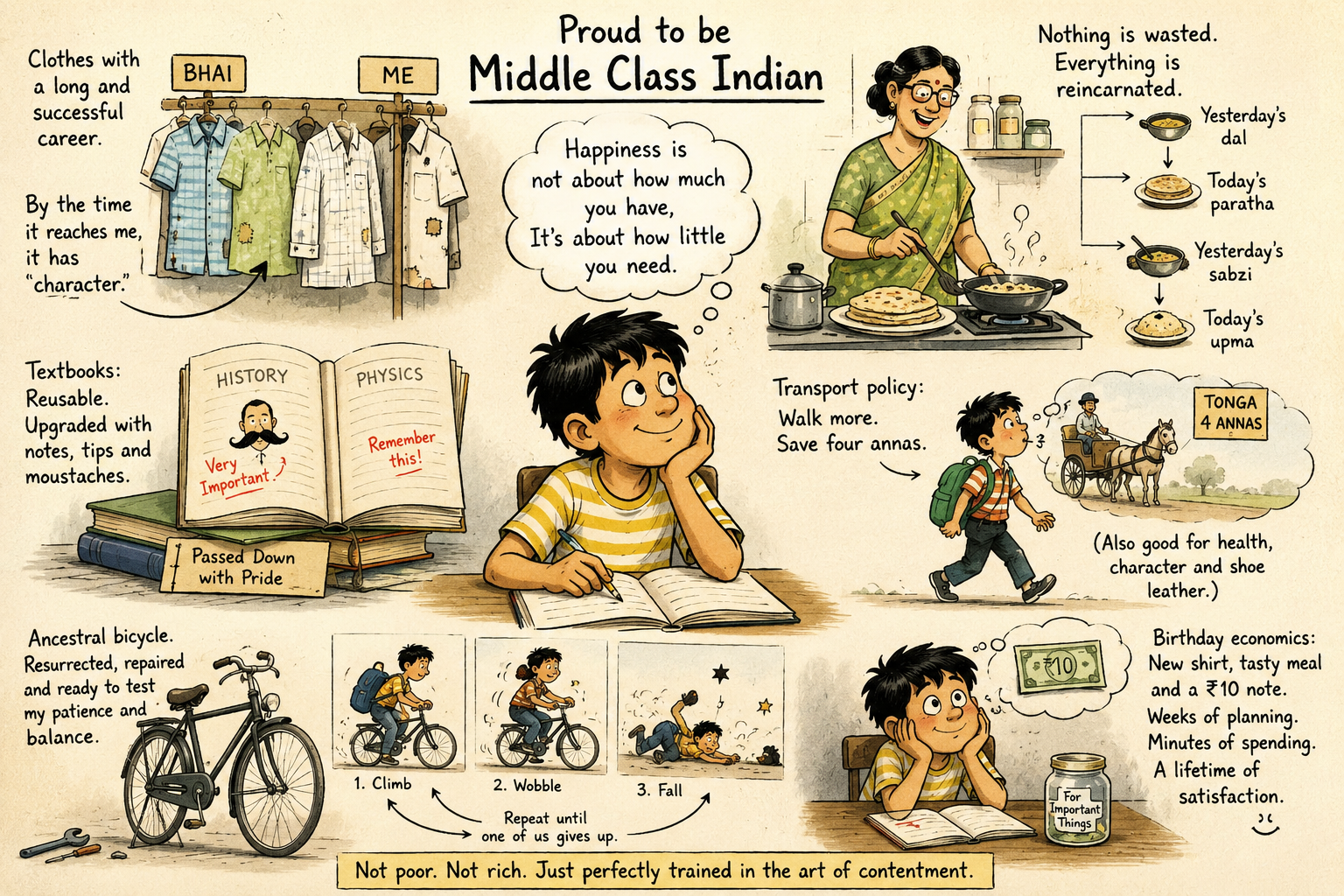
Food was treated with similar reverence. I learnt from my mother at a young age that leaving rice on one’s plate was considered a moral lapse bordering on criminal behaviour. Leftovers were not leftovers. They were tomorrow’s menu opportunity. Last night’s dal would return disguised as parathas. Yesterday’s vegetables would reappear as a perfectly respectable breakfast. In our kitchen, nothing retired. Everything was merely transferred to another department.
Clothes followed a similarly circular economy. My elder cousin’s shirts descended upon me in stages. By the time they reached my wardrobe, they had acquired wisdom, faded dignity and collars that had survived several rounds of repair. I never considered this unusual. The idea that some children received brand-new clothes simply because they had grown seemed extravagantly aristocratic.
School textbooks were inherited too. I recall books arriving complete with underlined passages, examination tips and occasional sketches that transformed national leaders into members of a travelling circus. Education was affordable because the same books appeared to educate multiple generations.
Then there was transport. A Tonga ride cost four annas. Four annas! I had been made to believe that such a sum spent without caution could destabilise our home economy, especially during the last week of the month. Consequently, we walked. Distances that modern people would consider suitable for expedition permits were covered cheerfully on foot. If a destination could be reached in forty minutes, spending four annas to arrive in ten was regarded as reckless financial behaviour.
And bicycles! Every middle-class household seemed to possess an ancient bicycle that had belonged to an uncle, a grandfather or possibly a forgotten Mughal emperor. We too had one and it lay peacefully in the courtyard for years until the day I had become old enough to learn cycling. The relic was resurrected, repaired and polished. Following instructions from elders, I climbed aboard with great optimism and immediately fell off. I was told that this trial process needed to be repeated until either I learned to ride or the bicycle surrendered.
Birthdays were modest affairs. A new shirt. A special meal. But what I would look forward to were the gifts of the ludo and the Chinese checker sets. I remember the occasion when I received the princely sum of a ten-rupee note from my uncle, surely during one of his generous and careless moments. That ten-rupee note was treated with the seriousness of an international investment portfolio. Weeks of deliberation preceded expenditure. For me, the pleasure lay not in buying, but in deciding.
Electricity was another matter. Leaving a fan running in an empty room could summon my father from astonishing distances. He possessed an almost supernatural ability to detect unnecessary power consumption. Lights were switched off with military precision. Water taps were closed firmly. Waste was viewed as a personal insult to future generations.
Looking back, none of this felt like hardship. We never considered ourselves deprived. We simply lived with the understanding that money was earned with effort, resources were finite and contentment did not depend on owning the latest thing.
Even today, I cannot throw away a half-used notebook. I switch off lights in hotel rooms. I feel guilty wasting food. Somewhere inside me lives that middle-class boy, still walking to save four annas and still trying to balance himself on an ancient bicycle. And truth be told, I am rather fond of him. For he grew up learning a lesson that seems increasingly rare: happiness is not about how much you have. It is about how little you need.
In Musing…… Shakti Ghosal
 A New Beginning