

Reflections on Christopher Marquis’s The Profiteers, the meaning of progress, and the choices we must make.
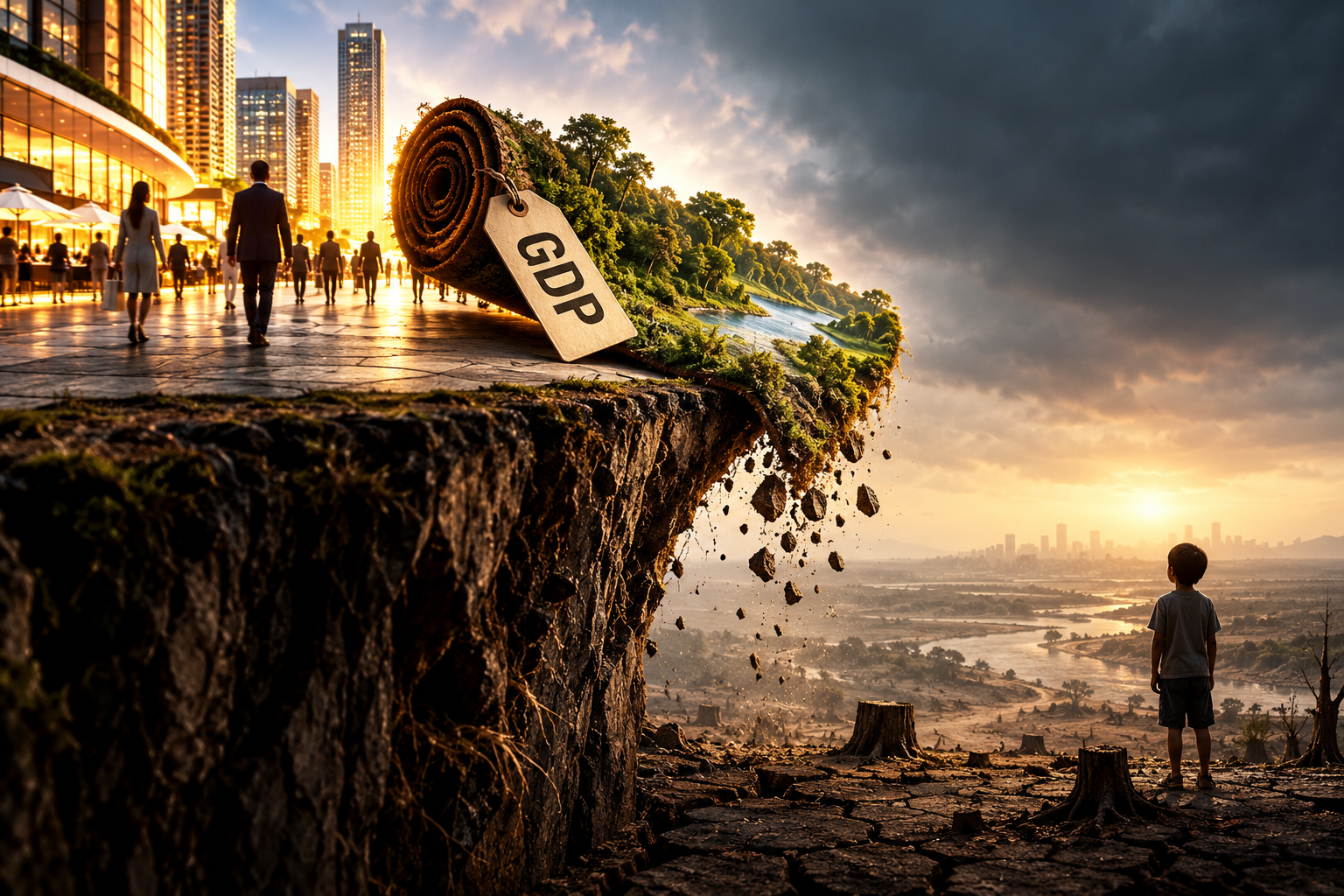
I recently came across The Profiteers: How Business Privatizes Profits and Socializes Costs by Christopher Marquis. I found it interesting, disturbing and deeply thought-provoking. One sentence by environmentalist Paul Hawken, which captures the book’s central concern, stayed with me: “At present we are stealing the future, selling it in the present, and calling it gross domestic product.”
I have been thinking about what this really means for the future of humanity. We celebrate economic growth, rising corporate profits, booming markets and increasing consumption as evidence of progress. And much of it is progress. Economic growth has lifted millions out of poverty, created opportunities and improved the quality of human life.
But I cannot help asking a more uncomfortable question. What if, in our increasingly aggressive pursuit of the present, we are shortchanging the future?
When a company makes profits while leaving behind a polluted river, who really pays the price? When we exhaust natural resources faster than they can regenerate, are we creating wealth or merely liquidating an inheritance? When we sacrifice employee development, environmental responsibility or long-term investment to improve quarterly results, are we creating sustainable value or simply moving tomorrow’s costs off today’s balance sheet?
The costs do not disappear. They merely change hands, often ending up with people who had little say in creating them.
Christopher Marquis’s book examines this troubling imbalance between private gain and public cost. Consider Jack Welch, the legendary CEO of General Electric. Under his leadership, GE’s market value rose dramatically, and he became an icon of managerial excellence. Yet the controversy over GE’s refusal to clean up polychlorinated biphenyls, or PCBs, discharged into the Hudson River raised a profoundly uncomfortable question: Could extraordinary corporate performance coexist with a failure to accept responsibility for the damage left behind?
Welch’s later observation that shareholder value is a result, not a strategy, is particularly relevant here. It reminds us that business performance must rest on something more substantial than a rising share price. The larger issue, in my view, is not whether businesses should make profits. Of course they should. It is whether we have begun to confuse the means with the end.
Profit is necessary. But what kind of profit, created at whose expense, and with what consequences for the future?
This question becomes even more urgent as artificial intelligence transforms work, climate change intensifies, and economic power becomes increasingly concentrated. We could be entering an era of extraordinary human progress. Equally, we could be creating a world in which productivity rises while human security, opportunity and dignity fail to keep pace. The future will depend, in part, on which of these possibilities we choose to pursue.
So, what perspective shift do I believe is necessary? I find myself returning to four ideas.
1. We must learn to measure progress differently. I do not believe GDP is irrelevant. My sense is it is incomplete. An economy can grow while its rivers become more polluted, its citizens become more anxious, its education system produces graduates without employable capabilities, and its natural resources steadily diminish.
Should we not measure progress alongside the health of our environment, the quality of our education, the dignity of our work, the distribution of opportunity and the resilience of our communities? I would like us to ask not merely how much wealth we have created, but how much genuine human well-being that wealth has produced.
2. We must redefine what we expect from business. I have nothing against capitalism or the pursuit of profit. My concern is with a model that rewards the immediate gain while allowing the long-term damage to be borne by society. I would like corporate boards, investors and business leaders to ask four questions: Is the business profitable? Is it creating genuine value? Are its costs being honestly accounted for? And will the way it operates remain beneficial and viable ten or twenty years from now?
I believe executive incentives should reflect these longer-term considerations, and that environmental and social responsibilities must be supported by transparent reporting, independent scrutiny and meaningful accountability. A business should not be considered successful merely because it has made its shareholders richer. Its success should also be judged by the health of the ecosystem in which it operates.
3. We must invest in human capabilities, not merely extract human productivity. This concerns me particularly in an age of AI. I have been examining and writing about this aspect of late. We celebrate automation, efficiency and the promise of doing more with less. But I wonder whether we are paying sufficient attention to the people whose lives and livelihoods will be transformed in the process. If technology creates unprecedented wealth but concentrates the benefits among a small minority, can we honestly call that progress for humanity?
I would like us to place far greater emphasis on lifelong learning, reskilling, accessible education and the development of distinctly human capabilities: critical thinking, creativity, empathy, judgement and the ability to work meaningfully with others. The real promise of technology should be to expand human possibilities, not merely to reduce the cost of employing human beings.
4. We must move from exploiting the future to regenerating it. My sense is that this is the most fundamental shift of all. For too long, we have treated nature as a warehouse of resources, people as factors of production and time as something to be compressed in the pursuit of returns.
I would like us to think differently. Can businesses restore the natural resources they consume? Can agriculture improve the health of the soil rather than exhaust it? Can cities become more liveable as they grow? Can economic activity create better opportunities for the next generation rather than leave it with depleted resources, fragile institutions and an enormous environmental bill?
This requires more than individual goodwill. It requires policy, investment, innovation and a willingness to accept that some of the most valuable returns may take years to materialise. But it also requires a change in how we think about our place in the world. We are not the owners of an unlimited inheritance. We are temporary custodians of a world that existed before us and, if we act wisely, will continue long after us.
So, where does this leave me?
I recognise that these are difficult questions. Governments must create jobs. Businesses must remain competitive. Families need rising incomes. Developing economies cannot be expected to abandon growth when millions still aspire to a better life. The answer, therefore, cannot be to stop growing. It must be to reconsider what we grow, how we grow, and who benefits from that growth. Nor can we place the entire responsibility on individual consumers. Systemic problems require systemic solutions. But citizens, investors, employees and business leaders can all influence the incentives that shape our collective future.
I keep returning to one simple distinction. There is a difference between borrowing from the future to build something worthwhile and consuming the foundations on which that future depends. The first creates possibilities. The second destroys them. Perhaps the most important question we should ask of our economic and corporate achievements is not simply, “What have we gained?” It is, “What have we left behind?”
Because if our prosperity today depends on making tomorrow poorer, we may eventually discover that what we called growth was, in part, a form of liquidation. And the tragedy would be that we knew the price all along but chose not to include it in the accounts.
The future is not ours to sell. It is ours to shape, protect and pass on.
What do you think? Are we measuring progress correctly, or have we become so focused on the returns of the present that we are losing sight of the possibilities of the future?
In musing……… Shakti Ghosal
References
[1] Christopher Marquis, The Profiteers: How Business Privatizes Profits and Socializes Costs (PublicAffairs, 2024). The book’s themes and the GE–Hudson River controversy are discussed in the Business Science Daily chapter-by-chapter summary.
[2] Jack Welch, comments on shareholder value, reported in the Financial Times in March 2009 and subsequently elaborated in an interview with BusinessWeek. See CBS News: Does Jack Welch Think Shareholder Value Is a Dumb Idea?.

