

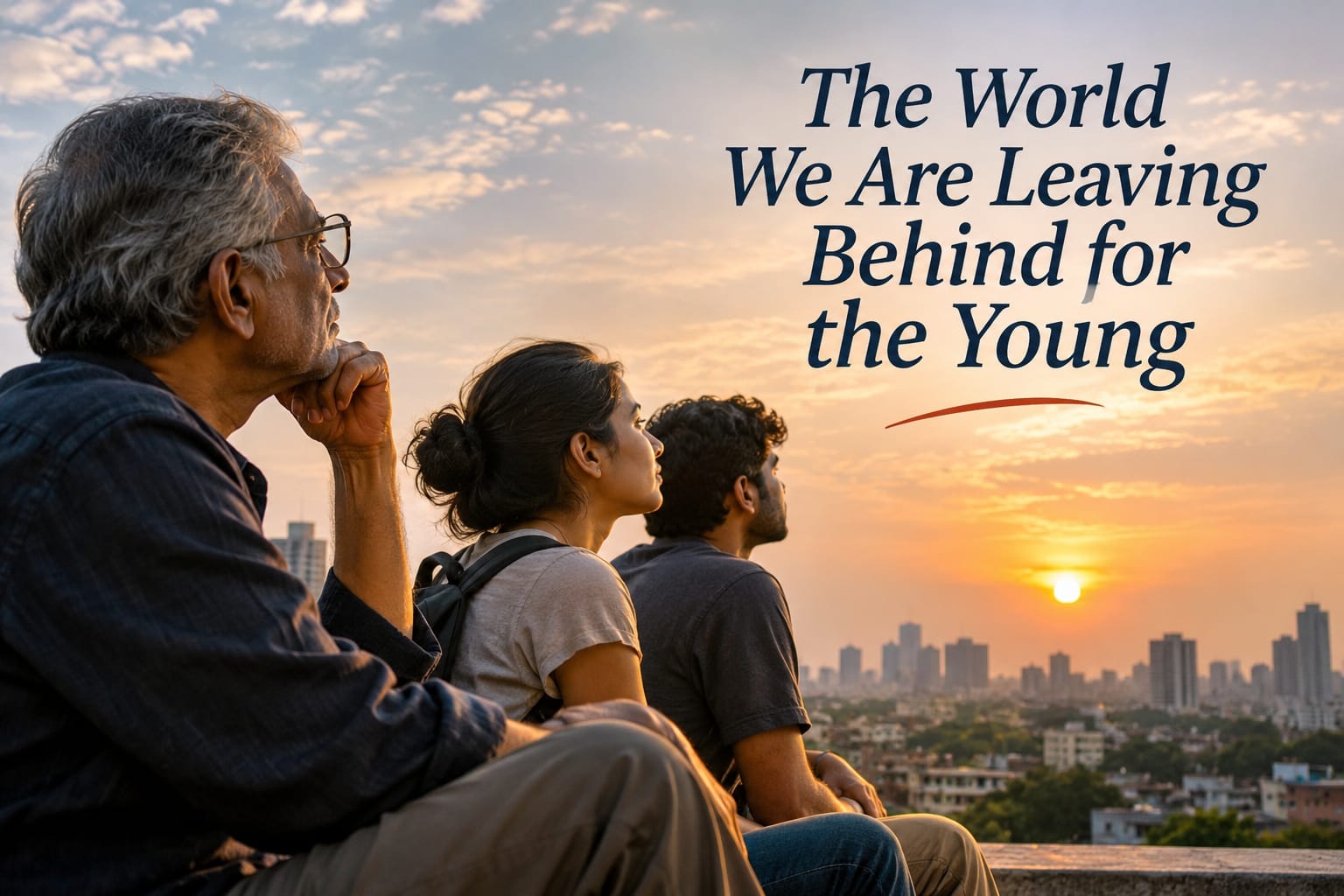
Have we become so obsessed with creating wealth that we have forgotten to create possibilities?
I have often wondered whether the world we are building today is quite the world we once imagined for the generations that would follow us.
A recent article in The Hindu, titled How Neoliberalism Turned the World Against Its Young *, set me thinking. Over the past four decades, the world has witnessed extraordinary economic transformation. Markets have opened up, businesses have flourished, technology has disrupted old ways of working and unprecedented wealth has been created. India’s own journey since economic liberalisation in 1991 is a remarkable example of what opening up an economy can achieve.
Yet, there is an uncomfortable contradiction. We have a generation that is better educated, more connected and technologically more capable than any before it. And yet, many young people seem increasingly uncertain about their future. A decent job, an affordable home, financial independence and the ability to raise a family without perpetual anxiety are becoming difficult aspirations for many.
Why?
Perhaps we have become too preoccupied with measuring economic success through GDP growth, stock market valuations, corporate profits and wealth creation. These are important indicators, but they tell us only part of the story.
An economy must do more than generate wealth. It must create opportunities for people to participate in that wealth creation.
I find the growing disconnect between education and employment particularly troubling. (Recently, I have delved into this in some detail through an Employment Education equation study. I am providing the link to that study in the reference below for all who may be interested). We keep telling young people to acquire more skills, become more competitive and reinvent themselves. All good advice. But are we creating enough productive jobs for those skills to find expression?
Not everyone can become an entrepreneur, a technology professional or a startup founder. An economy also needs millions of people working productively in manufacturing, healthcare, education, logistics, agriculture and modern services.
Perhaps the problem is not simply that our young are inadequately prepared for the future. Perhaps the future itself is not creating enough opportunities for them.
This is where I believe the debate around neoliberalism becomes relevant.
Markets are powerful engines of wealth creation. But they are not designed to solve every social problem. What is profitable is not always what is socially desirable. And what appears economically efficient in the short term may carry a considerable social cost over time.
I am certainly not arguing for a return to excessive State control or bureaucratic inefficiency. We have seen enough of that. But neither should we assume that markets, left to themselves, will automatically produce an equitable society.
Education, healthcare, affordable housing, public infrastructure and social security are not merely welfare expenditures. They are investments in human capability and in the future of a nation. For India, this question is particularly important. We frequently celebrate our demographic dividend. But a young population becomes a dividend only when it is educated, skilled and productively employed. Otherwise, an enormous opportunity can gradually turn into an equally enormous frustration.
Artificial Intelligence will make this challenge even more complex. It will create opportunities, eliminate certain jobs and fundamentally alter the nature of work. The real challenge will be ensuring that technological progress expands human possibilities rather than concentrating economic rewards in fewer hands.
I sometimes wonder whether, somewhere along the way, we have confused economic progress with human progress.
We celebrate how much wealth an economy generates. Perhaps we should also ask how many lives it enables to become better.
Every generation inherits the world shaped by the choices of those who came before it. We may not be able to guarantee the young a comfortable life. But surely we owe them a fair opportunity, a sense of security and a reason to believe that effort and aspiration still matter.
A society that creates billionaires but cannot create enough dignified opportunities for its young may be celebrating prosperity while quietly accumulating discontent. The young are not necessarily asking for a perfect world. They are asking for a fair chance in the one we have created.
Perhaps that is not too much to ask. And perhaps the real test of economic progress is not how wealthy we have made the present generation, but how hopeful we have allowed the next generation to become.
In musing …. Shakti Ghosal
References:
(2) The Education Employment equation : https://www.linkedin.com/pulse/india-educationemployment-equation-kolkata-laboratory-shakti-ghosal-c7ihf/


