

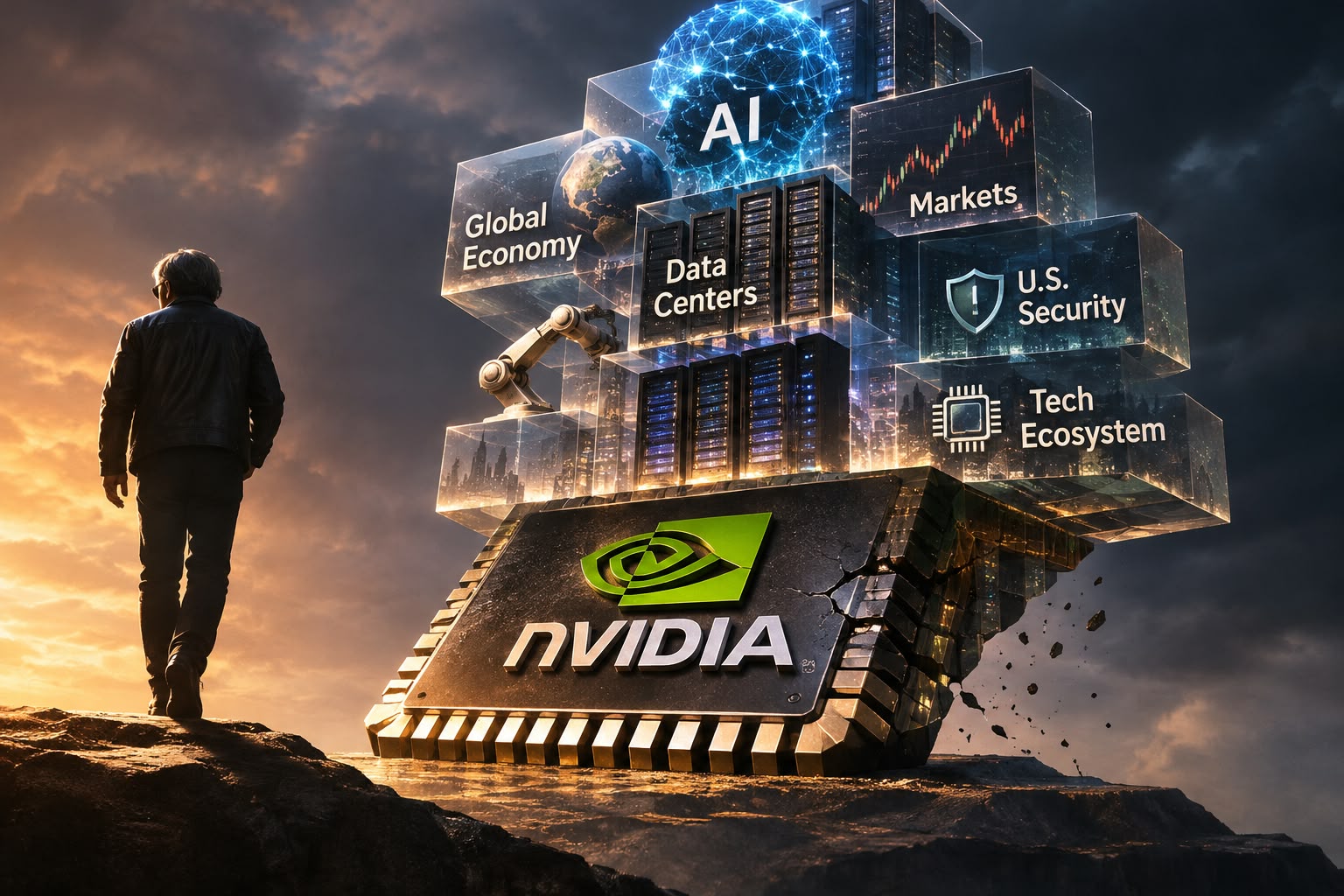
There is something deeply fascinating, and perhaps a little unsettling, about what is unfolding at Nvidia.
Until recently, Jensen Huang was almost synonymous with the company he founded. He was the visionary who anticipated the extraordinary potential of artificial intelligence long before it became fashionable. His leather jacket became an iconic symbol of Silicon Valley’s new power. His company, meanwhile, became indispensable to the technological ambitions of the world.
And then, quite suddenly, the narrative changed.
Personal controversies, questions of corporate governance and concerns about leadership culminated in his resignation. Nvidia’s share price came under pressure, billions of dollars in market value evaporated, and an industry that appeared invincible suddenly found itself confronting an uncomfortable question: What happens when the person who built the empire is no longer there?
I find this episode interesting for reasons that go well beyond the immediate controversy.
The first lesson is about the extraordinary power, and inherent danger, of a single individual.
There is no denying Jensen Huang’s contribution. He saw the potential of AI when much of the semiconductor industry was looking elsewhere. He made strategic bets, built an ecosystem of hardware and software, and positioned Nvidia at the center of a technological transformation. That is what visionary leadership can accomplish. It sees around corners and creates opportunities where others see uncertainty.
But somewhere along the way, Nvidia became so closely identified with its founder that the distinction between the institution and the individual began to blur.
And therein lies the danger.
When an organisation becomes excessively dependent on one person, its greatest strength can gradually become its greatest vulnerability. Decisions, relationships and even investor confidence begin to revolve around an individual. The organisation may be enormous, but its psychological architecture remains surprisingly small.
The second lesson is about the difference between building a great company and building a great institution.
A great leader creates value. A great institution creates continuity. The real test of leadership is not how indispensable one makes oneself, but how successfully one builds an organisation that can function without one’s constant presence.
We celebrate vision, innovation, disruption and financial performance. But how often do we ask a more fundamental question: If the leader were to walk away tomorrow, would the institution remain equally capable of navigating its future?
Steve Jobs left Apple with a capable successor in Tim Cook. The transition demonstrated that even the most charismatic founder-led organisations can evolve beyond their founders.
Perhaps that is the ultimate achievement of leadership: creating something that can outlive its creator without losing its sense of purpose.
The third lesson takes us beyond corporate leadership and into the architecture of the global economy.
The Nvidia story exposes an extraordinary paradox of our interconnected world.
In our pursuit of efficiency, we have created concentrations of power that can become dangerous single points of failure.
Nvidia designs the chips. Taiwan’s TSMC manufactures them. The sophisticated equipment required for that manufacturing depends on a handful of specialised suppliers, including the Dutch company ASML. An event involving one company, one individual or one geographical location can therefore have consequences far beyond its immediate boundaries.
This is what economists and geopolitical strategists increasingly describe as a choke point.
The more indispensable a component becomes, the greater the power it commands. But that very indispensability creates exposure. We have witnessed similar vulnerabilities during the pandemic, in global energy markets and in semiconductor supply chains.
Efficiency without resilience can be a rather expensive illusion.
The fourth lesson is about investors and the curious psychology of financial markets.
Markets are good at pricing expectations, but not always equally good at distinguishing between the enduring value of an institution and the perceived value of the individual leading it. When a company’s valuation becomes closely linked to the reputation and perceived infallibility of its founder, the market is effectively pricing its dependence on that individual as well.
The subsequent reassessment can be brutal.
Yet it would be simplistic to conclude that Nvidia’s technological capabilities will disappear with Jensen Huang. Its intellectual property, engineering talent, software ecosystem and customer relationships do not vanish with a change of leadership. The institution has accumulated capabilities far greater than any one individual. Its challenge now is to demonstrate that it can convert those capabilities into sustained institutional performance.
There is a difference between losing a visionary and losing one’s vision. The former is inevitable at some point. The latter is a failure of institution-building.
And finally, the larger philosophical reflection.
We spend much of our lives building things: careers, businesses, reputations, institutions and sometimes empires. In the process, we begin to believe that our presence is central to their survival. The more successful we become, the easier it is to confuse indispensability with importance. But history repeatedly reminds us otherwise. Individuals may create extraordinary beginnings. Institutions must create enduring futures.
Perhaps the true measure of a leader is not the magnitude of the empire built during his or her lifetime, but its ability to remain relevant, resilient and purposeful after the leader has left.
Nvidia will find another CEO. The AI revolution will continue. The markets will eventually find their equilibrium. But the question this episode leaves behind is much larger than Nvidia.
Have we become so good at creating extraordinary individuals that we have forgotten how to build extraordinary institutions? That, to me, is the real story beyond the memes.
In musing….. Shakti Ghosal


