

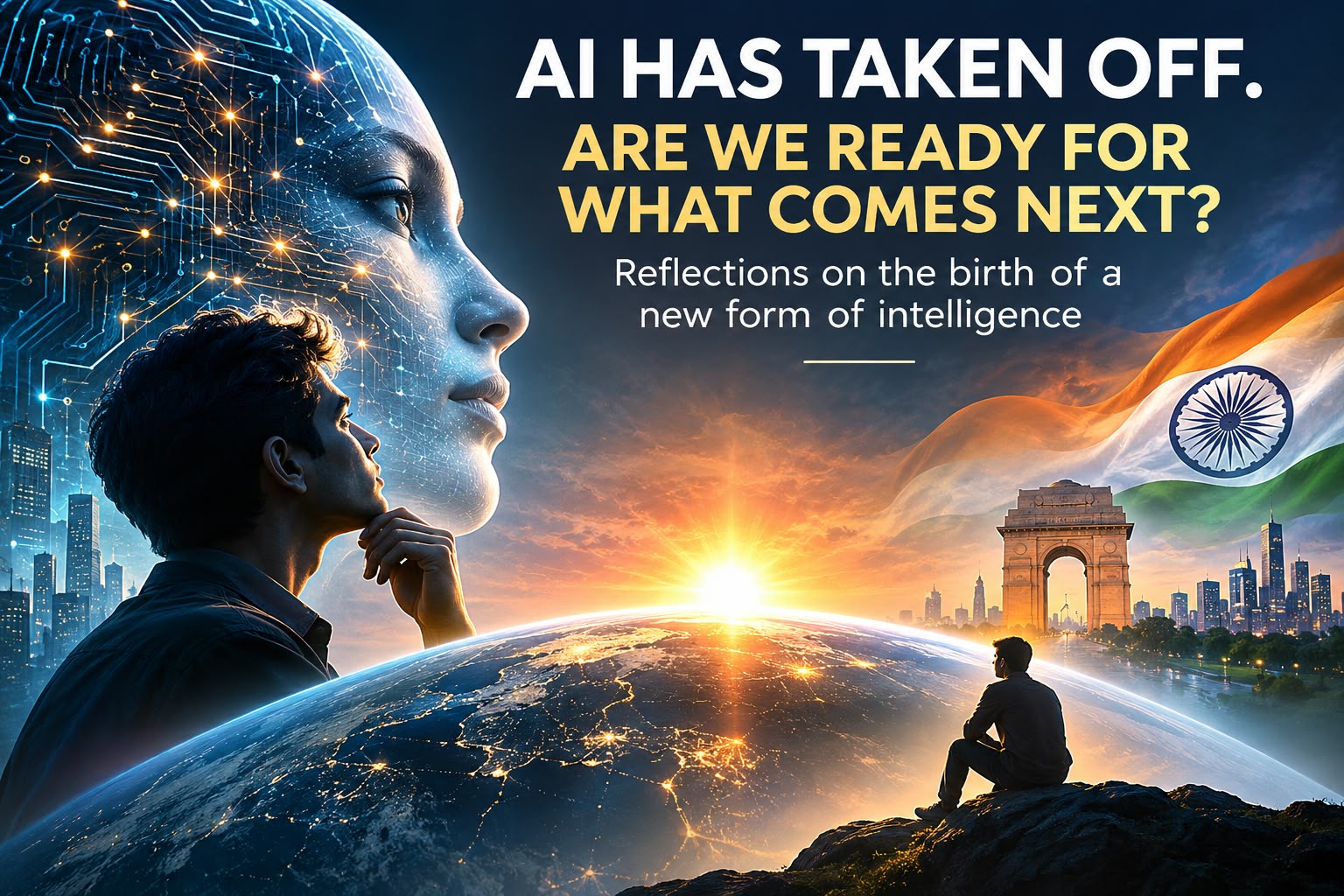
I recently watched a fascinating presentation by Nina Schick, titled AI’s Takeoff Year – Live from Utrecht. I found myself reflecting on it long after the presentation had ended. Not because everything she said was entirely new, but because she brought together several developments in AI into a rather unsettling, yet compelling, picture of where humanity might be heading.
Her central proposition was simple: AI has already taken off. We may simply not have recognised the significance of the moment we are living through.
I think there is something profoundly important about that observation.
For centuries, intelligence has been regarded as an exclusively biological phenomenon. It has been the product of evolution, the human brain, experience, curiosity and the ability to reason and imagine. We have built civilisation on this extraordinary human capability. Now, for the first time in history, we are beginning to manufacture intelligence outside the biological world.
Think about that for a moment.
We are no longer merely developing machines that calculate faster, automate repetitive tasks or retrieve information. We are creating systems that can reason, write code, solve complex problems, examine their own conclusions and increasingly act independently.
Schick draws attention to frontier models such as Anthropic’s Mythos and OpenAI’s Astra. Their emerging capabilities, particularly in cybersecurity, are remarkable. Their ability to identify vulnerabilities in computer systems and develop ways of exploiting them also raises serious questions about access and safeguards. This is no longer science fiction. It is becoming an operational reality.
From artificial intelligence to industrial intelligence
One of the most interesting ideas in Schick’s presentation is that intelligence itself is being industrialised.
Until now, intelligence has been scarce. Developing expertise required years of education, experience and human effort. Its availability was naturally limited. But what happens when intelligence can be replicated at scale, made available almost instantly and accessed at an increasingly affordable cost? We have seen something similar with electricity, computing and telecommunications. Once these became scalable utilities, they transformed the economic and social order.
Could intelligence become the next such utility?
I suspect it could. Yet there is a paradox. The infrastructure required to produce this intelligence is extraordinarily expensive. Semiconductors, data centres, computing power and energy will increasingly determine who controls this new resource. The geopolitical contest is therefore no longer simply about technological superiority. It is about who controls the infrastructure of intelligence itself.
The changing relationship between humans and machines
For most of the industrial age, machines extended human physical capabilities. Computers subsequently extended our ability to process information.
AI is different. It is beginning to extend, and in some areas replicate, capabilities that we have traditionally associated with the human mind. This raises a question I find difficult to ignore.If a machine can analyse faster, write better, develop software, undertake research and increasingly make decisions, what happens to the traditional value we attach to human knowledge and expertise?
Perhaps knowing things will matter less than knowing what to ask, how to interpret the answers and when to exercise judgement. The premium may gradually shift from information to wisdom, from knowledge to discernment, and from execution to imagination.
But intelligence and wisdom are not necessarily the same thing. A system may be extraordinarily intelligent without possessing empathy, compassion, moral responsibility or an understanding of what it means to be human. We should be careful not to confuse the ability to produce an intelligent answer with the ability to understand its human consequences.
The opportunities are enormous. So are the responsibilities.
I do not subscribe to either extreme in the AI debate. The uncritical enthusiasm that sees AI as the solution to every human problem is misplaced. Equally, resisting technological progress out of fear is unlikely to serve humanity well.
The real challenge is to ensure that our ability to govern this technology keeps pace with our ability to create it.
Who controls this new intelligence? Who benefits from it? What happens to employment, economic inequality and human dignity? How do we preserve individual agency when machines become increasingly capable of making decisions on our behalf? And perhaps most importantly, how do we ensure that human beings remain responsible for the world they are creating?
And where does India stand in this emerging world?
While Schick’s presentation looks at the global AI transformation, I found myself wondering where India fits into this unfolding story.
We have much going for us: engineering and scientific talent, a globally recognised IT industry, a vibrant startup ecosystem and a vast digital population. Our experience with digital public infrastructure has demonstrated our ability to build and scale technology platforms. Yet, much of the frontier AI ecosystem — foundational models, advanced computing infrastructure, semiconductors and the capital driving this revolution — remains concentrated elsewhere.
We risk becoming enthusiastic consumers and implementers of intelligence created elsewhere, rather than architects of it. For a country aspiring to become a leading global economy, this is a strategic question we cannot afford to overlook. Our challenge is not merely to adopt AI faster, but to invest in indigenous research, computing infrastructure, talent and foundational capabilities.
We need not replicate everything others are doing. We could carve out our own space by applying AI to healthcare, education, agriculture, manufacturing and inclusive development. But we must recognise that in an age where intelligence itself becomes an economic resource, technological dependence could eventually translate into strategic dependence.
India’s opportunity is not merely to participate in the AI revolution. It is to help shape it.
A new chapter in human civilisation?
What stayed with me most after watching Nina Schick was not the technological detail. It was the historical significance of what she was describing.
Human civilisation has passed through several defining transitions: the agricultural revolution, the industrial revolution and the information revolution. Each fundamentally altered how we lived, worked and understood our place in the world. Could the industrialisation of intelligence be an even more consequential transition?
I think it is entirely possible.
We may be the first generation to witness the emergence of another form of intelligence that is not born, does not grow biologically and does not necessarily share our limitations. Whether this ultimately becomes artificial general intelligence, or something even more transformative, remains to be seen.
But perhaps the more important question is not whether machines will eventually become as intelligent as humans, or even more intelligent. It is whether we, as human beings, will become wiser in the process. Technology has always amplified human capability. It has also amplified human folly. Nuclear energy gave us extraordinary possibilities as well as the capacity for unprecedented destruction. Artificial intelligence could present an even more profound version of that dilemma.
I find myself thinking that we may be standing at the beginning of a chapter whose consequences we cannot yet comprehend. Future generations may look back at these years and wonder how little we understood about the significance of the moment.
The question is no longer whether AI will change our world. It is whether humanity is intellectually, morally and institutionally prepared for the world that AI is about to create.
That, to me, is the real conversation we should be having.
In musing….. Shakti Ghosal


