

I recall a conversation from many years back. During an overseas visit, I was having coffee with a colleague and I found him looking frustrated and confused.
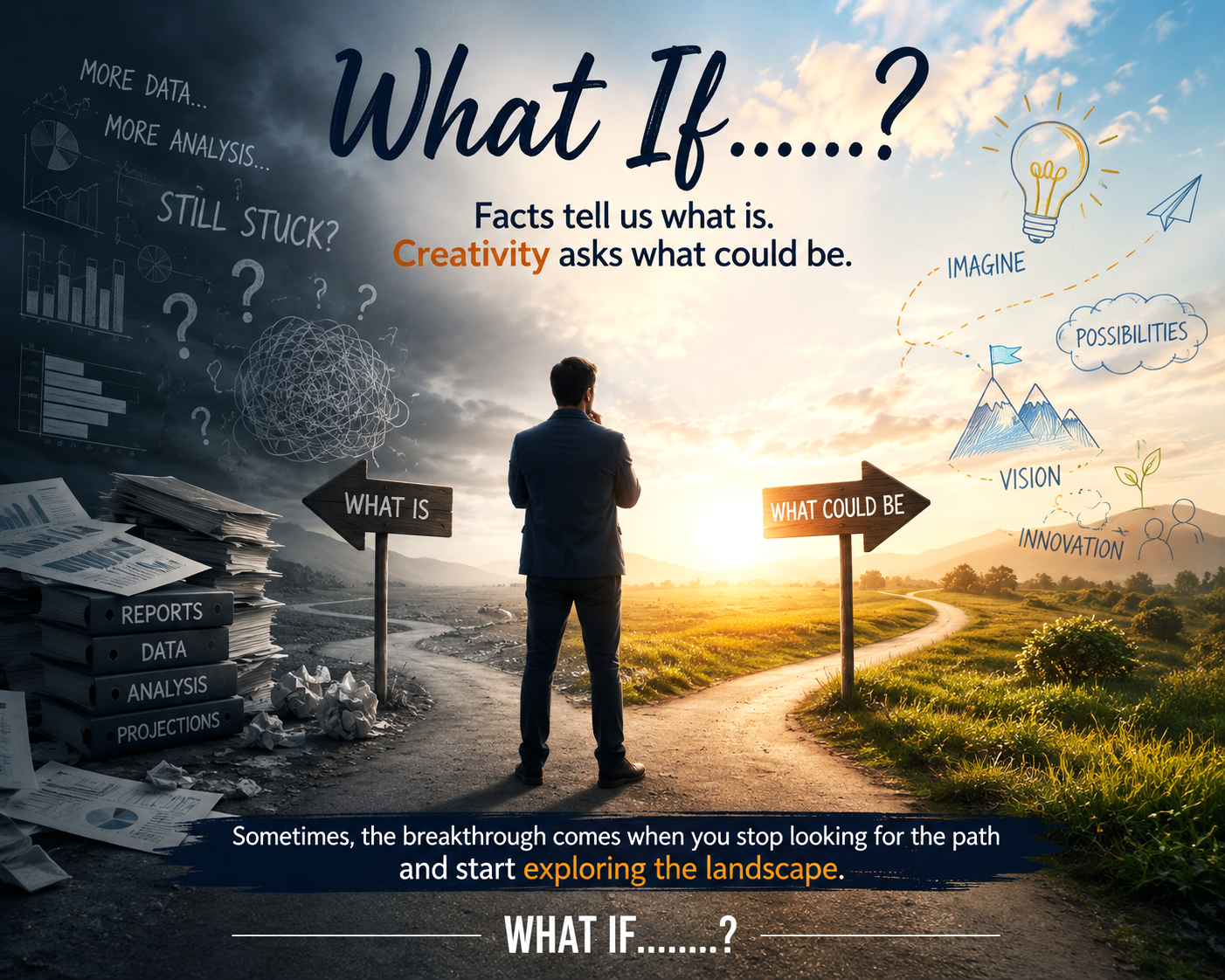
He pushed aside his tray and said, “I don’t get it. We’ve analysed the issue of increasing our business share from this market from every angle. We’ve got the data, the reports, the projections. Yet we seem to be still stuck.”
“Maybe that’s the problem,” I replied.
He looked at me, uncertainty writ on his face, “How can having more data be the problem?”
“Because sometimes,” I said, “we can become so busy looking for the right answer that we stop looking for other possibilities.”
He smiled politely—the kind of smile people give when they think you have said something impractical, “So what’s the alternative? Ignore the facts?”
“Not at all. Facts matter. But facts tell us what is. Creativity asks what could be.” That seemed to catch his attention. I related a story.
“In the 1970s, a scientist at 3M was trying to create a super-strong adhesive. The adhesive was weak. By conventional standards, the experiment was a disappointment. It seemed a failure. That’s exactly how most people saw it. But years later, someone else looked at the same ‘failed’ adhesive and saw a different possibility. The result was the Post-it Note.”
My colleague laughed, “So one of the world’s most successful office products began as a mistake?”
“Or perhaps,” I said, “it began as a possibility that nobody had noticed yet.”
For a moment, neither of us spoke. Then he said something interesting.
“You know, in our meetings we’re always asking, ‘Will this work?’ Maybe we should first ask, ‘What else could this become?'”
Now we were getting somewhere. The truth is that most organisations reward certainty. We admire people who have answers. We celebrate expertise. We fill spreadsheets, analyse trends and minimise risks. All these are important. But the future is rarely created by these certain aspects alone. It is often created by someone willing to explore a possibility that doesn’t yet fit neatly into a presentation slide.
The more we talked, the more I realised that creativity is not about being artistic. It is not about painting, music or design. Possibilities which flow out of a creative mindset is the courage to see beyond the obvious. It is the willingness to ask a different question. It is the ability to sit with uncertainty long enough for a new idea to emerge.
Before we left, my colleague said, “Maybe we’ve been trying too hard to find the right path.”
“Perhaps,” I replied. “Sometimes the breakthrough comes when you stop looking for the path and start exploring the landscape.”
A few days later he called, “We’ve found a completely different solution. We stopped trying to prove what was possible and started imagining it. Imagining the end goal, without getting enmeshed with how to make that happen, allowed new possibilities to show up.”
That conversation stayed with me. Because in a world overflowing with information, knowledge is no longer the rarest resource. Possibility is. And every great innovation, every breakthrough and every new beginning starts with a simple question:
“What if……..?”
In Musing……. Shakti Ghosal


Sometimes the breakthrough comes when you stop looking for the path and start exploring the landscape.” This line stopped me. Because that’s exactly the shift, from certainty to possibility, from analysis paralysis to creative courage. The Post it Note story perfectly shows how “failure” was actually the beginning of something nobody expected. Your colleague’s realization, Maybe we should first ask, ‘What else could this become?’” that’s where transformation happens. In a world drowning in answers, asking better questions is everything.
Cheers
Khadz
LikeLike
Wonderfully said Khadz. Indeed asking better questions and holding the ability not to get swayed perceptions and prejudices of others is what can fuel the transformation you have alluded to.
Thank you for your presence here.
Shakti
LikeLiked by 1 person
Beautifully expressed.
to ask “what if…..” is as much about creativity as it is about courage.
thank you for writing this
LikeLiked by 1 person
Hi Deepak,
Delighted you liked the post. Thanks for your visit here.
Shakti
LikeLike
I too love tapping into creativity when problem solving.
LikeLike
I suppose it is all about holding the awareness in the moment.
Thanks for the comment.
Shakti
LikeLiked by 1 person
Shakti, I just love reading your posts even though we circulate in very different circles, I am sure. And I always find I am nodding my head wwhile reading them. Because they don’t just apply to business, which doubtless you know. Who can’t use the advice contained in this poignant little line?
“Possibilities which flow out of a creative mindset is the courage to see beyond the obvious.”
My husband is really good at thinking outside the box. I get better all the time, although it’s not the way I was trained. 😉 I think it’s a good practice for anybody, anytime.
🙏
LikeLike