In today’s fast changing world, we are almost always confronted by situations about which we lack past experience to engage or resolve. We try to force fit some past learning and end up either failing to get an outcome, or if lucky, achieving part success.
In a past assignment, I was managing a Travel & Destination services management company. One of our major customer accounts was the national petroleum development organisation and because of the large business quantum, we had an implant operation with a dedicated team. Our service and response levels were appreciated by the client.
In line with the commercial norms, as our contract period was coming to an end, the company released a tender for a subsequent period. Believing the client was happy with us, we submitted our competitive offer in line with what we had done during our last successful bid. When the tender was finalised, we were shocked to know that we had lost. When we asked the client company’s commercial team, we were informed that we had not complied with the technical terms of the bid. Going back to the drawing board, so to say, our analysis of the tender document revealed that there had been a small section requiring development and implementation of a Travel management Services (TMS in short) software as part of the client’s intranet, which we had not responded to.
Soon, we had the opportunity to bid against a tender released by the National Gas Company. We noticed that in this tender document too, there was a requirement of implementing a TMS software. This time we were careful enough to comply with the requirement by indicating our willingness to develop. But we again lost the tender! The winner was a competitor who already possessed a fully developed TMS module and had provided a live demonstration of the same to the client.
We had been disrupted. By a new technology, a new competitor, which together had disrupted our traditional business model. The world had shifted, the business need in the environment had changed and the earlier alignment of the latter with the competence set of our company had been lost.
A situation like the above can create a quandary for each one of us. Should we stretch our own competence and experience profile to paper over the gaps that exist because of the changed requirement? This usually is the easy and the quickest option, and thus gets chosen by most leaders and Managers. But the more sustainable and resilient pathway, a much tougher and thus rarely taken option, is to continually equip oneself with the needed competences so that the alignment between us and a world that is shifting, is not lost.
What I have frequently noticed is leadership folks, rather than confronting, resort to whining and complaining. Of how no one could have foreseen what happened, how they had planned and were equipped to handle what did not happen, and so on.
If we are not careful, we can end up in a downward spiral of negativity. I have seen leaders ending as black holes. With a huge gap between their original intention and final impact. This is largely because of a human psychology quirk. The more we talk of something we failed to do, the more important it becomes. As Noble Prize winner Daniel Kahneman said, ‘Nothing in life is as important as you think it is, while you are thinking about it’.
Ways to avoid the Black Hole:
Ask, “What can we do to resolve?” Wait for a positive response. We are conditioned to put effort once we commit.
Envision a future that was not going to happen anyway. Ask, “If things were going flawlessly, what would that look like?”
Have you ever wondered about all the things you do not want, all the things you avoid? These may be at your workplace. Or they may be in your personal life or relationships. Do you realise that all the things you do not want can actually support you to move forward in life?
In the second year of my post graduation, we had to choose elective courses to achieve a minimum number of credits. I remained in my comfort zone by choosing electives which I had the ability to do with minimum effort. I avoided taking on courses in the Computer Science domain (then in its infancy and consequently a ‘black box’ to me) which I figured would require a lot of learning and effort. Was it a mere avoidance mindset or a deeper fear of failure? Most of my batchmates who ‘took the jump’ and majored in Computer Science subsequently did very well in their careers. Fear of failure can help us succeed.
Fear of failure can help us succeed
An aspect we do not want is frustration. Frustration is really our reaction to stuff we do not like or cannot control. The ugly underbelly of frustration is that we tend to vent it on folks who may have nothing to do with it. These folks may be our spouse, family members or colleagues at work place. Frustration shows up as anger, impatience or both. I can recall a particularly difficult meeting with a client about a service failure in which they threatened to cancel our contract. It was a situation outside our control but my reaction had been to call the service team and vent my frustration on them. What I had done was to further spread the cycle of exhausting negativity without finding a solution. The section head though was a guy with a cool temperament; leaving the meeting he did what was needed to be done to retrieve the situation. Frustration can be a good thing if we channel it to move towards solution finding.
Frustration can be a good thing……
We do not want to do ‘heavy lifting’, we succumb to the temptation of doing theoretical stuff. In a previous project assignment, I interacted with two kinds of people. The first set were those who were smart, articulate, detested leaving office and had theoretical solutions for all operational issues. The second set were those who were low profile, operated in the field and were hands-on with the project. I found it comforting to hang out with the first set and opinionate about what was needed to be done or not done; true to the perception I held I avoided going out into the field. However, I soon found that grit, resilience and character developed only when I got down to ‘digging ditches’ in the field to circumvent failures, prevent time over-runs and ensure project completion. Resilience and Character wait on the other side of our disappointment and failure ditch.
Resilience & Character wait on the other side of our failure & disappointment ditch
In the hurry-scurry of our work life, we tend to develop revolving -door relationships. Relationships that we create to achieve quick business objectives and which tend to get jettisoned soon after. Such relationships may seem energizing, even meaningful in the moment, but really build a shallow work life. How many of these questions can you answer in the affirmative?
Do you take genuine care of the people who pull alongside you?
Do you invest time with your team and other stakeholders beyond work related stuff?
Do you serve those who serve you?
The deeper we nurture relationships, the more valuable they become.
The deeper we nurture relationships, the more valuable they become.
A way to grow one’s Leadership is through introspection. One needs to look back into one’s past and identify all that which contributed to one’s Leadership and performance development.
This may sound easy but it is not. As we move through work responsibilities and the corporate hierarchy, we tend to develop our own plethora of ‘what we believe made us succeed’ mechanisms consisting of inauthentic facades, assumptions and ‘need to impress the other guy’ behaviours. We also hone our survival instincts. So, when we do get down to ‘looking into our past’ and identifying all that which contributed to our development and growth, we tend to see stuff distorted by our facades, beliefs and impress the-other-guy behaviours.
The way to grow one’s leadership through introspection is to do the following practices.
Ask yourself, ‘Who were the people who changed you?’
When I thought about this question, I could identify two individuals.
The first was a senior colleague at the start of my career as an Assistant Mechanical Engineer in the Indian Railways. The quality that my colleague brought into our relationship was one of sunny optimism and a natural instinct to mentor without a self-serving mindset.
The second was my boss in Voltas Ltd, where I was handling HVAC projects. The quality that he brought into our relationship was one of down to earth openness and transparency.
I realise today that what allowed me to grow through the above relationships was to try and inculcate a non-self-serving mindset as also authenticity through openness and transparency.
Ask yourself, ‘What kind of people did you gravitate towards?’
When I thought about this question, I could again identify two individuals.
In my tenure in the Indian Railways, I had two workshop foremen report to me. The first was a kind of a ‘yes man’ guy. He made me at once comfortable through his unquestioning loyalty; he would do exactly what I asked him to. This was a great relationship for maintaining status quo about situations and other stuff.
The second was a guy who was a ‘shop floor rebel’. He would usually give a counter viewpoint to most stuff I would suggest, and at times speak uncomfortable truths based on his own past experience and arguments. I would often ‘see’ his approach as unwillingness to accept my authority or trying to prove me wrong. I would feel upset.
This did not seem to be the kind of relationship I would be comfortable with or gravitate towards at that point in time. But I realise today that the person who allowed me to grow was this ‘rebel’ guy as he shattered my comfort zone and forced me to look at uncomfortable possibilities.
So how might you grow your leadership in today’s disruptive world? How might you foster such growth in your team members?
Gain mastery about how to succeed in a business environment that is constantly changing and being disrupted. Do this free module:
The reign of the dinosaurs had long ended. Snuffed out by an unlikely asteroid strike. A fifteen kilometers wide piece of Iridium laced rock had struck near present day Mexico, creating a ten times wide crater and unleashing lava, ashes, smoke and gigantic waves around the world.
Though the mass extinction event exterminated most of the flora and fauna on the planet, the continental drift and shifts continued unhampered for millions of years thereafter. The active planetary crust led to the Indian land mass smashing into the Eurasian land plate. The resulting crumpling and buckling at the collision point led to what came to be known as the Himalayas, a veritable abode of the Gods, the tallest mountain range in the world. An awesome creation standing testimony to Earth’s inner energies.
The permanent glaciers and ice formations led to glacial water bodies being formed. This is how the lake came into being. Situated at a height of 18,000 feet within the mighty Himalayan range, the lake acquired a mystical aura for all men and religions who passed by. The waters remained mostly frozen due to the height and the overwhelming presence of the Dongmar glacier which nestled it. Thirsty men and animals could not quench their thirst. And so it came to pass that a Guru was passing by when he too felt the mystical aura of the lake. He put his hand in the lake and Lo and behold! The water stopped freezing and became available for all to quench their thirst. This subduing of the Dongmar glacier’s frozen might by the Guru gave the lake the name of Gurudongmar. The second highest lake in the world with water that no longer froze.
**
The Man was indeed getting on in years.
As a child, he had been precocious and so had been nicknamed. ‘Buro’, an old man. He was now precisely that, replete with the mindset of the elderly. Over the years, he had acquired a liking for travelling and seeing the world. Age had dimmed the eyes somewhat, but not that inner passion to set forth and discover new places.
When the Man first heard about the wondrous lake of Gurudongmar, his heart urged him to travel. His brain though was more circumspect; it counselled, “My dear chap, are you crazy? You suffer from vertigo. What might happen when you go up all those torturously winding roads?” His friends too cautioned; they related dire tales of folks collapsing from lack of oxygen in a no-Man’s land with medical facilities hard to come by.
“But when a Man makes up his mind, he is not made for defeat. He can lose out, even destroyed, but not defeated.”
The tug of war between thoughts continued. But the die had been cast, the travel plans stood finalised. Came the day of travel and the Man set forth armed with some basic medications, a quiet resolve and some raucous misgivings. A flight, several car rides through mountainous roads into the Himalayan kingdom and the day of reckoning arrived.
“This was not the time to think of what was not there. It was the time to think of what one could do with what was there.”
Six in the morning and after nursing a cup of hot tea, the Man set forth for his rendezvous with the lake.
The slow wafting mist seemed in perfect harmony with the biting chill outside the moving car.
Passing through the last army check post, the vehicle climbed to the Kala Pathar, black stone viewpoint.
The fresh snow from the previous night lay in gay abandon. The white mist drifted upwards, a curtain rising up from the snow flakes and into the low hanging clouds.
As the old man stood watching the shifting views of the Kala Pathar blackness through the whiteness of the entwining gaps in the mist, it seemed like a ballet being performed. Was it the Universe sending him a message of hope?
“Every day is a new day. It is better to think it would be lucky. So when luck does come, one would be ready.”
The climb towards the lake had begun. It was not on roads cut out on the mountainsides which the man had been used to. It was on a rising terrain with no roads or markings to provide a direction. It was all down to the driver and the vehicle, their combined experience and strength to negotiate the path.
And then, all of a sudden, the heavens opened up. Sunbeams splayed and sliced all around. The climb had now reached above the level of the clouds and mist, a surreal moment. The old man nibbled on slivers of ginger; he had been advised so by some friends. A final swerving climb over barren rocks and the vehicle stopped on a mound from where the lake could be seen.
The stillness of the blue waters seemed to beckon. ‘Come, partake of my mysticism.’ The sun shone in all its splendour. Was it trying to discover that mystical aura with all those reflections? At the far end of the waters, part shrouded by rising mists, towered the snow laden glacier. As the old man stood transfixed by the wondrous surroundings, the tug of thoughts took over. Was this the place where divinity was born? What made the pristine barrenness so unworldly? Was it the glacier with its whiteness, or the water with its blueness?
A needle pricked the cheek. Then some more. Shaken out of his stupor, the man looked around. The hitherto gentle breeze had gained in strength. Crested by a whirlwind, tiny pebbles and dust particles chased each other in an ethereal dance. As the needles borne by the wind swayed through the onlookers, a soft murmur of protest could be heard. The old man slowly turned and moved back towards the waiting vehicle.
In Learning…….. Shakti Ghosal
Disclosure: The Old Man in the post is the author himself.
Acknowledgement : ‘The Old Man and the Sea’ by Ernest Hemingway
I was quite taken up with the book title and so decided to give it a read.
The curiosity piqued from two aspects. First, Bibhuti Dash, the author, happens to be a batchmate of mine from my MBA days and I was aware of his ‘tongue in cheek’ ability and how he liked to revel in the comic and the absurd in day to day life. The second was my innate curiosity as to how an easygoing and gentle soul like Dash could have stumbled into and then negotiated the rough and tough demands of a cop’s life. By the time he penned the book, Dash had spent an incredible third of a century donning the police uniform and mindset as part of the elite Indian Police Service cadre.
**
It was sometimes end of 2009 and I was visiting my Alma Mater, the Indian Institute of Management Bangalore in Bannergatta. The occasion was the twenty fifth anniversary reunion of our batch’s passing out of those hallowed portals. Going down the stairs, I bumped into this slim person coming up. Recognition was instant, “Hey, Dash, you haven’t changed a bit my friend”. I was meeting the guy after twenty-five years!
That was also when I learned about the storied career the guy had had, having spent some years in the corporate sector before qualifying for and joining the police services.
Our paths crossed again when I moved to Kolkata. Over the years, I have come to know and admire the mix of diffidence and humility that characterises Dash.
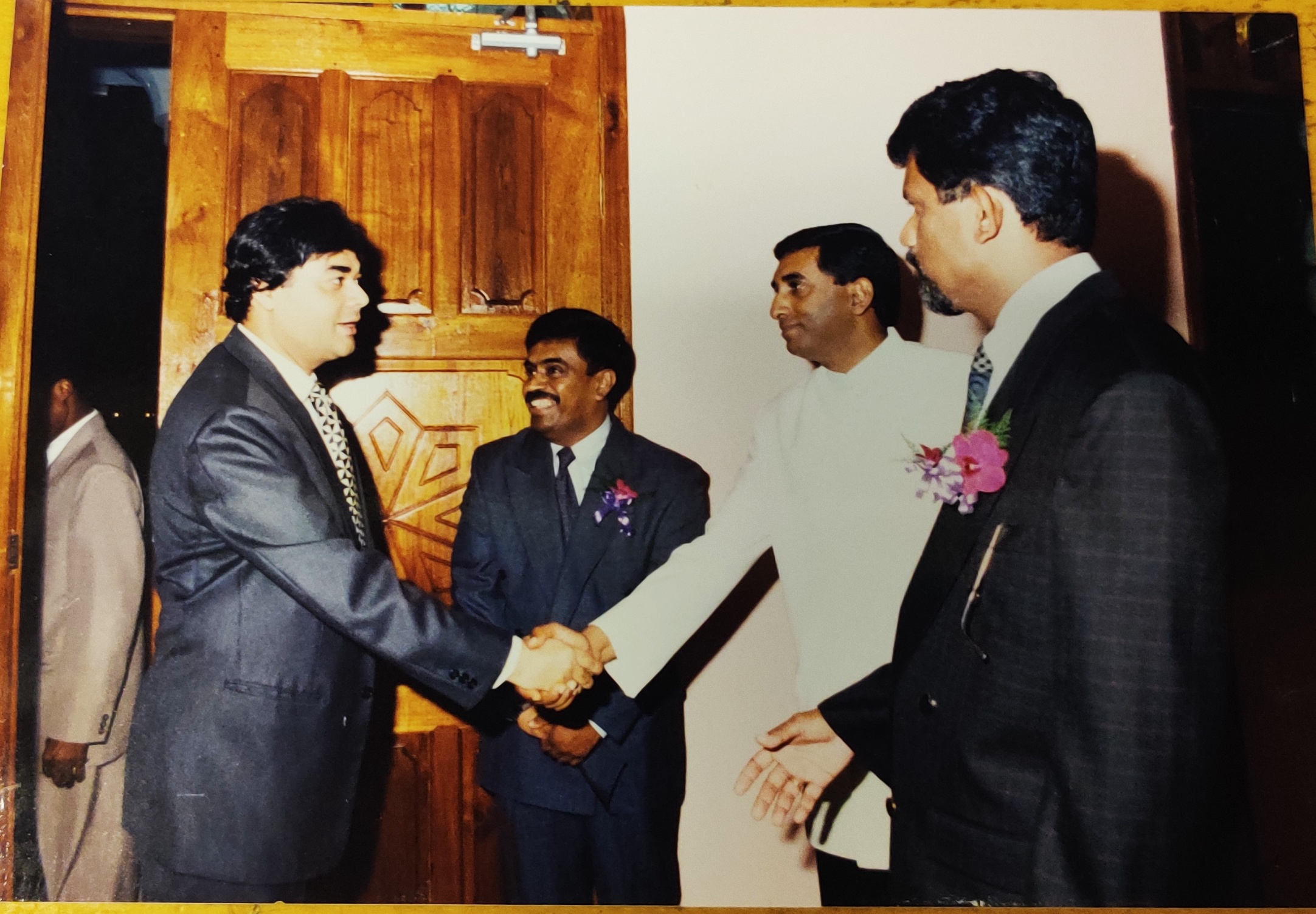
With Bibhuti Dash @ Belur Math, Kolkata Oct. ’22
**
In the book’s foreword, Dash mentions that the book evolved out of a “Whatever it is, I’m against it!” blog series that he had been penning over the last couple of years. I daresay that I have been an avid reader of the blog which Dash publishes on Saturdays.
I had particularly liked one of the blogs with the rather evocative title, “ It’s raining guns and bullets”. This three-piece blog held a particular interest for me as it was about the Purulia Arms drop case in which large caches of sophisticated arms, ammunition and explosives had fallen out of the skies into the the sleepy Purulia district villages of West Bengal in the winter of 1995. As I recalled, it had become a sensational front page media incident. Dash had been involved in solving that case and his description of how several events transpired is the stuff crime thrillers are made of. Let me not say much more for fear of becoming a spoiler, except that “It’s raining guns and bullets’ is part of the book.
‘Police in Blunderland ‘contains forty odd ‘real life’ tales from a policeman’s diary with the protagonist being Dash himself in them. What I found refreshing was how the narrations created perspectives of an observer, even though narrated in the first person.
In the words of Bibhuti Das, “Policing in India is considered very opaque, stern and brutal. In the articles, I have tried to say that there is a human side to Policing and not all of it is dry and taciturn, although it has its flaws.”
I would strongly recommend you to get your hands on a copy. It is sure to entertain with its pithy style and its gamut of interesting plots and characters.
“Language of Man here is defeated by the language of stone.” – Rabindranath Tagore
A visit to Puri in Odisha can never be complete without a trip to the Konark Sun temple. Having paid our homage to Lord Jagannath in that iconic Puri temple in the morning hours, we had the afternoon available for going to Konark.
A surprisingly good infrastructure exists in terms of road access from Puri as well as the upkeep of the Konark Sun temple complex. Getting down from the car in front of the long walkway, I had my first glimpse of the famous temple in the distance. The tiled pathway, overlooking gardens and the Konark temple information Centre (which incidentally has a wonderful audio-visual show about the temple and its origins) lead to the temple.
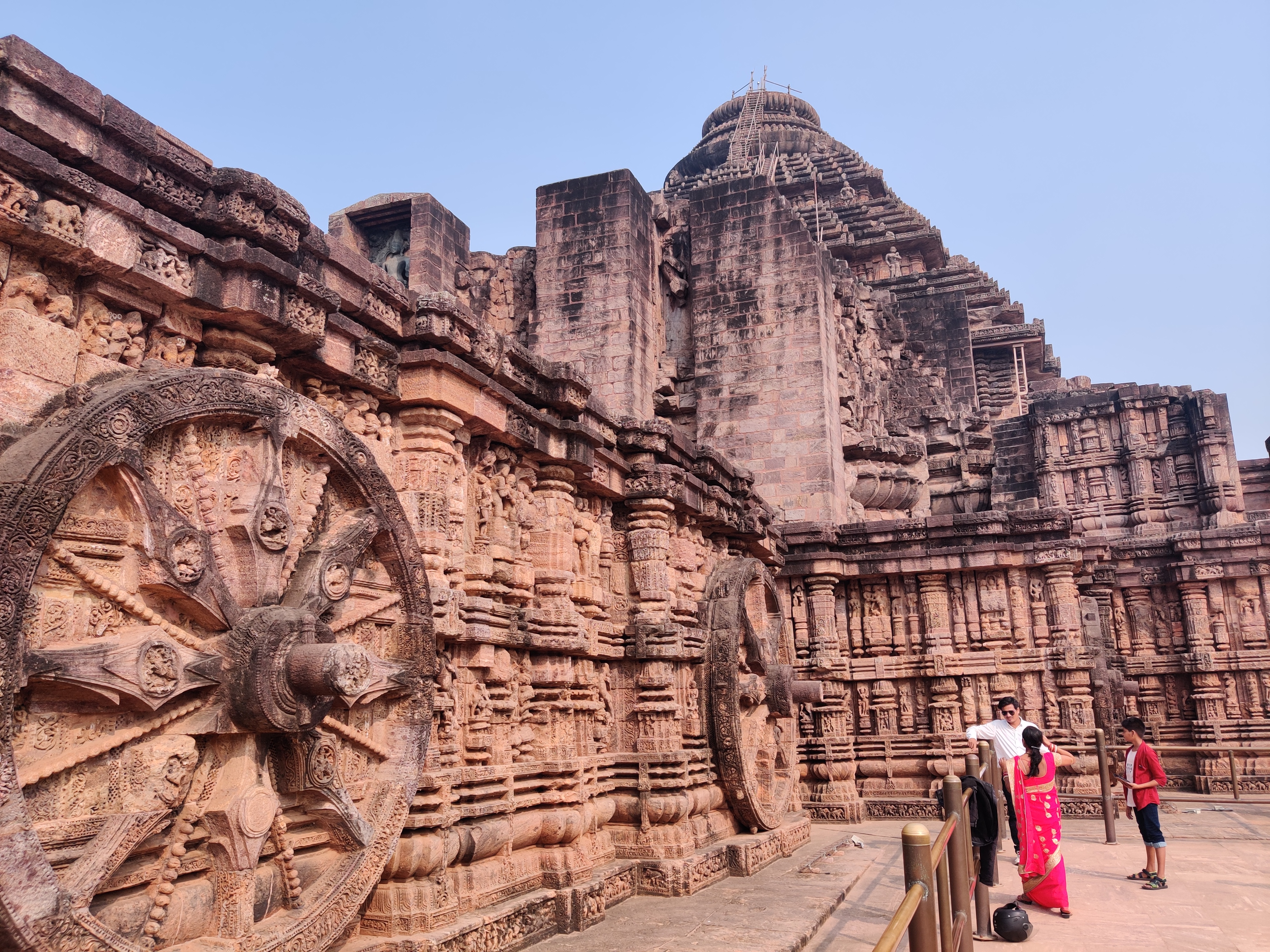
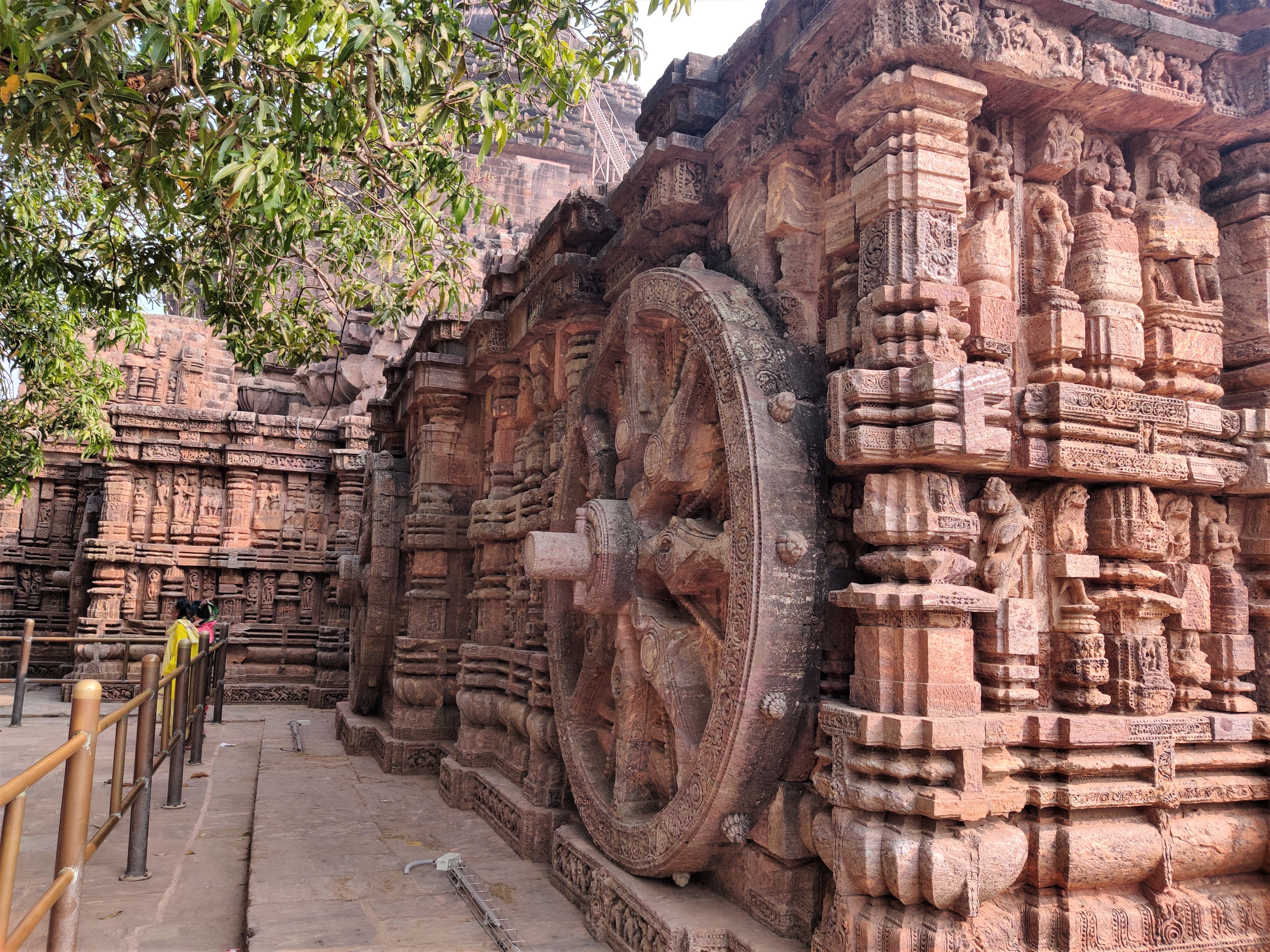
Standing there, as I looked at the ruined structure, my mind’s eye brought in the vision of an enormous chariot with its giant wheels and horses, a resplendent Sun seated as the charioteer, taking flight across the sky. The word Konark in Sanskrit is a sandhi, a combination of two words: Koṇa, which signifies a corner andArka which refers to the Hindu Sun God, Surya. Built out of stone seven and a half centuries back, the temple is an intricately carved, giant chariot of Surya, replete with ornaments, twenty-four giant wheels and pulled by seven horses. Throughout history, different cultures and lands have referred to ‘crossing the seven seas’ for a travel around the world. In India, it is called, ‘Saat Samundar Paar’. Did the seven-horse drawn chariot of the Sun God signify that it had the motive power to circumvent the world?
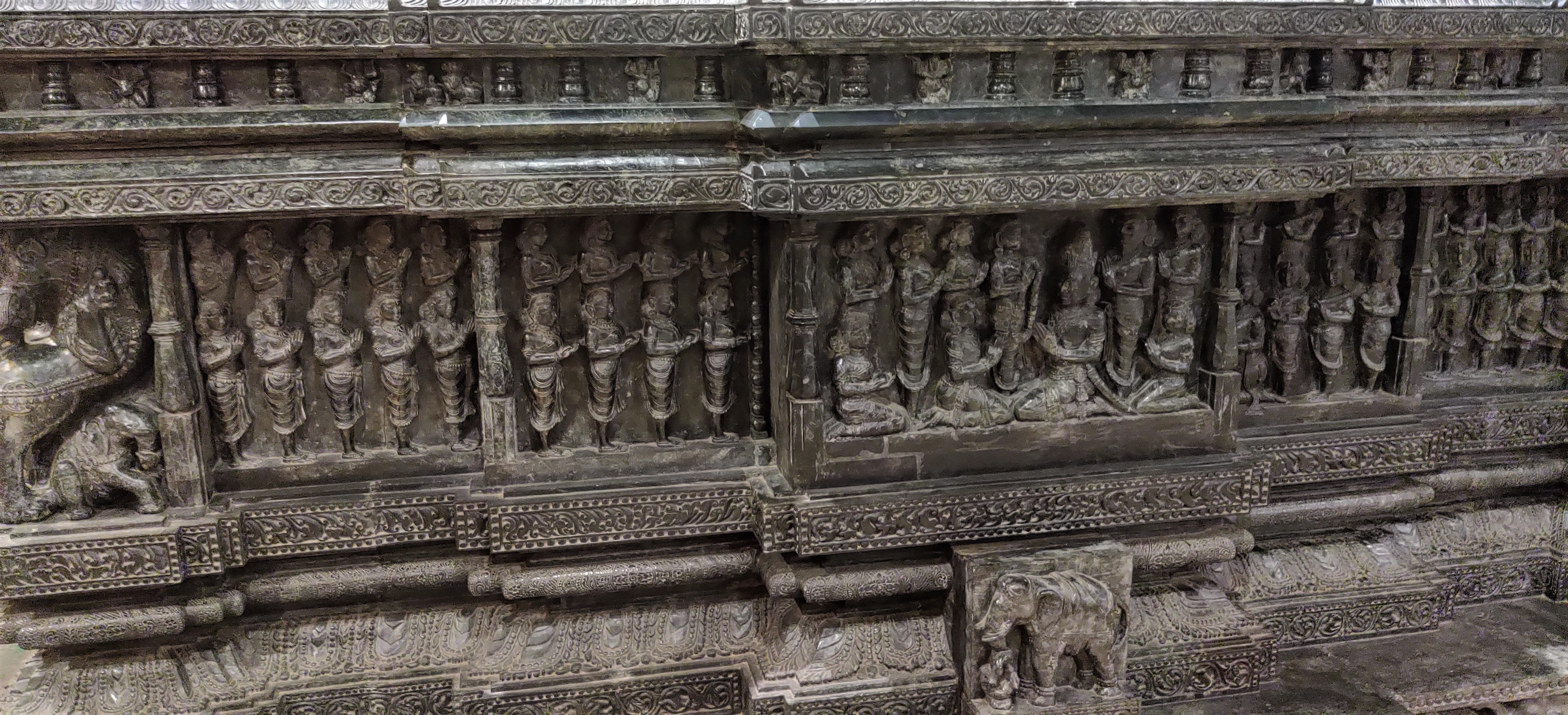
The temple external walls are sculpted with intricate and jewelry like miniature details. The carvings range from Hindu Gods and Goddesses, nymphlike apsaras, nature inspired motifs, day to day living and cultural activities of people ( Artha and Dharma) , animals, birds and sea creatures along with some depictions of the life and times of the king. Ernst Binfirld Havell, the English art historian and author, writes that the Konark temple is “one of the grandest examples of Indian sculpture extant“, adding that they express “as much fire and passion as the greatest European art” such as that found in Venice.
As I looked at the lengthening shadows of an evening sun, I envisioned the year 1756 AD when Vice Admiral Charles Watson of the East India Company navy accompanied by Robert Clive, was rushing to Calcutta to take back Fort William recently captured by the Bengal Nawab, Siraj Ud Daulah. Spotting the Black Pagoda, as the Konark Sun Temple was known then, along with the White Pagoda, the Jagannath temple near the then coastline ( which has since receded), Watson would surely have been relieved that their destination at the mouth of the Bay of Bengal was near.
History indicates that the Konark Sun temple was destroyed by invasions and natural calamities. Over time it ceased to attract the pious and the faithful. And like the other famous Hindu temple at Angkor Wat in present day Cambodia, the Sun temple too disappeared under dense forests for a long time prior to being rediscovered.
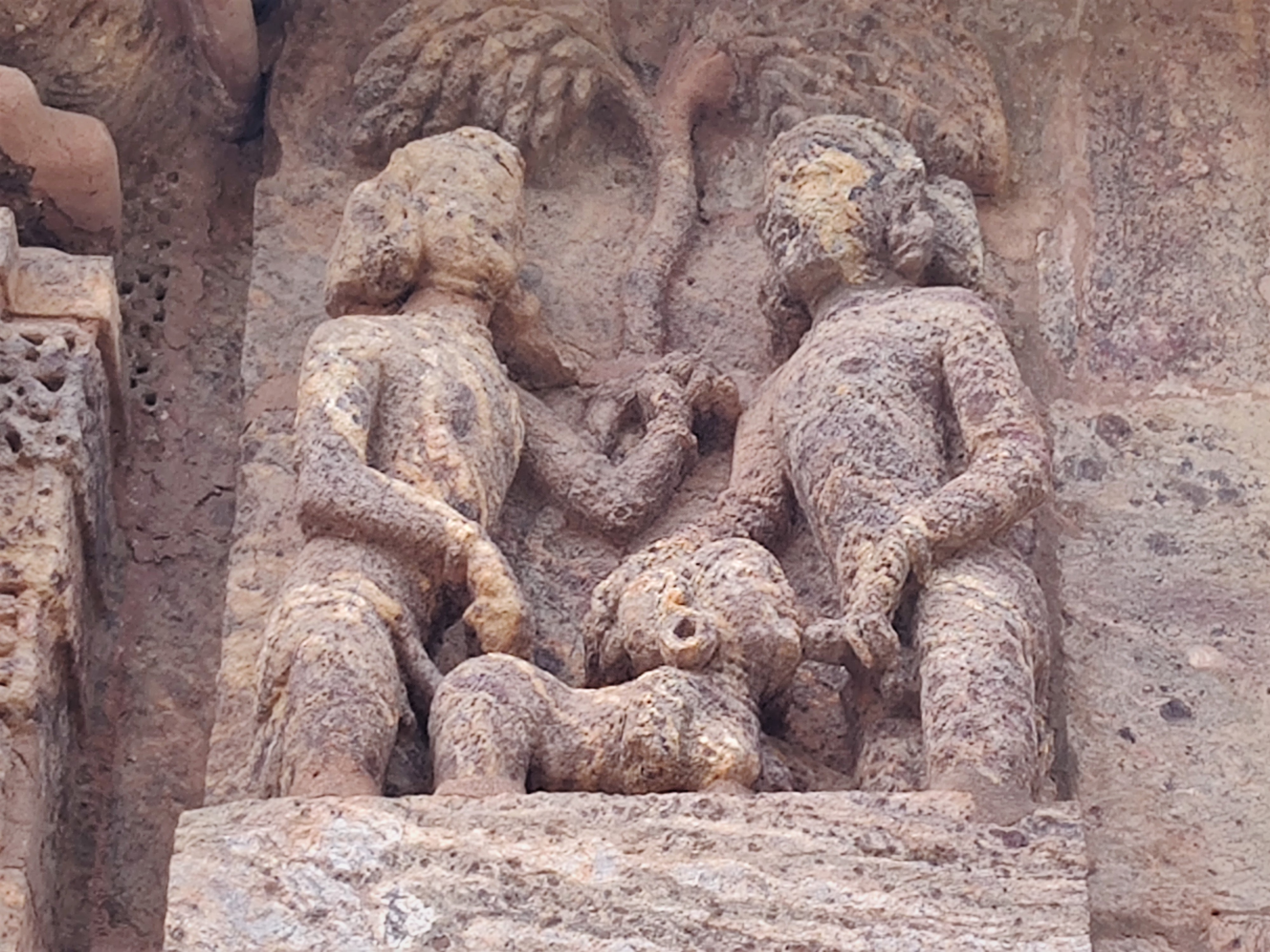
What remains most intriguing however is the highly erotic sculptures interspersed amongst the aforementioned carvings. As I stood there looking at the sculptures, it seemed that eroticism held sway over all else. The carved in stone figurines displayed sexual engagements and coitus in varying positions. I saw several of the chariot wheels depicting different sexual postures. What I found astonishing was the uninhibited depictions of polyandry, polygamy and lesbianism.
As I walked way, I was beset with several thought trains, trying to make sense of such brazen display of sexuality in a temple made to worship the Sun.
Was the displayed eroticism a deliberate attempt to increase sexual activity amongst the population in the 13th century? I had read somewhere that Buddhism, the prevailing religion in the land of Kalinga, preached abstinence which over the centuries, had led to a declining population. Had the King thus ordered the seductive carvings to stimulate carnal desires in his subjects?
Could it be that the depictions were a result of the sexual longings of the thousands of artisans tasked to work on the temple carvings for twelve long years, away from home and family?
Or were the erotic creations deliberate to strengthen the spiritual and divine belief of the devotees coming to the temple? Was the seemingly random display of eroticism, scattered amongst other displays of Gods, nature and public life motifs, a trigger for the observer to choose his/ her path between ‘dark’ attractions of sensuality and depravity vis a vis the brightness of spirituality?
Finally, could the differing displays be based on the age-old belief that each one of us would attain Moksha (release from the cycle of rebirth), that final desired state, only once we have fulfilled all our earthly duties and participated in the cycles of Dharma viz. spirituality, Artha viz. wealth and Kama viz. sexual pleasures?
Does the Konark Sun temple offer a perspective of our life as ‘lived in the moment’, cycling as we do through Dharma, Artha and Kama without the attachments of what is right or wrong, good or bad?
**
Postscript:
Back in Puri, I was watching the Sunrise next morning from the balcony of my hotel room.
Sitting there, as I soaked in the solitude, the morphing hues of the sunlight, the occasional bird chirps and their flights, I seemed to sense that all was well with my world.
As the sun rose in the sky, that solitary boat on the calm waters, seemed to be following the light. The sight brought to mind those immortal words of the Beatles:
My younger daughter Piya’s wedding was being celebrated.
The interesting thing was that though I have participated in several Bengali weddings, including my own. over the years, this one was providing me a refreshing ‘stand and stare’ perspective of the goings-on. Was this because this was ostensibly the last big event in the family? Or was it because of my acquiring a more relaxed and less impatient mindset with advancing age? I remained unsure.
The Tubri firecracker of Bengal has no real parallel elsewhere. When lit, the small round earthen pot emanates a gentle gurgling sound with tiny sparks coming out of the hole. The intensity increases with the colourful sparkles streaming up to great heights, accompanied by the rising crescendo of the combustion sound.
Like the Tubri, the Bengali Wedding too starts as a gentle symphony of fun and bonhomie which then blooms into a larger-than-life event showcased through a riot of colour, lights, feasting, and rituals.
Ai Buro Bhat, that Bachelorette and Rice event. The last ‘big meal’ of the would-be bride as a bachelor!
It is a much-awaited ritual and the wedding bell starts to ring as family and friends gather to bless the bride-to-be. A sumptuous meal awaits her and the others present. Ranging as it does from fish and meat dishes, fried foods to Mishti, the traditional Bengali sweets. A fun event replete with jokes, reminiscences by the elders, and banter.
The blessing…..as my nonagenarian ( 90 years old) mother blows the conch shell
Ai Buro Bhat
The pre-wedding evening gets packed with four events.
The Mehndi event is all about creating exquisite body art through the application of Mehndi or Henna. An event in which the bride-to-be and other ladies participate. As the evening progresses, Mehndi, that red-orange stain applied on the palms and hands, keeps on darkening! It is said that the darker the mehndi, the more would be love in the air.
Mehndi mysticism
Those exquisite designs
Ashirbaad, the Bengali pre-wedding ceremony, is all about blessing the would-be couple. The ritual is symbolized by parents and senior family members putting dhaan, rice husk and dubyo, trefoil leaves on the heads of the to-be-weds, along with exchanging gifts of gold jewellery, clothes, and sweets.
Ashirbaad
The blessing
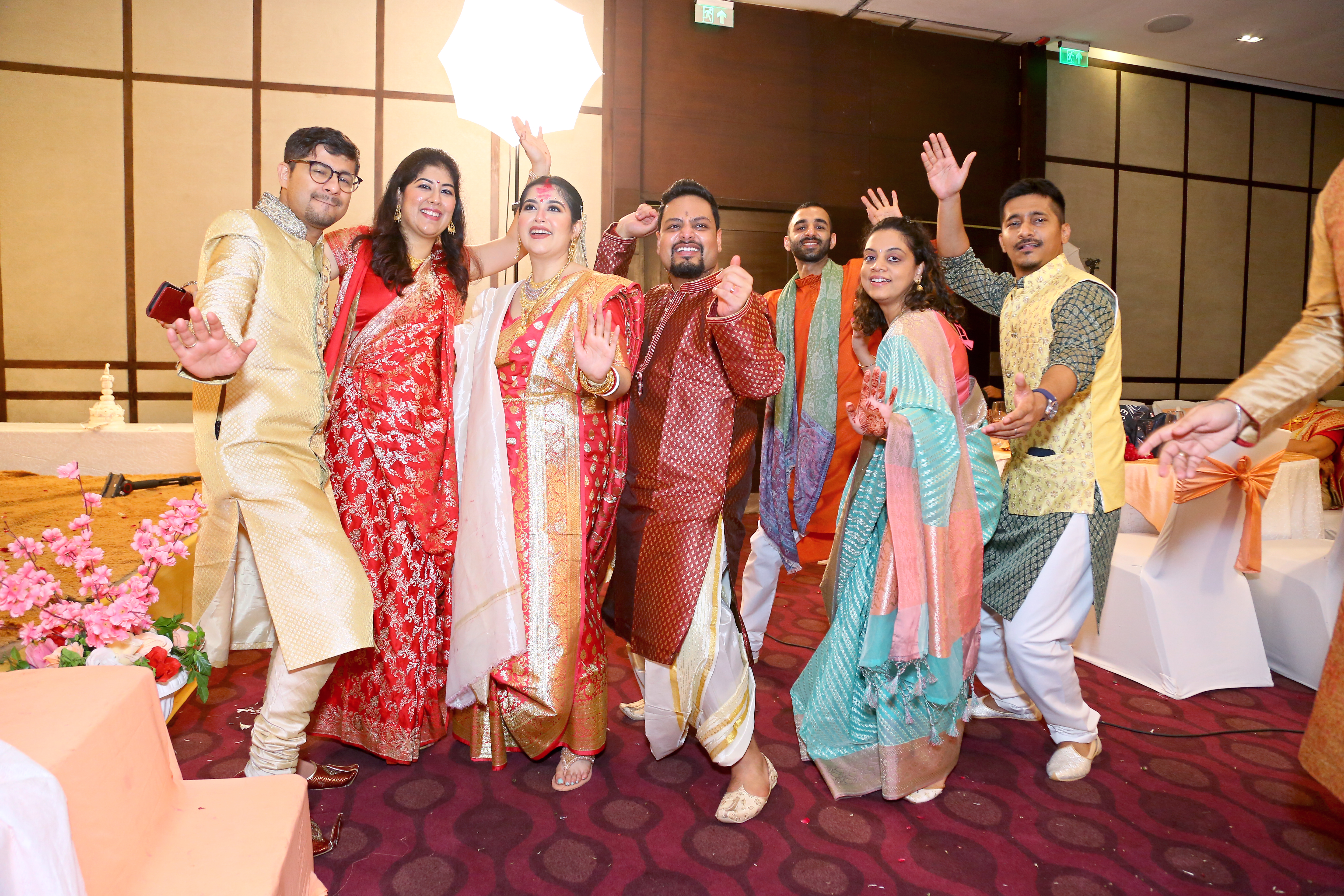
Sangeet literally means music. The Sangeet event with its music and dance, is a celebration of the wedding union and bonding. Everyone is expected to let one’s hair down and shake a leg. Be it through impromptu jiving or a choreographed dance performance.
Let’s waltz into the future….
Shall we jive?
Shake a leg
Rock n’ roll!
Eyi to Hethaye kunjo chayaye
And finally, it is about that one ring that signifies a resolve to join together in life’s journey. The Engagement ring ceremony.
The engagement
Comes the Bengali Wedding Day when the bride and the groom tie the knot.
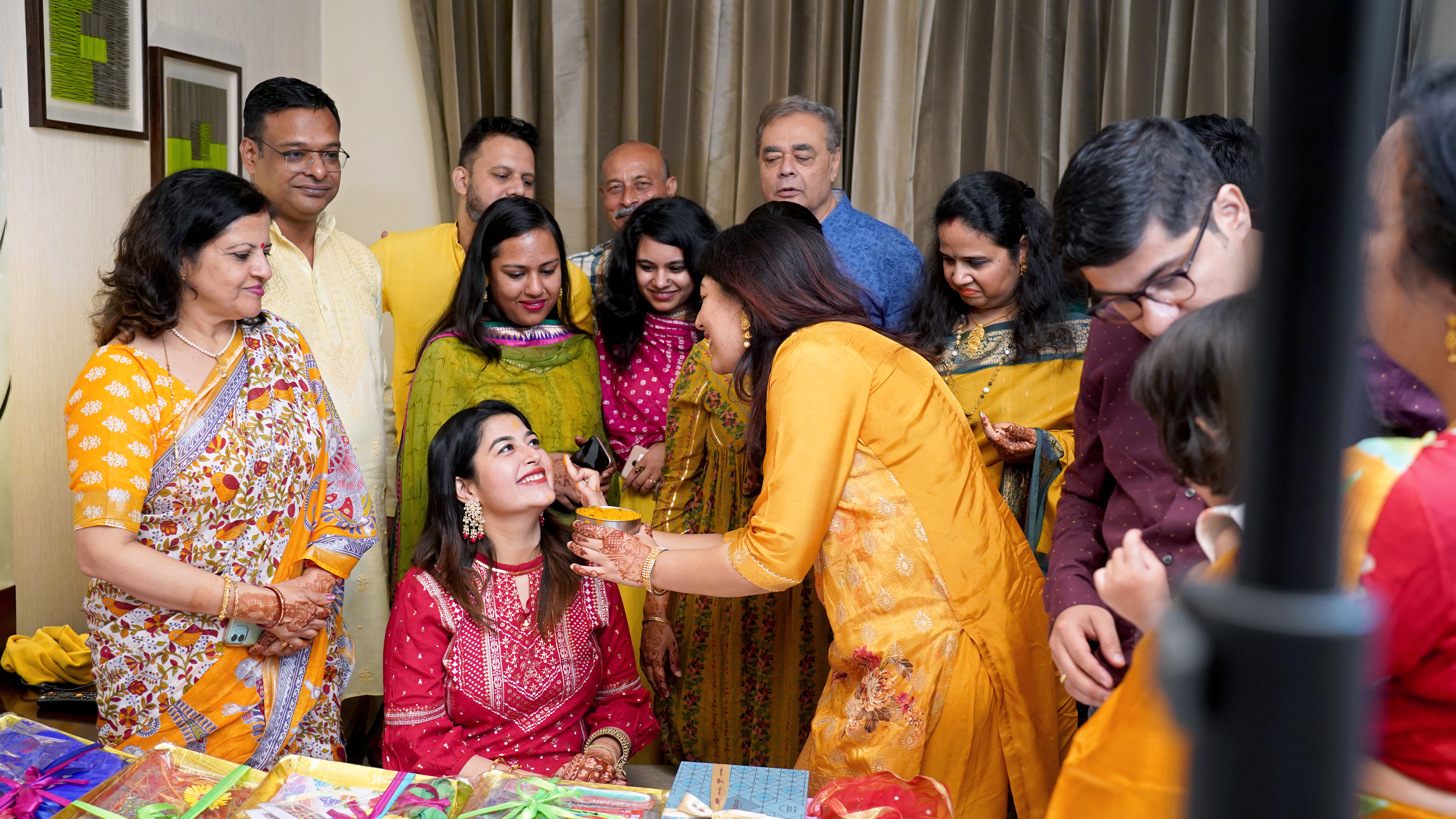
The morning starts with the Gaye Holud ritual. Gaye Holud is all about smearing turmeric paste on the bride’s face and body. The ‘groom smeared’ turmeric is brought for the bride by the groom’s family members. Apart from being considered a beautifying and brightening agent, turmeric symbolizes healthy relationships for the future.
Gaye Holud
The Bengali wedding has the practice of exchanging attractively packaged gifts. The bridegroom’s family members bring these along with the bowl of turmeric paste for the gaye holud. All those brightly decorated tatta trays, containing as they do clothes, gifts and accessories, are a visual delight. Apart from the sheer creative effort to make them, Tatta trays are supposed to bring with them abundant blessings and good wishes.
Totto ……. can you spot the decked-up fish?
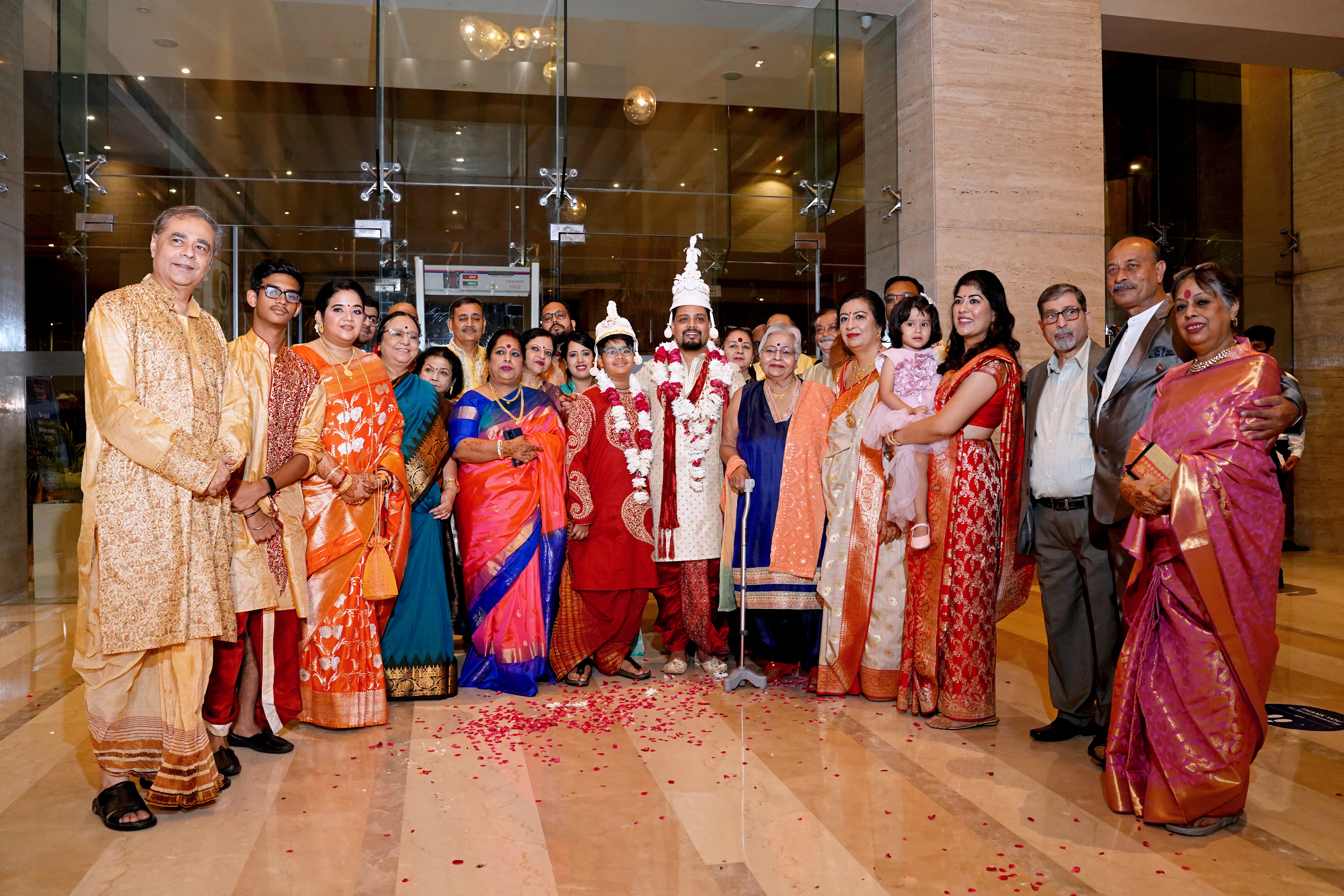
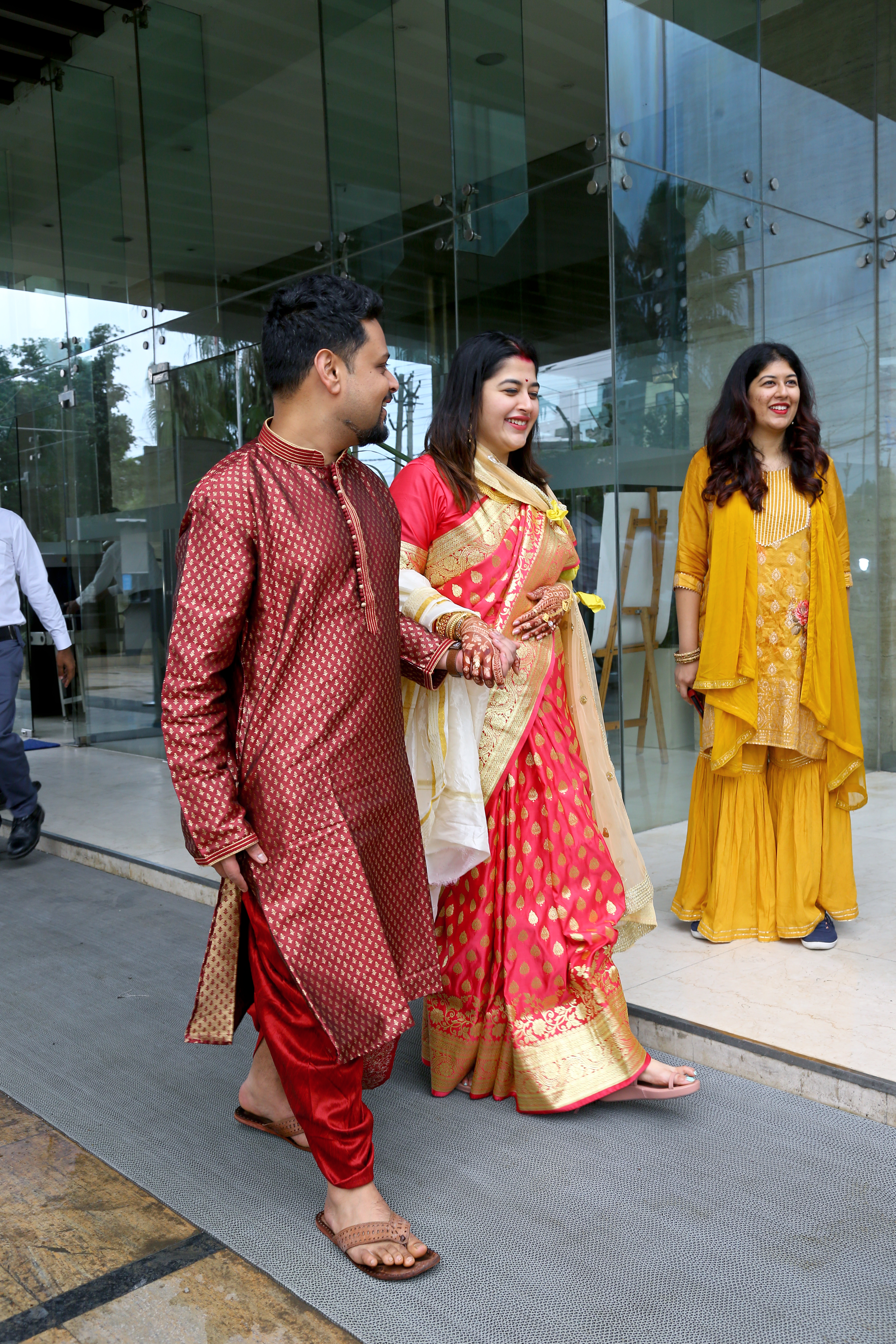
Bor Boron is all about formally welcoming the groom to the wedding. The Bor, Groom arrives with his bor jatri entourage (On his wedding day, Piyush the groom, and all the others had to come through a heavy downpour!). The bride’s mother does Boron viz. blesses and welcomes the groom at the entrance with a kula, bamboo winnow accompanied by the sounds of Uludhwani, before the latter is escorted to the Chhadnatola, the wedding mandap.
Bor Boron
Bor Jatri
Quintessential Bengali bride
Subho Dhristi is that first exchange of glances between the bride and the groom. Carried on a pidi, a wooden stool, seven times around the standing groom, the bride keeps her face covered with paan patta. betel leaves before slowly revealing her face for that auspicious glance.
Prelude to Shubho Drishti
Comes the Mala Bodol in which the bride and the groom garland each other thrice, the Sampradan in which the father ‘hands over’ his daughter, the bride, to the groom and the Anjali in which the groom holds the bride’s hands from behind as they offer khoi, puffed rice to the sacred yagna fire.
Mala Bodol
Sampradan
Anjali
The evening is still young … so photo opportunity, some dancing, good food, and drinks for all!
Newly weds
The evening is young!
Let’s make some noise!
Next morning and it is time for the bittersweet custom of Bidaye. The bride bids farewell to her parents and other family members as she gets ready to accompany her newly wedded husband to his home.
Bidaye
Let’s go home.
As the Bride reaches her new abode, she is welcomed by her mother-in-law with Arati, a ritual meant to bring in light. She steps into an Alta (red dye) filled tray and then walks onto a white cloth. Those alta laced red footprints on the cloth are supposed to herald Goddess Lakshmi into the household.
Arati
Lakshmi steps
It is the day of the Bou Bhaat and the wedding reception.
Bou Bhaat literally means bride’s feast. It signifies two things. As the bride settles down in her new home, it is time for the bhat Kapor ritual in which she is offered a new saree and jewellery by her newly wedded husband signifying that he takes responsibility for her food and clothes from now on. The bride then serves rice to all family members implying that she is now part of the household.
Bhat Kapor
Bou Bhat
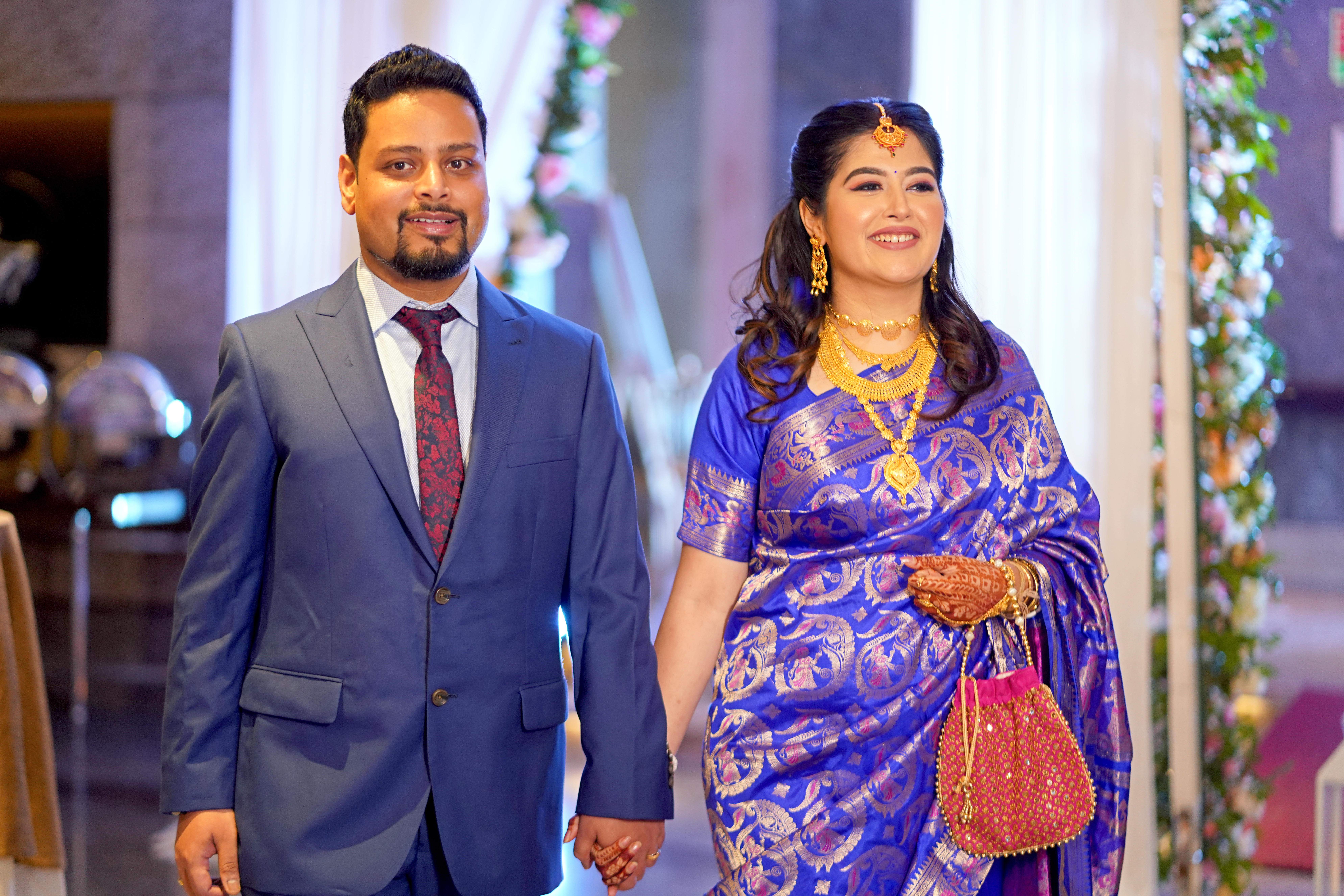
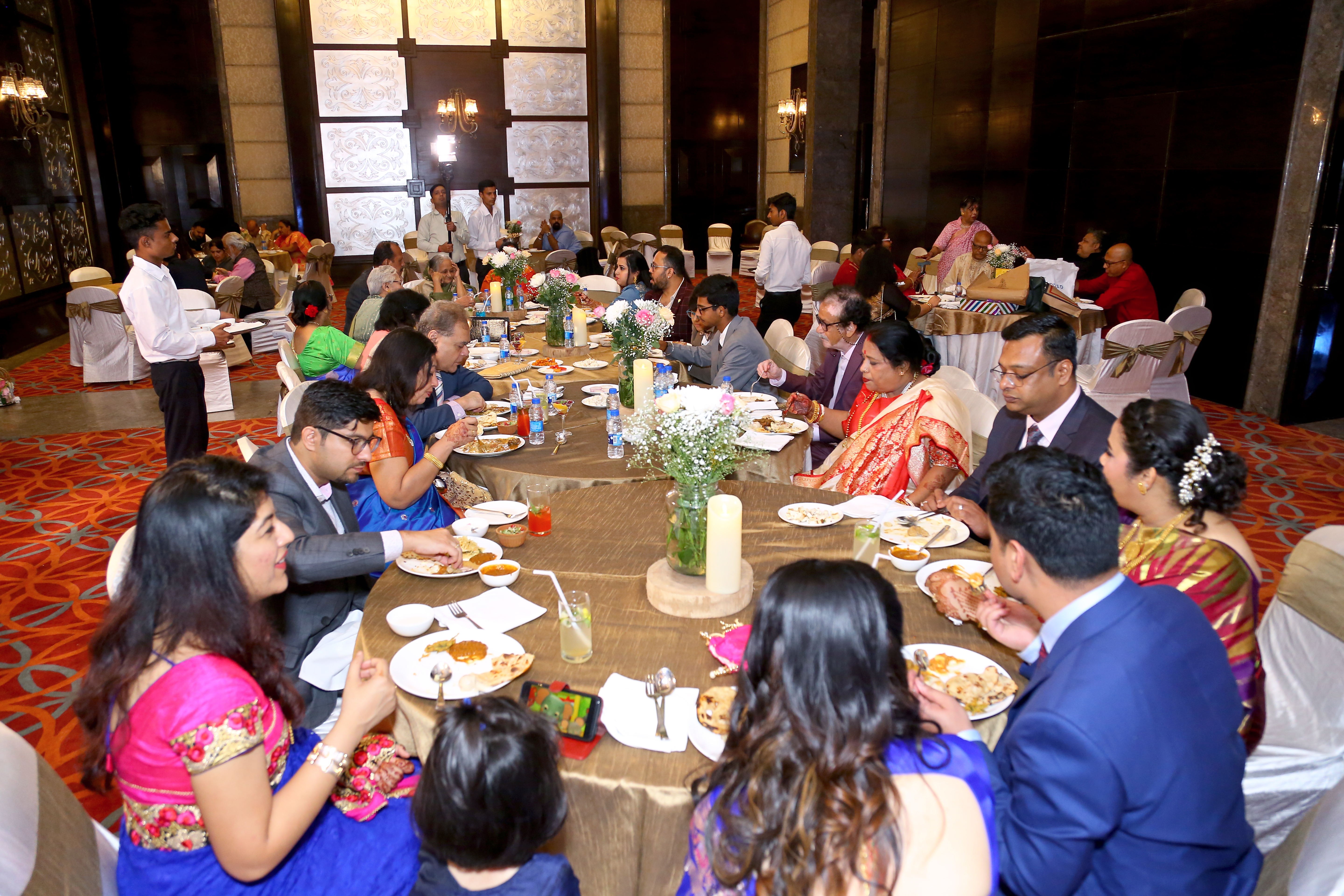
In the evening, the groom’s family invites all family members and friends to a preetibhoj or a gala dinner. The bride’s family, the kone jatri , are guests of honour at this reception.
Welcome to our beginning!
The arrival
The wedding cake
Preetibhoj
Guests @ the Gala Dinner
What does the future hold in store?
As an observer of the wedding events and rituals, I sensed how the Bengali Wedding has been able to maintain vibrancy and relevance by imbibing popular parts from elsewhere. The Sangeet custom is an import from Punjab and North India. The Mehndi tradition is from the Middle East and according to some sources, was brought into North India by the Moghuls. Over the years, it has become part of Bengali weddings too. The wedding cake, with its origins in ancient Rome, has always been part of wedding traditions in Europe. It has become increasingly popular in Indian and Bengali weddings. An eclectic blend of these customs from elsewhere with the traditional Bengali ones made the whole event a fascinating one for me.
Piya and Piyush’s wedding also made me recall the few lines I had penned about a Bengali wedding of a century back in my book, The Chronicler of the Hooghly and other stories:
“Thoughts and memories coalesced.
Malati looking at Dipen shyly from under her ghomta, saree drawn over eyes, on their wedding night during shubha drishti.
Malati being raised higher and higher by her brothers in fun to prevent Dipen from garlanding her easily during their wedding.”
I was left with the realisation that even though our society and the collective mindset have changed beyond recognition over the last hundred years, somewhere, somehow the glue of our customs and rituals has provided a reassuring continuity.
I built me a castle With dragons and kings And I’d ride off with them As I stood by my window And looked out on those……
I walked leisurely on the pedestrian path.
Walkers and tourists milled around me, like me all moving at a leisurely pace. No one seemed to be in a hurry. A family led by Dad with the son on his shoulders passes me in the opposite direction. Just in front, a group of giggling young women were taking a barrage of selfies. It seemed one or the other was not satisfied with the result, be it one’s expression or the way the long cables and the end tower showed up in the photo. A quick joint review, some more giggles and someone in the group would volunteer to take a new selfie. I watched this microcosm of humanity flowing around me.
It was a beautiful sunny morning which had prompted us to venture out on a spot of sightseeing. I was on the pedestrian walkway of the legendary Brooklyn Bridge. Below me on both sides were the motorways with cars and SUVs moving in either direction between lower Manhattan and Brooklyn.
One had glorious views of the New York skyline as well as the leisurely flow of the East River below. To the right one could spot Governor’s Island and in the distance the Statue of Liberty. But as I stood looking around, my mind’s eye wandered off to another unforgettable vision involving the Brooklyn bridge. Powerful searchlights frantically flashing, sounds of helicopters, people jumping off the bridge into the waters below as a terrified News Reporter announces that all of us are going to die! One of the most emotional scenes from the blockbuster ‘I am Legend’ in which scientist Robert Neville (Will Smith) tries to evacuate his wife and daughter from pandemic ridden Manhattan, only to see them die as another helicopter crashes into theirs in the chaos. In the background, the Brooklyn Bridge is being blown up by military aircraft to contain the spread of the disease.
An iconic film showing visuals of an iconic bridge.
A hundred and forty years old structure, the Brooklyn Bridge was the world’s first and longest steel-wire suspension bridge at the time of its opening. What further distinguishes the bridge are the pair of gothic towers standing tall on either side, holding the steel wires in place. Legend has it that when the lead engineer and architect Washington Roebling, became sick and bedridden, his wife Emily, who knew nothing about engineering or architecture, took over the project. For the next ten years, till the project got done, she studied Engineering design and project management on her own and became the first person to cross the bridge upon completion. The following was said about Emily and the Brooklyn bridge:
“…an everlasting monument to the self-sacrificing devotion of a woman and of her capacity for that higher education from which she has been too long disbarred.”
A sad reminder of the fact that during Emily’s time, women were not allowed into Engineering institutions in the US.
Having walked the mile long stretch of the Bridge, we stepped onto the roads of Brooklyn. The neighbourhood in which Neil Diamond had grown up six decades back. With his baritone voice and wonderful songwriting capabilities, Neil Diamond has been my favourite pop and country musician and singer since youth. The singer reminisces about his childhood in that wonderful number, ‘Brooklyn Roads’:
‘Two floors above the butcher First door on the right Life filled to the brim As I stood by my window And I looked out of those Brooklyn Roads……’
Neil Diamond
The place we were walking through had the curious name of DUMBO. I was left wondering whether it had anything to do with Disney’s Dumbo the flying elephant. Or was it about some presumed dumb folks who might have resided there in the past?
‘And report cards I was always Afraid to show
Mama’d come to school And as I’d sit there softly crying Teacher’d say, “He’s just not trying He’s got a good head if he’d apply it” But you know yourself It’s always somewhere else’
I learnt that DUMBO was really the short nomenclature for ‘Down Under the Manhattan Bridge Overpass’. Ironically, the neighbourhood today is home to a large number of technology start-up companies with the earlier warehouses on the riverfront converted into quaint eating houses and pubs overlooking the waters.
A bridge, a musician and a neighbourhood came together as legends for me that morning. They came with tales that were anecdotal, possibly unverifiable but nonetheless remain ingrained in my mind.
Apollo, son of Zeus and one of the major Olympian deities, is the God of voyages.
The Apollo space program got its name from the image of Apollo riding his chariot across the sun.
It was the sheer audacity of President Kennedy’s speech in September 1962 which launched the Apollo program. A speech in which he declared, “We choose to go to the moon, 240,000 miles away using a giant rocket more than 300 feet tall, the length of this football field, made of new metal alloys, some of which have not yet been invented, capable of standing heat and stresses several times more than have ever been experienced, fitted together with a precision better than the finest watch, carrying all the equipment needed for propulsion, guidance, control, communications, food and survival, on an untried mission, to an unknown celestial body, and then return it safely to earth, re-entering the atmosphere at speeds of over 25,000 miles per hour, causing heat about half that of the temperature of the sun and do all this, and do it right, and do it first before this decade is out–then we must be bold.”
A speech that was made based on US’s first manned space flight a year earlier (Alan Shephard, May 1961). A speech that shifted the goal post from near-earth space fights to a manned flight to the moon within the decade.
It was July 20th 1969 and humanity had come together as one. The Apollo Space program had succeeded in placing Man on the moon. Humanity had finally left its cradle. As a school kid, I accompanied my father to the US Information Services (USIS) center near Mandi House in Delhi. A crowd that milled around was gaping at a full size model of the Lunar Module which had successfully landed on the moon, allowing astronaut Neil Armstrong to step onto the lunar surface and utter those famous words, “ That’s one small step for (a) man, one giant leap for Mankind”. These words, successfully relayed over radio stations all around the world, were uniting Mankind like never before. As a child, I could sense that from the manner strangers were excitedly speaking to each other as they pointed to features of the lunar craft named Eagle. Going to school over the next few days, I recall the exhilarating discussions of my classmates vying with each other about how many newspaper cuttings of the momentous event and the grainy photos they had managed to cut out and paste into their scrapbooks.
**
The other day, I did a day excursion to NASA’s Kennedy Space Center at Cape Canaveral. For me the trip was a pilgrimage, growing up as I had in the sixties and seventies. When Space travel and Moon landings were what our dreams were made of. When our imaginations were fuelled by the stories of Isaac Asimov, Arthur C. Clarke and Robert Heinlein.
As I stood looking at the full-scale exhibit of the Saturn V Rocket that had powered the Apollo missions as well as the replica of the spacecraft that had successfully carried astronauts to the moon and back more than half a century ago, deep emotions stirred within me.
In the sixties when computing, communication and control systems were so rudimentary, I realised the awesomeness of the belief and effort that not only used brute rocket force to hurtle a spacecraft with astronauts beyond earth’s gravity, it could also deploy fine navigational controls to land the lunar module onto the moon surface and then lift off with the astronauts to dock with the orbiting command module before bringing them back to earth. It was the sheer cowboy-like bravado and risk of a journey into the unknown that had brought up the emotions.
NASA Command & Control center for the Apollo missions
” The Eagle has landed!”
Which brings me to the story of Artemis. In mythology, Artemis, the Goddess of the Moon and daughter of Zeus, is the twin sister of Apollo.
An apt name for Humanity’s next phase of exploring the unknown depths of space. Artemis is all about NASA’s vision to return to the moon after half a century. Artemis would deploy the cutting-edge technological advancements in computing, communications, robotics and materials of this century to not only put men and women on the moon but take them on manned flights to Mars and beyond. The Artemis vision incorporates sustainability, international cooperation and involvement of a plethora of private sub-contractors for developing innovative mission equipment and processes.
The following is an extract from the US Presidential Memorandum on reinvigorating America’s Human Space Exploration program:
“Lead an innovative and sustainable program of exploration with commercial and international partners to enable human expansion across the solar system and to bring back to Earth new knowledge and opportunities. Beginning with missions beyond low-Earth orbit, the United States will lead the return of humans to the Moon for long-term exploration and utilization, followed by human missions to Mars and other destinations.”
The Artemis initiative envisages the use of a powerful Space Launch System, the Orion spacecraft, a lunar space station similar to the International Space Station called the Gateway circling the moon, reusable human landing systems onto the lunar surface as well as a lunar basecamp. An initiative designed to leverage experience, technologies and mindset from Man’s return to the moon in 2024, to eventually make the quantum leap to Mars and beyond.
In the words of NASA Administrator Jim Bridenstine, “Pushing the boundaries of space exploration, science, and technology once again, America is on the verge of exploring more of the Moon than ever before. This new era of lunar exploration is called Artemis. Named after the twin sister of Apollo, she is the Goddess of the Moon, and we are the Artemis Generation.”
Could it be that Man’s destiny to the stars remains inexorably linked to the son and daughter of Zeus?
In Learning…….. Shakti Ghosal
Acknowledgment: ‘The ARTEMIS Plan – NASA’s lunar exploration program overview’, Sept. 2020
Just before five in the morning. I put on the FM channel and the so very familiar words wafted around the room, quickly overpowering the low hum of the air conditioner sound.
That ethereal sound of the conch shell interspersed with the chorus.
(Salutations to You O Divine Mother, I Invoke You; Who is the daughter of the Mountain; By Whose presence the whole World is filled with Joy; For Whom the whole World is a Divine Play and Who is Praised by Nandi, I Invoke You O Devi Who Dwell on the Summit of the Vindhyas, the Best of the Mountains; Who give Joy to Lord Vishnu as His sister ….)
That once a year rendition in the voice of Biren Krishna Bhadra.
Aswiner sarada prate beje utheche alokomonjir,
Dharanir bohirakashi ontorhito meghomala
(In the month of Aswin, amidst the meanderings of autumn, resounds the light of the sun like anklets
As the clouds disappear from the skies above the world)
Listening to that Chandi path chants and the music in a half asleep, half wakeful state, has always been an intensely personal and endearing experience since my childhood.
I recall my father putting on the All India Radio station at dawn all those decades back, as we all huddled back under the blankets to sleep-awake through Mahishasur Mardini during those wonderful autumn laced mornings with that slight nip in the air. I have tried to continue that tradition.
This year as I lay on my bed listening to Mahishasur Mardini, I saw in my mind’s eye folks who had been part of me since childhood. My father, my father-in-law, other family members, friends. They were standing in two rows and smiling at me. I could sense the love and the warmth seep towards me through the smiles. I luxuriated in the enveloping feeling and closed my eyes. I woke up to find that it was but a dream. Al those who I saw looking and smiling at me were no longer part of my life today, having left for their heavenly abode.
Mahalaya is the day of making offerings to our departed forefathers. According to the Puranas, our patriarchal generations come closer to the living world at this time and this is when they need to be remembered and thanked in our prayers.
Did my dream have anything to do about my remembrance of all the departed souls and them reciprocating back?